Banner AI generated.
Showing posts with label 1902. Show all posts

Tuesday, March 24, 2026

The marvelous Hungarian magician turns 152


Let's celebrate Houdini's 152nd birthday today by discussing a widely held assumption. This is the idea that Houdini always claimed to be an American. Of course, Houdini was born in Budapest, Hungary, on March 24, 1874. But during his lifetime, no one knew this, right? Well, not exactly.

In my first book, Escaping Obscurity: The Travel Diary of Harry Houdini 1897-1899, I showed how, during his struggling years, Houdini not only freely admitted to being a European, he exploited it! This made him exotic. Sometimes he would say he was from Budapest, but more often he would say he was from Austria (Hungary was part of the Austro-Hungarian Empire at this time). A few newspapers said he was Australian! But I believe this was just a mistake by the reporters. Try saying Austria with Houdini's accent and over pronunciation, and you can see how someone might hear it as "Aus-tral-ia." But most importantly, I have never seen him claim to be an American at this time. Born in Wisconsin? Boring!

But that's just his struggling years. When he became a success, he became all-American, right? Again, not exactly. Below is an image from my upcoming book, Handcuff King: The Conquests of Harry Houdini, 1900-1909. (I like long titles.) This is from January 1900, at the start of his all-important tour of the Keith's vaudeville circuit. Houdini had already found success on the Orpheum circuit out west. Now he was making his East Coast vaudeville debut. As you can see, he's billed here as "the marvellous [sic] Hungarian Magician."

Boston Evening Transcript, Jan 15, 1900.

Houdini continued to acknowledge his Hungarian birth for this entire tour. So, combined with his Orpheum tour, this means Houdini played the entire U.S. as a (sometimes) headliner for a full year as a Hungarian. But then it was off to Europe, where being an American was the exoticism to exploit. Born in Wisconsin? Wild! The identity stuck.

However, as late as 1902, Houdini told Ottokar Fisher that he was born in Hungary (check out Joe Notaro's own birthday post for more on this). I think this is suggestive. I'm betting that, at this time, his Hungarian birth was not unlike William Robinson's real nationality. If you knew him, you knew the truth. It wasn't a big deal. It was just showbiz. Certainly, everyone who knew Houdini from the 1890s -- and that included some very big names in magic like Howard Thurston, T. Nelson Downs, and Samri Baldwin -- knew his real birthplace.

It was later that Houdini worked to bury his Hungarian birth. People like Walter B. Gibson, who came to know Houdini in the 1920s, never knew of his real birthplace and had trouble accepting the truth when it came out. I don't know exactly why Houdini became so dogmatic about this aspect of his biography. Maybe that's something I'll discover when I start work on my next book.

However, even when Houdini claimed to be American, he always acknowledged that his parents came from Hungary and showed pride in that heritage. Here's something he told a reporter in Australia in 1910.
"You will think that I am vain to tell you these things. But I am a Magyar, and Magyars are vain. American born. Magyar descended; my parents came from Austria; my father was a clergyman in Wisconsin."
So here's a happy birthday to Houdini, the marvelous Hungarian Magician!


Cake image AI-generated.

Related:

Wednesday, September 24, 2025

Houdini appears at Madame Tussauds in Vienna


The Houdini wax figure from Madame Tussauds Budapest has temporarily moved to Madame Tussauds Vienna. The figure was revealed on Monday during a special event at Magic World Vienna. Lucca & Anca Lucian, the world champions of mentalism, gave a performance. Original Houdini memorabilia from the Circus & Clown Museum in Vienna was also on display.

"Harry Houdini represents courage, illusion, and showmanship like no other. We are delighted to be able to exhibit him here for a limited time and to give our guests unforgettable moments full of magic," said Lukas Rauscher, press spokesperson for Madame Tussauds.

Houdini will be on display in the attraction's wax section until the beginning of November. After that, the figure will return to the main attraction in Budapest.


This isn't Houdini's first time in Vienna. In March 1902, he appeared in the flesh at the Ronacher theater, which still stands today.

For more information, visit the Madame Tussauds Vienna official website.


Top image: Lucca & Anca Lucian with Madame Tussaud Vienna managing director Arabella Kruschinski. Photos by Denise Auer from Heute.

Friday, March 7, 2025

Houdini and the windmill


Ever hear the one about Houdini and the Dutch windmill? The story first appeared (as far as I can find) in an article by Walter B. Gibson called "Houdini's Last Interview Revealed His Narrow Escapes." This ran in several newspapers in December 1926. Below is an excerpt from the Wichita Falls Times.

Wichita Falls Times, Dec. 5, 1926

This windmill story appears in Harold Kellock's Houdini: His Life Story and Milbourne Christopher's Houdini: The Untold Story. I suspect Christopher got it from Kellock, and Kellock got it from Gibson. Try as I might, I've never been able to find any evidence or independent source for this story, and most current biographies omit it.

So is the windmill story fiction, or just another example of the Germany problem (which encompasses the Netherlands)? If any of you research bloodhounds want something to track down, this would be a good one! It would have happened in May or June 1902 when Houdini was with the Circus Corty-Althoff in Holland.

It's worth noting that this Gibson article also contains what appear to be the first appearances of the stories about Houdini being tied to railroad tracks in Dresden, and being tied to the back of a horse in Nova Scotia in 1896. Those are also tales of outdoor stunts gone wrong that I've never been able to confirm.

Want more? You can read the full "Houdini's Last Interview" by Walter B. Gibson as a Scholar member of my Patreon. Fact or fiction, it's good stuff!


Top image A.I. generated.

UPDATE: For those who don't like my A.I. image, here's an illustration from the March 1928 Tales of Magic and Mystery. Thanks to Joe Notaro for this one.

Tuesday, March 5, 2024

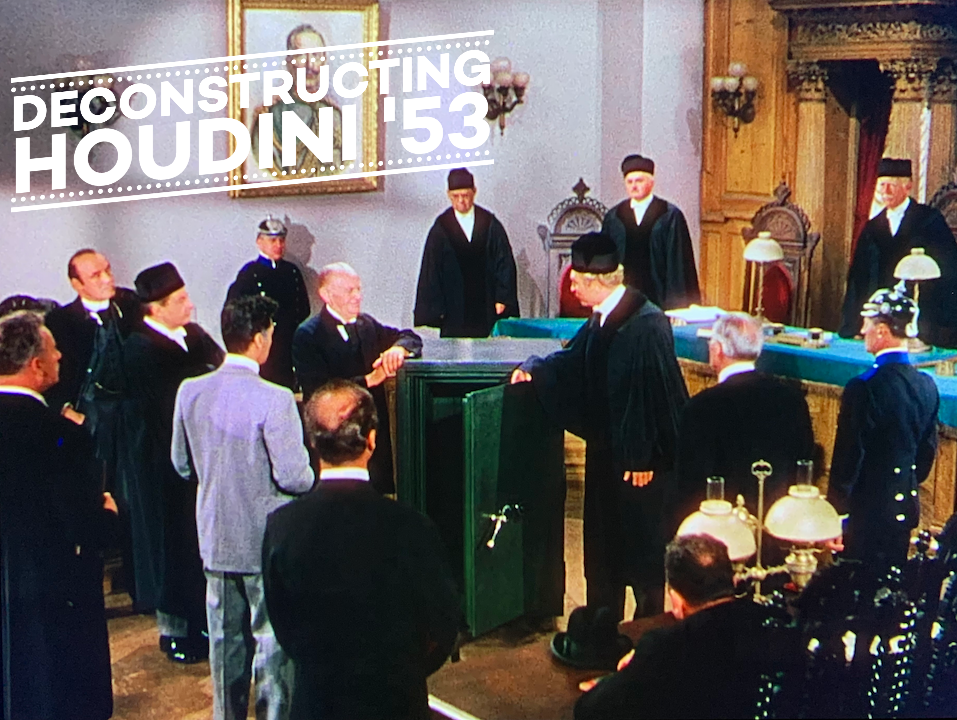
Deconstructing Houdini '53: Judgment in Germany

Continuing my scene-by-scene dissection of the 1953 biopic HOUDINI starring Tony Curtis and Janet Leigh. Last time we saw Houdini reach the heights of fame in Europe. But German law wants to bring him back down...

Chapter 14: Judgment in Germany

The next scene in Houdini (1953) is a highlight that furthers Houdini's legend and continues the story of his early European adventures. But did it really happen?

At the end of the last scene, Houdini received a summons to appear before a German tribunal accused of fraud. "I might have to go to jail," he warned Bess. Now we dissolve to the courthouse where a growling prosecutor (Stefan Schnabel) makes his case:

“When any magician transgresses the bounds of reason and humbugs the people into not only thinking but believing that he’s supernatural, then this man becomes a menace to society and must be restrained from further practice of such deception.”

Sounds serious! (And a little flattering.) It's hard not to see this as a witch trial. The prosecutor is dressed in robes from the last century. Houdini, on the other hand, is dressed in a modern gray suit. (The suit reminds me of the one he wore at his 1926 congressional hearing.) It makes for a nice contrast. Houdini represents modernity defending itself against old-world superstition.


Houdini stands and offers his defense, using words the real Houdini spoke many times from the stage.

"I have never claimed to be supernatural. All my escapes have been effected by purely physical means."

The judge (Lawrence Ryle) decides to put it to a test. If Houdini can open the courthouse safe in full view of the tribunal, he will have proven himself a man of skill and not the devil's pawn. Houdini volunteers to do one better. He will escape from the safe! As he hands his coat off to Bess, she reminds him of the last safe he got into. A nice callback.


After Houdini climbs inside the safe, we hear the poorly dubbed line, "Go ahead, what are you waiting for. Lock it up." The door is locked. Seconds tick by on the courtroom clock. All wait anxiously. All except Bess, who shows no concern at all. This is amusing, but it's actually inconsistent with her characterization. Janet Leigh's Bess is constantly worrying! By the way, notice she is wearing her royal crown brooch.


Soon, the tumblers on the safe door began to rotate. The door swings open, and Houdini emerges. "It's hot in there," he says. The courtroom bursts into applause, and the case is dismissed. Houdini even receives a grudging handshake from the sour prosecutor.


So, is any of this real? Yes, basically. Houdini did appear before a court in Germany in 1902 and demonstrated his escape abilities before a judge and jury. However, Houdini was the plaintiff, not the defendant.

It all started with an article in the Daily Rheinische Zeitung in which a German police officer, Werner Graf, who had challenged Houdini with a lock that he easily defeated, claimed the magician was a fraud who had used a saw to escape from his lock and had attempted to bribe him. Houdini demanded a retraction. Graf refused. So Houdini filed slander charges against Graf and editor Johann Merfeld. The case was heard in Cologne.

The first trial ran for three days, during which Houdini demonstrated how he easily opened Graf’s lock by rapping it against a metal plate fastened below his knee. He then showed the judge how he could slip out of any transport chain. Houdini won the case and created a poster that told the story of the trial with a dramatic image that clearly influenced Houdini's Art Directors, Al Nozaki and Hal Pereira, and/or Set Decorators Sam Comer and Ray Moyer.


But what about the safe?

Graf appealed the case twice. Houdini claimed that during the third trial, he was challenged to open the judges' safe, which, ironically, they had forgotten to lock. This is likely fiction. There is no record of Houdini doing anything at the third trial except being present. Houdini also often told the story of almost being defeated by an unlocked door, freely changing the details and location to suit the occasion. But the safe story is in the Kellock book on which this movie is based, so as far as screenwriter Philip Yordan was concerned, he was drawing from fact.

Okay, back to the movie.

As the "audience" leaves the courtroom, Mama says to Bess, "But Harry never saw that safe before, how did he ever do it? What is the trick?" Bess tells her the only trick was to get the judge to lock him inside the safe. "Safes were built to keep people from breaking in, not out."

Could this be considered an exposure? If so, it's the only exposure in the movie. But this "in, not out" idea comes from Kellock, so maybe it gets a pass for being Bess-approved. (In contracts Bess drew up for earlier biopic projects, there was always a stipulation that the film must not feature exposures.) It's also utter nonsense. Don't get inside a safe thinking you can easily get out!

But what about the mystery man with a stopwatch who has been watching the entire proceedings? The camera cuts to him several times. It appears someone else has taken an interest in the abilities of The Great Houdini...

Related:

Tuesday, January 16, 2024

"I played parts years ago"

One of the great things about reading Houdini's letters is that he sometimes gets into a mood to reminisce. In these moments, you can find gold! An excellent example is a 1916 letter to Quincy Kilby in which Houdini remembers various plays he acted in during his early career. There's new info here, so enjoy this Patreon history exclusive.


Thanks to my patrons for supporting my research and content like this. Not a member? Feel free to join us!

Related:

Monday, February 28, 2022

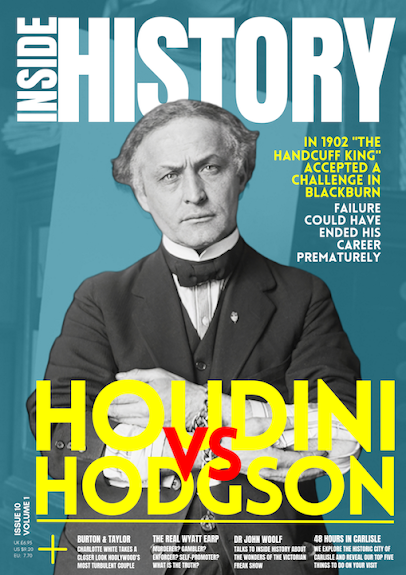
Inside History covers Houdini vs Hodgson

The UK magazine Inside History features Houdini on the cover of their latest issue (#10). Inside is a look at Houdini's torturous 1902 challenge in Blackburn.

In 1902, Harry Houdini came to entertain the town of Blackburn. As always, he set a challenge to the locals to produce locks that he could not escape from. William Hodgson took on the challenge that nearly brought down "The Handcuff King". 

You can purchase Inside History Issue 10 or read the digital version for free via their official website.

Tuesday, June 22, 2021

"Sherlock Holmes Eclipsed"

Here's an advertisement for Houdini at the People's Palace in Halifax (UK) on October 16, 1902. It's a standard basket challenge announcement. But what I find interesting is the tag-line: "Sherlock Holmes Eclipsed."

I'm not sure how to interpret this. Is this saying Houdini is like Sherlock Holmes only better? Or is it saying that Houdini would fool even Sherlock Holmes? Whichever the case, this is nice reflection on the popularity for Sherlock Holmes at this time. Conan Doyle's classic The Hound of the Baskervilles had been released in book form that year and marked a return after an eight year hiatus for the great detective. Holmes was hot. And so was Harry!

Halifax Evening Courier, October 16, 1902.

If you're wondering, Houdini escaped the basket in three minutes. Elementary.

Related:

Saturday, September 19, 2020

A dog before Charlie?

Over the past several weeks I've been deep diving into The British Newspaper Archive seeking dates and data for my New Houdini Chronology. Along the way I've stumbled on some interesting tidbits, such as the below from the Manchester Evening News on November 22, 1902.


So does this mean the Houdinis had a dog--a Scotch Collie to be precise--before their famous dog Charlie? Or is Houdini is just helping someone find a lost dog? This is when Houdini was playing St. James Music Hall in Manchester. Note the address he gives is 91 Grosvenor Street. Today it looks like this. No Scotch Collies in sight.


Afraid that's all I have for this one. Just another Houdini mystery. Click below for more adventures of the Houdinis pets.

Related:

Saturday, December 14, 2019

The Houdinis 1902 Christmas card rings in $3,120

The Houdinis 1902 Christmas card--the earliest card that I'm aware of--sold today in Potter and Potter's "Winter Magic Auction" auction for a jolly $3,120 (including buyers premium). It's a beautiful and uncommon card with a terrific photo of the young Harry and Bess. It handily beat the auction estimate of $800 - $1,200.

Notice that Bess is wearing her famous Royal Crown Brooch in this photo. This pretty much closes the door on the idea that she received this as a gift from Russian royalty as the Houdinis sent out this card four months before they ever traveled to Russia.

The auction also included a few very nice Houdini movie related lots. One was comprised of a letter on Houdini Picture Corporation stationary and a terrific unpublished photo from The Man From Beyond from the Milbourne Christopher collection. It sold for $2,280. The other was a letter and stock certificate framed with a photo of Houdini and Bess with director Scott Sidney at Inceville in Los Angeles in 1915. It took $3,840.


But the big ticket Houdini item was a locked book that Remigius Weiss used to expose the medium Henry Slade in 1882. Weiss later presented the book to Houdini who wrote about it in A Magician Among the Spirits. The auction lot included letters of provenance from Oscar Teale and Jack Flosso, whose father acquired the book from Joe Dunninger. The Houdini-Slade-Weiss Locked Book unlocked $12,000 (including premium).


Congrats to the buyers.

Related:

Tuesday, August 1, 2017

Houdini in 1902


The year 1902 can be characterized as one of the most combative of Houdini's career. Having  proclaimed himself the "Undisputed King of Handcuffs and World's Champion Jail Breaker," the year would find him defending his title in a variety of arenas. Even in court.

This post is now retired. 

But you will be able to enjoy the story of Houdini in 1902 in my upcoming book.

Monday, February 27, 2017

Vivianne Perret discovers Hardeen in Budapest

While in Budapest researching the third book in her "Houdini Magicien et détective" series, author Vivianne Perret made a surprise discovery. Along with House of Houdini researcher Barbara Kiss, Vivianne found that Hardeen appeared in Budapest with the Circus Carré in August of 1902.

While we know Hardeen played several cities that Harry never did -- Stockholm being a good example -- this is the first mention of him appearing in his birthplace. Houdini visited to Budapest in 1901 (and possibly 1902, another House of Houdini discovery), but as far as we know, he never performed anywhere in Hungary. Interestingly, Houdini was also performing with the Circus Carré in August of 1902, but in Munich.

Below are two ads showing Hardeen with the circus.


Vivianne's next book is titled La Reine of Budapest ("The Queen of Budapest") and will be released in October 2017. Her current book, Le Kaiser Et Le Roi Des Menottes ("The Kaiser and the King of Handcuffs") is available now.

Thanks to Vivianne Perret and Barbara Kiss.

Related:

Saturday, December 17, 2016

Was Collins Hardeen's Kukol?

(And if you understand that headline, you're in the right place.)

Recently our friend Bill Mullins discovered Jim Collins' obituary in Variety for March 11, 1942 (p 54). It's not a long obit, but it contains a bombshell bit of information in regards to when and how the all-importnat Jim Collins came into Houdini's world.

James Collins, 60, assistant for many years to the late Harry Houdini, died Friday (6) in the Philadelphia General Hospital, Philadelphia. At his bedside was Hardeen, Houdini's brother, with whom Collins was appearing in 'Hellzapoppin,' which wound up a long stay in Philadelphia last week. Collins suffered a heart attack last week.
He began his career as a magician's assistant in 1902, when he answered an ad in a London newspaper placed by Hardeen. He later shifted to Houdini, with whom he worked until 1926, and was credited with inventing several illusions used by both magicians. He is survived by his widow.

So the thing that immedialty jumps out at me is the information that Collins started working for Hardeen in 1902. I don't believe I've ever heard that!

Most biographies say Collins came into Houdini's life around the time of the Milk Can. Gresham says Collins was hired in 1908, but Christopher in Houdini The Untold Story says Collins signed his assistant's oath with Houdini on December 3, 1910. It's been said Collins, who had carpentry skills, was hired specifically to build the Double Fold Death Defying box.

But if we are to believe Variety, Collins had been Hardeen's assistant for some eight years before he went to work for Houdini. As Hardeen's act was mirror of Houdini's -- right down to his own Bess in "Miss Trixy" (who left the act in 1905) -- this makes Jim Collins Hardeen's own version of Franz Kukol (Houdini's chief assistant during his Handcuff King days).

Now, I admit I've not tried very hard to confirm or refute this. I'm taking Variety at its word. But it is amusing to think that Harry not only snatched Bess from his younger brother, but also Jim!

Collins once again went to work for Hardeen following Houdini's death in 1926. At the time of his own death, he clocked an amazing 40 years with the Brothers Houdini.

Thanks Bill.

Related posts:

Monday, September 19, 2016

LINK: German Berliner Handcuffs used during trial?

Joe Notaro at Harry Houdini Circumstantial Evidence asks if these handcuffs -- pictured in The Great Houdini Handcuffs and Legirons by Dick Wresh -- were really the cuffs used at Houdini's famous slander trail in Germany in 1902. Joe has dug up some nice facts about these cuffs and the case, so click on over to HHCE and help unlock the mystery.

Related:

Friday, January 8, 2016

Rarities from Houdini's early career sweep eBay

This was an exciting week on eBay. A small treasure trove of never-before-seen rarities from Houdini's first European tour appeared from a seller who recently sold a rare German Houdini item. These were sent by Houdini to magician C.C. Dunbar in Boston and appear to have been taken from a scrapbook. These items have never before been offered for sale and are stunners! Here's a rundown:

GERMANY 1902 early HOUDINI POSTCARD RARE

Click to enlarge.

The highest priced item was this postcard Houdini sent from Germany to "Herr C.C. Dunbar" in 1902. I knew this one was going to be a battle royal, and I wasn't wrong. It sold for $4,520.00 with 64 bids.

RPPC PHOTO POSTCARD Harry Bessie HOUDINI

Click to enlarge.

This German postcard card might have been my favorite item of the batch. "Well Hallo" from "Harry and Bessic Houdini" with a rarely seen image of the Houdinis. It sold for $2,276.56 with 37 bids.

1900 HOUDINI HANDCUFF KING theater news

Click to enlarge.

A terrific press release on a postcard with "Theatrical News From Germany, 1900." The back is addressed to Dunbar by Houdini. Sold for $1,875.00 with 28 bids.

HOUDINI FRAUD slander case Cologne GERMANY

Click to enlarge.

Another rarity from Germany, this postcard details Houdini's famous slander trail in Cologne. One would assume that Houdini printed hundreds of these and sent them far and wide. However, this is the only one I've ever seen. This was the "deal" of the bunch at $578.00 with 13 bids.

Rare 1901 HOUDINI People's Palace BRADFORD UK

Click to enlarge.

A 1901 program for the "People's Palace" in Bradford, England with two pages highlighting Houdini's $5000 challenge to any rival to duplicate his feats. Sold for $1,256.00 with 10 bids.

Exciting to see so many unknown Houdini rarities appear on eBay. It's a shame that many of them appear to have suffered damage while being removed from the scrapbook.

Related posts:

Monday, June 1, 2015

LINK: 150 years of the Leeds City Varieties

The Yorkshire Post has a nice article and video about the 150th birthday of the Leeds City Varieties Music Hall. The video includes discussion of Houdini and a peek at the recently discovered ledger in which Houdini's appearance is recorded.


Click here or on the headline to watch the video at The Yorkshire Post. Special 150th birthday celebrations will be held at Leeds City Varieties theater this weekend.

Related:

Wednesday, April 24, 2013

The Handcuff King's blog: The inescapable Loop the Loop

When Houdini first toured Europe during his early fame as The Handcuff King, he penned a regular column for the New York Dramatic Mirror. The columns are filled with wonderful tidbits about variety performers of the day, and also contain many revealing opinions and slice-of-life gems about Houdini himself. In a way, these can be read as if they are Houdini's own personal blog -- The Handcuff King's blog.

In 1900 a unique variety act took Europe by storm. Born of the circus in the 19th century, no one had ever seen anything like it on a Music Hall stage. The sensation spread from England to France and Germany and even traveled into Russia in 1903, defying police and garnering headlines at many stops. Imitators abounded, many pilfering the original act's very name.

Sounds like I'm talking about Houdini, doesn't it? But I'm not. I'm talking about the "Loop the Loop," a sensation that paralleled Houdini's own rise to fame and oddly seemed to follow him from country to country. Of all the acts Houdini discusses in his Dramatic Mirror column, none get as much attention as the various "Loopers" and their misadventures. It was the act he couldn't escape.

So what is a Loop the Loop? It's best described by the poster below advertising Diavolo, who was one of the most famous Loopers of the day. As you can see, a performer would ride a bicycle around a large wooden loop to loop apparatus. Some would perform the loop on roller skates and even in a car. What's shocking is just how many artists were injured and even killed performing the hazardous stunt


What follows are several excerpts from Houdini's columns which discuss the Loop the Loop. Gathered together, these provide a nice history of this unique turn of the century sensation, which may have helped shape Houdini's later career.

Manchester, Nov. 23, 1902 - Diavolo is being eagerly sought for by mangers on the Continent as all the riders that were going to do the "loop the loop" have lost their nerve and none of them will attempt it. Mrs. Barber [Diavolo's manager] will have to go to Berlin and France and scoop in the marks and francs.
Berlin, Feb 21, 1903 - I arrived here from Amsterdam and found things in the theatrical business, especially in Berlin, are booming. Every theatre in Berlin is playing to sold out houses. At Circus Schuman, Mrs. Barber's "Loop the Loop" has packed them in for the last two months, and is prolonged for the month of February. Nothing has ever drawn like the "Loop the Loop." Herr Director Busch, of Circus Busch, has had a "loop" built and for the last three months has looked for some one to ride it. Up to the present time no one has been successful, although every morning is devoted to trail performances. One German racing man named Mindner has tried it five times, but has come to grief every time. They are now reconstructing the "loop," and Busch hopes to have the trick in good running order in a few weeks
Cologne, March 25, 1903 - The Isoias Freres have again shown that the are lucky managers. Having engaged "Loop the Loop" from Mrs. Barber, they were busily billing Paris as it has never been billed before, and they have actually been compelled to raise the roof of their already high theatre Olympia. What was their astonishment to find one day, to their great consternation, that Dupre and Bornea, of the Casino de Paris, had also engaged a Loop the Looper, and were also busily engaged in letting Parians know the fact. Naturally this aroused great excitement and it was with great pleasure that both managers announced that they would positively have the only Loop the Looper to do the act in Paris. It was announced that the Mephisto Loop the Loop at the Casino would be stopped from trying to break his neck by Diavolo, who claimed through his mangeress, Mrs. Barber, that the Loop was patented. But the papers wanted to know how you could patent the Loop when it was already done in 1856, and said that you could not patent the Loop an more then you could a twist double somersault or a twister. Be that as it may, on the first attempt by Mephisto, he had an accident and smashed his wheel, and Mr. Police stepped in and stopped the show. But not so with Diavolo.
Berlin, March 31, 1903 - Since writing my last letter regrading Paris and the "Loop the Loop" affair, Mephisto has again started in to work. He was stopped by the police, who were told that the act was patented, etc., but after several nights had passed Mephisto merrily risked his life just the same as Diavolo, who is drawing large houses at the Casino, while at the Olympia big business is also the rule. It seems that the people go first to see one and then the other "looper" as they wish to see which comes nearest to having an accident.
Berlin, April 12, 1903 - I have heard that an act called "Sloping the Slope" has opened in Paris. It consists of a man sitting down, and doing a kind of "Loop the loop," while in this position. Up to the present moment he has not received any medals for courage.

Interestingly, when Houdini traveled to Russia in the summer of 1903, the Loop to Loop followed...

Moscow, May 12, 1903 - Weston has brought a "Loop the Loop" act here and open at Aumont's inside of fifteen days, provided that the police will not interfere. News has reached Moscow that a young man was killed in Paris while giving a trial show, riding the loop, which will make it risky for any one to open up here, especially as I have heard that "Loop the Loop" will not be permitted.
Moscow, May 31, 1903 - Looping the Hoop opened last last night at Aumont's, and the police allowed four performances to be given, after which they were forbidden, and will have to move to St. Petersburg, where, I think the police will permit this "Hoop," for they allowed Madame Barber's "Loop" to work. Gifford's "Hoop," with which he was so successful in Berlin, and has so many uncertain first nights in Leipzig, has opened very successfully at the Hippodrome in London. Loop the Loop riders are again becoming scarce, as the late record of accidents is showing plainly that to ride the "Loop" successfully you race with a rider named Death, and there is no telling when something will happen.
Moscow, June 1903 - The latest sensation which is promised to Russia is the "Loop the Loop on Roller Skates," but I hardly think the police will allow it.
Moscow, July 19, 1903 - Emil Nolsett is drawing packed houses as Mephisto, King of Loopers, and with his loop the loop is going to tour the provinces of Spain. Barber, with his loop, is touring the South of France, and is also making a fortune. The looper Browns in Buda Pest was badly injured at Circus C. Sidoli last week and there is little hope of his recovery. Rambler, who had advertised a "Hoop the Hoop," failed to make his hoop work, and the young lady that he had engaged to ride the hoop sued him salary and was given the verdict.
Novgorod, Russia, Aug 8, 1903 - In Mannheim, at the Theatre Saaibau, there is a "Loop the Loop" being advertised and as far as I know the theater the only place that a "Loop the Loop" could be placed would be on the roof.
Holland, Sept 18, 1903 - In Frankfort A. M., a "loop the loop" was going to be delivered to the public, not the common way, with a bicycle, but with a man and woman seated on a tandem. At their first attempt they went around the loop, but the man, who was on the front seat and whose duty it was to steer the tandem safely around, must have forgotten to attend to affairs, for when they had completed the circuit he managed to steer the wheel out of the loop, and from what I hear they both are going yet. The lady recovered her senses the next day, and the gent has not recovered yet, as he says that he will try it again as soon as he finds a lady with the required nerve to make a second attempt. The first lady says that she is not taking any more chances, thanks. She is cured.
Dresden, Oct 14, 1903 - Noisett is touring through Spain with his own company, and the crop of Loopers is as large as ever. To give you an idea of how cheap Loop riders have become in Europe (outside of playing on percentage), you can obtain a Loop and rider for less than one-third of the price it cost at the time it was the rage. A Hoop the Hoop can be had for less than 300 marks a night, and two months ago they were paid 800 marks. So as, roughly counting, 420 marks make $100, you can easily figure out how much you can get risking your neck. Barber and Diavolo are still the highest paid of the entire lot, and rumor says that Madame Barber has collected the largest of the "filthy lucre" in connection with this device.
London, Aug 30, 1904 - Morock, a trick cyclist, killed himself while trying to throw a somersault after coming out of the Loop the Loop. He had some kind of an arrangement made which would make him throw a somersault after leaving the loop. He went after the trick, was carried from his apparatus covered with blood, and died a few days after. Two of the boards on the loop broke and he was thrown twelve feet into the air.
Liverpool, June 4, 1905 - All Europe is waiting to hear what the judges will say in Paris to Dupree and Berney, managers of the Casino de Paris, for permitting Mile. Randle to do the "Somerset of Death" in a motor car. It seems her uncle forced the girl to do the leap, and some people are going to prove that she tried to jump out of the window the evening before she was killed. From what the Paris papers say it looks like some one will be severely punished; at any rate, this will be the death-knell to all hazardous performances in France.

Indeed, it appears the Paris case did help put an end to death-defying loop the loops acts. Or it's possible that by 1905 the public had simply had their fill. As to it being "the death knell of hazards acts" in Vaudeville...well, three years after penning this last entry, Houdini threw off the mantle of "The Handcuff King" and became Houdini The Death Defier when he introduced his Milk Can escape.

I can't help but wonder whether his early years playing alongside the death-defying Loop the Loop had anything to do with his decision.

Coming next: A night at the opera and a day in Liverpool.

Wednesday, April 17, 2013

The Handcuff King's blog: The Flower Medium

When Houdini first toured Europe during his early fame as The Handcuff King, he penned a regular column for the New York Dramatic Mirror. The columns are filled with wonderful tidbits about variety performers of the day, and also contain many revealing opinions and slice-of-life gems about Houdini himself. In a way, these can be read as if they are Houdini's own personal blog -- The Handcuff King's blog.

At the turn of the century a medium named Anna Rothe made a specialty out of producing various kinds of flowers for her sitters "from the fourth dimension of space." For this she was known as the "Flower Medium." In 1902 Rothe was arrested in Berlin, Germany. The book A Science for the Soul by Corinna Treitel, describes the episode:

In March 1902, two officers on the Berlin police force interrupted the medium Anna Rothe in the act of plucking first a hyacinth and then a narcissus flower out of thin air. They grabbed Rothe's hands, wrestled her to the ground, and whistled to bring several more policemen pouring into the room. As the other seance participants watched in horror, a female police assistant subjected Rothe to a physical examination that revealed 157 flowers as well as several oranges and lemons tucked under her petticoat. Placed under arrest and charged with fraud, Rothe spent most of the next year in jail awaiting trial.

When Rothe finally came up for trial, Houdini was playing in Germany. While many TV documentaries and movies connect Houdini involvement with Spiritualism to his mother's death in 1913, the truth is Houdini's interest in spiritualism and spiritualistic trickery dates back to the beginnings of his interest in magic itself. Houdini was well aware of the Rothe episode, and in his Dramatic Mirror column for March 31, 1903, he writes:

Anna Rothe, the "Flower Medium" was found guilty of swindling and given eighteen months in prison, for swindling the public, although she had several well-known professors to testify that she was a real spiritualistic medium. This city is very rough on spiritualists, as you will know from the treatment of Anna Eva Fay, Doctor Slade, Schraps and many other well-known mediums, and it has been a sad blow to the cause of spiritualism as Ann Rothe was looked on as the prominent medium of the time. She is pretty well on in years, and she has been in jail ten months waiting trial, this time will be deducted from the original sentence, so she will have to serve only eight months. I saw the trial, and had to go at eight in the morning in order to get standing room. All the spiritualists in Germany tried to be there, but the court room in Moabit was to small to even hold a small percentage of the hundreds that tried to obtain admission. Although there were no prices charged, it cost me 10 marks to stand up.

Houdini's tone here is interesting. He certainly does not reveal his own skepticism toward Spiritualism. Indeed, with phrases such as "a sad blow to the cause of spiritualism", he almost sounds sympathetic.

The story of Anna Rothe, the Flower Medium, surprisingly did not find its way into Houdini's book, A Magician Among The Spirits. However, Houdini did mention attending the trail in a letter he wrote to Sir Arthur Conan Doyle when the two men were first beginning their friendship and discussions about spiritualism.

Coming next: The inescapable Loop the Loop.

Wednesday, March 27, 2013

The Handcuff King's blog: Freaks of Octoberfest

When Houdini first toured Europe during his early fame as The Handcuff King, he penned a regular column for the New York Dramatic Mirror. The columns are filled with wonderful tidbits about variety performers of the day, and also contain many revealing opinions and slice-of-life gems about Houdini himself. In a way, these can be read as if they are Houdini's own personal blog -- The Handcuff King's blog.

In our last installment, Houdini expressed admiration for Bavarian beer drinkers and shock at the availability of indecent postcards; "after I had purchased all I wanted--that is."

Now we find Houdini still in the capitol city of the German state during a very festive season. It's October 6, 1902, and in an column headlined "Houdini's Entertaining Chat" he writes:

München at the present time is enjoying what is known here as the Octoberfest, and is something on the order of our American Fair Grounds Exhibits. Thousands of small theaters have been built, and also thousands of beer-drinking booths, and therefore the Münchener public is happy. Everything imaginable is on exhibition. Among the freaks I recognize many Americans. Barnum's Aztecs are here. They are now gray-haired and wear whiskers (all except the lady folks), and one of them almost has a beard. The Living Skeleton is married daily to the fat lady for the benefit of the public and incidentaily [sic] the admission fees. The strong man makes love to the tattooed beauty; the magician sells tickets at the door and manages to mix people up with his short change methods, and so it goes. It reminded me of the time when I was traveling with the Welsh Brothers' Circus through Pennsylvania and had to be a freak myself. I was put in a small den and called "Projea, the Wild Man of Mexico." I remember once when Clint Newton threw me some raw meat to eat, he hit me in the eye, and I would not look at him for three weeks, as my eyes were closed. That caused me to become tame, and some one else had to play the wild man of Mexico.

Houdini playing the "Wild Man" has become part of his lore, mainly because it was so memorably portrayed in the 1953 movie Houdini with Tony Curtis and Janet Leigh. In the film Harry is playing the wild man in a dime museum and this is where he first sees and courts Bess...with disastrous results. "You can have tears in your eyes for the Wild Man; but for The Great Houdini, nothing."

The wild man story was told at length in the first major Houdini biography, Houdini His Life Story by Harold Kellock, and has appeared in many subsequent Houdini biographies. But it wasn't until Ken Silverman's seminal 1996 study, Houdini!!! The Career of Ehrich Weiss, that the full name, "Projea, the Wild Man of Mexico," was ever revealed. Silverman doesn't give his source, but it's likely it was this very column. By the way, the meat thrower, Clint Newton, was the ringmaster of the Welsh Bros. Circus. (Read more about Houdini's tours with the circus here.)

It's fun to see the famous Houdini recalling his days as a sideshow circus freak. And remember; "it was women who made the wild man wild."

Bess meets The Wild Man in Houdini (1953).

Coming next: Breaking into Russia.

Wednesday, March 20, 2013

The Handcuff King's blog: Art and beer in Bavaria

When Houdini first toured Europe during his early fame as The Handcuff King, he penned a regular column for the entertainment section of the New York Dramatic Mirror back in the USA. The columns are filled with wonderful, bizarre, and sometimes very funny bits of information about variety performers of the day, and give a vivid snapshot of the world of show business during Houdini's emerging super stardom.

There are also many revealing opinions and slice-of-life gems about Houdini himself that have never found their way into any books. In a way, these regular columns can be read as if they are Harry Houdini's very own personal "blog."

Thanks to the great Patrick Culliton, I now have a large collection of these blogs...I mean columns. I've been working my way through them with yellow highlighter and today I'd like to launch a new series, The Handcuff King's blog, in which I'll share some of my discoveries.

Let's start with an entry from September 14, 1902, headlined "Houdini in Bavaria". Houdini was writing from München (Munich) and opened his report by sharing a few observations about the capital city of the German state of Bavaria. The first thing that impressed the famous teetotaler was, surprisingly, the beer:

Well, here I am in the famous city of München, and have admired it until there is nothing else for me to admire. This is the city of "Art and Beer." The beer ought to come first, and just so, as in München it is always beer first and last. They certainly have made it an art, the brewing and drinking of beer. The first thing they do in the morning, after opening their eyes, is to ask "how is the beer to-day?"
I have lived for years in Milwaukee, where every other house seems to be a brewery, and have always had a grand opinion of the beer drinkers there, but they would "away to the rail timbers" if they could could see the amount the average person here can put away.

While Houdini was impressed with the beer drinking, he was shocked (maybe) by another discovery in a München store:

I must make an apology to Paris for what I have said regarding her sale of indecent postcards. The cards sold here openly would make Anthony Comstock blush. I entered a store to purchase a few pictorial cards to send home. The very saintly looking lady behind the counter showed me some cards hanging on the wall, and I turned all colors and hurriedly went away, after I had purchased all I wanted--that is. I did not want them, but simply bought them to show how wicked are the pictorial cards in München. In Paris, London, Belgium and Germany they sell cards secretly, but in Bavaria they are actually sold the same as gum drops. No wonder this city is known for its "Art."

So all Houdini collectors are on notice. Should you find a collection of naughty Bavarian postcards among Houdini's private papers, know they were just purchased so he could show how "wicked" they were. Indeed.


Ironically, it was during this same first tour of Germany that Houdini posed for a famous series of photos in loincloth and shackles, some of which were later used on postcards. Nothing sexy about those.


Coming next: Freaks of Octoberfest.

Thursday, July 26, 2012

Guest Blog: Houdini's encounter with the German police in 1902

Once again, Johan Ahlberg from Sweden shares with us some fresh research via translations of foreign newspapers. This time Johan digs into German papers to uncover some unknown facts about Houdini's lawsuit with the German police in Cologne. The translations from the original German are a little challenging to read, but Johan has unearthed some gold here. Enjoy.


The story when Houdini sued the German police for slander has been told many times and how he got an honorary apology by command of Kaiser Wilhelm II emperor of Germany. The stern policemen with moustaches and spiked helmets, armed with swords, looking down on Houdini standing manacled before the court like a dangerous prisoner makes a superb poster.

Different versions have been told about what really happened. After extensive research in the German newspapers, I found some interesting articles. The following is a translation from four different articles in The Rheinische zeitung and reports from the court proceedings. The originals are printed in old style German and hard to read. I had help from a German scholar to translate.

Court proceedings 26 February 1902

The artist Harry Houdini, who has performed as an escape artist, have given in a personal sue for slander against policeman Graf and editor Merfeld on the Rheinische zeitung. Houdini accuses Graf for have fettered him with a so called dead lock (tricked lock) that can’t opened after it’s locked. Therefore he had to blow the lock.

According to this there was an article in R.Z no.170 that the escape king Houdini in circus Corty Althoff was exposed by police officer Graf that could tell that Houdini had contacted him and that both of them could earn a lot of money on that Graf fettered him in such a way that he couldn’t get free. The private (this is a kind of private employed in the police force common used to transport prisoners) Lott should have received 20 Marks for lending Houdini  an extra transport chain Houdini showed the audience after he had saw through the (first) transport chain. The accused Merfeld (editor) explained that he got the material for the article by a trustworthy journalist.

The accused Graf claims that he told the story as it was told in several newspapers. Graf claims that it not was a dead lock but the lock he had put before the court. Houdini couldn’t open the lock since it has a concealed opening that Houdini didn’t know about. The witness Lott was in the audience at the circus with Houdini and Graf he was changing his story and admitted that he didn’t tell the truth. Houdini had asked him against 10 Mark to lock him so he couldn’t get free. Graf had another extra transport chain he had given to Houdini. Houdini was fettered and went into his cabinet and came out free from the transport chain. He said (Houdini) it was impossible to get free from the chain so he was forced to saw of the transport chain.

Houdini had offered before the court to make an escape from the transport chain. Graf fettered him with the transport chain around Houdini's wrists, as the police commonly do. Houdini went behind a table in the court room and freed himself immediately from the transport chain under the courts supervision.

Houdini's wife Bess statement tells that she noticed how Graf had removed the dead lock from his west pocket and fettered her husband with this lock. She tried to stop this but was forced back. The witness mechanic Krogh swore that the lock put before the court are the same as Graff fettered Houdini with and after the circus show he had altered the lock (?)

The hearing is closed. The plaintiffs lawyer (Houdini) claimed that the accused should be sentenced for slander and public offence.
The accused lawyer claims his client should be free.

The court ruling was given today: Graf was sentenced to pay 200 mark and Merfeld to 50 Mark. 

  1. Gerich Zeithung (report from the court):

    The ruling in the court case Houdini against Graf is fine to pay 200 Mark and 20 days in jail, Merfeld are fined to pay 50 Mark. Of the hearing the judging court finds the witness Lott to be totally untrastable. The sentenced are going to take the case to a higher court.
  1. The escape artist, plaintiff Harry Houdini, in the third court (strafkammer) Cologne, the case are in session on Saturday regarding the complaint by Houdini against police officer Graf. The case against Merfelt was drawn back. The court session took a long time and was not finished before late evening. On Houdini's side was witnesses from London, Breemerhafen, Wilna, Dortmund and Essen.  Graf had one whiteness a police inspector, two captains (commissaries high rank police officer) and around 20 policemen, some private persons. In the court nothing new was presented, it got interesting when a discussion aroused between Grafs defense lawyer and Houdini when Houdini should open a manipulated lock that Graff brought with him to test Houdini's skills. Houdini looked for a short time on the lock and asked for a room where he in privacy could work on the lock. After two minutes had passed by Houdini arrived in the court with the lock opened. Graf was very surprised that Houdini managed to open the lock.
Graf was sentenced for slander and to fine 30 Mark and pay al costs. The costs are high since all witnesses should be compensated and the lost income. Houdini is on Grafs expense publishes the court ruling in al Cologne newspapers.

  1. Plaintiff, the escape king Houdini. In the earlier message that Graf and Merfeldt was convicted for slander, can we report that the court has gone on Grafs line and convicted Houdini for public insult and Houdini should fine 3 Mark. In the court rulings against Graf and Merfeldt it’s heard that they should answer for slander. The newspaper article is impressing slander of the plaintiff as person and artist. The truth in the article can’t be strengthening. Regarding the conversation in the police station , where the plaintiff (Houdini) promised the police officer Graff 20Mark, are Graf accused and his statement cant be trustworthy, furthermore Krog and Bekelz says the lock had been changed (altered) after the circus performance. Krog only said that the lock had been opened. By the statement from Houdini is it clear that Graf in the circus performance changed the lock in the last moment. The other information in the newspaper article in circus is the whiteness Lott responsibility for.

    The court doesn’t think he is trustworthy and that he had given different statements regarding the 20 Marks. Under the cross examination had Lott said that the plaintiff had cut or blown the chain. It could be added by the captain that Lott are totally untrustworthy. Regarding the bribes to the lower ranks with 100 Marks is the captain’s statement right with the whiteness Joseph that didn’t tell this. There are no mistakes that the newspaper article was written to lower the plaintiff’s skills. It must be stressed that the plaintiff did escape within minutes from the police fetters that Lott had put on him.

    It’s possible that Graf not had acted against his conscious like editor Merfeld. In circus Lott had told Graff that he had received 20 Mark. The punishment against Graff have been set so high with thought on the disadvantage for the plaintiff.

Reflections

I think it’s clear that Houdini had approached the police to fetter him. In other cases it was claimed that Houdini paid challengers to bring their irons to test him. Its not certain that Houdini had paid to get an extra transport chain. There was two padlocks one regular and one special padlock fabricated so it couldn’t be opened once locked. What was told in court it had a hatch covering the keyhole to deadlock, this was fabricated by Krogh master mechanic and Houdini was fettered with it when performing. Bess immediately saw how the padlock was switched and gave Houdini the signal. The only reason was to snare Houdini so he couldn’t free himself even if Houdini had the key for the padlock. Houdini had to cut the chain and it was fair since he had been tricked.

In his book Handcuff Secrets, Houdini states that he picked the padlock with the picks marked X . To pick a three lever padlock with hands chained is not at all easy and if it can be done it will take time. When Houdini explains the method for escaping from a transport chain he either tells a story where he was friend with a locksmith Mr.Mueller, who had a shop in Mittle strasse Berlin. Working for free he repaired locks for Mueller and had him order several gross of locks “with a peculiar shape with 3 or 4 levers” he practiced for hours to pick the padlocks. In another explanation he claimed to have slipped the chain by use of a strong hook, painful at first, or using his teeth’s and by bringing the arms parallel he could slip the chain. Possible if you have small hands but not a method you can depend on if you are fettered by the German police.

It's an excellent example where Houdini the master showman turned the court to his favor by doing an escape from a chain and opening the dead lock. Other escape artists would have failed, or lost their nerves, but this must have confused the judge. Nothing is mentioned if Houdini was locked up in a safe or the special Berliner handcuffs he claimed to have been manacled with. It seems like the story of a public apologies in all German paper is not true it was in the Cologne newspaper Graf had to pay for advertisement.

The story is intriguing and facts points at methods used by Houdini. Houdini got a lot of publicity from this court case. On the other hand had he failed it could have been the ruin of his career at least in Germany. The ruse to trick Houdini by changing the lock or handcuffs was tried in the challenge with Mr. Wilson in Blackburn, England in 1903. Bess did immediately spot the switch and signaled Houdini. Brian Lead and Roger Woods wrote an excellent book on that matter.

Even if the newspaper reporters on the Rheinische zeitung was not accurate, it is as close we ever will come to Houdini's secrets.

Johan Ahlberg ©
Sweden

Translate