Showing posts with label Summerfield test. Show all posts

Friday, December 6, 2024

Off to see Harry...


I'm going to wrap up 2024 with a speculative journey. I often think about time travel. Well, more specifically, I think about time traveling to see Houdini. I know I'm not alone in this. So if time travel were possible, and, say, you could select 3 specific days in the past in which to see Houdini, what days would those be? Here are the 3 days I would program into my flux capacitor:

Saturday, May 14, 1898
On this day, the Welsh Bros. Circus was playing in Harrisburg, Pennsylvania. The young Harry and Bess Houdini were traveling with the circus performing Metamorphosis in the circus concert tent, where Bess would also do her seriocomic songs. It's also possible I could find Harry doing his King of Cards act in the sideshow. While all this would be enough, this day marked Houdini's debut as a "clown on bars" in the Big Top show. "Went big and funny," he wrote in his diary. So, yeah, a chance to see so many aspects of the young Houdini and Bess and experience the entire Welsh Bros. show... What a day! Also, if the rules of time travel allow, it would be easy to approach and talk to him.

For my second date, it's very hard to not select March 17, 1904, as that was the day of the famed Mirror Handcuff Challenge in London. Very hard! But the Mirror Challenge was just one performance, and I want to maximize my Houdini time. Besides, I know Joe Notaro will choose the Mirror Challenge, so I can learn all about it from him. Instead, I'm going to...

Saturday, March 2, 1918
This time, I'm landing in New York City to see Houdini vanish his elephant and escape from an underwater packing case at the Hippodrome. In fact, I could see it twice as the Hippodrome had a matinee (at 2:15) and an evening show (at 8:15). After the evening show, I could zip over to Martinka's magic shop and, using a 1918 S.A.M. card borrowed from one of my collector friends, I could attend the 174th regular meeting of the S.A.M. which Houdini presided over as President. But there's more! This was the week Houdini was giving World War I soldiers lessons on how to escape from German handcuffs. So, disguised as a soldier, I could get a lesson in escapes from the Handcuff King himself! Although, a 60-year-old private might seem a bit suspicious. He might think I'm an imitator come to steal his secrets! Maybe I need to rethink this one.

My last choice has to be a performance of the 3 Shows in One. But which one? While it is tempting to see Houdini's final show in Detroit, I think it would be too upsetting. So I'll leave that to others. Instead, I'm going to...

Thursday, September 30, 1926
This was when Houdini was playing his 3 Shows in One in Worcester, Massachusetts. This is also the day of the Summerfield's Department store test, in which he was sealed in a glass casket for an hour propped up on view. Unlike his other outdoor stunts, which were over relatively quickly, this is one I could savor. I'd get to stand and look at the 52-year-old Houdini for an hour! Heck, maybe I could even strike up a conversation with Jim Collins. Maybe get a backstage pass to the show that night! And speaking of that show, Houdini was doing the onstage Buried Alive in Worcester at this time. So I can see exactly how he presented this still largely mysterious escape. Yes, this means I would not see the Water Torture Cell, but I want to learn during each jump. I would also get to see all the new and improved magic for the 1926-27 season, including Slicing a Girl. And how poetic to see Houdini at age 52 doing his King of Cards routine, just as I had seen him do it three days and 28 years earlier.

How about you? What would your three days with Houdini be? Let us know in the comments below. I've also launched a POLL on my Patreon.

Thank you for your patronage and support this year. It was a big year for centennials and celebrations, and I expect more of the same in 2025. Happy holidays. I'll see you all in the future!
The Houdinis 1924 Christmas Card.

2024 in Review:
January (23 posts)
February (20 posts)
March (20 posts)
April (20 posts)
May (21 posts)
June (19 posts)
July (11 posts)
August (18 posts)
September (19 posts)
October (22 posts)
November (19 posts)
December (8 posts)

Most Viewed New Post of 2024

Tuesday, October 10, 2023

Houdini's final outdoor stunt described at last


Houdini's last outdoor stunt occurred in Worcester, Massachusetts, on September 30, 1926. At least we think it did! Not a single book mentions this air-tight coffin test, and while I've found advertisements and newspaper articles promoting it, I've never found an actual account of the stunt itself. Also, no photos have ever surfaced. At times, I've wondered if, for one reason or another, it never took place.

Well, I can now put those doubts to rest because I've finally found the proof I've been looking for. It happened! Below is an account from the September 30, 1926 Worcester Evening Gazette which offers some terrific details.

Evening Gazette, Sept. 30, 1926

I love the detail about Houdini blinking his responses to Collins and also that he wrote on the fogged glass. I believe this would have become Houdini's new go-to outdoor stunt, forever replacing the suspended straitjacket, and it's striking how similar this is to what David Blaine would be doing 70 years later. It's also chilling to hear Houdini declaring this would be the casket in which he would be buried. Only a month later that would prove to be the case, so the people who saw Houdini on this day saw something darkly prophetic.

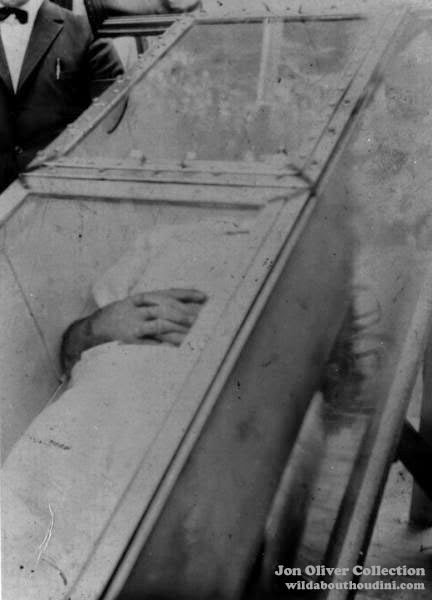
Now that we know this happened, I am more hopeful than ever that a photograph will one day surface. Considering this took place outside and lasted for an hour, it seems certain that photos were taken. Yes, there's the mystery casket photo that could be the Summerfield's test, but we need another photo to confirm this.

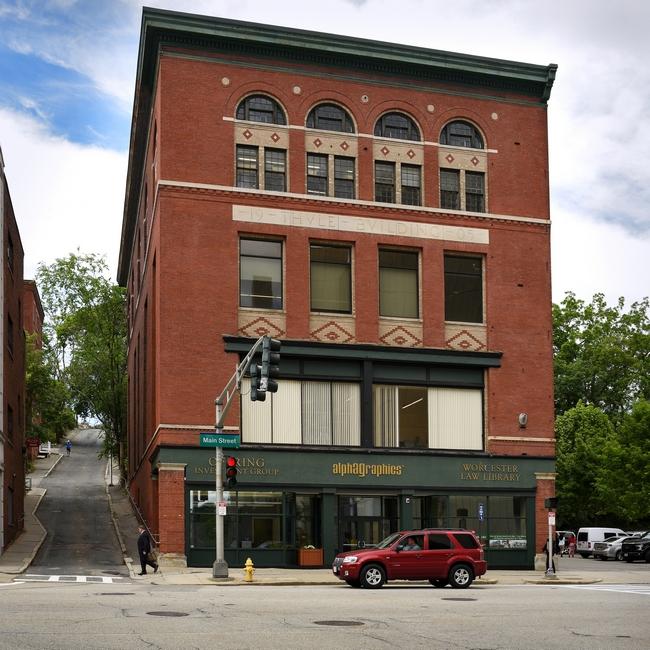
The building that housed Summerfield's still stands at 184 Main St. in Worcester and doesn't look all that different than it did in 1926.


Speaking of Worcester, our friend Jessica Jane and The Foolers will appear tomorrow at The Hanover Theatre and Conservatory for the Performing Arts in Worcester. So if you see the show, why not swing by the location of Houdini's last outdoor stunt?

Want more? You can read all the newspaper clippings and images I've gathered about the Summerfield's test as a "Scholar" member of my Patreon.

Monday, August 1, 2016

Site of Houdini's last publicity stunt

The Worcester Telegram has posted a short article about how on September 30, 1926 Houdini remained sealed in a glass-topped air-tight coffin while up on display at Summerfield's Furniture store in Worcester, MA. This was Houdini's third air-tight container test, and the only one done for the public. This was also likely Houdini's last publicity stunt.

While the Telegram article has less information about this stunt than what I posted here back in 2011, it does have a nice photo of the store from that time.


Read: Then & Now: Do you know where this is?

As revealed in the Telegram's follow-up story HERE, the building, known as the Thule Building, still stands at 184 Main St. in Worcester.

Saturday, July 11, 2015

Houdini death photo keeps us guessing

Discussion has once again flared-up over this remarkable photo of what is said to be Houdini in death. This photo comes from the collection of Jon Oliver who says it was once part of a private scrapbook put together by Bess Houdini. Jon received the photo from Bessie's niece, Ruth Kavanaugh, and on the back Bess herself has written: "This is the last photo of Houdini."

There was some speculation that this could be Houdini alive during his Summerfield's furniture store test in September 1926, which was a repeat of his Buried Alive test out of water (more on that here). However, Perry from NJ comments that Houdini's fingers appear to be bound together with "some sort of elastic material" to hold them in place, which certainly suggests this is a corpse.


What do we think? Alive or dead? I'm afraid I'm the one who suggested the possibility that this was the Summerfield's test, but I'm coming back toward the belief that this is indeed the dead Houdini, most likely taken in Detroit before or during his return trip to New York. (It was widely reported that Houdini was returned to NY, and later buried, in his glass-topped Buried Alive casket).

But the circumstances of this photo are still puzzling. Why is he propped up as if on display? What is he wearing? Are his fingers bound? Who is the man in the background? And who took this photo and why?

I'm preempting my planned post today to re-share this photo for those who might have missed it on the first round, and provide a place for comment and discussion. It is a weird and remarkable image. Alive or dead, Houdini always keeps us guessing!

Thanks to Jon Oliver and Patrick Culliton.

Related:

Wednesday, February 27, 2013

What if Houdini didn't die in 1926?

Houdini in his last new suit suggests how he
might have looked in the 1930s.
Here's the scenario: J. Gordon Whitehead is on his way to the Princess Theater when an attractive young lady on the streets of Montreal turns his head. Whitehead decides to forgo his plans to return a borrowed book to Houdini (and ask those burning questions about the Bible and whether he can take a punch to the gut), and instead has coffee with the young lady. Houdini can wait.

A few days later it's reported that Houdini, having cancelled his engagement in Detroit because of abdominal pain, has checked himself into the hospital to have his inflamed appendix removed before it could rupture.

"Houdini Escapes Death Once Again" is the headline on October 31, 1926.

Okay, now what? What if Houdini didn't die in 1926? What would his life and career have looked like into the 1930s and '40s or even longer? It's pure speculation, but one can play this game with some informed speculation. Here's what I think would have been Houdini's path had he survived beyond Halloween 1926.

Houdini was already stepping into the next phase of his life and career, so it's not hard to invision what his future performance life would have been like. He had successfully transitioned out of vaudeville and into a full evening roadshow, much like his contemporaries Thurston and Blackstone. His roadshow would have continued as the "3 Shows in One" and continued to be successful for many years. Walter Gibson says Houdini intended to play his roadshow for 10 seasons. He would modified the show from time to time, ultimately replacing the Water Torture Cell with the Buried Alive or the curious shelf of boxes escape.

It's said that Houdini was looking to wind down his spiritualist exposures and replace it with exposes of the techniques used by gamblers and other cheats. This changeover would prove to be very timely and successful in the 1930s when Houdini might have made headlines exposing the "smuggling methods of bootleggers" etc. All his career he enjoyed working with law enforcement, and I think he would relish this transition from "Ghost Buster" to "Crime Buster." Eventually this would be the new third act of his show. It's also possible that he would so cultivate this new identity as a "criminal expert" that he would be called in to consult on real-life high profile crimes, such as the Lindbergh baby kidnapping.

I think one of the things that would be most surprising about the post-1926 Houdini is that he would be less and less associated with daring escapes. His publicity stunts would become endurance tests, not unlike what David Blaine does today. This evolution was already happening in 1926 with his buried alive tests and notably his Summerfield's department store test. Seeing Houdini displayed in his "air-tight casket" would become the new suspended straitjacket escape. He probably would have also perfected and performed his frozen in ice test. It's even possible Houdini might have cut escapology from his repertoire entirely by the mid 1930s and would firmly cement a reputation as THE master magician of the age.

Houdini would take his roadshow to Europe and once again claim the title of "Europe's Eclipsing Sensation." I also believe he would have toured the Far East for the first time in his career to tremendous success, possibly the greatest success of his career. He might even have spent a year or more touring Asia, and would incorporate more "mysteries from the Far East" into his act on his return to the U.S.


Houdini would continue to write and publish books at an accelerated rate. The Cancer of Superstition would be one. He was also committed to a revised edition of A Magician Among The Spirits. At the time of his death, Houdini was gathering material for a series of books, including a book about the lives of famous magicians and an encyclopedia of magic. He was also working on his autobiography. The book we now know as Walter Gibson's Houdini's Escapes and Magic would have appeared under Houdini's name. It's speculative, but I think he might have also penned a book about Sir Arthur Conan Doyle after the author's death in 1930.

As he was never into the Stock Market, Houdini would have avoided ruin in the 1929 crash, although I think the depression would scuttle his plans to open a "College of Magic." But "Houdini" as a brand name -- connected with ever increasing books on magic and magic tricks -- would have kept him flush during the depression. Eventually he would have followed through with his plans to create a special theater of magic, as Hardeen later did with the Houdini Temple of Mystery in Atlantic City.

Houdini definitely would have become more involved in radio, possibly as the host of a "Houdini Mystery Hour," and he would have dabbled in early television. At some point he would again appear in movies, although not as a producer or star; he would likely cameo as himself as Bess did in Religious Racketeers. One thing is for sure, we would have lots of sound footage of Houdini, maybe even a series of short films in which he demonstrates various techniques employed by fraudulent spiritualists or criminals. Even though he once said he would retire to California, I think he would have remained in New York. It was the hub of his universe. But he would have spent more and more time on the West Coast and might have even bought a vacation home in Hollywood at some point.

Even though Thurston was celebrated as one of the greats of the era, I think Houdini's true rival at this time would have been Harry Blackstone Sr. Blackstone developed a Houdiniesq sense of self-promotion in the '30s and '40s, using new media like radio and comic books to brand his name as synonymous with magic, just as Houdini had done at the turn of the century. Houdini would have felt compelled to counter this. There would have been a Houdini version of Blackstone's "Super Magician" comic book, and Houdini would delight in boasting how it outsold Blackstone's comic book. Houdini vs. Blackstone would have been a real highlight of this era. They might even have engaged in a "battle of magic," which became popular in the '30s as seen with Hardeen Jr. vs. The Great Dagmar.

Houdini certainly would have continued his association with magic organizations like the Society of American Magicians and The Magicians Club in London. He would eventually become THE grand old man of magic as Kellar was in his day, and would have certainly been named Dean of the SAM -- Dean Harry Houdini. But he probably would have at least one serious falling out with one or both organizations at some point. That was just his combative nature, which would have mellowed but not abated with age.

Houdini would have become more philanthropic as he aged, and depending on his wealth, he would have dedicated some kind of library or building on a college campus named after himself or his father. He would have deemed this dedication as "the proudest moment of my life." During World War II he would have thrown himself into the war effort, selling Bonds and performing for the troops, as he did during the first World War. He might have even appeared with Hardeen in USO shows. How wonderful to see The Brothers Houdini reunited in 1941!

It's interesting to think of the men Houdini might have associated with in the '30s and '40s. I believe one of those men might have been Orson Welles. One can easily imagine Welles traveling the few blocks from his Harlem based Federal Theater to 278 to meet with the great wizard of his boyhood. Welles might have even interviewed Houdini at length about his career in a mirror of Welles' own master-student friendship with Peter Bocdovich in the 1970s.

I don't think Houdini would have ever stopped performing, although I think he would eventually franchise out his show (as Kellar had done with Thurston), and possibly would have selected a "successor". Who that successor would have been is anyone's guess, but I think Houdini would have plucked him (or her?) from relative obscurity. Without incident or accident, I think Houdini would have lived into the 1940s, mirroring the lifespans of Bess and Hardeen. But as one Weiss brother (Leo) lived until 1964 (and then died from suicide, not illness), Houdini might have had the genetic makeup to last even longer.

Houdini himself had a vision of a long life. In 1926 he told his friend William J. Hilliar:

"I am going to live as long as I want to and on my 100th birthday I am going to do my upside-down strait-jacket escape hanging from the tallest building in New York City."

It's intriguing to imagine this scene; a 100-year-old Houdini doing his famous suspended straitjacket escape at a time when Doug Henning was appearing on Broadway in The Magic Show. It's even more intriguing when you remember that the tallest building in New York on Houdini's 100th birthday was the World Trade Center.


So that's my take. How about you? What do you think Houdini's life would have looked like if he didn't die on Halloween 1926? Feel free to share your thoughts in the Comments below.

Sunday, July 3, 2011

Uncovering Houdini's THIRD air-tight container test and death casket

Last year I posted a blog about Patrick Culliton's discovery of a second underwater coffin test that Houdini performed at the YMCA in Worcester, MA, two months after his well-known Shelton pool test in New York. Inspired by that post, Worcester resident Mark Russell decided to do a little digging and discovered a few newspaper clippings that shed more light on this forgotten second test, as well as evidence that Houdini performed the test for a THIRD time!

According to an article in the Daily Telegram (Sept 27, 1926) promoting the upcoming Worcester stunt, this second underwater test was in direct response to the suggestion that the telephone Houdini used during the Shelton test somehow funneled air into the air-tight box. The paper states that Houdini will use a new "coffin" with a glass top so he can signal to his assistants on the surface.

"This time he will leave no loophole for the cynics, for there will be no connection with the outside save for signals seen through the glass top. Houdini will take with him a red bandanna for a warning signal, and a slate and chalk to write on and tell the onlooker how he likes conditions in his submerged quarters."

However, the Telegram's account of the actual test the follow day says Houdini did use a telephone and bell system during the Worcester test, and makes no mention of a glass top coffin or red bandanna signals. It sounds like Houdini intended to use a new custom casket for the Worcester test, but it doesn't arrive on time, so he uses a container similar to the Shelton test. Unfortunately, that "loophole for the cynics" remains.

Okay, until now, it was thought that the Worcester YMCA casket was the one that was famously used to ship Houdini's body back to New York following his death in Detroit. It was also reported that he was buried in this custom casket (although photos of Houdini lying in state and footage from his funeral suggest otherwise). But it turns out this wasn't the "death casket," and here's where it starts to get spooky and we need to revise Houdini history a bit.

According to another article and an advertisement in the Daily Telegram, Houdini performed the air-tight coffin test for a THIRD time! This third test took place in front of Summerfield's Furniture Co. on Main Street on Sept. 30, 1926, and was not a submerged test. As the advert (below) states, "This is the first public test in full view of the people."

Advertisement for Houdini's third air-tight coffin test on Sept. 30, 1926.

The full Telegram article (which is again a promotional article, Mark could find no article about the event itself) specifically states that the coffin Houdini would use for this open air public test will be a brand new one, not the one he used at the YMCA, which like the Shelton container, "had to be soldered by a tinsmith after he was placed into it" and then broken open to let him out. This new air-tight casket was made by the Boyertown Casket Co. of New York for $5000 and delivered to Houdini at noon on Sept. 28, 1926 (two hours after the YMCA test). The casket was put on display in the window of Summerfield's in the days preceding the test.

We now know THIS was the coffin used to transport Houdini's body from Detroit, and possibly holds his skeleton today. How can we be so sure? Because, incredibly, Houdini said so!

Houdini, the world famous magician, will perform his death-defying stunt of remaining in an air-tight coffin for one hour in front of the Summerfield Furniture Co,'s store on Thursday from 12 o'clock until 1 p.m. in the coffin in which he will be buried when he dies.

This is pretty mind-blowing as it is the only public declaration that I've ever heard about this coffin being made for Houdini's real interment. Most biographies say he communicated this wish privately (I believe to Joe Dunninger). It's pretty macabre, but also highly effective for Houdini to promote this as "the coffin in which he will be buried." It makes this stunt as much about getting a preview of Houdini in death as a test of breath control, but isn't this true of all of Houdini's most effective stunts? In fact, the Telegraph article talks more about this new coffin than the test itself.

This brand new coffin, delivered at the Worcester theater yesterday where Houdini is appearing all week, weighs 420 pounds. It is made of copper composition frame with a glassed top in two sections, each of which is 1/4-inch thick. The glass was installed by the Pittsburgh Plate Glass Co.

I'm now wondering if this photo (right) -- which Patrick Culliton shared on his website (www.houdinisghost.com) and is said to be a photo of Houdini in death -- is actually a photo from this open air Summerfied's test. This description of the casket matches, and he appears to be on public display here. Note the person standing on the side and the fact that the coffin appears to be propped up on a platform. The construction of a special platform is specifically mentioned in the Telegraph article, "so that the coffin in which Houdini will be in for an hour will be seen by everyone in the vicinity of the store."

Finally, how eerie is it that this is only one month before Houdini really does die and this casket really is used to hold his body? I think we can add this to the series of premonitions and bizarre coincidences that proceeded Houdini's death on Halloween 1926.

A very big thank you to Mark Russell for uncovering this information and allowing me to share it on WILD ABOUT HARRY.

UPDATE: Some clarification about the coffin from Patrick Culliton's Houdini The Key. Patrick describes the Worcester custom coffin as being a "coffin liner." He says this liner was made to be put inside the bronze casket that we see in the funeral footage. Patrick believes, "Houdini may still be in this coffin liner, inside the bronze coffin."

Translate