Showing posts with label Will Goldston. Show all posts

Saturday, December 2, 2023

Limited edition 'Magical Rope Ties and Escapes'

Philip David Treece at CollectingMagicBooks.com has released a high-quality reprint of Houdini's Magical Rope Ties and Escapes. This is a limited edition hardback (100 numbered copies) printed and bound in the UK by a specialist short-run printer. It is a full facsimile produced directly from an original copy, with all the plates reproduced as plates, just like the original. As you can see below, it's a beauty!


Magical Rope Ties and Escapes was originally published in the UK by Will Goldston in 1921. It was never released in the U.S. The only other reprint I'm aware of was a paperback by Houdini's Magic Shop in 2011. Of all Houdini's books, this is the one that contains the most photos of him.

You can purchase this new limited edition of Magical Rope Ties and Escapes at CollectingMagicBooks.com.

Thank you, Philip!

UPDATE: Excited to have my copy in hand. It's every bit as good as advertised. The quality of the illustrations and photos match the original exactly. (This is certainly not the case with the 2011 reprint.) Originals are scarce and expensive, so if you don't have this book or want a reading copy, this is the one to get!


Wednesday, November 23, 2022

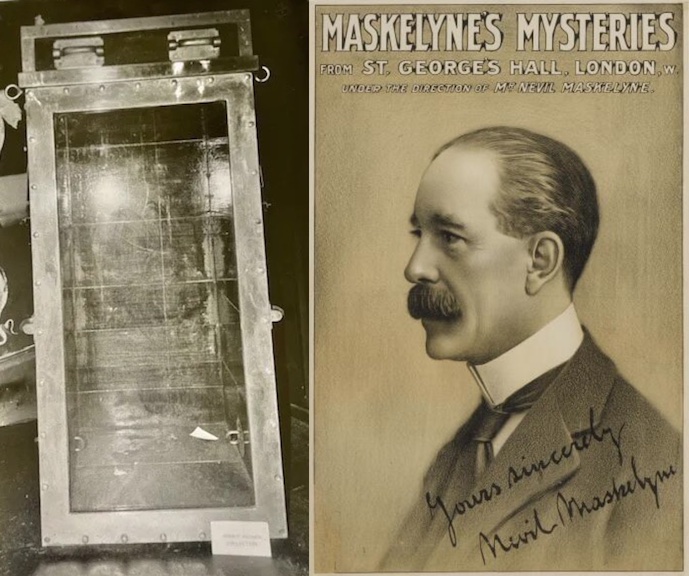
Nevil Maskelyne and the Water Torture Cell sale


Here's a tasty piece of untold magic history to chew on this holiday. In 1920 Houdini tried to sell his most famous escape, The Chinese Water Torture Cell, to magician Nevil Maskelyne. I uncovered the correspondence between the parties during my trip to the Harry Ransom Center last summer. Here's the story.

In January 1920 Houdini arrived in the UK for a five month tour. Having just completed two films in Hollywood, Houdini was convinced that his future lay in the movies. He was only making this tour to honor bookings made before the war and avoid a hefty fine. For the first time in years he revived his standard vaudeville act; Needles, straitjacket, challenges, and, of course, The Chinese Water Torture Cell.

Getting the Torture Cell back into action took some effort. Houdini recorded in his diary that he "nearly cracked my neck" in a test run of the escape. During the second week of the tour the glass cracked. Then in Liverpool, Houdini seriously injured his right ankle performing the escape. These struggles may have something to do with what happened next.

On February 6 Houdini sat down with magician and inventor Fred Culpitt (right) at the North Western Hotel in Liverpool. There they discussed the possibility of selling the Water Torture Cell to Nevil Maskelyne, who was performing his "Maskelyne's Mysteries" at St. Georges Hall in London at this time. Houdini gave Culpitt the go-ahead to approach the magician on his behalf.

Culpitt wrote to Maskelyne on February 10th, presenting the idea of a sale and laying out the specifics. Unfortunately, that letter in not in the Ransom Center file, so it's unclear if the idea was for Maskelyne to take possession of the cell immediately or at the end of Houdini's tour.

"It certainly seems as though they are interested in the proposition," Culpitt wrote to Houdini three days later. But there was one hiccup. Maskelyne's representative, George Facer, told Culpitt that Will Goldstone had offered the same effect to Maskelyne that very same week. "Of course, it does not matter to me who gets the illusion 'placed'," wrote Culpitt, "but I think it would be wise for me to know my position."

Houdini quickly wrote back clarifying that Goldston offered Maskelyne "some sort of mermaid illusion", not the Water Torture Cell. He also told Culpitt that he had attended Maskelyne's show at St. Georges Hall and Maskelyne had asked to see the escape. Houdini sent the magician two tickets to his show at the Empire Palace in Stratford. "If anything transpires, I will let you know," he assured Culpitt.

It appears nothing did transpire and that's the end of the correspondence. Houdini kept his Water Torture Cell and performed it for the remainder of his career.

It's hard to know how serious Houdini was about selling the Torture Cell. Perhaps his initial frustrations with the apparatus caused him to overreact. However, he reportedly did destroy magic apparatus that he had stored in the UK at the end of the tour and the cell was likely expensive to ship. So if Houdini really did believe he had no more use for the escape then it would make sense for him to offload it in the UK.

There's also another possibility, but this is pure speculation. Is it possible what Houdini was looking to sell was a second Water Torture Cell, perhaps the cell he had made for "Miss Trixy" in 1912? It's likely that cell would have been stored in England.

As for Maskelyne, the magician was 56 and not an escape artist, so it seems unlikely he would perform the escape himself. What he would have done with it is anyones guess. So this episode offers a fascinating "what if" of magic history.

Want more? You can read the original Houdini/Culpitt correspondence as a "Scholar" member of my Patreon.


Happy Thanksgiving!

Saturday, January 30, 2021

Set of Houdini printing blocks sell (quickly!) on eBay

On Monday there was some excitement on eBay when six original Houdini wood printing blocks appeared from a seller in Florida with relatively low Buy It Now prices (which quickly shot up as they started selling fast!). When the dust settled, I was thrilled to come away with the below.


Wood blocks like these were used in the printing of newspapers and other print media and can be one of a kind. The seller says she found the entire set at an estate sale of a 90+ year-old man. Three of the blocks are etched plates like the above and three are photos on copper. The largest of these is the well-known "Houdini at Different Ages of His Career" page from his pitchbook. Below are the auction images.


While I recognize all these blocks from their newspaper appearances, my own block is a bit of a mystery. While I suspect it was also used in newspapers, the only image I've found so far is the below print in the McCord Museum. Is this the original drawing from which this block was made? You'll notice it has the artist signature. Unfortunately, I can't make it out. [See UPDATES.]

McCord Museum

I would love to more more about printing blocks in general. Were they all one of a kind? How did newspapers acquire them? Would Houdini have provided them himself? If you have any answers, please let me know in the Comments.

Thanks to Todd Karr of The Miracle Factory for giving me the heads up on these!

UPDATE: Chuck Romano of My Magic Uncle tells me the artist here appears to be Howard K. Elcock, an English pen and ink illustrator who did a lot of artwork for Will Goldston's publications. The following is from The Magazine of Magic, February 1915:


UPDATE: Another development. I've just discovered this illustration appears in the "Revised 1920" edition of Houdini's The Adventurous Life of a Versatile Artist pitchbook (below). Curiously, the illustration is not in the later "Revised 1922" edition. Instead, the original photograph appears in its place. Maybe he lost the block!


UPDATE: I've now learned these plates came out of the famous 1980 278 estate sale. Also, what the seller told me about these coming from the estate of a 90+ year old man may not be accurate.

Thursday, November 7, 2019

Houdini's Magicians Club portrait to be auctioned

An interesting piece of Houdini history is set to be sold in Haversat & Ewing Galleries latest magic auction November 8-9. I'll let the auction description speak for itself.

This fabulous framed portrait was given to Will Goldston by Harry Houdini for the London Magician's Club. The Magicians' Club of London was formed in 1911 by Harry Houdini, Will Goldston, Servais Le Roy along with other notable names in magic. 
On March 19, 1913 the gathering place for the organization was officially recognized with a large crowd and much pomp and circumstance. With the press at hand, the organization's president Harry Houdini formally declared the club as being officially open! The Clubroom is where the Houdini portrait was hung in 1913 and where it would remain for decades. The early photo of the room (below) clearly identifies the Houdini framed image on the right hand side of the wall. 
The Davenport Family acquired the famous portrait when they purchased Will Goldston's estate in 1949 and it has since been hanging at Davenport's Magic Shop. In original frame, does not contain glass. Portrait itself measures 26" x 19.5" - with frame 28.5" x22". This is a genuine and important piece of magic history, not to be missed. Est. $10,000-12,000

The auction includes several other nice Houdini lots from the Davenport Family/Will Goldston estate that can be viewed HERE.

UPDATE: Bidding topped out at $6,125.00, but the Reserve Price was not met.

Related:

Monday, February 4, 2019

Mystifier, Second Quarter 1996

Continuing my issue by issue look back at the Mystifier, the newsletter of the Houdini Historical Center that ran from 1991-2003.


The Second Quarter 1996 Mystifier is made up largely of a very fine article by Edwin A. Dawes about Houdini and The Magicians' Club in England. Houdini was president of the club from its founding in 1911 to his death. The article is a treasure trove of information about the various Magicians' Club events that Houdini attended, including this gem about a 1920 dinner honoring Houdini officiated by The Great Raymond.

Will Goldston claimed in his book Sensational Tales of Mystery Men (1929) that Houdini detested Maurice Raymond and, when he learned that Raymond was the occupy the Chair at this particular function, at first refused to accept any presentation from him. It took Goldston's powers of persuasion to get Houdini to allow Raymond to officiate. Even then Goldston had to reprint the tickets to placate Houdini who insisted that "The Great Raymond" be replaced with "M.F. Raymond" because "he's not great at all."

According to Milbourne Christopher in Houdini The Untold Story (1969), the antipathy had been aroused years previously when Raymond ordered a Water Can escape from Ornum, a British manufacture, without seeking Houdini's permission. However, Raymond apologized and at the dinner presumably made ample amends by declaiming in his speech, "Harry Houdini was born, as I was, under the Stars and Stripes. He saw them a little ahead of me and he had been ahead of me ever since."

The newsletter continues with a photo of the newly installed "Harry Houdini Family" inscription on the Wall of Honor at Ellis Island in New York City. Getting Houdini's name on the wall was due to the efforts of HHC member Paul Rosen. Among the "New Members" are Lance Burton and Dean Gunnarson.

The newsletter only runs four pages this time, but tipped into each member's issue was a letter from HHC Executive Director Steven M. Wilson announcing that the Mind Over Magic exhibition, announced in the previous issue, is being postponed (indefinitely, as it would turn out). Wilson explains that "concerns began to surface about the many directions the project could take, and whether the exhibit was right for our audiences needs."

Sid Radner starts off his "Backstage" column with an amusing look at people he has encountered who have legally changed their names to "Harry Houdini." [We have a regular reader here named "Harry Houdini." Is he one of the folks Sid mentions?] Sid then announces that Houdini Comes To America by Ronald J. Hilgert will be the first HHC publication and will be limited to 300 signed copies.

Sid finishes with a promise to reveal details on Ken Silverman's upcoming book and the recently completed Houdini documentary in the next issues. He signs off with: "Houdini Lives!"

Mystifier
Volume 6, Number 2
Second Quarter, 1996
4 pages

Contents:
Houdini and the Magicians' Club
Houdini Family Named on Wall of Honor
Backstage with Sid Radner


Related:

Saturday, September 30, 2017

Derek Tait's new book is a Houdini ESSENTIAL

Derek Tait's The Great Houdini: His British Tours is now available in the U.S. (a month early). Here's my review.

To date there have been approximately 152 non-fiction works on the life and career of Harry Houdini (double that if we include fictional works). But only a small number of these would I consider essential -- a work that so contributes to Houdini history that is a must read. Essential works do not come along all that often, and that's why the arrival of Derek Tait's The Great Houdini: His British Tours is cause for celebration, because this is a new essential Houdini work of the highest commitment and caliber.

Derek takes a specialized approach, focusing only on Houdini's performances in the UK. The author spent 11 years unearthing the exact dates and details of just about every Houdini appearance. The book is packed with new, fascinating facts. Among the many revelations is Houdini's original iron bar escape (page 91); a detailed account of a bridge jump in rough seas (page 145); a mysterious operation Bess underwent in 1913 (page 194); fresh details on his Prison Cell & Barrel Mystery (which I mined for this post); and much, much more. The book is laid out chronologically, so using this book in conjunction with Frank Koval's Houdini Research Diaries allows one to place Houdini in time and place like never before. As I said, essential.

But before plunging in, one should understand this is very much an academic work. Derek does not compress, finesse, or fictionalize information for the sake of narrative. He sticks to the chronology and reproduces accounts of Houdini's act in full, even if that means repetition (my God he escaped from a lot of packing crates!). When available, Derek also includes reviews of the other performers on the bill, creating context for the world of show business that Houdini inhabited. While an academic approach may alienate a casual reader, the serious reader will be exhilarated. With this approach, you can truly see how Houdini evolved his act and grew as a performer.

But even the most general Houdini fan will thrill to the many beautiful photos in the book, some never before published. So on that level alone, this book is a must buy for all.

The only area where I might fault the author is his inclusion of excerpts from Will Goldston's Sensational Tales of Mystery Men (1929). I don't entirely trust these colorful accounts of Houdini as Goldston was a bit of a myth-maker. His story about Bess crying the key away from the Mirror representative is infamous. But these tales are still interesting to read, especially for those who have not encountered the Goldston book or his stories before.

Finally, Derek does not interject himself or his own theories into this work. He reports. This is refreshing in an era when biographies sometimes irresponsibly mix fact and speculation. Instead, Derek takes one of the most hands off approaches I've seen in any Houdini book, presenting his findings in full without comment or conclusion. It's a selfless approach and an ethical one. He does the hard work of knocking down the door so all can enter and freely explore the fascinating world of Houdini in the UK. Bravo!

Purchase The Great Houdini: His British Tours by Derek Tait at Amazon.com (U.S.) and Amazon.co.uk (UK).

Related:

    Friday, February 17, 2017

    A book that's bound to please

    Here's an end-of-the-week treat from the collection of the great Kevin Connolly. This is a pre-order advertisement for Houdini's Magical Rope Ties and Escapes. Not only have I never seen this ad, but I don't think I've ever seen any ad for this book! I love the image of Houdini bound to the book here.

    Kevin Connolly Collection

    Published by Will Goldston in 1921, Magical Rope Ties and Escapes was only released in the UK. It was no doubt timed to take advantage of Houdini's return to the UK after six years of absence because of the war. While it's not one of Houdini's more substantial works, it does contain terrific photos of Houdini in escape action, and the frontispiece photo of Houdini and Ira Davenport seems to foretell the next chapter in his career.

    Magical Rope Ties and Escapes is available today for the Kindle. A reprint is also available from Houdini's Magic Shop.

    Thanks, Kevin.

    Related:

    Saturday, November 12, 2016

    Master Mystery episode 3 poster sells for $28,080

    An original poster for episode 3 of Houdini's The Master Mystery sold for $28,080 at today's Haversat & Ewing Galleries November magic auction.

    The poster came from the collection of Dorothy Dietrich and Dick Brookz of the Houdini Museum in Scranton, who own a complete set of all 14 posters from the serial. An Episode 3 ("The Water Peril") has never come up for auction before.

    The auction contained several unique and desirable Houdini rarities. A cabinet photo of Houdini and his mother fetched a remarkable $16,380. This appears be an all-time record for a Houdini photo at auction. A "King of Cards" poster brought in $11,700. A letter on unique stationary in which Houdini talks about his bi-plane in Australia went for $10,852. A letter to Will Goldston in which Houdini discusses an early injury took in $7,575.

    One item that I had my eye on was a business card for Houdini's first chief assistant Franz Kukol. But it looks like it caught the eye of others as well. It beat the auction estimate of $250-$300 and went for $2,661. (All prices include the 17% buyers premium.)


    As always, congratulations to the buyers and sellers and to Haversat & Ewing Galleries for another stellar auction.

    Related:

    Thursday, May 26, 2016

    Haversat & Ewing auction June 3-4

    Haversat & Ewing Galleries upcoming "Spring Into Summer Auction" on June 3-4 will include several interesting Houdini rarities among their 190 lots.

    Two items specifically relate to Houdini in New York. The first is a program and ticket stubs for Houdini's 1917 S.A.M. benefit for the families of the Antilles disaster, in which he shared the stage with Harry Kellar among others (Lot 145). To promote the patriotic event, New York officials finally granted Houdini permission to perform a suspended straitjacket escape in Times Square. There's also a program for Houdini's first appearance at The Palace Theater, in which he shared the bill with Fanny Brice (Lot 136). The Palace was a collaboration between Martin Beck and B.F. Keith and became the preeminent vaudeville house of the golden age.

    Also at auction are eleven typed pages about the Davenport Brothers compiled by Oscar Teale for Houdini (Lot 146). An article called "The Idolatrous Dog" signed by Houdini to Will Goldston: "W.G. Knowing your love of your pretty little Greyhound - know this will interest. Regards, Houdini" (Lot 137). And two keys from Houdini's personal collection owned by Jerry Metallo, who was once Houdini's metal worker (Lot 160).


    You can view the full online catalog HERE. Active bidding on all lots begin at 11:30 AM EST - Friday, June 3, 2016. The first lot closes Saturday, June 4, 2016 at 5:00 PM EST.

    Related:

    Saturday, January 12, 2013

    The secrets of The Secrets of Houdini

    Today I continue my examination of books about Houdini with images and insights from my own collection.

    The Secrets of Houdini by J.C. Cannell is a remarkable and somewhat mysterious book. First published in the UK in 1931, the book does indeed expose some key Houdini methods and contains an impressive collection of rare photographs. The book is arguably superior to the officially sanctioned Houdini's Escapes by Walter B. Gibson, which was published in the U.S. the previous year. So how did this book come to be without the apparent involvement or blessing of Beatrice Houdini and Bernard Ernst?

    1931 UK first edition hardcover.

    Not all that much is known about the author, J.C. Cannell. According to MagicPedia, John Clucas Cannell was a journalist, author, amateur magician and also Vice-President of the Magician's Club in London. Cannell is only credited with two other works, In Town Tonight (1935) and Modern Conjuring for Amateurs (1938).

    But reading The Secrets of Houdini, it's pretty clear that famed magic publisher and Magicians Club President Will Goldston had a hand in this book, even though his name does not appear as publisher or even as a contributor. Cannell makes reference to "his friend" Will Goldston within the first few paragraphs of his introduction (he says Goldston is a "spiritualist"?), and you don't have to go very deep into the book before you find a photo of Houdini and Goldston. I can't help but wonder whether Goldston was the true author of this book and used Cannell as a front? It's possible.

    The Secrets of Houdini was first published in hardcover by Hutchinson & Co. in the UK in 1931. Hutchinson released a revised hardcover edition in 1932 promoted as the "First cheap edition." Added to the text was a dedication ("To my wife Dorothy") and a new "Author's Note" in which Cannell expressed surprise at the controversial reaction of the book:

    Since this book appeared I have received a large number of letters from people who have read it, and their reactions to the exposure of the method and technique of a would-famous illusionist and professional deceiver interested me mightily. Some of the letter writers declared that I had struck a deadly blow at the popular belief in the supernatural by revealing the coldly materialistic explanation of this modern wizard, Houdini. Others affirmed that, in spite of my revelations their belief in the psychic powers of Houdini had not been shaken.

    A paperback edition of "J.C. Cannell's famous book" was released by Hutchinson's Pocket Library in 1938. The title page notes that it's the "38th Thousand" printing(!). The Author's Note does not appear in this printing.

    UK "cheap edition" and the 1938 paperback.

    The Secrets of Houdini wasn't published in the United States until 1971. The first U.S. edition was put out by Gyrphon Books and was a facsimile of the UK printing. The two Gyrphon editions that I've been able to examine (my own and one in the Arthur Moses collection) have different bindings, but both state "Third Impression" on the title page, so it appears the facsimile was struck from the British 3rd edition.

    This was followed by another hardcover published by Gale in 1974, also a facsimile of the Third Impression. As far as I know, neither the Gyrphon nor Gale editions were issued in dust-jackets, and neither contains the "Author's Note" (which tells us the Author's Note was unique to the UK second edition?).
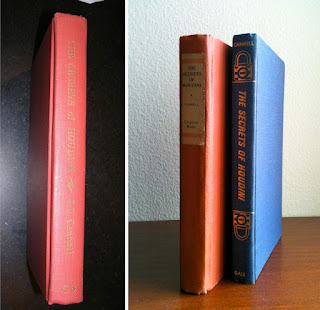
    1971 Gryphon editions (red) and the 1974 Gale edition (blue).

    But the way most American readers (including yours truly) first discovered The Secrets of Houdini was via the Dover trade paperback first published in 1973. This edition added 24 new illustrations. Like Dover's other popular Houdini title, Houdini on Magic, it's still in print to this day. There have been dozens of printings of the Dover paperback over the years that offer subtle changes in the color of the cover art. And speaking of cover art, it was the Dover edition of The Secrets of Houdini that inspired a young David Blaine.

    Original 1973 and current Dover editions.

    The Secrets of Houdini was published in a new hardcover edition by Bell in 1989. This edition contained a new forward by Bud Masterson and is unique in that it restores Cannell's "Author's Note" -- the first time the Author's Note had ever appeared in any U.S. edition to my knowledge. The Bell edition also retouched some of the photographs and credits the poster and props on the attractive dust-jacket to "Flosso Hornmann Magic Inc., the world's oldest magic shop" (which had once been owned by Houdini).

    In 2010 The Secrets of Houdini was made available as a print-on-demand in hardcover and paperback.

    The 1989 Bell hardcover and the 2010 print-on-demand.

    But perhaps the strangest "reprinting" of The Secrets of Houdini happened in 2012 when Amazon listed six new "books" by J.C. Cannell with titles like: Harry Houdini the True Escapist Extraordinaire and Houdini and the Art of Illusion and Disillusion. Some of these showed prices as high as $26 and page counts as low as 30 pages.

    But this was just the good-old Secrets of Houdini carved up into sections and offered up under new titles, part of an epidemic of sneaky public domain reconfigurations that have sprung up in the digital age.


    Thanks to Arthur Moses for his help sussing out details on the U.S. editions. Also thanks to John Bushey for the image and details about the 1932 "cheap" edition.

    Also enjoy:

    Translate