Showing posts with label 1910. Show all posts

Thursday, September 5, 2024

Houdini in Australia facts and fantasy

Andrew McConville from the State Library Victoria discusses Houdini in Australia on the "In Black and White" podcast hosted by Jen Kelly. These are well done. You can listen via the links below at the Herald Sun.


Speaking of Australia, here's something I recently found. This 1895 ad for the Welsh Bros. Circus in Lancaster, Pennsylvania, advertises "The Mystifying Houdinis" as hailing from Melbourne, Australia.

Lancaster New Era, April 22, 1895.

I've actually seen several other early mentions of Australia being Houdini's home country. I always suspected reporters were confusing Australia with Austria (because Houdini claimed that as well). But this mention of Melbourne puts that notion to rest. So, yeah, in his early days, Houdini sometimes claimed he was an Aussie!

Monday, May 20, 2024

Did Houdini escape from Scrubs?

This photo sold over the weekend in Haversat & Ewing Galleries Auction #45 for $354. The auction description says it came from the Houdini family in the 1990s. On it, we see a notion in Houdini's hand reading: "Wormwood Scrubs Jail entrance London."


Still in operation today, Wormwood Scrubs is located in the London Borough of Hammersmith and Fulham. Houdini did perform at the Hammersmith Palace the week of October 31, 1910. So could this mean he did a jailbreak from Scrubs that week?

I have no record of a jailbreak at this time, and 1910 is a little late for such an escape. Houdini was well into bridge jumps as his preferred outdoor stunt. Scrubs is also not listed among the jails that David De-Val escaped from. De-Val is said to have escaped from all the surviving jails that Houdini escaped from in the UK.

It's still possible Houdini did a jailbreak from Scrubs that was not widely reported. Or maybe the old jailbreaker just found this an impressive-looking building, as it still is today!


Congrats on the winner of this intriguing rarity. And thank you to our friends at Haversat & Ewing for being regular advertisers. Click the image below to see the prices realized on their latest auction.

Wednesday, December 6, 2023

Rosehill Racecourse in Sydney to be redeveloped


ABC News reports that Rosehill Racecourse in Sydney, Australia, will be relocated, and the area on which it has stood since 1883 will be turned into a "mini-city" of 25,000 new properties, green space, and a Metro station.

What does this have to do with Houdini? Well, Rosehill was one of only three fields where Houdini flew his Voisin biplane. While he learned to fly at Hufaren parade grounds in Germany and clinched the honor of Australia's first flight at Diggers Rest near Melbourne, it was at Rosehill that he made his final and most harrowing flight on May 1, 1910.


All I ask is one of the streets in this new development be named in honor of Houdini!

Thanks to Tom Waller for the alert.

Saturday, July 23, 2022

Houdini of Arabia

Here's a photo that you'll sometimes see credited as being Houdini in Egypt. However, this clipping from the March 3, 1912 Virginian Pilot identifies it as being "Aden Arabia". Houdini did indeed stop off in Aden (Yemen) during his journey to Australia in 1910. This would have been after his stop in Port Said, Egypt. I'm not sure I buy the claim that Houdini escaped from their jail. I think this pic is all about the camel.


This appeared as part of a full page profile that ran in anticipation of Houdini's appearance at the Colonial Theater in Norfolk, Virginia, in March 1912. This would mark his first and only appearance in the city and proved to be one wild week! I'll be sharing that story soon...


BONUS: Our good friend David Haversat of David Haversat Magic has sent over this image as a beautiful first generation photo from his own collection. You can see it on my new WILD ABOUT HARRY Patreon by joining at any level. Just click the image below to go:


Below are some more posts about Houdini the world traveller.

Related:

Friday, October 8, 2021

Watch Houdini's historic Australian flight

Here's another excerpt from 'High Lights in the Strenuous Career of Harry Houdini, Edited and Compiled by Houdini's Brother Hardeen'.

Film of Houdini's history making flights in Australia is widely available. But it's nice to have it collected here in sequence instead of just fragments. Also, the final shot is entirely new to me. So even though it's brief, this clip does appear to offer footage of a Houdini flight that has never been seen before. Enjoy.


Notice that the date is shown here as March 16, 1910. The true date of Houdini's first Australian flight was March 18. But Houdini adopted the March 16 date in publicity, and speculation is that he was concerned about a claim from Fred Custance that he had beat Houdini into the air by a day.

Thanks to escape artist Rick Maisel for allowing me to share this rare footage. A playlist of these clips can be found on the WILD ABOUT HARRY YouTube Channel.

Related:

Thursday, April 8, 2021

Houdini's Melbourne bridge jump (sans corpse)

Houdini's tour of Australia in 1910 is most celebrated for his aviation exploits. But he also wowed audiences with escapes, including a leap from the Queen's Bridge into the Yarra river in Melbourne on Thursday, February 17. What makes this particular stunt so famous is the story of how Houdini's jump dislodged a suicide from the river depths, causing the corpse to float to the surface. The crowd feared the dead man was Houdini himself, until the escapist surfaced beside it. But did that really happen?

Below are a set of photos and an account of the stunt from the Melbourne Weekly Times. As you can see, no corpse involved, but some nice details, including that Houdini wore a blue bathing suit instead of his usual crimson.


A DARING DIVE
_______________

A PUBLIC SPECTALE

MELBOURNE, Thursday.
The announcement that Houdini, who is at present appearing at the Opera House, would dive from Queen's Bridge into the Yarra attracted many thousands of people this afternoon. Every point of vantage on the Bridge was quickly occupied by spectators, as were also the roofs of the sheds lining the north and south banks of the river and the various steamers lying in the stream. On the river itself were craft of all kinds, densely crowded with men women and children, eager to view the sensational spectacle. It was with the greatest difficulty that a large force of mounted and foot police could secure even space enough for a narrow line of vehicular traffic.
    At about 1.30 Houdini drove up on to the center of the bridge in the motor car. Making his way through the crowd he mounted the parapet, where he was manacled with stout chains. After being handcuffed his hands were fixed behind his back. The chains were passed over his neck and round his body, and were fastened with a stout brass padlock in the middle of his back.
    Clad in a blue jersey and blue trunks but with his arms and head bare, he stood unconcernedly in the blazing hot sunshine. When the manacling arrangements have been completed he looked quietly down on to the lower wharf, and asked "Is it already Jim; is the way clear?" Receiving a reply in the affirmative he first took several long breaths, then, without the slightest hesitation, dived into the river. In about sixty-five seconds he came to the surface again free of his chains, which, by the way, weighed about 26 pounds. The chains themselves he brought up in his hand. As he mounted the steps, Houdini was loudly and continuously cheered, the spectators thronging round him as he again made his way to the waiting motor car. From the time he mounted the bridge until he was driven off again in the car only about seven minutes elapsed.

There are some other details that didn't make this report. The temperature that day was a scorching 101 degrees. Several onlookers fell into the river. Following the escape, reporters on the dock asked Houdini how he liked the taste of the water. He replied by grimacing and saying it was "the least toothsome" he had ever sampled. Later news accounts made light at the idea of Houdini "insulting" their river water.

Houdini's Queen's Bridge jump was his first outdoor stunt in Australia. He told reporters he had considered making a leap from the deck of the ship Malwa when it first arrived in Fremantale, but talk of shark infested waters convinced him otherwise. He later made a 31 foot handcuffed jump into the Domain Municipal Baths in Woolloomooloo Bay in Sydney (below). That jump resulted in him hitting the water wrong and blackening both eyes.


So what about the whole floating corpse thing? If this happened, not a single newspaper (that I've been able to find) reported it, which does not seem likely. The story appears to be a Houdini invention. I'm not sure when he first started telling it, but it appears in a 1918 Boston Post interview along with his famous trapped under the ice story. In it Houdini emphasizes his shock at finding himself beside a dead body. "As long as I live I will not forget that incident. It was the worst thing that ever happened to me."

Like reporters in Houdini's day, biographers can't seem to resist this story. The Australian corpse surfaces in Kellock, Gresham, Christopher, and even Kalush. Only Ken Silverman leaves it out of his account of the escape.

With or without the corpse, I still enjoy the story of Houdini's Melbourne bridge jump, especially as the Queen's Bridge is still there today!

Thursday, March 18, 2021

Houdini's LAST Australian flight was the wild one


Today marks the 111th anniversary of Houdini first successful flight in Australia on March 18, 1910. Certainly this was his most famous aviation exploit, and it's one that has been covered pretty thoroughly. So today I thought I would talk instead about Houdini's last flight in Australia on May 1, 1910. This was the flight that truly showcased his skills and nerve as a pioneer aviator, and may have been the greatest risk he ever took in a life full of risks!

Houdini completed several successful flights at Diggers Rest in Melbourne after his first historic flight on March 18. Some of these flights were captured on film. At the end of the month Houdini moved on to the Tivoli Theater in Sydney. He had his Voisin bi-plane trucked to the city where it was made ready for flight at Sydney's Rosehill racecourse (which is still there).

Houdini made several private flights at Rosehill. His first flight of 300 yards on April 18 constituted the first controlled airplane flight in New South Wales. Later that same day Houdini flew three quarters of a mile, but he came down hard he was thrown from the plane. Another hard landing broke a wheel.

News of Houdini's successful flights had reached the residents of Sydney who were eager to see Houdini fly for themselves. So during his final week in the city, Houdini advertised that he would give public exhibitions every day between the hours of 9 AM and 3 PM (conditions permitting). Bess and Houdini's assistants were tasked with providing tea and cakes for the crowds.


Bad luck set in. The weather would not cooperate, and even when conditions were right mechanical problems would shut down the day's attempt. At one point a tube supplying coolant to the Voison's cylinders slipped off and hot water scalded Houdini's mechanic Brassac on his shoulder and thigh. Later in the week two aviators named Kotta and Newman arrived at Rosehill with their own Australian made plane to compete with Houdini. But their chassis broke while wheeling it out onto the field. The April 27, 1910 Parramatta Cumberland Argus And Fruitgrowers Advocate captured a typical day's disappointment:

CHEAP TO TALK
There were several hundred people at Rosehill racecourse on Sunday morning when it was announced that Houdini would go aloft on his aeroplane. The charge for admission was a silver coin. The day was very calm, but there were ominous streaks in the clouds, indicating confused currents. At about 11 o'clock Houdini announced it was too windy to fly, and this statement was met by shouts of derision from those who had paid to see the performance. He again announced that an accident cost in repairs from £50 to £300, and there was also a risk of life, which he did not feel disposed to take. Still there was banter, and Houdini then remarked: "It is cheap to talk, but it has cost me £3000 to learn to fly, and I know what I am talking about." Then the crowd melted away, feeling rather disgusted.

Houdini closed at the Tivol on Saturday, April 30. The next day was the last he could fly before the plane needed to be dismantled and made ready for shipping back to England. Conditions were still not ideal, but Houdini climbed behind the wheel of his Voisin anyway. Newspapers recorded what happened next:

Kalgoorlie Miner, May 2, 1910.

It was a wild ride and a fitting end to Houdini's Australian adventure. It would also turn out to be his last flight ever. And who can blame him?

After he had left the country, an aviation journalist discussing Houdini's Australian flights in the Brisbane Queensland Country Life remarked:

I think Houdini is one of the pluckiest men I have ever seen. And one of the rashest! The things he was trying to do at Rosehill! It was a small area, there were fences everywhere, and a stiff wind blowing. It was trying to fly under conditions in which Latham, for instance, would never have allowed his pupils to try to get off the ground. How that man escaped breaking his neck I don't know! But he did one good flight. Give him a month and a decent open plain and he would make a splendid one.


Related:

Tuesday, March 9, 2021

Hanco scoops Houdini (or perhaps Blackstone)


When Houdini toured Australia in 1910, he discovered the country was as jam-packed with rival "Handcuff Kings" as the U.S., UK, and Europe. In fact, part of his stage patter while in Australia was to inform his audiences that he was the originator of the feats they've been seeing other escapists perform for years.

One of the most active of those rivals was "Hanco The Handcuff King" (real name Sam Cooke). Hanco did handcuff, straitjacket, and challenge escapes, and also promoted his appearances with outdoor stunts. After Houdini left Melbourne for Sydney in April 1910, Hanco arrived in town and did a stunt at Queen's Bridge where Houdini had made a handcuffed dive just a few weeks earlier. But Hanco had his own approach. Check out the description below:

Ballarat Star, April 2, 1910.

Yes, that certainly sounds like an overboard box escape to me! And this is two years before Houdini's first overboard box in New York on July 7, 1912. Hanco also did a version of the escape on stage, which you can see advertised below.


Hanco did his overboard box in several Australian cities that year. But he seems to have had repeated difficulty getting his box--which may have been a commercial steamer trunk--to sink. And in Wagga Wagga he had another mishap.

The Wagga Wagga Advertiser, Feb. 24, 1910.

It's possible the issues Hanco had with staging the escape led to him abandoning it by mid year. After Houdini left the continent, Hanco began doing standard bridge jumps instead.

Houdini was certainly aware of Hanco. He posted some of Hanco's billing into his scrapbook of imitators. So there's little doubt Houdini would have been aware of Hanco and his overboard box escape during his 1910 tour. So is this were Houdini got the idea?

We've all heard the story of how Harry Blackstone Sr. said he originated the overboard box escape, a claim Houdini always disputed. I've tried my best to confirm Blackstone's story, but I've never found any newspaper clippings or photos of Blackstone doing the escape before Houdini. But now I'm thinking that argument is moot. From the evidence we have here, it appears both Harrys were beat to the box by Hanco The Handcuff King!

Thanks to Fred Pittella for the top photo which shows Hanco later in his career.

Related:

Monday, March 18, 2019

HOUDINI FLIES!

At dawn on March 18, 1910, Harry Houdini made the first powered controlled flight of an aircraft on the continent of Australia. The historic flight occurred 109 year ago today in Diggers Rest near Melbourne. Click below to read the details of Houdini's historic flight in a post I wrote back in 2010 commemorating the 100th anniversary.


Related:

Thursday, February 14, 2019

New photos reveal Houdini's Voisin

While browsing the online archives of the National Library of Australia (via Trove), I discovered two terrific high resolution photos of Houdini and his Voisin biplane that I've not seen before. The photos reveal nice details of the plane with Houdini at the wheel. [Click all photos below to enlarge.]

This first photo shows the plane being tended to by a ground crew.


Here's a blowup of Houdini who appears to be calling out instructions from the cockpit. Notice how you can see the stitching on the plane.


This blowup shows nice details of the wheels and shock absorbers. Also notice the wheel blocks.


Below you can see Houdini's French mechanic Antonio Brassac inflating the wheel using a bicycle pump. I wonder who the man is with his hands with his pockets?


This next image shows Houdini either preparing for takeoff or taxing in his Voisin. This is credited to the Sydney Morning Herald and Sydney Mail and is captioned: "First controlled flight in Australia, made by Harry Houdini in a Voisin biplane at Diggers Rest, Victoria." Is this the historic moment itself?


I wonder what happened to the top of Harry's "H"? Also notice the Voisin's canvas was thin enough to be transparent in the sunlight.


You can view and zoom into the full resolution versions HERE (photo 1) and HERE (photo 2).

Related:

Saturday, January 26, 2019

Here's Houdini's rarely seen aviation trophy today

Last Sunday I had the great pleasure of spending the morning with Eric Colleary who curates the Houdini Collections (and more) at the Harry Ransom Center at the University of Texas at Austin. Eric and his team recently spent two years cataloging their massive Houdini holdings, making many discoveries in the process.

While returning from brunch at The Magic Castle, Eric mentioned that the Center has an aviation award that Houdini received. I instantly thought of the photo in Houdini's pitchbook of the trophy he received from The Aerial League of Australia for being the first man to fly on that continent (right). I've never seen this trophy outside of that one photo, and I've always believed it to be a lost piece of Houdini memorabilia, so this was exciting! But Eric said theirs was not a standup trophy, it was a wall hanging plaque, and that it mentions the Wright Bros. (?) So it didn't sound like we were talking about the same thing. But I was still intrigued to know what this could be, and so was Eric.

So before we said goodbye, we both pulled out our phones and started searching. I brought up the familiar pic from the pitchbook while Eric pulled up a photo from their database.

And my jaw hit the floor!


This is indeed Houdini's Australian Aviation Award, which is not so lost and quite different from what I've always thought it to be. As you can see, it's not a standup trophy as the pitchbook photo makes it appear. What's even more interesting is Houdini appears to have mounted it inside a frame with a label noting that "In the Competition to win this Trophy HOUDINI had to defeat a Wright Bros. Flier & Bleriot Monoplane."

I believe this was used as part of a theater display as the typography on the label matches others I have seen (notably in a photo of a Houdini window display in Silverman, credited to the Ransom Center). It's also interesting that Houdini felt the need to enhance his accomplishment by making it clear that he had beat others for the prize.

Making this discovery was a great way to end our morning. I told Eric if we could accomplish this sitting in my car in Los Angeles, just imagine the damage we could do at the Ransom Center itself! We're both hoping that day will come sooner than later.


Thank you to Eric and the Harry Ransom Center for letting me share this photo of Houdini's rarely seen Australian Aviation Award. The Houdini Collections are open to the public and available via finding aids at the Ransom Center website.

Related:

Wednesday, October 25, 2017

Harry Houdini Down Under (video)

Here's a well-done video about Houdini in Australia in 1910. There's even a photo here I don't believe I've ever seen; Houdini standing and pointing in row boat at 1:58. This is from "Doctor Colin's World of History" YouTube Channel.


I'm not sure where the good Doctor got the idea that Houdini flew 85km from Geelong to Diggers Rest on March 18. History records Houdini's plane was assembled at Diggers Rest where he flew short exhibition flights on that historic day. He later made several flights at Rosehill Racetrack in Sydney.

You can read more about Houdini's aviation exploits below.

Related:

Tuesday, March 28, 2017

LINK: Antiques Roadshow Houdini letter

The PBS show Antiques Roadshow recently featured a Houdini letter from a collection in Palm Springs, California. The letter has some pretty interesting content. It's dated July 21, 1910, shortly after Houdini's return from Australia, and in it he talks about using his "bi-plane" to fly from city to city during his upcoming British tour. He also mentions having a car in New York, which nicely debunks the oft-repeated notion that Houdini never drove after Australia.


Click the headline to check out the full story and letter at Antiques Roadshow. There you can also watch the segment from the show and join in on the discussion of exactly who Houdini is writing to here.

Related:

Saturday, January 28, 2017

Harry and Bess hit Ceylon

The photo below sold in Haversat & Ewing Galleries Winter Auction today for $749 (including 17% premium). This is an unpublished shot of Houdini and Bess in Ceylon, which is today Sri Lanka. The Houdinis visited this and other exotic ports of call while en route to Australia in 1910. They look like a proper pair of colonialists, don't they? I love Harry's pith helmet.


You can see other photos from this trip in Doug Henning's Houdini His Legend and His Magic and Milbourne Christopher's Houdini A Pictorial Life. Christopher says Houdini planned on issuing an illustrated book about this "trip around the world" using photos such as the above.

Related:

Monday, April 4, 2016

Houdini and his electric chair


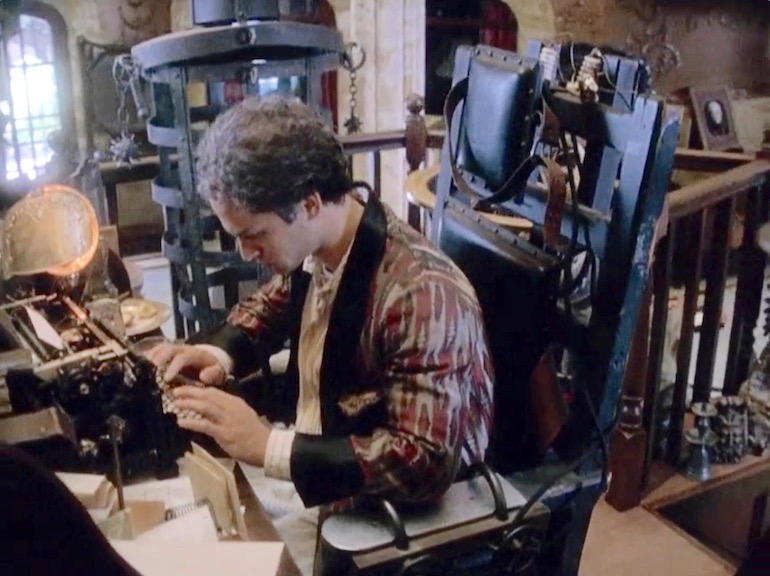
In the 1998 Houdini cable movie starring Johnathon Schaech, there are two scenes showing Houdini sitting in an electric chair in his home. This begs the question; did Houdini own an electric chair? The answer is yes.

Houdini's electric chair, said to be the world's first, was originally displayed at Huber's Dime Museum on 14th Street in New York City where Houdini performed in his early years. According to Kellock's Houdini His Life Story, Houdini and the chair both made their debut at the museum at the same time:

On Houdini's first engagement there, he arrived simultaneously with the first electric chair, acquired by Huber from the Auburn prison, where it had first been used to kill [Kemmler], the murderer, in 1890. When Huber's and its effects were put on the auction block in 1910, Houdini, the indefatigable collector, parked himself at the sale, and the first day he came home in a cab triumphantly bearing the historic chair, which he had acquired for a bid of $6.70. His wife was never able to get this gruesome and unlovely relic out of the house. Whenever she had it quietly removed to the cellar, Houdini missed it and had it brought upstairs again. 

Houdini said of his purchase: "I want this chair for sweet sentiment's sake. It came while I did my first week at Huber's." At the same auction, he purchased an Egyptian mummy for $3.


I don't know what happened to Houdini's "sentimental" electric chair (or mummy). But if it was still in 278 after Houdini's death, it's unlikely it was something Bess kept.

So what did Houdini's electric chair look like? If Huber's did indeed get the chair from Auburn Prison, and it was the first, then it is the chair pictured below. A "spare chair" from the prison today resides at Swaby's Tavern in Auburn and can be seen HERE.


Despite the inherent drama, Houdini never performed an electric chair challenge escape, as far as I know. His only encounter with an electric chair came in his 1918 movie serial The Master Mystery. In fact, the chair we see in that scene does bear a resemblance to the Auburn chair. Could it be Houdini's own?


Thanks to Bill Mullins. The photo of Houdini in the electric chair above is Lot 192 in Potter & Potter's upcoming Houdiniana auction.

UPDATE: We now have the answer to what happened to Houdini's chair and also a photo! Check out: Houdini's electric chair - the shocking truth.

Related:

Thursday, June 5, 2014

Houdini on being "not too tall"

I once heard a recorded interview with a man who saw Houdini give one of his spiritualism lectures. He didn't know what Houdini looked like, and his first reaction on seeing the famous magician was; "Oh, he's a short guy."

Houdini stood 5 feet 5.276 inches (according to a 1926 physical). Until now, I've never heard Houdini make reference to height. But recently I spotted this paragraph in an interview with Houdini published in the Adelaide Daily Herald on April 16, 1910 while Houdini was touring Australia. Characteristically, he viewed his size as an advantage, especially in regards to athletics. Says Houdini:

"It is good for me that I am not a tall man. Why? Because I must be quick! and a tall man is always slow. It is so all through the profession. The best men are not too high. A tall man is easy going, good-natured; a short man is sometimes good-tempered, more often not so. All the mean, cunning men that I have known—short! All the keen, eager, ambitious men—short! And for work—the tall man has too much to carry, he is too far from the ground, he cannot lose and recover balance as it is necessary, in a flash."

In this same candid interview, Houdini gives more vital statistics (adding a couple inches to his height), and also addresses the perception of egotism:

"You will think that I am vain to tell you these things. But I am a Magyar, and Magyars are vain. American born. Magyar descended; my parents came from Austria; my father was a clergyman in Wisconsin. My name, Ehrich Weiss; my height about 5 ft. 7 in; weight about 12 stone; 36 this month of April. Only 36, but I feel old; I have done too much in order to be, in my poor little way, Columbus."

You can read the full interview by A.G. Stephens at Trove, an amazing archive of Australian newspapers created and maintained by the National Library of Australia.

Thanks to "Anonymous" who turned me onto Trove. Photo of T. Nelson Downs and Houdini (on tiptoes) from Houdini A Pictorial Life by Milbourne Christopher.

Tuesday, May 27, 2014

LINK: Smoking in Australia

Houdini prided himself on the fact that he did not drink nor smoke. He mentions this in several interviews. But now our friend Joe Notaro over at Harry Houdini Circumstantial Evidence has uncovered evidence that Houdini might have fired up the occasional cigarette, and maybe even partook in a "nip of opium." This is good stuff as always, so click the headline and have a read at Joe's site.

(And on this topic, don't be shocked if we see a drunk Houdini in the upcoming HISTORY miniseries.)

Saturday, September 21, 2013

Footage of Houdini's Australian flight (now with more goggles)

Here's a Pathe newsreel about Houdini's historic first flight in Australia from the Smithsonian's National Air and Space Museum. There's more footage here than we typically see, especially in showing Houdini adjusting his cap and goggles. The site also has an interesting article on The Hunt for Houdini’s Airplane which appears in the November 2013 issue of Air & Space magazine.


I wonder what ever became of Houdini's aviation hat and goggles? What a collectible those would be!

Thanks to Tom Frueh.

Related:

Monday, February 25, 2013

"Houdini, we started it, you finish it."

Library of Congress

On July 5, 1910, Houdini paid a visit to Ira Davenport at his home in the small community of Mayville, New York.

Ira, along with his brother, William, created the famous Spirit Cabinet act that helped popularize and propagate Spiritualism in the United States and Europe in the late 19th Century. The Davenport Brothers were the first famous stage mediums. The brothers could also be considered among the very first escape artists as their methods for conjuring the spirits employed special rope ties for quick release -- methods Houdini would study and use himself.

During Houdini's visit, Ira is reported to have said, "Houdini, we started it, you finish it."

Ira died the following year and Houdini did indeed set out to "finish" fraudulent spiritualistic practices in the 1920s.

Tuesday, June 5, 2012

Houdini and his Voisin

A postcard image of Houdini in his Voisin bi-plane in Australia has sold on eBay for $348.52. The auction received 17 bids. I've never seen this particular image of Houdini and his plane before. Note that his assistant, James Vickery, is in the shot. Looks like a dog also got in on the action.


You can read about Houdini's historic first Australia flight here.

Translate