Showing posts with label George Hackenschmidt. Show all posts

Tuesday, November 24, 2020

Houdini's own Mirror Challenge

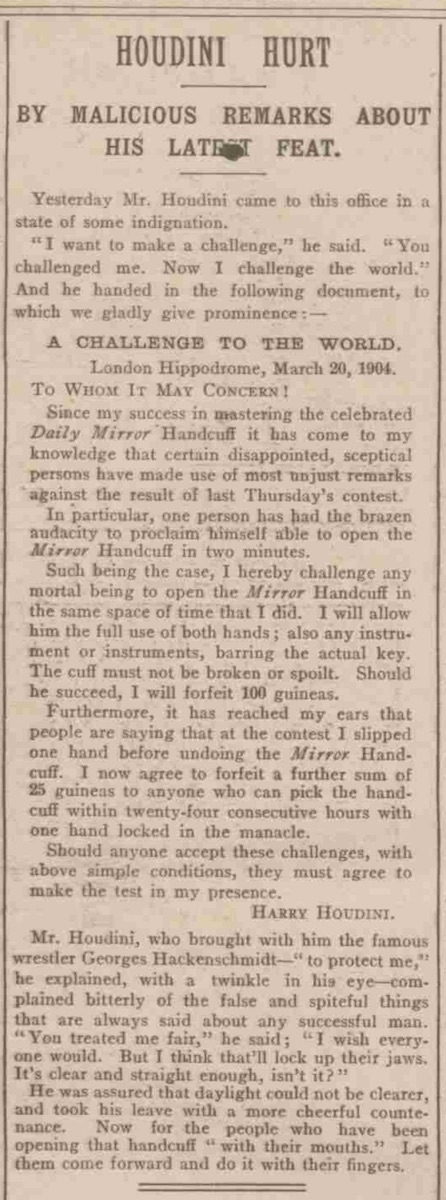
Here's a terrific news item from the March 21, 1904 London Daily Mirror. This is only four days after Houdini's famous escape from the inescapable Mirror Handcuff. I love the detail that he arrived at the newspaper office with wrestler George Hackenschmidt "to protect me." The idea of these two guys palling around London together is just great. I also like the "click bait" headline. Anyway, enjoy.


A few people did take up Houdini's challenge, but as far as I know, no one succeeded in opening the Mirror Handcuff.

Friday, August 14, 2020

Burnley Empire rewrites Houdini history

Here's a video of magician and actor Paul Zenon (you might remember Paul from his acclaimed one-man show Linking Rings) discussing this post from last Sunday about Houdini Defeats Hackenschmidt. One thing I didn't mention in that post is that the Burnley Empire building still stands!


As Paul mentioned, the Burnley Empire Trust is working to preserve this historic theater. To support their efforts and help make a new history for the Burnley Empire, please consider donating to their crowdfunding campaign HERE.


Sunday, August 9, 2020

Confirmed: 'Houdini Defeats Hackenschmidt' did exist!


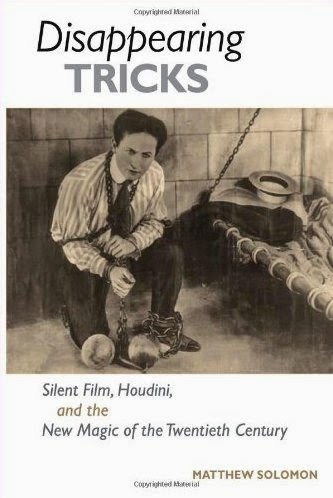
Back in 2010 I went wild for the new book Disappearing Tricks: Silent Film, Houdini, and the New Magic of the Twentieth Century by Matthew Solomon. This excellent book contained several revelations about Houdini's film work, foremost of which was the discovery that something called Houdini Defeats Hackenschmidt was shown during Houdini’s March 1906 engagement at Keith’s Theater in Boston. This is significant as it pre-dates his 1907 Rochester bridge jump footage, which Houdini claimed to be his first appearance on film. Also, the idea of film of Houdini and the famous Russian wrestler George Hackenschmidt, a.k.a. "the Russian Lion", was incredibly intriguing. Unfortunately, Solomon was unable to provide any further details.

For ten years I've searched in vain for more information on Houdini Defeats Hackenschmidt. I've also searched for confirmation of the Boston screening. Solomon's source was a single notation in an unpublished managers report for the week of March 26, 1906, housed in the Keith/Albee Collection at the University of Iowa Library. Houdini's Boston engagements were very well covered in the newspapers, but I've never been able to find a single mention of any film in any notice for that or any other week.

Doubts began to set in. Was it even a film? Could it have just been a lantern slide? Or maybe it was a parody that had nothing to do with the real Houdini or Hackenschmidt? As the years wore on, evidence for Houdini Defeats Hackenschmidt became as nonexistent as evidence of Houdini's "spy work" (ahem). I began to suspect that it never existed, at least not as we imagined. I even cut it from my recent talks on Houdini in cinema.

But all that changed yesterday when I made one of those accidental discoveries that researchers live for!

On March 22, 1905, the Burnley Express reviewed a variety show at the Empire Music Hall in Burnley, England. This was not a show featuring Houdini, who was performing in Paris at this time. The headliner was "Herr Fritz, Illusionist and conjurer," who delighted the audience with tricks that included "the flying lamp" and "catching of gold fish in the audience."

At the very end of the review is this bombshell:

 
The performance is closed by the Empire Biograph, by which are reproduced "An office boy's revenge" and Houdini extricating himself from manacles placed on him by Hackenschmidt, who appears to enjoy the fun immensely.

There can be no doubt that this is the same film that played in Boston, here playing a year earlier in England. This confirms that it existed, that it was indeed a film, and, most excitingly, it featured Houdini doing an escape at the hands of challenger George Hackenschmidt. Wow!

This also tells us the footage is older than first thought. But how much older? The companion film on the bill, "An Office Boy's Revenge", is from 1903 (it actually has an IMDb page), so the "Empire Biograph" was not exhibiting new films. It's unclear when Houdini first came to know Hackenschmidt, but there are reports of them together in London in 1904. This means Houdini could be in his 20s in this footage. Again, wow!

So it's time to once again get excited about Houdini Defeats Hackenschmidt. This is currently the earliest known film footage of Houdini (and likely of George Hackenschmidt). Maybe within the next ten years we can uncover a photo or the film itself. That would be the biggest "wow" of all!

UPDATE: Looks like this post has made news in Burnley!

Sunday, January 31, 2010

'Houdini Defeats Hackenschmidt' and other cinema revelations

In his new book, Disappearing Tricks: Silent Film, Houdini, and the New Magic of the Twentieth Century, Matthew Solomon shines a spotlight on Houdini’s film work as never before. In doing so, Solomon has made several discoveries that rewrite Houdini film history.

First and foremost is the discovery that Houdini’s first stab at narrative film was not the 1909 short The Adventures of Houdini in Paris (more on this later), but a lost film from 1906 entitled Houdini Defeats Hackenschmidt.

The title refers to George Hackenschmidt aka “the Russian Lion,” a popular wrestler whom Houdini befriended in the UK. The Houdinis and Hackenschmidt became great friends, and Houdini even proposed bringing the wrester to the U.S. under his management.

Houdini Defeats Hackenschmidt was shown during Houdini’s engagement at Keith’s Theater in Boston in March 1906. While nothing is known about the content of the film, Soloman suggests in his footnotes that Houdini’s “defeat” of the famous fighter could have been financial instead of physical. Houdini took pride in the fact that his box office receipts of £300 eclipsed the £210 record set by Hackenschmidt in Sheffield. If this were the case, it could explain Keith’s management's private assessment of this latest Houdini attraction as merely “fair.”

Next up is major clarification regarding what had been considered Houdini’s first narrative film, Les merveilleux exploits de Houdini à Paris aka The Adventures of Houdini in Paris. This film has long been attributed as being produced by Pathe -- an attribution that can be traced back to Houdini himself who noted this on a still production photo (below). But it turns out this is not the case.

The Adventures of Houdini in Paris was actually made by Film Lux, a rival to Pathe. While it could be argued that maybe Houdini made an earlier film for Pathe in 1901 (as noted on the photograph), Solomon’s search of the Pathe archives turns up no work with Houdini, and he even nails down the precise release date for Merveilleux Exploits; May 17, 1909.


But why would Houdini attribute this film to Pathe when it was actually made by a rival company? My own speculation is either Houdini made a mistake when he annotated this photo years later (as he did with the date), or Houdini was engaging in his famous habit of rewriting his own history. Pathe clearly emerged as the more successful French production company, even setting up shop in Edendale, California, the first film colony in Los Angeles. It’s likely that Houdini preferred history to record him as working for the more famous company. If this were the case, the ploy worked...until now. Sorry Harry.

(A significant portion of Les merveilleux exploits is included on the 3-disc DVD set Houdini The Movie Star, although it is not identified by name.)

Finally, Soloman clears up what has been an intriguing mystery for many years; did Houdini star in a lost film called The Soul of Bronze?

The U.S. film copyright record lists this film title among Houdinis other work, as do several other sources, including some encyclopedias. Of course, it’s highly unlikely that an entire film, and all the publicity that would have accompanied it, could completely vanish. So what’s the story with The Soul of Bronze?

Turns out that in 1921 Houdini purchased two cases of films from the U.S. customs office in an auction of unclaimed goods. Ken Silverman first discussed this purchase in his excellent biography, Houdini!!! The Career of Ehrich Weiss, noting that Houdini would re-edit and attempt to distribute one of those films, The Mystery of the Jewell, through his Mystery Pictures Corporation.

But Soloman reveals that there was another film in this acquisition -- a 1917 french film entitled L’ame du bronze. Yep, The Soul of Bronze. Houdini copyrighted both these films as his own, hence, the unreleased The Soul of Bronze appears as a “Houdini film” in the official record. Mystery solved.

Disappearing Tricks: Silent Film, Houdini, and the New Magic of the Twentieth Century by Matthew Solomon is available now in paperback from Amazon.com. A hardcover will be released on February 15.
Translate