Showing posts with label 1911. Show all posts

Thursday, August 1, 2024

LINK: Houdini and Raymond: Revealing Letters

Myron the Magnificent has shared on his blog three interesting letters between Houdini and Maurice Raymond that shed light on their contentious relationship. The letters are part of the collections of The New York Public Library for the Performing Arts, Billy Rose Theater Collection. Check them out by clicking the headline above or visit Myron's Blog.

Sunday, March 31, 2024

LINK: Houdini and the Sea Monster

David Britland at Cardopolis has written an excellent account of Houdini's famous escape from a "sea monster" in Boston. It's very thorough and also provides fresh information about the turtle itself. I'm sorry I missed this back in 2021 when it first appeared, but I'm happy to have found it now. Click on the headline to have a read at Cardopolis.

Thursday, October 12, 2023

Foster Lardner photo albums find a new home

Today I have some exciting news about a fantastic find! Our good friend David Haversat has just acquired several photo albums from the family of the late Foster Lardner.

Foster Lardner was an actor, magician, and head of the Keith's organization in and around Providence, Rhode Island, during the height of vaudeville. He was also a photography enthusiast. Lardner's albums chronicle the history of Providence's theaters and include an incredible collection of photos of performers who played the city, including about two dozen unpublished photos of Houdini!

Lardner's great-granddaughter, Claire, was kind enough to show me the albums and the Houdini photos last week. Lardner captured Houdini's handcuffed jump from the steamer Warwick in 1911 and his suspended straitjacket escape before 80,000 people in downtown Providence in 1924. He also appears to have been friendly with Houdini as there are candid shots of them visiting the Providence Arts Club (still there) and photos of Houdini with Edward Albee. A treasure trove to be sure!

Lardner himself can be seen in film of Houdini's suspended straitjacket in Providence (which, thanks to the album, I can now date as Sept. 18, 1924). He is standing on the platform beside Houdini with his camera in hand. In fact, at 17 seconds, you can see him snap a photo facing directly into the camera.


Here is the photo Lardner took at that moment preserved in the album today. How cool is this? This is just one of several photos Lardner took that day from his unique vantage point on the platform. 


David plans to leave the albums intact to preserve Lardner's work and all the history they contain. Congratulations to all!


Thanks to Claire and David for letting me share in this adventure. You can see more album images as a member of my Patreon.

Friday, July 28, 2023

Challenge packing case postcard sells big on ebay

It has been a while since I've seen something of note sell on ebay, but today was one of those days. The below unused postcard shows Houdini in front of a challenge packing case in Rochester, New York. While not unknown, it's a great image that sold for a whopping $2,350.00.


The auction didn't identify exactly when and where this was taken, but I can! This appears to be Houdini's challenge from the Rochester Box & Lumber Co. on November 10, 1911 at the Temple Theater in Rochester. This week also saw him escape from his Milk Can filled with beer by the Moerlbach Brewing Co. Below is an ad for that engagement and the theater as it appeared in Houdini's day.


Congrats to the winner!

Tuesday, July 18, 2023

The aeroplanist in Nottingham

The Football Post in Nottingham, England, announces Houdini's upcoming appearance at the Empire Theater for the week of January 9, 1911. Nothing groundbreaking here. I just really like the photo and the use of the word "aeroplanist."

The Football Post, Jan. 7, 1911.

Houdini first appeared in Nottingham in 1909 at Barrasford’s Royal Hippodrome. Now he was at the Empire. During his run he was challenge by joiners from Henry Vickers & Son to escape packing case. Houdini returned to the Nottingham Empire in 1913, 1914, and 1920. During his 1914 engagement he presented his Grand Magical Revue, making the Empire one of only a handful of stages to have featured Houdini short-lived magic show.


The Nottingham Empire stood on S. Sherwood Street and saw many famous entertainers during its long life. It closed in June 1958 and stood empty until it was demolished in 1969. Today a modern extension of the Theatre Royal occupies the site.

Here's the outside of the Empire in its final year. Home of the aeroplanist!

Saturday, September 17, 2022

Houdini in the bank


I'm working hard on the next installment about my visit to the Harry Ransom Center and planning to share it next week. In the meantime, here's a taste of things to come. I included this as part of my special part 2 preview for patrons, but it drew enough interest that I decided to break it out into its own post.

Among the papers in the Ransom Center are documents related to Houdini's finances. Here is Houdini's––or rather, Ehrich Weiss'––balance sheet for 1911. This shows his total income for that year was $117,851.27. According to the CPI Inflation Calculator, this is equivalent to $3,675,421.35 in 2022. And this is before there was such a thing as income tax. Not too shabby, Ehrich!

Click to enlarge.

I'm curious what kind of "House Maintenance" cost $7,912.13 ($246,667.73 today). I know at some point Houdini added a new heating system to 278. Maybe this is that?

If you're curious about the names at the bottom of the expense column: W.G. Weiss is Houdini's brother, Bill; Mrs. Cecelia Weiss is his mother; Miss Carrie Weiss is his sister; and Mrs. Rahner is Bess's mother.

Wednesday, August 31, 2022

Houdini spills the inspiration for his "Chinese" Water Torture Cell

Where did Houdini get his ideas? Where, for instance, did he get the idea to be locked in a giant Milk Can? Could he have seen a milk truck rolling down on the street one day and was suddenly struck by the idea--a moment of inspiration now forever lost in time?

Unfortunately, we really don't know when and where Houdini got the ideas for many of his most famous feats. That's why what I have today is so exciting.

Houdini debuted his famous Water Torture Cell in Germany in September 1912. At the start of 1913, he brought the effect to England. On January 6 he opened at the Cardiff Empire and gave an interview to the Western Mail. In it he reveals exactly when, where, and how he landed on the idea for his new escape. This has never appeared in any book as far as I know.

I'll let Houdini tell you it himself:

Acknowledged to be one of the world's greatest mystery men, Houdini, the self-liberator and the original "Handcuff King," who is performing at the Cardiff Empire this week, made the interesting fact known to a Western Mail reporter on Thursday that he will always retain happy memories of Cardiff.
"I like Cardiff, and I like Cardiff audiences, and I think they like me," said Houdini; "but what will ever keep Cardiff dear to me is the fact that your city is really the birthplace of my latest and greatest trick––the Chinese water torture cell.
At the time the inspiration came to me through reading an article in your excellent paper illustrating types of Chinese torture which I purchased in Cardiff. I had rented premises for the purpose of perfecting an entirely different trick. When the idea came I at once stopped working the trick which I was engaged on and set about the 'torture cell,' with the result you may see any evening this week. It is a great trick––my greatest. But, though I had perfected the idea, it was nearly a year before I nerved myself to perform it."


The "entirely different trick" Houdini was working on was, I believe, his frozen in ice escape. As I covered here, this would have involved a glass tank described a being "brass fitted and jointed." News of Houdini working on the effect was reported in January 1911. Houdini played Cardiff in March of 1911. Interestingly, Frank Koval says Houdini visited someone named Charles O. Williams about the construction of the cell this same week. So the timeline of Houdini's story does check out.

One thing that really surprises me here is Houdini calling it the "Chinese" Water Torture Cell. Before I read this, I would have told you Houdini only used "Chinese" in the United States. In Europe, it was always billed as just The Water Torture Cell. Check out the playbill for this very week in Cardiff as an example.

I also always though the use of the word "Chinese" was a commercial flourish, like calling the Needles the "Hindoo Needle Trick" or saying the "Chinese Linking Rings." Evoking the mystery of far off lands has long been fashionable in magic. But here's Houdini saying the inspiration for the escape actually came from images of Chinese torture. This is news to me!

Try as I might, I could not locate the original article in the Western Mail that inspired Houdini in 1911. What kind of torture instruments could it have depicted? Sometime involving foot stocks? Water? Inversion? I would love to know.

I guess it's also possible that Houdini is making all this up just for the reporter. We know he sometimes did that. But I sense we have something real here and a unique glimpse into Houdini's creative process.

Want more? You can read and download the original Western Mail article along with other research material gathered for this post as a Scholar on my Patreon.

Thursday, July 14, 2022

Before Beyond

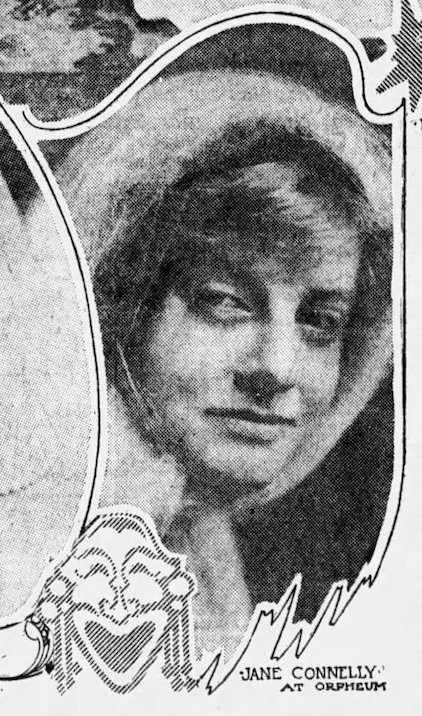
Recently I stumbled on an advertisement showing Houdini on the same vaudeville bill as his future co-star in The Man From Beyond, Jane Connelly. Jane had never appeared in a movie before, and I've often speculated that Houdini may have known her and her husband, Erwin, who also appears in the movie as Dr. Gregory Sinclair, from vaudeville. This clipping seemed to confirm that.

This led me to do a little investigation into Jane's career before she went Beyond. Here's what I found.

Jane and Erwin Connelly appear to have started their vaudeville careers around 1907. Their act was a presentation of the popular english sketch, "Sweethearts," written by W.S. Gilbert. Here's a review from the January 26, 1907 Birmingham News:

"Sweethearts," as presented by Mr. and Mrs. Connelly, seems really more than a vaudeville turn, for the audience feels, as the curtain slowly descends upon the reunion of sweethearts of long ago, true to each other for forty years, as though a drama of several acts was just closing. It is called a "dramatic contrast," for it shows not only the bashful lover filled with the vigor of youth pleading his cause with a maiden, for after forty years waiting they are united, showing a pretty picture, old as love itself. The sketch was written by W.S. Gilbert famous for his composition of "H.M.S. Pinafore."
The Fort Wayne Journal Gazette, Dec. 15, 1912.

Unlike Houdini, most vaudevillians did not change their act. That was certainly the case with the Connellys who toured with "Sweethearts" for over 10 years. The first time I find them sharing the bill with Houdini is at Shea's Theater in Buffalo in October 1911. They appeared together again at the Maryland in Baltimore in 1912 and at Keith's Theater in Rhode Island in 1915.

The Connellys on the bill with Houdini....

But it wasn't just Houdini who shared the bill with the Connellys. Check out this appearance by Hardeen at the Columbia Theater in Davenport in April 1916.

...and Hardeen...

You'll notice the act is now billed as Jane Connelly & Co. Ewrin was still part of the act, but Jane was now featured more prominently in advertising. (I can't help but be reminded here of Bess Houdini's belief that billing an act as husband and wife was a bad idea.) The photo at the top of this post is from San Fransisco in 1915 and is a good example of this. Interestingly, that engagement saw the Connellys on the same bill as the Marx Brothers.

...and the Marx Brothers!

Despite a story in The Man From Beyond press book that says Houdini cast Connelly because she perfectly matched a composite photo of famous "psychic types" (you can read about that here), I think it's pretty clear Houdini knew the Connellys from vaudeville and felt comfortable casting the experienced actors in these important supporting roles. It's even possible the Connellys would have been familiar to audiences of the time and that offered some additional appeal. This was their first appearance in a film, and the movie does provide them with a nice scene together.

Erwin and Jane in The Man From Beyond.

The Connellys continued to perform in vaudeville into the 1920s, broadening their repertoire with new comedic sketches written by Erwin such as "A Tale of a Shirt" and "A Strong Cup of Tea". The only other film Jane would appear in was Buster Keaton's classic Sherlock Jr. (1924), again with Erwin.

In 1925 Jane died at her home in Los Angeles. She was only 42. The below is from Variety. I'm not sure what to make of the cause of death being "a nervous breakdown."


After Jane's death, Erwin continued to appear in films, including an uncredited appearance as The Zouave in Rudolph Valentino's final film, The Son of the Sheik (1926). He died from injuries suffered in a car accident in 1931.

Chicago Tribune, Feb. 12, 1931.

Clippings: Newspapers.com

Friday, March 18, 2022

A lost purse in Huddersfield

Here's something I just stumbled upon that is too fun to not share right away. This  appeared in the Huddersfield Daily Examiner during Houdini's engagement in that city the week of April 3, 1911.


So what do we think? Is this legit, or a clever and inexpensive piece of Houdini advertising? If legit, was the purse ever found? Were the seats ever occupied???

Just another Houdini mystery. Happy Friday!

Thursday, January 27, 2022

Houdini's Frozen in Ice escape of 1911


Our friend Joe Fox, Assistant Librarian at the Magic Castle, recently made an intriguing discovery in the January 25, 1911 issue of The Magical World, a British weekly publication. In a column by editor Max Sterling is following item:

Harry Houdini, of handcuff and other fame, who has been appearing at the Nottingham Empire with huge success, has been confiding with a correspondent of the "Encore" that he "has another big surprise to spring up on the public." He avers that his tank act will be a "pup" to his new show, and I believe him. Clad in a diving suit––the helmet will contain an air enough to last him 10 minutes––he proposes with the aid of a glass box, to allow himself to be frozen solid. The freezing plant will be on the stage in full view of the audience. The squares of glass, brass fitted and jointed, constitute the box, and when the wily one is thoroughly frozen, the entire outfit is placed in his cabinet, and he does the rest by releasing himself, yet leaving the ice intact. How it is going to be done Houdini himself only knows, but he has tried it and accomplished the seeming impossible, I presume there will be no "frost" as far as he is concerned. The above show he proposes springing upon London in five or six weeks' time.

I always believed Frozen in Ice was a concept Houdini was working on near the end of his career. But here it is in 1911! While Houdini never did "spring" this upon London (as far as I know), this is still an exciting find as it offers the first and most detailed description of any frozen in ice escape that I'm aware of.

The use of a diving suit is entirely new. I also can't help but wonder if the glass box, "brass fitted and jointed", is the Water Torture Cell. The debut of the USD was still a year away (the "tank act" referred to here is the Milk Can), but the cell was likely in construction at this time. Could Houdini have been considering a very different use for the cell? Or could this all be a ruse to conceal the actual escape Houdini had in mind?

Houdini's Escapes by Walter Gibson contains a chapter on a "Frozen in a Block if Ice" escape. But that is a very different concept and Gibson offers no history behind it. The version that finally did make it to the stage was performed by Bess in 1927 but, again, a very different concept.

Gibson illustration (left) and Bess version (right).

Thank you Joe!

UPDATE: Joe Notaro of Harry Houdini Circumstantial Evidence has found another description in the January 15, 1911 "The Umpire" that provides a few more performance details:

The performer, having dressed for the part, will take his place in the water in a glass tank, the sides of which fit into brass sides, and the freezing process will be effected in sight of the audience by means of a special plant installed on the stage. When the refrigerator has got in its fine work, the glass slides will be removed, and the block of ice, with Houdini inside, will be placed under the canopy. A few seconds later the performer will reveal himself in kind friends in front, and the iceberg will be shown intact.

Fred Pittella of Houdini and Escapes Museum sends over a detailed look at how Bess's 1927 freezing effect operated. This sounds very similar to the "plant" as described in the 1911 clippings. I'm wondering if it was the same apparatuses?

Science and Invention, September, 1928.

Saturday, October 16, 2021

LINK: Remember when Harry Houdini escaped the belly of a ‘sea monster’ in Boston?

Here's an excellent article by Steve Annearin about Houdini's famous escape from the carcass of a "sea monster" in 1911. Some new information here. Click here or on the headline to have a read at the Boston Globe.


Thursday, July 29, 2021

The girl who beat Houdini

Houdini was a superstar in American vaudeville and even once held the distinction of being its highest paid performer. But vaudeville had other superstars who drew crowds and salaries that sometimes matched Houdini. One of these performers was Eva Tanguay.

Today Eva Tanguay is largely forgotten. But if you were around in Houdini's time, you would have certainly known who she was. By many accounts, Tanguay could neither sing nor dance. But that didn't dampen her enormous appeal. A profile of her at the New England Historical Society (Eva Tanguay, The Lady Gaga of Vaudeville) says:

Her celebrity was no accident, but a well-planned assault on stuffy Victorian convention. She provoked reaction, singing songs with titles like Go As Far As You Like and wearing bizarre costumes like a dress made out of pennies. The tabloids ate up stories about her love life, which included a romance with the African-American vaudeville star George Walker. You couldn’t escape her from 1904 to the early 1920s.

Like Houdini, Tanguay was a headliner on the big time Keith vaudeville circuit, thus they played many of the same theaters. This invited direct comparison. Such was the case in Boston in January 1911 as you can read below:

Boston Sunday Post, Jan. 15, 1911.

Not only was Eva beating Houdini's attendance records, but she was also surpassing his salary, making as much as $3500 per week. By 1912 Houdini had to put a spin on his claims of being Vaudeville's highest paid performer. Check out the below ad from Harrisburg, Pennsylvania, in which he now calls himself "the highest salaried male performer in the world."

Courier Sun, Feb. 25, 1912. 

After losing her fortune in the Wall Street crash of 1929, Eva Tanguay retired in 1930 and slipped into obscurity. She died on January 11, 1947 at age 68. In another Houdini parallel, in 1953 a highly fictionalized biopic was made of Eva's life, The I Don't Care Girl, starring Mitzi Gaynor. This was the same year as the Houdini biopic with Tony Curtis.


If you'd like to learn more about Eva Tanguay check out the book Queen of Vaudeville: The Story of Eva Tanguay by Andrew L. Erdman. Below is the only known recording of Eva made in 1922.


UPDATE: Today I went to the 94th Rudolph Valentino Memorial Service at Hollywood Forever cemetery (Rudy being the other big celebrity death of 1926), and I paid a visit to Ms. Tanguay.


Related:

Tuesday, April 27, 2021

Sailor rope tie challenge revealed at last

One of Houdini's go-to challenges was to be tied with heavy rope by Navy sailors or seamen of some sort. The precise manner in which Houdini would be bound was always spelled out step by step in the challenge handbills, and it always involved him lying on a plank with a broomstick under his legs. No photos exist, and try as I might, I've never been able to envision exactly how Houdini was tied.

That's why I was very excited to discover this illustration from the Boston Post following one these challenges from "T" Wharf fishermen on September 22, 1911. Now that's a rope tie!


Not only did the paper do a great job of illustrating the rope tie, but their description of the challenge itself is pretty terrific. Below are a few excerpts:

Harry Houdini made the escape of his life last night on the stage of Keith's Theatre, when he extricated himself from hundreds of knots and fathoms of rope, tied by four veteran T wharf fishing captains.

On the stage was a large committee of seafaring men. They were men who could appreciate skillful knotting of cordage, for many a time their safety has depended on the trustworthiness of knots in ropes and lines.

There was a sort of grimness to the preparations that did not escape the audience, for the honor of T wharf and Atlantic avenue was at stake. 
Captain Richard McDonald of 336 Summerfield St., East Boston, who has had 40 years' experience, calmly removed his coat and prepared for business after Mr. Houdini had made a short speech.

The article details the process of tying Houdini, then...

For the first few minutes it seemed impossible that he could get slack enough to escape. He struggled, but the cordage would not give. It seemed that the captains had made good. High up in the gallery a roughly clad man gave a cheer.

Houdini worked away, wiggling, pulling and twisting, until he kicked off one shoe. The other then followed, and soon he had slack enough in the ropes binding his legs to permit him to pull out with his teeth one of the knots that held his right hand.

In the audience were hundreds of women, some of whom seemed to grow faint at the sight of the struggling man, but when freedom was assured they cheered him on. 
When Houdini had freed his hands the rest was simple and he stood erect, bowing to the valley of cheers. 
"It was the hardest experience of my life," said Mr. Houdini, as he exhibited cuts and scars made by the ropes and cords. 

Among the first to congratulate Mr. Houdini were the captains.

Below are links to more Houdini rope tie escapes. For those who have subscribed to my WILD ABOUT HARRY WEEKLY newsletter, you can expect and a nice rope-tie related EXTRA this Sunday.

Related:

Tuesday, February 9, 2021

Did Houdini really almost drown in beer?


On February 9, 1911, Houdini was challenged by the Joshua Tetley & Son Brewing Company in Leeds to escape from his Milk Can filled with beer. This was the first of his popular "beer challenges." But the reason the Tetley challenge is so famous is not because it was first; it's because Houdini is reported to have failed. In Houdini His Life Story by Harold Kellock, it's said Houdini, a teetotaler, became "stupefied" by the beer fumes and passed out before he could free himself. Only the quick action of an assistant "who entered the cabinet and hauled him out" saved his life.

Tetley's is still around today and they've not forgotten this night. They even feature the following on their official website:


But there's a problem with all this. If Houdini really had such a dramatic on-stage failure during such a well-publicized challenge escape, one would think it would have been big news at the time. But I have yet to find any newspaper account of any accident or failure that night. Furthermore, in his book The Great Houdini: His British Tours, author Derek Tait reproduces an eyewitness account from audience member who says the escape went as planned.

So what really happened at the Leeds Empire exactly 110 years ago? They can't both be right. Or can they? 

I think the truth is actually hidden in the eyewitness account itself, which is also filled with nice details about how the challenge was staged. I'm reproducing it below with Derek's permission. This comes from the Yorkshire Evening Post, December 22, 1928:

"When the curtain went up, the barrel of ale was on a gantry and four brewers' men were on the stage. To a lively tune by the orchestra, they tapped the barrel and filled a jug. They poured out a glass and handed it to Mrs. Houdini and she put it to her lips but did not drink any. Then Houdini pretended to take a drink. Then the brewers' men had a glass each. After that, they filled up a tin (which was something like the milk churns you see on the railway) with beer.

Houdini, who in bathing costume, kissed his wife, and went head first into the tin. Immediately, half-a-dozen men, who were are on the stage as a committee, fastened the lid on with padlocks all around the lid, the padlocks being locked to staples that were on a collar on which the lid fitted. The can was then lifted into a cabinet and the curtains closed. In a very short period, one of the attendants went into the cabinet and almost immediately opened the curtains and Houdini walked out. The tin was then brought out and the padlocks were still fastened.

Although I met Houdini many times, I never heard of him being stupefied by the beer as his biographer says. And, by the way, a few nights after the beer episode, he did the trick in the can filled with milk."

While the eyewitness said nothing went wrong, it seems clear to me that something did. Notice he says "one of the attendants went into the cabinet" shortly before Houdini appeared. This may have appeared normal, but it was not. The only reason I can think of an assistant going into the cabinet is if something was wrong. This also comports with the Kellock account. But the speed in which Houdini appeared suggests he wasn't fully unconscious and was able to cover. So the accident appears to have happened. It's just no one in the audience knew it!

There are a few other things that stand out here. It's interesting to see Bess present, suggesting that while she retired from performing in 1908 she still appeared on stage during select escapes. I also love the whole staging of the challenge with the tapped cask and everyone taking a drink. It's also striking that the eyewitness says Houdini went into the Milk Can "head first." This was not typical. Could this have been the real reason Houdini had difficulty escaping and not the fumes?

Houdini went on to do the beer challenge (successfully) many times. Below is a list of brewers who challenged Houdini to either escape from his Milk Can or a beer-filled cask. Is your brand among them? Cheers!

Joshua Tetley & Son Brewing Company, Leeds, UK (1911)
Independent Brewing Co., Pittsburgh, PA (1911)
Hoster-Columbus Associated Breweries Co., Columbus, OH (1911)
Moerlbach Brewing Co., Rochester, NY (1911)
Jacob Ruppert, Brewers, Knickerbocker Beer, New York, NY (1912)
Hauck's beer, Atlanta, GA (1912)
Louis Bergdoll Brewing Co., Philadelphia, PA (1912)
Fink's Brewery, Harrisburg, PA (1912) 
Schlitz Brewing Company, Milwaukee, WI (1912) 
Hacker Brewery, Munich, Germany (1913) 
Burkhardt Brewing Company (Tivoli beer), Boston (1914) 
The Louis Bergdoll Brewing Company, Philadelphia, PA (1914)
Haberle Brewing Co., Syracuse, NY (1915) 
Dow's Brewery, Montreal, Canada (1915)
Standard Brewing Co. (Tru-Age Beer), Scranton, PA (1915) 
Hanley Brewery (Hanley's Peerless Ale), Providence, RI (1915)
Indianapolis Brewing Co., Indianapolis, IND (1915) 
Frank Fehr Brewing Co., Louisville, KY (1915)
The Cleveland & Sandusky Brewing Co., Cleveland, OH (1915)
Interboro Brewing Co., New York, NY(1916)
Abner and Drury's - Washington D.C. (1916) 
G-B-S Brewing Co. (Arrow Beer), Baltimore, MD (1916)
Phoenix Brewery, Buffalo, NY (1916) 
Olt Brewing Co., Dayton, OH (1916)


Thanks to Allan J. Taylor of the UKEA (United Kingdom Escape Artists) for his help with this post.

Related:

Saturday, December 5, 2020

Houdini's Night With the Spirits?

Here's a discovery that initially had me very excited. We know Houdini did spiritualist exposure shows very early and very late in his career. But here's one from mid career, 1911!

Chester Times, December 8, 1911

Unfortunately, my Houdini chronology tells us this can't be the real Houdini. Houdini was performing at the Keith's Theater in Columbus, Ohio, all this week. On this very night, December 8, he accepted a challenge from the Lazarus Company to escaped from a packing crate. (The original challenge playbill is in the Fred Pittella collection.) 

It's 466 miles between these two cities and even today it's a 12 hour train ride. So it appears this is someone using Houdini's name, or someone using a Houdini-like name that the newspaper misconstrued. But it's still a strange coincidence that it foretells Houdini's future performances and spirit lectures. And it sounds like a good show!

And if this is Houdini performing in two places at the same time...well, we would have all the proof of the supernatural we need!

Sunday, May 31, 2020

Arthur Moses reprints the first Houdini & Holmes adventure

Here's something exciting. Arthur Moses has released a new book that examines the 1908 story "Auf den Spuren Houdinis" (On The Trail Of Houdini). This marked the first fictional pairing of Houdini and Sherlock Holmes. The book includes the original German text as well as a never before published English translation. Below are details.

After a performance in Berlin, Germany, Houdini is kidnapped by his lesser rivals. Sherlock Holmes is urgently summoned to Berlin to investigate. Through his masterful deductive reasoning he tracks down the dangerous perpetrators in the nick of time. 
A recreation in its entirety of the German language pulp magazine series Aus den Geheimakten des Welt-Detektivs, featuring the 1908 issue number 101 "Auf den Spuren Houdini's" (On The Trail Of Houdini). Uniting Harry Houdini and Sherlock Holmes, formidable protagonists together, one being a fictional character and the other a living legend of history, is a masterful stroke synchronizing their uniquely charismatic identities. This text focuses on a single 1908 German language publication which brought them together, along with its never before published English translation in addition to later translated foreign language editions based upon the German work. Their two personas are as popular today as ever, with many modern pastiches, comic books and films successfully pairing Houdini and Holmes. 
Other reprints of this title in other foreign languages are represented by reproducing their covers; France, Belgium, Denmark, Mexico, Netherlands, Portugal, Romania, and Spain. Sherlock Holmes was the creation of Sir Arthur Conan Doyle.

But it gets even better! Arthur has also released two other separate volumes containing the rare Portuguese versions of this story from 1911 and circa 1920.


Says Arthur, "All 3 will have a great interest for both Houdini and Sherlock Holmes collectors." He has launched a website devoted to the books. All can be purchased from Amazon:

Harry Houdini & Sherlock Holmes Together Again In 1908: Auf Den Spuren Houdinis (On The Trail Of Houdini) 

Harry Houdini & Sherlock Holmes "Extraordinary Adventures of a Secret Police - The Missing Athlete" (Portuguese Edition 1911) 

Harry Houdini & Sherlock Holmes "Extraordinary Adventures of Sherlock Holmes - The Missing Athlete (Portuguese Edition 1920) 
The books can also be found on Amazon.de, Amazon.fr, Amazon.es, Amazon.it, Amazon.jp, and Amazon.ca.

Related:

    Monday, May 13, 2019

    Houdini secrecy oath sells on eBay

    A handwritten Houdini oath of secrecy signed by locksmith Gilbert Dawes and witnessed by Franz Kukol sold on eBay over the weekend for $988. The oath is dated February 10, 1911 when Houdini was performing at the Empire Theater in Leeds. Below is a photo and the auction description.

    Click to enlarge.

    This rare and famous letter was a oath of secrecy from Harry Houdini's Locksmith; in the letter Mr. Gilbert Dawes agrees to not to disclose the secrets of Houdini. The second individual in the letter is Houdini's apprentice. We contacted the current living relatives of Gilbert to learn that the famous living magician Edwin Dawes is a relative of the late Gilbert Dawes and found records of his existence. Dated 1911. 
    Henry Muller (1930 –2017), was the founder, owner and curator of the Houdini Magical Hall of Fame in Niagara Falls, Canada. Mr. Muller purchased this letter in 1967 along with other Houdini original locks, keys, illusions and paraphernalia from Joseph Dunninger. Dunninger had acquired them from Houdini’s wife Beatrice and his brother Hardeen, to whom Houdini had bequeathed the collection. The Houdini Magical Hall of Fame existed from 1967 to 1991. In 1991, a fire consumed much of the museum. This item was on display in a part of the museum that was not consumed by the flames. The keys are now is custody of the late Mr. Muller’s son David. David is offering a COA and will field any questions about the keys' chain of custody for authentication purposes. I also encourage you to do your research on the Houdini Magical Hall of Fame to validate my information. These are museum pieces of history and would be a exciting item to own! (see attached photos)

    Does anyone recall seeing this letter on display at the Houdini Magical Hall of Fame (because I don't)? It will be interesting to see if more Henry Muller rarities surface on eBay. Muller died in 2017

    Thanks to Kevin Connolly for the alert.

    Related:

    Tuesday, April 2, 2019

    Poster for Houdini's Water Torture Cell play to be auctioned

    Potter & Potter's upcoming auction of "The Magic Collection of Ray Goulet" will include a likely one-of-a-kind Houdini rarity. It's a broadside for his 1911 playlet, "Challenged" or "Houdini Upside Down". This was the short play Houdini performed only one time for the purpose of licensing his yet-to-be-revealed Water Torture Cell. The poster, which I've never seen before, reveals some fresh details about the play, including that Houdini's assistants and brother Leopold were part of the cast. And it's signed! Below is an image and the full auction description.

    A SIGNED HOUDINI RARITY

    Houdini, Harry (Ehrich Weisz). Hippodrome Southampton. Houdini “Challenged”. Southampton: What’s On in Southampton, [1911]. Letterpress poster advertises a matinee performance of “Challenged” or “Houdini Upside Down” at the Southampton Hippodrome. Inscribed and signed by Houdini in the central right blank space: “To my friend John Mulholland/Houdini.” 30 x 20”. Browning, restored losses at folds affecting parts of the text, a few chips and creases. Laid down to Japan. The only known example of this broadside. 
    Houdini devised and wrote the script for “Challenged” with the goal of protection in mind – that is protecting his Water Torture Cell from infringement by copycat escape artists. Under British law, theatrical productions appropriately staged, scripted, registered, and performed before a live audience could be protected from infringement by imitators. Consequently, after assembling his cast (enumerated in details on this poster and including his three trusted assistants, James Vickery, Jim Collins, and Franz Kukol), the props, and booking the theatre in which to perform, Houdini staged the “playlet,” just once, on April 29th, 1911 in Southampton. 
    According to Houdini scholar Patrick Culliton, the show may have been staged for an audience of just one, as the one guinea price of admission was an outrageous sum at the time. Interestingly, the Water Torture Cell is here described as an “aquarium,” and part of the poster suggests that Houdini will also be locked in a rubber bag which will then be tossed in the tank, from which he will escape. In his regular vaudeville and music hall turns, the bag was not part of the act. 
    The broadside is inscribed and signed by Houdini to the scholarly magician and editor of The Sphinx magazine, John Mulholland, a fellow New Yorker, dedicated magic collector, and a sometime visitor to Houdini’s home as a young man, where he undoubtedly learned to appreciate the value of rare and precious magical artifacts.

    The auction estimate is $15,000 - $25,000. But for something this unique and important to Houdini history, the sky could be the limit.

    "The Magic Collection of Ray Goulet" will take place on April 27, 2019. For more details visit Potter & Potter Auctions.

    UPDATEHoudini "Challenged" poster sells for $18,000.

    Related:

    Monday, February 18, 2019

    Houdini gives the all clear to his imitators???

    We all know Houdini was ferociously protective of his original inventions, going to great lengths to copyright and protect them. We also know he hated imitators and would not hesitate to go after them for infringing on his act. So how on earth do we explain this!?

    Click to enlarge.

    This is a half page ad Houdini took out in Variety on October 7, 1911. As you can see, he's giving the all clear to his competition to perform his latest invention without consequences. Note that he also uses this ad to announce he's giving up his latest passion: "P.S.–I have given up Aviation, because there are so many Aviators and Only One Houdini."

    The invention he's talking about here is the Double Fold Death Defying Mystery, a dramatic improvement to his Milk Can escape. In fact, conventional thinking has always been that this was his way to deal with the many imitators who had copied his Milk Can. But here he is inviting them to copy it?


    This wasn't the only inexplicable thing Houdini did this week. He was playing Keith & Proctor's 5th Ave. Theater in New York, and for reasons that aren't clear, he took himself out of the star position, which his contract guaranteed. Instead he played sixth on the bill, and he seemed to enjoy it! Variety reported:

    "The experience is a delightful one," said Houdini. "I never imagined how 'soft' it was in the middle of the show. Monday afternoon I rushed out and commenced to talk fast, to keep them from walking out on me. But I didn't see anyone with their hats on and the audience looked so restful, I took my time."

    So what is wrong with Houdini? Was he having some sort of breakdown? Or was he crazy like a fox?

    At this time, Houdini has already developed and copyrighted (via playlet) his Water Torture Cell. But he would not debut it for another year. So maybe this was a way to get the competition to invest in Double Fold boxes and managers to book their houses full of Double Fold knocks offs. And then Houdini brings out the Torture Cell. Boom!

    I should say I don't know of any imitators who actually did copy the Double Fold Mystery. It was an expensive and complex piece of apparatuses. In fact, the Double Fold chest can still effectively hold its secrets, as I discovered last year. So maybe Houdini is simply daring his competition to try and figure it out his latest invention and this is really just a sly bit of advertising.

    Whatever was going on here, Houdini never ceases to amaze!

    Related:

    Wednesday, September 19, 2018

    Houdini takes on the truant officer

    Here's an interesting item from the October 21, 1911 Buffalo Courier. It appears Houdini took offense to the idea of truant children being manacled, and this is an effective way to use his fame to call out that cruel policy. Go Harry.


    One wonders if part of Houdini's feelings here are rooted in any experience he had with truant officers during his own runaway years.

    Related:

    Translate