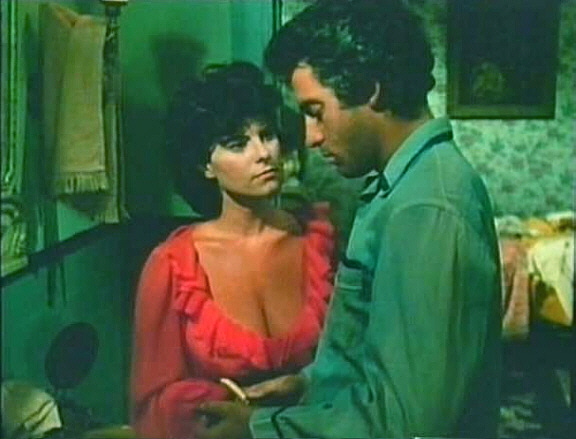
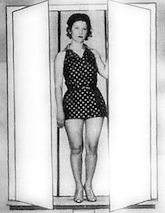
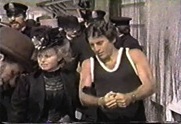
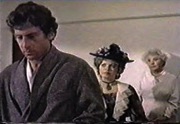
Adrienne was part of stellar cast and is so far the only actress to portray Houdini's rumored mistress. She included her experience shooting the movie in her 2007 autobiography There Are Worse Things I Could Do.
- Home
- Life
- Escapes
- Magic
- Movies
- Houdini's Movies
- Les merveilleux exploits de Houdini à Paris (1909)
- The Master Mystery (1918)
- The Grim Game (1919)
- Terror Island (1920)
- The Man From Beyond (1922)
- Haldane of the Secret Service (1923)
- Velvet Fingers (1925-26)
- Medium Well Done (1937)
- Religious Racketeers (1938)
- Houdini Picture Corp.
- Film Developing Corp.
- Filming locations
- Unmade Movies
- Deconstructing Houdini '53
- Spiritualism
- People
- Beatrice Houdini
- Theo Hardeen
- Cecelia Weiss
- Mayer Samuel Weiss
- Jim Collins
- Franz Kukol
- Martin Beck
- Sir Arthur Conan Doyle
- Margery
- J. Gordon Whitehead
- Edward Saint
- Jacob Hyman
- Leopold Weiss
- Carrie Gladys Weiss
- Bernard M.L. Ernst
- Charmian London
- Jess Willard
- H.P. Lovecraft
- Sherlock Holmes
- Assistants
- Imitators
- Other magicians
- Media
- Full Bibliography
- By Houdini
- Biography
- Fiction
- Foreign
- For Kids
- Methods
- Wild About Harry Bookshelf
- Houdini His Life Story (1928)
- Houdini The Man Who Walked Through Walls (1959)
- Houdini The Untold Story (1969)
- The Life and Many Deaths of Harry Houdini (1993)
- Houdini!!! The Career of Ehrich Weiss (1996)
- The Secret Life of Houdini (2006)
- The Metamorphosis: The Apprenticeship of Harry Houdini (2012)
- The Witch of Lime Street (2015)
- The Life and Afterlife of Harry Houdini (2019)
Showing posts with label Daisy White. Show all posts
Friday, September 25, 2020
Fresh Daisies
Recently some new images from The Great Houdinis have appeared on the Getty Images website credited to the Walt Disney Television Photo Archive. Included are these two shots of the great Adrienne Barbeau as Daisy White that I've never seen before.
Friday, June 7, 2019
Dean Carnegie discovers the hidden Daisy White
Dean Carnegie goes in search of the elusive Daisy White on his terrific The Magic Detective podcast. Dean has uncovered new details about her life, as well as her real name. Click below to have a listen:
Ep. 24: Daisy White & Houdini
Also check at THIS POST at Dean's Magic Detective Blog for new photos of Daisy.
Related:
Ep. 24: Daisy White & Houdini
Also check at THIS POST at Dean's Magic Detective Blog for new photos of Daisy.
Related:
Sunday, October 8, 2017
LINK: The Adrienne Barbeau Blogathon: The Great Houdini (1976)
Debbie Vega's Moon in Gemini has an "Adrienne Barbeau Blogathon" post about the 1976 biopic The Great Houdinis. It's a review of the movie and an appreciation of Adrienne's performance as Daisy White. You all know how nostalgic I am about The Great Houdinis, and Adrienne Barbeau is always worth our attention, so head on over to Debbie's site and show her some love. Daisy would!
Last year Debbie also did a "Star-Studded Couple Blogathon" that included Tony Curtis and Janet Leigh. You can keep up with Adrienne Barbeau at abarbeau.com.
By coincidence, today marks the 41st anniversary of The Great Houdinis first airing on October 8, 1976.
Related:
"I saw it during its original broadcast, but didn’t recall that it’s actually a very good movie..."
Last year Debbie also did a "Star-Studded Couple Blogathon" that included Tony Curtis and Janet Leigh. You can keep up with Adrienne Barbeau at abarbeau.com.
By coincidence, today marks the 41st anniversary of The Great Houdinis first airing on October 8, 1976.
Related:
Wednesday, November 9, 2016
Adrienne Barbeau to receive Lifetime Achievement Award
As Daisy White she's helped Paul Michael Glaser beat back the blues in The Great Houdinis ("Come to bed, Harry"), and now the 14th annual New York City Horror Film Festival will celebrate the career of Adrienne Barbeau this Saturday, November 12, with a Lifetime Achievement Award.
Of course, horror fans recognize her as the star of The Fog, Escape from New York, Swamp Thing and other films. But she'll always be Daisy to us! So far she is the only actress to have played the real-life temptress.
For more information on the New York New York City Horror Film Festival visit the official website.
UPDATE: You can read a report on the event at Geeks of Doom.
Of course, horror fans recognize her as the star of The Fog, Escape from New York, Swamp Thing and other films. But she'll always be Daisy to us! So far she is the only actress to have played the real-life temptress.
For more information on the New York New York City Horror Film Festival visit the official website.
UPDATE: You can read a report on the event at Geeks of Doom.
Related:
Wednesday, August 10, 2016
The imposter
In 1946, Maurice Zolotow penned The Great Balsamo, a novel about a famous magician and escape artist. Even though the author states in his introduction that his character "is not a lightly doctored version of any famous magician," the similarities between Barney Balsamo and Harry Houdini are hard to escape.
The Great Balsamo was first published in hardcover by Random House in 1946. It later appeared as an abridged paperback edition from Pyramid in 1954. I admit I've never read the book cover to cover. I've only scanned it. But even a scan tells me that Houdini was first and foremost on Zolotow's mind, and that he intended Houdini to be on the mind of the reader as well. Consider his description of Barney Balsamo in the first chapter:
The similarities continue. Balsamo, who doesn’t drink or smoke, performs with his wife Lami as The Balsamos. Their signature trick is the substitution trunk. When times get hard, they do a spiritualistic mind reading act that uses a word/number code. Zolotow spells out their code on pages 184-185 in a way that is very reminiscent of how the first Houdini biography, Houdini His Life Story by Harold Kellock, spelled out Harry and Bessie's own secret code.
In fact, it's pretty clear that Zolotow used the Kellock biography as a source in ways that border plagiarism. Compare these two passages from Kellock and Zolotow:
The similarities continue. Advised by vaudeville manager Sam Blitzer to focus on handcuffs escape, Balsamo hits it big as "The Handcuff King and Jail-Breaker." He travels to Europe and escapes handcuffs at Scotland Yard -- yes, his hands are locked around a pillar -- and experiences his own Hodgson-like challenge. (Both these sections again lift whole passages from Kellock). Back in the U.S., Balsamo performs suspended straitjacket escapes, vanishes an elephant, and is devastated by the death of his mother. In the end, Balsamo dies in an overboard box escape gone wrong.
The Great Balsamo is peppered with mentions of classic era magicians such as Thurston, Blackstone, T. Nelson Downs, and Horace Goldin. Zolotow also identifies S.W. Erdnase as being Edward Samuel Andrews. The name "Houdini" is conspicuously absent until near the end of the book when he warrants one quick mention (his photo is named among others on the wall of a magic shop).
It's also worth noting that Houdini himself used the name "The Marvelous Balsoma" for a fictional magician in his short story, "The Magician's Christmas Eve." Houdini was no doubt drawing the name from Cagliostro, who also happens to be a hero to Barney Balsamo.
So there's no question Zolotow is offering is a veiled portrait of Houdini in The Great Balsamo. However, it's not always a flattering one. Consider this passage near the end of the novel:
So who was Maurice Zolotow and what were his feelings toward Houdini?
Born in 1913, Maurice Zolotow was a prolific show business biographer. He penned the first biography of Marilyn Monroe, as well as biographies of John Wayne and Billy Wilder. He was also a magic buff who claimed to have seen Houdini perform at Coney Island. Later in life, he became friends with magician Ricky Jay.
In his psychological study, Houdini A Mind in Chains (1976), author Bernard C. Meyer (father of Houdini miniseries screenwriter Nicholas Meyer) repeatedly references Zolotow and Balsamo, stating, "it is clear that in fashioning the erotic aspect of his novel, Zolotow drew freely upon elements in Houdini's past."
Indeed, the erotic aspect of Houdini's life appears to have fascinated Maurice Zolotow. It was Zolotow who famously said, "Houdini loved only two women, his mother and Daisy White." (In Balsamo, Daisy is Myra Wilcox.) I don't know this for a fact, but I suspect Zolotow might have also influenced Melville Shavelson's 1976 biopic, The Great Houdinis.
In October 1979, Zolotow wrote a profile of Houdini for Los Angeles Magazine. It's surprisingly negative. He starts with an account of the Jess Willard confrontation and concludes: "All of Houdini's biographers relate this and similar stories about him, as if to prove what a heroic guy he was. To me, it suggests he was an arrogant bastard."
First edition hardcover (1946).
The Great Balsamo was first published in hardcover by Random House in 1946. It later appeared as an abridged paperback edition from Pyramid in 1954. I admit I've never read the book cover to cover. I've only scanned it. But even a scan tells me that Houdini was first and foremost on Zolotow's mind, and that he intended Houdini to be on the mind of the reader as well. Consider his description of Barney Balsamo in the first chapter:
He was not of commanding height, but when be began to speak in a firm, harsh voice, ungrammatical, but pervaded with unanswerable conviction, he could project any illusion about himself which he wished.
At the high point of his fame, Balsamo was a stocky muscular person with a large round face, curly black hair, and eyes of a murky marbled grayness, that fixed you with an immobile translucency. You were unable to escape from the eyes. They captured you like and insect on a scientific pin. You were lost in the eyes, like round, superbly polished stones in a ring, cloudy chrysophrase stones. Before an interview or a stage appearance, he placed a few drops of belladonna in his eyes to heighten the staring intensity.
The similarities continue. Balsamo, who doesn’t drink or smoke, performs with his wife Lami as The Balsamos. Their signature trick is the substitution trunk. When times get hard, they do a spiritualistic mind reading act that uses a word/number code. Zolotow spells out their code on pages 184-185 in a way that is very reminiscent of how the first Houdini biography, Houdini His Life Story by Harold Kellock, spelled out Harry and Bessie's own secret code.
In fact, it's pretty clear that Zolotow used the Kellock biography as a source in ways that border plagiarism. Compare these two passages from Kellock and Zolotow:
Houdini His Life Story (page 90):
Toward the end of the week he came home one evening with a whole packing-box for the fire. It was so complete that he obviously hated to break it up, and before tackling it he sat for a long time staring at it. At last, with a sigh, he began to wrench it apart.
"Bess," he said, "I have a new idea for a packing-box escape. I think I can get out without using a trick box. I'll work it out some day, and it will help make us famous.
In this curious fashion the idea of his famous packing-case escape had it's inception.
The Great Balsamo (page 207-206):
Lami could not help giggling when she saw what an absurd figure he made hauling the crate. It was the first time he had ever secured a box in such unbroken condition. He seemed to be reluctant to break it up and throw it into the stove. For a long time he stared at the box, and thumped its sides, examining the way the slates were nailed together. Finally, he began to dismantle the box.
"Lami," he said, thoughtfully, "I have a new idea for a packing-box escape. I think I can get out without using a trick box. I think I know a way where I can get a committee of carpenters to come on stage and build a box right on stage and nail me into it and I can escape and still leave the box it its original condition.
This was the germ of Balsamo's celebrated packing-box escape...
The similarities continue. Advised by vaudeville manager Sam Blitzer to focus on handcuffs escape, Balsamo hits it big as "The Handcuff King and Jail-Breaker." He travels to Europe and escapes handcuffs at Scotland Yard -- yes, his hands are locked around a pillar -- and experiences his own Hodgson-like challenge. (Both these sections again lift whole passages from Kellock). Back in the U.S., Balsamo performs suspended straitjacket escapes, vanishes an elephant, and is devastated by the death of his mother. In the end, Balsamo dies in an overboard box escape gone wrong.
Abridged paperback (1954).
The Great Balsamo is peppered with mentions of classic era magicians such as Thurston, Blackstone, T. Nelson Downs, and Horace Goldin. Zolotow also identifies S.W. Erdnase as being Edward Samuel Andrews. The name "Houdini" is conspicuously absent until near the end of the book when he warrants one quick mention (his photo is named among others on the wall of a magic shop).
It's also worth noting that Houdini himself used the name "The Marvelous Balsoma" for a fictional magician in his short story, "The Magician's Christmas Eve." Houdini was no doubt drawing the name from Cagliostro, who also happens to be a hero to Barney Balsamo.
So there's no question Zolotow is offering is a veiled portrait of Houdini in The Great Balsamo. However, it's not always a flattering one. Consider this passage near the end of the novel:
"Balsamo, growing older, resembled Cagliostro more and Balsamo less. In both, cunning and evil had gradually come to dominate and corrupt the physiognomy."
So who was Maurice Zolotow and what were his feelings toward Houdini?
Born in 1913, Maurice Zolotow was a prolific show business biographer. He penned the first biography of Marilyn Monroe, as well as biographies of John Wayne and Billy Wilder. He was also a magic buff who claimed to have seen Houdini perform at Coney Island. Later in life, he became friends with magician Ricky Jay.
In his psychological study, Houdini A Mind in Chains (1976), author Bernard C. Meyer (father of Houdini miniseries screenwriter Nicholas Meyer) repeatedly references Zolotow and Balsamo, stating, "it is clear that in fashioning the erotic aspect of his novel, Zolotow drew freely upon elements in Houdini's past."
Indeed, the erotic aspect of Houdini's life appears to have fascinated Maurice Zolotow. It was Zolotow who famously said, "Houdini loved only two women, his mother and Daisy White." (In Balsamo, Daisy is Myra Wilcox.) I don't know this for a fact, but I suspect Zolotow might have also influenced Melville Shavelson's 1976 biopic, The Great Houdinis.
In October 1979, Zolotow wrote a profile of Houdini for Los Angeles Magazine. It's surprisingly negative. He starts with an account of the Jess Willard confrontation and concludes: "All of Houdini's biographers relate this and similar stories about him, as if to prove what a heroic guy he was. To me, it suggests he was an arrogant bastard."
Zolotow goes on to quote conversations with Dai Vernon, a Houdini hater of the first order, which might account for the article's negative tone. And despite excellent sources, such as Manny Weltman, the article contains several factual errors.
In the same issue, Zolotow provided a short article about "The Houdini Gary Gilmore Connection" in which he spells out the claim by murderer Gary Gilmore that he was the illegitimate grandson of the famous magician. So it's clear Zolotow liked to dish dirt on Houdini.
Maurice Zolotow died on March 14, 1991.
The Great Balsamo stands as a curiosity. It's not a great novel, nor does it really work as a "veiled" Houdini biography. The real Houdini and his life remians just so much more compelling than any fictional version. But I still think it's an interesting book and a worthy addition to any Houdini bookshelf.
Zolotow's Los Angeles Magazine profile of Houdini (1979).
In the same issue, Zolotow provided a short article about "The Houdini Gary Gilmore Connection" in which he spells out the claim by murderer Gary Gilmore that he was the illegitimate grandson of the famous magician. So it's clear Zolotow liked to dish dirt on Houdini.
Maurice Zolotow died on March 14, 1991.
The Great Balsamo stands as a curiosity. It's not a great novel, nor does it really work as a "veiled" Houdini biography. The real Houdini and his life remians just so much more compelling than any fictional version. But I still think it's an interesting book and a worthy addition to any Houdini bookshelf.
Other selections from the WILD ABOUT HARRY bookshelf:
- "This book is full of lies" - Houdini His Life Story
- The secrets of The Secrets of Houdini - The Secrets of Houdini
- "Had Houdini lived he would have written this book" - Houdini's Escapes and Magic
- The gateway biography - The Great Houdini
- An alternative gateway - Houdini Master of Escape
- The first great Houdini biography - Houdini The Man Who Walked Through Walls
- The textbook - Houdini The Untold Story
- The perennial - Houdini on Magic
- The Fantastic Four - The Original Houdini Scrapbook, Houdini His Art and Magic, Houdini A Pictorial Life, Houdini His Legend and His Magic
- The Brandon book - The Life and Many Deaths of Harry Houdini
- The best forgotten Houdini book - Houdini's Fabulous Magic
Tuesday, March 15, 2016
Scarne on Houdini
The website The Amazing World of John Scarne has a fantastic excerpt from John Scarne's autobiography about meeting Houdini in 1918. This is one of the best first-hand descriptions of a Houdini meeting I've ever read. One can really feel his presence on the page. Bess, Daisy White, and Jim Collins are also part of the story. And forget Dai Vernon. It appears Johnny Scarne was the man who truly fooled Houdini. But Scarne didn't reveal that he had done so. Well, until his autobiography.
Have a read at The Amazing World of John Scarne.
Thanks to Leonard Hevia for this discovery.
Have a read at The Amazing World of John Scarne.
Thanks to Leonard Hevia for this discovery.
Wednesday, July 1, 2015
Jack Carter, first Hardeen, dies at 93
Comedian Jack Carter has passed away at age 93. Carter was a popular television star who made more than 50 guest appearances on The Ed Sullivan Show. He also directed episodes of Here's Lucy and appeared on Broadway in such hits as Oliver! and The Odd Couple.
But for Houdini fans, Jack will be remembered as the first actor to portray Theo Hardeen on film. Carter played Houdini's brother in the 1976 television movie The Great Houdinis opposite Paul Michael Glaser.
Below is a clip of Jack Carter's one scene as Hardeen. I enjoy this. Carter nicely plays both his comedic and showbiz savvy sensibilities. I also like his references to almost drowning in the Milk Can and Walking Through A Brick Wall (both true). And we meet Daisy White played by Adrienne Barbeau.
But for Houdini fans, Jack will be remembered as the first actor to portray Theo Hardeen on film. Carter played Houdini's brother in the 1976 television movie The Great Houdinis opposite Paul Michael Glaser.
Below is a clip of Jack Carter's one scene as Hardeen. I enjoy this. Carter nicely plays both his comedic and showbiz savvy sensibilities. I also like his references to almost drowning in the Milk Can and Walking Through A Brick Wall (both true). And we meet Daisy White played by Adrienne Barbeau.
Related posts:
Monday, June 22, 2015
William Lindsay Gresham on the Houdinis marriage
Today, on the 121st wedding anniversary of Harry and Bess Houdini, I'm offering up a recent find which, if we are to believe it, casts the Houdinis 33-year marriage in a different light. This one definitely falls under the category of the salacious and gossip, but when the person doing the gossiping is William Lindsay Gresham, who in 1959 wrote the first major Houdini biography, Houdini: The Man Who Walked Through Walls, it's worth a listen. So here we go.
While visiting the American Museum of Magic in Marshall, Michigan last month, I came across a letter written by Gresham to his agent, Bernice Baumgarten, in 1954. In it Gresham pitches the idea for his Houdini book, taking aim at what was the only other Houdini biography in print at the time, Houdini His Life Story by Harold Kellock. Gresham writes:
Later, Gresham turns to the subject of Daisy White, for which he appears to have had a singular fascination:
This last paragraph contains a true bombshell. Love letters "Harry had written Daisy." By the time Gresham writes his book, the author and nature of these letters has drastically changed. On pages 291-292 of Houdini: The Man Who Walked Through Walls, Gresham writes:
So which version are we to believe? Did Houdini write Daisy love letters, or did Daisy send Houdini "gag-love-letters"? The difference is enormous. The truth might be revealed in Gresham's assurance that he knew "how to avoid libel." Did he change the truth to make the letters innocent so as not indict Houdini? Or, with further research, did he discover what he had written to Bernice was incorrect? Tough one.
And what are we to make of Gresham's claim that the Houdini's marriage was "like hell"? Certainly his final book did not reflect a troubled marriage. In fact, in a lengthy passage on pages 75-76, Gresham paints the Houdinis marriage as, yes, idyllic. He even adds: "There was only one thing of which she could be absolutely sure: he was not interested in other women."
So was Gresham exaggerating in this letter, trying to make his book sound more salacious and therefore more appealing to his agent who wasn't yet sold on the idea of Houdini biography? Was he repeating gossip or making a snap judgment that he later backed away from? Or, again, did he avoid the topic entirely in his final book to protect himself from libel?
I want nothing more to believe the fairytale -- that the Houdini's marriage was what Bess characterized as "33 years of heaven." But I have to admit that the more I do primary research, the more I encounter troubling indicators, such as this Gresham letter, that there might have been some problems.
The wild card for me is the extent of Bessie's involvement with alcohol. If she had a serious drinking problem during the marriage -- if she was an alcoholic -- then there certainly could have been times that it was "like hell." But we also have ample evidence of the Houdinis love and affection for one another.
My guess is the Houdinis 33-year marriage was, like many long term marriages, a complex personal relationship. I doubt it was all "heaven." But until we get more evidence, I find it hard to believe it was "like hell." Still, this is a curious letter from a man who seemed committed to uncovering the truth about Houdini.
Thanks to Alex and Keli Hindenach of the American Museum of Magic for providing me with a copy of this letter, and to Diego Domingo for his help identifying Bernice Baumgarten.
Related:
While visiting the American Museum of Magic in Marshall, Michigan last month, I came across a letter written by Gresham to his agent, Bernice Baumgarten, in 1954. In it Gresham pitches the idea for his Houdini book, taking aim at what was the only other Houdini biography in print at the time, Houdini His Life Story by Harold Kellock. Gresham writes:
I'm sorry you didn't like the Houdini book idea. What you saw (the carbon of the True booklenghther) is just a bare outline of what that guy really was. There has never been a real biography written -- the book by Harold Kellock, Houdini, His Life Story, is just posthumous publicity, with Bess portraying her marriage as a 33-year idyll. It was like hell.
Later, Gresham turns to the subject of Daisy White, for which he appears to have had a singular fascination:
Perhaps I'm just an enthusiast but I'd love to write a true account of Houdini's life and my years as a fact-detective editor have given me enough know-how to avoid libel. Incidentally, many years ago there was a cute little redhead bombshell who worked in the old Martinka's magic store. She was named Daisy White. After Houdini's death Bess Houdini found a stack of carbon copies of love letters Harry had written Daisy. The schmuck, he thought he took one great secret with him to the grave! What a character.
This last paragraph contains a true bombshell. Love letters "Harry had written Daisy." By the time Gresham writes his book, the author and nature of these letters has drastically changed. On pages 291-292 of Houdini: The Man Who Walked Through Walls, Gresham writes:
Knowing Houdini's prudishness and ultraconservatism in his attitude toward women, Daisy had written him several torrid love letters just to see what would happen. Houdini never threw away any scrap of paper unless it was a clipping which boosted and imitator. He kept the gag-love-letters hidden. After his death Bess found them and is said to have pitched quite a fit until Daisy explained the circumstances and managed to pacify her.
So which version are we to believe? Did Houdini write Daisy love letters, or did Daisy send Houdini "gag-love-letters"? The difference is enormous. The truth might be revealed in Gresham's assurance that he knew "how to avoid libel." Did he change the truth to make the letters innocent so as not indict Houdini? Or, with further research, did he discover what he had written to Bernice was incorrect? Tough one.
And what are we to make of Gresham's claim that the Houdini's marriage was "like hell"? Certainly his final book did not reflect a troubled marriage. In fact, in a lengthy passage on pages 75-76, Gresham paints the Houdinis marriage as, yes, idyllic. He even adds: "There was only one thing of which she could be absolutely sure: he was not interested in other women."
So was Gresham exaggerating in this letter, trying to make his book sound more salacious and therefore more appealing to his agent who wasn't yet sold on the idea of Houdini biography? Was he repeating gossip or making a snap judgment that he later backed away from? Or, again, did he avoid the topic entirely in his final book to protect himself from libel?I want nothing more to believe the fairytale -- that the Houdini's marriage was what Bess characterized as "33 years of heaven." But I have to admit that the more I do primary research, the more I encounter troubling indicators, such as this Gresham letter, that there might have been some problems.
The wild card for me is the extent of Bessie's involvement with alcohol. If she had a serious drinking problem during the marriage -- if she was an alcoholic -- then there certainly could have been times that it was "like hell." But we also have ample evidence of the Houdinis love and affection for one another.
My guess is the Houdinis 33-year marriage was, like many long term marriages, a complex personal relationship. I doubt it was all "heaven." But until we get more evidence, I find it hard to believe it was "like hell." Still, this is a curious letter from a man who seemed committed to uncovering the truth about Houdini.
Thanks to Alex and Keli Hindenach of the American Museum of Magic for providing me with a copy of this letter, and to Diego Domingo for his help identifying Bernice Baumgarten.
Related:
Saturday, June 8, 2013
The first great Houdini biography
Today I continue my examination of books about Houdini using images and insights from my own collection (and in this case some additional images from the Arthur Moses collection).
When Houdini: The Man Who Walked Through Walls by William Lindsay Gresham hit bookstores in 1959, it had been a remarkable 31 years since the last major Houdini biography. That last biography was Houdini His Life Story by Harold Kellock, a book notorious for being "full of lies." With his new biography Gresham took a quantum leap forward, washing away many of the Kellock fictions and unearthing essential new information. Indeed, I consider this the first great Houdini biography, and one that all subsequent biographies owe the biggest debt. It's also still the one with the best title.
It's in Houdini: The Man Who Walked Through Walls that Houdini's real birthplace and birthday is revealed for the first time. Gresham also dismisses as apocryphal almost all of the familiar boyhood tales (picking the lock on the pie cabinet, the locksmith apprenticeship); tells the true story of Harry and Bess's meeting and marriage; debunks the trapped under the ice story; reveals Martin Beck's involvement in launching Houdini's career; exposes some of the sordid details of the Arthur Ford seance; introduces us to Daisy White ("one of the most mischievous little minxes ever to be shot through a trap door"); and introduces a myriad of new Houdini facts that are now taken for granted.
There is also some information that remains still largely exclusive to this book, such as a one-off underwater straitjacket escape in the New York Hippodrome pool and Houdini's advanced plans for a crusade against gambling cheats "after mediums wore out." Gresham also shows great reverence for Jim Collins and the role he played in Houdini's life and career. He even goes as far to say: "Had Collins been in the dressing room that fateful day in 1926, Houdini might be with us yet."
Part of Gresham's success was because his sources in 1959 were excellent. Many of them knew Houdini personally. His Author's Acknowledgments cite: Joseph Dunninger, Walter Gibson, Will Goldston, Milbourne Christopher (and his collection of 500 Houdini letters), Sidney Radner, Robert Lund, John Mulholland, Jean Hugard, Fred Keating (the book includes two wonderful personal memories of Houdini from Keating), and even Houdini's assistant, Lewis Goldstein (likely the source of an untold story of Houdini going "berserk" when his dog was accidentally delivered to the theater instead of his trained eagle which traveled in a similar box). Gresham dedicates the book to James "The Amazing" Randi, who also helped greatly in Gresham's research.
Sure, Gresham still falls into a few familiar traps. He embraces Will Goldston's version of the Mirror challenge, with Bess crying the key out of the rep (although it's impressive that he questions the traditional version at all). He says Houdini escaped from the Russian Siberian Transport Van by cutting through the floor. He speculates on a method of the Water Torture Cell which we now know is incorrect (as we now know Sid Radner was withholding the real method from the author, which might have been wise as Gresham does reveal secrets in this book). He also reports that it was Houdini himself who survived the plane crash in The Grim Game, identifies J. Gordon Whitehead (whom he does not name) as a boxer, and includes the now discredited quote from "Jim Collins" saying that he put the ruler in the Margie Box.
Regardless, Houdini The Man Who Walked Through Walls is a top notch, well-written, and surprisingly accurate Houdini biography that provided a new and much needed fact-based foundation for magic historians to build on. It was also a book with a surprisingly long publication life.
Publication history:
Houdini The Man Who Who Walked Through Walls was first published in the U.S. as a hardcover by Henry Holt & Co. on August 3, 1959. The book would go into a second printing that same month, a third printing in October, and a fourth in January 1960. The book included several pages of photos, an "Opinionated Bibliography," and an Author's Acknowledgments in the front.
In 1960 Victor Gollancz, Ltd. published the book in hardcover in the UK. For some reason, the UK edition uses an image of Robert-Houdin on the cover. Hard to believe this could have been an error -- confusing Houdin and Houdini -- but I guess it's possible. The UK edition includes slightly different photos from the U.S.
Houdini The Man Who Who Walked Through Walls was first published in paperback by Hillman Books in June 1961. All new photos were used in the paperback edition, and the Author's Acknowledgments were moved to the back of the book.
Later paperbacks were published by Macfadden Books. Apart from different publisher markings, the only noticeable difference between the Hillman and Macfadden editions is the tinting of the photo of Houdini (credited to Dunninger) on the back. Macfadden released at least five printings. All use the same cover art, but show variations in price and the occasional inclusion of "Printed in the USA" on the back.
Houdini The Man Who Walked Through Walls doesn't appear to have been widely published outside the U.S. and UK. As far as I know, there wasn't even a UK paperback edition. However, there was a Dutch edition published in 1964 (update: Russian Gresham).
The 1970s saw the return of Houdini The Man Who Walked Through Walls in hardcover by what was now Holt, Rineheart and Winston. I don't know the publication order of their two later hardcovers for certain, but it seems logical that 1973 hardcover, which uses the same artwork as the first edition, came first followed by what is only described inside as an 11th printings with brand new cover artwork (this edition eluded me for years).
The last printing of Houdini The Man Who Walked Through Walls was a paperback by Manor Books in 1975 with all-new cover art. This was the first Houdini biography I ever bought and read, so this particular edition has always held a special place for me.
Houdini: The Man Who Walked Through Walls has now fallen long out of print, and that's a shame. Sure, some of the information is now out-of-date, but by and large it's a very solid Houdini biography and one that should always be remembered as a milestone. Even the great Max Maven once called it "the best of all the Houdini biographies." Some kind of collectible Anniversary Edition would not be unwelcome one day.
UPDATE: Gresham on Kindle.
Also enjoy:
When Houdini: The Man Who Walked Through Walls by William Lindsay Gresham hit bookstores in 1959, it had been a remarkable 31 years since the last major Houdini biography. That last biography was Houdini His Life Story by Harold Kellock, a book notorious for being "full of lies." With his new biography Gresham took a quantum leap forward, washing away many of the Kellock fictions and unearthing essential new information. Indeed, I consider this the first great Houdini biography, and one that all subsequent biographies owe the biggest debt. It's also still the one with the best title.
It's in Houdini: The Man Who Walked Through Walls that Houdini's real birthplace and birthday is revealed for the first time. Gresham also dismisses as apocryphal almost all of the familiar boyhood tales (picking the lock on the pie cabinet, the locksmith apprenticeship); tells the true story of Harry and Bess's meeting and marriage; debunks the trapped under the ice story; reveals Martin Beck's involvement in launching Houdini's career; exposes some of the sordid details of the Arthur Ford seance; introduces us to Daisy White ("one of the most mischievous little minxes ever to be shot through a trap door"); and introduces a myriad of new Houdini facts that are now taken for granted.
There is also some information that remains still largely exclusive to this book, such as a one-off underwater straitjacket escape in the New York Hippodrome pool and Houdini's advanced plans for a crusade against gambling cheats "after mediums wore out." Gresham also shows great reverence for Jim Collins and the role he played in Houdini's life and career. He even goes as far to say: "Had Collins been in the dressing room that fateful day in 1926, Houdini might be with us yet."
Part of Gresham's success was because his sources in 1959 were excellent. Many of them knew Houdini personally. His Author's Acknowledgments cite: Joseph Dunninger, Walter Gibson, Will Goldston, Milbourne Christopher (and his collection of 500 Houdini letters), Sidney Radner, Robert Lund, John Mulholland, Jean Hugard, Fred Keating (the book includes two wonderful personal memories of Houdini from Keating), and even Houdini's assistant, Lewis Goldstein (likely the source of an untold story of Houdini going "berserk" when his dog was accidentally delivered to the theater instead of his trained eagle which traveled in a similar box). Gresham dedicates the book to James "The Amazing" Randi, who also helped greatly in Gresham's research.
Sure, Gresham still falls into a few familiar traps. He embraces Will Goldston's version of the Mirror challenge, with Bess crying the key out of the rep (although it's impressive that he questions the traditional version at all). He says Houdini escaped from the Russian Siberian Transport Van by cutting through the floor. He speculates on a method of the Water Torture Cell which we now know is incorrect (as we now know Sid Radner was withholding the real method from the author, which might have been wise as Gresham does reveal secrets in this book). He also reports that it was Houdini himself who survived the plane crash in The Grim Game, identifies J. Gordon Whitehead (whom he does not name) as a boxer, and includes the now discredited quote from "Jim Collins" saying that he put the ruler in the Margie Box.
Regardless, Houdini The Man Who Walked Through Walls is a top notch, well-written, and surprisingly accurate Houdini biography that provided a new and much needed fact-based foundation for magic historians to build on. It was also a book with a surprisingly long publication life.
Publication history:
Houdini The Man Who Who Walked Through Walls was first published in the U.S. as a hardcover by Henry Holt & Co. on August 3, 1959. The book would go into a second printing that same month, a third printing in October, and a fourth in January 1960. The book included several pages of photos, an "Opinionated Bibliography," and an Author's Acknowledgments in the front.
![]() |
| 1959 U.S. first edition hardcover and 1960 UK first edition with curious cover. |
In 1960 Victor Gollancz, Ltd. published the book in hardcover in the UK. For some reason, the UK edition uses an image of Robert-Houdin on the cover. Hard to believe this could have been an error -- confusing Houdin and Houdini -- but I guess it's possible. The UK edition includes slightly different photos from the U.S.
Houdini The Man Who Who Walked Through Walls was first published in paperback by Hillman Books in June 1961. All new photos were used in the paperback edition, and the Author's Acknowledgments were moved to the back of the book.
![]() |
| Hillman 1961 U.S. paperback first edition. |
Later paperbacks were published by Macfadden Books. Apart from different publisher markings, the only noticeable difference between the Hillman and Macfadden editions is the tinting of the photo of Houdini (credited to Dunninger) on the back. Macfadden released at least five printings. All use the same cover art, but show variations in price and the occasional inclusion of "Printed in the USA" on the back.
![]() |
| Macfadden 3rd printing October 1967 (Arthur Moses collection). |
![]() |
| Macfadden 5th printing July 1970 (note "Printed in USA" on back). |
Houdini The Man Who Walked Through Walls doesn't appear to have been widely published outside the U.S. and UK. As far as I know, there wasn't even a UK paperback edition. However, there was a Dutch edition published in 1964 (update: Russian Gresham).
![]() |
| 1964 Dutch edition (Arthur Moses Collection). |
The 1970s saw the return of Houdini The Man Who Walked Through Walls in hardcover by what was now Holt, Rineheart and Winston. I don't know the publication order of their two later hardcovers for certain, but it seems logical that 1973 hardcover, which uses the same artwork as the first edition, came first followed by what is only described inside as an 11th printings with brand new cover artwork (this edition eluded me for years).
![]() |
| 1970s Holt, Rineheart and Winston hardcovers. |
The last printing of Houdini The Man Who Walked Through Walls was a paperback by Manor Books in 1975 with all-new cover art. This was the first Houdini biography I ever bought and read, so this particular edition has always held a special place for me.
![]() |
| 1975 Manor Books paperback. |
Houdini: The Man Who Walked Through Walls has now fallen long out of print, and that's a shame. Sure, some of the information is now out-of-date, but by and large it's a very solid Houdini biography and one that should always be remembered as a milestone. Even the great Max Maven once called it "the best of all the Houdini biographies." Some kind of collectible Anniversary Edition would not be unwelcome one day.
UPDATE: Gresham on Kindle.
Also enjoy:
Thursday, January 19, 2012
Link: Opening the door on Daisy White
Dean Carnegie has uncovered an amazing amount of information on the elusive Daisy White, the magician's assistant and Martinka counter girl who was long rumored to be the original Houdini mistress. Daisy was memorably played by Adrienne Barbaeu in the film, The Great Houdinis.
But there's much more to Daisy, including the fact that Daisy White was not even her real name. So head on over to Carnegie: Magic Detective and let Dean introduce you to the real Daisy White.
Tags:
[History],
Bess,
Daisy White,
Links,
Mistresses,
Sex
Saturday, March 19, 2011
Making the great Great Houdinis
![]() |
| Unused promo art for The Great Houdinis (from the collection of MSW) |
Anyone who has spent any time reading this blog knows I have a bit of a thing for the 1976 ABC TV movie, The Great Houdinis. Maybe that’s because it aired during the first year of my burgeoning interest in Houdini. Maybe it’s because it’s damn good! One thing that has always puzzled me is where exactly this film was shot. Even actress Adrienne Barbeau was unable to recall which studio was used. Houdini expert Patrick Culliton was able to provide some information, but the filming of this movie has always been a mystery… until now.
The Great Houdinis, ABC Production #7602, shot for 20 days between April 28 and May 25, 1976. The film utilized five major locations, with the final location set for a major scene that was either cut or never filmed (we’ll get to that). The film was directed by writer/producer Melville Shavelson. His production manager was Don Goldman. Assistant directors were F. A. Miller and Penny L. Vaughn. The executive at ABC who oversaw the production was Marty Katz.
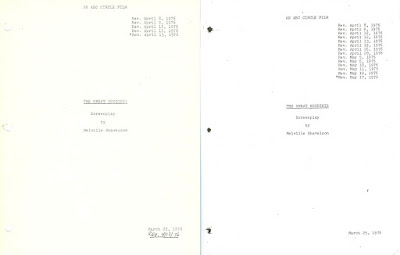
The title was The Great Houdini! (singular) up until at least the April 13th draft of the script. By the final revision on May 17, it had become The Great Houdinis (plural). The change might have been a reflection of how writer-director Shavelson viewed his story. "It's as much a love story as it is a story about a magician," he would say. (Update: According to Patrick Culliton, the title was changed when Sally Struthers was signed to play Bess as part of her deal.)
![]() |
| Two scripts show change in title (click to enlarge). |
On April 28, 1976, the cameras rolled on The Great Houdinis at its first location:
Wilshire Ebell Theater, 4401 W. 8th Street, Los Angeles, CA (April 28 to April 30, 1976)
The first three days of filming were done at the Wilshire Ebell Theater, a historic 1,270 seat theater dating back to 1927. Long a popular filming location, the Ebell would double for the Alhambra, the Hippodrome and Hammerstein's Victoria, as well as unnamed theaters in San Francisco, Paris and Detroit.
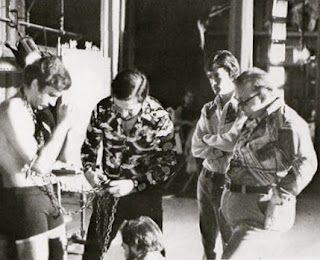
The first day of shooting involved all the complex stage escape apparatuses. The first scene shot was The Milk Can Escape. Then the Water Torture Cell action was shot, with star Paul Michael Glaser failing to escape as a horrified Sally Struthers (Bess) looks on. Abb Dickson provided the cell, which would be touted in some media as “the original cell,” which of course is not correct.
![]() |
| Harry Blackstone Jr. helps prepare Paul Michael Glaser for the Milk Can escape (Photo by Patrick Culliton, Genii) |
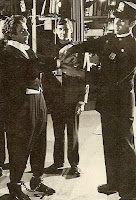
The first day wrapped by filming another escape which only appeared in the opening credits -- Houdini's escape from a casket after Bess passes him a key -- or "feke" as the script calls it -- in a kiss. This was arbitrarily noted as taking place in the Hippodrome in 1920. Houdini expert Patrick Culliton was also on set that day playing Houdini’s assistant Franz Kukol. Artist Dave Stevens, famous for The Rocketeer
One hundred and fifty extras were brought in on Day 2 to act as audience members. All audience reactions to the various stage escapes and spirit exposes were shot on this day. Glaser and Struthers then filmed the scene in which Harry helps Bess with her French during Metamorphosis, which is described as taking place in a “French Theater” in 1900. Harry Blackstone, Jr., who received credit as technical advisor on the film, appeared in the scene as a police officer. Newsreel footage was then shot projected against a backdrop screen on the stage.All the backstage scenes were shot in the third and final day at the Ebell, starting with Harry coming to see his brother, Theo Hardeen (Jack Carter), at what is supposed to be Hammerstein's. This was also Adrienne Barbeau’s first day of shooting. Filmed was Daisy and Bess's conversation backstage in 1926 ("I tried. Not a damn thing."), along with the moment that Bess bumps into the hanging witch and says, "Sorry, Mama."
Queen of Angels Hospital, 2301 Bellevue Ave., Los Angeles, CA (May 3, 1976)
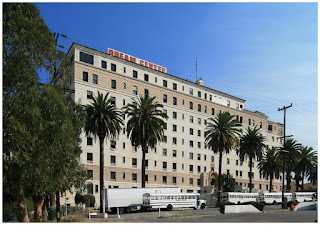
After a few days off, the production moved for a single day to Queen of Angels Hospital near downtown Los Angeles. Here one of the movie's best dramatic scenes was shot -- when Bess comes to see Harry after his nervous breakdown and pulls him from his funk by suggesting they make spiritualist exposes "part of the act." This was also the first day of shooting for the legendary Vivian Vance, playing Minnie the nursemaid. Vance, of course, is best known for her role as Ethel on I Love LucyThe Queen of Angels Hospital closed this location in 1989. After remaining vacant for many years, it became The Dream Center, a Pentecostal Christian Church mission, in 1996.
![]() |
| Queen of Angels, now The Dream Center, today |
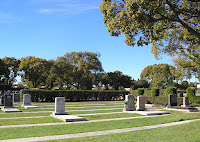
Home of Peace Memorial Park & Mausoleum, 4334 Whittier, Los Angeles, CA (May 4 to May 5, 1976)
![]() |
| Home of Peace Memorial Park doubles for Machpelach |
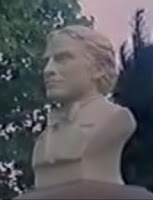
![]() |
| Where is this bust today? |
One thing to watch for in this scene -- even though Bess/Struthers kneels and plants flowers in front of the exedra, as she enters the plot one can spot a fairly accurate reproduction of Houdini's tombstone sitting approximately where it does in the real cemetery plot.
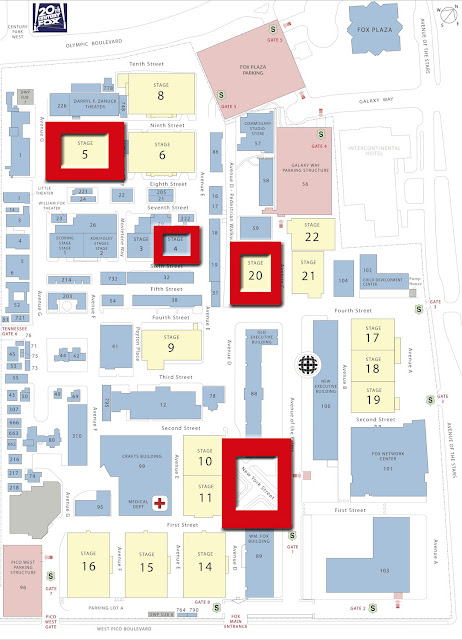
20th Century Fox Studios, 10201 West Pico Boulevard, Los Angeles, CA (May 6 to May 21, 1976)
![]() |
| The 20th Century Fox lot with The Great Houdinis shooting locations marked in red |
On May 6, production moved into the historic 20th Century Fox Studios in Century City. Here the bulk of the filming would take place over the course of the next two weeks. The production would utilize Stage 5, Stage 20 and Stage 4, as well as shooting on the studio's two remaining exterior sets (Fox sold their large backlot in 1961).
![]() |
| On the Hello Dolly street |
Only a small section of the Hello Dolly street (seen here in 1976) remains on the Fox Lot today. But the Brownstone Street (aka "New York Street") still looks very much as it did in the film.
![]() |
| Brownstone Street as seen in the film and today |
Soundstage 20 was also put into action on the first day of lot shooting. Here, the scene in which Bess gets trapped in the sub truck and Harry has to chop her free was shot. Over the following days, stage 20 would also house a train car set where Harry tells Bess what it means to be a magician, and she tells him she’s pregnant (shot on May 7). Stage 20 was also home to the Scotland Yard sets (jail cell and Melville’s outer offices). The Scotland Yard scenes would all be shot on May 12.
![]() |
| 278 was housed on Stage 4 |
The 28,274 sq. ft. Soundstage 5 was used for a wide variety of single scene locations. It was here on May 7 that Houdini exposes Margery the Medium (Barbara Rhoades). The stage also housed the Congressional hearing room where Bess, under oath, confesses that she still loves Harry (May 10). The legendary Nina Foch appears in this scene as the Rev. Le Veyne. Stage 5 was also the site of the Budapest Hotel, where Harry throws a “Royal” reception for Mama, and Bess rebelliously sings “Onward Christian Soldiers,” shot on May 14.
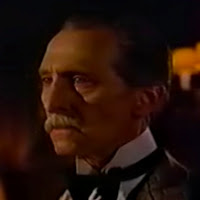
![]() |
| Cushing fresh off the set of Star Wars |
![]() |
| The Weiss home was on Stage 5 |
Shooting on the Fox lot wrapped on May 21 with, appropriately enough, the fatal dressing room punch, shot on Stage 20.
Malibu Pier, 23000 Pacific Coast Highway, Malibu, CA (May 24, 1976)
After two days rest, The Great Houdinis production was again on location, this time at the Malibu Pier off Pacific Coast Highway in Malibu. Originally built in 1905, the pier was expended in 1938 and was made a historic landmark in 1985. The script has this down as being the Peekskill Bridge in New York in 1895, even though in the film a cop calls Houdini "that New York jerk." Here, Houdini’s failed underwater handcuff escape action was shot. A double was used for Glaser’s dive – the only time a double is mentioned on the schedule. Another desirable prop used on this day is the banner that is hung between the two fishing houses at the end of the pier. Nice to see the production designer used authentic Houdini letting from his early European tour posters.
![]() |
| Malibu Pier in The Great Houdinis (top). The pier doesn't look any different today (bottom) |
Belmont Amusement Park, 3000 Mission Park, San Diego, CA (May 25, 1976)
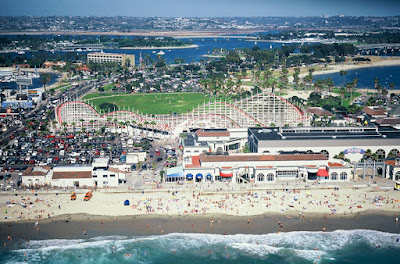
The final day of principle photography for The Great Houdinis was planned for the Belmont Amusement Park in San Diego, which was to double for Coney Island. Here a scene in which Harry proposes to Bess aboard a roller coaster would be filmed.
While it appears in the script, this scene didn’t make it into the final film. Was this scene cut, or never shot? This is something I haven’t yet to be able to discover, but it seems unlikely that a TV movie would cut a scene that took this much effort and expense to film. It’s my guess the scene and location were scrapped, and the last day was used instead to complete a schedule that may have run over (update).
![]() |
| Belmont Park was scheduled to double Coney Island |
The Great Houdinis was edited by John Woodcock and scored by Peter Matz, who would also serve as musical director for Doug Henning’s second World of Magic TV special.
ABC promoted The Great Houdinis with an impressive four page photo spread in the popular gossip magazine, Preview (October 1976), as well an article in TV Guide that claimed to reveal the secret of the Water Torture Cell (it doesn't). The image of Glaser reenacting Houdini's famous semi-nude chained pose was used extensively in advertising. A novelization, written by Shavelson, was released in both the U.S. and UK. In the UK the book was serialized in Reveille, and also released in hardcover with photos of the real Harry and Bess Houdini.
![]() |
| The original TV Guide ad for the October 8, 1976 airing. |
The Great Houdinis aired on October 8, 1976 as part of ABC’s Friday Night Movie. In some markets it aired from 8-10, others from 9-11 (including Los Angeles). Competition that night was from the 1975 John Wayne movie, Brannigan, on CBS and The Rockford Files with James Garner on NBC. In some markets the final line, "I believe the son-of-a-bitch loved her," was edited out. It would repeat once on April 6, 1977 (April 6 was the day Houdini celebrated his birthday, which may or may not have been coincidental). For this '77 broadcast the title was changed to the singular, The Great Houdini, which is what the movie is better known by today.
Reviews were generally good, although, as had been the case 23 years earlier with Paramount's HOUDINI, the magic community took the film to task for its inaccuracies. David Lustig, who performed as La Velma and knew Houdini well, said watching the film made him "feel nauseated." Another reviewer called the film "an object lesson in the abuse of dramatic license."
However, over time, what in 1976 seemed to be a steamy confection of dramatic license (Houdini's affairs, Bessie's alcoholism) has turned out to be fact. No evidence has ever surfaced that hostility existed between Bess and Houdini's mother, however. This notion of a fractious household was first put forth by author Maurice Zolotow, who also spoke openly about Houdini's supposed affair with Daisy White. I've often wondered whether Zolotow had any direct influence over Shavelson's creation of the story. Regardless, it all made for great TV drama.
A very big thanks to The Magic Castle's William Larsen, Sr. Memorial Library and librarian Bill Goodwin for helping me uncover the story of the making of my favorite Houdini biopic. Also thanks to Patrick Culliton, MSW, Dean Carnegie (Magic Detective), and Steve Santini.
Tags:
[History],
1970s,
Arthur Ford,
Biopics,
Blackstone,
Busts,
Conan Doyle,
Daisy White,
Filming locations,
Los Angeles,
Patrick Culliton,
Screenplays,
Siblings,
Star Wars,
Television,
The Great Houdinis (1976)
Sunday, January 9, 2011
A Palm Springs rendezvous with Daisy White
Actor and author, Adrienne Barbeau -- who we love around here for her turn as our favorite Houdini mistress, Daisy White, in The Great Houdinis -- will be making an appearance at Just Fabulous in Palm Springs on Saturday, January 29, from 3 to 5pm.
Adrienne will sign her autobiography, There Are Worse Things I Could Do
(which includes mention of The Great Houdinis), and her two novels, Love Bites
and Vampyres of Hollywood
. The store will also hold a reception.
Just Fabulous is located at 515 North Palm Canyon Drive. Phone 760.864.1300. For more info visit their website bjustfabulous.com.
Adrienne will sign her autobiography, There Are Worse Things I Could Do
Just Fabulous is located at 515 North Palm Canyon Drive. Phone 760.864.1300. For more info visit their website bjustfabulous.com.
Subscribe to:
Posts (Atom)