Showing posts with label Grand Magical Revue. Show all posts

Saturday, November 20, 2021

The Scandinavian tour that wasn't


Here's an interesting item from the New York Clipper that provides new insight into Houdini's ill-fated Scandinavian tour of 1913. It also challenges conventional wisdom about exactly where Houdini was when his tour came to its sudden end. But we'll get to that.

New York Clipper, July 12, 1913

Of course, most of what was announced did not happen. That's because on July 17 Houdini's mother died and he immediately returned to New York (breaking his contract which had consequences as you'll read below). The three month Scandinavian tour was canceled and so too much of the tour of France. Houdini did honor his commitment to the Moss circuit in the UK the following year. Notice the mention of an "entire two hour show." I can only assume this is his Grand Magical Revue. It's interesting to see it was planned this early.

What's strange is the mention of Houdini playing Stockholm, Sweden, on July 16-18. Biographers have all put Houdini in Copenhagen when he received the news of his mother's death on July 17. That ain't Sweden!

It's possible plans changed or the paper got it wrong. But the below article from the New York Evening World announcing Houdini return to New York also says he was "called from Sweden." By the way, the "double" who was arrested was Jim Collins.

New York Evening World, July 29, 1913

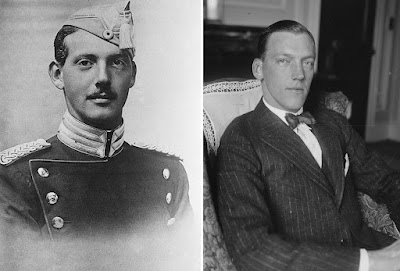
Despite this, the evidence for Copenhagen is strong. Milbourne Christopher in Houdini The Untold Story has many details that confirms the location, including the fact that Princes Aage and Axel of the Danish Royal Family attended Houdini's show.


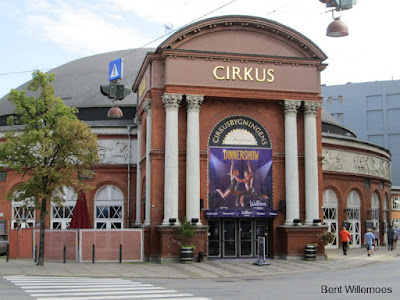
In 1990 Danish magician and collector Johan Ahlberg visited the Royal Library archives and uncovered newspaper accounts that confirmed Houdini's 1913 appearance in Denmark. Houdini opened on July 16 at the Cirkus Building in central Copenhagen. He was scheduled to give a special matinee the following day, July 17, but moments before the show he received the news of his mother's death and collapsed.

The Cirkus Building still stands today. So it was in the building that Houdini began and ended his 1913 Scandinavian tour, and received the worst news of his life.


UPDATE: Our friend David Merlini of The House of Houdini has provided information on another hitherto unknown stop on this tour. On August 16 Houdini was scheduled to appear with the Beketow Circus in Budapest! This would have marked his first and likely only professional appearance in his home town.

Related:

Thursday, September 16, 2021

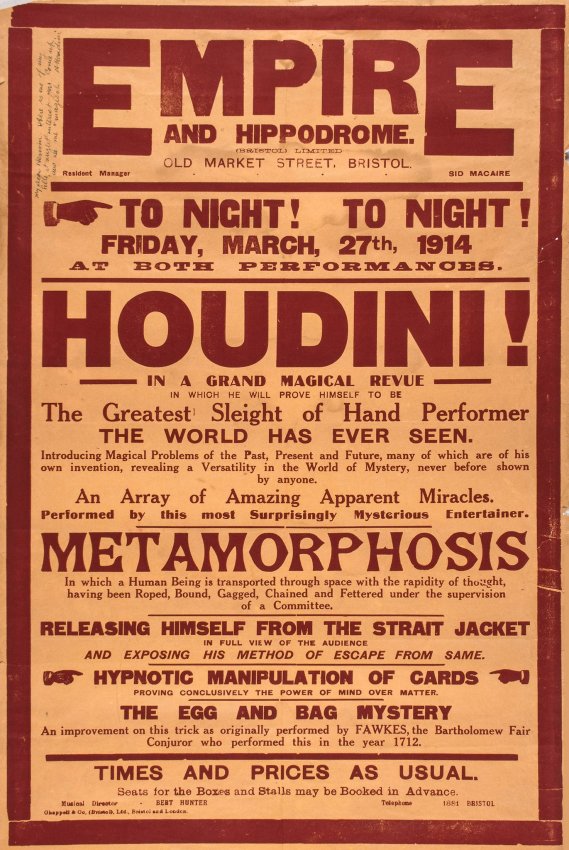
Poster for Houdini's Grand Magical Revue

Over the weekend a poster for Houdini's 1908 appearance at the Circus Brusch in Germany sold on eBay. I mentioned that I had seen that poster along with another for Houdini's "Grand Magical Revue" at Wilshire Coin in Santa Monica in 2016. Here's a photo I took that day of that other poster.


The Grand Magical Revue with a short-lived attempt by Houdini to mount a straight magic show in England in 1914. He only presented it a dozen times. This poster is for the last known performance at the Empire Theatre in Nottingham on June 12, 1914.

Both this and the Circus Brush poster came from the Houdini Magical Hall of Fame in Canada. Both are heavily lacquered. There are a few surviving Grand Magical Revue posters, but what's nice about this one is it lists "De Kolta's Marvellous Cube" among the illusions to be performed. This poster appears on page 101 of Houdini His Life and Art by James Randi and Burt Randolph Sugar.

I've not seen this poster since that day back in 2016, but it was for sale along with the Circus Brush poster. Perhaps that means we will see it appear on eBay as well?

UPDATE: Looks like this poster has inspired some reproductions over the years, as seen below. The one on the left was part of a "Houdini Portfolio" from the 1970s. On the right is a reproduction created by the Houdini Historical Center in 1995 (thanks to Chunk Romano for the image). Looks like the HHC felt the need to add a photo of Houdini in chains, which is incongruous on a poster advertising him as a straight Magician.


Related:

Wednesday, January 23, 2019

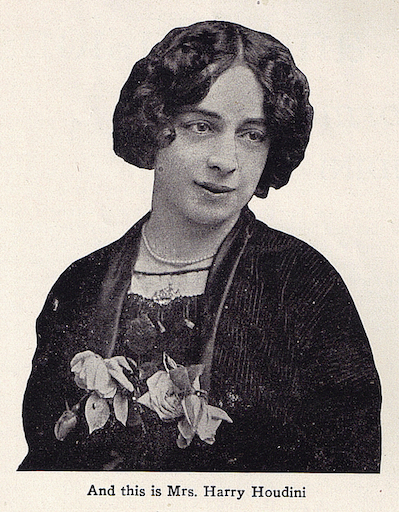
Bess leaves the act in 1908

Today is Bess Houdini's birthday. She was born January 23, 1876 in Brooklyn, New York. For the occasion, I thought I'd share a piece of information I only recently discovered. I've always wondered when Bess officially left the act. This clipping from the June 13, 1908 issue of Variety finally provided the answer.

Variety June 13, 1908

Bess made a brief comeback in 1914 doing Metamorphosis in the short-lived Grand Magical Revue. Houdini wrote in his diary that she was "magnificent" and "working as though she never retired." Bess would then periodically return to assist her husband on special occasions, such as a 1922 S.A.M. banquet attended by Sir Arthur Conan Doyle where the Houdinis used his coat during Metamorphosis.

In 1925, Bess returned and became a full-time part of Houdini's 3 Shows in One. In fact, she was so much a part of the show, she even had her own poster.


Happy birthday Bess!

Related:

Saturday, February 24, 2018

Into The Copperfield Zone, Part II

On Tuesday, February 13, I had the extreme honor of visiting David Copperfield's International Museum and Library of the Conjuring Arts in Las Vegas. In PART I, we went as far as the famous Houdini display, and this is normally the grand finale. But then David said, "Just wait. You haven't seen anything yet." He was so right...


Leaving Houdini behind (not an easy thing to do!), David and I entered what is to be the expansion of the museum. Here two assistants and the tireless Mikayla were at work sorting what appeared to be a recently acquired magic collection (or perhaps just unsorted items of David's own collection). Racks of magic books stood on one side of the room and select piles of ephemera covered the floor. This was the "mess" David had warned me about, but I thought it was glorious! I was seeing items being discovered and shown to David on the spot. One item that caught his eye was a program for Man of Magic, which he directed to the "Houdini stuff." There was also an original UK playbill featuring the Water Torture Cell, and David was excited to point out that the illustration was unlike any other -- the monster holding down the stocks was not the "giant" we normally see.

David then showed me where the new Houdini area will be. It's probably three times the size of the old section. He pointed out where Houdini's bookcase and "ice-filled" bathtub from 278 will sit (these are not yet in Vegas). Sitting against that wall at the moment were several gigantic Houdini posters, including the only known Overboard Box Escape poster, which came from the Norm Nielsen collection. This is a poster that has never been reproduced in color and it's a beauty! There was also a gigantic straitjacket poster [remember David Copperfield has a big one], a poster for The Grim Game, and a French poster for The Master Mystery. There may have been more which I overlooked, if you can believe that!

Also sitting against the wall was something I noticed was conspicuously absent from the Houdini display; the Double-Fold Death Defying Mystery chest. Next to the Water Torture Cell, I'd rank this as the most important piece of surviving Houdini escape apparatus. But unlike the USD, it's all still original! David acquired the chest at auction in 2014 for a cool $55,000. I was dying to see inside, so I asked David if this was possible. His answer: "Of course!"


David called over Mikayla and she and I lifted the heavy lid. Inside was the canvas transport sack. There was also a ring stain on the bottom where Houdini's Milk Can once sat. This was exactly what I had hoped to see. (I still contend the Double-Fold Milk Can is currently sitting in an uncaring Santa Monica coin shop.)

Now, I have to be careful because I don't reveal secrets on WAH, but I explained to David that while I knew in principle how the effect worked, I didn't know how it worked in practice (and if that's confusing, good!). We were missing a certain something that would help reveal the secret, but certainly we could discover it on close examination, right? Well, David, Mikayla and I poked and prodded and searched all sides, turning everything upside down and sideways, and we could NOT discern any means by which Houdini escaped from the chest, let alone a Milk Can at the same time. We were all on our hands and knees at one point! We actually had to give up, and this delighted me. Here a 108-year-old piece of Houdini-Collins apparatus had held its secret against the ultimate committee. Bravo!

During the tour, David hadn't told me what I would see. I simply followed him room to room. Now I followed him beyond this work area into a private office, and then beyond that into a small side room. In here were several huge safes, the kind Houdini himself would escape from. This was by no means part of the normal tour, and I held my breath as David stepped up to an enormous vault door at the end of the room. He didn't even ask me to look away as he keyed in the combination, but I looked away anyway--I don't need to know such things!

The vault door swung open and we stepped inside. Now I understood why David kept saying, "You haven't seen anything yet." Here were racks filled with foot high stacks of original Houdini posters, photos, and challenges. I recognized one photo that had recently sold in auction sitting on top. Rows of file boxes filled an entire wall, each neatly labeled with their precious contents: "Houdini Letters," "Houdini Scrapbooks," "Houdini Bibles", "Conan Doyle Correspondence", etc. Somehow I wasn't able to commit to memory, or even read, all I was seeing. I was just too overwhelmed. Houdini's own words came to me when he described seeing the collection of Henry Evans Evanion: "I remember only raising my hands before my eyes, as if I had been dazzled by a sudden shower of diamonds."

I now kick myself for not taking a photo, even just one to illustrate this blog or to later read what was written on those file boxes. But one doesn't take photos inside Fort Knox. And I was clearly inside a Fort Knox of magic.

David then pointed to a small square black box sitting in the corner and asked if I knew what that was. The first thing that leapt to mind was De Kolta's Cube (a.k.a. The Expanding Die). But just as quickly, I dismissed that as impossible. If David Copperfield owned De Kolta's Cube, we would all know about it. It would be discussed in the same breath as the Water Torture Cell and written up in magic journals. And it would not be in here. It would be sequestered in it's own isolation chamber, guarded like Hannibal Lecter or the Hope Diamond. Far too dangerous and valuable to be within the reach of humans. So this was not De Kolta's Cube. But it would be something cool. So I answered, "No."

"It's De Kolta's Cube," said David.

Remember that scene in Jaws when Sheriff Brody sees the Kitchener boy eaten by the shark in one bloody gulp, and Spielberg uses a special camera move called a dolly-counter-zoom that warps the world around Brody and isolates him in a vortex of pure and utter shock? That was me.


Okay, time out for a quick bit of history. Buatier de Kolta was a French magician and a brilliant illusion builder who died in 1903. One of his last creations was an effect in which a cube (or die) would be sat on a table, and then on command would instantly and visibly expand to many times its size. De Kolta would then lift the cube to reveal his wife inside. By all accounts it was a masterpiece in both presentation and construction, and it became a legend in it's own time. Even today it is praised as one of magic's finest creations.

Houdini purchased De Kolta's Cube in 1913 to feature in his Grand Magical Revue the following year. It would be a standout effect of his first attempt to get away from escapes and establish himself as a master magician -- "The Supreme Ruler of Mystery." But Houdini only performed De Kolta's Cube a few times (Gresham claims only once). It isn't exactly clear why, but the complex mechanics took a full hour to prepare, and if not prepared precisely right, it might not expand. Or maybe it would expand when you didn't want it to! Still, Houdini kept the effect in his collection as an important piece of magic history. I like to think of it as the trick that even intimidated Houdini. And now here it was in front of me.

"You can open it if you want," said David.

The idea of opening this Pandora's box spooked me. If it was unpredictable when new, what would it be like 100+ years later? But how could I not! So I got down on my knees and flipped open the latch and lifted the hinged lid. Inside was a leather case nested tightly within. There was a handwritten note sitting on top saying the case was made by Houdini himself. I wasn't sure how best to get that out, but David said to just lift it by the handle. A new wave of apprehension came over me as I could imagine the aged handle ripping off in my hand. But I took hold and lifted. One revelation I'll share about De Kolta's Cube, it is HEAVY!

I had to turn around in the small space and sit the case down on the floor between David and I. I was a bit too timid with the hasp on the front, so David knelt down and undid it for me. The case is made in such a way that the lid lifts and the front falls forward, so you can see the cube without having to extract it fully from the case (thank you, Harry). I folded it open and there before me was De Kolta's Cube, black with white dots, held in its tightly compressed state by a few old straps and hatpins. Who knows how long it had been since this had been opened, and I had a real fear that it would suddenly expand, crushing both David and I and destroying all the precious Houdini artifacts in the room. I looked up and saw David's eyes were as big as mine, and I had a feeling he might have been thinking the exact same thing! I asked if he had ever performed it. He just shook his head and said he hadn't, he was too afraid it would "blow apart."

With some relief, I closed it back up and returned it to its case. (A full explanation of the cube and its workings can be found in Will Goldston's Exclusive Magical Secrets, the publication of which infuriated Houdini.)

I was still reeling when David reached up and plucked down a file box from the shelf. He opened it and slid from within a smaller box containing a spirit slate complete with a chalk written message in Houdini's own hand. I just couldn't handle it anymore and I blurted out (hopefully not too rudely), "No way. That can't be real!" David just smiled and returned it to its box and said, "There's a whole story behind it."

We then started sifting through the stacks of posters, retrieving a beautiful poster for the Grand Magical Revue to see if it included a mention of De Kolta's Cube (this one did not). David then said he'd be happy for me to come back sometime so I could go through all this vaulted material. He'd even set up a few tables for me out in the work area.

Once again, I was Sheriff Brody.

Oh, did I mention the bound set of all of Robert-Houdin's personal diaries and Michael Curtiz's Oscar for Casablanca? Yeah, those were in here too.

After locking up the vault, we returned to the normal museum and David showed me one last surprise. Until his show, I didn't know David had started as a ventriloquist. "A bad one," he admits. Now we entered a room filled with vintage ventriloquist dummies, some of which were quite famous, such as Edgar Bergen's Charlie McCarthy and Wayland Flowers' Madame. But what really caught my attention were the original dummies from one of my favorite episodes of The Twilight Zone. It's the episode in which a ventriloquist played by Cliff Robertson is driven mad by his own dummy, and in the end he becomes a dummy himself. David not only has the abusive dummy, but he has the dummy that Robertson became in the end. The artist forever imprisoned within his obsession.

So there I was, standing in a Las Vegas warehouse at 1:30 AM beside the world's most famous living magician, surrounded by hundreds of grinning ventriloquist dummies. I had truly entered...The Copperfield Zone.

I woke up the next morning in my room at the MGM Grand, with the massive visage of David Copperfield staring in at me through the window. Was it all a dream? It very well could have been! But now it was time to get back to the real world.

As I showered, all I could think about was De Kolta's Cube. That seemed to sum up the whole experience for me. I was allowed to go as deep as I dared into a special world of magic and mystery to see something very few have ever seen. I still don't know what I did to deserve such trust from David and his team, but I'm eternally grateful.

I fired off a short thank you email to David and Chris Kenner, then packed up my computer and bag and left.

But I had one last stop to make. I had resolved to visit the "showroom" location of Houdini's Magic Shop on Dean Martin Drive. Inside was a display case of nice Houdini artifacts, including a letter from Hardeen talking about Bessie's funeral (finally I was able to add that date to my A.D. chronology). But not unlike my visit to New York and 278, after being inside Houdini's bathroom, there wasn't much that could wow me the next day.


After taking a few photos and chatting with the friendly magician at the counter, I climbed back into my car. But before hitting the road for the drive back to L.A., I quickly checked my email and saw I had received a reply from David himself. It was just a single line...


Related:
    Sunday, May 15, 2016

    A forgotten Houdini assistant?

    Recently I received an email from Ruth Owen in the UK who tells me family lore claims her grandmother, Ellen Cook, assisted Houdini while he was performing in Yorkshire in 1914.

    Had Ruth mentioned any other year, I would have been skeptical. As we know, Houdini primarily used male assistants or Bess during the bulk of his career. But 1914 was the year Houdini experimented with his "Grand Magical Revue" in the UK, and in that show he would have used female assistants for illusions such as "Goodbye Winter" and "The Arrival of Summer." So was Ellen Cook one of them? Here's what Ruth's mother recorded:

    "Eventually Mum obtained a post at Barnsley Empire Theatre. She used to tell us that one of the highlights was when she assisted Houdini in his spectacular escapology feats. Photographs of her then show fine features and long, thick, black hair styled in a bun. 
    Lucky for me that she was in that place, at the time, or I would not be writing this! For it was at the Empire that my father, Christopher Musgrave, first saw her assisting Houdini."

    To investigate this further, I turned to Derek Tait, the true expert on Houdini in the UK (watch for Derek's The Great Houdini: The British Tours coming this year). Derek tells me Houdini did appear twice in Yorkshire in 1914. Between February 16 and 21 he played the Empire Theater in Leeds. Later he played the Palace Theatre in Hull from April 27 to May 2, where he did indeed present the Grand Magical Revue. However, there is no record of Houdini in Barnsley.

    So we have the right time, the right region, the right type of act, but not the right theater. But that doesn't preclude the possibly that Ellen Cook is a forgotten Houdini assistant. We'll just need to keep digging

    This has also set me to thinking about Houdini's Grand Magical Revue. The idea that Houdini would have had to have used new female assistants never occurred to me before. (Unless Bess worked each illusion with him?) Houdini may have hired his "box jumpers" regionally, so there may be a few Ellen Cook's out there.

    Thanks to Ruth Owen and Derek Tait.

    Related:

    Thursday, April 2, 2015

    "Come up and see me magisch."

    In all The Grim Game excitement, this one fell off my radar, but Joe Notaro at HHCE reminds me that a rare playbill for Houdini's "Grand Magical Revue" sold last month at Bloomsbury Auctions in the UK for a healthy £6,500 ($9,660). The auction estimate was £2,000-£4,000.

    The playbill measures 30 x 20ins and is inscribed by Houdini: "My dear Herwin. Here is one of my bills, it might interest you. Come up and see me 'magisch'"

    The Grand Magical Revue was a magic only act that Houdini mounted in the UK in 1914. As you can see on the poster, he revived Metamorphosis, which brought Bess back into the act for the first time in several years. But theater managers were not enthusiastic about Houdini the magician -- they still wanted the escape artist -- so he folded the show after a short time, possibly doing as few as 10 performances.

    Anything from the Grand Magical Revue is pretty rare, so I'm not surprised this fetched a high price.

    Thank you Joe.

    Wednesday, July 31, 2013

    Houdini's plan to tour East Asia in a 500-seat super car

    "You wanna do what now, boss?"

    One thing that is notable about Houdini's career is that he never performed in Asia. Many magicians of the time made tours of countries like China, Japan and India, scoring great success and coming back to the West with trunks full of exotic bragging rights. Some performers like Dante and Murray made world touring their life's work. But apart from his 1910 Australian tour, Houdini confined himself to North America and Europe.

    However, an article in a July 1914 New York Dramatic Mirror reveals that Houdini was indeed planning to tour East Asia at the beginning of 1915. His plans were, of course, pure Houdini. In an article titled "How Harry Houdini Picked the Lock of Success", the paper reports:

    Houdini plans to sail to the Continent in January, crossing to Russia and going by way of the Trans-Siberian Railroad to Japan. While he is an excellent swimmer, he doesn't like sea travel, and is going as far as possible by land. He is now having a huge motor car constructed according to his own ideas for a trip into the interior of Japan and China. The car will be built so that it can be opened to six times its own length, and will seat 500 people. With the van open and a stage arranged in front of the seats, Houdini can give entertainments at will.

    One thing that should be pointed out is that the Trans-Siberian terminates in Beijing (then Peking), not Japan, so one wonders how Houdini and his 500-seat super car would deal with the body of water that separates China and Japan.

    While it sounds wild, I do believe this East Asia tour was on the level. In fact, I expect the roadshow Houdini was going to present would have been his Grand Magical Revue, which he was performing at this time. This is especially interesting as it's evidence that Houdini was planning his evolution from Vaudeville headliner to touring magician as early as 1915.

    So what happened to Houdini's ambitious plans? It seems likely that World War I scuttled the idea. The war broke out on July 28, 1914, just a few weeks after this article was published. Houdini would not even be able to travel back to the UK until 1920. He would remain in the U.S. and in Vaudeville for the duration of the war, and would not head up his own roadshow until 1925.

    It's too bad, because oh what a chapter in the Houdini story this super car tour would have made! Thanks a lot, War. Now it's personal.

    Thanks to Steve Knight at The Magic Cafe forums for putting on the path to this discovery.

    Friday, March 8, 2013

    Houdini nods in Disney's new OZ

    Houdini gets a few nice nods in the new movie, OZ The Great and Powerful, which is released today by Disney. The movie is a prequel to the 1939 classic The Wizard of Oz and tells the origin story of the Wizard as well as the Wicked Witch. Lance Burton is credited as the film's magic consultant.

    In the early part of the film (which is in black and white and a 1:33 aspect ratio) there are two Houdini playbills on the wall of the traveling circus wagon belonging to magician Oscar Diggs a.k.a. "Oz" played by James Franco. If you have an eagle eye, you can identify the first as an advert for Houdini's short-lived Grand Magical Revue of 1914. The other playbill is actually a Hardeen advert with Hardeen's name masked off. However, Princess Yvonne's name is still visible and gives it away.

    Houdini/Hardeen playbills spotted in OZ.

    During these same opening scenes, Oscar/Franco gives Houdini himself a nice name-check when he says, "I want to be Harry Houdini and Thomas Edison all rolled into one."

    Of course, Franco could have said he wants to be a combination of Harry Keller and Thomas Edison. It's said that Oz author L. Frank Baum modeled his wizard on Kellar, who was then the leading American magician of the day. But I won't deny Houdini the honor. By the way, Baum wrote his OZ novels in a house he called Ozcot, which sat very close to what is today The Magic Castle.

    Houdini with OZ inspiration Harry Kellar (NYPL)

    While maybe not a deliberate nod to Houdini, it's also worth noting that James Franco's costume bears a striking resemblance to a famous photo of Houdini. If you think I'm looking too hard, know that this same Houdini photo was used as the bases for the costume worn by Harvey Keitel in FairyTale: A True Story, so we know it's a reference photo Hollywood costumer designers have used to in the past. Just saying...


    OZ The Great and Powerful co-stars Rachel Weisz as Evanora, and we all know about Rachel's Houdini connection. The magnificent score was composed by Danny Elfman who was originally hired to write the music for the upcoming Houdini Broadway musical. Finally, Mila Kunis, who plays Theodora, once starred in a movie written by a familiar Houdini enthusiast...

    For the record, I really enjoyed OZ The Great and Powerful, even beyond the nods to our Harry. I hope we get more OZ adventures from the Mouse House.

    Tuesday, June 12, 2012

    Houdini's watch sells for $25,000

    An 18K gold pocket watch given to Houdini by his English agent, Harry Day, sold at Bonhams today for $25,000 (including buyers premium). The watch beat its auction estimate of $10,000 - $15,000.

    Described as a "hunter cased minute repeating chronograph with calendar and moon phases", the watch carries an inscription showing it was given to Houdini by Day in May 1914. This was right at the time Houdini was performing his "Grand Magical Revue" in England. It was also Houdini's last tour of the UK before the outbreak of World War I, so it's possible this was a farewell gift from Day.

    According to the auction, after Houdini's death the watch was given to his nephew, Harry White.

    Wednesday, March 9, 2011

    John Gaughan performs 'Goodbye Winter' at The Magic Castle

    Last night I had the pleasure of attending The Magic Castle's special Magic History Week showcase, and I'm happy to report that Houdini is well represented. Not only does his photo grace the Magic History Week program (below), but legendary illusion builder John Gaughan performed one of Houdini's lesser-known stage illusions, Goodbye Winter, in the Palace of Mystery.

    In the trick, an assistant (in this case the attractive Vanessa Lauren) vanishes atop a tall table after she's covered with a simple curtained frame. Houdini's own description of the effect reads: "Vanishing a living, breathing human being in mid-air, in the center of the Stage, away from all curtains and in full glare of lights in less than One Millionth of a Second."

    Houdini first introduced Goodbye Winter as part of his 1914 "Magical Revue." He revived it in 1922, along with the Vanishing Elephant, during live appearances at the Times Square Theater in New York to promote his film, The Man From Beyond. He later incorporated it into the magic portion of his 1925/26 full evening show under the new name, Wintertime.

    It's really a remarkably effective trick, very simple and direct in design and presentation. It tells me Houdini brought his escape act philosophy to his stage magic -- keep the props simple and relatable and present it in full view of the audience (meaning natural stage lighting). One minute she is there and next she is gone. Simple and baffling! A large reproduction of the "Houdini For President" lithograph graced the stage during the effect. John later told me the Goodbye Winter apparatus is authentic in design, but the patter Houdini used in unknown.

    Even though the trick was created for Houdini by Charles Morritt, seeing an authentic Houdini stage illusion makes me what to argue with a little more passion that his reputation as a magician deserves more respect.

    However, as effective as Houdini's Goodbye Winter was, it was John's presentation of Robert-Houdin's trapeze automaton, Antonio, that truly stole the show. It's just amazing how a trick created in 1848 could completely captivate an audience in 2011.

    The Palace show was MC'd by Mike Caveney, who performed Paul Valadon's "The Drum that Can't Be Beat" and "Well, I'm...!". Closing the show was a remarkable performance by actor and magician Jonathan Levit playing Howard Thurston under the technical direction of Jim Steinmeyer. Using authentic props and patter, "Thurston" presented The Cards of the Air and Sawing a Woman in Halves. Maybe I'm just a big magic history nerd, but I found the original Sawing a Woman more entertaining, amusing, and baffling that any modern interpretation.

    Also as part of Magic History Week is the lovely Lisa Cousins, who performs elegant and authentic antique magic in the Parlour of Prestidigitation. Houdini gets some attention here as well as Lisa's act includes an early version of The Flight of Time, which was later modernized and performed by both Houdini and Hardeen.

    The Magic Castle's Magic History Week is presented by The Los Angeles Conference of Magic History and continues through March 13. It is a must see! In fact, I just might go back and see it again.

    Translate