Showing posts with label Dunninger. Show all posts

Wednesday, August 5, 2026

Houdini's Shelton pool test at 100


"If I die, it will be the will of God and my own foolishness." - Houdini

Today marks the 100th anniversary of Houdini's famous "Buried Alive" test at the Hotel Shelton in New York on August 5, 1926. It was a very different kind of Houdini stunt, as it did not involve any kind of escape. But it was every bit as miraculous, and it garnered Houdini some of the last headlines of his career. It all began with a man named Rahman Bey.

Rahman Bey was an Egyptian fakir who performed feats such as piercing his cheek with a needle, stopping his pulse, and having himself buried alive. Bey was promoted and championed by Hereward Carrington, Houdini's nemesis from the Margery committee, who also acted as his master of ceremonies. Carrington attributed Bey's abilities to mystic powers and his survival in his buried-alive coffin to "a cataleptic trance."

Bey's feats were nothing new to Houdini. They were the standard sideshow fare that he had exposed in his book Miracle Mongers and Their Methods. To prove Bey accomplished his feats by natural means, Houdini offered to repeat his signature stunt of being buried alive. He told the Evening World: "I guarantee to remain in any coffin that the fakir does for the same length of time he does, without going into any cataleptic trance."

Bey normally remained in his casket for 8-10 minutes. But spurred by Houdini's words, he stayed for a full hour while submerged in the swimming pool at the Hotel Dalton. The challenge was on.

Houdini went into training, shedding 13 pounds and working to get his lungs "accustomed to battle without air." With Dr. W.J. McConnell watching over him, he conducted practice tests in the back room of the Boyertown Burial Casket Co., which had provided Bey's casket. Houdini remained in his casket for an hour and ten minutes, but he did not trust the results. He suspected air had somehow seeped inside. So he repeated the test a few days later, submerged in water. What stood out for him during both tests was his increased irritability; but he otherwise felt confident he could duplicate Bey's feat.

Temperature readings from Houdini's second practice test.

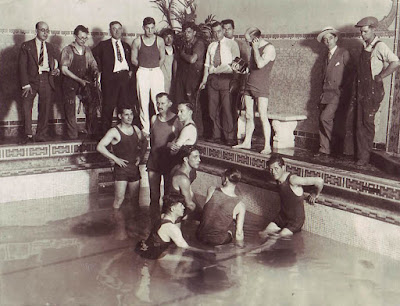
Houdini's public test would take place at the Hotel Shelton on Lexington Ave. in New York City, which had a large indoor swimming pool. Houdini sent out invitations to press, friends, and scientists. Among the gathering was mentalist Joseph Dunninger, who can be spotted in some of the event photos, and Houdini's boyhood friend and fellow psychic investigator, Joseph Rinn. Even the hated Hereward Carrington was there to watch the demonstration.

The Boyertown Company provided a new casket that held 34.398 cubic inches of air (larger than Houdini's practice casket). Still, physicians estimated that a human being could only survive for three to four minutes as the container would rapidly fill with carbon dioxide. The coffin was equipped with an alarm bell and a telephone so Houdini could communicate with his assistant Jim Collins on the surface. Houdini's one major concern on arriving was that the pool area was overly warm.


Houdini stripped down to a pair of black shorts. He was then examined by Dr. McConnell, who measured his pulse, respiration, and blood pressure. Just after noon, Houdini lay down in the casket, and the lid was soldered into place. Portholes on the lid were screwed shut, making the casket air-tight. It was then lowered into the pool where it stubbornly remained on the surface until several men stood on the lid to sink it to the bottom.

Because of the warmth, Houdini was not as comfortable as he had been during his practice sessions, and his irritability was "pronounced." At regular intervals, his assistants would gently rock the casket to circulate the air inside. During one of these sessions, an assistant fell off, causing the casket to shoot to the surface and nearly overturn. Houdini feared the casket had sprung a leak. Because the lid had been soldered into place, a serious rupture could see him drown before he could ever be released. The incident left Houdini angry and gasping for air. He had only been sealed for a half hour.

Settling back to the pool bottom, Houdini concentrated on controlling his breathing. Collins relayed the time to him every minute. After 50 minutes, Houdini began panting and was unsure he could remain even for an hour. He repositioned himself at the foot of the casket, recalling from his test data that the air there was a little cooler. He began to taste metal in his mouth. He also felt wetness around his head and realized the coffin was indeed leaking. Finally, the bell rang, announcing to all that one hour had elapsed.

Having beaten Bey's time, Collins asked Houdini if he wanted to be brought up. But Houdini wanted to try and beat Bey's time by at least 15 minutes. The temperature in the casket was now 99.8 degrees. But Houdini found a second wind and remained well past his 15-minute goal. At one hour and twenty-eight minutes, he began seeing yellow lights. He wedged himself sideways, propping the phone against his ear as he began to feel drowsy. Fearing he might fall asleep, he told Collins to haul him up at the one-hour thirty-minute mark no matter what.

At the appointed time, the coffin was raised, and the portholes quickly unscrewed. Houdini said he could feel the rush of air lift him off his back. Tinsmiths then got to work peeling open the casket. Houdini emerged drenched in sweat and, according to some, looking "deathly white."

He had remained sealed for 91 minutes.


Houdini had gone to the brink. His pulse rate had soared, and the yellow lights he was seeing meant his brain was dangerously oxygen-deprived. According to some, he was within minutes of death. But despite feeling weak and with the metallic taste still in his mouth, that afternoon he went to the YMCA where he spent an hour playing handball and sprinting on an indoor track.

The next day, news of Houdini's feat was reported nationally. The Brooklyn Eagle hired an Egyptian to interview Bey. That's when it was discovered that the fakir did not understand Arabic. Rahman Bey, it turned out, was Italian.

Houdini thought the practical application of his methods could help people in need, such as miners who might become trapped in a collapse. He shared his training data with the U.S. Bureau of Mines. Houdini biographer William Lindsey Gresham tells of how, not long after the test, a family became trapped in their car after it had run off a bridge and into the water. The father instructed his wife and kids to breathe evenly and slowly and not panic, just like Houdini in the Shelton pool. When the car was hoisted out, the family was found alive and well.


Still, some speculated that Houdini might have cheated in his Shelton Test. Some thought the telephone wires could have concealed air hoses. Hereward Carrington suggested the batteries for the emergency bell might have contained oxygen-liberating chemicals and soda lime to absorb the CO2. But Houdini wrote to a friend that no tricks had been employed:
"There is a rumor going around that there is a gimmick to this thing. I pledge my word of honor there isn't a thing to it excepting to lie down and keep quiet."
Houdini repeated his test at the Worcester YMCA on September 28, 1926, this time remaining submerged for one hour and eleven minutes. He then gave a public demonstration at the Summerfield's Furniture store in Worcester using a new coffin with a glass top so the public could see him inside.

Trading on the publicity, Houdini introduced a "Buried Alive" escape into his full evening show for its 1926-27 tour. It was an escape he first developed in 1914 in which he was locked in a casket and buried under "one ton" of sand. The new poster he had made for the effect boasted: "Egyptian Fakirs Outdone!"

The Shelton casket remained poolside for some 20 years, advertised as "the casket Houdini was buried alive in." On February 7, 1956, James Randi undertook to prove once and for all that Houdini used no trickery in his test. Randi, who was younger and weighed less than Houdini, remained sealed in a similar casket in the Shelton pool for one hour and forty-five minutes.

The Hotel Shelton still stands at 525 Lexington Avenue. Today it is student housingThe pool was filled in in the early 2000s, but it's said the original tiled ladder in the corner where Houdini was submerged remains. A small reminder of Houdini's miracle at the Shelton pool...100 years ago today.
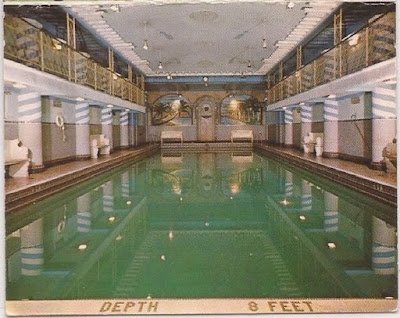
The Shelton pool in the 1950s.

Shelton Pool Test Special! In honor of today's anniversary, I am offering one copy of Escaping Obscurity: The Travel Diary of Harry Houdini, 1897-1899, for $91. That's a dollar per minute and 27% off the normal cover price. So if you haven't gotten the book yet, now may be the time to take the plunge! (SOLD)

This is an updated post first published on August 5, 2016.

Related:

Monday, February 23, 2026

LINK: Dunninger tells dramatic stories about Houdini’s Death

Our friend Joe Notaro has added the October 26, 1952 Parade Magazine to his collection. This issue contains an article about Houdini and Joe Dunninger by Hy Gardner. Many wild tales here, but are any of them true? This one is a must-read, so click on over to Harry Houdini Circumstantial Evidence.

Related:

Tuesday, June 3, 2025

Deconstructing Houdini '53: Pagoda Torture Cell

HAPPY BIRTHDAY, TONY CURTIS! Let's celebrate what would have been Tony's 100th by continuing our scene-by-scene dissection of Houdini (1953). Last time we went to a seance. Now Houdini gets back to business...

Chapter 22: Pagoda Torture Cell

We now enter the final act of Houdini (1953). It starts with Bess arriving at a theater advertising Houdini's return. Much to her alarm, she sees a large poster for the "Pagoda Torture Cell." Beside it is a sign reading, "Opening Tomorrow Night, Halloween." Fate is screaming out at Bess (and us) from the theater front. 

It's a shame we don't see the theater name. But we know this is New York, not Detroit, and based on the Variety headline we saw in the preceding montage, this is Halloween 1925, not 1926. So the movie is taking liberties in the buildup to the big climax.

As Bess dashes into the lobby, a janitor tells her Houdini is not at the theater; he's at "Sherman Ironworks on 14th Street." Notice there is a Houdini handcuff case on display in the lobby with a man looking at it. Before high-resolution, I wondered if this could be a cameo by Joseph Dunninger. It resembles him, and what is a great idea, especially as Dunninger knew Houdini in these final years. But I can now see it's just an extra, dang-it.


Bess arrives at Sherman Ironworks, which is not rooted in any real Houdini history. Houdini's workshop was in New Jersey. There, Bess finds Harry and Otto working on the large glass Pagoda Torture Cell. Bess folds her arms and says. "So this is why you kept me in the country all week." Bess spending time in the country while Harry worked in New York is rooted in Houdini history. In fact, I'm pretty sure Bess was in the country when Houdini performed his famous Shelton Pool Test.


Houdini says they just wanted to see if it was "workable." Bess calls him out on this, saying she has been to the theater and it's "plastered all over the front." Houdini shrugs and says he's done water escapes before; this is nothing different.

"Nothing different?" says Bess, "It's an exact copy of Von Schweger's man in the bottle. It's what killed him. Don't you understand, Harry? It's what killed him."


Wait a minute. While this is a copy of the model Harry received as a gift from the late Von Schweger (see Chapter 15), Otto said nothing about it having anything to do with Von Schweger's death. I can only assume that Bess means Von Schweger's obsession with his "man in the bottle" trick isolated him and led to a collapse in health, hence "killing" him?

Notice that Bess does not mention the fact that Harry is planning this for Halloween. Remember her warning before the ice escape in Detroit: "That's not your day." But this would have been redundant, and there is something smart about letting the audience see this red flag without having to articulate it once again.

Harry says he's not worked before an audience in two years (further muddying the timeline as established in the montage), and he has to give them something new. "People aren't going to stand in line to watch me pull rabbits out of a hat," he says. This line reminds us of the poster that stood on Harry's platform at Schultz's Dime Museum. A rabbit from a hat was enough for audiences back then. But now Houdini and the world have lost their innocence. Both have hardened like the iron we see and hear being forged all around them.

Harry and Bess then address the key underlying issue, and we have this excellent exchange:

BESS
Why? Why must every act you do be flirting with death?

HARRY
Because it's the only act that'll hold an audience spellbound. People fall asleep at the opera, but they stay wide awake at the bullfights. Because there's one man defying death down in that arena. You take this out of my act and I'm nothing.

BESS
You keep it in and we're both nothing.

It's a standoff. Notice the X on the glass of the cell between them during this confrontation. A clever visual that separates them and marks the cell as the ultimate object of their core conflict.


Harry chooses death. He tells Otto, "Have this sent to the theater. We'll test it for tomorrow's performance." Even Otto, the enabler, seems upset by this decision. Houdini snaps at him, "Well, what are you standing there for?" Bess turns and leaves. Everyone is at odds as we head into the final show.

By the way, I've always thought Otto looked more like Houdini in his famous workshop photos than Tony Curtis, amiright?


Houdini (1953) presents the "Pagoda Torture Cell" as Houdini's final creation at the end of his career. That is far from the truth. Houdini debuted his Water Torture Cell, later known as The Chinese Water Torture Cell, in 1912, midway through his career, and he performed it hundreds of times. But it was still Houdini's penultimate stage escape, just as it is here.

Contrast this with the Houdini Miniseries of 2014, in which the Water Torture Cell is presented as Houdini's first major stage escape. That movie has nowhere to go (and it doesn't). So, as far as old-fashioned drama is concerned, making the Torture Cell Houdini's final escape is a great way to build up its importance...and menace.

Friday, April 12, 2024

Own a replica Steel Straitjacket from Houdini '53


One of the standout escapes in the 1953 Houdini biopic is when Houdini frees himself from a "steel straitjacket." The steel straitjacket is a one-of-a-kind piece of magic apparatus provided by Joseph Dunninger. While I've never found any account of the real Houdini doing such an escape, it has become iconic in its own right.

Now, our friend Richard Sherry of Sherry and Krall Magic has manufactured a beautiful reproduction of the Steel Straitjacket. He has produced a limited run of only TEN jackets that can be purchased gaffed or ungaffed. And, as Tony/Houdini says, I'm sure he used "only the very best steel."

If interested, you can find pricing and details on Richard's website or email him at richard@richardsherrysmagic.com

Wednesday, December 14, 2022

Hear Dunninger inventory his Houdini collection

David Muller, author of Growing Up With Houdini, recently sent me an extraordinary recording of Joseph Dunninger verbally cataloging his entire collection of magic and Houdini artifacts. Dunninger sold his collection to David's father, Henry Muller, in 1967. These rarities were displayed for many years at the Houdini Magical Hall of Fame in Niagara Falls, Canada. 

I shared Dunninger's 29-minute primary inventory for members of my Patreon on Monday. Today I'm posting his 8-minute "supplemental" list unlocked so anyone can listen for FREE. Just click below to go.

Wednesday, November 30, 2022

Houdini's curious cross escape

One of the more unusual pieces of surviving Houdini apparatus is his "Cross Escape." There are actually two crosses. One is gaffed for quick release and was acquired by Sidney Radner from Hardeen. Today it is owned by Teller. The other was acquired by Henry Muller from Dunninger and was displayed for many years at the Houdini Magical Hall of Fame. The photo in the right shows this latter cross as it appeared in the museum. (Fun fact: I now own that mannequin head.)

I admit this particular escape has always perplexed me. The Houdini Magical Hall of Fame described it as "a famous Houdini challenge escape," yet I've never been able to find any account of Houdini ever performing it. The quick release gaff seems more like a spiritualism or magic effect than a Houdini escape, and the overt religiousness doesn't seem to be Houdini's style. Recall how he took offense to Carl Mysto's use of a coffin onstage.

But David Muller recently sent me extraordinary audio of Joseph Dunninger going through the collection he sold to David's father in 1967, describing each piece of apparatus and its history. Here's what he says about the cross:

Dunninger: "The Houdini cross escape, used in Houdini's earlier performances. Made in his museum days. He would be tied to the cross, a screen would be placed in front of it and in a few moments he would liberate himself. It needs some repair as is obvious, but it's of very great historical value as it belonged to Houdini and was one of his first sensational escapes."

Hearing Dunninger call this an effect from Houdini's "museum days" is informative. Maybe this explains why I've not been able to find an account of it? And its similarity to a spiritualism or magic effect fits with the evolution of the escape act.

Teller also describes it as a "carnival item." In an interview Two Magicians One Mic Podcast, in which we get a glimpse of his cross in his "Houdini alcove", Teller says:

Teller: "It's a carnival item. It would be erected on stage and the person who's doing the spiel on the bally would take, usually, a runaway 13 or 14-year-old drug addicted girl, who happens to be with the carnival, and tie her neck and wrists to this cross. And then at the moment when they were trying to turn the tip and bring the whole group into the tent, all of a sudden she would just walk away from it. The ties would be gone."


The cross escape coming from dime museums or carnivals does makes sense. It's even possible Houdini didn't build the effect himself, but acquired it as he did his electric chair. But I'll keep on searching for some account of Houdini doing the escape himself.

In the 1970 BBC documentary The Truth About Houdini, Sidney Radner demonstrated his gaffed cross. This scene was cut scene from the documentary––possibly because The Magic Circle objected to the exposure––and it does not appear in any version of the doc today. But you can watch the full clip as a member of my Patreon below.


Thanks to David Muller for the Dunninger audio and Dan Bowen for the Teller interview alert.

Related:

Thursday, May 19, 2022

The Pecoraro Files

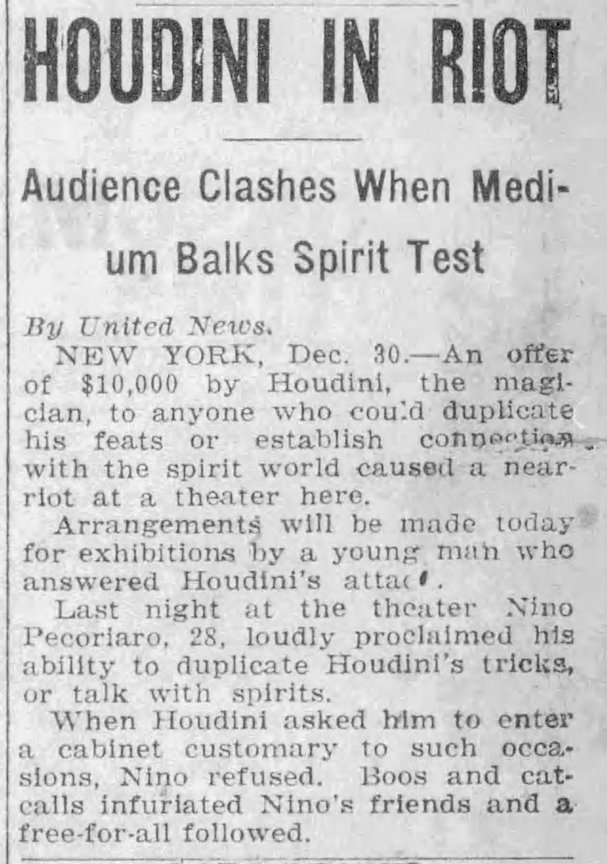
Here's a news item that was widely syndicated in late December 1925. This occurred during Houdini's 3 Shows in One at the National Theater on 41st Street in New York City. An evening with Houdini was never dull!

The Cincinnati Post, Dec. 30, 1925.

Nino Pecoraro (misspelled Pecoriaro in the above) was an Italian spiritualist who claimed his spirit guide was the deceased medium Eusapia Palladino. Pecoraro's reputation was greatly bolstered when he impressed Sir Arthur Conan Doyle during a seance at the offices of the American Psychical Institute in New York City in 1922. However, Doyle was dismayed when full details of the seance appeared in newspapers the next day "with the copyright mark below it, to show that it had been duly paid for."

The incident at the National wasn't Houdini's first encounter with Pecoraro. In 1923 the famed "boy medium" was tested by the Scientific American committee on which Houdini served. Houdini was on tour and did not attend the first two tests, during which Pecoraro impressed the committee with his ability to manifest ghostly phenomena while securely bound. The head of committee, J. Malcolm Bird, who would later collude with Margery, even wondered if the smell of garlic on the Italian's breath could be "celestial garlic." No joke.

Things looked good for Pecoraro. That is until Houdini arrived for the third test on December 18. He was mortified to see the committeemen securing Pecoraro with a single piece of long rope. Houdini cut the rope into pieces and tied the medium himself. That put an end to Pecoraro's ghost show and his shot at the Scientific American prize. (For an excellent account of all this check out The Witch of Lime Street by David Jaher.)

While Houdini biographies all contain the story of the Scientific American tests, none of them mention this follow-up incident at the National. Was it really a "riot"? One thing I find intriguing is the photo below. This shows Houdini and Pecoraro around the time of this confrontation. In fact, Houdini and the young medium took a series of portraits together at a New York photo studio. Why would they do this? Were they planning a public test, as alluded to in the article, that never came to pass? Could the theater incident have been a publicity stunt that got out of hand? There may be an untold story here.


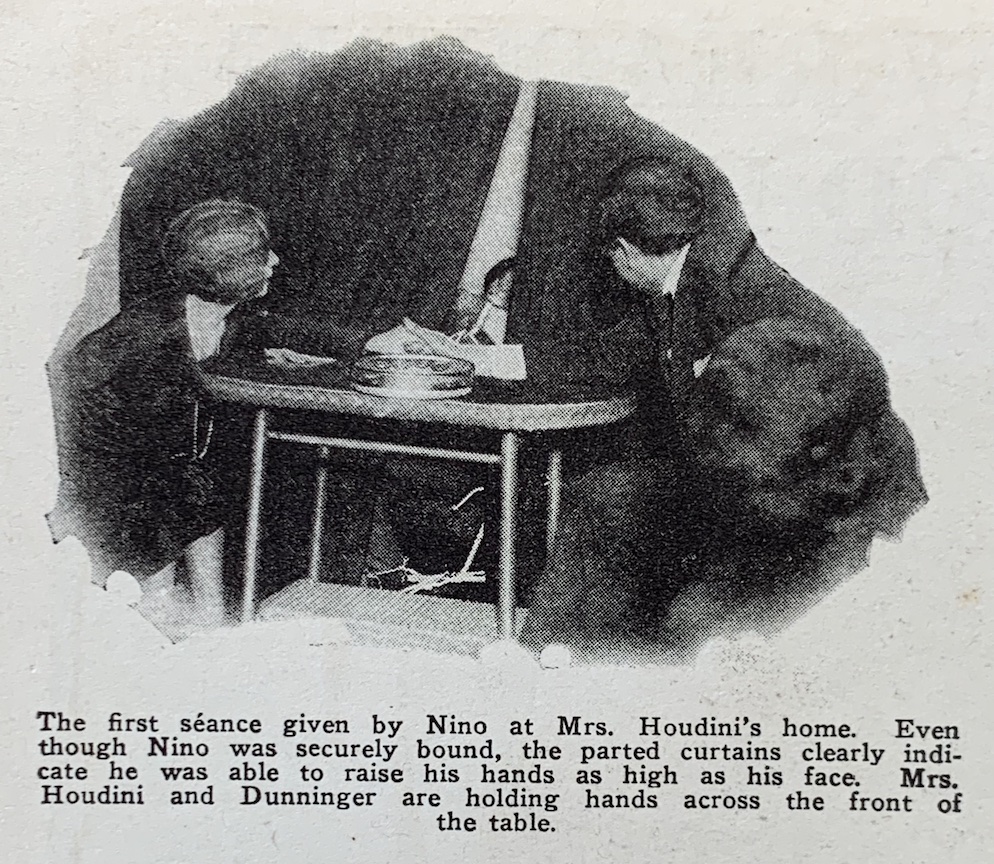
After Houdini's death, Pecoraro gave Bess a private seance at her home on Payson Ave. Joseph Dunninger was also in attendance. Nino went through his regular routine but failed to deliver the all important Houdini Code to Bessie.


In 1928 Pecoraro was at it again. This time the medium offered to produce Houdini's physical spirit at the offices of Science & Invention magazine which offered a $21,000 prize for genuine spirit phenomena. Bess attended the seance and cameramen surrounded Pecoraro's cabinet, ready to snap a photo of the master magician. Nothing happened. "Not Even for $21,000 Would Houdini Show Himself at Seance" read a newspaper headline the next day.

A few days later Joseph Dunninger recreated Pecoraro's seance using trickery for better results. The photo below shows "Houdini" making his reappearance with Bess looking on. Pecoraro's manager, Charles E. Davenport, asserted that Dunninger had mediumistic powers even if he didn't know it.


In 1931 Pecoraro finally confessed to being a fraud. He demonstrated his methods, which included producing a message from Houdini, at a New York press conference. The resulting United Press story is pretty amusing.

The Ogden Standard Examiner, April 9, 1931.

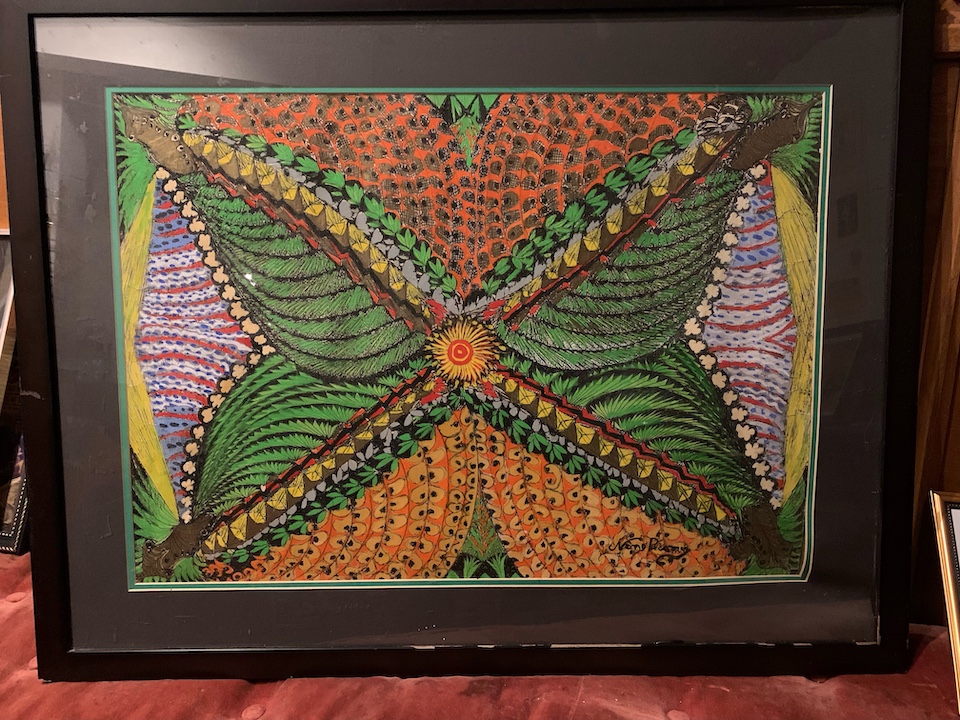
It's unclear if Pecoraro ever did become a cement salesman, but he did continue to paint. In fact, two of his paintings are on exhibit at the Houdini Museum in Scranton, PA.

On April 27, 1973, Pecoraro collapsed while walking with a friend in Naples and died on his way to the hospital. He was 74.

Painting by Nino Pecoraro at the Houdini Museum in Scranton.

Thanks to the Houdini Museum in Scranton for the photo of their Nino painting. Other images come from Houdini: A Pictorial Life by Milbourne Christopher, Houdini's Sprit Exposes by Joseph Dunninger, and Newspapers.com.

Wednesday, May 19, 2021

The Steel Straitjacket

Near the end of Houdini (1953) we see Tony Curtis' Houdini challenged to escape from what the movie calls "a steel straitjacket." It's a terrific escape performed by Curtis without a cut. The "steel straitjacket" was provided by Houdini's technical advisor Joseph Dunninger, who claimed it was used by Houdini himself. Below is a photo of Dunninger with the jacket from the July 26, 1967 Middletown Journal.


The steel straitjacket was purchased along with the rest of the Dunninger collection by Henry Muller in 1967 to supply his Houdini Magical Hall of Fame in Niagara Falls, Canada. The jacket was displayed as the "Armoured Breast Plate" (it was no longer on display when I went to the museum in 1990). After the catastrophic fire of 1995 the steel straitjacket was housed in a warehouse along with the rest of the surviving collection.

One person who remembered seeing the straitjacket in the museum was magician and collector Rob Allen from Niagara Falls, New York. "I always remember seeing it on display there," says Rob. "I would always stop and look at it as I thought it was the most intriguing piece among the Houdini escaped pieces." Following the fire, Rob purchased some items from Henry's warehouse. But there was one item he always coveted. In a November 2007 issue of Magicol, Rob remembered:

After my first purchase from Henry, I met him numerous times, often taking things he owned to sell at Yankee Gatherings and Magic Collectors' Weekends. It was fun for me and I finally told Henry during one of our meetings that I wanted to buy the Steel Straitjacket although I couldn't afford to pay for it at that time.

"Rob, it's yours," he said. "It won't leave the warehouse. When you have the money you can come pick it up."

That day finally came. If I had not arranged to buy it, the Houdini Steel Straitjacket would have been shipped with the rest of the warehouse contents to Hollywood, where the items were auctioned by Butterfield & Butterfield in November 1999.

Happily, Rob still owns the steel straitjacket today. Here's a photo he shared. Still looks fantastic!


But the question remains. Did Houdini really use this? Like the iron overboard box from the movie--also supplied by Dunninger who also claimed it was Houdini's--I've never seen any photo or read any reference to Houdini doing this particular escape. But how great would it be if one day we did find a photo of Houdini in this now iconic restraint?

Until then, we'll have to be satisfied with the scene from the movie (this is copyrighted so may have ads). Enjoy.


Thanks to Joe Fox for his help with the post, and a big thanks to Rob Allen for showing us the steel straitjacket today.

Saturday, April 10, 2021

Deconstructing Houdini '53: Main titles

The 1953 Paramount biopic Houdini with Tony Curtis and Janet Leigh is what ignited my interest in Houdini. While beloved by many, the movie is often criticized for being wildly inaccurate. But I feel differently. While the movie does inject Hollywood fabrications to be sure, I'd argue that the overall plot is generally faithful to Houdini's life and every scene contains elements rooted in reality, or at least the "approved mythology" of the book on which it is based.

I've always dreamed of providing a DVD commentary where I could make my case for the greatness and accuracy of this movie. I've even considered recording my own for upload to YouTube (and still may do). But I've not quite figured out the technology. So I've decided instead to launch a new series here on WILD ABOUT HARRY in which I will "deconstruct" the movie scene by scene, showing where and how it is rooted in Houdini history...and anything else that comes to mind.

So with that, let's begin at the very beginning!

Chapter 1: Main Titles

The Main Titles for Houdini are designed to look like a vaudeville playbill on the outside of a theater. This would have been recognizable to audiences of the 1950s, but it may be lost on a modern viewers today. Topping the bill is, of course, the name of HOUDINI. Right off the bat we have an image rooted in fact. Not only would Houdini's name always top a vaudeville bill, but the multi-color letters match a real Houdini playbill from the era (below). Maybe this match is coincidence. But for a Houdini buff, it offers the first thrill of recognition and is an excellent start to the movie.


It's also satisfying to see the Paramount name and logo at the head of the film as it brings to mind Houdini's own movies The Grim Game and Terror Island, which were distributed by the studio. In a way, one can almost think of Houdini (1953) as Houdini's third Paramount picture.


Now begins the clever effect of moving down the playbill to the other players and contributors in this "HOUDINI" headlined show. Stars Tony Curtis and Janet Leigh are the first names we see. It's interesting to note that Janet Leigh was the bigger star at this time. Houdini was actually Curtis' first lead role. Leigh was under contract to MGM and had to be loaned out at the expense of Paramount. But the studio was eager to feature the newly married couple in their nostalgic and romantic biopic, and Leigh's star-power would bring a name to the movie. It certainly worked out!


With a screenplay by Philip Yordan, Houdini was "Based on a book by Harold Kellock." For our purposes, this may be the most important credit on the bill. The book in question is 1928's Houdini His Life Story, a collaboration between author Harold Kellock and Beatrice Houdini. It was the first Houdini biography and is packed with popular mythology, some of which will find its way into Houdini and later movies. In the 1930s, Bess and her partner/manager Edward Saint shopped the film rights, eventually landing a deal at Paramount. For those who fault Houdini for inaccuracies, you should read those earlier scripts!

That first film was never made and the rights to the book drifted around Hollywood for decades. At one point Gone With The Wind producer David O. Selznick wanted to make the movie with Cary Grant and Alfred Hitchcock. But Paramount reacquired the rights when producer George Pal showed interest. A new script was commissioned and the result is the movie we have today.


A prominent credit for Technicolor was common at this time time as Hollywood was eager to differentiate movies from television and the transition to color was key. But there is also a nice Technicolor connection to the real Houdini. Daniel Comstock, who co-founded Technicolor in 1916, was one of Houdini's allied members on the Scientific American committee during the Margery investigation. In fact, it was Comstock's control device, not Houdini's infamous "Margie Box," that finally prevented the medium from producing her phenomena. Oh, and the color in this movie is gorgeous!


Joseph Dunninger receives a prominent credit as Houdini's Technical Advisor. Dunninger was one of the most famous names in magic at this time and his inclusion in the credits would certainly be noticed by audiences. He was also good friends with Houdini. While Dunninger loaned some props to the production (such as the iron overboard box), the true technical advisor to the film was magician George Boston who taught stars Tony Curtis and Janet Leigh to do magic and oversaw the magic sequences. But Dunninger's name in the credits gave the film its magical gravitas and a nice personal connection to the real Houdini.


Houdini was produced by George Pal, who was one of Paramount's top producers at the time. Like his subject, Pal was Hungarian. He graduated from the Budapest Academy of Arts and made his early movies for Hunnia Films in Budapest. It's interesting to note that Pal was working on his sci-fi classic The War of the Worlds at the same time Houdini was in production. Tony Curtis and Janet Leigh, in costume, were even photographed with Pal and one of the famous Martian flyings saucers.


The playbill ends with a final credit for director George Marshal and the title sequence fades out. When the picture fades back up, we've transitioned to...


Sunday, February 21, 2021

French edition of '100 Houdini Tricks You Can Do'

French publisher Fantaisium has released the 1954 book 100 Houdini Tricks You Can Do by Joseph Dunninger as 100 tours de magie d'Houdini pour tous. Translation is by François Montmirel.

Not sure why they decided to use poster art from The Master Mystery as cover art, but... C'est la vie.

This is latest in a series of reprints from Fantaisium. Last year they released translations of Houdini's A Magician Among the Spirits, The Right Way to Do Wrong, and Magical Ropes Ties and Escapes (see related link below). They've also released Houdini's Margery pamphlet as Trucs et Astuces des Médiums.

Saturday, November 7, 2020

Growing Up With Houdini by David J. Muller

David Muller, son of the late Henry Muller, has written a new book called Growing Up With Houdini. It's a wonderful work that tells the story of the Muller family and, of course, his father's Houdini Magical Hall of Fame. 


The first part of the book relates the incredible story of how the Muller family fled the Nazis and their native Slovakia to settle in Niagara Falls, Canada, where they established a successful meat selling business. The book then covers in detail the founding and formation of the Houdini Magical Hall of Fame in 1968, along with many photographs and documents. A true highlight is a reproduction of the original inventory of artifacts in the Dunninger collection that made up the bulk of the museum. David also shares a wild early connection between the museum and Doug Henning.

David is taking a unique and generous approach in offering this book. It is not for sale. David gives them away and in exchange asks people to give a donation to their favorite charity in his father's memory.

You can contact David Muller via the website: www.growingupwithhoudini.com.

Saturday, October 31, 2020

The secret origins of the annual Houdini Seance

Today is the 94th anniversary of Houdini's death in 1926. To mark this occasion, let's take a deep dive into a Halloween Houdini tradition.


Halloween typically means Houdini seances galore! But due to the Covid pandemic, many of the annual Houdini seances are skipping this year. So does this break a chain that links all the way back to the first anniversary of Houdini's death? Not really. In fact, the origins of the annual Houdini seances as we've come to know them do not really link back to Houdini nor even Bess, but to a group of magicians in Detroit in 1946. But let's start from the top.

The general belief is that Bess Houdini held seances on the anniversary of her husband's death for 10 consecutive years. This was per an agreement made with Houdini on his deathbed. But even this "10 year compact" is not as clear cut as it seems. For starters, it does not appear Bess held her seances on Halloween at all! The only Bess seances I've been able to uncover were held on April 18, 1928, January 8, 1929 (the Arthur Ford seance), and July 25, 1935.

In fact, all the formality and traditions of the Halloween Houdini Seance really come into existence in the promotional material hyping the Final Houdini Seance of 1936, which in itself evolved from the original idea of being a seance that would try and contact Houdini, Thurston, and Carter with all three widows in attendance. So was there ever a 10 year compact? It's possible Bess elected to do these seances in private. But the public Halloween Houdini Seances as we've come to know them started with this "last" seance of 1936.

It should also be noted that the Final Houdini Seance was, for Bess, FINAL. She wasn't kidding when she announced, "It is finished." In the following years there where several attempts to interest Bess in another seance, one at the famous Winchester Mystery House. But Bess and Edward Saint turned them all down. They were done.

For the next ten years the world seems largely devoid of Houdini seances. Bess and Ed Saint passed away, as did others in Houdini's inner circle. Then in 1946 a group of magicians in Detroit decided to hold a seance to mark the 10 year anniversary of the Final Houdini Seance of 1936. The seance was the idea of Karrell Fox, a popular Detroit magician who would appear on the Ed Sullivan Show and became known as the King of Korn.

Fox told the papers, "Mrs. Houdini saw fit to select intelligent men, with above-average minds, who were not, however, magicians. We believe magicians, of which Houdini was one, will have a better chance of reaching him. For example, Mrs. Houdini had a lot of politicians in the audience. What ghost would want to talk to a politician?"

Fox's idea for a seance may have been prompted by another gathering in Toledo that same month. On October 16, the Rev. Howard Plummer told members of the Toledo Magician's Society that he had made contact with Houdini, and that the escapist had promised to return during a full moon. The Society announced they would make a new attempt in January.

Meanwhile, Fox's seance went forward on Halloween as planned. It was held in the basement of a downtown hotel where Fox operated his shop. His inner circle was made up of 13 men with a 14th chair left empty for Houdini. A pair of handcuffs said to have been used by Houdini and an autographed book and photo were placed on a table.

Exactly at midnight, the men joined hands and Robert Ungerwitter, another Detroit magician, called out to Houdini to show himself. After five minutes of silence, it was concluded the test was unsuccessful and Houdini had not come through. Only magician Al Monrie claimed to have seen something. But on reflection he concluded, "It must have been the flicker of the candle."


As with the announcement of the seance itself, news of the unsuccessful attempt, together with a photo of the 13 magicians, went national. As with the Final Seance of 1936, the Fox seance seemed to prove that Houdni seances, while unsuccessful in contacting Harry, where VERY successful in conjuring publicity.

This publicity did not go unnoticed by other magicians, and the following year, 1947, saw a boom in Houdini Seances. The Mystical Order of Magicians of the Orient (MOMO) held a seance in Japan that garnered news as far away as Massachusetts. A.L. Caroselli, a magic dealer who claimed to have been a close friend of Houdini, held a seance in his Detroit home and also captured headlines. But the two men who really embraced the Houdini seance idea (and publicity) were the two leading magicians of the day, Harry Blackstone and Joseph Dunninger.


Blackstone held his 1947 Houdini seance on the stage of the Nixon Theater in Pittsburgh with a group of magicians and newspaper men. In the center of the table was a lock that Blackstone said Houdini had given him as part of their own compact. If the lock opened, it was a sign that Houdini had returned. But the lock remained closed. As with the Fox seance the year before, the attempt began at midnight.

Meanwhile, in an office of a Manhattan skyscraper, Dunninger headed up what he called the "Waiting for Houdini" committee. The seance was also held at midnight. Dunninger possessed a 10 word code that Houdini had promised to communicate if he could. But the only manifestation during the seance was a telephone call from a man on the other end saying, "Hello this is Harry."

Both the Blackstone and Dunninger seances received press and both men vowed to try again the following year. The annual Houdini seance was on!

In 1948 a new group entered the scene with a seance held in the Greenwich Village apartment of Walter B. Gibson. The seance was sponsored by the recently revived Conjurer's Monthly Magazine, of which Gibson was editor. In attendance was collector Sidney Radner who brought along his "seance cuffs". These were yet another pair of handcuffs Houdini reportedly vowed to open in spirit form. Their attempt was unsuccessful, but the group vowed to make their seance an annual tradition. (This seance is generally seen as the genesis of what is today known as "The Official Houdini Seance".)


Dunninger was back in 1949 for a seance held in Houdini's Harlem home, which brought another dubious phone call from "Harry". Dunninger would continue his seances for the rest of his life, sometimes merging it with members of the 1948 group. Always the showman, Dunninger arrived in a hearse for what would prove to be his final seance at the Houdini Magical Hall of Fame in 1974. 

Blackstone continued his seances as well. But his enthusiasm for the ritual seems to have diminished along with the press. In 1951 he held his seance in a well lit room of the Omaha Herald Building. Sitting with his hands on his padlock and a deck of cards, Blackstone called out, "All right Harry, if you're around, let us know." After a minute and a half, Blackstone decreed the seance concluded. Blackstone entered the great beyond himself in 1965.


Today there are several annual Houdini Seances that have been around long enough to claim their own proud lineage and traditions. And while some claim to link back to Bess, Hardeen, and even Houdini himself, as far as I can tell, they ALL owe their start to the 1946 seance by the King of Korn, Karrell Fox. The secret origin of the annual Houdini Seance.

Translate