Here's the magnificent new Houdini historical marker unveiled yesterday at the corner of 10th and Main in Kansas City, MO. This commemorates Houdini's very first suspended straitjacket escape at this site on September 8, 1915.
This historic marker was the brainchild of Dennis Burks, who organized with his local IBM Ring 129 and local SAM Assembly 38 to make this a reality. Funding for the marker was provided through grants from the SAM Magic Endowment Fund and the IBM Endowment and Development Fund.
Yesterday's ceremony was opened with remarks by Dennis, followed by words from me explaining Houdini's suspended straitjacket escape and the significance of the marker. Kelly Rusk, IBM Ring 129 President, then read the Kansas City Proclamation recognizing September 2026 as Harry Houdini Month. Matt Gurley, SAM Assembly 38 President, read an email from the national President Michael J. Heckenberger and the text of the historical marker. The marker itself was then unveiled to applause. As you can see above, it's a beauty!
But the best was yet to come. Magician David Sandy took over as emcee and introduced St. Joseph magician and escape artist Lance Rich, who performed his own suspended straitjacket escape. The crowd loved it. You can watch the video that I shot of the escape on my Patreon below.
It was a terrific event that came off without a hitch. It had been raining in Kansas City all week, but for this one day the skies cleared and it was beautiful. Harry wouldn't have had it any other way!
This week, Kansas City and the local chapters of the SAM and the IBM are celebrating Houdini and his very first suspended straitjacket escape. In fact, September 2026 is officially "Harry Houdini Month" in Kansas City! The upcoming events have already received some nice publicity from KCUR, the Kansas City Star, and an especially good piece at News Press NOW. Here's a rundown:
Wednesday, September 9 at 6:00 PM
Kansas City Central Library
I will be giving a one-hour lecture on "Houdini's Kansas City Connections" at the Kansas City Central Library in the Helzberg Auditorium. Kansas City has a lot of terrific Houdini history, and I'm looking forward to sharing the full story. You can find more details at kclibrary.org. The talk will also be live-streamed via the library's YouTube channel.
Friday, September 11 at 2:00 PM
Corner of 10th and Main Street
A historic marker commemorating the site of Houdini’s first suspended straitjacket escape on September 8, 1915 will be unveiled in a ceremony that will feature remarks from the local SAM and IBM presidents and a reading of the Kansas City Proclamation signed by Mayor Quinton Lucas, officially recognizing September 2026 as Harry Houdini Month. I will also be on hand to say a few words. The unveiling ceremony will conclude with a live suspended straitjacket escape attempt by magician Lance Rich.
This week's events represent a long-term effort by Dennis Burks, the local IBM Ring 129, SAM Assembly 38, and the city to preserve Houdini’s Kansas City legacy. Funding for the historic marker has been provided through grants from the SAM Magic Endowment Fund and the IBM Endowment and Development Fund.
Hope to see you in Kansas City!
Top image generated with ChatGPT using artwork available at Bozz Prints.
Here's a nice clipping of Houdini doing a suspended straitjacket escape from the Seattle Times building on October 19, 1915. This was during Houdini's week-long run at Seattle's Orpheum Theater located on 3rd & Madison. It was his first appearance in the city.
Seattle Daily Times, Oct. 20, 1915
While finding a new photo of Houdini is always great, I get just as excited when I discover a nugget such as the below. This is an early mention of Houdini's belief in reincarnation and fatalism, and how he came to hold these beliefs.
Seattle Daily Times, Oct 22, 1915
A fatalist is a person who believes that all events are predetermined and therefore inevitable. A fatalist believes in destiny. Houdini would often describe himself as a fatalist. The earliest mention I've found was in 1909, and the latest was in 1924. You could say that it was a core philosophy.
Hey, let's see what Google's A.I. has to say about this:
WRONG
This week, Houdini sat for a new series of publicity photos at the studio of F. C. LaPine at 1109 Third Avenue in Seattle. One of those famous portraits is below.
The Fatalist
What's left of Houdini's Seattle? Not much. The Orpheum was demolished in 1949. The Seattle Times building stood on the northeast corner of 2nd Ave. and Union St. Like so many Houdini locations, a parking lot stands on the site today.
You can read more about Houdini in Seattle at HistoryLink.org. You can also continue on to his next stop, Portland.
Want more? I've uploaded a file of newspaper clippings related to Houdini's 1915 Seattle engagement, along with a few more articles in which he describes himself as a fatalist, to my Patreon.
We all know that Houdini registered for the draft when the United States entered the first World War. We also know he never called due to his age. The draft would have likely sent him into the Army, but the clipping below shows Houdini was gunning for another branch of the military.
The Jersey Journal, Aug 21, 1915.
Yes, the world's worst sailor envisioned himself as a Navy man. I guess he'd be okay as long as he stayed in the air. Fortunately or unfortunately, we never got Top Gun Houdini.
Did you know Henry Fonda was inspired to act after an encounter with Houdini? The actor told the story in an interview shortly before his death in 1982, and I think I've been able to pinpoint exactly when and where this would have happened. This is a Patreon History Exclusive that you can read by clicking below.
Not yet a member of my Patreon? If you join this weekend using the promo code FONDA you'll get 20% off your first month. Come hang with us!
Here's a nice post on Rachel's SLC History about Houdini's appearance in Salt Lake City in 1915. Rachel gave me a nice shout-out, so happy to return the favor. I enjoy supporting blogs that are still created by human beings! And Rachel's story graphic (right) is pretty cool.
Click the headline to read at Rachel's SLC History.
Last Saturday, I had the pleasure of touring the Palace Theater with the Los Angeles Historic Theater Foundation. Houdini appeared here in 1915 and 1923 when it was the Orpheum. It was here that he had his famous verbal fisticuffs with heavyweight champion Jess Willard. So this is a very historic Houdini theater! Today it is used primarily as a rental for movies and television, so getting a chance to not only see inside but also explore every part of the theater was an amazing opportunity. I could feel the spirit of Houdini in this amazing space.
The Orpheum was built in 1911 and remains very much the theater Houdini would have known. It's surprisingly shallow. But it was built for vaudeville before amplification, so the acoustics are such that someone on stage can be heard throughout the auditorium. This was the third Orpheum in Los Angeles (Houdini played the others in 1899 and 1907). It served the city until a new Orpheum was built down the street in 1926.
Los Angeles Evening Express, April 6, 1923.
One big change, which I learned about during the excellent presentation by LAHTF's David Saffer, is that the box seats that existed on both sides of the auditorium were removed when the theatre switched to all movies in 1929. They were replaced with two gigantic paintings by Los Angeles artist Anthony Heinsbergen. Jess Willard would have been sitting in one of those box seats.
While the boxes are gone, you can still see the outline of the doorway that led to the seats. This is where Willard would have slunk out as the audience of 2000 hissed him from the theater. Don't hit your head, Jess!
But it's where Houdini went after the performance that had me most excited. The star dressing room still survives! It's located just off stage right and up a flight of stairs. The other dressing rooms are located below the stage. This is a configuration I've not seen before, but I can appreciate the luxury of having a dressing room just steps from the stage and away from the other players, props, and animals.
The dressing room had a "Do Not Enter" sign on the door as work was being done inside. Fortunately, there was an open vent through which I could see inside. What appears to be the original sink survives. It also has a second connecting room. This is the largest star dressing room that I've yet seen in a theatre from Houdini's time.
An "A" above the door? Is this from Houdini's day? I'd like to think so.
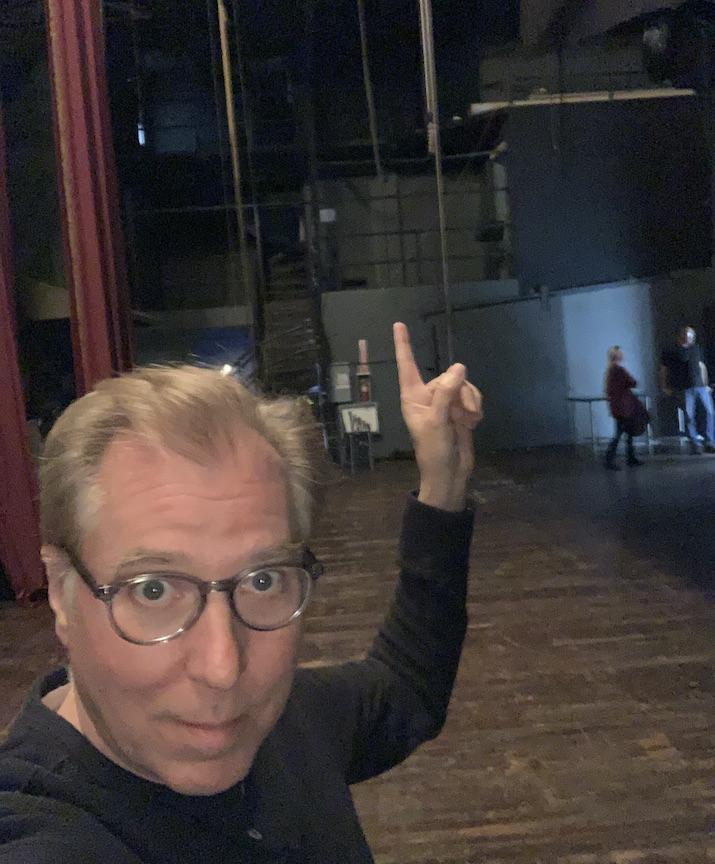
It's interesting to think that Houdini could have watched the other acts from just outside his dressing room. He had a great view. Thanks to fellow Houdini nut and artist Jenny Lerew for snapping this photo of me in Houdini's perch. You can check out Jenny's own photos on her Instagram @blackwingjen.
There was a lot more to see and learn. In fact, we spent three hours exploring the theater from top to bottom. I even wandered into a few places I later learned were off-limits. If you'd like to see more, I've uploaded a collection of 40+ photos to my Patreon below.
Thanks to the Los Angeles Historic Theater Foundation for this amazing day. The LAHFT regularly tours historic theaters and also offers talks via Zoom. Check out their website for more information and consider becoming a member.
Lastly, here's an unknown challenge from Houdini's 1915 Orpheum/Palace appearance.
Here's one that has me very excited. On Saturday, April 13, the Los Angeles Historic Theatre Foundation (LAHTF) will tour the Palace Theater in downtown Los Angeles. The Palace was originally called the Orpheum and is where Houdini performed in 1915 and 1923. It's also where he had his famous verbal joust with then-heavyweight champ Jess Willard. So this is a fantastic Houdini location!
LAHTF is thrilled to be returning to the Palace Theatre on Broadway for our signature ALL ABOUT tour. Join us for our first event of 2024 when we go behind-the-scenes from below stage to the projection booth above and everything in between.
I've twice missed out on LAHTF Palace events, so I'm thrilled to be jumping aboard this one. It will be my first time inside Houdini's L.A. Orpheum.
If you want to join the fun, you can purchase tickets via the LAHTF website.
While we know Hardeen was born on March 4, 1876, in Budapest, like his famous brother, he later claimed Appleton as his birthplace and changed his birthdate. The date Dash chose was February 29 (Leap Day), showing he had a sense of humor about all this. As it only happens once every four years, let's celebrate Hardeen's "birthday" today with some dashing posters.
Below is one of my all-time favorite posters for either brother. If Houdini ever created a poster depicting a bridge jump, I've not seen it. But it would be tough to do better than this one. This appeared on the back of the July 1945 Conjurers Magazine "Hardeen Memorial Issue." How I would love to see this in color.
Here's another Hardeen poster that features a bridge jump as a key image. This is a blow-up from a photo of an Oakland billboard when the brothers were both performing there in 1915. Again, how I'd love to see this in color.
Here's another beauty. This appears on the back of Hardeen's pitchbook.
While the above posters will be familiar to some, I'm sharing a Hardeen poster on my Patreon today that I bet you've never seen because I sure hadn't! And, yes, this one is in color. This comes from Eric Colleary and our friends at the Harry Ransom Center. Enjoy.
Remember that scene in the 2008 film Death Defying Acts that shows Houdini posed like a preening beach boy atop his Water Torture Cell at the conclusion of the escape? It's even in the trailer.
I've always seen this as an abomination of how the real Houdini would conclude the escape. By all accounts, when the tension was at its height, Houdini would come crashing through the front of the curtains out of breath as if he had just made his escape in the nick of time. That's how the real Houdini did things, Hollywood!
And then I found this illustration from Houdini's performance at the Cleveland Hippodrome in 1915 and now I need to shut up.
Cleveland Plain Dealer, March 30, 1915.
Okay, maybe this is just the illustrator placing Harry atop the cell as his own artistic interpretation. Or maybe this is what he saw. Which would mean Hollywood can occasionally get things (accidentally) right.
Houdini's overboard box escape is one of his most famous and iconic outdoor stunts. It's also the one he appears to have done the least. In fact, I've only documented nine such escapes. Contrast this with 74 suspended straitjacket escapes!
While Houdini's two overboard box escapes in New York in 1912 and 1914 are well documented, we hear far less about the others. That's why I was excited to find the below. This is an account of Houdini's overboard box escape on July 28, 1915, from the Garden Pier in Atlantic City. Sounds like they had some problems with the block and tackle. But Houdini made his escape as always. Enjoy.
Atlantic City Daily Press, July 29, 1915.
Here's another nice detail. The below ran in the Atlantic City Review on the day of the stunt. I love this kind of thing.
Finally, here's a fun post-escape item that appeared in the Atlantic City Daily Press.
Atlantic City Daily Press, July 29, 1915.
Want more? You can view 20 newspaper clippings from this eventful week in Atlantic City as a "Scholar" member of my Patreon.
Top photo from 'Houdini His Legend and His Magic' by Doug Henning. Original in David Copperfield's International Museum and Library of the Conjuring Arts.
I admit I always cringe when I hear someone call Houdini "the first superhero." It just feels too much like a pander to Hollywood's current obsession with superhero movies, etc. But, gosh darn-it, there are times when it appears people really did think of Houdini as a superhero! This is a case in point.
The below comes from when Houdini was playing Keith's Garden Pier Theater in Atlantic City during the week of July 26, 1915. For context, the U.S. had not yet entered the war in Europe, but there was plenty of news about German U-boats lurking in the Atlantic. So in this environment of war nerves, I'll let these two stories speak for themselves.
Atlantic City Review, July 27, 1915.
You gotta love that the frightened vacationers thought Houdini might be the only man who could get the bottom of this. And as it turns out, that's exactly what happened! Check out the follow-up story below. (Sorry this one's a little hard to read.)
Atlantic City Daily Press, July 30, 1915.
So was Houdini a dupe or part of this publicity stunt? It's hard to tell from the story. But we can imagine what would have happened had this turned out to be a real German sub!
Houdini clocked a lot of stunt time on the Garden Pier. He did an overboard box escape during this same engagement in 1915 (post on that coming soon); a suspended straitjacket escape from the pier tower in 1916; and a manacled leap in 1917. No wonder he was seen as [*cringe*] a superhero.
Two weeks ago I gave a lecture on "Houdini in Cleveland" at the Magic Collectors Expo 2023. After the conference I spent a day visiting many of the locations I featured in my talk. While it's all still fresh in my head, here's my fact-finding tour of Houdini's Cleveland.
Houdini's first appearance in Cleveland was the week of March 12, 1900. This was during his first Keith's vaudeville tour before he traveled to Europe. He appeared at the Empire Theater which stood at 750 Huron Road. Today Cleveland's beautiful art deco AT&T Building stands at that address.
During his 1900 engagement Houdini escaped from manacles at the Central Police Station on Champlain Street. This was one of his nude tests. That station was razed in 1925 to make way for Terminal Tower which still stands today in downtown Cleveland.
Houdini returned to Cleveland in 1905 and 1908 playing B.F. Keith's Theater at 619-625 Prospect Avenue. In 1908 he was more than a little chagrined to find he was not the headliner. Instead Julius Steger & Co. in the skit "The Fifth Commandment" was the featured performer. "Is this week the first step toward oblivion?" Houdini wrote in his diary.
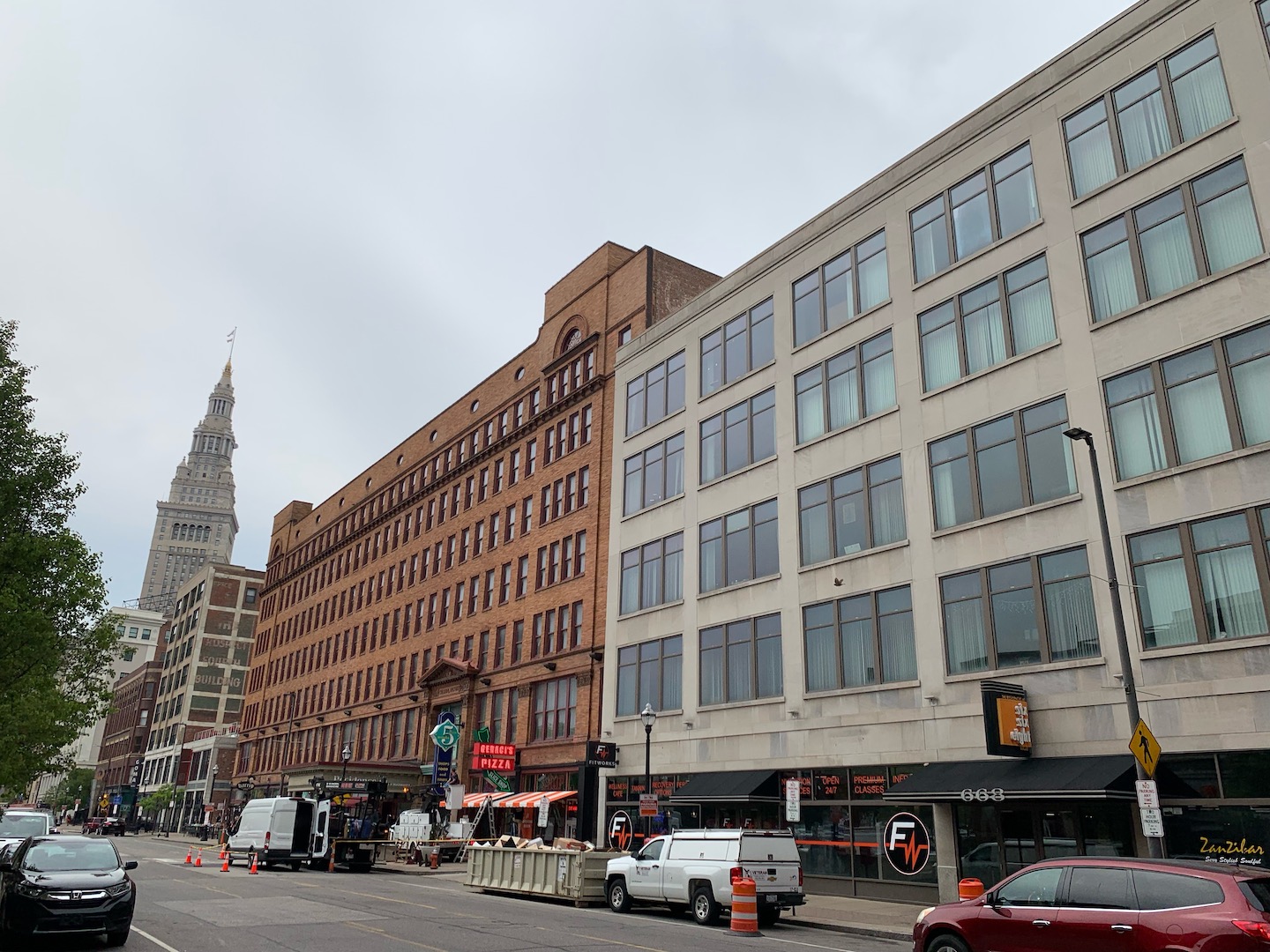
The Prospect Avenue Keith's closed in 1923 and today a modern office building stands on the site. Or at least that's what I thought. When I visited, I could see that the "modern" building was a facade fronting what appears to be the original building that still shows the profile of a theater. The building beside it, which in Houdini's time was the Colonial Hotel, is still there and very recognizable.
Houdini cancelled his 1911 appearance in Cleveland when he broke a blood vessel in his kidney in Detroit (an injury that never properly healed and gave him pain the rest of his life). But he was back in 1915, this time playing the magnificent Hippodrome Theater at 720 Euclid Avenue. This was the second largest stage in the world at this time. Houdini would play the Hippodrome three times in 1915, 1916, and 1922. Among his escapes at this theater was a challenge from the Cleveland & Sandusky Brewing Co. to escape from a cask of their famous Gold Bond Beer.
The Hippodrome stood until 1981 when it was razed to make way for a parking garage. Today the new City Club Apartments are rising on the site of the theater.
A survivor in downtown Cleveland is the beautiful May Company building. The May Co. challenged Houdini to escape from a packing case made by their shipping department three times in 1905, 1908 and 1915. Houdini beat them every time. In 1925 they left it to their competitor the Baily Co. to challenge Houdini with their own packing case. He beat that one too!
In 1915 Houdini performed one of his more untypical outdoor stunts in Cleveland. He was strapped into a straitjacket atop a railway boxcar and escaped while spectators watched from the Cleveland viaduct bridge above. For more details on this unusual escape, check out THIS POST.
Houdini performed two suspended straitjacket escapes in Cleveland. The first was from the John Harkness Brown Building at 1019 Euclid Avenue on December 20, 1916. Happily, the building still stands today as the Euclid Grand apartments.
Houdini's second suspended straitjacket escape was from the Cleveland Press building on February 3, 1922. The building stood on the NW corner of East 9th and Rockwell. A terrific photo of the escape ran in the paper the following day.
Today the Press building is long gone, and even the Dunkin Donuts that now stands on this corner was out of donuts when I visited. So a double let down at this location! But at least we know Houdini hung here.
In 1924 Houdini barnstormed the country with his spiritualism lecture. Cleveland was one of his tour stops. Houdini appeared at Engineers Hall on February 27, 1924. Engineers Hall was located inside the Engineers Building on St. Clair Ave. It was demolished in 1989 and today is the Marriott Key Tower. By the way, I didn't know the location of Engineers Hall when I gave my talk. Fellow expo attendee Jim Kopco found it for me. Thank you, Jim!
Tickets for Houdini's lecture were sold at the Korner & Wood bookstore located at 1512 Euclid Avenue. This was a popular store that stood until 1963. Both Houdini and Blackstone are remembered to have been customers. Today the store and building are long gone.
If there was ever a time to be a Houdini fan in Cleveland it was 1925. Houdini performed in the city twice that year. But don't take it from me. Let's hear from someone who was there!
Houdini performed at the Palace for two weeks beginning March 9, 1925. The first week he featured his escape act. The second week he devoted to spiritualist exposes. The Palace is inside the magnificent B.F. Keith Building at 1615 Euclid Avenue. The good news is the Palace survives along with several other beautiful theaters in Cleveland's Playhouse Square.
While the theater was closed during my visit, I was still able to find my way into the lobby. It's a beautiful space and I could imagine Houdini as the prince of this palace.
During Houdini's 1925 run he exposed the well-known trumpet medium George Renner. Houdini attended Renner's seance at 2650 Superior Ave. in disguise and secretly smeared his trumpet with lampblack. When the lights came on, Renner's hands and face were cover in the soot, proving that the trumpet manifestations were the work of the medium and not the spirits. Renner was arrested and charged with fraud. Houdini had ten minutes to make it to the Palace for his performance. Newspapers reported he did his act with his hands still covered in the lampblack.
While Houdini's exposures drew headlines and large crowds to the theatre, it made him at least one enemy. Check out the below from the March 10, 1925 Cleveland Plain Dealer:
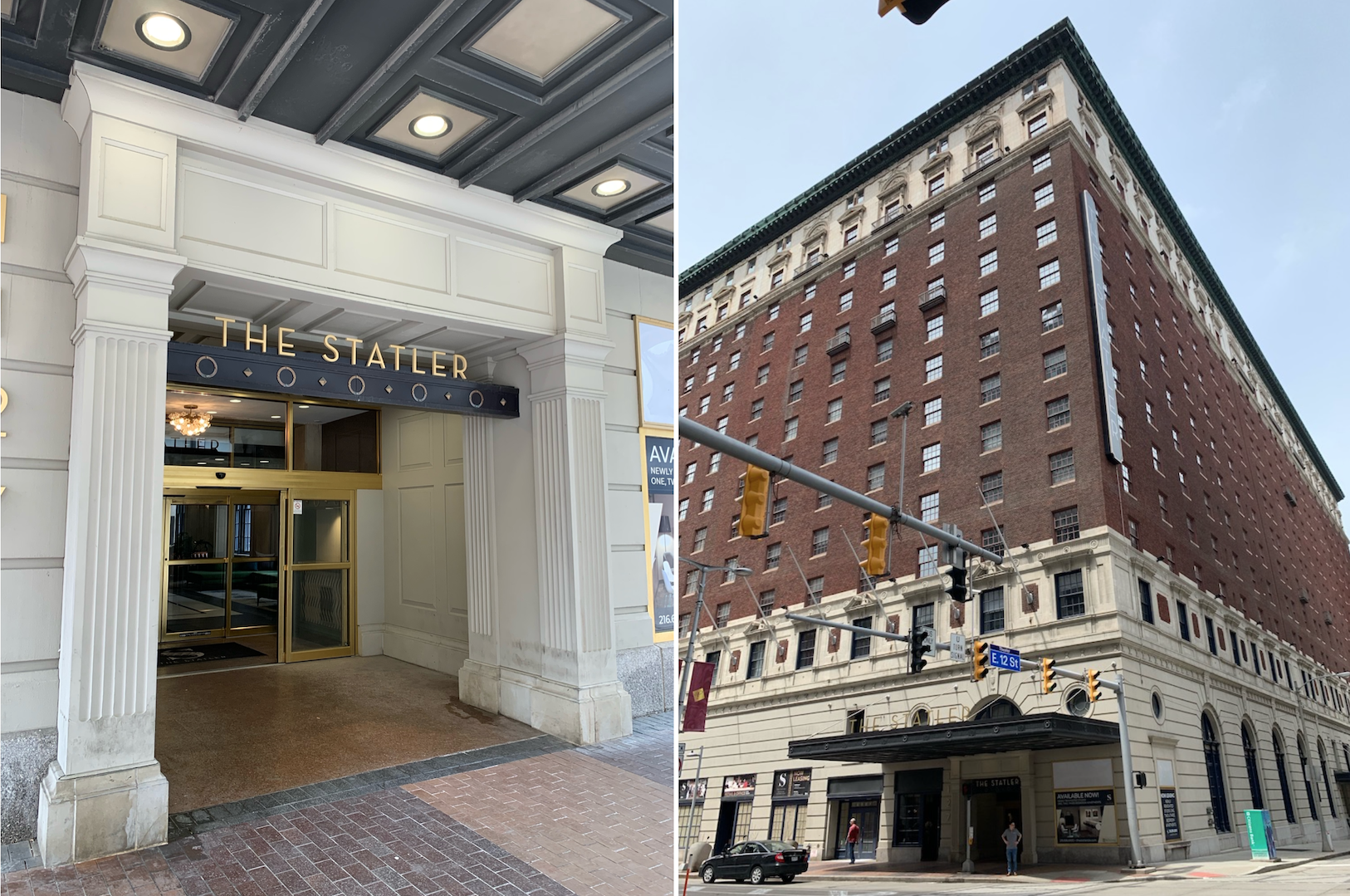
While in Cleveland Houdini stayed at the Hotel Statler at 1127 Euclid Avenue. The Statler is still there (it's now apartments), and from the outside appears just as it did in Houdini's time. A bonus is that the building stands beside the former John Harkness Brown building where Houdini did his 1916 suspended straitjacket escape. It's a great block for Houdini location seekers!
Houdini returned to Cleveland in November 1925 with his "3 Shows in One." This time he performed at the Hanna Theater located at 2067 East 14th Street, just a block over from the Palace. The Hanna still stands today. I couldn't get inside, but I did find the old stage door and could feel Houdini's spirit on that spot.
During his final Cleveland appearance, Houdini performed for handicapped children at the Sunbeam School. Below is a terrific photo of Houdini performing for the kids. An account of this show in the November 6, 1925 Cleveland Plain Dealer details Houdini's performance of the die box. The original school building was razed for the new Sunbeam School located at 11800 Mt. Overlook Ave.
Houdini was booked to return to the Hanna for the week of November 9, 1926. This was to be his next stop after his two week engagement in Detroit. He didn't make it. As we know, Houdini died in Detroit on Halloween of that year.
There's one last Houdini Cleveland connection. In 2017 the city played host to the Official Houdini Séance inside a bank vault. Houdini was a no show, but his memory proved to be alive and well in Cleveland -- a five star Houdini city!
Want more? You can see an exclusive photo of Houdini in Cleveland from the collection of Dr. Bruce Averbook and download the research I did for my lecture as a "Scholar" member of my Patreon by clicking the image below.


.jpg)




%20copy%202.png)


.jpg)


.jpg)


.jpg)
.jpg)