|
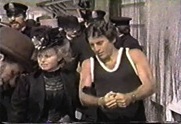
| Unused promo art for The Great Houdinis (from the collection of MSW) |
Anyone who has spent any time reading this blog knows I have a bit of a thing for the 1976 ABC TV movie,
The Great Houdinis. Maybe that’s because it aired during the first year of my burgeoning interest in Houdini. Maybe it’s because it’s damn good! One thing that has always puzzled me is where exactly this film was shot. Even actress Adrienne Barbeau was unable to recall which studio was used. Houdini expert Patrick Culliton was able to provide some information, but the filming of this movie has always been a mystery… until now.
The Great Houdinis, ABC Production #7602, shot for 20 days between April 28 and May 25, 1976. The film utilized five major locations, with the final location set for a major scene that was either cut or never filmed (we’ll get to that). The film was directed by writer/producer
Melville Shavelson. His production manager was Don Goldman. Assistant directors were F. A. Miller and Penny L. Vaughn. The executive at ABC who oversaw the production was Marty Katz.
The title was
The Great Houdini! (singular) up until at least the April 13th draft of the script. By the final revision on May 17, it had become
The Great Houdinis (plural). The change might have been a reflection of how writer-director Shavelson viewed his story. "It's as much a love story as it is a story about a magician," he would say. (
Update: According to Patrick Culliton, the title was changed when Sally Struthers was signed to play Bess as part of her deal.)
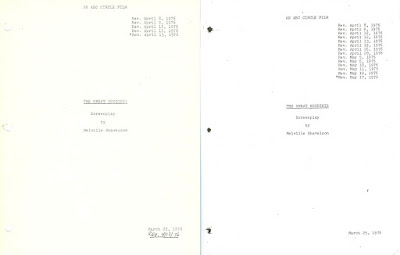 |
| Two scripts show change in title (click to enlarge). |
One thing not generally known is that
The Great Houdinis was in a race with a rival Houdini movie at NBC called
The Heart Is Quicker Than The Eye. That film was written by Jean Holloway and was being produced by Playboy Productions. The NBC project got the jump by announcing a start date of March 15, 1976. Both films were intending to air on or near Halloween to commemorate the 50th Anniversary of Houdini's death. Possibly a buy-out agreement was reached between the two networks as
Heart never materialized and Playboy Productions is mysteriously listed among
The Great Houdinis producer credits on the novelization.
On April 28, 1976, the cameras rolled on
The Great Houdinis at its first location:
Wilshire Ebell Theater, 4401 W. 8th Street, Los Angeles, CA (April 28 to April 30, 1976)
The first three days of filming were done at the
Wilshire Ebell Theater, a historic 1,270 seat theater dating back to 1927. Long a popular filming location, the Ebell would double for the Alhambra, the Hippodrome and Hammerstein's Victoria, as well as unnamed theaters in San Francisco, Paris and Detroit.
The first day of shooting involved all the complex stage escape apparatuses. The first scene shot was The Milk Can Escape. Then the Water Torture Cell action was shot, with star
Paul Michael Glaser failing to escape as a horrified
Sally Struthers (Bess) looks on. Abb Dickson provided the cell, which would be touted in some media as “the original cell,” which of course is not correct.
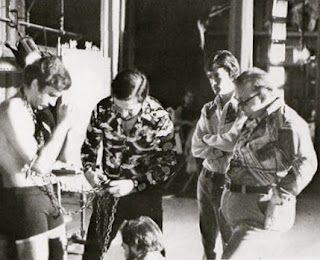 |
Harry Blackstone Jr. helps prepare Paul Michael Glaser for
the Milk Can escape (Photo by Patrick Culliton, Genii) |
The first day wrapped by filming another escape which only appeared in the opening credits -- Houdini's escape from a casket after Bess passes him a key -- or "feke" as the script calls it -- in a kiss. This was arbitrarily noted as taking place in the Hippodrome in 1920. Houdini expert
Patrick Culliton was also on set that day playing Houdini’s assistant Franz Kukol. Artist Dave Stevens, famous for
The Rocketeer ,
, accompanied Culliton and spent the day taking behind the scenes photos (some of which can be viewed on Patrick's website,
Houdini's Ghost).
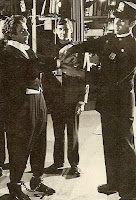
One hundred and fifty extras were brought in on Day 2 to act as audience members. All audience reactions to the various stage escapes and spirit exposes were shot on this day. Glaser and Struthers then filmed the scene in which Harry helps Bess with her French during Metamorphosis, which is described as taking place in a “French Theater” in 1900.
Harry Blackstone, Jr., who received credit as technical advisor on the film, appeared in the scene as a police officer. Newsreel footage was then shot projected against a backdrop screen on the stage.
All the backstage scenes were shot in the third and final day at the Ebell, starting with Harry coming to see his brother, Theo Hardeen (
Jack Carter), at what is supposed to be Hammerstein's. This was also
Adrienne Barbeau’s first day of shooting. Filmed was Daisy and Bess's conversation backstage in 1926 ("I tried. Not a damn thing."), along with the moment that Bess bumps into the hanging witch and says, "Sorry, Mama."
Queen of Angels Hospital, 2301 Bellevue Ave., Los Angeles, CA (May 3, 1976)
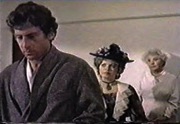
After a few days off, the production moved for a single day to
Queen of Angels Hospital near downtown Los Angeles. Here one of the movie's best dramatic scenes was shot -- when Bess comes to see Harry after his nervous breakdown and pulls him from his funk by suggesting they make spiritualist exposes "part of the act." This was also the first day of shooting for the legendary
Vivian Vance, playing
Minnie the nursemaid. Vance, of course, is best known for her role as Ethel on I Love Lucy .
.
The Queen of Angels Hospital closed this location in 1989. After remaining vacant for many years, it became
The Dream Center, a Pentecostal Christian Church mission, in 1996.
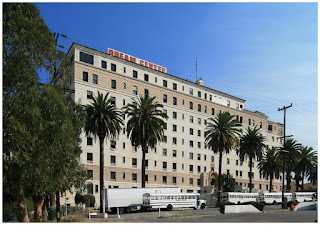 |
| Queen of Angels, now The Dream Center, today |
Home of Peace Memorial Park & Mausoleum, 4334 Whittier, Los Angeles, CA (May 4 to May 5, 1976)
 |
Home of Peace Memorial Park
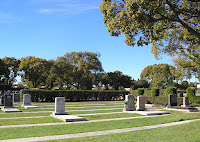
doubles for Machpelach |
The fifth and sixth days of shooting found
The Great Houdinis crew at the
Home of Peace Memorial Park & Mausoleum, Los Angeles' oldest Jewish Cemetery. The first scene shot had Bess and Harry copying information from headstones for a spiritualist act, and then making love among the graves. This is described as taking place in a “small cemetery” in the 1890s. This was going to be a flashback at the start of the film, and would have been Glaser’s first appearance as Houdini. It's a terrific two-page scene that appears in both the script and novelization, however, the scene doesn’t appear in the final film. Instead, a beat where Bess hears Harry's disembodied voice signing "Roseabell" was inserted. Also shot on day one was Harry lingering at his mother’s grave with Bess unable to reach him.
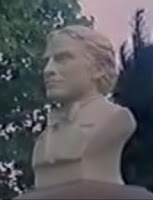 |
| Where is this bust today? |
On the second day Home of Peace was dressed as Machpelach Cemetery in Queens, with a replica of the famous Houdini exedra erected in a quite corner. Here was shot the scene in which Bess meets the Reverend Arthur Ford (
Bill Bixby), and her catty encounter with Daisy White that opens the movie. A "bust" is listed among the props at this location. Where is that bust today, I wonder?
One thing to watch for in this scene -- even though Bess/Struthers kneels and plants flowers in front of the exedra, as she enters the plot one can spot a fairly accurate reproduction of Houdini's tombstone sitting approximately where it does in the real cemetery plot.
20th Century Fox Studios, 10201 West Pico Boulevard, Los Angeles, CA (May 6 to May 21, 1976)
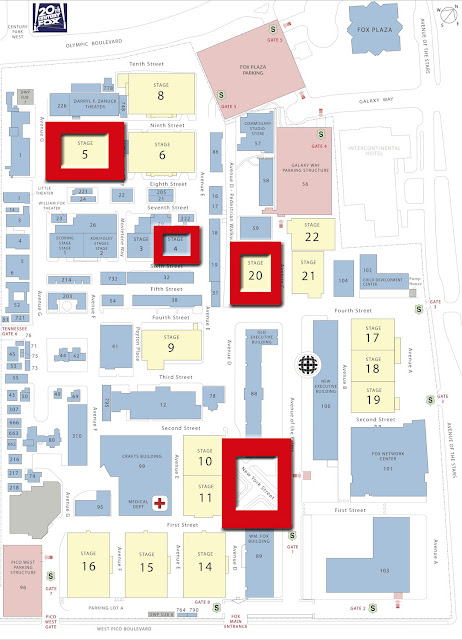 |
| The 20th Century Fox lot with The Great Houdinis shooting locations marked in red |
On May 6, production moved into the historic
20th Century Fox Studios in Century City. Here the bulk of the filming would take place over the course of the next two weeks. The production would utilize Stage 5, Stage 20 and Stage 4, as well as shooting on the studio's two remaining exterior sets (Fox sold their large backlot in 1961).
 |
| On the Hello Dolly street |
Shooting commenced on May 6 on the still standing
Hello Dolly
street set
. Here, the scene where Harry and Bessie are "riding in style" in a horse-drawn buggy was filmed, as was Houdini stopping to admire Queen Victoria’s dress in a store window. At the same time, on the adjacent "Brownstone Street," the exteriors of 278 were shot, including the spooky Halloween night scenes that involved creating wind and rain effects. Also filmed was Reverend Ford’s arrival by taxi near the end of the film.
Only a small section of the
Hello Dolly street (
seen here in 1976) remains on the Fox Lot today. But the Brownstone Street (aka "New York Street") still looks very much as it did in the film.
 |
| Brownstone Street as seen in the film and today |
Soundstage 20 was also put into action on the first day of lot shooting. Here, the scene in which Bess gets trapped in the sub truck and Harry has to chop her free was shot. Over the following days, stage 20 would also house a train car set where Harry tells Bess what it means to be a magician, and she tells him she’s pregnant (shot on May 7). Stage 20 was also home to the Scotland Yard sets (jail cell and Melville’s outer offices). The Scotland Yard scenes would all be shot on May 12.
 |
| 278 was housed on Stage 4 |
Soundstage 4 was used solely for the interiors of Houdini’s New York home. Here all the scenes with the older Bess and the Arthur Ford séance were filmed (on May 20), as was the famous Houdini-Daisy seduction scene (on May 19). In her 2007 autobiography,
There Are Worse Things I Could Do, actress Adrienne Barbeau says a slightly more racy “semi-nude” version of this scene was to be filmed for a European cut. If that happened, it wasn’t included, as the international version (available on VHS) is identical to what aired in the USA.
The 28,274 sq. ft.
Soundstage 5 was used for a wide variety of single scene locations. It was here on May 7 that Houdini exposes Margery the Medium (
Barbara Rhoades). The stage also housed the Congressional hearing room where Bess, under oath, confesses that she still loves Harry (May 10). The legendary
Nina Foch appears in this scene as the Rev. Le Veyne. Stage 5 was also the site of the Budapest Hotel, where Harry throws a “Royal” reception for Mama, and Bess rebelliously sings “Onward Christian Soldiers,” shot on May 14.
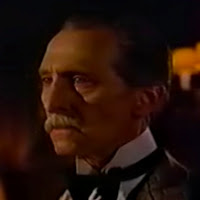 |
| Cushing fresh off the set of Star Wars |
May 11 was a special day on Stage 5, when legendary actor
Peter Cushing arrived for two days of filming his scenes as Sir Arthur Conan Doyle. Interestingly, Cushing had just come from the set of
Star Wars in England –
The Great Houdinis was his first post-
Star Wars work. (
Star Wars would have as much impact on my life as Houdini – strange to think of all these converging forces at play in 1976.) Cushing started on the London Pub set, where Houdini impresses him and Superintendent Melville (
Wilfrid Hyde-White) with a handcuff escape. The following day, May 12, he would film the Atlantic City séance on Stage 5 before moving over to Stage 20 for the Scotland Yard jail escape action.
 |
| The Weiss home was on Stage 5 |
Stage 5 would then be outfitted with all the interiors of the Weiss family home, including Harry’s bedroom (where Mama “meets” Bess), the kitchen (aftermath of meeting and Harry does the Needles), and the living room (New Years Eve wedding party). These scenes would be shot over three days on May 14, 17, 18. Among the principle characters listed on the schedule for the wedding party are Nathan, Leo, and Nathan's bride "Dorothy" (
Marilyn Brodnick), who would actually be the infamous Sadie Weiss. Theo is also in the scene -- the script identifies him as the man who quips "Open Sesame" when Harry kicks open the bedroom door -- but here he's played by someone other than Jack Carter.
Shooting on the Fox lot wrapped on May 21 with, appropriately enough, the fatal dressing room punch, shot on Stage 20.
Malibu Pier, 23000 Pacific Coast Highway, Malibu, CA (May 24, 1976)
After two days rest,
The Great Houdinis production was again on location, this time at the
Malibu Pier off Pacific Coast Highway in Malibu. Originally built in 1905, the pier was expended in 1938 and was made a historic landmark in 1985. The script has this down as being the Peekskill Bridge in New York in 1895, even though in the film a cop calls Houdini "that New York jerk." Here, Houdini’s failed underwater handcuff escape action was shot. A double was used for Glaser’s dive – the only time a double is mentioned on the schedule. Another desirable prop used on this day is the banner that is hung between the two fishing houses at the end of the pier. Nice to see the production designer used authentic Houdini letting from his early European tour posters.
 |
Malibu Pier in The Great Houdinis (top). The pier doesn't
look any different today (bottom) |
Belmont Amusement Park, 3000 Mission Park, San Diego, CA (May 25, 1976)
The final day of principle photography for
The Great Houdinis was planned for the
Belmont Amusement Park in San Diego, which was to double for Coney Island. Here a scene in which Harry proposes to Bess aboard a roller coaster would be filmed.
While it appears in the script, this scene didn’t make it into the final film. Was this scene cut, or never shot? This is something I haven’t yet to be able to discover, but it seems unlikely that a TV movie would cut a scene that took this much effort and expense to film. It’s my guess the scene and location were scrapped, and the last day was used instead to complete a schedule that may have run over (
update).
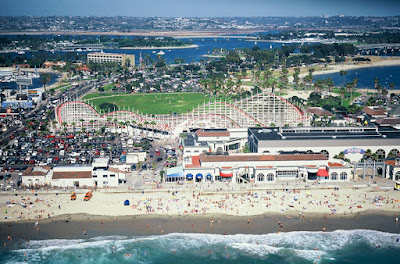 |
| Belmont Park was scheduled to double Coney Island |
The Great Houdinis was edited by
John Woodcock and scored by
Peter Matz, who would also serve as musical director for Doug Henning’s second
World of Magic TV special.
ABC promoted
The Great Houdinis with an impressive four page photo spread in the popular gossip magazine,
Preview (October 1976), as well an article in
TV Guide that claimed to reveal the secret of the Water Torture Cell (it doesn't). The image of Glaser reenacting Houdini's famous semi-nude chained pose was used extensively in advertising. A novelization, written by Shavelson, was released in both the U.S. and UK. In the UK the book was serialized in
Reveille, and also released in hardcover with photos of the real Harry and Bess Houdini.
 |
| The original TV Guide ad for the October 8, 1976 airing. |
The Great Houdinis aired on October 8, 1976 as part of ABC’s Friday Night Movie. In some markets it aired from 8-10, others from 9-11 (including Los Angeles). Competition that night was from the 1975 John Wayne movie,
Brannigan, on CBS and
The Rockford Files with James Garner on NBC. In some markets the final line, "I believe the son-of-a-bitch loved her," was edited out. It would repeat once on April 6, 1977 (April 6 was the day Houdini celebrated his birthday, which may or may not have been coincidental). For this '77 broadcast the title was changed to the singular,
The Great Houdini, which is what the movie is better known by today.
Reviews were generally good, although, as had been the case 23 years earlier with Paramount's
HOUDINI, the magic community took the film to task for its inaccuracies. David Lustig, who performed as
La Velma and knew Houdini well, said watching the film made him "feel nauseated." Another reviewer called the film "an object lesson in the abuse of dramatic license."
However, over time, what in 1976 seemed to be a steamy confection of dramatic license (Houdini's affairs, Bessie's alcoholism) has turned out to be fact. No evidence has ever surfaced that hostility existed between Bess and Houdini's mother, however. This notion of a fractious household was first put forth by author Maurice Zolotow, who also spoke openly about Houdini's supposed affair with Daisy White. I've often wondered whether Zolotow had any direct influence over Shavelson's creation of the story. Regardless, it all made for great TV drama.
A very big thanks to The Magic Castle's William Larsen, Sr. Memorial Library and librarian Bill Goodwin for helping me uncover the story of the making of my favorite Houdini biopic. Also thanks to Patrick Culliton, MSW, Dean Carnegie (Magic Detective), and Steve Santini.


 Did you happen to catch the Houdini connection in the new Star Wars: The Force Awakens? If you have an eagle eye, near the end of the film you can spot Houdini miniseries producer Gearld Abrams in a cameo as a Resistance officer. Even though he doesn't have dialogue, Abrams appears in the final credits as Captain Cypress.


 One hundred and fifty extras were brought in on Day 2 to act as audience members. All audience reactions to the various stage escapes and spirit exposes were shot on this day. Glaser and Struthers then filmed the scene in which Harry helps Bess with her French during Metamorphosis, which is described as taking place in a “French Theater” in 1900. Harry Blackstone, Jr., who received credit as technical advisor on the film, appeared in the scene as a police officer. Newsreel footage was then shot projected against a backdrop screen on the stage.