- Home
- Life
- Escapes
- Magic
- Movies
- Houdini's Movies
- Les merveilleux exploits de Houdini à Paris (1909)
- The Master Mystery (1918)
- The Grim Game (1919)
- Terror Island (1920)
- The Man From Beyond (1922)
- Haldane of the Secret Service (1923)
- Velvet Fingers (1925-26)
- Medium Well Done (1937)
- Religious Racketeers (1938)
- Houdini Picture Corp.
- Film Developing Corp.
- Filming locations
- Unmade Movies
- Deconstructing Houdini '53
- Spiritualism
- People
- Beatrice Houdini
- Theo Hardeen
- Cecelia Weiss
- Mayer Samuel Weiss
- Jim Collins
- Franz Kukol
- Martin Beck
- Sir Arthur Conan Doyle
- Margery
- J. Gordon Whitehead
- Edward Saint
- Jacob Hyman
- Leopold Weiss
- Carrie Gladys Weiss
- Bernard M.L. Ernst
- Charmian London
- Jess Willard
- H.P. Lovecraft
- Sherlock Holmes
- Assistants
- Imitators
- Other magicians
- Media
- Full Bibliography
- By Houdini
- Biography
- Fiction
- Foreign
- For Kids
- Methods
- Wild About Harry Bookshelf
- Houdini His Life Story (1928)
- Houdini The Man Who Walked Through Walls (1959)
- Houdini The Untold Story (1969)
- The Life and Many Deaths of Harry Houdini (1993)
- Houdini!!! The Career of Ehrich Weiss (1996)
- The Secret Life of Houdini (2006)
- The Metamorphosis: The Apprenticeship of Harry Houdini (2012)
- The Witch of Lime Street (2015)
- The Life and Afterlife of Harry Houdini (2019)
Showing posts with label Fulton Oursler. Show all posts
Tuesday, February 5, 2019
Adolphe Menjou was almost the first Houdini
In 1932, RKO was going to make a movie based on Houdini's life called Now You See It, written by Houdini's friend and fellow spirit buster Fulton Oursler. It was not strictly a biopic as the main character was called Harry Pinetti. But events in Pinetti's life, such as becoming trapped under the ice of frozen lake and exposing fake spirit mediums, would leave little doubt in anyone's mind that this was the story of Houdini.
I covered the development of Now You See It at length in 2010. In fact, it was my first real research scoop here on WILD ABOUT HARRY. But recently I found the following item in the November 12, 1932 issue of Hollywood Filmgraph that shows the movie came even closer to being made than I had thought. In that year the studio signed actor Adolphe Menjou to play Pinetti/Houdini.
It was later reported that Menjou was being coached in magic by Walter Baker, who had originated what became the famous Tarbell Course in Magic. When the Harrisburg Telegraph picked up the news on December 28, they recalled their days with the real Houdini.
Now You See It was never made and marked the first of many Houdini projects developed and then abandoned by Hollywood. That finally changed in 1953 when Paramount released the classic Houdini with Tony Curtis in the lead.
Adolphe Menjou had a long career, appearing in both silent and sound films such as Valentino's The Sheik, The Front Page (in which he was nominated for an Oscar), and the original A Star Is Born with Janet Gaynor. He was also a stanch Republican who cooperated with Senator Joseph McCarthy's House on Un-American Activities Committee in the 1950s. Menjou died on October 29, 1963.
For more on Now You See It check out my two-part posts below.
Related:
Friday, June 24, 2016
See Margery's seance kimono and 'Imponderable' at MoMA
But what makes this MoMA exhibition especially exciting is it includes items on display from Oursler's collection, as well as artifacts from the private Libbet Crandon de Malamud Collection that have never been shown before. These include Margery's seance chairs and her original seance kimono, seen above on actress Sarah Kinlaw who plays the famous medium in the movie.
Here's a description of the film and exhibition from the MoMA website.
Tony Oursler’s Imponderable (2015–16) offers an alternative depiction of modernism that reveals the intersection of technological advancements and occult phenomena over the last two centuries. Presented in a “5-D” cinematic environment utilizing a contemporary form of Pepper’s ghost—a 19th-century phantasmagoric device—and a range of sensory effects (scents, vibrations, etc.), Imponderable is an immersive feature-length film inspired by Oursler’s own archive of ephemera relating to stage magic, spirit photography, pseudoscience, telekinesis, and other manifestations of the paranormal. Drawing on these objects, Imponderable weaves together a social, spiritual, and empirical history of the virtual image that overlaps with the artist’s own family history. A cast of characters including Sir Arthur Conan Doyle, Harry Houdini, Mina “Margery” Crandon, and members of Oursler’s family are portrayed by an eclectic ensemble of artists, musicians, and performers including Kim Gordon, Jim Fletcher, Keith Sanborn, and Constance DeJong. Bringing together Oursler’s ongoing interest in mysticism, psychedelia, popular culture, and media history, the work employs macabre humor and theatrical surrealism to reflect on the irrational relationship between belief systems and the authenticity of images. Imponderable is presented in conjunction with selections from Oursler’s archive relating to the film.
Imponderable was originally commissioned and produced by the LUMA Foundation for the Parc des Ateliers, Arles, France, and LUMA Westbau, Zurich, Switzerland, 2015.
The Museum of Modern Art (MoMA) is located at 11 West 53 Street, New York, NY 10019. The museum recently screened Houdini's The Grim Game.
Tony Oursler's work and collection also appear in the book, Imponderable: The Archives of Tony Oursler.
Thanks to Anna Thurlow for the image of Sarah Kinlaw in the Margery kimono.
Related:
- Tony Oursler collection spooks LUMA
- Keepsakes (Margery Kimono)
- Have a seat (Margery seance chairs)
- The Margery Files
Friday, July 31, 2015
Tony Oursler collection spooks LUMA
Blouin Artinfo reports that a collection of artifacts and artwork from the collection of Tony Oursler, grandson of Houdini's friend and associate Fulton Oursler, are on show at the LUMA Foundation in Arles, France, though September 20.
"Tony Oursler’s Imponderable" includes spirit photographs, supernatural ephemera, and Houdini material inherited from his grandfather in 2000 (including the image on the right) displayed in artistic ways.
"Collecting this stuff was a hermetic hobby for me," Oursler said. "But this challenged me to look at the archive in a different way."
Oursler has also created a film featuring Houdini, Conan Doyle, Margery the Medium and, oddly enough, Frankenstein's monster. It all sounds pretty avant-garde. Below is an image from the film showing Margery in her famous Houdini-made control box. You can watch the trailer on Vimeo.
Tony Oursler's work and collection will also be published in an upcoming book, Imponderable: The Archives of Tony Oursler, due for release on September 29, 2015. The book can be pre-ordered now on Amazon.
"Tony Oursler’s Imponderable" includes spirit photographs, supernatural ephemera, and Houdini material inherited from his grandfather in 2000 (including the image on the right) displayed in artistic ways.
"Collecting this stuff was a hermetic hobby for me," Oursler said. "But this challenged me to look at the archive in a different way."
Oursler has also created a film featuring Houdini, Conan Doyle, Margery the Medium and, oddly enough, Frankenstein's monster. It all sounds pretty avant-garde. Below is an image from the film showing Margery in her famous Houdini-made control box. You can watch the trailer on Vimeo.
Tony Oursler's work and collection will also be published in an upcoming book, Imponderable: The Archives of Tony Oursler, due for release on September 29, 2015. The book can be pre-ordered now on Amazon.
Related:
Friday, February 10, 2012
Bessie's two graves
Tomorrow marks the 69th anniversary of the death of Beatrice "Bess" Houdini on February 11, 1943. She passed away aboard a train bound for New York as it arrived in the town of Needles, CA. For the occasion, I thought I'd take a look at the question of her two gravesites.
Bessie's first grave is the one that was prepared for her in life. Inscribed on Houdini's tombstone in Machpelah Cemetary in Queens, NY, is Bess's full name, Wilhelmina Beatrice, her birth year, and the year of her death which as you can see in the pic below has not been carved. That's because despite Houdini's wishes, Bess was not buried alongside him in the Weiss family plot.
Instead Bess was buried in Gate of Heaven Cemetery in Hawthorne, New York. The reason for this has never been made 100% clear, but it's said that her family wanted her buried in a Catholic cemetery (consecrated ground and all that). Some have said Machpelah wouldn't allow Bess to be buried there, but from what I've read online, Jewish cemeteries do allow the burial of non-Jewish spouses.
According to David Charvet's superb article on Bess in Magic (Oct 1995), Bess's sister Marie claimed "that Bess had re-embraced Catholicism on her deathbed." So if it was Bess's wish to be buried in a Catholic cemetery instead of Machpelah, so be it. But if it wasn't, I think it's sad that religion, which did not prevent Harry and Bess from falling in love and getting married in 1894, would separate them in eternity.
Nevertheless, Bessie does have an attractive headstone in Gate of Heaven, and she's in good company with such notables as Babe Ruth, James Cagney, New York mayor Jimmy Walker, and Houdini's friend and associate Fulton Oursler nearby.
Thanks to Joe Fox for the photo of Bess's Gates of Heaven headstone.
Bessie's first grave is the one that was prepared for her in life. Inscribed on Houdini's tombstone in Machpelah Cemetary in Queens, NY, is Bess's full name, Wilhelmina Beatrice, her birth year, and the year of her death which as you can see in the pic below has not been carved. That's because despite Houdini's wishes, Bess was not buried alongside him in the Weiss family plot.
Instead Bess was buried in Gate of Heaven Cemetery in Hawthorne, New York. The reason for this has never been made 100% clear, but it's said that her family wanted her buried in a Catholic cemetery (consecrated ground and all that). Some have said Machpelah wouldn't allow Bess to be buried there, but from what I've read online, Jewish cemeteries do allow the burial of non-Jewish spouses.
According to David Charvet's superb article on Bess in Magic (Oct 1995), Bess's sister Marie claimed "that Bess had re-embraced Catholicism on her deathbed." So if it was Bess's wish to be buried in a Catholic cemetery instead of Machpelah, so be it. But if it wasn't, I think it's sad that religion, which did not prevent Harry and Bess from falling in love and getting married in 1894, would separate them in eternity.
Nevertheless, Bessie does have an attractive headstone in Gate of Heaven, and she's in good company with such notables as Babe Ruth, James Cagney, New York mayor Jimmy Walker, and Houdini's friend and associate Fulton Oursler nearby.
Thanks to Joe Fox for the photo of Bess's Gates of Heaven headstone.
Tuesday, October 11, 2011
85 years ago: Houdini's Water Torture Cell accident
It was 85 years ago on October 11, 1926, that Houdini had his only recorded accident while performing his famous Water Torture Cell. No, he didn't drown, as Hollywood has portrayed in three different films. But the accident was serious, and it can be seen as the first in a series of strange events that would ultimately lead to his death on Halloween.
While performing at the Capitol Theater in Albany, New York, Houdini was being locked in the stocks and preparing to be hoisted upside-down over the Torture Cell. But just as he was being raised from the stage, one of the cables loosened and twisted, causing the heavy stocks to shift and fracture his ankle. He was attended onstage by Dr. Elwynn Hannock (or Brannock).
The next day the papers made much of the doctor's comment that had the cable loosened only three seconds later, Houdini's foot would have been completely severed. Houdini himself quipped, "Into all kinds of danger I have thrown myself, and I have not been touched. Then I lie on my back and fracture my foot!"
Of course, Houdini enemies saw this as an omen. One medium reportedly sent a message to Houdini's friend and fellow ghostbuster, Fulton Oursler, warning, "The waters are black for Houdini. He thinks he has only broken his ankle, but his days as a magician are over."
With his foot in a brace, Houdini would perform next in Schenectady, before moving on to Montreal...
Newspaper clipping image from Houdini The Key.
While performing at the Capitol Theater in Albany, New York, Houdini was being locked in the stocks and preparing to be hoisted upside-down over the Torture Cell. But just as he was being raised from the stage, one of the cables loosened and twisted, causing the heavy stocks to shift and fracture his ankle. He was attended onstage by Dr. Elwynn Hannock (or Brannock).
The next day the papers made much of the doctor's comment that had the cable loosened only three seconds later, Houdini's foot would have been completely severed. Houdini himself quipped, "Into all kinds of danger I have thrown myself, and I have not been touched. Then I lie on my back and fracture my foot!"
Of course, Houdini enemies saw this as an omen. One medium reportedly sent a message to Houdini's friend and fellow ghostbuster, Fulton Oursler, warning, "The waters are black for Houdini. He thinks he has only broken his ankle, but his days as a magician are over."
With his foot in a brace, Houdini would perform next in Schenectady, before moving on to Montreal...
Newspaper clipping image from Houdini The Key.
Tuesday, August 23, 2011
The men who almost played Houdini
The list of the men who have played Houdini on screen is impressive: Tony Curtis, Paul Michael Glaser, Harvey Keitel, Guy Pearce... But even more impressive is the list of actors who at one time or another have been considered for the role of the master magician, but ultimately never saw the inside of the straitjacket. Here is a list of actors who almost played Houdini.
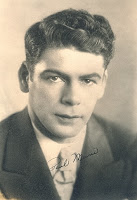
Paul Muni - Best known for the Howard Hughes hit Scarface
, Paul Muni was considered for the lead in the 1932 RKO biopic, Now You See It, based on a story treatment by Houdini's friend and ghost-busting colleague, Fulton Oursler. Because the studio had acquired no life-rights, the script would call the main character Harry Pinetti, but it was clearly the story of Houdini, and even included a sequence in which Pinetti/Houdini gets trapped under the ice during a bridge jump (later used in Paramount's 1953 HOUDINI). Now You See It went through several drafts, including one that suggested "a musical treatment" before being shelved indefinitely in 1936.
UPDATE: Actor Adolphe Menjou was signed to play Pinetti/Houdini when the movie came close to production in late 1932.
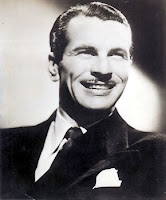
John Calvert - Magician and actor John Calvert knew Bess Houdini and Edward Saint when they lived in Hollywood in the 1930s. When Bess saw Calvert's show, she is reported to have said, "Calvert plays the part of a magician better than any actor I have ever seen, except for Harry, of course." Bess would send a letter to Calvert, who had a seven year contract with Columbia, saying, "In my opinion, you are the only actor capable of portraying the life of my late husband, Harry Houdini. Are you interested?"
Calvert was interested. Unfortunately, the head of Columbia, Harry Cohn, was not, complaining that Houdini's story was "lacking in romance and needed a better ending than a punch in the solar plexus."
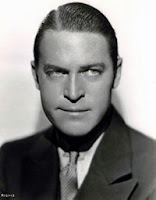
Chester Morris - After years of effort, Bess Houdini and Edward Saint finally set-up a Houdini biopic at Paramount in 1936. The film would be based on Houdini His Life Story by Harold Kellock. Bessie is said to have insisted on a stipulation in the contract that no secrets would be revealed in the film. But who would star as Houdini?
Not long after the sale, Arnold Furstenberg in The Linking Ring announced an "Exclusive Scoop" that Chester Morris was being considered for the lead role in The Great Houdini (later called Houdini The Great). Apart from being an actor, Morris was an amateur magician and a member of the IBM. "He is by far the most logical man for the role," said Furstenberg.
Houdini The Great would languish in development for many years with drafts written by Frank O' Conner and Pierre Collins. Despite Chester's lobbying for the role ("He spent time and money" reported George Boston in Genii), the studio never gave the project the green light.
Cary Grant, Joseph Cotton, Garry Moore - In 1944 producer David O. Selznick (Gone With The Wind) pitched the idea of a Houdini biopic to Alfred Hitchcock "with either Cary Grant or Joe Cotton" in the lead role. Said Selznick, "I think [it] can be an outstanding and enormously popular picture with very great opportunity for treatment by you."
Hitchcock turned down Houdini, and Selznick eventually cast radio personality and future television star Garry Moore as his Handcuff King. But like so many other proposed Houdini biopics, Selznick's Houdini failed to materialize.
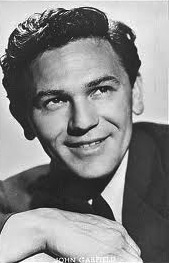
John Garfield or Lee Cobb - In 1950, a former drug store operator, Joseph Raboff, and a real estate man, Earl Cohen, acquired the film, radio, and TV rights to Kellock's Houdini His Life Story. Teaming with a former Paramount executive, Endre Bohem, the indie producers announced production of The Life Story of Harry Houdini with "either John Garfield or Lee Cobb" in the lead role. There was also talk of a half-hour TV series following the film's release.
It's unclear what happened to Film Producers, Inc. ambitious project, but it's likely Raboff and Cohen found they had bitten off more than they could chew and used Endre Bohem's connections to sell their valuable Houdini life rights to Paramount.
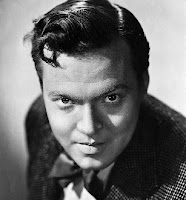
Orson Welles - When Paramount announced renewed plans to make a Houdini biopic in 1951, names such as Edward G. Robinson and Glenn Ford were mentioned. But influential gossip columnist Hedda Hopper lobbied in print for Orson Welles to play the lead.
Did the studio ever seriously consider Welles? This isn't known, but I agree with Hopper that Welles would have been an inspired choice, and it's somewhat amazing the actor, who was a magician and had seen Houdini in his youth, never played Houdini on stage or screen. However, Paramount did pretty well when they ultimately cast Tony Curtis in the part.
Welles would later collaborate with Another Burgess on a Houdini stage musical, but it's not clear if he had plans to star in the show himself.
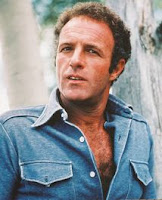
James Caan - In 1974 producer Ray Stark, fresh off his success with Funny Girl (a musical biopic of Vaudeville star Fanny Brice), announced plans to make The Magic Man: The Story of Houdini based on William Lindsay Gresham's, Houdini: the Man Who Walked Through Walls. Stark teamed with producer John Houseman (who would also appear in the film a Sir Arthur Conan Doyle) and hired James Bridges to write and direct. Variety announced that James Caan, who had rocketed to fame in The Godfather, was the top choice to play Houdini.
On the strength of the talent involved, Columbia Pictures agreed to distribute the film, which promised to be in production within a year (it was in a race with yet another Paramount Houdini project). Unfortunately, Stark's Houdini movie would never emerge from development hell.
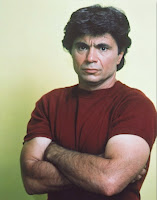
Robert Blake or Charles Bronson - In 1976 NBC developed a Houdini TV movie that would air on the 50th Anniversary of Houdini's death on Halloween. The project was called, The Heart Is Quicker Than The Eye, and would be produced by Playboy productions from a script by Jean Holloway. The network was actually in a race with rival ABC, who had similar plans to air their own Houdini TV movie written by Melville Shavelson.
Patrick Culliton, who worked as a technical advisor on the project, says two names producer Bill McCutchen mentioned to him to play Houdini were Robert Blake and Charles Bronson. Bronson was a big movie star at the time so that was probably wishful thinking, but Robert Blake was a real possibility and pretty good choice. Blake was the star of the hit TV show Baretta at the time.
The Heart Is Quicker The Eye never made it beyond the script stage and NBC lost it's race with ABC, which aired The Great Houdinis in October of 1976 with another TV star in the lead, Paul Michael Glaser.
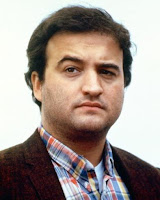
John Belushi - In 1980 it was reported that comedy star John Belushi was the favorite to play Houdini in the big screen adaptation of E.L. Doctorow's bestselling novel, Ragtime. It's not known how close Belushi came to getting the part in the Milos Forman directed film (he was starting to branch out into dramatic roles at that point), but Belushi did bare a resemblance to Houdini and his intensity could have been interesting. However, Houdini's role in the movie would be greatly reduced from what it was in the novel, and when the film was released in 1981, Houdini was played by Jeffrey DeMunn in just a few cameo appearances.
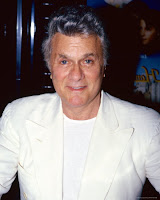
Tony Curtis - No, this isn't a mistake. While Tony Curtis did play Houdini in the 1953 classic HOUDINI, he almost played Houdini for a second time in a sequel of sorts called, Harry's Back! Written by David Simon & Michael Norrell for CBS, Harry's Back! was a comedy that had Houdini suddenly appearing in present day New York, where skeptics must decide if it's the real Houdini come back from the grave or just some nut.
The project was announced for production in Fall of 1988 with Curtis reprising his famous role. Unfortunately, Harry never came Back.
Don Ferguson - In 1986 it was announced in The Linking Ring that a new "Magical Music Show" called HOUDINI LIVES AGAIN! was headed to Broadway. With a book by Walter B. Gibson and music by Scott Joplin, the ambitious $2,500,00 musical would feature a cast of twelve "portraying forty-seven different roles" and star "magician-escape artist illusionist, Don Ferguson, in the title role as Houdini." Houdini Lives Again! never saw life, and Don Ferguson would later cause controversy when he claimed to be a blood relative of Houdini.
Tom Cruise - In 1992 Ray Stark and his Houdini project made a dramatic reappearance when mega-director Robert Zemeckis signed aboard what was now called The Great Houdini. The new movie promised to tell Houdini's story as "a magical special effects-laden adventure" and would be a Colombia/Universal co-production. Tom Cruise was the favorite for the lead.
But Zemeckis would suddenly leave the project in September of '92, saying he wasn't "100 percent certain what direction the project needs to take". Director Paul Verhoeven signed aboard in 1997, but dropped out a year later, also citing difficulties with the script. Stark would continue to try and get his Houdini/Tom Cruise movie made until his death in 2004.
Hugh Jackman - In 2008 development of a major Houdini Broadway musical was announced. The show would be produced by Scott Sanders and David Rockwell with music by Danny Elfman and a book by Aaron Sorkin. In 2009 Hugh Jackman confirmed plans to star in the play. He described his fascination with Houdini, saying, "He was a showman basically. He was probably the first rock star. A master manipulator of the media and a showman through and through."
Periodically news about the Houdini Broadway musical surfaces, but as of yet, there is no firm date for when we might see Jackman's Harry. (UPDATE: Jackman dropped out of the project in 2014.)
Jeremy Piven - In 2009 Entourage
star Jeremy Piven said in an interview that he would like to play Houdini. "He was a fascinating guy," said Piven. "He was one of the first hard working artists and magicians. He was one of the first real icons, ever. And he died tragically and he just blew people away all over the world. There is a tremendous story there and I'd love to do that one day."
With all the recently announced Houdini movie and TV projects in development (no less than five are currently making their way through the Hollywood machinery), maybe Piven will get his wish?
Thanks to Bill Goodwin of The Magic Castle's William Larsen, Sr. Memorial Library for helping me nail down the date of 'Harry's Back'. And thanks as always to Patrick Culliton for the information on 'The Heart Is Quicker Than The Eye'.
![]() |
| Paul Muni |
UPDATE: Actor Adolphe Menjou was signed to play Pinetti/Houdini when the movie came close to production in late 1932.
![]() |
| John Calvert |
Calvert was interested. Unfortunately, the head of Columbia, Harry Cohn, was not, complaining that Houdini's story was "lacking in romance and needed a better ending than a punch in the solar plexus."
![]() |
| Chester Morris |
Not long after the sale, Arnold Furstenberg in The Linking Ring announced an "Exclusive Scoop" that Chester Morris was being considered for the lead role in The Great Houdini (later called Houdini The Great). Apart from being an actor, Morris was an amateur magician and a member of the IBM. "He is by far the most logical man for the role," said Furstenberg.
Houdini The Great would languish in development for many years with drafts written by Frank O' Conner and Pierre Collins. Despite Chester's lobbying for the role ("He spent time and money" reported George Boston in Genii), the studio never gave the project the green light.
![]() |
| Cary Grant |
Hitchcock turned down Houdini, and Selznick eventually cast radio personality and future television star Garry Moore as his Handcuff King. But like so many other proposed Houdini biopics, Selznick's Houdini failed to materialize.
![]() |
| Lee Cobb |
It's unclear what happened to Film Producers, Inc. ambitious project, but it's likely Raboff and Cohen found they had bitten off more than they could chew and used Endre Bohem's connections to sell their valuable Houdini life rights to Paramount.
![]() |
| Orson Welles |
Did the studio ever seriously consider Welles? This isn't known, but I agree with Hopper that Welles would have been an inspired choice, and it's somewhat amazing the actor, who was a magician and had seen Houdini in his youth, never played Houdini on stage or screen. However, Paramount did pretty well when they ultimately cast Tony Curtis in the part.
Welles would later collaborate with Another Burgess on a Houdini stage musical, but it's not clear if he had plans to star in the show himself.
![]() |
| James Caan |
On the strength of the talent involved, Columbia Pictures agreed to distribute the film, which promised to be in production within a year (it was in a race with yet another Paramount Houdini project). Unfortunately, Stark's Houdini movie would never emerge from development hell.
![]() |
| Robert Blake |
Patrick Culliton, who worked as a technical advisor on the project, says two names producer Bill McCutchen mentioned to him to play Houdini were Robert Blake and Charles Bronson. Bronson was a big movie star at the time so that was probably wishful thinking, but Robert Blake was a real possibility and pretty good choice. Blake was the star of the hit TV show Baretta at the time.
The Heart Is Quicker The Eye never made it beyond the script stage and NBC lost it's race with ABC, which aired The Great Houdinis in October of 1976 with another TV star in the lead, Paul Michael Glaser.
![]() |
| John Belushi |
![]() |
| Tony Curtis in the '80s |
The project was announced for production in Fall of 1988 with Curtis reprising his famous role. Unfortunately, Harry never came Back.
Don Ferguson - In 1986 it was announced in The Linking Ring that a new "Magical Music Show" called HOUDINI LIVES AGAIN! was headed to Broadway. With a book by Walter B. Gibson and music by Scott Joplin, the ambitious $2,500,00 musical would feature a cast of twelve "portraying forty-seven different roles" and star "magician-escape artist illusionist, Don Ferguson, in the title role as Houdini." Houdini Lives Again! never saw life, and Don Ferguson would later cause controversy when he claimed to be a blood relative of Houdini.
![]() |
| Tom Cruise |
But Zemeckis would suddenly leave the project in September of '92, saying he wasn't "100 percent certain what direction the project needs to take". Director Paul Verhoeven signed aboard in 1997, but dropped out a year later, also citing difficulties with the script. Stark would continue to try and get his Houdini/Tom Cruise movie made until his death in 2004.
![]() |
| Hugh Jackman |
Periodically news about the Houdini Broadway musical surfaces, but as of yet, there is no firm date for when we might see Jackman's Harry. (UPDATE: Jackman dropped out of the project in 2014.)
![]() |
| Jeremy Piven |
With all the recently announced Houdini movie and TV projects in development (no less than five are currently making their way through the Hollywood machinery), maybe Piven will get his wish?
Thanks to Bill Goodwin of The Magic Castle's William Larsen, Sr. Memorial Library for helping me nail down the date of 'Harry's Back'. And thanks as always to Patrick Culliton for the information on 'The Heart Is Quicker Than The Eye'.
Tags:
[History],
Bess,
Biopics,
Fulton Oursler,
Houdini (1953),
Movies (unmade),
Musicals,
Orson Welles,
Plays,
Ragtime,
Ragtime (1981),
Ray Stark,
RKO 589,
Television,
The Great Houdinis (1976),
Tony Curtis
Friday, April 8, 2011
Martinka online auction catalog live
The catalog for Martinka & Co.'s Milbourne Christopher Collection auction is now online at LIVE Auctioneers. There are over 30 Houdini related lots, including two personal Hardeen scrapbooks, one of Houdini's rarest pitchbooks, Mein Training Und Meine Tricks, personal letters and manuscripts, a copy of A Magician Among The Spirits signed to Fulton Oursler (read about Oursler's attempt to make the first Houdini biopic), and A LOT more.
The auction will be held at the Hotel Pennsylvania (401 Seventh Ave.) in New York City on April 20th, 2011. A preview will be held on April 19th.
Good luck!
The auction will be held at the Hotel Pennsylvania (401 Seventh Ave.) in New York City on April 20th, 2011. A preview will be held on April 19th.
Good luck!
Tuesday, April 5, 2011
Houdini and Hardeen rarities on the auction block, April 20
Martinka & Co. will auction items from the famous Milbourne Christopher Collection at the Hotel Pennsylvania (401 Seventh Ave.) in New York City on April 20th, 2011. A preview will be held on April 19th. On-line bidding will be available as well.
Several Houdini and Hardeen items will be in the auction including: Two personal Hardeen scrapbooks; the original manuscript for Magic in Boston 1792-1918, which was researched and written for Houdini by H. J. Moulton; rare unused Houdini window decals (pictured); a typed letter to Will Goldston from Houdini; a 1918 letter from Harry Kellar to Houdini congratulating him on the vanishing elephant; a seven piece Hardeen ephemera lot; a copy of A Magician Among The Spirits signed by Houdini to Fulton Oursler, and more.
Martinka & Co. has been entrusted to handle this historic sale through arrangement with Maurine Brooks Christopher. David Goodman will be the live auctioneer. Both a printed and online catalog will be available soon. A preview can be seen here.
Several Houdini and Hardeen items will be in the auction including: Two personal Hardeen scrapbooks; the original manuscript for Magic in Boston 1792-1918, which was researched and written for Houdini by H. J. Moulton; rare unused Houdini window decals (pictured); a typed letter to Will Goldston from Houdini; a 1918 letter from Harry Kellar to Houdini congratulating him on the vanishing elephant; a seven piece Hardeen ephemera lot; a copy of A Magician Among The Spirits signed by Houdini to Fulton Oursler, and more.
Martinka & Co. has been entrusted to handle this historic sale through arrangement with Maurine Brooks Christopher. David Goodman will be the live auctioneer. Both a printed and online catalog will be available soon. A preview can be seen here.
![]() |
| Lot 212: Revelations of a Spirit Medium, 1922, Presentation copy from author Harry Price to Houdini. Signed by Houdini. |
Thanks to David Goodman for providing these preview images.
Monday, February 14, 2011
Jim Steinmeyer unspools The Spider
I just received the latest copy of Gibecière (Vol. 6, No. 1), the impressive publication of the Conjuring Arts Research Center, and I was pleasantly surprised to see it contains an article by Jim Steinmeyer examining Fulton Oursler's play, The Spider, a murder mystery with a magician as the main character.
Of course, Oursler was also the subject of my own investigation into his "Houdini" film project at RKO, Now You See It. You can read about that in the current issue of MAGIC Magazine. Great minds think alike? ;)
On a related note, Houdini expert Patrick Culliton says Oursler also wrote an unproduced play called, The Fox, which had a main character based on Houdini. Sounds like a follow-up to The Spider and, Patrick suspects, possibly a stage version of Now You See It.
Of course, Oursler was also the subject of my own investigation into his "Houdini" film project at RKO, Now You See It. You can read about that in the current issue of MAGIC Magazine. Great minds think alike? ;)
On a related note, Houdini expert Patrick Culliton says Oursler also wrote an unproduced play called, The Fox, which had a main character based on Houdini. Sounds like a follow-up to The Spider and, Patrick suspects, possibly a stage version of Now You See It.
Thursday, December 30, 2010
Adroit Harry and ancient hokum
It's easy enough to find contemporary takes on Houdini's movies and acting ability, but how were his films received by critics when they were first released? I took my curiosity to the Motion Picture Academy's Margaret Herrick Library and dug out reviews of Houdini's two Paramount features, Terror Island and The Grim Game.
While Terror Island is not a masterpiece, it's not this bad. Feels like Motion Picture News had it out for Harry somewhat. It is interesting to find the phrase "goes back to the nickelodeon days" in a review from 1920. Cool how the industry had already developed a sense of advancement.
But it wasn't all bad for Harry in Hollywood. His first Paramount feature fared far better with the critics, including this review in the November 1919 issue of Photoplay:
This last review almost seems too good to be true -- and maybe it is. Recall that Photoplay was a part of Macfadden Publications where Houdini had a good friend in editor, Fulton Oursler (who would later write his own "Houdini" movie for RKO).
Nevertheless, The Grim Game is supposed to be Houdini's best film, so while this review might be a touch effusive, it's overall assessment is shared by many. One bit of nice info is that Ann Forest was also known as Ann Kroman. That I didn't know.
Terror Island, Motion Picture News, Vol. 1, 1920:
The sponsors of this picture made an apology for it in the introductory caption and so disarmed the spectator to some extent from being unduly critical. The result is one must accept it for what it is -- a mere vehicle for the exploitation of the handcuff king, Houdini. The apology was kept up throughout the length of the feature, which proves how those in charge erred in putting over something on the public. Really, Terror Island goes back to the nickelodeon days, there being an absence of rhythm and reason in theme, treatment and interpretation. A sophisticated audience will surely kid the life out of it, just as they did at the Rialto. The picture is nothing more or less than a wild serial compressed into five reels and the incidents contained in it might have been conceived in a nightmare.
Highly impossible as the ancient hokum is, it is going to take a lot of explanation as more apology than what is offered to make even a child believe the stunts that take place underwater. Houdini might get away with it on a bet, but not Lila Lee.Ouch!
While Terror Island is not a masterpiece, it's not this bad. Feels like Motion Picture News had it out for Harry somewhat. It is interesting to find the phrase "goes back to the nickelodeon days" in a review from 1920. Cool how the industry had already developed a sense of advancement.
But it wasn't all bad for Harry in Hollywood. His first Paramount feature fared far better with the critics, including this review in the November 1919 issue of Photoplay:
The Grim Game, Photoplay, November 1919:
This is the best play Harry Houdini has ever grappled with, or wiggled himself out of, and it is the best of school which may be described as trick melodrama. In other words, all of Houdini's celebrated stunts, such as shaking off a set of bracelets, withering out of a straight-jacket, or breaking half a ton of manacles are included, but there are also many new and entirely localized manifestations of his diabolic cleverness; and almost all the feats, escapes, and what-not are part of a well-woven, logical plot. Includes in this five-reel fracas, also, is the actual air-collision which stirred Hollywood a few months ago. Two machines, performing at altitude for Houdini's play, accidentally crashed together and fell to earth wreaking themselves, but fortunately not killing and of the occupants. Ann Forrest -- who, at Triangle, was known as Ann Kroman -- is a delightful ingenue lead in the adroit Harry's adventures; and the cast includes, also, Mae Busch -- reappearing after nearly two years absence: she was formally at Keystone -- Anothy Boyd, Tully Marshall and Augustus Phillips.
This last review almost seems too good to be true -- and maybe it is. Recall that Photoplay was a part of Macfadden Publications where Houdini had a good friend in editor, Fulton Oursler (who would later write his own "Houdini" movie for RKO).
Nevertheless, The Grim Game is supposed to be Houdini's best film, so while this review might be a touch effusive, it's overall assessment is shared by many. One bit of nice info is that Ann Forest was also known as Ann Kroman. That I didn't know.
![]() |
| Harry gets comfortable and catches up on his latest reviews in Variety |
Wednesday, November 24, 2010
RKO 589: Discovering Hollywood's first Houdini film
Part II: "The waters are dark for Pinetti."
Houdini getting lost under the ice of a frozen river is one of the most memorable scenes in the 1953 Paramount movie Houdini
, starring Tony Curtis. But did you know that scene was first due to appear in a "Houdini" film 21 years earlier?
This was just another surprise discovery I made while examining the long forgotten file on “RKO 589,” aka Now You See It -- Hollywood's first attempt to make a movie based on the life of Harry Houdini. The file was unearthed by Warner Bros. archivist and Houdini buff, Steven Bingen (author of the upcoming book MGM: Hollywood’s Greatest Backlot), in the massive Warner Bros. Corporate Archives in Sun Valley, CA.
Now You See It was set-up at RKO by Houdini’s friend and fellow crusader against fraudulent spiritualists, Fulton Oursler. From the outset it was clear this would be a Houdini film, even though the main character would be called Harry Pinetti. Actor Paul Muni was touted as being "an ideal Houdini." During September and November 1932, Oursler delivered two treatments, mining Houdini lore and his own imagination to create a raucous and fairly dark movie (see PART I for a full examination of Oursler's treatments). The studio then brought in Kubec Glasmon, writer of the James Cagney hit The Public Enemy
(1931), to help Pinetti escape the page and make it to the screen.
Glasmon and Oursler appear initially to have collaborated on a revised story. A treatment in the file dated November 10, 1932 and marked “Latest Rough Version” carries both their names. Oursler had gutted his original treatment on his second pass. Now some of his original elements would be restored, including the Margery-like medium Evelyn, and having Pinetti’s Bessie-like wife “Tommy” die (although now it was by accident -- getting hit by a fire truck -- instead of suicide). The treatment is rough indeed, with many sequences incomplete, including what would be a major new climax centered around an unspecified “challenge” that nearly takes Pinetti’s life. In his first treatment, Oursler’s big stunt was having Pinetti escape the path of a speeding train while bound to the tracks. It is likely Glasmon was in pursuit of something more modern.
The most exciting find of this rough outline is the inclusion of the line, “The waters are dark for Pinetti. His career as a magician is almost over.” This, of course, is an echo of the ominous real-life prophecy laid against Houdini only weeks before his death, for which Oursler was the recipient. Having provided this last little bit of true insider info, Oursler would depart RKO 589 and let Glasmon tackle the screenplay by himself.
It’s clear Glasmon continued his Houdini research, most likely using what was then the only biography available, Houdini His Life Story
by Harold Kellock. Information from this book (some of it spurious) finds its way into his “Final Script” which he delivered to the studio on November 29, 1932 (10 days after his estimated delivery date).
In his script, Glasmon creates an entirely new opening that introduces Pinetti in a more cinematic way. We see a “shabby” Harry Pinetti (real name Schwartz) visiting the shop of a grocer named Oppenheimer. He asks Oppenheimer how much it would cost to replace the store’s large plate glass window. Oppenheimer says it would cost him nothing; it’s insured. Pinetti then leaves the shop, picks up a brick, and throws it through the glass. He’s promptly arrested and jailed. But the next day, as Oppenheimer replaces the window, Pinetti suddenly reapers, having escaped the jail. He again breaks the glass, and he’s again arrested, this time strapped in a strait-jacket. But he baffles the police when he escapes and appears in a press agent’s office, announcing that he is Pinetti the Great! Fun stuff.
The script proceeds (as did the early Oursler treatments) with Pinetti being called to his father’s death bed, and the promise that Pinetti will one day pour gold into his mother’s lap. Pinetti again meets and marries the loyal Tommy (sans the sadistic tests), and the couple tour small towns until Pinetti resolves to make a name for himself by performing a death-defying escape from a chained box lowered through the ice of a frozen river, a sequence that is familiar indeed.
Now, it should be noted that Houdini himself is responsible for this popular fiction, so it’s not that unusual that it would appear in a movie before the 1953 Tony Curtis dramatization. Again, Glasmon most likely mined this from Kellock. The real coincidence is that, as in the Curtis film, Pinetti does this during a box escape. In Houdini’s telling it’s a straight-ahead bridge jump.
In this version, Pinetti escapes the box, which is then hoisted to the surface and found to contain a “jaunty” note reading: “Now you see it, and now you don’t.” But Pinetti finds himself lost under the ice sheet. He’s able to catch breath in air pockets, as holes are smashed in the ice above in a frantic effort to find him. Finally, Pinetti is able to locate a section of ice thin enough to use his shackles to break through. (That’s actually an improvement on both the Curtis and Houdini versions of this story). He then appears bleeding and trembling to the amazed crowd.
When Pinetti returns home, he throws his hat through the door, waiting to see if Tommy throws it back out or not. This, of course, was a familiar routine that the real Houdini and Bessie engaged in when they had a fight, and it is used to good effect a few times in the script. Again, this is something Glasmon probably pulled from Kellock.
The box escape brings Pinetti fame and an engagement at the Palace in New York (his opening day is April 6), where he performs the Needles to great acclaim. Pinetti requests his salary in all gold and sets off to fulfill his promise to his mother, who’s named Queenie in the script. The one-page scene where he brings his treasure home to his Queenie is quite effective:
Enter Sir Gilbert Crewe (Arthur Conan Doyle) and Evelyn (Margery), and Pinetti’s battle with spiritualists, leading to Evelyn’s incarceration. Happily, Tommy’s life is spared in the script. Glasmon instead develops the major conflict of the story between the married couple (who now remain childless), as Tommy begins to believe in Evelyn’s powers and is especially frightened by her prophecies of Pinetti’s demise. (Unfortunately, “The waters are dark for Pinetti” line didn’t find its way into this final script.)
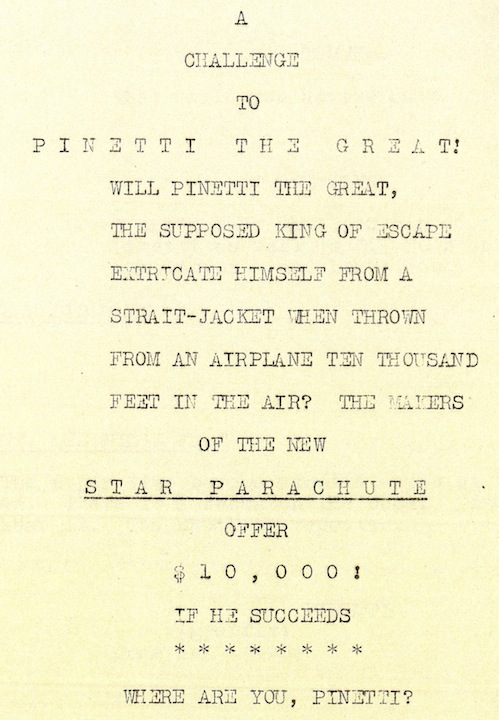
Matters come to a head, when the Star Parachute Company challenges Pinetti to leap from an airplane in a straitjacket and escape while in freefall. (Glasmon found his modern escape, although Houdini had considered performing a similar stunt in London in 1908.) From her jail cell, Evelyn predicts Pinetti will die in the attempt. Despite his own reservations, Pinetti accepts the challenge in order to prove to Tommy, and the world, that Evelyn’s predictions are hokum. It’s a good setup for what proves to be a spectacular climax.
Before the escape, Pinetti dictates his “Last Will and Testament,” giving “everything I own in the world to the Society of American Magicians, to be used solely for the purpose of exposing mediums.” But the stunt goes wrong, as the straps of Pinetti’s straitjacket become entangled in the parachute pack. In a thrilling sequence of cross cuts, Pinetti struggles to free himself -- which he does just in time to deploy his (Star) parachute. Sir Gilbert and Tommy rush to his side, however, they find Pinetti dead -- his heart having failed before he reached the ground. A doctor gives him an injection of adrenaline, and the shot revives Pinetti -- back from the dead!
An amazed Sir Gilbert says, “You've been dead...what lies beyond?”
Pinetti answers, “I can’t tell you, but we must go on and live.”
Okay, the final line is a bit lame, but the script itself is actually pretty good. Glasmon would deliver a “Revised Estimated Script” on December 2, 1932, with “additions as of December 3, 1932.” Probably for budgetary reasons, this version was reduced by 23 pages with 102 fewer “speeches.”
Despite what looks like a very steady march to production (we’d call it “the fast track” today), Now You See It did not move forward. The files do not record the reasons why, but the December 2nd draft would be the last – at least from Kubec Glasmon.
Three years later playwright Vivian Cosby, whose only film writing credit was Trick For Treat (1933), would attempt to revive the dormant project. Cosby radically reinvented the story in a new 30-page page treatment dated August 3, 1936. Offering up an alternate title, Man of Magic, Cosby also suggests that “the following story will easily lend itself to a musical background.”
However, it’s hard to find anything all that musical (or magical) in Cosby's Man of Magic. Now “The Great Pinetti” is an older, already established master magician, who is described as being a “Thurston type.” He’s not even the lead. The new main character is Bill Lloyd, who inherits the show from Pinetti on his deathbed and continues it as “Pinetti, Jr.” With the show struggling, Lloyd resolves to perform a suspended straitjacket escape (one of the only escapes in the story).
Here we do find some fresh Houdini lore, when Lloyd tells the police strapping him into the jacket, “Treat me as you would the most dangerous of the criminally insane.” But that is pretty much it for Houdini. In fact, after Lloyd predictably strikes it big, magic takes a back seat as he is framed for murder. The story shifts into a magician-as-detective caper in the second half. Evelyn makes a brief appearance, but she is not a factor in the film aside from providing a red herring. Lloyd ultimately unmasks his assistant, Ross, as the murderer (which was painfully obvious -- Ross felt he was the true successor to Pinetti, you see), and Lloyd’s final lines of dialog suggest that he may be involved in more crime solving in the future.
Not surprisingly, Cobsy’s treatment was never turned into a script (at least there isn’t one in the file), and that appears to have marked the end of the Pinetti/Houdini story at RKO. The production number “589” would be reassigned to a film that was ultimately made (The Roadhouse Murder). All the work completed on Now You See It, Hollywood's first Houdini film, would be filed away in the archives of RKO, where it lay forgotten and undiscovered for -- well, that’s where we began our story.
A very big THANK YOU to Steven Bingen for all his help in making this discovery possible. For information on the amazing Warner Bros. Corporate Archive Research Center, visit the official website.
Houdini getting lost under the ice of a frozen river is one of the most memorable scenes in the 1953 Paramount movie Houdini
This was just another surprise discovery I made while examining the long forgotten file on “RKO 589,” aka Now You See It -- Hollywood's first attempt to make a movie based on the life of Harry Houdini. The file was unearthed by Warner Bros. archivist and Houdini buff, Steven Bingen (author of the upcoming book MGM: Hollywood’s Greatest Backlot), in the massive Warner Bros. Corporate Archives in Sun Valley, CA.
![]() |
| The entrance to RKO |
Glasmon and Oursler appear initially to have collaborated on a revised story. A treatment in the file dated November 10, 1932 and marked “Latest Rough Version” carries both their names. Oursler had gutted his original treatment on his second pass. Now some of his original elements would be restored, including the Margery-like medium Evelyn, and having Pinetti’s Bessie-like wife “Tommy” die (although now it was by accident -- getting hit by a fire truck -- instead of suicide). The treatment is rough indeed, with many sequences incomplete, including what would be a major new climax centered around an unspecified “challenge” that nearly takes Pinetti’s life. In his first treatment, Oursler’s big stunt was having Pinetti escape the path of a speeding train while bound to the tracks. It is likely Glasmon was in pursuit of something more modern.
The most exciting find of this rough outline is the inclusion of the line, “The waters are dark for Pinetti. His career as a magician is almost over.” This, of course, is an echo of the ominous real-life prophecy laid against Houdini only weeks before his death, for which Oursler was the recipient. Having provided this last little bit of true insider info, Oursler would depart RKO 589 and let Glasmon tackle the screenplay by himself.
It’s clear Glasmon continued his Houdini research, most likely using what was then the only biography available, Houdini His Life Story
![]() |
| Screenplay by Kubec Glasmon dated November 29, 1932 |
The script proceeds (as did the early Oursler treatments) with Pinetti being called to his father’s death bed, and the promise that Pinetti will one day pour gold into his mother’s lap. Pinetti again meets and marries the loyal Tommy (sans the sadistic tests), and the couple tour small towns until Pinetti resolves to make a name for himself by performing a death-defying escape from a chained box lowered through the ice of a frozen river, a sequence that is familiar indeed.
Now, it should be noted that Houdini himself is responsible for this popular fiction, so it’s not that unusual that it would appear in a movie before the 1953 Tony Curtis dramatization. Again, Glasmon most likely mined this from Kellock. The real coincidence is that, as in the Curtis film, Pinetti does this during a box escape. In Houdini’s telling it’s a straight-ahead bridge jump.
| Pinetti The Great would face this same ordeal 21 years before Tony Curtis in Paramount's HOUDINI (1953) |
In this version, Pinetti escapes the box, which is then hoisted to the surface and found to contain a “jaunty” note reading: “Now you see it, and now you don’t.” But Pinetti finds himself lost under the ice sheet. He’s able to catch breath in air pockets, as holes are smashed in the ice above in a frantic effort to find him. Finally, Pinetti is able to locate a section of ice thin enough to use his shackles to break through. (That’s actually an improvement on both the Curtis and Houdini versions of this story). He then appears bleeding and trembling to the amazed crowd.
When Pinetti returns home, he throws his hat through the door, waiting to see if Tommy throws it back out or not. This, of course, was a familiar routine that the real Houdini and Bessie engaged in when they had a fight, and it is used to good effect a few times in the script. Again, this is something Glasmon probably pulled from Kellock.
The box escape brings Pinetti fame and an engagement at the Palace in New York (his opening day is April 6), where he performs the Needles to great acclaim. Pinetti requests his salary in all gold and sets off to fulfill his promise to his mother, who’s named Queenie in the script. The one-page scene where he brings his treasure home to his Queenie is quite effective:
55. INT. KITCHEN QUEENIE’S FLAT - DAY
It is deserted. A clock is ticking monotonously. Pinetti sets the package down on the table, and then peers into the living room.
SHOOTING THROUGH THE DOORWAY we see an old-fashioned high backed rocker, facing the window. Seated in it is the form of Mrs. Schwartz. On the floor is a ball of yarn. It seems as if she were dozing. Pinetti, holding the bags of gold, tiptoes into the room.
CUT TO
56. INT. QUEENIE’S PARLOR - DAY
We DOLLY UP to Pinetti standing behind the rocker, looking down at his mother’s grey head. He takes both bags, and holding them over her shoulder, he pours their contents into her lap.
SOUND - THE GOLD FALLING INTO HER LAP, AND SOME OF THE COINS SLIPPING TO THE FLOOR
Pinetti’s expression of anticipation slowly fades from his face, as his mother fails to respond to the sound of the money. He steps around to the side of his mother.
PINETTI
Queenie!
(he takes her by the shoulders)
Queenie!
The gold continues to fall to the floor as he shakes her. From the expression on his face we know that Queenie is dead. And as the CAMERA PULLS BACK we see only the rocker before we
LAP DISSOLVE OUT
Enter Sir Gilbert Crewe (Arthur Conan Doyle) and Evelyn (Margery), and Pinetti’s battle with spiritualists, leading to Evelyn’s incarceration. Happily, Tommy’s life is spared in the script. Glasmon instead develops the major conflict of the story between the married couple (who now remain childless), as Tommy begins to believe in Evelyn’s powers and is especially frightened by her prophecies of Pinetti’s demise. (Unfortunately, “The waters are dark for Pinetti” line didn’t find its way into this final script.)
![]() |
| Pinetti Challenged! |
Before the escape, Pinetti dictates his “Last Will and Testament,” giving “everything I own in the world to the Society of American Magicians, to be used solely for the purpose of exposing mediums.” But the stunt goes wrong, as the straps of Pinetti’s straitjacket become entangled in the parachute pack. In a thrilling sequence of cross cuts, Pinetti struggles to free himself -- which he does just in time to deploy his (Star) parachute. Sir Gilbert and Tommy rush to his side, however, they find Pinetti dead -- his heart having failed before he reached the ground. A doctor gives him an injection of adrenaline, and the shot revives Pinetti -- back from the dead!
An amazed Sir Gilbert says, “You've been dead...what lies beyond?”
Pinetti answers, “I can’t tell you, but we must go on and live.”
Okay, the final line is a bit lame, but the script itself is actually pretty good. Glasmon would deliver a “Revised Estimated Script” on December 2, 1932, with “additions as of December 3, 1932.” Probably for budgetary reasons, this version was reduced by 23 pages with 102 fewer “speeches.”
Despite what looks like a very steady march to production (we’d call it “the fast track” today), Now You See It did not move forward. The files do not record the reasons why, but the December 2nd draft would be the last – at least from Kubec Glasmon.
Three years later playwright Vivian Cosby, whose only film writing credit was Trick For Treat (1933), would attempt to revive the dormant project. Cosby radically reinvented the story in a new 30-page page treatment dated August 3, 1936. Offering up an alternate title, Man of Magic, Cosby also suggests that “the following story will easily lend itself to a musical background.”
![]() |
| Pinetti would be a "Thurston type" in the 1936 version of Now You See It |
Here we do find some fresh Houdini lore, when Lloyd tells the police strapping him into the jacket, “Treat me as you would the most dangerous of the criminally insane.” But that is pretty much it for Houdini. In fact, after Lloyd predictably strikes it big, magic takes a back seat as he is framed for murder. The story shifts into a magician-as-detective caper in the second half. Evelyn makes a brief appearance, but she is not a factor in the film aside from providing a red herring. Lloyd ultimately unmasks his assistant, Ross, as the murderer (which was painfully obvious -- Ross felt he was the true successor to Pinetti, you see), and Lloyd’s final lines of dialog suggest that he may be involved in more crime solving in the future.
Not surprisingly, Cobsy’s treatment was never turned into a script (at least there isn’t one in the file), and that appears to have marked the end of the Pinetti/Houdini story at RKO. The production number “589” would be reassigned to a film that was ultimately made (The Roadhouse Murder). All the work completed on Now You See It, Hollywood's first Houdini film, would be filed away in the archives of RKO, where it lay forgotten and undiscovered for -- well, that’s where we began our story.
![]() |
| The file on RKO 589 aka Now You See It at the Warner Bros. Corporate Archive |
A very big THANK YOU to Steven Bingen for all his help in making this discovery possible. For information on the amazing Warner Bros. Corporate Archive Research Center, visit the official website.
Monday, November 22, 2010
RKO 589: Discovering Hollywood's first Houdini film
Recently I had the extreme pleasure of traveling to the Warner Bros. Corporate Archive to examine the long forgotten file on what could very well be Hollywood's first attempt to make a movie based on the life of Harry Houdini.
The file was discovered by archivist Steven Bingen, a fellow Houdini buff and all around good guy (as well as the author of the upcoming book, MGM: Hollywood's Greatest Backlot). Steve encouraged me to have a look. He didn't have time to examine the file himself, but he was pretty certain it predated Paramount's 1936 Houdini The Great. Besides, this wasn't a Paramount project. This file had come from a box in the archives of the late great RKO Studios (and I have a particular fascination with RKO).
![]() |
| RKO Studios at Melrose and Gower in Hollywood (now part of Paramount) |
So, early on a Monday, I set off to the massive Warner Bros. Corporate Archive Research Center in Sun Valley, where Steve was waiting with an old file box from the vaults. From inside he pulled the thick file for "RKO 589" (the production number) and said it was very likely that no one had laid eyes on this in 50 years. He left me to have at it, and asked me to let him know if I found anything interesting.
The first thing I saw blew my mind.
![]() |
| Fulton Oursler |
I confess I didn't instantly recognize the name. But it didn't matter. A notation on an undated studio synopsis told me exactly what I needed to know about Oursler, and confirmed that I was holding something very special in my hands indeed. It read it full:
The leading character in this story is founded on Houdini, with whom Oursler was very well acquainted. An actual medium is the heavy. Oursler himself has participated in the unmasking of spirit mediums, and, if the story is approved, will cooperate in working out the technical detail in the exposure of the mediums and of certain of Houdini's tricks. The picture is designed as a mixture of mystery and melodrama with a topical atmosphere. Paul Muni would make an ideal Houdini.
![]() |
| Paul Muni |
Unfortunately, the main character in Now You See It would not be named Houdini. Possibly there were life rights concerns. Oursler would instead call his magician Harry Pinetti. The author explained: “Houdini, whose real name was Weiss, stole his name from the master magician of the French Empire, Robert-Houdin. Penetti [sic], whose real name was Mendel, stole his name from Pinetti, the glittering court magician of Louis XVI and Marie Antoinette.”
In his original treatment, Oursler fleshes out the character of Pinetti in some detail. Interestingly, he does so in the past tense, clearly recalling the deceased Houdini instead of introducing a living main character. Coming from a man who knew Houdini well, Oursler's description is fascinating and revealing:
Pinetti was a truly remarkable man. He was a showman whose genius for showmanship and self-advertising, for flamboyant effects that crashed the front page, exceeded Barnum and all his tribe. Pinetti was a man of keen intelligence. Without formal schooling he had educated himself. He had a mocking sense of humor and could turn any situation to his own advantage. He was a master of the deadly art of ridicule. There was a strain of cruelty in him at such times.
Physically he was a Greek god, with muscles of an athlete and the grace of a panther. He could have been a champion wrestler or boxer, runner or jumper. He was first of all a superb human animal. He did not smoke nor drink nor swear. He was devoted to his mother and loved his wife with a tender affection of a father toward a child. But he could hate with the ferocity of a python.
His interests were boundless. He had probed into aviation, languages, music; and he had an ambition for social advancement. He wanted to have a finger in every pie and believed that he was capable of reaching the top in any field. In other words, Pinetti the Great was an egomaniac, and that was the quality that made him great. If his faith in himself were ever destroyed, his soul would be blown to smithereens. When his egotism was not crossed, he was good hearted, gentle and kind.
![]() |
| Fulton Oursler's original 59-page treatment for The Master Magician (aka Now You See It) dated September 1, 1932 |
While performing in Kennett Square, Pinetti meets the equally destitute Antonia Scott, aka “Tommy,” in a tavern. (Oursler notes: “Here I plan to show first Houdini’s expert trick of pitching his hat at a nail and never missing, even at incredible distance.”) Pinetti gives her a job in his show, testing her loyalty by hiring men to offer her bribes if she’ll reveal his secrets. He even has her kidnapped and threatened. Tommy remains loyal throughout, and her final reward is an offer of marriage.
![]() |
| "The Great Pinettis" |
Aboard ship, Pinetti amazes the passengers with his feats, including an escape from an “old Chinese torture cell.” But in Europe, Pinetti and Tommy fail to find bookings and are reduced to performing in the streets. Even his escape from a Russian Siberian Transport Prison van fails to get him bookings, when Russian authorities censor news of the escape and banish him from the country. And now the young couple has a baby.
In desperation, Pinetti aggress to be chained in a box and thrown into the Seine. The escape is a sensation, and Pinetti becomes the talk of the Folies Bergeres. Then comes an offer of $5000 a week to return to New York. Pinetti agrees only if his first week’s salary is paid in gold.
![]() |
| Sir Gilbert Crewe, I presume |
Pinetti goes into a “profound depression” and starts attending séances in hopes of reaching his late mother. But all he finds is fraud. He also starts to perform more and more dangerous escapes, to Tommy’s increasing alarm. Finally Sir Gilbert invites Pinetti to a séance with “the greatest of all mediums,” a “dangerously beautiful” young woman named Evelyn. The séance is impressive, until Pinetti shines a flashlight on the scene and exposes Evelyn as a fraud. She begs Pinetti not to publically expose her. He refuses and drives her out of town.
Pinetti becomes the great enemy of spiritualism, offering $10,000 for any manifestation he cannot reproduce. When he learns Evelyn is now performing in Washington, D.C., he travels to the capitol to introduce an anti-spiritualist bill in Congress. He puts on a raucous demonstration at the hearings, once again exposing and humiliating Evelyn, and ending his friendship with Sir Crewe. Afterwards Evelyn plots with her boyfriend, Leighton Stark, “the complete destruction of Pinetti.”
Stark kidnaps Pinetti’s son. Evelyn then informs Tommy that the boy will be released unharmed, if she tells them Pinetti’s secrets – especially the method by which he plans to escape the path of the Mercury Limited after he’s bound to the tracks by iron bands (an upcoming stunt). Worried for her son, Tommy relents and tells them all.
![]() |
| Houdini and his "Evelyn" |
Mad with grief, Pinetti vows to kill Evelyn “with my own hands, slowly, painfully, pleading for mercy.” Using all his magical skills, he terrorizes her in her duplex apartment. As she swims in her rooftop pool, Pinetti pulls her underwater. Stark arrives and drains the pool, but Pinetti is gone. Pinetti then shows himself to Stark and Evelyn, “his eyes glowing with a mad light.” He tells them he’s created a “mechanical” version of himself, which is establishing an alibi 50 miles away.
As Pinetti is about to kill them both, the telephone rings. On the other end, Pinetti hears the voice of the deceased Tommy, begging him to think of their son and not commit murder. The voice from beyond snaps Pinetti back to his senses. He rushes home to find the source of the call. The doctors tell him it was the maid, Emilie, who had risen up in a “strange trance” and spoken in Tommy’s voice over the phone. Pinetti embraces his son as we FADE OUT.
Pretty wild stuff, eh? Clearly many of the episodes are taken right out of Houdini’s life, with some dramatic embellishments. Sir Gilbert Crewe is obviously Sir Arthur Conan Doyle. Evelyn is clearly the infamous Margery (aka Mina Crandon). And I can’t help but think about The Automaton from The Master Mystery when Pinetti speaks of his “mechanical man.” However, Houdini's expert hat-throwing skill is news to me!
![]() |
| Oursler's revised treatment |
The trip to Europe was now gone. Instead, Pinetti escapes his box in San Francisco Bay. Gone too is the testing of Tommy, her suicide, and the conflict with Evelyn. In fact, the medium isn’t even in this treatment. Instead Lady Crewe gives Pinetti a séance in which she brings back his dead father. But with these missing elements also went much of story, which now ends abruptly with Pinetti coming home with his bag of gold and finding his mother dead. Oursler may have lightened the tone and cut back the scope, but this new approach did not move the project forward (it's also possible this treatment is simply unfinished).
For that, the studio would turn to a new writer, Kubec Glasmon, who penned the James Cagney hit The Public Enemy
But we will save all that for PART II.
A very big THANK YOU to Steven Bingen for all his help in making this discovery possible. For information on the amazing Warner Bros. Corporate Archive Research Center, visit the official website.
Subscribe to:
Posts (Atom)