Showing posts with label Julia Sawyer. Show all posts

Sunday, December 8, 2019

Houdini's troupe seeks new work in 1926

Here is a remarkable article form the New York Daily News that ran on December 5, 1926. The article details the disbanding of Houdini's show after the magician's death and includes quotes from many members of Houdini's inner circle that we rarely see quoted, such as Jim Collins and Julia Sawyer (spelled here as Sauer). There's also mention of an assistant named Jack Arden who I've not heard of before.

I've been struggling with how to best present this in a blog post because it's just so jam-packed with great information. I finally decided the best was just to give you the full article to read for yourselves. So click to enlarge, then right click to save to your desktop where you should be able to open it full size. Enjoy!

Click to enlarge.

James Collins and Jim Vickery went on to work for Hardeen in January 1927. I don't know what became of Julia Sawyer. Some assistants unnamed in this piece, such as Elliot Sanford, stayed on and helped Bess deal with Houdini's collections. But once Bess sold 278 in June 1927, the Houdini troupe appears to have disbanded for good.

Related:

Saturday, October 22, 2016

The beginning of the end

It was 90 years ago today that Harry Houdini was playing at the Princess Theater in Montreal, Canada. He had lectured a few days earlier at McGill University, where he boasted about his ability to withstand blows to his stomach. He even took a blow from a student as a demonstration.

On October 22, Houdini invited two McGill students, Sam Smilovitz (aka Smiley) and Jacques Price, to visit him at the theater. The boys arrived around 11:15 AM. Houdini was nursing a broken ankle, caused by an accident in the Water Torture Cell, so he reclined on his small dressing room couch and read mail while Smiley, an art student, sketched him. Smiley recalled that Houdini was kind, affable, and seemed to be trying "to impress upon us the he was 'one of the boys.'" He also recalled that Houdini appeared to be a man "much in need of a long, carefree vacation."

As Smiley sketched, Houdini spoke. He told them that even though he found film production "highly interesting," he would not return to it. He said that in a year or two he would write a book containing many of his secrets, but would withhold publication for a long time.

That's when a third student named J. Gordon Whitehead was shown into the dressing room. Whitehead was tall (six-foot-one) and spoke, as Smiley recalled, with "an exaggerated Oxford accent." He wore a blue gabardine coat that seemed too small for him. Whitehead was there to return a book Houdini had loaned him. Houdini invited him to have seat with the other boys.

The talkative Whitehead began peppering Houdini with questions. Eventually he asked Houdini his opinion of the miracles mentioned in the Bible. Houdini declined to comment on "matters of this nature." Whitehead then asked if it was true he could withstand blows to his abdomen without injury, a question Smiley said "came out of a clear sky." Houdini said that it was.

Whitehead rose up and started hitting Houdini in the stomach. He delivered several blows that Smiley described as being "terribly forcible, deliberate, well-directed." Eventually Houdini waved him off saying, "That will do."

After the bizarre incident, the boys settled back and Smiley finished his sketch, which Houdini signed and dated for him. Looking at the image, Houdini is reported to have said, "You made me look a little tired in this picture. The truth is, I don't feel so well."

Later that afternoon, Houdini's niece and show assistant Julia Sawyer found him in pain in the dressing room. Houdini explained that he had been struck in the stomach by a student before he had a chance to stand and get ready for the blow, "possibly because of a misunderstanding."

Nine days later Houdini would die on Halloween from complications of a ruptured appendix.

Here are collection of links related to Houdini's final days:

Saturday, April 9, 2016

Potter & Potter Houdiniana auction results

Potter & Potter held their remarkable auction of "Houdiniana" today, and the results did not disappoint. It was a wild ride with some lots soaring to new highs while others offered up surprise bargains.

As I've already reported, the most publicized lot, the unpublished manuscript for The Cancer of Superstition, sold for $28,000 (all prices noted here are before 23% buyer's premium). A collection of letters from Houdini's manager, Martin Beck, which I considered to be the most historically significant item in the entire auction, went for $26,000. A Houdini scrapbook sold for $43,000 in what I believe was the highest price realized. Houdini scrapbooks have certainly become hot auction items lately!

The Castle Lock display case featured in the 1953 Houdini biopic starring Tony Curtis locked up $27,000. (It sold for $22,000 in the 2014 Pat Croce auction.) A Houdini lock pick brought $3,200 while a ball and chain, authenticated by Dunninger, went for $8,000. A pair of black McKenzie Mitts grabbed $5,500.

Martin Beck correspondence - $26,000.

Houdini scrapbook - $43,000.

Castle Lock display case - $27,000.

Houdini's Needles - $18,000.

A set of Houdini's Needles, complete with box, fetched $18,000. Twenty-six minutes of film footage, including film of Houdini's funeral and some missing footage from The Master Mystery, brought in $4,000. A 1904 "Caught" and "Flown" Christmas card sold for $3,200 while a colorful 1908 Christmas card sold for $3,000.

Photos sold fast and furious and ran the gamut of prices. An original photo of Houdini and Ching Ling Foo sold for what I thought was a low $300 (estimate was $400 – $500), while an 8x10 from The Grim Game sold for a surprisingly high $1,500 (estimate $600 – $800). Grim Game stills in general seemed to fetch premium prices. A pic of Houdini and the Roosevelt grandchildren (his toughest audience) sold for $750. A street scene of Houdini shooting a movie sold for $1,900.

But the image I thought was the photo of the auction -- and the one I most wanted for myself -- was the infamous "frenemies" shot of Houdini and Margery at Lime Street. I bowed out and let it go at $1,300 (and will probably kick myself forever).

Houdini and Ching Ling Foo - $300. Houdini and Margery - $1,300.

Street shoot - $1,900.

A postcard showing Houdini's historic Australian flight flew away with an impressive $3,200 (estimate $1,000 – $1,200). Another postcard showing Hardeen and his two "prize winning" pups brought $400 (another one I'll kick myself over). A wonderful pen and ink cartoon from 1905 drew $2,600.

The best bargains seemed to be books. A copy of Handcuff Secrets in very good condition sold for $375. A near fine copy of Magical Rope Ties and Escapes went for a low $250, and The Right Way To Do Wrong for $175. The pitchbook Houdini: His Life and Work in Prose and Picture by Hardeen sold for only $60.

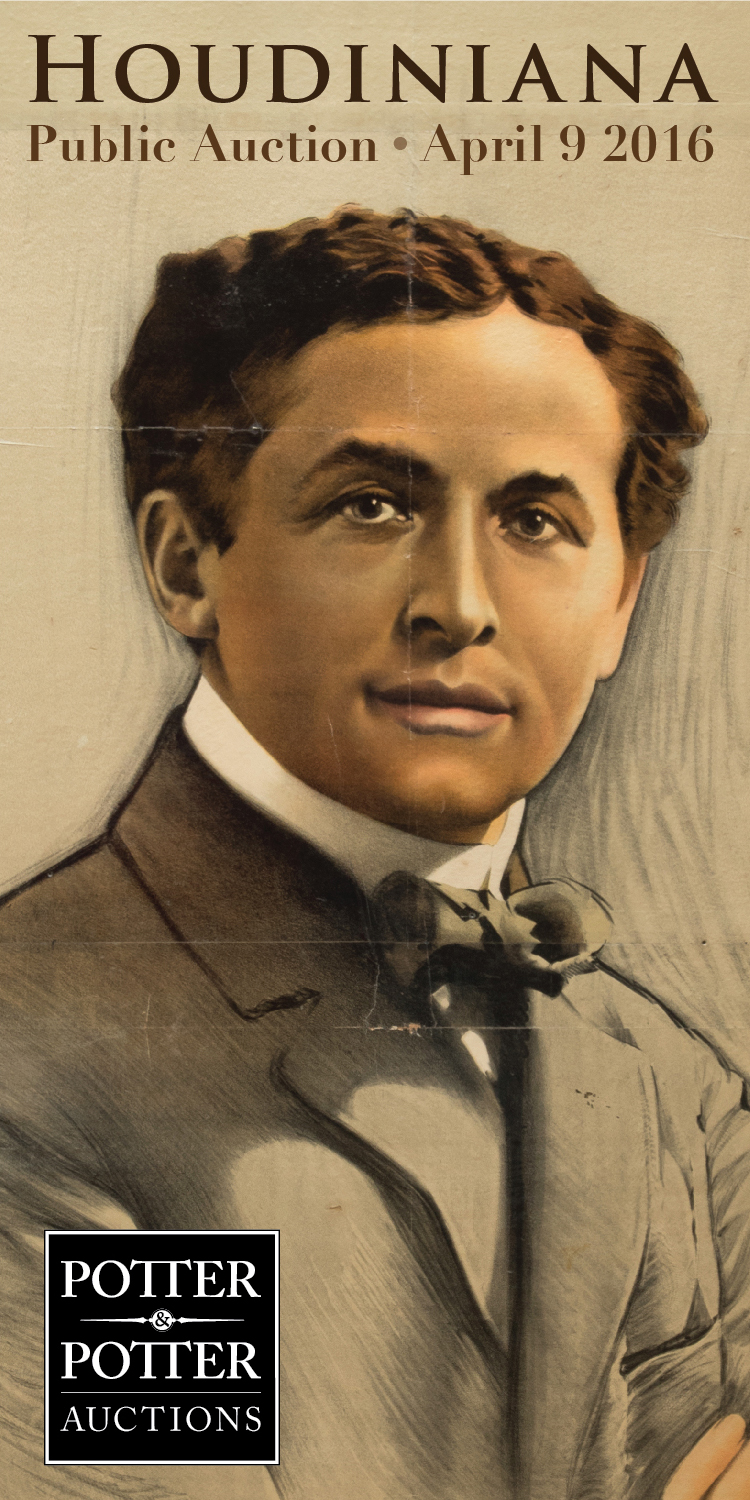
Surprisingly, posters came in at the lower end of their auction estimates. The famous "Houdini for President" lithograph featured on the auction catalog cover sold for $12,000 (estimate $12,000 – $18,000). A King of Cards sold for $9,500, below the estimate of $12,000 – $15,00. In a 2014 Potter & Potter auction a King of Cards sold for $17,000. Finally, a sensational original lobby display and transport case was a steal, IMO, at $7,000 (estimate $7,000 – $9,000).

Houdini lobby display and case - $7,000.

Poster fragment - $650.

If you log into Live Auctioneers you can see all the auction results.

Congrats to Potter & Potter and all the buyers and sellers in what was yet another historic and exciting Houdini auction.

UPDATE: These two lots came late in the auction so I missed them yesterday. An unusual signed photo of Bess and Julia Sawyer in French costumes and wigs sold for $2,400. A Robert-Houdin glass column mystery clock brought a whopping $42,000!

Bessie and Julia - $2,400.  Robert-Houdin clock - $42,000.

Related:

Monday, August 17, 2015

Houdini Headquarters

Here's another incredible unpublished image from the collection of the American Museum of Magic in Marshall, Michigan. This shows Houdini dealing with his correspondence, presumably somewhere inside 278. This is the only glimpse I've ever seen of what could be called "Houdini Headquarters."


The man on the left side of the photo is Bess's brother, John Rahner. The woman on the far right appears to match photos of Julia Sawyer. I'm unsure of the identity of the young woman in the center. Possibly Julie Karcher.

Thanks to Keli Hindenach of the American Museum of Magic. This photo was supplied to the museum by Jon Oliver.

Related:

Friday, May 15, 2015

Houdini to Bess – "Sweetheart Mine"

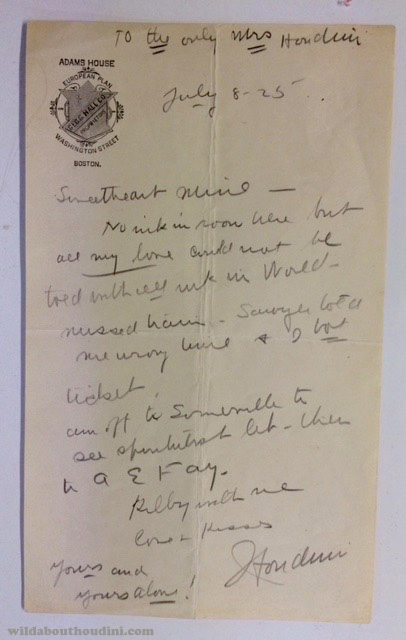
Houdini famously wrote love letters to his wife Bess that he would leave on her pillow or around the house. Now a fellow Houdini buff shares with us one of those letters from his collection. I don't believe it has ever been published. It's dated July 8, 1925, and appears to have been written while the Houdinis were staying at the Adams House hotel in Boston.

The letter is handwritten and a little hard to decipher. I've made my best attempt below. Maybe someone can improve on it?


To the only Mrs Houdini
July 8 - 25
Sweetheart Mine –
No ink in room here but all my love could not be told with all ink in World –
Missed train. Sawyer told me wrong time & I bot ticket!
Am off to Sommerville to see spiritualist [illegible] - then to a E Fay.
Kilby with me.
Love & Kisses
Houdini
Yours and yours alone!

"Sawyer" is likely Bess's niece Julia Sawyer (I've also seen it spelled Sauer), who worked as an assistant to the Houdinis both onstage and off. "Kilby" is Houdini's friend and fellow theatre collector Quincy Kilby. Houdini's reference to "a E Fay" is Anna Eva Fay, the famous medium who lived in Melrose, Massachusetts.

This is a wonderful and also somewhat curious letter. Houdini's assurances to Bess that she is "the only Mrs Houdini" and that he's "yours and yours alone" feel like reassurances, as if they've had a fight. It's known that Bess would sometimes have fits of jealously. Perhaps this letter followed one of her "brain storms" (as Houdini once called them).

The Adams House was a Boston hotel built in 1883 that offered long-term lodging in the heart of the theater district. Next door was an annex where B. F. Keith opened his first vaudeville house in 1885. In 1908 he converted it into one of Boston's first cinemas, the Bijou Dream. The Adams House was closed in 1927 and demolished in 1931, although the annex building still stands today.


Thanks to our friend for sharing this wonderful letter. And thanks to "Ace Underwood" and David Saltman for helping improve the transcription.

UPDATE: This letter sold on eBay for $1,875.99.

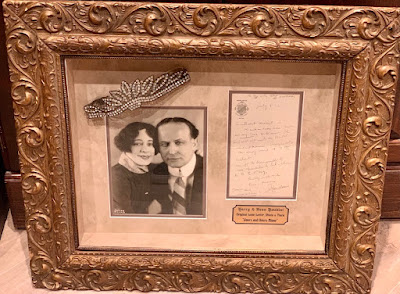
UPDATE (2021): This letter is now part of Roger Dreyer's Houdini Revealed museum. It's framed with a tiara that belonged to Bess Houdini.

Monday, April 28, 2014

"Slicing A Girl" in Worcester

Following up on my post last week about Houdini's performance of Buried Alive at the Worcester Opera House in Sept. 1926, John Hinson, the great-nephew of Harry and Bess Houdini, has done some leg-work at the Worcester library and has uncovered this terrified newspaper ad for that very week of performances.


I love the illustration of Houdini here, and the fact that it notes this as his "Second Annual Tour." But what's especially interesting is this ad references "Houdini's Newest Sensation." No, it's not Buried Alive, but something called "Slicing A Girl." I've also seen this advertised as "Slicing a Woman in Seven Parts." But exactly what this effect was (apart from the obvious description) appears to be another Houdini mystery.

Thank you, John.

UPDATE: So it appears this wasn't such a mystery after all (just a mystery to me). Thanks to Joe Notaro and Tom Interval's Houdini Magical Hall of Fame Facebook page, here is a photo of the effect, along with a description from the great Patrick Culliton:

"The Cutting a girl into eight pieces apparatus was in the Niagara Museum from its opening until the fire. I put it together (not to perform, but, to display) for the Butterfield auction. I was not impressed with the illusion which Dunninger made, and Kevin Connolly has a letter from Houdini to Dunninger in which Houdini really complains about the shoddy workmanship. He says his men had to completely tear it down and rebuild it. It was really to take advantage of the Sawing a Lady in Half fad of a few years before. Hardeen performed it, and in a very rare professional appearance as a magician, Jimmy Collins performed it (and handcuff escapes and a straight jacket escape) around 1928."

- Patrick Culliton

It's said Dunninger's original design for the effect had the assistant fully concealed inside the box. But Houdini felt this would arouse audience suspicion, so he redesigned it to display the girl's head and feet.

The original "Slicing A Girl in Eight" apparatus sold for $3,450 at Butterfied & Butterfiled's auction of memorabilia from the Houdini Magical Hall of Fame held in Los Angeles on November 15, 1999. The restored effect was resold at a Bonhams auction of Entertainment Memorabilia on June 16, 2008 for only $2,700.

UPDATE: A December 5, 1926 article in the New York Daily News reveals that the women in the box was Houdini's niece Julia Sawyer.

Related:

Monday, July 9, 2012

Houdini press photos sell big on eBay

A collection of six terrific original Houdini press photos from various Chicago newspaper and sports archives sold yesterday on eBay for a collective $1,225. I knew these were going to draw attention, and I wasn't wrong.

Among the photos are three shots (below) that I've never seen. One is a nice portrait (sold for $152.49), the other a shot of Houdini demonstrating spirit trumpet trickery ($256.99), and the last one is a remarkable shot of Houdini with assistants Julie Karcher and Julia Sawyer ($222.50). This is a fantastic image of Houdini as a magician that has never been published, and what I especially love is that Houdini is dressed in shirtsleeves, suggesting this was maybe taken during rehearsals.


Another thing I find intriguing about some of these shots is the stamp on the back from Houdini's roadshow (below). This tells me that these pictures might have been sent to the papers by Houdini himself.

Saturday, April 2, 2011

Dorothy Young remembers her days with Houdini

On April 6, 2000, Rhoda Newman of the Monmouth Library interviewed Dorothy Young as part of the library's Remembering the 20th Century: An Oral History of Monmouth County project. It's a wonderful interview filled with interesting remembrances from Dorothy, who passed away on March 20 at age 103.

Here is an excerpt from that interview in which Dorothy talks about her experiences with the Houdini roadshow. I especially love the story of her and Bess smuggling booze over the border from Canada. That's our Bessie!

Ms. Newman: And you were how old at this point?

Ms. Young: Seventeen. And, I went to the Longacre Theatre up at 48th Street and Broadway, and when I arrived the stage was full of girls auditioning. I saw two men down in the Orchestra viewing the audition. I had no idea who they were. One was Houdini and the other was his manager, Mr. Smith. I was about the last one to audition. I did a Charleston. And they chose me right away and took me over to their lawyer over on 44th Street. I called Mrs. Houdini "Mrs. H." Sometimes an interviewer would say to me, "When you are so close, why do you call her Mrs. H?" I said a seventeen year old girl is not about to call a mature woman by her first name. So, she was always Mrs. H. to me. She took me over to choose material to make my outfit, my costume, and then I signed the contract. I dashed to my father and said, "I'm going to dance on Broadway," and he said, "No way." I went to Houdini. They must have been flabbergasted because they were to open in one week, and they had gone through these auditions. Anyway, I told them my father and mother wouldn't allow me to. They asked to speak to them, and they convinced my parents that they would look after me as their very own daughter, which they did. It was a wonderful, wonderful year. Mrs. H. was a second mother to me. She taught me how to sew and put on makeup. We spent our days together. I've done five documentaries about Houdini. One thing they never put in is that I say Houdini was a very kind, compassionate man. They liked to picture him as egotistical and temperamental. And, my year with them was really, really wonderful. Another thing they never put in: he had been famous for about thirty years, but his dream, his project dream was to always star in his own production on Broadway, and this was his dream come true. Well, we opened, and my father arranged for me to live with a widow with two daughters for the week I would be in New York, before leaving to break in the show at Hartford, Connecticut. And, one of the daughters said, "Oh I'm going to a party tonight, and would you like to go?" I said, "Surely." I remember it was the day I had my costume fitted up at 103rd Street at Houdini's home.

Ms. Newman: Can you describe the costume?

Ms. Young: Oh, I have pictures of them. They were very, very scanty. I'll show you a picture of them later. And, Mrs. H., who was a wonderful designer, always made all of hers.

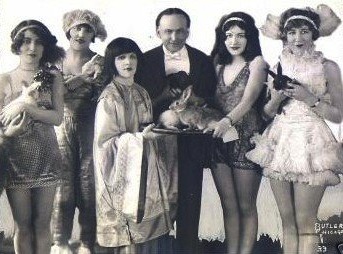
Houdini and his roadshow girls. Young is second from the right.

Ms. Newman: Where they silk? And what colors?
Ms. Young: Oh, beautiful bouquets and metallic. So, after I had my costume fitted, I jumped in a taxi at 103rd Street. A young girl and I went down to The Village where the party was to be. The girl introduced me around. We danced in a club. I met this man. He seemed very, very sophisticated to me. I guess he was around thirty. He said, "Oh you are so young to be in New York all by yourself. You need a big brother to take care of you." I didn't care for him. So, he was smart enough not to ask for my phone number, but he asked the girl I was staying with for her phone number. And he called up the next day and took us both to lunch. For the whole week, he took me to all the best places in New York City. And during the whole year I was with Houdini, he called me once a week. On the way to Hartford, I still didn't know who Houdini was. They had a drawing room and I had the parlor. Houdini came out with a deck of cards and he did all of his card tricks for me. And then he proceeded to tell me a lot about his childhood, which was very interesting. Well, when we arrived at Hartford, it was on a Sunday night. And Rachmaninoff had a concert there, and we went directly to the theatre to unpack. I remember I stood in the wings and listened. And I was so thrilled. And when he came out, I guess he wondered why a young girl like that would just be standing there listening the whole time. It is a very happy memory having had a visit with Rachmaninoff. He was very tall and slender. I remember when he said goodbye, he patted my head. After I fulfilled my year contract, of course, Houdini wanted me to stay on.

Ms. Newman: What did you do as part of the Houdini act?

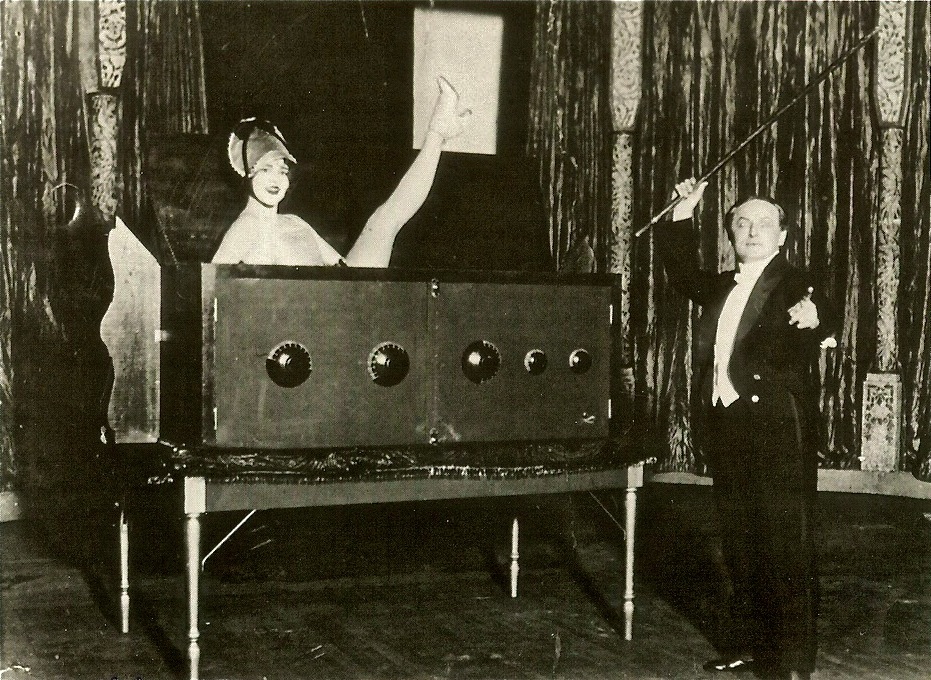
Ms. Young: At first they had a very beautiful curtain made of mementos of things they had been given in Europe, and this curtain was very beautiful. Mrs. H. was dressed as Marie Antoinette, and I her escort. Mrs. H came out on one side and I the other. We joined in the center and did a little minuet, and pulled back the curtains. Then a big stage was there, and a black back drop and Houdini came out in his magnificent entrance. Two years ago, Harvey Keitel, an actor, I didn't know who he was, he was doing an impersonation of Houdini, and he sent his limo down for me to go up and have dinner with him, and I did Houdini's entrance for him about twenty times, and he studied the mannerisms. Houdini was not a tall man. He was very muscular, and the way he carried himself, you didn't think of height. He was dressed in full dress, immaculate. And the jacket was designed that he could remove the sleeves from the elbow down so that while he worked, you could see that he wasn't concealing anything. Well, the show opened with the proverbial magic thing with the scarves and the birds and all that. Then Mrs. H. had her famous, famous trunk trick. It's now called "Metamorphosis." Houdini purchased it when they were young in Coney Island for $25.00 from a retiring magician, and now that has become so famous. And Mrs. H. must have been almost, I bet she was, no she must have been at least fifty or fifty-two, but from the back of the stage she looked like sixteen, the way she was made up in her little gown. She kept herself beautiful. My first number was a Radio Girl. Collins and Vickory, his two assistances, would bring out a large table. Houdini would go in back and show nothing underneath the table, no mirrors or anything like that. Then Collins and Vickory would bring out a big radio. And Houdini would open the doors, would prop them back and show there was nothing inside. He'd lift out a panel like tubes and things. Then he would close it up and tune in like, for instance, Pittsburgh would be KDKA, and it's say, "KDKA, Ms. Dorothy Young doing the Charleston." And, that was my cue to put my foot out, then the other foot, then I'd kick them together, jump up and do a curtsey.

Dorothy as the "radio girl"

Ms. Newman: You were inside the radio?

Ms. Young: Yes. Then Houdini would take me by the waist and lift me down, and I would go into a Charleston. And, my other number was called the "Slave Girl." The big stage was empty and there was just a pole in the middle of the big stage. And Collins would bring me out with my hands tied behind me. And I had a little skimpy burlap costume. And, Houdini would say, she has been a naughty girl, so I have to tie her up. So they tied me up to the pole from my throat down to my ankles. And then Houdini said, she has been naughty, so we will have to put her in darkness. He would press a button, and the curtain would fall to the floor. And I would come out in a beautiful butterfly costume on my toes and do a ballet number. And then another number I did: there was a big cabinet, and Houdini would walk through it and turn it around to show it was absolutely empty. Then, he would say presto, and Mrs. H. in a very beautiful elaborate costume, and myself, and Julia, his secretary, in an elaborate costume, and Kosher, in an elaborate costume, would all came out. And once in a while when Mr. Smith's wife would be there, we would add her to it. And, then the very, very exciting thing was Water Torture Cell. I think it was sad the way they made the movie about him dying in the water. The whole movie was terrible. Houdini would turn over in his grave. It was terrible. Well, Mrs. H. always stood in the wings. They had this large cabinet and Houdini would come out in swim trunks. They'd lift him up by his feet and lower him head first with his hands tied behind him and lower him in the tank. And then, to make it more dramatic, the orchestra would play, "Asleep In the Deep," which made it very dramatic. I stood with Mrs. H. often, and she said only once in their life, did he have to give the signal to be taken out. And, when I appeared at any magicians' conventions they always want to know what the secret was, of course. I would tell them I was sworn to secrecy.

Ms. Newman: You were aware of the secret, but were sworn to secrecy?

Ms. Young: Yes. The last half of his act was devoted completely to exposing spiritualism. He felt spiritualism was wicked; it preyed on poor people who'd spend their last dollar to hear the voice of their loved ones. And, he had a person we called the Reva woman who would visit the entire spiritualist, the mediums, and card people in the city before we would play. And then she would come to report to Houdini. We never could eat dinner before the show because we had to be as thin as possible. So, we always, Mrs. H., Kosher, and Julia, and Mr. Smith, Houdini, and I always had dinner after the show. And, in all those years, I never remember once Houdini showing any anger or anything. Mrs. H. was a real cut up. She was a lot of fun, and she, when we were playing Buffalo, she suggested that we go to rent a limo and go over to Canada. We went through the Mist and everything.

Ms. Newman: Niagara Falls?

Ms. Young: Yes. She was a lot of fun. And just before we left the border, she said, "Let's get a bottle of liquor and see if we could smuggle it in." Well, that night at dinner, somehow we joked about it.

Ms. Newman: This was during prohibition?

Ms. Young: Oh yes, and Houdini snapped, "Do you realized the publicity we would have had if they had caught you bringing liquor in?" And that is the only time I ever heard him express anger. He was just the most wonderful compassionate person to work for. The last act involved a very famous medium called Marjorie. He dressed up, he put on a wig and a cane, and dressed up as an old man, and went to Marjorie and told them to get in touch with the spirit of a loved one. And he copied her séance completely in the last act of the show. He would ask people to come up who would invariably be interested in spiritualism. And, they would sit at a table, and they would ask to speak with a loved one. And then, Houdini would go through the seance, and it really was weird to see. And then after he did it, he broke it apart to show the whole audience how it was done.

Ms. Newman: He would show that it was a fraud.

Ms. Young: Yes. Houdini was like a father to me, but never personal, you know. Before I left the show he said to me, "Dorothy, did you ever wonder why you were chosen over 200 girls?" I said, "No." He said, "Mr. Smith and I are opposite personalities, and you appealed to both of us. And we knew you were the one that we wanted." As I look back, I think it might have been in the first place all of those girls were typical Broadway girls, and they weren't going to have someone like that travel with them closely. It was a close unit. That is one thing, and the other thing, I was shorter than Houdini, and most of them were taller. That was my experience with Houdini.

Ms. Newman: So you had a year's contract and that was the end?

Ms. Young: Yes. And he died two months after. Two young boys were visiting him backstage. They had seen the show, and Houdini had had a pain and the doctor didn't diagnosis it right. His appendix was in the center rather than at the side. He had appendicitis, but the doctors didn't diagnose it that way. And then, one of the boys said, "You mean you could withstand a punch with all my might?" And Houdini said, "Yes." What the boy didn't realize was that Houdini had to prepare himself first, and the boy struck him, and his appendix burst. So, they rushed him to the hospital, but it was too late. He fought for a whole week. He thought he could lick it, but he couldn't, and finally he had to give up.

Ms. Newman: Did your father ever see you perform?

Ms. Young: Oh, yes, when we were in Pittsburgh, my father was in the audience, and Houdini asked him to stand up. And when I was in Chicago, my Grandmother Caldwell was there, and we were sold out. I don't know. Somehow or another, he got her a seat in the first row center. And when I took her back stage to meet Houdini, Houdini kissed her forehead and said, "Now I know where Dorothy gets her charm." (Laughs)

Ms. Newman: He does sound like a dear man. Were there other people traveling?

Ms. Young: No. We were a close unit. Collins was his main assistant, and Victory was his helper. Mrs. H., Houdini, Julia, Kosher, Mr. Smith, and I. That was our entourage.

Ms. Newman: And you went across the country.

Ms. Young: Oh, yes. And we played Broadway twice.

Ms. Newman: Were these one night stands?

Ms. Young: Oh, no, I think we played Chicago four weeks.

Ms. Newman: And you traveled by train?

Ms. Young: Yes, by train. I'd spend my day with Mrs. H. I don't remember what salary I had, but it must have been plenty, because I always stayed right in the next room to them, and I always had my breakfast sent in my room and I felt so sophisticated. I remember I had a black satin negligee with white marabous. And in those days, eating breakfast for one, they would wheel it in on a whole table. Now days if you had breakfast for one, they'd just bring it on a tray. I remember I would drape myself and feel so grown up.

Ms. Newman: What year was this?

Ms. Young: 1925 and 1926. So, that was my story with Houdini.

CLICK HERE to read the entire interview at the Monmouth Library's "Remembering the 20th Century: An Oral History of Monmouth County" website.

Translate