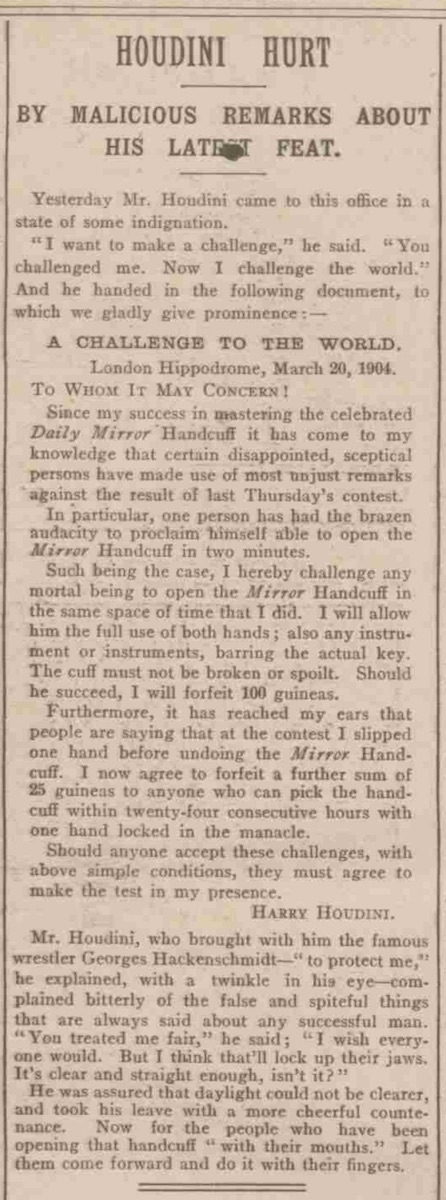
It was about this time that Houdini was advertised at the Hippodrome. He would give 500 pounds to any one who could get out of a special set of handcuffs, called "Mirror Handcuffs." The Daily Mirror Newspaper Corporation had these handcuffs made especially to challenge Houdini to get out of them, and Houdini accepted the challenge. At the same time, he passed the challenge along to any one. After a lot of urging, Valadon and Albini persuaded Pongo to compete, telling him that he had a fine chance to win, but warned him never to say a word about Valadon and Albini asking him to compete. In fact, never to mention either of their names.The evening came when Houdini was to get out of the Mirror Cuffs. It had been advertised all over London. Val gave me tickets for Pongo and myself, with strict orders for me to see that Pongo got to the Hippodrome, and that his seat was right down near the stage. After having helped him in the back yard, he knew I was his friend, and he stuck close by. We got seats in the third row, and I had never seen such a full house before. Every seat was taken. The stage was set for Houdini. On the stage a small tent was erected. In came Houdini. The applause was tremendous. He stated what he was about to do—or try to do. He made a long speech, and he knew what to say and how to say it. He then made the challenge to any one in the audience who would attempt to get out of these handcuffs. Up jumped Pongo. "I accept that challenge," he shouted. Every eye was turned on him. Houdini stopped and stared. Then the audience gave a yell. Pongo grabbed me to go with him on the stage, but I pulled away from him and he went alone. Houdini asked three or four from the audience to come onto the stage to see that everything was fair. Valadon and Albini were among those who responded. Houdini looked Pongo over, and no doubt sized him up correctly. He then made a talk explaining things. He said he would fasten the Mirror cuffs on Pongo, and also an ordinary pair of cuffs. Pongo positively refused the ordinary cuffs; only the Mirror cuffs for him. So Houdini fastened the Mirror cuffs on Pongo and led him to the tent. In Pongo went.After waiting a half hour, the audience became restless and began to shout. Another half hour passed and Houdini went and spoke to Pongo. Pongo came out, looking as if he had been in a fight. The audience saw him with handcuffs still on. He went down to the footlights with uplifted arms, and the spectators, seeing that he had something to say, quieted down. Pongo shouted: "Give an Englishman a chance!" That got them. The yelling and stamping was deafening. So Pongo went in for another half hour, but finally had to call it a go, and quit. The handcuffs were unlocked by the referee, and Pongo acknowledged his defeat.Houdini was handcuffed with the Mirror cuffs, then with the ordinary pair of cuffs. He went into the tent, and in about ten minutes, out flew the ordinary cuffs. More yells and shouts, then they quieted down, for about twenty minutes. Houdini came out, still handcuffed. His assistant got a pair of shears and cut his coat up the back. It looked as if the coat was too tight. More yells and shouts and stamping! Houdini went into the tent again, and in about twenty minutes he was out with the cuffs unlocked. Then bedlam prevailed, and we went home.
- Home
- Life
- Escapes
- Magic
- Movies
- Houdini's Movies
- Les merveilleux exploits de Houdini à Paris (1909)
- The Master Mystery (1918)
- The Grim Game (1919)
- Terror Island (1920)
- The Man From Beyond (1922)
- Haldane of the Secret Service (1923)
- Velvet Fingers (1925-26)
- Medium Well Done (1937)
- Religious Racketeers (1938)
- Houdini Picture Corp.
- Film Developing Corp.
- Filming locations
- Unmade Movies
- Deconstructing Houdini '53
- Spiritualism
- People
- Beatrice Houdini
- Theo Hardeen
- Cecelia Weiss
- Mayer Samuel Weiss
- Jim Collins
- Franz Kukol
- Martin Beck
- Sir Arthur Conan Doyle
- Margery
- J. Gordon Whitehead
- Edward Saint
- Jacob Hyman
- Leopold Weiss
- Carrie Gladys Weiss
- Bernard M.L. Ernst
- Charmian London
- Jess Willard
- H.P. Lovecraft
- Sherlock Holmes
- Assistants
- Imitators
- Other magicians
- Media
- Full Bibliography
- By Houdini
- Biography
- Fiction
- Foreign
- For Kids
- Methods
- Wild About Harry Bookshelf
- Houdini His Life Story (1928)
- Houdini The Man Who Walked Through Walls (1959)
- Houdini The Untold Story (1969)
- The Life and Many Deaths of Harry Houdini (1993)
- Houdini!!! The Career of Ehrich Weiss (1996)
- The Secret Life of Houdini (2006)
- The Metamorphosis: The Apprenticeship of Harry Houdini (2012)
- The Witch of Lime Street (2015)
- The Life and Afterlife of Harry Houdini (2019)
Wednesday, February 14, 2024
Did Houdini repeat the Mirror Challenge?
Tuesday, November 28, 2023
Houdini's humor
Related:
Saturday, May 21, 2022
Earliest known professional photo of Houdini sells for $78,000
![]() |
| SOLD for $20,400. |
![]() |
| Inscribed Houdini ($21,600) and brother Bill ($660). |
![]() |
| Young Theo ($3600) and Cecelia Weiss ($2400). |
![]() |
| SOLD for $102,000. |
![]() |
| SOLD for $6,600. |
Monday, March 8, 2021
Guest Blog: Author-Lecturer-Mystifier-Mason
On any list of famous Freemasons, Brother Harry (Houdini) is sure to be found. He was raised in St. Cecile Lodge #568 in New York on August 21,1924. St. Cecile Lodge was (and still is) a Daylight Lodge, geared specifically towards those in the performing arts, who often would not be able to attend evening meetings.
For at least the last thirty years, it has been reported that Harry became a Shriner shortly before his untimely death in 1926 and dates for his Scottish Rite Membership were not recorded publicly. However, a recent discovery at Mecca Shrine allows us to cement both his Scottish Rite and Shrine initiation dates much earlier than previously reported.
Mecca & The Mystifier
In March 2019, while cleaning up their office in the Grand Lodge of New York, Members of Mecca Shrine discovered a door hidden behind an old filing cabinet. The door led to a locker room and a curious discovery. The Current Assistant Rabban of Mecca Shrine in New York City, Noble Zachary Ostrow (right) explains "There was a big green locker that just had Mecca Shrine scribbled on the front of it. I don’t think anyone knew it had noticed it at least since the eighties. In there we found books full of Lodge records including petitions. The petitions were all numbered so we knew which ones were missing. After a few days of going through those books I found Houdini’s petition and it shows that he became a member in 1924. All the history books say 1926, and so people have gotten upset with me for finding this and making them have to re-write the history books."
![]() |
| Image courtesy Maynard Edwards. |
Houdini was 50 years old when he became a Mason, but his experience in fraternal organizations began in 1903 when he became a member of the fledgling Society of American Magicians. The group had started only the year before with just 24 members in the back of a New York City magic shop. A rift with another prominent member of the club would cause Harry to resign in 1908, but by 1915 fences had been mended and Houdini was from then on an avid supporter of the group. He would be elected SAM President from 1917 until his death (interestingly, as President of S.A.M., Harry and other officers were referred to by the the title Most Illustrious).
When performing in a particular town, it was often Harry’s habit to connect with the local magicians and there are many surviving letters of his correspondence with fellow illusionists. It may have been such a connection that caused Harry to first mention an interest in Freemasonry.
My Dear Buckle
A postcard sent from Harry Houdini to a Mr. A. Buckle in 1904 was recently sold by the world famous Potter & Potter auction house in Chicago. The type written postcard, which sold for $900, reads:
My Dear Buckle,
Am very busy, have a very big task Tomorrow, and do not feell [sic] very much like writing. Regarding me being a Mason, I regret to inform you that I am not a Mason, and hope some day to belong to that Order. I do not belong to any secret order, and am a member of the S. of A. Magicians, and an Artist club in Germany.
Regards
Houdini.
The “A. Buckle” in this case was 20-year old Manchester Magician Arthur Buckle, sometimes billed as the Manchester Wizard. Buckle’s career consisted of mostly of private performances and writing for magical trade publications. The relationship between the then 30-year old Houdini and the younger conjurer isn’t well-documented, but it would not be a stretch to assume that as magicians they would have made each other’s professional acquaintance and become friends. The postcard salutation “My Dear Buckle” and another surviving letter from Houdini to Buckle indicate a personal relationship.
The postcard itself is remarkable for several reasons. First, the date of the postcard is March 16th, only a day before the famous Daily Mirror Handcuff Challenge, and the writing clearly indicates the challenge was on his mind. Also, Houdini expresses that he did not feel like writing. We know Houdini was troubled by an unknown illness during the end of his Hippodrome engagement and not long after the handcuff challenge, Harry was forced to take 12 days bed rest, canceling a number of engagements. Does this note indicate he was already feeling ill? Finally of course, it does seem to be the first documented expression of Houdini’s interest in Freemasonry.
While the postcard only reveals one side of the conversation between the two magicians, from it we can suppose that Arthur Buckle was a Mason and had asked if Houdini was a Mason, perhaps even inviting him to Lodge. In a collection of Houdini papers at the University of Texas in Austin, there exist other letters between Houdini and Buckle that may reveal more details, however as of this writing, those letters are not accessible due to the COVID-19 crisis.
Masonic & Magical Legacy
It would be another twenty years before Houdini’s interest in Freemasonry would manifest itself into his petitioning a lodge. Perhaps the business of being an international celebrity kept Houdini from joining the Brotherhood sooner rather than later? Or perhaps being elected President of the Society of American Magicians in 1917 increased his interest in fraternal organizations? We can only speculate as to why two decades elapsed before he was raised, his reasons are just one of the many secrets the Great Harry Houdini took to his grave.
There are no known photos of Harry in any Masonic garb, and his blue lodge petition, though not in question, has yet to be located. According to several Masonic sources, it is alleged that sometime after he became a Mason, Harry gave a benefit performance for for the Scottish Rite Valley of New York before a sold-out crowd of more than 4000 spectators at the Scottish Rite Cathedral (formerly the Manhattan Opera House, currently the Manhattan Center). However, no contemporary reports of this performance have been located, and no references to any such fundraiser has been found in any official Scottish Rite transaction. This leaves much doubt as to whether or not the performance truly occurred or perhaps was somehow conflated with another similar performance at some other time and place.
However, after his untimely death in 1926, Masonic funeral rites were performed by the Brothers of St. Cecile’s Lodge- which incidentally was held at the Elks clubhouse in New York (Harry became an Elk in 1912).
A great many vaudevillian performers were members of the Craft. Several of Harry’s Magical contemporaries were taken and accepted including Harry Kellar, Howard Thurston and even William Ellsworth Robinson- better known by his stage name Chung Ling Soo. As traveling performers, the Masonic Brotherhood would have provided vaudevillians with sort of safety-net while on the road. So too, the fraternity may have lent some of its dignity to a professional class that had historically been looked down upon.
Today the legacy of Houdini and the other Magical Masons of his era lives on in the Invisible Lodge, a Masonic club specifically for Master Masons who are either professional or amateur magicians. Founded in 1953 the club meets annually at midnight either at local Magician’s conventions or more recently at the Magic Castle in Hollywood. The Magic Castle itself is a private club for magicians and regularly members gather to hold a séance in an effort to contact the spirit of none other than Harry Houdini; so far the even the Great Houdini has not managed to reach back from the other side.
*Ill. Brent Morris, 33 and Jeff Croteau, Director of Library & Archives at the Scottish Rite Masonic Museum and Library in Lexington Massachusetts contributed to this article.
Related:
Tuesday, November 24, 2020
Houdini's own Mirror Challenge
A few people did take up Houdini's challenge, but as far as I know, no one succeeded in opening the Mirror Handcuff.
Monday, September 28, 2020
Early illustrations reveal Houdini's "ghost house"
![]() |
| Illustrated Sporting and Dramatic News, February 9, 1901. |
![]() |
| Dramatic News, April 9, 1904. |
Related:
Sunday, September 27, 2020
First look at the Mirror Handcuffs?
Friday, September 11, 2020
Did Hardeen really discover the full view straitjacket escape?
![]() |
| Click to enlarge. |
![]() |
| Hartlepool Northern Daily Mail. |
![]() |
| Music Hall and Theatre Review, March 24, 1905. |
Thursday, September 3, 2020
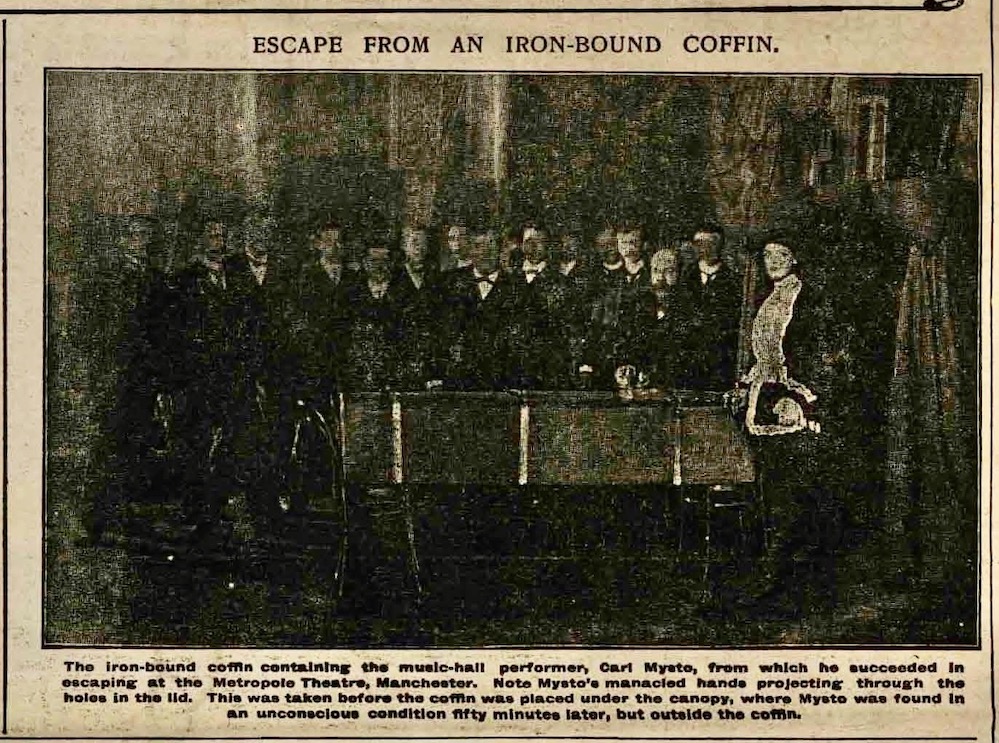
More trouble for Mysto
![]() |
| Click to enlarge. |
Tuesday, September 1, 2020
Opening Mysto's coffin
Unlike the stories of Houdini undoing Kleppini with the French Letter Cuff or Frank Hilbert with a crafty disguise, the Mysto affair doesn't present Houdini in an especially heroic light. It's an out-and-out exposure of another magician's original invention and a clear breech of the Magician's Code. Local magicians were said to be "blazing with anger", and at least one reader of the Mirror found Houdini's behavior unsportsmanlike:
Saturday, August 8, 2020
The Handcuff King in England
I recently subscribed to The British Newspaper Archive, and I'm losing my mind! I'm adding volumes of information about Houdini in the UK my Chronology. I'm also coming across many photographic gems, such as the below. This comes from the February 17, 1904 Tatler magazine. Not much to say except, wow, what a pic!
For the record, Houdini appeared in the UK in 1900, 1901, 1902, 1903, 1904, 1905, 1908, 1909, 1910, 1911, 1913, 1914, and 1920.
Okay, back to work!
Saturday, July 25, 2020
The Tatler Mirror Cuff mystery deepens (update)
Joe is continuing the investigation with some interesting new findings and observations. This is wild stuff, so I encourage you to click the links below and read the posts and comments.
Friday, July 3, 2020
Houdini on race equality
In Houdini's day the great struggle was that of women seeking equality in society and especially the right to vote. The "Suffrage" movement sparked demonstrations and even violence. When asked if he approved of "women participating in everyday life" (code for equal rights), Houdini's answer was an unequivocal, "Yes."
But he largely led by example–such as inviting Suffragettes onstage to challenge him in 1908–and avoided the mire of politics, stating: "I hope to keep out of politics, for that is a game in which most of us are defeated before we even get into."
But what about racial equality?
Being Jewish and an immigrant, Houdini certainly understood the sting of institutional discrimination. And while he wasn't perfect (his films and fiction trade on racial stereotypes), he had a strong sense of justice and did express a tolerance uncharacteristic for that time. For instance, he was impressed with the racial equality he witnessed in British Music Halls, and wrote about it in his New York Dramatic Mirror column on November 12, 1904.
In this remarkable paragraph, written in England for American readers, one may infer of his own feelings on race equality. And while Houdini's use of the word "colored" is considered offensive today, it was the most respectful language he could have used at that time.
Just a few lines referring to your article appearing Sept. 24, in which you reproduce a cut of a team called Cline and Clark, in which a white woman is doing a sketch with a colored man. That is nothing unusual on this side of the pond, and were I a colored man I would never leave this country. They are all looked upon here just as amicably as if they were white. The color line is unknown here, and many a team I've seen in which the man is colored and his partner white. The colored race over here has made a great big hit, and certainly are making good with their ability. I have been on the bill with several American colored acts that have "made good" without question. I may mention Brown and Navarro, Grant and Grant, La Belle Morcschania, Johnson and Dean, White and Black, the Four Black Troubadours, Eph Thompson, George Jackson, etc., and all have done well.
I trust that these few lines will not open any controversy, as I simply write for general information and nothing else.
Wishing everyone a safe and united Fourth of July weekend.
Related:
Wednesday, September 12, 2018
Houdini in 1904
This post is now retired. But you will be able to enjoy the story of Houdini in 1904 in my upcoming book.
Thursday, May 10, 2018
"The Great Handcuff Contest"
Anything related to the Mirror Challenge is always of interest, and this is especially exciting to see because there is no illustrated standalone poster that we know of. (The closest thing we have is an image on this lost poster.) Of course, David also owns the Mirror handcuffs themselves.
Earlier this year I had the extreme honor of visiting David Copperfield's amazing collection in Las Vegas. Click the related link below to relive that adventure. Also stay tuned for some exciting Copperfield Collection news...
Related:
Sunday, September 3, 2017
The Prison Cell & Barrel Mystery...or misfire?
The origin of the Prison Cell & Barrel Mystery goes back to Houdini's earliest days as a performer. Harry's first partner in The Brothers Houdini, Jacob Hyman, left the act and was replaced by Houdini's real brother, Theo. After a short stint in the army, Hyman got back into show business as J.H. Houdini. Having co-created the name, Jacob believed he had as much right to use it as Harry. His feature was an escape from a barrel that he called The Barrel Mystery.
| Jacob Hyman a.k.a. J.H. Houdini |
Now in possession of Jacob's barrel, Houdini developed a new effect to replace Metamorphosis. The effect would see him locked in the barrel and then "triple-locked" into a portable prison cell. In "less that 2 seconds", Houdini would make his escape and his assistant, Franz Kukol, would be discovered inside. It's interesting that it was not Bess who played this substitution role as she had for 10 years with Metamorphosis. But it appears Bess was ready to leave the act, at least as a regular participant. The Prison Cell & Barrel Mystery offered her that...escape.
The first performance of the Prison Cell & Barrel Mystery was at the Regent Theatre in Salford during the week of October 3, 1904. Houdini offered £100 to anyone who could find trap doors within the jail cell. (The barrel is apparently not part of the deal.) But a review of his act the following week at the Empire Palace of Varieties in Bristol describes the effect is being performed with a curtain cabinet instead of the jail cell, much in the style of Metamorphosis. Perhaps there was a problem with the cell that night. Or might this be the first sign that something wasn't quite working?
![]() |
| Advert in the Houdini Museum of New York. |
However, it's clear from the notices that the new feat did not pack the same punch as Metamorphosis. Newspapers frequently praised Metamorphosis as "clever" and a "neat trick." But descriptions of the Barrel Mystery tend to be somewhat dispassionate, such as this November 15, 1904 review of Houdini’s act in Leeds:
Houdini, in addition to his handcuff business, at which he is a past master, showed a packed house at the Tivoli last night a model of a prison cell. Enclosed and locked in a sort of barrel, he was duly placed in the cell, which was triply locked outside. In a minute or so, he was outside the cell and the barrel, when opened, contained an attendant.
So what was wrong? The Prison Cell & Barrel Mystery had it all. But maybe that was the problem. Was it an escape or a magic trick? It seemed designed to be both, but in doing so, it becomes neither. The set-up is pure escape, and a sacred one at that. This is "The Jail Breaker" after all. But the appearance of an assistant at the end reveals it to have been "just a trick" all along. One could see this as being confusing for the audience. It could have the unintended effect of undercutting the legitimacy of all of Houdini's escapes. Because if Houdini could secrete an assistant inside his escape apparatus whenever he liked, well...
It's also been suggested that the appearance of a male assistant lacks the poetry of man into a woman, husband into wife. Hardeen himself noted the improvement in Metamorphosis when Harry replaced him with Bess. Said Dash, "The exchange of one young man for another who looked a lot like him could not be as dynamic as the virtual transformation of a woman into a man."
This is probably why, despite the posters he had made touting the exchange, Houdini appears to have dropped the substitution element, at least on occasion. The Sunderland Echo on May 23 1905 describes the Prison Cell & Barrel Mystery as a straightforward escape, with Metamorphosis back in the act as the closer. But even as an escape, it doesn't seem to have always wowed the crowds. As Houdini explained the workings of his prison cell one night in Hastings, someone in the upper part of the house repeatedly shouted, "It is faked."
Nevertheless, Houdini took the Prison Cell & Barrel Mystery to America and featured it during his triumphant return tour of 1906. Despite having a fresh poster created that now billed it as "The Prison and Barrel Transposition" (right), he again appears to have presented it as a straight escape, as suggested in this April 19, 1906 review in the Hartford Courant:
In Salem, Mass, he was locked in a stout barrel with four locks and many straps, and placed in a facsimile of a German cell. In a few moments he was free.
But not all the reviews were dispassionate. When Houdini played the American Theater in New York in May 1906, the NY Clipper records:
His "prison cell and barrel substitution" was new to most of the audience, and was a tremendous success, being one of his best offerings.
Houdini was doing the Prison Cell & Barrel Mystery as late as December 1906 (when the above photo was taken), so it's likely it continued as a periodic feature right through his 1907 tour. But with the coming of his next original invention in 1908, the undeniably successful Milk Can escape, the Prison Cell & Barrel Mystery vanishes from the record. Metamorphosis returns as Houdini's preferred substitution illusion, and never again would Houdini so mix magic and escape into a single effect.
There is no known photo of Houdini performing the Prison Cell & Barrel Mystery, and none of the apparatus survives (as far as I know). One can see the barrel in photos of Jacob Hyman, and it's likely its secret is revealed in Walter Gibson's Houdini's Escapes (page 212). Unfortunately, there are no photos or even a sketch of the prison cell. That part of the effect remains a mystery.
Today Metamorphosis stands as Houdini's great substitution trick, and is still performed to acclaim. The legacy of the Prison Cell & Barrel Mystery remains a poster, and perhaps a rare example of when Houdini got it wrong.
Information critical to my understanding of the Prison Cell & Barrel Mystery appears in Derek Tait's terrific new book, The Great Houdini: His British Tours. Also thanks to Joe Posnanski and Bill Mullins for finding me reviews in America. The photo of Jack Hyman with the barrel is from The Secret Life of Houdini Laid Bare. The original belongs to Roger Dreyer. U.S. poster pic comes from HHCE.
Related:
Monday, February 1, 2016
Guest blog: Houdini Reflected, Part II
In the first part of this article, you read the full official account of the famous “Mirror Cuffs” and Houdini’s eventual escape and triumph over them. Now, if you were to take it all at face value, which you probably shouldn’t, you’d be no worse for wear in thinking that Houdini truly was the world’s greatest escape artist! No one here is arguing that point, but this is Harry Houdini we’re talking about, and with him nothing was usually what it seemed. The true story of the “Mirror Cuffs” is one that is multi–layered. By simply scratching the surface, true answers do reveal themselves, however others uncover one mystery, after another, after another.
A Challenger’s Challenge
"Talk about being billed big. You ought to see London and look about. Nothing on the walls but Houdini!"
With these not-so-humble words, Houdini wrote back to well-wishers in the United States. As mentioned previously, Houdini was deluged with adoration in the weeks following the event. The intense pressure he must have been under manifested itself by the end of the Hippodrome run when he became sick and was confined to bed for 12 days. Houdini, it would seem, was mortal after all.
Mortal or not, the answer to the puzzle of the Mirror Cuffs has been baffling experts for years. Where did these so-called mysterious handcuffs really come from? Was Houdini himself in on the challenge? The theories and answers to these questions, while not crystal clear, give us a unique insight into this challenge and, most importantly, the mind of Harry Houdini.
![]() |
| Will A. Bennet |
I was working with a London daily. One morning I suggested to the editor that it would be a good “gag” or “scoop” if we could put a pair of handcuffs on Houdini, the Handcuff King, that he could not open…The editor agreed in much the same way as he might have done had I suggested that it would be a good “gag” if I could get His Majesty...to give me an interview on his life as a monarch.
After being given reluctant permission, Bennet travelled to Birmingham to locate a pair of handcuffs strong enough to stump Houdini. What follows is the kind of story that should be taken with liberal grains of journalistic salt. Allegedly, Bennet was turned down by numerous locksmiths unwilling to take on such a challenge. With frustration mounting, his cab driver asked him to leave after doubting that he would have enough to pay him in the end. A heated argument ensued, causing a nearby police officer to break up the fight. As luck would conveniently have it, the police officer knew of just the right locksmith for Bennet to talk with…Nathanial Hart.
It is Hart, of course, who is the locksmith generally credited with creating the “Mirror Cuffs.” According to Bennet’s story, Hart wouldn’t sell the cuffs, only loan them for the challenge. It is at this point that it’s hard to say if this whole article is one long “embellishment” or sprinkled with some degree of fact. Bennet seems to play the challenge idea off as an afterthought for his editor and the newspaper. But, when looking at it from a real business angle, for the Mirror and Houdini, it was very much a win-win situation. It was one that could provide mutually beneficial publicity for them both…and publicity is exactly what Houdini craved and the Mirror offered.
Hart to Hart
In the 111 years since the challenge, Nathaniel Hart’s remains just as elusive and enigmatic as the day the challenge was issued. Many theories exist as to who he really was and how involved or not involved he may have been in the challenge. Or for that matter did he even exist at all? As for the latter, all signs seem to point to yes. The late British Mirror Cuffs expert and locksmith Mick Hanzlick spent the better part of his life tracking down the truths of the incident. In a newspaper interview from the Hertfordshire Mercury dated January 25, 2008 Hazlick elaborates on his hunt for Nathaniel Hart:
I assumed that as Hart was named as coming from Birmingham, the heart of the metal working industry in the late 1800s and early 1900s, the place to look was in that area. However, it seemed that I was looking in the wrong place. I received a copy of a census form from 1891, which showed a Nathaniel Hart, coachsmith (metal worker), as living at 24B West Street, Hertford.
While this didn’t 100% prove the existence of the Nathanial Hart from Bennet’s newspaper article, it was an intriguing lead. Hanzlick went onto bring up other interesting points such as: Why wasn’t Hart in the Hippodrome audience to see the challenge take place? Why wasn’t he publicly thanked after the event? Was it actually a set-up by Houdini resulting in Hart being paid to keep quiet for his services?
The latter question leads us back to Kenneth Silverman’s Houdini!!! The Career of Ehrich Weiss. Citing lock expert Bill Liles, Silverman states:
Like British police cuffs of the period…the Mirror Cuffs were non-adjustable. Just as Bobbies often had to carry several different-size cuffs, the creator of the Mirror Cuffs needed to know Houdini’s wrist size in order to forge cuffs that fit him. This and other evidence led Liles to believe that Houdini designed the cuffs himself.
When talking about Houdini you’re always going to get more questions than answers. Nathanial Hart is no exception, and his dubious involvement in the “Mirror Cuffs” episode has to be left to our conspiracy-obsessed imaginations.
Conspiracies, Keys, and Cuffs
In our mind’s eye, it’s easy to envision a restrained Houdini within the darkness of his ghost cabinet locked in the throes of violent contortions. However, the real solution to the escape is most likely a little more simple than that…he had the key. If you’re still not a buying this theory, look no further than the Amazing Randi’s blunt assessment:
"I can assure you that the Mirror Handcuffs were not opened with anything but the key!"
One of the more prominent theories ties into something as simple as…a glass of water. Smuggling a key inside a glass of water featured into several of Houdini’s other challenges. This lends credence to the fact that Bess may have passed it to him around the moment when he requested to stretch his legs and a cushion was brought onstage for him.
However, Kenneth Silverman dismisses this theory due to the key’s large size and suggests that the key was in the cushion. However, as Harry Houdini Circumstantial Evidence convincingly mentions:
Handcuff experts point out that the working area of the key is all that is required and that the key could have been cut down to a length of about 1 ½ inches. The actual nested mechanism is only about an inch from the keyhole and not deep inside the cuff lock tube.
The exact way he obtained the key, for the time being at least, will have to be relegated to the world of scholarly research and rabid internet forum speculation. Both are places that the world of Houdini is right at home.
One would think that at this point there’s not much left to unearth regarding the challenge. However, William Kalush and Larry Sloman’s 2007 book titled The Secret Life of Houdini brought forth a scenario that seemingly altered the way the incident was viewed and Houdini’s involvement within it.
Six weeks after the Hippodrome, Houdini was presented with a silver replica of the original handcuffs by the British silversmiths Hamilton and Company while performing in Brighton, England. According to Kalush and Sloman, after you analyze the marks on the silver replicas, the visible date stamp was 1903. As the actual challenge took place in 1904, this naturally brought up an interesting question. Were the replica “Mirror Cuffs” possibly constructed for Houdini one year before the challenge took place?
In 2013, Mirror Cuffs expert Mick Hanzlick consulted with the London Assay Office; a firm that has controlled trademarks on silver for hundreds of years. This was their response.
The HC&O mark is the maker’s mark Hamilton & Company…the “h” denotes the date, 1903…The date marks did not run from January to January. The date marks ran from May to May.
Mick countered with this response:
The challenge was March 17, 1904. The replica cuffs were presented to Houdini about six weeks after the challenge, so at the latest that would be towards the end of April, 1904. During those six weeks, the cuffs would have to be registered as required by the Assay Office. So, that would have had to have been before May, 1904, therefore the 1903 “h” mark would have been the only one that could have been used.
Are you still with me? Hanzlick believed that the replica cuffs could have been made anytime between May 1903 and May 1904 and still carry the “h” mark. However, Hanzlick’s personal opinion was that the replicas were indeed made in the six weeks following the challenge and not a year before as stated in Kalush and Sloman’s sometimes factually embellished book.
Final Bows
When unraveling the Mirror Cuff’s long paper trail it’s hard to deny that nagging feeling that we will most likely never know the true answers and secrets that lie behind it. Houdini knew exactly what he was doing. The fact that the challenge is still being analyzed and dissected is a testament to his innate gifts at publicity and always leaving audiences wanting more.
Today the Mirror Cuffs and its silver replica reside in the personal collection of magician David Copperfield. They are a physical reminder of a simpler and more innocent; a time when Harry Houdini reigned supreme.
Special thanks to the works of Kenneth Silverman, William Kalush, Larry Sloman, and, above all, the late Mick Hanzlick.
Related: