Showing posts with label Levitation. Show all posts

Wednesday, September 11, 2024

Deconstructing Houdini '53: America's Sensation

Continuing my scene-by-scene dissection of the 1953 biopic HOUDINI starring Tony Curtis and Janet Leigh. Last time, Houdini returned to America only to find himself ignored by the press. That's about to change.

Chapter 17: America's Sensation

We start in the bedroom of an unknown woman (Maxine Gates). She's in a nightgown and is clearly just waking up. The sound of a band in the street briefly draws her attention, but she shrugs it off. As a New Yorker, she's seen it all. She then raises her blinds to find Harry Houdini hanging upside-down in a straitjacket outside her window and flips out.

We then cut outside to the scene of a classic Houdini suspended straitjacket escape. There's a crowd watching as Houdini struggles high above what is later identified as Times Square. It's worth noting that Houdini is using the same style of straitjacket from the Magician's Club dinner scene. It's also fun to know that this was shot on the Paramount backlot on Halloween (1952).

In the crowd, a policeman on horseback briefly blocks Bess and Mama's view. I'm not entirely sure of this policeman's purpose. Are we supposed to be worried he will stop the performance? Houdini did famously have trouble with the New York police during two such stunts, so this might be a way to express the idea that New York police kept a close eye on Houdini street stunts. Or maybe it's just a way to draw our eye across the crowd.


The policeman moves on once Houdini sheds his straitjacket and the crowd applauds. Among them is a reporter, Simms (Douglas Spencer), who tells his companion, "Remarkable fellow. I'll interview him today."


The suspended straitjacket escape became Houdini's go-to outside stunt in 1915 and continued until the end of his career. Houdini only did the escape in North America, so its use here as Houdini's first big American outdoor stunt is perfect.

Houdini doing the suspended straitjacket in Times Square has its own interesting history. Houdini first attempted to do the stunt in Times Square in 1916, but police stepped in and stopped the performance. Not wishing to "break faith with the public," Houdini did the escape unannounced in Bowling Green Park the next day.

Houdini finally received permission to do the stunt in Times Square in 1917 to promote a war benefit at the New York Hippodrome. In 1923, he repeated the escape in front of the famed Palace Theater in Times Square. He got into the air before police could stop him and was later fined.

The movie now dissolves into a montage of Houdini's American success. This is the second montage of the film, and as I said in Chapter 13, I love a good Houdini movie montage! So let's break this one down.


We begin with a shot of B.F. Keith's Palace Theater in New York, where we see Houdini is held over for his "26th week." Houdini certainly played the Palace, but no vaudevillian would be held over 26 weeks! Houdini's longest engagement was 19 weeks at the New York Hippodrome with his Vanishing Elephant. And speaking of the Vanishing Elephant...


Houdini's most famous feat of magic is represented on the front page of Variety. We see two photos of the elephant vanish with Tony Curtis inserted into an actual photo of Houdini (see below). The date on the paper is August 12, 1919, which is a year after the vanishing elephant, but still close. This also re-establishes an in-movie chronology that I will track as we continue.


The montage continues with Houdini and Bess doing a levitation. The Houdinis did do a Trilby levitation early in their careers, but it wasn't a trick Houdini was ever known for. But it's another nice uncut magic trick for the actors to perform. However, Tony makes a small mistake that reveals the trick if you know what to look for.


Other material was shot for this montage that never made it into the finished film. This includes Houdini's plane-to-plane transfer from The Grim Game (shot in black and white and undercranked to look like a silent film), a cremation illusion (again, not something Houdini was known to perform), and the Milk Can escape. It's a shame to lose The Grim Game clip, as it would have been a nice nod to his film career. (Houdini's movies would not get acknowledgment until the 2012 Houdini Miniseries.)

However, the true heartbreaker is the loss of the Milk Can escape, which still did make it onto posters and promotional material. Photos from the scene show Houdini performing it at the Orpheum Theatre in Harrisburg, PA. At the start of the montage, we saw the B.F. Keith's name on the Palace marquee. This name-checks the two primary American Vaudeville circuits of Houdini's day. These names would have been familiar to 1953 audiences, and it's a great way to show that Houdini was a vaudevillian for much of his career. 


The montage concludes with a shot of Mr. and Mrs. Schultz (Sig Ruman and Connie Gilchrist) from the Dime Museum opening sequence sitting among Houdini's appreciative audience. They have a short and one-sided argument about who exactly fired him. It's a nice callback and a great way to end the scene.


Up to this point, Houdini has been a light, colorful, and celebratory movie. But it's about to shift tone and travel into darker waters with its most famous and frightening sequence.

Want more? The poster we see in the cut Milk Can scene is based on an actual poster from Houdini's appearance in Harrisburg in 1912. You can see that, as well as a review of his Milk Can escape, as a "Scholar" member of my Patreon below.


Related:

Thursday, November 16, 2023

Deconstructing Houdini '53: Europe's Eclipsing Sensation

It was 48 years ago today that I first saw Houdini on television, and it changed my life! So what better day to continue my scene-by-scene dissection of the movie. Last time Harry beat two challenges in London. Today he takes on the rest of Europe...

Chapter 13: Europe's Eclipsing Sensation

We're just over an hour into Houdini (1953), and Harry has become a sensation. What better way to show this than with a montage! I love a good Houdini movie montage. It's a chance to quickly touch down on some key events and see some cool recreations, and that's what we get here.

The montage begins with a shot of Houdini entering his 26th Week at the Alhambra in London. Oddly, this is being pasted over his "12th Week." Shouldn't it be Week 25? Anyway, it is true Houdini was held over for many weeks at the Alhambra in 1900, eight weeks during his first run and nine weeks at the end of the year. So a lengthy run at the Alhambra is right in sync with real Houdini history.


The next establishing shot is pretty vague, but it looks appropriately Europe-ish. Here we see Harry and Bess doing the Needles. This is a trick Houdini was famous for, so getting a recreation shot is a treat. The Needles is also on the cover of the Kellock book on which Houdini '53 is based, so that makes this extra special. It's worth noting that all the montage scenes, including several that did not make the cut, were filmed on Halloween 1952.


Paris is the next stop. Nothing vague here as we see a shot of the Eiffel Tower. Here Harry and Bess do an arrow through girl effect. This isn't a trick that comports with any known Houdini history, but this one falls into the category of contemporary magic for audiences of the time. In reality, Houdini's card magic won the day during his first Paris engagement. While Houdini's "big game hunter" costume might seem out of character, recall the photos of Houdini in his "ice cream suit" and pith helmet during his travels to Australia and publicity for Terror Island. So a pith-helmeted Houdini...box checked!


A shot of an overnight train takes us to Germany and the Hotel Europea in Berlin. Here we see Houdini is playing the Wintergarten, another real theater from Houdini's first European tour. As the montage ends, we learn that Harry's many letters sent to the enigmatic Herr J. Von Schweger have been returned.


In Chapter Eight I hinted that Von Schweger is rooted in reality. These returned letters should be the tip-off. To my mind, von Schweger is clearly Wiljalba Frikell. Houdini tried to visit the famous German conjurer during his first European tour, and Frikell repeatedly and mysteriously rejected him. The similarities will become even more evident in a few chapters.

We seem to have taken a leap in time as Houdini now shows grey at his temples. This is our first look at the successful and wealthy Houdinis, and Tony Curtis and Janet Leigh slip into these new roles perfectly. They were, after all, a wealthy and famous married couple!


Bess comments that it's his birthday, which Harry doesn't seem to want to celebrate. But then his mother appears as a birthday surprise. Houdini's mother did come to Europe at this time, so we are once again right in line with real Houdini history. I've also always thought this scene of Harry celebrating his mother in a hotel before an admiring crowd is a nod to the famous reception Houdini had for his mother at the Royal Hotel in Budapest.


Here the movie also reinforces Houdini's great love for his mother. "That's my girl," he says at the end of their dance. This echoes the famed "My two sweethearts" photo of Houdini with Mama and Bess in 1907. This is also the first time we hear "The Golden Years," which was offered as a 45 single and as sheet music and will come back later.

Houdini is then encouraged to do a trick. He does an impromptu broom levitation with Bess. This is not a trick the real Houdini ever performed, but it's another contemporary magic piece performed from beginning to end without a cut by the actors, and it's terrific! It's probably my favorite magic trick in the movie and the most effective.


It's worth noting that this hotel sequence is one that would be truncated or cut entirely when the movie was shown on television in the 1970s and 80s. The version I had recorded on Beta tape and watched endlessly went from the montage to the courtroom scene. It was many years before I ever saw this sequence in its entirety.

We end with Houdini being served a summons to appear in a German court for fraud. "I might go to jail," he tells Bess. Of course, this is also rooted in reality, and it's where we will be traveling next.

Monday, July 28, 2014

Houdini gives Wanda Hawley a lift

After several days of enjoying images of Adrien Brody as Houdini, let's get back to the real thing. For that I'm going to send you over to Joe Notaro's Harry Houdini Circumstantial Evidence for this fantastic photo of Houdini levitating actress Wanda Hawley at the Famous Players-Lasky studio in Hollywood.


This is the only photo I've ever seen of Houdini performing a levitation, and it's always great to see him playing the role of traditional magician. This magical discovery of Joe's comes from The Moving Picture World, June 14, 1919.

For more on Houdini and the levitation, check out my post from 2012: Houdini's lost levitation.

Saturday, March 22, 2014

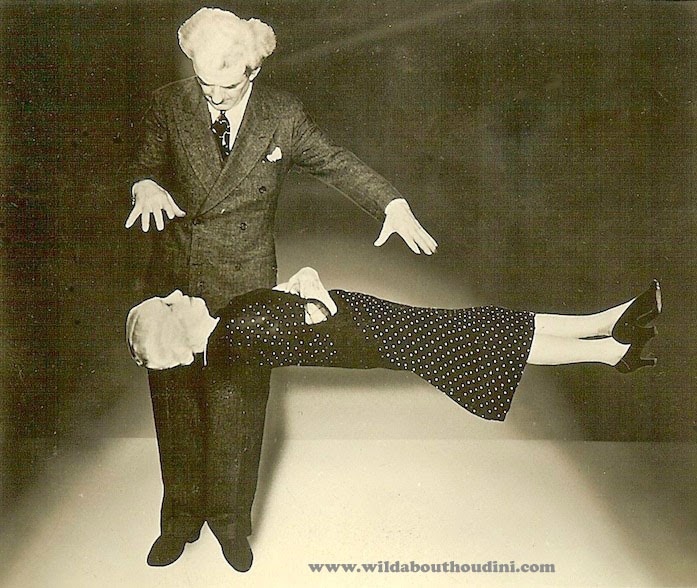
Blackstone gives Bessie a lift

Here's a remarkable period photo of Harry Blackstone Sr. levitating Bess Houdini. I picked this up on eBay where I was surprise to see it cycle unsold twice. I've never seen this image before, and it's a really great shot featuring two true legends of magic. Although I can't quite tell if this is an actual performance of levitation or a photo composite (possibly done for a convention?).


Of course, this isn't Bessie's first time being floated. While touring Canada early in their careers, the Houdinis performed a version of the Trilby levitation.

The irony of this photo is that Blackstone was a rival to Houdini. The men clashed several times. Once when Blackstone floated a large balloon advertising his show near a theater where Houdini was playing, Houdini considered shooting it down, but feared that would just draw more attention to it. He even filed a complaint with the National Variety Artists to stop Blackstone from performing his overboard box escape. In return, Blackstone frequently took swipes at Houdini's ego. In Milbourne Christopher's Panorama of Magic (1962), the author recalls:

The first time Blackstone visited my apartment he went from room to room, stopping now and again to examine a print, a painting or a book more closely. Finally, as he came to the colorful lithographs, he said: "Houdini used to have a place like this. The only difference is that all of his pictures were of Houdini."

After the deaths of Houdini and Thurston, Blackstone became the preeminent magician of his day, and really the last great stage magician of the Golden Age of Magic. He died in 1965 at age 80 in an apartment just blocks from The Magic Castle in Hollywood.

For more on the career of Harry Blackstone, check out the first part of an excellent profile by Michael Lauck over at iTricks: Blackstone: The Last Great Stage Show.

Thursday, December 20, 2012

Review: Bruce MacNab mines Houdini gold in the Maritimes

In The Metamorphosis: The Apprenticeship of Harry Houdini, author Bruce MacNab has combined his passions for Houdini and Maritimes history to create a book that is not only a terrific day by day account of Houdini's 1896 Canadian tour, but also a vivid snapshot of everyday life at the turn of the century. It really is one of the most remarkable books ever written about Houdini, as well as being a marvelous chronicle of what it was like to be a traveling magic troop in the 1890s.

Because this period of Houdini's life has never really been put under the microscope, this book contains a wealth of previously unknown details about the great escape artist. We learn that Houdini used a trained chicken, "Banjo" (named by his mother), early in his career; discover the details of Houdini's lost Trilby levitation; meet his very first assistant, John Kenny; and learn the exact nature of Houdini's challenge rope escape in which he guaranteed to escape in less time than it took to tie him (and his failure to do so one night in Nova Scotia).

Bruce has also uncovered the location of Houdini's ill-fated horse back escape; speculates on what could be a connection between J. Gordon Whitehead and another Canadian named Whitehead who traveled with the magic troop; and has unearthed a terrific story about Baldwin - The White Mahatma, visiting the Marco troop and helping to perform a "stolen watch" trick during a hotel dinner. There is also a wealth of new details about Houdini's short-lived American Gaiety Girls burlesque show, and the Marco Magic Company's chief rival, Markos (whose assistant later married Houdini's early performing partner, Joe Hayman).

But maybe the most historically important aspect of this book is how Houdini's employer, Edward James Dooley (aka "Marco"), is fleshed out as he has never been in any book before. The perception has long been that Dooley was a bit of con man who abandoned Harry in Bess in Canada. But this is not true at all. Dooley was a sincere performer and lover of magic who's greatest flaw appears to have been his bad luck (which I can't help but think continues in 2012 with a book that immortalizes his most disastrous tour). But Houdini had great affection for Dooley, and McNab has discovered that their friendship continued long after the ill-fated tour and into the years of Houdini's great success. This is as much a book about a failed magician as it is about the early career of a superstar.

What also makes The Metamorphosis a real joy is how MacNab has fleshed out each chapter with wonderful details about the Canadian towns and cities that Houdini and the Marco Co. played. One really gets a strong sense of time, place, and local color. Even without Houdini (and Harry is sometimes absent for full chapters) this book remains fascinating as it vividly captures the pulse of life in the 1890s.

And I haven't even mentioned the generous amount of never-before-seen photographs and documents, including a mind-blowing series of four sequential shots of Harry and Bess performing Metamorphosis (with this trunk) in 1901.

While The Metamorphosis is truly wonderful reading, I realize getting a copy has been anything but a wonderful experience for eager readers. I've recently heard that Amazon has become very stingy with stocking books by smaller publishers. I'm not sure if this has anything to do with this book's sketchy availability on the site, but know that the book can be purchased direct from Goose Lane Editions or from Barnes & Noble.com where it is currently available. It can also be found at The Book Depository, which offers free shipping worldwide.

The Metamorphosis: The Apprenticeship of Harry Houdini by Bruce MacNab is meticulously researched, beautifully written, and essential reading for anyone interested the deeper story of Harry Houdini.

Friday, November 23, 2012

Houdini's lost levitation


There's a moment in Paramount's 1953 Houdini biopic when we see Harry (Tony Curtis) doing a classic levitation with Bess (Janet Leigh). The levitation is one of the most iconic tricks in all of magic, so of course the filmmakers wanted to include a shot of Houdini performing the effect. The image even made the poster. Trouble is, there is no record (that I can find) of Houdini ever doing a levitation, so I've always chocked this up to just another fictional embellishment of the film.

But now it looks like the Curtis movie had it right (without knowing it). Turns out Houdini did indeed perform a traditional levitation with Bess early in his career. This fresh revelation comes from the new book, The Metamorphosis: The Apprenticeship of Harry Houdini by Bruce MacNab (see, I told you this book rewrites Houdini history).

Here's the story...

When Harry and Bess set out as part of the Marco Magic Company's tour of the Canadian Maritimes in 1896 (the subject of Bruce's book), one of the headline effects of the show was a levitation. At the time, it was fashionable to tie-in the levitation with the popular novel Trilby by George du Maurier (as Alexander Herrmann had done). Onstage "Marco", aka Edward James Dooley, played the part of Svengali with Bess as his hypnotic subject, Trilby. Bess/Trilby would be laid on a plank across two chairs. On Marco/Svengali's command, the chairs would be removed and Bess with remain suspended in mid air. It's possible Houdini, who doubled as an assistant in the troop, might have operated the complex levitation apparatus behind the scenes.

But when the Marco show failed and folded and Dooley went home to the U.S., Harry and Bess continued the tour with their own act. Many of Marco's props had been confiscated for non-payment of bills, but somehow Houdini was able to salvage a few pieces of equipment, including his own Metamorphosis trunk and the Trilby levitation.

So when The Houdinis performed their act in several Maritime cities, along with handcuff escapes and Metamorphosis, audiences saw "Mysterious Harry" and "Le Petite Bessie" doing a classic Trilby levitation as part of their show. In fact, a review of The Houdinis act at the Moncton Opera House singled out the effect for praise:

"Trilby, or the mystery of Mahomet, in which a human being actually floats in space without any visible means of support, was one of the startling features of last night's evening's performance."

But it looks like the levitation would be unique to Harry and Bessie's Canadian adventure. When they booked passage home abroad the steamship S.S. Yarmouth, they couldn't even afford the price of a ticket for themselves, let alone heavy cargo. The Metamorphosis trunk made the trip, but it appears the Trilby levitation remained behind in Nova Scotia.

(Interestingly, Howard Thurston patented a "Trilby" levitation in 1927, although I expect Thurston was using a completely new and much more complex method.)

So there we have it. Harry Houdini did indeed perform a traditional levitation with Bess, if only for a short time. So now the question remains -- what ever happened to Houdini's levitation apparatus? Also, how awesome would it be if we could find a photo of the young Harry and Bess performing the effect...just like Tony and Janet 57 years later.

Bruce MacNab's The Metamorphosis: The Apprenticeship of Harry Houdini can be purchased on Amazon.com or direct from Goose Lane Editions. For more about the history of the levitation illusion, enjoy this episode of the BBC documentary, History of Magic.


UPDATE: Houdini's Trilby levitation is mentioned on page 1 of Houdini The Key by Patrick Culliton. So it's Patrick -- who also wrote the forward to Bruce's book -- who deserves the credit for first bringing this information to light.

UPDATE 2: Eric Fry reminds me that Houdini put the secret of the Trilby levitation up for sale in his 1898 magic catalog, Magic Made Easy. Price: $1.00

The Original Houdini Scrapbook

UPDATE 3: Want to see a photo of Houdini doing a levitation? Here you go.

Tuesday, November 2, 2010

Thurston versus Houdini? Not really

I’ve just finished my review copy of Jim Steinmeyer’s excellent new book, The Last Greatest Magician in the World: Howard Thurston versus Houdini & the Battles of the American Wizards. So what is this book exactly and what does it offer to us Houdini buffs?

First and foremost, this is a superbly researched and entertaining biography of Howard Thurston. It’s fascinating to read the story of a magician whose life and career parallels Houdini’s. (It’s also sad to move with Thurston beyond 1926 and wonder what could have been.) I’ll leave it to others to review the book properly (Genii is preparing a review for an upcoming issue), but know that once again Jim Steinmeyer has produced a MUST BUY book about magic history.

Now, as far as the “versus Houdini” aspect to the book...

I suspect this subtitle is just a bit of thematic misdirection. Yes, Houdini was well-known for his ferocious battles with fellow conjures (those who stole his act or spoke ill of him in public), but aside from a perceived slight in Chicago and one testy encounter at an SAM meeting, Howard Thurston wasn’t one of them.

While they may have been rivals in their hearts, Houdini and Thurston seem to have gotten along relatively well as they had much in common. Both men came up through the sideshow and circus route (they met at the 1893 Chicago Exhibition at the dawn of their respective careers), both were Masons, Thurston was vice president to Houdini during his presidency at the SAM, and both shared a close personal relationship with Harry Kellar. As Thurston didn’t perform escapes, and Houdini rarely performed magic, there was little opportunity for them to cross swords. Houdini even promoted Thurston as Kellar’s successor over frontrunner Paul Valadon in the pages of his Conjurers Monthly Magazine, and loaned Thurston money when the conjurer was down on his luck (although he did refuse him a second loan years later).

So while this isn’t book loaded with juicy untold battles between the two superstars of magic (Blackstone seems to be the true combatant of both men), it still offers the Houdini scholar some stories of the man that haven't been reveled before -- including the aforementioned SAM incident (related to Steinmeyer by Walter B. Gibson who was there). Also interesting is the revelation that Bess Houdini first met Arthur Ford the night Thurston debated the spiritualist “minister” at Carnage Hall in 1927. And the story that opens the book -- Thurston inviting Houdini on stage during a performance of his famous levitation -- showcases both men in their best light.

The Last Greatest Magician in the World: Howard Thurston versus Houdini & the Battles of the American Wizards will be released on February 3, 2011. Pre-order now on Amazon.

Translate