Showing posts with label 1918. Show all posts

Wednesday, December 3, 2025

The Dream Big Folio: Houdini’s Illusion That Inspired David Copperfield

Here's a nice holiday gift idea. "The Dream Big Folio: Houdini’s Illusion That Inspired David Copperfield" is a new release by History By Mail. Below is a photo and details.

Step into the moment that redefined what humans believe is possible.

Dream Big Folio – Houdini’s Illusion That Inspired David Copperfield brings you inside the legendary 1918 Vanishing Elephant performance at the New York Hippodrome—an act so audacious it later inspired a young David Copperfield to imagine making the moon disappear.

This folio is built around one extraordinary centerpiece: a replica of Houdini’s original letter to Harry Kellar, preserved exclusively in David Copperfield’s International Museum and Library of the Conjuring Arts, the world’s largest private collection of magic memorabilia. Kellar, widely known as the “Dean of American Magicians,” was the most celebrated magician in the United States before Houdini and one of Houdini’s early heroes and mentors. The original letter resides only in Copperfield’s museum.

Everything in the folio is designed to give you the same spark Copperfield describes in his letter—the spark that later helped fuel some of the most iconic illusions in modern history.

You can purchase "The Dream Big Folio: Houdini’s Illusion That Inspired David Copperfield" at the History By Mail website.

Related:

Sunday, June 22, 2025

Houdini's secret leg braces?

Potter & Potter held their fourth auction of memorabilia from Ken Klosterman's The Salon de Magie yesterday. One lot that really captured my attention was a set of leather leg braces said to have been used by Houdini during his suspended straitjacket escapes. They sold for $6000 (including premium). This may seem low, but that's likely because there is no record of Houdini using such devices. However, I think these may be the real deal, and a long-concealed Houdini secret.


By my current count, Houdini did 78 suspended straitjacket escapes. It makes sense to me that at some point he would devise some kind of ankle protection, and I can see these coming from his inventive mind. (Can we now say Houdini invented gravity boots?)

The auction description states that Joseph Yadah acquired the braces from Hardeen. Yadah eventually sold them to The Salon de Magie. A letter of provenance was part of the lot, but not pictured. Coming from Hardeen is good. We know he inherited his brother's escape apparatus, and Hardeen himself never did a suspended straitjacket escape (as far as I can find).

Unfortunately, there are no known photos showing Houdini using these braces. But there are some photos that might. Below is a shot of Houdini doing a suspended straitjacket escape in Times Square in 1917. Note the unnatural sharp protrusions at the knees. This really looks like it could be the top edge of the braces. Also, bending at the waist as we see Houdini doing here would be far easier (and safer) if he were wearing braces like these.


Here's another shot from Houdini's famous 1918 Ladies Home Journal spread (How I Get Out Of A Strait-Jacket). Houdini's left pant leg is sliding down, giving a glimpse of his leg. That could just be his sock. But it looks a little thicker and sturdier to me. Could it be a brace?


Finally, there is a sentence from the November 6, 1916, Pittsburgh Sun describing Houdini's suspended straitjacket escape in that city. Could this "special appliance" be a reference to these braces?

Then Houdini's ankles were fastened to the rope by a special appliance that prevented injury, but insured safety.

Why wouldn't Houdini wear these on the outside of his pants? That I don't know. But I suspect he felt it was visually more appealing to conceal them. And why show this clever device to his competitors? Let them break their ankles! So, in their own way, these braces were a well-kept Houdini secret.

None of this is conclusive, but I will continue the search for evidence. In the meantime, congratulations to the winner. I think you might have landed a very special and unique piece of Houdini history.

Related:

Friday, December 6, 2024

Off to see Harry...


I'm going to wrap up 2024 with a speculative journey. I often think about time travel. Well, more specifically, I think about time traveling to see Houdini. I know I'm not alone in this. So if time travel were possible, and, say, you could select 3 specific days in the past in which to see Houdini, what days would those be? Here are the 3 days I would program into my flux capacitor:

Saturday, May 14, 1898
On this day, the Welsh Bros. Circus was playing in Harrisburg, Pennsylvania. The young Harry and Bess Houdini were traveling with the circus performing Metamorphosis in the circus concert tent, where Bess would also do her seriocomic songs. It's also possible I could find Harry doing his King of Cards act in the sideshow. While all this would be enough, this day marked Houdini's debut as a "clown on bars" in the Big Top show. "Went big and funny," he wrote in his diary. So, yeah, a chance to see so many aspects of the young Houdini and Bess and experience the entire Welsh Bros. show... What a day! Also, if the rules of time travel allow, it would be easy to approach and talk to him.

For my second date, it's very hard to not select March 17, 1904, as that was the day of the famed Mirror Handcuff Challenge in London. Very hard! But the Mirror Challenge was just one performance, and I want to maximize my Houdini time. Besides, I know Joe Notaro will choose the Mirror Challenge, so I can learn all about it from him. Instead, I'm going to...

Saturday, March 2, 1918
This time, I'm landing in New York City to see Houdini vanish his elephant and escape from an underwater packing case at the Hippodrome. In fact, I could see it twice as the Hippodrome had a matinee (at 2:15) and an evening show (at 8:15). After the evening show, I could zip over to Martinka's magic shop and, using a 1918 S.A.M. card borrowed from one of my collector friends, I could attend the 174th regular meeting of the S.A.M. which Houdini presided over as President. But there's more! This was the week Houdini was giving World War I soldiers lessons on how to escape from German handcuffs. So, disguised as a soldier, I could get a lesson in escapes from the Handcuff King himself! Although, a 60-year-old private might seem a bit suspicious. He might think I'm an imitator come to steal his secrets! Maybe I need to rethink this one.

My last choice has to be a performance of the 3 Shows in One. But which one? While it is tempting to see Houdini's final show in Detroit, I think it would be too upsetting. So I'll leave that to others. Instead, I'm going to...

Thursday, September 30, 1926
This was when Houdini was playing his 3 Shows in One in Worcester, Massachusetts. This is also the day of the Summerfield's Department store test, in which he was sealed in a glass casket for an hour propped up on view. Unlike his other outdoor stunts, which were over relatively quickly, this is one I could savor. I'd get to stand and look at the 52-year-old Houdini for an hour! Heck, maybe I could even strike up a conversation with Jim Collins. Maybe get a backstage pass to the show that night! And speaking of that show, Houdini was doing the onstage Buried Alive in Worcester at this time. So I can see exactly how he presented this still largely mysterious escape. Yes, this means I would not see the Water Torture Cell, but I want to learn during each jump. I would also get to see all the new and improved magic for the 1926-27 season, including Slicing a Girl. And how poetic to see Houdini at age 52 doing his King of Cards routine, just as I had seen him do it three days and 28 years earlier.

How about you? What would your three days with Houdini be? Let us know in the comments below. I've also launched a POLL on my Patreon.

Thank you for your patronage and support this year. It was a big year for centennials and celebrations, and I expect more of the same in 2025. Happy holidays. I'll see you all in the future!
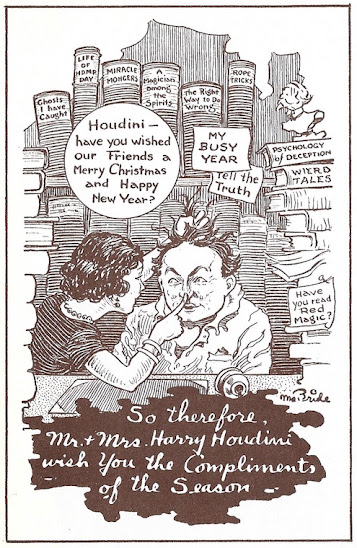
The Houdinis 1924 Christmas Card.

2024 in Review:
January (23 posts)
February (20 posts)
March (20 posts)
April (20 posts)
May (21 posts)
June (19 posts)
July (11 posts)
August (18 posts)
September (19 posts)
October (22 posts)
November (19 posts)
December (8 posts)

Most Viewed New Post of 2024

Monday, April 8, 2024

Houdini's eclipse

It's eclipse day! Where will you be to see (or partially see) today's total solar eclipse? Of course, my mind goes to Houdini. Did he ever see a total solar eclipse?

As it turns out, Houdini was in the right place at the right time to experience the famous total solar eclipse of January 24, 1925. The eclipse passed through New York State and through New York City just above 96th Street. Houdini was playing the New York Hippodrome at this time. It was reported that streetlights turned on, seagulls landed in the Hudson thinking it was night, and three women fainted. It was the first total eclipse to pass over New York since 1478. (The next will be in 2079.)

The wonderful image below of the 1925 eclipse was captured by photographer Adolf Fassbender in Bronx Park. This comes from the website New York Historical Society, where you can read more about the photo and photographer.


Houdini would also have experienced the eclipse of June 8, 1918 as a partial eclipse from New York City. September 10, 1923 was another total solar eclipse that Houdini would have experienced partially. He was performing in Memphis on that day.

You can watch today's eclipse track live on NASA's YouTube Channel. Remember, don't look directly at the sun!

Wednesday, June 21, 2023

Accident at the Hippodrome


On April 18, 1918, a terrible accident occurred on the stage of the New York Hippodrome during a performance of Cheer Up. While Houdini wasn't involved in the accident, he was in the theater at the time. Below is a report from the New York Sun.

The New York Sun, April 19, 1918.

The day after the accident, Houdini wrote to Harry Kellar describing what he saw and also the panic backstage, which was not covered in the newspapers. This letter is housed at David Copperfield's International Museum and Library of the Conjuring Arts and reads in part:

I was out in Mark Lueschers office when I heard awful screaming. Mark and I rushed out into the auditorium, and what an awful site. We arrived when the damage in sight of the audience has been done, then two fool firemen passing me rushed downstairs and they must have lost their head. 

Houdini goes on to explain, with a fair measure of disgust, that the firemen panicked the chorus men who then "stampeded" the chorus girls waiting in the wings. "Then there was a hellavu time," says Houdini.

Houdini volunteered to go onstage to fill the gap in the show, but "things were in too disturbed a state" and his offer was not accepted. He did express relief that the flying car did not go into the audience.

According to Houdini, the stagehand, Henry Casey, died on the way to the hospital. This was not reported in the papers. In fact, it hard to find any followup on the accident. But Axel Mirano survived and the brothers were back performing their "Flying Torpedo" act by the end of the year. The advert below from the Palace shows what their apparatus looked like.


The timing of this accident is interesting. This was within a month of the accidental shooting of magician Chung Ling Soo on the stage at the Empire Theater in London. This was also the very week Houdini planned to perform his own version of Soo's bullet catch at the Hippodrome. 

As I covered in this post, the Hippodrome management requested Houdini cancel the dangerous trick and he did. I wonder if this accident had anything to do with that? I also wonder if being in such close proximity to two stage tragedies might have spooked Houdini. He didn't want to be number three!


Want more? You can read more details about the Hippodrome accident as a "Scholar" member of my Patreon.


Thanks to David Copperfield.

Friday, November 18, 2022

You cannot keep him out!

On November 18, 1918, Houdini's The Master Mystery premiered at the St. James Theater in Boston. Houdini attended the premiere with co-star Marguerite Marsh. It's been a few years since I've celebrated The Master Mystery's debut, so let's do so today with this terrific ad from the Exhibitors Herald.


I think it's interesting that this ad doesn't feature Houdini's image. Instead, this showcases his co-star, Q The Automaton, said to be the very first movie robot. You can't keep HIM out of your theater either, as this footage from the 2015 Los Angeles Magic History Conference proves.


I'll be marking this anniversary by watching the first few episodes tonight. Q lives!

Related: 

Thursday, August 18, 2022

Yes, there was a Vanishing Elephant poster


It's one of the great white whales of Houdinidom. Was there ever a poster for his Vanishing Elephant illusion? This has long been the stuff of dreams and April fools jokes. But while doing research at the Harry Ransom Center last week, I discovered that, yes, there absolutely was a Vanishing Elephant poster!

The proof is found in a letter from Birchet "Kit" Clarke to Houdini dated March 7, 1918. The 85-year-old Clarke was a former press agent, Harry Kellar's manager, and a real character (I'll have more on him in time). His letter begins:

My dear Houdini:-

        The red poster came along this morning and is now decorating the wall before my easy chair where I can easily gaze upon it and see Jennie vanish into the upper air like "the baseless fabric of a vision."

There can be no doubt about what Clarke is talking about here. A great deal of Clarke's correspondence at this time references the Vanishing Elephant, and the name of Jennie cinches it. Clarke's description of a "red" poster with Jennie vanishing "into the upper air" brought to my mind the prototype Vanishing Elephant posters also held by the Harry Ransom Center (below). I posted about these a few years back and at that time wondered if they ever became real posters. I think we now have our answer!


Unfortunately, we still don't know what this finished poster looked like. But maybe one day one Clarke's copy or another might surface like "the baseless fabric of a vision."

Want more? You can read Kit Clarke's full 3-page letter, which includes an epic takedown of the Williamson Brothers, as a Scholar on my Patreon.

Sunday, July 10, 2022

Houdini kicks off his heels for the Ladies

This original press photo sold in Haversat & Ewing's latest magic auction for $560.50. There's a lot to love about this image. But what I especially like is it gives us a good look at Houdini's boots. Look at the size of those heels!


This photo was part of series taken at the White Studios in New York to illustrate Houdini's article, "How I Get Out of My Rope Ties," in the June 1918 The Ladies' Home Journal. I've always thought this was an unusual choice of magazine for this and his companion article, "How I Get Out of a Strait-Jacket." But I love the photos they gave us!


Related:

Wednesday, July 6, 2022

Houdini freezes the Detroit river in 1912


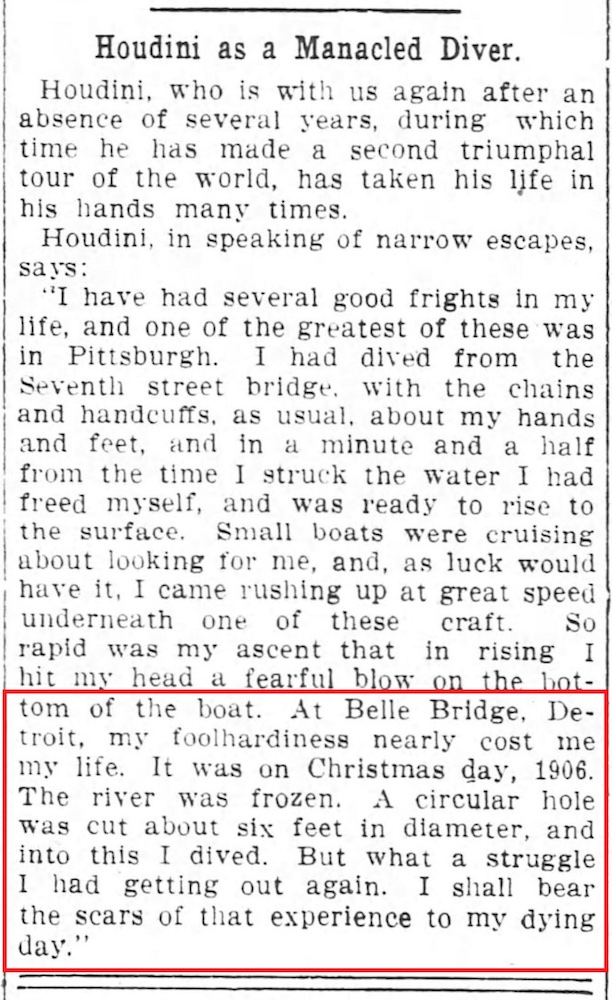
Recently I came across this intriguing article from the February 11, 1912 Washington Post. The quotes here come from an interview Houdini gave while appearing at the Maryland Theater in Baltimore. It's short so I'm sharing the entire thing, but it's the last part that interests me the most.

The Washington Post, Feb. 11, 1912.

While I've not done an exhaustive search, I believe this might be the first mention of any bridge jump into a frozen river through a hole cut in the ice. Here it's the Belle Isle bridge in Detroit in 1906. That was a real jump, but the river was not frozen nor was it Christmas day. Still, this appears to be the genesis of the famous myth of Houdini being trapped under the ice of a frozen river.

Houdini would tell that story in full for the first time (as far as I know) in an article he wrote for the September 1918 issue of The American Magazine called "The Thrills in the Life of a Magician". But now he relocates the action to Pittsburg and doesn't provide a specific date. It's also become an overboard box escape instead of a handcuffed bridge jump.

The dramatic story was picked up by newspapers at the time, including the Boston Sunday Post below (click to enlarge):

Boston Sunday Post, Sept. 1, 1918

Houdini told the tale again in his 1919 article for Hearst's magazine, "Nearly Dying for a Living". But it's interesting to note that this story, as with other Houdini mythology, does not appear in any of his pitchbooks. It seems to me that Houdini made a distinction between disposable media, such as newspapers and magazines, and what he considered to be the official record. His pitchbook does record that he had to "break through the ice" during a bridge jump in Breman, Germany, which is likely true. That jump was made during a snow storm.

Later biographies made no such distinction, and the full under the ice drama became part of the official record with the publication of Houdini His Life Story by Harold Kellock in 1928. Interestingly, Kellock moves the action from Pittsburg back to the Belle Isle bridge in Detroit in 1906.

Then, of course, the 1953 biopic Houdini starring Tony Curtis dramatized the incident (beautifully) and cemented it in the minds of the public. In the movie the location remained the Detroit river, but the day was changed to Halloween(!). Also, as in Houdini's telling, it's an overboard box escape.

Houdini (1953)

The first doubt was cast on the story by William Lindsay Gresham in his 1959 biography Houdini The Man Who Walked Through Walls. Ironically, Gresham had been one of the recent propagators of the myth, publishing an account with fresh embellishments in SAGA magazine the previous year. But Gresham credited Robert Lund with tracking down the original newspaper accounts of the Belle Isle stunt and calls out the inconstancies, namely that the Detroit river was not frozen. He writes:

The river was not frozen over, Houdini had a rope tied around him all the time, he got out of two pairs of cuffs and was picked up by a boat! As for escaping from under the ice—as Tom Sawyer would say, "He just let on he done it."

The story largely disappears from Houdini books after that.

However, Hollywood doesn't let the truth get in the way of a good story, and the full under the ice drama was resurrected in the 2014 Houdini miniseries biopic starring Adrian Brody, this time relocating it to the Eads bridge in St. Louis. But by this point no one was fooled.

It's fun to see how this all appears to have started in Houdini's mind back in 1912 as a way to add some color to an interview. He understood what reporters wanted!


Below are some more posts related to Houdini's adventure under the ice.

Clipping source: Newspapers.com.

Monday, May 30, 2022

Houdini and his doughboys take a dunk


Here's a wet one for this Memorial Day.

You'll often hear the story of how Houdini taught World War I soldiers the secrets of escaping from German handcuffs and restraints. This is true. Houdini was provided with his own "class room" on the promenade level of the New York Hippodrome Theater where he gave his lessons to a regular rotation of doughboys.

While this did generate publicity, it wasn't a publicity stunt. Houdini's classes were actually sanctioned by the War Department, as you can see in the below.

The Evening World, Feb. 27, 1918.

Recently I found there was another class that Houdini gave to soldiers from Camp Upton (where he had entertained a few weeks earlier). But this time the lesson was given in the famous Hippodrome water tank. Check it out.

The Standard Union, March 8, 1918.

The Hippodrome water tank, which was under the stage and would be opened for special aquatic performances, was equipped with several secret underwater diving bells. I wonder if these came into play here -- maybe showing the soldiers how to survive inside pockets or air within a sunken ship? Below is a photo of the bells from the blog New Yorker State of Mind


By the way, Houdini did some notable underwater challenge escapes in the Hippodrome tank doing his lengthy Cheer Up engagement, once from a straitjacket. I suspect he may have utilized these bells as well. But that's a different story.

Have a Safe and Happy Memorial Day

Top image: "Soldiers Swimming and Playing in the Water during World War I" from MondovisionsClippings: Newspapers.com.

Thursday, May 26, 2022

Houdini's gibbet and the Hippodrome war float


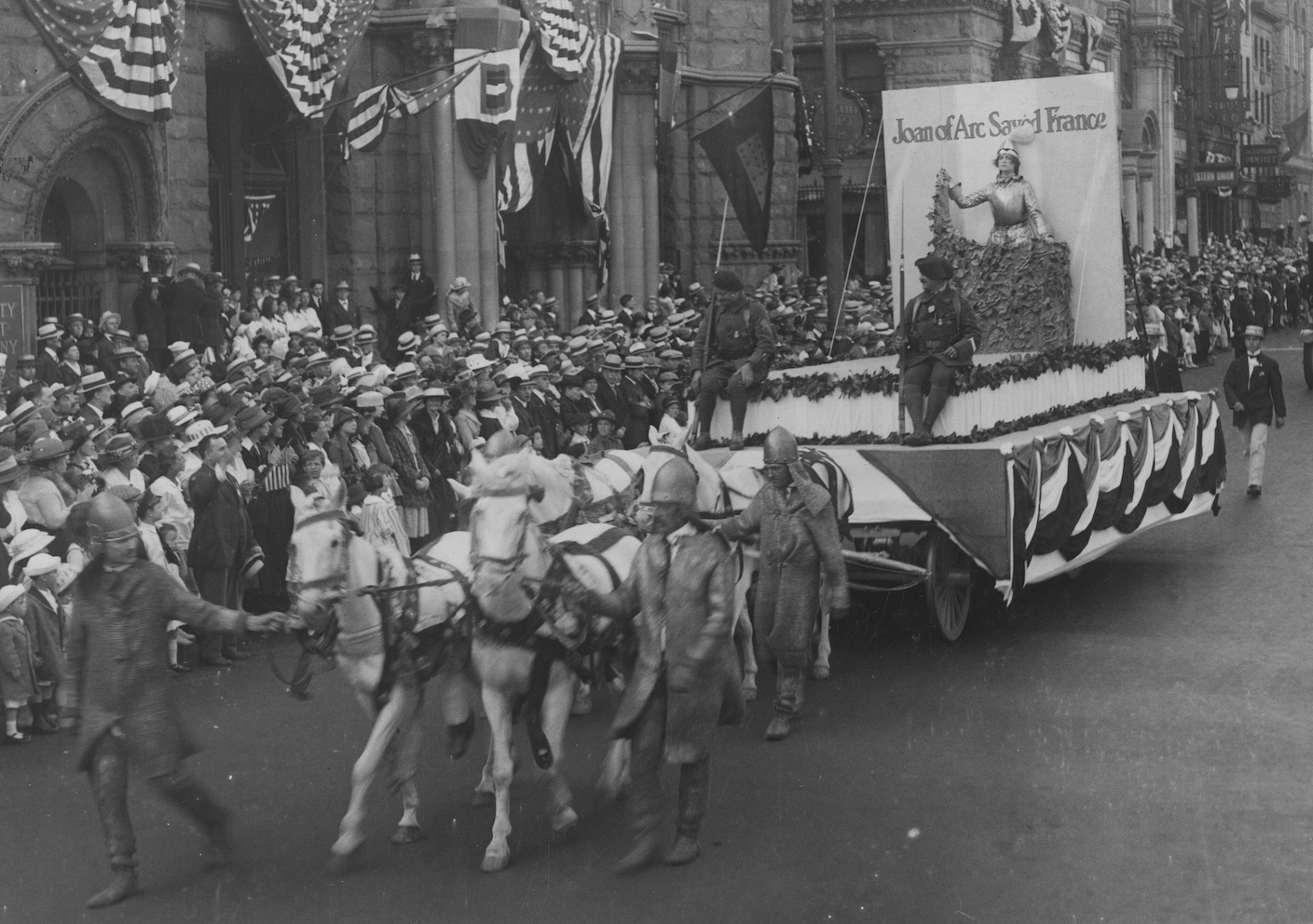
On April 20, 1918, a War Stamp and Liberty Loan parade snaked its way through New York City starting at 6th Avenue and 45th Street. Among the marching bands and dignitaries were three large floats created by the New York Hippodrome. One float featured star Belle Story costumed as Joan of Arc. A second carried a browning machine gun. And as for the third float, well, you can read for yourself:

New York Tribune, April 13, 1918.

Houdini was playing the Hippodrome as part of the revue show Cheer Up at this time. I've not been able to find a photo of this float, but the photo at the top of this post will give an idea of what it might have looked like (this is from a later War Stamp parade in Newark). But what were these "German instruments of torture"? A follow-up story provides the answer:

New York Tribune, April 21, 1918.

I'm pretty certain what crowds saw that day was Houdini's own gibbet. This is sometimes called an Iron Maiden, but that is not technically correct. (At least according to this guy, and I'm not about to argue with him!) Houdini's gibbet was made by blacksmiths in Scotland as a challenge escape in 1909. Houdini would repeat the gibbet challenge on occasion and frequently display the macabre device. He even once set it out on a Baltimore street during a suspended straitjacket escape.

So how fair was it to present the gibbet as a "German torture device"? As you might expect, this was pure war time propaganda. Gibbets were not unique to Germany. They had been used throughout Europe and even in America. But the practice of gibbeting, in which freshly executed corpses would be put on display until they decayed, ceased by the 1840s.

Sidney Radner acquired Houdini's gibbet from Hardeen and displayed it at both the Houdini Magical Hall of Fame and the Houdini Historical Center in Appleton. In 2004 David Copperfield acquired the gibbet in The Great Houdini Auction for $65,000. He then re-created the original frame using period wood. Another fun fact: this frame is the actual "gibbet." The iron cage hanging inside is called the gibbet irons, gibbet cage, or sometimes a crows cage. (Again, this guy.)

Today Houdini's gibbet resides happily in Copperfield's International Museum and Library of the Conjuring Arts in Las Vegas, where it still looks ready for use!

Wednesday, May 11, 2022

Taking aim at Houdini's abandoned bullet catch


Most Houdini biographies contain the story of how Houdini announced he would perform the infamous bullet catch trick shortly after the onstage death of magician William Robinson, a.k.a. Chung Ling Soo, in 1918. But magician Harry Kellar wrote Houdini a heartfelt letter talking him out of it and Houdini cancelled the performance. Turns out that scenario isn't strictly accurate. But we will get to that.

Milbourne Christopher in Houdini The Untold Story was the first to identify the event at which Houdini proposed to do the trick as a gala S.A.M. benefit for the Showmen's Hospital Fund at the New York Hippodrome on April 21, 1918. It's said the bullet catch was widely advertised. However, I've never been able to find any advertisement that confirms this. Below is a typical advert for the benefit that mentions "his new death defying sensation." But this could be the Water Torture Cell.

The New York Sun, April 20, 1918.

Likewise, the program for the event itself--an original of which is in the Harry Ransom Center--makes no mention of the bullet catch. It only shows that Houdini would perform his Water Torture Cell that evening.

I began to consider the possibility that famous cancelled bullet catch might have been a back engineered Houdini myth. But while searching for something completely unrelated, I finally found the smoking gun!

New York Tribune, April 21, 1918.

So, yes, it appears Houdini did intend to do the bullet catch at this Hippodrome show. A fantastic new detail here is that Houdini's firing squad would be made up of real doughboys from the 71st Regiment using regulation army rifles. What a terrific modern piece of staging. I'm actually sorry this didn't happen. But why didn't it happen?

Here's where the truth diverges from the familiar telling. While Kellar did indeed write a heartfelt letter of warning to Houdini, he wrote that letter after the benefit (on May 1st). So the reason Houdini dropped the bullet catch wasn't Kellar. He dropped it on the request of the Hippodrome management.

The following is from an account of the benefit that appeared in the April 1918 issue of MUM:

Houdini had been advertised in the leading newspapers through reading notices, as intending to do the Bullet Catching Act. He was dissuaded by management of Hippodrome from taking up this dangerous feat, for he announced his famous Chinese water torture cell, which is probably just as, if not more, dangerous than the bullet catching business, as in either, the slightest error means a tragedy.

(To give credit where it is due, Bill Kalush in The Secret Life of Houdini was the first and so far only biographer to present the correct chronology of the bullet catch and Kellar letter.)

It's been suggested that Houdini never actually intended to perform the bullet catch and that he just announced it for the publicity. Maybe. But Houdini felt strongly about doing what he advertised and not "breaking faith" with his audience (a prime example here). Also, this was a prestigious S.A.M. event for charity that Houdini himself emceed. Doesn't seem like the kind of event in which you would want to be disingenuous in any way. But it is a possibility.

It's also worth pointing out that in the weeks following Chung Ling Soo's death there was gossip in magic circles that the magician may have been murdered. Joe Hayman, who informed Houdini of Robinson's death, offered some dark speculation that Houdini shared with Harry Kellar. Hence Kellar's warning that the same fate could befall Houdini -- "some dog might 'job' you." But an inquest into Soo's death discovered faulty equipment was the culprit.

So there we go. We've confirmed when and where Houdini planned to do the bullet catch. We've learned how he intended to stage it. And we know why he didn't. There's also the possibility that Houdini did the effect early in his career, but that's another story.

Thanks to Joe Fox at the Magic Castle Library for the MUM clipping and Eric Colleary at the Harry Ransom Center for a look at the original program.

UPDATE: Could this have has something to do with the cancelation of the stunt? Read: Accident at the Hippodrome

Saturday, December 4, 2021

All business

Here's a portrait photo of Houdini you don't see too often. There is a more famous photo taken during this same session that shows Houdini smiling. But here he is all business. This comes from the January 1927 Spanish movie magazine, Cine-Mundial.


While most associate these photos with Houdini's Hollywood days and date them as 1919, I recently found this image used in a 1918 movie magazine. So it appears these were taken in New York and mark some of the first portraits taken of Houdini with his cut and dyed hair and without his mourning suit (yes, I still believe my theory). 

Thursday, August 19, 2021

Unknown French Master Mystery poster surfaces

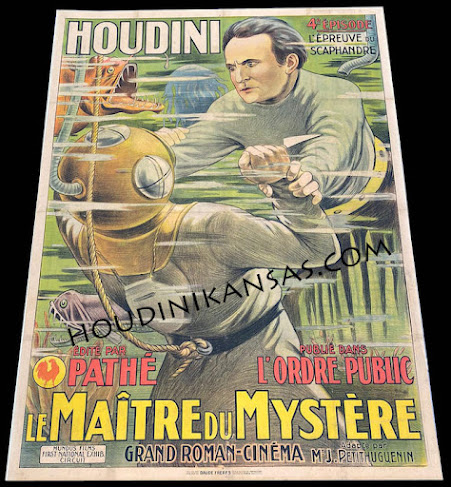
I'm very excited to share some fantastic news today! Don Creekmore, who is currently writing a book about Houdini in Kansas, has acquired this hitherto unknown French poster for Houdini's 1918 serial The Master Mystery (Episode 4). The poster measures approximately 42" by 63" and as you can see for yourself, it's a stunner!


Don tells the story of how he came to own this treasure:

The poster was found among hundreds of other silent movie era posters in a movie theater in France. No other Houdini or magic related posters though. The owner discovered my website regarding my book research on Houdini's time in Kansas, www.houdinikansas.com. While the poster is unrelated to my book research, he did notice that my business, www.oldhelmet.com, is buying and selling authentic antique diving helmets.

When he sent me the image of this poster, I couldn't believe my eyes! Not often does an antique make me physically shake on first sight, but this did! After a number of months talking with the owner an agreement was made, bringing it to my collection of magic posters and diving helmets in Wichita, Kansas.

While this poster is completely new to me, a French Episode 8 poster in a similar style sold at a Christies auction in December 2008. I'm also aware of one other French poster in this style for Episode 3 in a private collection.

Congratulations Don!

Wednesday, May 26, 2021

The Great Grey Mystery mystery

Here's a page from the December 1918 issue of Film Fun, a New York based movie magazine. Some nice shots here of Q the Automaton from Houdini's The Master Mystery. But what's odd is they refer to the title of the serial as "The Great Grey Mystery."

Click to enlarge.

By December 1918 the first chapters of The Master Mystery had been released to theaters, so I don't know why the magazine uses this title, nor where it came from. As it says; "It's a Mystery."

Speaking of the Automaton, last year some side panels from the 2017 Houdini Pinball machine sold on eBay. On one side you can see the Automaton and his...Automawoman?


Below are a few more links for the Automaton aficionado.

Related:

Saturday, May 15, 2021

Houdini's advice for retailers

I don't know if this is even remotely true, but this is Houdini being Houdini. He always had some wisdom to impart and newspapers were always happy to print it. Enjoy!

Boston Sunday Post, Aug. 25, 1918.

Monday, March 29, 2021

Houdini stops off in Lowell (update)


On November 18, 1918 Houdini made a quick personal appearance at the Merrimack Square movie theater in Lowell, Massachusetts. He was on his way to Boston for the premiere of The Master Mystery that very night. Here's a terrific account of his appearance from The Lowell Sun that also serves up a couple Lowell-related mysteries.

The Lowell Sun, November 19, 1918.

Note that Houdini says he had made three previous visits to Lowell. I can identify two of those. The first was in 1896 when Houdini played with the American Gaiety Girls in Lowell for three days in late March (23-25). The second is when Houdini played the Lowell Opera House for the week of February 12, 1906 (my sourcing on this is a little loose so this isn't a lock).

The article also mentions a jailbreak from the Market street police station "five or six years ago." I don't have any record of this. Possibly it happened during that third yet undiscovered appearance? But a jailbreak would also fit with his 1906 appearance as that was his standard publicity stunt at that time. * Hardeen also played Lowell on occasion.

It's surprising the Sun article doesn't mention The Master Mystery as Houdini was there expressly to promote it playing at the Merrimack. And what a day at the Merrimack that was! Not only could you see the first episode of The Master Mystery and Houdini in person, but you also got Charlie Chaplin and William S. Hart movies!


The Merrimack Square Theater was located at 146 Paige Street from 1909 to 1953. You can see a photo of the theater as it appeared in 1950 HERE. Today the site is a parking lot.

 
* UPDATE: I've now confirmed that Houdini did indeed do a jailbreak during his 1906 appearance in Lowell. You'll be able to read about in my upcoming book, Handcuff King: The Conquests of Harry Houdini, 1900-1909.

Related:

Translate