Showing posts with label Radio of 1950. Show all posts

Sunday, February 27, 2022

Something's missing

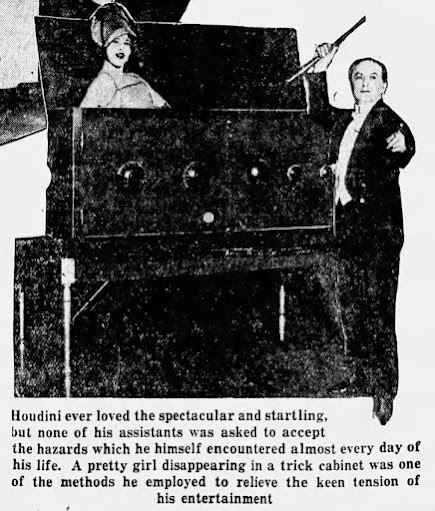
Let's cap our Weird Week with this weird one. Here is the famous photo of Houdini and Dorothy Young performing Radio of 1950 as it appeared in the Wichita Daily Times on December 5, 1926. When I first saw this I thought I had found a new image. There was something different about it. But I now realize it is the same image, just with something missing. Can you tell what that something is?


If you don't know, CLICK HERE to compare this to the familiar image.

So which photo should we believe? Was this image too sexy for Witchita and altered? Or was the more familiar photo altered to be made more sexy and what we have here is the original?

If you can tell me for sure, you'll win a Major Award.


Related:

Saturday, March 14, 2020

Dean Carnegie dials in Houdini's Radio of 1950

Dean Carnegie's The Magic Detective Podscast is going strong and now in its second season. Dean's latest episode investigates Houdini's little discussed "Radio of 1950" illusion. I agree with Dean that Houdini's magic is vastly underrated, and Radio of 1950 is one of those Houdini originals worth consideration. (I do hope Dean's follows through with his idea to rebuild the illusion.) Click below to have a listen:

Ep. 46: Houdini’s Radio Illusion

Click the top Related link below to see the photo of Hardeen with the Radio of 1950 illusion that Dean discusses in the podcast.

Related:

Thursday, June 14, 2018

Mystifier, Third Quarter 1993

Continuing my look back at Mystifier, the quarterly newsletter of the Houdini Historical Center that ran from 1991-2003.


The Third Quarter 1993 Mystifier opens with a letter by Randall Bassett, author of Zen Karate (the previous issue contained an excerpt from the book), offering insightful speculation about Houdini's need to remain physically fit and his training regiment. It's a good letter and his observations seem spot on. For example:

From what I can gather, strength and endurance were critical to most of his spectacular effects. Early on, Houdini grasped that what audiences wanted to see was a struggle--a severe test of sorts in which he would emerge victorious or...die. Anything that looked easy or was not dangerous seemed to lack dramatic impact. I further believe that Houdini felt the best way to convince the audience of the veracity of his struggle was to make it a real one whenever he could do this and not give away the secret of an illusion. But this required, I believe, his certainty that his body could keep up with his mind. It always did.

Next up is a real treat and what in 1993 was a true game changer. It's an interview with Dorothy Young (referred to here as Dorthy Young Kiamie) who toured with the Houdini show in 1925. The interview is by Ken Silverman, who was working on his own Houdini biography as this time. Much of what the interview contains we are now familiar with, but there's a paragraph in which Dorothy mentions Bess and her smoking that feels new:

I never thought of Mrs. H. as being older. We were just pals. I had breakfast with her and spent my days with her, laughing and kidding. We'd buy clothes together; she liked clothing and was always charmingly dressed. She made all my costumes, too, using gorgeous materials and making the costumes very sexy. I remember that she smoked a lot. (Houdini didn't at all.) The doctor told her to stop, that she would live ten years longer. She said she'd rather enjoy the ten years smoking.

The interview is accompanied by the "Radio Girl" photo, which was also new to the Houdini world at this time. I wasn't yet a subscriber, but I can only imagine how exciting it must have been to receive this one in the mail.

Members of the Houdini Historical Center staff and board members are then introduced with a short biography of each. Readers are also informed that the museum's new poster reprints, Coliseum, Houdini in Kaiser Wilhelm's Court, Houdini in Russia, and Houdini in the Water Torture Cell are "hot off the press" and ready to ship.

Sid Radner devotes a large section of his "Backstage with Sidney Radner" column to a 1930 horoscope of Houdini that appeared in the book Your Future, A Guide to Modern Astrology by Sidney K. Bennett aka "Wynn." Sid wryly points out:

Considering that Wynn did not known when or where Houdini was born, missing the date by 13 days and the location by a few thousand miles, it is quite remarkable how accurate the horoscope is. Or can we attribute Wynn's skills to the fact that he was doing the horoscope after Houdini's death?

Sid continues with the news that the daytime soap opera The Bold and the Beautiful has a storyline in which two characters move into Houdini's house...in Beverly Hills? He notes that the new Arnold Schwarzenegger movie The Last Action Hero has "an important Houdini connection." He concludes with the news that the BBC is in Appleton shooting a Houdini documentary to be broadcast in England in October.

Mystifier
Volume 3, Number 3
Third Quarter, 1993
6 pages

Contents:
Master of Physical Conditioning
Recollections of Houdini
Introducing HHC Staff, Board Members
Order Houdini Posters from Museum Shop
Backstage with Sid Radner

Thanks to Jay Hunter for supplying me with a scan of this issue. If anyone is willing to part with an original, this is one of only two issues that I do not own, and I'd love to complete my set.


Related:
Thursday, April 17, 2014

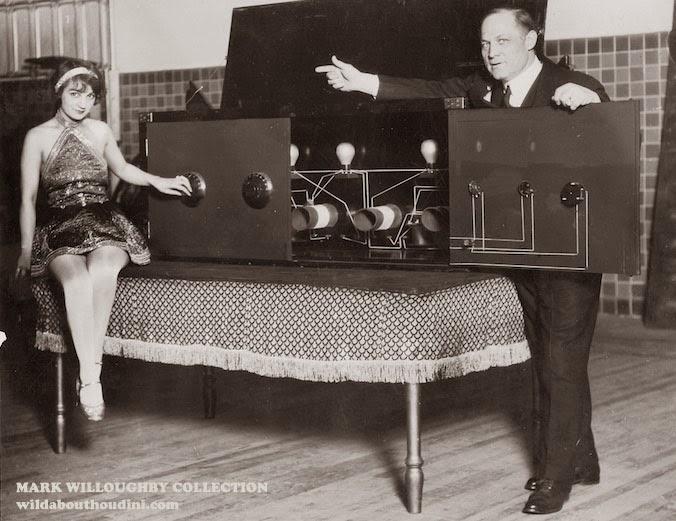
Hardeen dials in Radio of 1950

Here is a magnificent unpublished photo of Hardeen performing Houdini's "Radio of 1950" illusion. This comes from the collection of our good friend Mark Willoughby and there is a lot to love about this image.


First off, I'm struck by how much Dash looks like Houdini in this shot. It it wasn't for the hair, you could almost mistake this for Houdini. This is also the only photo I know of that shows the inside workings of the "radio" apparatus (I'm guessing those light bulbs were illuminated or even blinking). Finally, the assistant here is Hardeen's daughter, Gladys Hardeen (at least that's what it says on the back of the photo), and it's a rare shot of her.

I don't know much about Gladys Hardeen. Her passport application says she was born February 15, 1902 and Genii reported her death in Daytona, Florida on February 17, 1966. But according to Jon Oliver, Dash and Elsie Fozzard married in 1904 (this info came direct from Hardeen's son, Harry Houdini Hardeen). Was Gladys a stepchild? She later assisted Douglas Geoffrey aka Hardeen Jr.

Houdini developed Radio of 1950 for his full evening show of 1925-26. A review of Houdini's first performance of his full evening show in Baltimore called the effect "Radio 1925." Hard to know if this was a mistake or if Houdini later changed the name. In her 2003 booklet, Touring With Houdini, assistant Dorothy Young described how the illusion was staged:

Radio was quite new in 1925. The first commercial station KDKA, had gone on the air in Pittsburg, Pennsylvania just five years earlier. So a magic trick about radio was a very up-to-the-minute feature.

To present the illusion of Radio of 1950, Houdini walked around and behind an empty table in the center of the stage so the audience could see there were no mirrors underneath. Then two assistants put the "radio" on top, completely filling the table.

"I would like to present my original conception of what radio will be like in 25 years." Houdini said, "Tune in to any station and get the girl you want. No, gentlemen, it is not for sale."

He opened the entire front, which consisted of two doors, and removed a panel that held various coils and transformers and large glass tubes the size of light bulbs that were used before transistors were invented. The audience could see there was nothing else inside. He replaced the panel and closed the front.

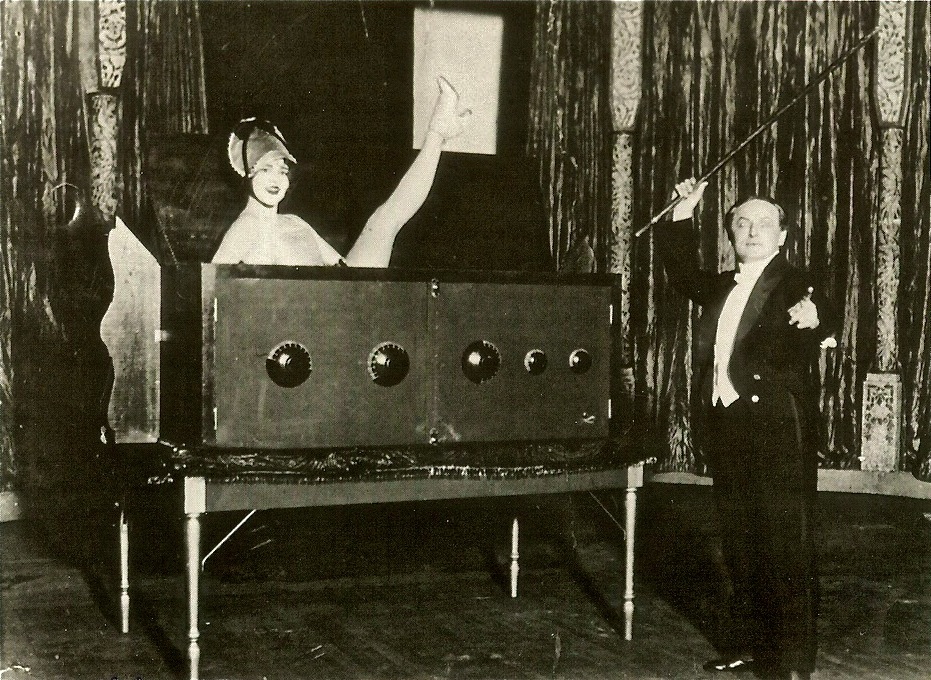
"Now," he said, "we will tune in Pittsburg Station KDKA." He began twisting the dials. Suddenly a voice from the radio speaker announced, "Miss Dorothy Young, doing The Charleston." That was my cue. As the orchestra started playing that popular jazz dance, I threw open the lid, popped up my head at one end and kicked one leg up in the air. I kicked the other leg, clicked my feet together, jumped up, and curtsied. Houdini opened the front of the radio, lived me down, and I went into a wild Charleston as the audience laughed and applauded.

Hardeen inherited the effect after Houdini's death and featured it in his own show. After he died, it was put up for sale for $125 along with other Hardeen-Houdini apparatus. Today the whereabouts of the Radio of 1950 illusion is unknown.

Below is a shot of Houdini himself doing Radio of 1950, showing the appearance of "Radio Girl" Dorothy Young. And if you're dying to know how this trick was done, check out Patrick Culliton's Houdini The Key (page 402). He gives a very good explanation of the method.


Thanks to Mark Willoughby for sharing this special photo and for the intel on Gladys Hardeen.

Related:

Saturday, April 2, 2011

Dorothy Young remembers her days with Houdini

On April 6, 2000, Rhoda Newman of the Monmouth Library interviewed Dorothy Young as part of the library's Remembering the 20th Century: An Oral History of Monmouth County project. It's a wonderful interview filled with interesting remembrances from Dorothy, who passed away on March 20 at age 103.

Here is an excerpt from that interview in which Dorothy talks about her experiences with the Houdini roadshow. I especially love the story of her and Bess smuggling booze over the border from Canada. That's our Bessie!

Ms. Newman: And you were how old at this point?

Ms. Young: Seventeen. And, I went to the Longacre Theatre up at 48th Street and Broadway, and when I arrived the stage was full of girls auditioning. I saw two men down in the Orchestra viewing the audition. I had no idea who they were. One was Houdini and the other was his manager, Mr. Smith. I was about the last one to audition. I did a Charleston. And they chose me right away and took me over to their lawyer over on 44th Street. I called Mrs. Houdini "Mrs. H." Sometimes an interviewer would say to me, "When you are so close, why do you call her Mrs. H?" I said a seventeen year old girl is not about to call a mature woman by her first name. So, she was always Mrs. H. to me. She took me over to choose material to make my outfit, my costume, and then I signed the contract. I dashed to my father and said, "I'm going to dance on Broadway," and he said, "No way." I went to Houdini. They must have been flabbergasted because they were to open in one week, and they had gone through these auditions. Anyway, I told them my father and mother wouldn't allow me to. They asked to speak to them, and they convinced my parents that they would look after me as their very own daughter, which they did. It was a wonderful, wonderful year. Mrs. H. was a second mother to me. She taught me how to sew and put on makeup. We spent our days together. I've done five documentaries about Houdini. One thing they never put in is that I say Houdini was a very kind, compassionate man. They liked to picture him as egotistical and temperamental. And, my year with them was really, really wonderful. Another thing they never put in: he had been famous for about thirty years, but his dream, his project dream was to always star in his own production on Broadway, and this was his dream come true. Well, we opened, and my father arranged for me to live with a widow with two daughters for the week I would be in New York, before leaving to break in the show at Hartford, Connecticut. And, one of the daughters said, "Oh I'm going to a party tonight, and would you like to go?" I said, "Surely." I remember it was the day I had my costume fitted up at 103rd Street at Houdini's home.

Ms. Newman: Can you describe the costume?

Ms. Young: Oh, I have pictures of them. They were very, very scanty. I'll show you a picture of them later. And, Mrs. H., who was a wonderful designer, always made all of hers.

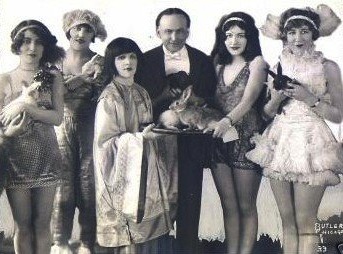
Houdini and his roadshow girls. Young is second from the right.

Ms. Newman: Where they silk? And what colors?
Ms. Young: Oh, beautiful bouquets and metallic. So, after I had my costume fitted, I jumped in a taxi at 103rd Street. A young girl and I went down to The Village where the party was to be. The girl introduced me around. We danced in a club. I met this man. He seemed very, very sophisticated to me. I guess he was around thirty. He said, "Oh you are so young to be in New York all by yourself. You need a big brother to take care of you." I didn't care for him. So, he was smart enough not to ask for my phone number, but he asked the girl I was staying with for her phone number. And he called up the next day and took us both to lunch. For the whole week, he took me to all the best places in New York City. And during the whole year I was with Houdini, he called me once a week. On the way to Hartford, I still didn't know who Houdini was. They had a drawing room and I had the parlor. Houdini came out with a deck of cards and he did all of his card tricks for me. And then he proceeded to tell me a lot about his childhood, which was very interesting. Well, when we arrived at Hartford, it was on a Sunday night. And Rachmaninoff had a concert there, and we went directly to the theatre to unpack. I remember I stood in the wings and listened. And I was so thrilled. And when he came out, I guess he wondered why a young girl like that would just be standing there listening the whole time. It is a very happy memory having had a visit with Rachmaninoff. He was very tall and slender. I remember when he said goodbye, he patted my head. After I fulfilled my year contract, of course, Houdini wanted me to stay on.

Ms. Newman: What did you do as part of the Houdini act?

Ms. Young: At first they had a very beautiful curtain made of mementos of things they had been given in Europe, and this curtain was very beautiful. Mrs. H. was dressed as Marie Antoinette, and I her escort. Mrs. H came out on one side and I the other. We joined in the center and did a little minuet, and pulled back the curtains. Then a big stage was there, and a black back drop and Houdini came out in his magnificent entrance. Two years ago, Harvey Keitel, an actor, I didn't know who he was, he was doing an impersonation of Houdini, and he sent his limo down for me to go up and have dinner with him, and I did Houdini's entrance for him about twenty times, and he studied the mannerisms. Houdini was not a tall man. He was very muscular, and the way he carried himself, you didn't think of height. He was dressed in full dress, immaculate. And the jacket was designed that he could remove the sleeves from the elbow down so that while he worked, you could see that he wasn't concealing anything. Well, the show opened with the proverbial magic thing with the scarves and the birds and all that. Then Mrs. H. had her famous, famous trunk trick. It's now called "Metamorphosis." Houdini purchased it when they were young in Coney Island for $25.00 from a retiring magician, and now that has become so famous. And Mrs. H. must have been almost, I bet she was, no she must have been at least fifty or fifty-two, but from the back of the stage she looked like sixteen, the way she was made up in her little gown. She kept herself beautiful. My first number was a Radio Girl. Collins and Vickory, his two assistances, would bring out a large table. Houdini would go in back and show nothing underneath the table, no mirrors or anything like that. Then Collins and Vickory would bring out a big radio. And Houdini would open the doors, would prop them back and show there was nothing inside. He'd lift out a panel like tubes and things. Then he would close it up and tune in like, for instance, Pittsburgh would be KDKA, and it's say, "KDKA, Ms. Dorothy Young doing the Charleston." And, that was my cue to put my foot out, then the other foot, then I'd kick them together, jump up and do a curtsey.

Dorothy as the "radio girl"

Ms. Newman: You were inside the radio?

Ms. Young: Yes. Then Houdini would take me by the waist and lift me down, and I would go into a Charleston. And, my other number was called the "Slave Girl." The big stage was empty and there was just a pole in the middle of the big stage. And Collins would bring me out with my hands tied behind me. And I had a little skimpy burlap costume. And, Houdini would say, she has been a naughty girl, so I have to tie her up. So they tied me up to the pole from my throat down to my ankles. And then Houdini said, she has been naughty, so we will have to put her in darkness. He would press a button, and the curtain would fall to the floor. And I would come out in a beautiful butterfly costume on my toes and do a ballet number. And then another number I did: there was a big cabinet, and Houdini would walk through it and turn it around to show it was absolutely empty. Then, he would say presto, and Mrs. H. in a very beautiful elaborate costume, and myself, and Julia, his secretary, in an elaborate costume, and Kosher, in an elaborate costume, would all came out. And once in a while when Mr. Smith's wife would be there, we would add her to it. And, then the very, very exciting thing was Water Torture Cell. I think it was sad the way they made the movie about him dying in the water. The whole movie was terrible. Houdini would turn over in his grave. It was terrible. Well, Mrs. H. always stood in the wings. They had this large cabinet and Houdini would come out in swim trunks. They'd lift him up by his feet and lower him head first with his hands tied behind him and lower him in the tank. And then, to make it more dramatic, the orchestra would play, "Asleep In the Deep," which made it very dramatic. I stood with Mrs. H. often, and she said only once in their life, did he have to give the signal to be taken out. And, when I appeared at any magicians' conventions they always want to know what the secret was, of course. I would tell them I was sworn to secrecy.

Ms. Newman: You were aware of the secret, but were sworn to secrecy?

Ms. Young: Yes. The last half of his act was devoted completely to exposing spiritualism. He felt spiritualism was wicked; it preyed on poor people who'd spend their last dollar to hear the voice of their loved ones. And, he had a person we called the Reva woman who would visit the entire spiritualist, the mediums, and card people in the city before we would play. And then she would come to report to Houdini. We never could eat dinner before the show because we had to be as thin as possible. So, we always, Mrs. H., Kosher, and Julia, and Mr. Smith, Houdini, and I always had dinner after the show. And, in all those years, I never remember once Houdini showing any anger or anything. Mrs. H. was a real cut up. She was a lot of fun, and she, when we were playing Buffalo, she suggested that we go to rent a limo and go over to Canada. We went through the Mist and everything.

Ms. Newman: Niagara Falls?

Ms. Young: Yes. She was a lot of fun. And just before we left the border, she said, "Let's get a bottle of liquor and see if we could smuggle it in." Well, that night at dinner, somehow we joked about it.

Ms. Newman: This was during prohibition?

Ms. Young: Oh yes, and Houdini snapped, "Do you realized the publicity we would have had if they had caught you bringing liquor in?" And that is the only time I ever heard him express anger. He was just the most wonderful compassionate person to work for. The last act involved a very famous medium called Marjorie. He dressed up, he put on a wig and a cane, and dressed up as an old man, and went to Marjorie and told them to get in touch with the spirit of a loved one. And he copied her séance completely in the last act of the show. He would ask people to come up who would invariably be interested in spiritualism. And, they would sit at a table, and they would ask to speak with a loved one. And then, Houdini would go through the seance, and it really was weird to see. And then after he did it, he broke it apart to show the whole audience how it was done.

Ms. Newman: He would show that it was a fraud.

Ms. Young: Yes. Houdini was like a father to me, but never personal, you know. Before I left the show he said to me, "Dorothy, did you ever wonder why you were chosen over 200 girls?" I said, "No." He said, "Mr. Smith and I are opposite personalities, and you appealed to both of us. And we knew you were the one that we wanted." As I look back, I think it might have been in the first place all of those girls were typical Broadway girls, and they weren't going to have someone like that travel with them closely. It was a close unit. That is one thing, and the other thing, I was shorter than Houdini, and most of them were taller. That was my experience with Houdini.

Ms. Newman: So you had a year's contract and that was the end?

Ms. Young: Yes. And he died two months after. Two young boys were visiting him backstage. They had seen the show, and Houdini had had a pain and the doctor didn't diagnosis it right. His appendix was in the center rather than at the side. He had appendicitis, but the doctors didn't diagnose it that way. And then, one of the boys said, "You mean you could withstand a punch with all my might?" And Houdini said, "Yes." What the boy didn't realize was that Houdini had to prepare himself first, and the boy struck him, and his appendix burst. So, they rushed him to the hospital, but it was too late. He fought for a whole week. He thought he could lick it, but he couldn't, and finally he had to give up.

Ms. Newman: Did your father ever see you perform?

Ms. Young: Oh, yes, when we were in Pittsburgh, my father was in the audience, and Houdini asked him to stand up. And when I was in Chicago, my Grandmother Caldwell was there, and we were sold out. I don't know. Somehow or another, he got her a seat in the first row center. And when I took her back stage to meet Houdini, Houdini kissed her forehead and said, "Now I know where Dorothy gets her charm." (Laughs)

Ms. Newman: He does sound like a dear man. Were there other people traveling?

Ms. Young: No. We were a close unit. Collins was his main assistant, and Victory was his helper. Mrs. H., Houdini, Julia, Kosher, Mr. Smith, and I. That was our entourage.

Ms. Newman: And you went across the country.

Ms. Young: Oh, yes. And we played Broadway twice.

Ms. Newman: Were these one night stands?

Ms. Young: Oh, no, I think we played Chicago four weeks.

Ms. Newman: And you traveled by train?

Ms. Young: Yes, by train. I'd spend my day with Mrs. H. I don't remember what salary I had, but it must have been plenty, because I always stayed right in the next room to them, and I always had my breakfast sent in my room and I felt so sophisticated. I remember I had a black satin negligee with white marabous. And in those days, eating breakfast for one, they would wheel it in on a whole table. Now days if you had breakfast for one, they'd just bring it on a tray. I remember I would drape myself and feel so grown up.

Ms. Newman: What year was this?

Ms. Young: 1925 and 1926. So, that was my story with Houdini.

CLICK HERE to read the entire interview at the Monmouth Library's "Remembering the 20th Century: An Oral History of Monmouth County" website.

Monday, March 21, 2011

Dorothy Young passes away at 103

Sad news. Dorothy Young, who acted as Houdini's assistant in his full evening show, has passed away at age 103. Patrick Culliton just posted the news on Genii forum. He says he was notified by Stanley Palm. Young was the last living person to have worked with Houdini. R.I.P., Dorothy. A true legend.

Dorothy Young and Houdini perform "Radio 1950"

Translate