Our great friend Joe Notaro provides the answer in two posts at his blog, Harry Houdini Circumstantial Evidence. Follow the links below and all will be revealed.
- Home
- Life
- Escapes
- Magic
- Movies
- Houdini's Movies
- Les merveilleux exploits de Houdini à Paris (1909)
- The Master Mystery (1918)
- The Grim Game (1919)
- Terror Island (1920)
- The Man From Beyond (1922)
- Haldane of the Secret Service (1923)
- Velvet Fingers (1925-26)
- Medium Well Done (1937)
- Religious Racketeers (1938)
- Houdini Picture Corp.
- Film Developing Corp.
- Filming locations
- Unmade Movies
- Deconstructing Houdini '53
- Spiritualism
- People
- Beatrice Houdini
- Theo Hardeen
- Cecelia Weiss
- Mayer Samuel Weiss
- Jim Collins
- Franz Kukol
- Martin Beck
- Sir Arthur Conan Doyle
- Margery
- J. Gordon Whitehead
- Edward Saint
- Jacob Hyman
- Leopold Weiss
- Carrie Gladys Weiss
- Bernard M.L. Ernst
- Charmian London
- Jess Willard
- H.P. Lovecraft
- Sherlock Holmes
- Assistants
- Imitators
- Other magicians
- Media
- Full Bibliography
- By Houdini
- Biography
- Fiction
- Foreign
- For Kids
- Methods
- Wild About Harry Bookshelf
- Houdini His Life Story (1928)
- Houdini The Man Who Walked Through Walls (1959)
- Houdini The Untold Story (1969)
- The Life and Many Deaths of Harry Houdini (1993)
- Houdini!!! The Career of Ehrich Weiss (1996)
- The Secret Life of Houdini (2006)
- The Metamorphosis: The Apprenticeship of Harry Houdini (2012)
- The Witch of Lime Street (2015)
- The Life and Afterlife of Harry Houdini (2019)
Showing posts with label Oscar Teale. Show all posts
Sunday, March 26, 2023
What was Adams Press?
You may have noticed the name Adams Press on many of Houdini later publications. Sometimes the address for Adams Press shows Houdini's own address. Sometimes not. So what exactly was the story with Adams Press?
Saturday, December 14, 2019
The Houdinis 1902 Christmas card rings in $3,120
The Houdinis 1902 Christmas card--the earliest card that I'm aware of--sold today in Potter and Potter's "Winter Magic Auction" auction for a jolly $3,120 (including buyers premium). It's a beautiful and uncommon card with a terrific photo of the young Harry and Bess. It handily beat the auction estimate of $800 - $1,200.Notice that Bess is wearing her famous Royal Crown Brooch in this photo. This pretty much closes the door on the idea that she received this as a gift from Russian royalty as the Houdinis sent out this card four months before they ever traveled to Russia.
The auction also included a few very nice Houdini movie related lots. One was comprised of a letter on Houdini Picture Corporation stationary and a terrific unpublished photo from The Man From Beyond from the Milbourne Christopher collection. It sold for $2,280. The other was a letter and stock certificate framed with a photo of Houdini and Bess with director Scott Sidney at Inceville in Los Angeles in 1915. It took $3,840.
But the big ticket Houdini item was a locked book that Remigius Weiss used to expose the medium Henry Slade in 1882. Weiss later presented the book to Houdini who wrote about it in A Magician Among the Spirits. The auction lot included letters of provenance from Oscar Teale and Jack Flosso, whose father acquired the book from Joe Dunninger. The Houdini-Slade-Weiss Locked Book unlocked $12,000 (including premium).
Related:
Tuesday, August 29, 2017
LINK: Deconstructing Houdini's Grave
Looks like Chuck Romano over at My Magic Uncle has caught our Machpelah Fever. Chuck has a terrific post about the men and materials that made the Weiss family plot and exedra. A highlight is a photo of Oscar Teale standing over Houdini's grave. As Teale died in 1934, this is the earliest/best photo of the full plot that I've ever seen! But you'll have to head on over to My Magic Uncle to see the whole thing, so click the headline and keep digging Houdini's grave.
Related:
Wednesday, August 23, 2017
Have we been looking at this photo all wrong?
For starters, I don't think that is William Weiss. To my eye, that appears to be Oscar Teale, Houdini's private secretary who was tasked by Houdini to create the large marble exedra for the family plot in Machpelah cemetery in 1915-16. Teale appears to be holding something in his hand. What could that be? I'll come back to that.
So can we prove this is Machpelah? Happily, yes! While there are a several photos of Houdini in Machpelah, this is the only one that shows anything that is today still recognizable. The bench that Houdini and Teale are sitting on appears to be one of the stone benches that are still there today (although the benches today are replacements for the originals destroyed by vandals in 1993). Armed with this photo, Colleen and her husband Frank did a little digging (ha!) and pinpointed exactly where this photo was taken.
As you can see, this appears be have been taken in the South West corner of the family plot. There are three distinct graves behind both Colleen/Frank and Houdini/Teale that are unmistakable; an urn, angel, and obelisk. Unfortunately, this also reveals more vandalism as only the base and foot remain of the angel in the center of the image.
Now, the location of the bench in the Houdini photo brings up a few observations. First off, this is Houdini sitting almost on top of his own final resting place. Back then it appears the plot had a gated entrance where Houdini's grave is today. It also appears the bench is not positioned as it is today. Today it sits perpendicular to the plot, directly facing the other bench. (This is why the angle on the Colleen/Frank shot is somewhat different.)
But in the Houdini/Teale photo, the bench appears to be sitting at an angle. It's actually facing towards the exedra. And that's what makes everything fall into place and why I think we have been looking at this photo all wrong.
Look at the photo again with its newly understood position of the bench in mind. Houdini is looking in the direction of the exedra with concentrated interest, and Teale is looking at him as if seeking approval. And what are those in Teale's hands? Design plans maybe?
So far from being a moment of repose with a family member, this appears to be Houdini and Oscar Teale either inspecting the newly installed exedra or possibly planning where the exedra will sit (because we really have no way of knowing whether it's there -- possibly the benches proceeded it?).
If this was a planning session or first inspection, it seems unlikely this would be the only photo taken that day. So are there more photos out there? Is there one that will finally give us a good look at the exedra as it appeared in Houdini's lifetime (before the S.A.M. mosaic and bust). Just another piece of the Houdini jigsaw puzzle!
Thank you Colleen and Frank for the great detective work.
Postscript: After I finished this post, I stumbled on an article that highlights some Houdini diary entries for the year 1916 (the year of the exedra dedication) and noticed this:
Related:
Sunday, January 1, 2017
Houdini in 1917
Welcome to another year of WILD ABOUT HARRY. Let's kick off 2017 with a look back at what Houdini himself was up to 100 years ago.
Quick! Name a significant Houdini escape, piece of magic or performance associated with the year 1917?
One can easily do this for nearly every year of Houdini's life: 1903/Carette; 1908/Milk Can; 1914/Walking Through A Brick Wall. But 1917 is tricky. That's because for the first time in many years, Houdini didn't invent or perform any new escape or feat of magic. In fact, his act was basically the same one he had been doing since returning to the U.S. in 1914. Of this period Silverman writes: "Much of what had brought Houdini to this height he was now preparing to downplay or abandon."
Quick! Name a significant Houdini escape, piece of magic or performance associated with the year 1917?
One can easily do this for nearly every year of Houdini's life: 1903/Carette; 1908/Milk Can; 1914/Walking Through A Brick Wall. But 1917 is tricky. That's because for the first time in many years, Houdini didn't invent or perform any new escape or feat of magic. In fact, his act was basically the same one he had been doing since returning to the U.S. in 1914. Of this period Silverman writes: "Much of what had brought Houdini to this height he was now preparing to downplay or abandon."
This post is now retired.
You will be able to enjoy the story of Houdini in 1917 in my upcoming book.
Saturday, October 29, 2016
First subscriber's copy of Conjurers' Monthly sells for $20,910
The first subscriber's copy of Houdini's Conjurers' Monthly Magazine inscribed to Oscar Teale sold for a remarkable $20,910 in today's Potter & Potter auction of The Magic Collection of David Baldwin (Lot 279). The auction estimate was $3,000 - $5,000. Sale price includes the buyers premium.
Houdini launched his Conjurers' Monthly Magazine in September 1906. The magazine ran for 23 issues until August 1908. In 1945, Hardeen helped revived it as The New Conjurors' Magazine, which lasted until 1949.
Overall, this latest Potter auction saw some remarkably high prices, with a Robert-Houdin Electric Pendulum Clock selling for $61,500 and another for $51.660. I tried for two Houdini photos (Lots 282 & 286), but lost out on both. (Still looking for my "Moses Buy" for 2016.)
Related:
Description: Houdini, Harry (Ehrich Weiss). First Subscriber’s Copy of the First Issue of Conjurers’ Monthly Inscribed and Signed by Houdini, Together with an Inscribed and Signed Photo of Houdini. August/September, 1906. Two pieces, matted in handsome presentation in a gilt wooden frame. Including Oscar S. Teale’s copy of the first issue of Houdini’s magazine Conjurer’s Monthly, inscribed and signed by Houdini: “To O. Teale, the first subscriber./This copy is the first one sent to anyone!! The regular subscribers will get theirs when others are made. 14th Sept. 1906/ Harry Houdini.” Together with a 1906 portrait of Houdini, inscribed and signed: “Aug 14/06. Dear Mr. T/Your dollar to hand for yearly subs. for Conj. Mag. and you are the first one to send money, therefore you are the first authentic subscriber/ Thanks/Houdini.” Both pieces torn in places, the magazine cover toned in nameplate. 21 x 12”. Not examined out of frame. Unique.
Houdini launched his Conjurers' Monthly Magazine in September 1906. The magazine ran for 23 issues until August 1908. In 1945, Hardeen helped revived it as The New Conjurors' Magazine, which lasted until 1949.
Overall, this latest Potter auction saw some remarkably high prices, with a Robert-Houdin Electric Pendulum Clock selling for $61,500 and another for $51.660. I tried for two Houdini photos (Lots 282 & 286), but lost out on both. (Still looking for my "Moses Buy" for 2016.)
Related:
Saturday, October 1, 2016
The Houdini-Weiss exedra turns 100
It was 100 years ago today that Houdini unveiled the exedra that fronts the Weiss family plot at Machpelah cemetery in Queens. Houdini dedicated the monument in a special ceremony on Sunday, October 1, 1916.
The creation of the exedra (resting place) had taken over a year. Houdini entrusted the task to Oscar Teale, a past president of the Society of American Magicians whom Houdini employed as a private secretary. Teale worked throughout 1915-16 while Houdini was on tour. The job was not an easy one. The contractors deviated from Teale's model, a marble seat developed a crack, and faulty drilling broke large slabs of stone which had to be replaced. In the end, it cost Houdini a whopping $40,000 (that's close to a million dollars today).
The finished exedra was cut from a thousand tons of Vermont granite and ornamented with figures hewn from Italian marble. The original headstones for Houdini's parents were placed inside each end of the exedra. On the back was etched:
Erected By
HOUDINI
1916
In Sacred Memory
Of His
BELOVED PARENTS
About 250 people attended the dedication ceremony, which was conducted by Rabbi Bernard Drachman and Rabbi A.B. Tinter. Newspapers from as far away as Pittsburgh covered the event. The new plot had the Weiss family laid out under uniform headstones made from the same granite as the exedra, with Houdini's headstone in place beside his mother.
The exedra that was unveiled 100 years ago is slightly different from the one we know today. It did not have the bust nor the cut glass mosaic emblem of the Society of American Magicians. Those would be added a year after Houdini's death and unveiled during a special memorial service attended by Bess. I've never seen a close-up image of the original exedra, but glimpses of it can be seen in photos taken during construction and Houdini's funeral. (Which you can see below.)
However, the grave site has also seen rough times and controversy. In April 1975, the grave became the focus of attention when escape artist and Houdini provocateur Norman Bigelow claimed to have "deciphered a complex code" that revealed Houdini had hidden his secrets inside the exedra. That same month, cemetery revelers, high on PCP, dislodged and broke the original grave bust. The timing lead some, including James Randi, to believe Bigelow had committed the vandalism in an attempt to prove his theory.
The bust was replaced by the S.A.M. in a special ceremony on March 24, 1976, in time for the 50th anniversary of Houdini's death (Saturday Night Live would do a "broadcast" from the gravesite that year). However, the second bust was stolen in 1983. After two more replacements were stolen, the S.A.M. decided it was best to leave the monument headless. Then, on May 25, 1994, the entire gravesite experienced extreme vandalism with the destruction of two stone benches and the headstones of Leopold and Gladys Weiss.
With help from magicians, including generous donations from David Copperfield and James Randi, the S.A.M. repaired the gravesite (although Gladys and Leopold's headstones have yet to be replaced). In 2007, the site once again became of the center of controversy when a plan to exhume Houdini's body to test for poisoning drew nationwide attention. It was later dismissed as a publicity stunt.
In 2011, Dorothy Dietrich, Dick Brookz and Steve Moore of the Houdini Museum in Scranton took it upon themselves to restore the long missing Houdini bust with a reproduction made at their own expense. They also oversaw the upkeep of the gravesite during a time of dispute between the S.A.M. and the cemetery over costs.
But all disputes have now been settled, and the S.A.M. has resumed the upkeep of the grave of their "Most Illustrious" past president. In fact, this past May, the S.A.M. concluded a major cleaning and restoration of the entire exedra, just in time for its 100th anniversary today.
Below are photos of the exedra throughout the years.
![]() |
| Houdini takes a seat during construction. |
![]() |
| The dedication on October 1, 1916. |
| Houdini's funeral, November 4, 1926. |
![]() |
| Hardeen and Bess in the 1930s. |
![]() |
| Elsie Hardeen, Gladys Weiss, and Marie Hinson in 1954. |
![]() |
| On Saturday Night Live, October 30, 1976. |
| Me with the headless exedra in 2005. |
![]() |
| The bust is restored by the Houdini Museum in 2011. |
Last Monday, September 26, our magical friend Colleen Bak visited the gravesite and took these beautiful photos (as well as the image at the top of this post), giving us a nice look at the 100-year-old Houdini-Weiss exedra as it proudly stands today.
Background on the building of the exedra from Houdini!!! The Career of Ehrich Weiss by Kenneth Silverman.
Timeline:
- 1904: Houdini buys plot for $450. Moves grandmother, father, and half-brother Herman.
- 1916: Houdini dedicates exedra in memory of his parents on October 1st.
- 1926: Houdini is buried on November 4.
- 1927: S.A.M. holds memorial service and unveils Houdini bust and S.A.M. emblem.
- 1975: Houdini bust is smashed by vandals on night of April 8-9.
- 1976: S.A.M. replaces Houdini bust with replica on March 24.
- 1983: Second Houdini bust is stolen on August 14. Replaced by S.A.M. with replica.
- 1987: Machpelah Cemetery goes into bankruptcy. State takes ownership.
- 1988: Third Houdini bust is stolen. Replaced.
- 1990: Fourth Houdini bust is stolen in November. Not replaced.
- 1994: Benches are smashed and Gladys/Leopold headstones damaged on May 25.
- 1996: Grave is restored with funds raised by S.A.M. with help from David Copperfield and James Randi. Bust and Gladys/Leo headstones are not replaced.
- 2002: Police recover bust stolen in 1983. (Returned to S.A.M. in 2011 and now on display at the Houdini Museum of New York.)
- 2007: S.A.M. stop paying for the upkeep of the plot over dispute with cemetery owners.
- 2007: Book authors announce plan to exhume Houdini's body to check for poisoning.
- 2011: Dorothy Dietrich and Dick Brookz replace Houdini bust with replica on September 29.
- 2013: S.A.M. announces it will resume paying for the upkeep of the gravesite.
- 2016: S.A.M. rededicates the cleaned and restored exedra on May 9.
- 2016: Exedra celebrates 100th anniversary on October 1st.
Related posts:
Thursday, May 26, 2016
Haversat & Ewing auction June 3-4
Haversat & Ewing Galleries upcoming "Spring Into Summer Auction" on June 3-4 will include several interesting Houdini rarities among their 190 lots.
Two items specifically relate to Houdini in New York. The first is a program and ticket stubs for Houdini's 1917 S.A.M. benefit for the families of the Antilles disaster, in which he shared the stage with Harry Kellar among others (Lot 145). To promote the patriotic event, New York officials finally granted Houdini permission to perform a suspended straitjacket escape in Times Square. There's also a program for Houdini's first appearance at The Palace Theater, in which he shared the bill with Fanny Brice (Lot 136). The Palace was a collaboration between Martin Beck and B.F. Keith and became the preeminent vaudeville house of the golden age.
Also at auction are eleven typed pages about the Davenport Brothers compiled by Oscar Teale for Houdini (Lot 146). An article called "The Idolatrous Dog" signed by Houdini to Will Goldston: "W.G. Knowing your love of your pretty little Greyhound - know this will interest. Regards, Houdini" (Lot 137). And two keys from Houdini's personal collection owned by Jerry Metallo, who was once Houdini's metal worker (Lot 160).
You can view the full online catalog HERE. Active bidding on all lots begin at 11:30 AM EST - Friday, June 3, 2016. The first lot closes Saturday, June 4, 2016 at 5:00 PM EST.
Related:
Two items specifically relate to Houdini in New York. The first is a program and ticket stubs for Houdini's 1917 S.A.M. benefit for the families of the Antilles disaster, in which he shared the stage with Harry Kellar among others (Lot 145). To promote the patriotic event, New York officials finally granted Houdini permission to perform a suspended straitjacket escape in Times Square. There's also a program for Houdini's first appearance at The Palace Theater, in which he shared the bill with Fanny Brice (Lot 136). The Palace was a collaboration between Martin Beck and B.F. Keith and became the preeminent vaudeville house of the golden age.
Also at auction are eleven typed pages about the Davenport Brothers compiled by Oscar Teale for Houdini (Lot 146). An article called "The Idolatrous Dog" signed by Houdini to Will Goldston: "W.G. Knowing your love of your pretty little Greyhound - know this will interest. Regards, Houdini" (Lot 137). And two keys from Houdini's personal collection owned by Jerry Metallo, who was once Houdini's metal worker (Lot 160).
You can view the full online catalog HERE. Active bidding on all lots begin at 11:30 AM EST - Friday, June 3, 2016. The first lot closes Saturday, June 4, 2016 at 5:00 PM EST.
Related:
- Houdini in New York (Times Sq. escape)
- Houdini in cuffs photo unlocks $7,371
Friday, March 11, 2016
The Flatbush years
One hundred years ago, Houdini returned home after an exhausting seven month coast to coast Vaudeville tour. But the New York home he returned to was not his famous brownstone at 278 W 113th Street in Harlem. It's not generally known, but Harry and Bess Houdini lived in Flatbush for 3 1/2 years between 1914 and 1918. In fact, it was in this Flatbush house at 394 East 21st Street (pictured above) that Houdini produced what today might be considered his single most important surviving artifact, but I will get to that.
When Houdini purchased his Harlem brownstone in 1904, it was to serve as a new Weiss family home and, primarily, a new home for his mother. At the time, Houdini was performing in Europe and only returned to New York for short periods. As a family home, 278 saw a steady rotation of resident Weisses (and Rahners). Houdini's brother Leopold even set up his radiology practice in the parlor.
When Cecelia Weiss died in 1913, Houdini was devastated and reportedly didn't like the memories that came with the house. At least that's the official story. Jon Oliver, who spoke with Harry Hardeen Jr., claims the real issue with 278 was that mama's corpse had been left inside the house for the week it took Houdini to return from Europe, and it had become uninhabitable (and unsellable). Whatever the truth, Houdini felt the need to escape.
Houdini's brother Dash, who performed as Hardeen, had purchased a home in Flatbush in 1912. Hardeen's pitchbook identified the address as 394 Kenmore Place, but in reality it was located at 394 East 21st Street. However, it was more house than Dash required (or could afford?) and in July 1914 he put an ad in the Brooklyn Daily Eagle looking to sublet the top floor:
The tenants Hardeen ended up with were the Houdinis. Houdini moved to 394 East 21st Street in September 1914. On his new stationary (rimmed in black to show he was in mourning) he wrote to a friend:
Click to enlarge.
The Flatbush house became the hub of activity during the years Houdini was land-locked in North America because of the war in Europe. It was during his time that Houdini began to build what he hoped would be one of the world's greatest dramatic collections, and the mounds of new material he acquired flooded into Flatbush. When Houdini met Harry Kellar in 1916, he invited him to the house where he showed off his collection and also amazing the great magician (according to Kellar himself) with card magic.
But it was on October 29th, 1914, that the Flatbush house became the sight of what might arguably be the single most important Houdini artifact of them all. It was here that Houdini used an Edison wax cylinder phonograph to record his voice, now the only recording of Houdini's voice in existence. While I can't say conclusively that he made the recording in the house itself, he identifies his location as "Flatbush, New York" and his sister Gladys is with him, so I'm thinking it's likely this was done at home.
The Houdinis (and, presumably, their many pets) lived on the top floor of 394 while the Hardeens (and their children) lived below. Was living in such close quarters a strain? Possibly. In his book, Houdini!!! The Career of Ehrich Weiss, Kenneth Silverman identifies a few cryptic references in Houdini letters and diaries that suggest tension. "I do not like atmosphere re certain things in Flatbush" Houdini wrote to Oscar Teale. And when Houdini was honored at an S.A.M. banquet, he noted curtly in his diary: "Dash and Elsie did not wish to go."
The shared residence also caused some amusing confusion. When Hardeen was arrested for speeding, the Brooklyn Daily Eagle reported that it was Houdini who received the $25 fine. The paper later printed a retraction, quoting Houdini himself as saying that he had "never been arrested nor fined, and does not drive a motor car."
1929 map showing the location of 394.
Hardeen moved out of 394 in 1921, relocating a few blocks to 537 East 21st St. This would be the home he and Elise would live out the remainder of their lives.
Today a modern apartment block sits at the site of Houdini's forgotten Flatbush residence.
A very big thanks to Bill Mullins for his invaluable help in locating Hardeen's house and for the Brooklyn Eagle classified ad and map.
Also thanks to Joe Notaro of Harry Houdini Circumstantial Evidence and Jon Oliver. The Houdini Flatbush letter is reproduced from the collection of James Crossini on page 29 of The Illustrated Houdini Research Diary, Part 4: 1911 to 1915 by Frank Koval.
Related:
Saturday, September 27, 2014
Houdini the unhappy commuter
On Wednesday I had the great pleasure of seeing Teller's Tempest at the South Coast Repertory in Costa Mesa, thanks to the generosity of magician and Magic Castle librarian Lisa Cousins and Tim Quinlan of Inside Magic. The play was as amazing as the rave reviews promised, and it was great to see it with a group of magicians from the Castle. ("What do the magicians think?" someone eagerly asked me at intermission.)
But what I want to share today was a discovery we made after the play. Our group returned to the Magic Castle to ring in the birthday of "Princess Irene" Larsen at midnight. But before the clock struck 12, Lisa and I stole down to the closed library where she wanted to show me a recent discovery in their special "locked case" collection.
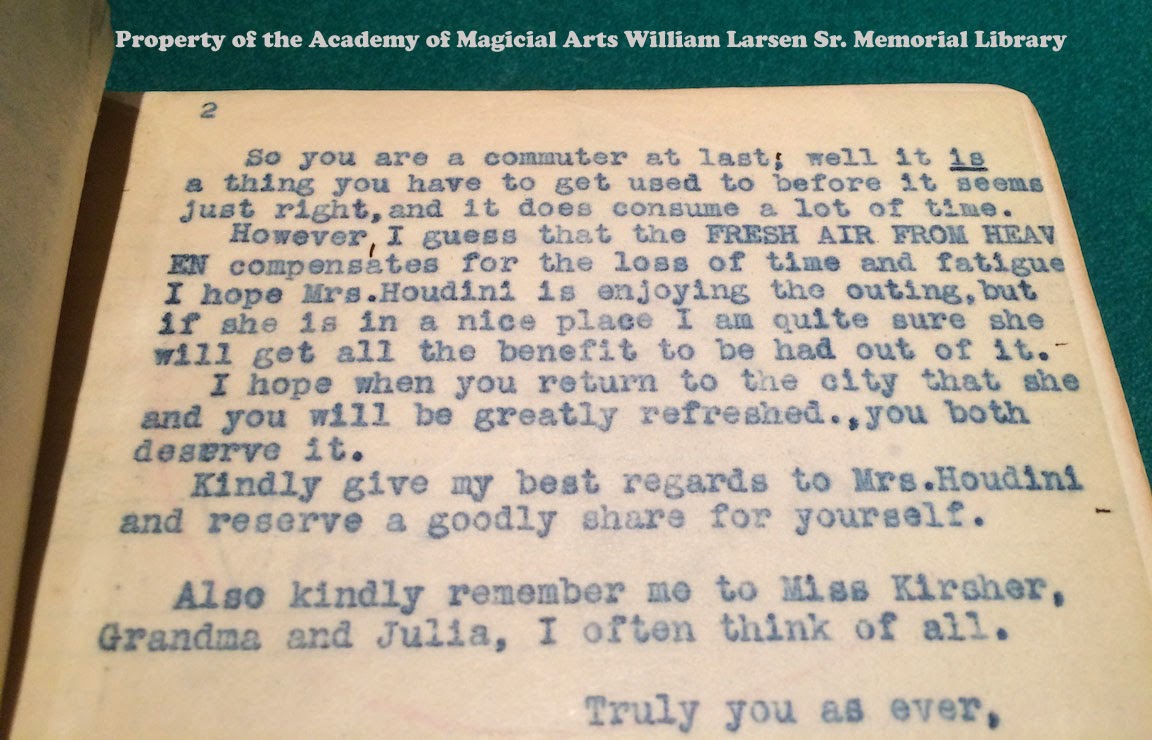
It was a copy of the book The Missing Link in Modern Spiritualism by A. Leah Underhill of the Fox Family, which had belonged to Houdini. Tipped inside were two remarkable letters. The first was from Houdini to his friend and research assistant Oscar Teale. What I love about this letter is it's a great slice of life, and it reveals a different side of Houdini. And have we ever heard about this Long Island rental before?
Now, not to get all Bernard Meyer on us, but it seems to me that this letter comes from a Houdini who is a little depressed. There's also a strong sense of abandonment here, both by Bess and Teale. Houdini was almost certainly a workaholic, and I do think he was prone to slipping into funks when he wasn't working. It's not the first time this depressed Houdini shows himself while on vacation. It's also worth noting that this letter was written the day before the 12th anniversary of his mother's death. That could be the real explanation for his mood here, even if Houdini wasn't aware of it himself.
The second letter is Teale's response, and it's just as personal and revealing. Teale seems to be going out of his way to cheer up Houdini and reassure him that he isn't alone (I unfortunately didn't photograph page 1 in which Teale explains why he wasn't able to make it to the S.A.M. meeting). Teale was an older man, and as a past National President of the S.A.M. (1908-09), he might have been somewhat of a father figure to Houdini. This unique exchange hints at that kind of a relationship.
Teale tipped these letters into the book and it remained part of his collection until his death. Today many of Teale's books, several of which had come direct from Houdini, are housed at the William Larsen Sr. Memorial Library at the Magic Castle.
Thanks again to Lisa and Tim for the invite to the play, and permission to share this treasure here on WILD ABOUT HARRY.
Related:
But what I want to share today was a discovery we made after the play. Our group returned to the Magic Castle to ring in the birthday of "Princess Irene" Larsen at midnight. But before the clock struck 12, Lisa and I stole down to the closed library where she wanted to show me a recent discovery in their special "locked case" collection.
It was a copy of the book The Missing Link in Modern Spiritualism by A. Leah Underhill of the Fox Family, which had belonged to Houdini. Tipped inside were two remarkable letters. The first was from Houdini to his friend and research assistant Oscar Teale. What I love about this letter is it's a great slice of life, and it reveals a different side of Houdini. And have we ever heard about this Long Island rental before?
![]() |
| Click to enlarge. |
Now, not to get all Bernard Meyer on us, but it seems to me that this letter comes from a Houdini who is a little depressed. There's also a strong sense of abandonment here, both by Bess and Teale. Houdini was almost certainly a workaholic, and I do think he was prone to slipping into funks when he wasn't working. It's not the first time this depressed Houdini shows himself while on vacation. It's also worth noting that this letter was written the day before the 12th anniversary of his mother's death. That could be the real explanation for his mood here, even if Houdini wasn't aware of it himself.
The second letter is Teale's response, and it's just as personal and revealing. Teale seems to be going out of his way to cheer up Houdini and reassure him that he isn't alone (I unfortunately didn't photograph page 1 in which Teale explains why he wasn't able to make it to the S.A.M. meeting). Teale was an older man, and as a past National President of the S.A.M. (1908-09), he might have been somewhat of a father figure to Houdini. This unique exchange hints at that kind of a relationship.
![]() |
| Click to enlarge. |
Teale tipped these letters into the book and it remained part of his collection until his death. Today many of Teale's books, several of which had come direct from Houdini, are housed at the William Larsen Sr. Memorial Library at the Magic Castle.
Thanks again to Lisa and Tim for the invite to the play, and permission to share this treasure here on WILD ABOUT HARRY.
Related:
- Houdini's hurt feelings
- Haversat & Ewing Galleries auction starts January 25 (Teale/Houdini photo)
Tuesday, January 21, 2014
Haversat & Ewing Galleries auction starts January 25
The first magic auction from Haversat & Ewing Galleries -- the teaming of magic powerhouses David Haversat and Tom Ewing -- is set to go live this Saturday, January 25, and of course there are several Houdini items in the sale. Among them is this terrific candid snapshot of Houdini, Oscar Teale, and Julius Zancig.
The auction will begin on Saturday, January 25 at 2:00 PM EST and will end on Saturday, February 1st at 5:00 PM EST. Click here to view all the auction lots.
Thanks to David Haversat for permission to share this image here.
The auction will begin on Saturday, January 25 at 2:00 PM EST and will end on Saturday, February 1st at 5:00 PM EST. Click here to view all the auction lots.
Thanks to David Haversat for permission to share this image here.
Saturday, October 26, 2013
Download 'Elliott's Last Legacy' now
Today's "Houdini-palooza" offering from the Conjuring Arts Research Center is Houdini's 1923 book Elliott's Last Legacy. A FREE PDF is available for the next 24 hours from the CARC online store.
All this week CARC is offering a free Houdini book every day leading up Halloween. Each new title becomes available 1:26pm (EST) and is available for only 24 hours. Additionally, all Houdini items at the CARC store are marked down 50%.
Elliott's Last Legacy contains the work of champion card manipulator Dr. James William Elliott, who died before he completed this book. Elliott's collaborator, Clinton Burgess, turned to Houdini for assistance in finishing it and getting it published. Houdini enlisted the aid of Oscar Teale and published the book through his own "Adams Press Print." Houdini also penned the introduction.
Burgess later complained that Houdini had featured his name on the cover as editor while relegating his own name to a small "complied by" credit inside. (I own an inscribed copy in which Burgess has written below his name, "author and compiler".) The dispute grew so heated that Houdini eventually had Burgess removed from the S.A.M. for "conduct unbecoming a member." But if Burgess wanted Elliott's work to have a legacy, then Houdini's name certainly did the trick.
Head on over to the Conjuring Arts Research Center and download your free PDF of Elliott's Last Legacy.
All this week CARC is offering a free Houdini book every day leading up Halloween. Each new title becomes available 1:26pm (EST) and is available for only 24 hours. Additionally, all Houdini items at the CARC store are marked down 50%.
Elliott's Last Legacy contains the work of champion card manipulator Dr. James William Elliott, who died before he completed this book. Elliott's collaborator, Clinton Burgess, turned to Houdini for assistance in finishing it and getting it published. Houdini enlisted the aid of Oscar Teale and published the book through his own "Adams Press Print." Houdini also penned the introduction.
Burgess later complained that Houdini had featured his name on the cover as editor while relegating his own name to a small "complied by" credit inside. (I own an inscribed copy in which Burgess has written below his name, "author and compiler".) The dispute grew so heated that Houdini eventually had Burgess removed from the S.A.M. for "conduct unbecoming a member." But if Burgess wanted Elliott's work to have a legacy, then Houdini's name certainly did the trick.
Head on over to the Conjuring Arts Research Center and download your free PDF of Elliott's Last Legacy.
Sunday, May 5, 2013
A new twist in Houdini vs. Houdina
The story of Houdini's altercation at the Houdina Company in New York is well-known. It's a Rashomon-like tale in which, according to the owners, Houdini burst into their office wild-eyed, accused them of using his name, and started to break the place apart.
Houdini's version of the story is that he and his secretary, Oscar Teale, went down to the Houdina office to object to the use of the name because he was receiving their bills. He was threatened by four "Gorillas" and a scuffle broke out.
Said Houdini, "Two of the men started towards me and two were behind. Teale was thrown up against the wall, staggering. Had no idea I was smashing up chandeliers. All I thought was to save myself. I picked up a chair and acted in real life the scenes that I have portrayed before the camera."
The incident made the New York Times on July 22, 1925:
But now our friend Dean Carnegie at The Magic Detective has uncovered a remarkable third version of the story. Dean has been in contact with the son of Francis P. Houdina (a fictitious name) who says the entire thing was staged!
You'll have to visit Dean's site to read the details of this latest twist in our Rashomon tale, but this is a major discovery. My only reservation is that, as you can read above, the incident resulted in legal action. Sure, Houdini frequently staged events...but to involve the legal system in a publicity stunt? Seems even Houdini wouldn't have crossed that line.
Nevertheless, Dean's evidence is compelling and this is a true scoop, so click on over and read Clearing the name of HOUDINA at The Magic Detective.
Saturday, April 27, 2013
Bill Kalush shares Houdini gold in Washington
Conjuring Arts Research Center founder and The Secret Life of Houdini author William Kalush wowed attendees of the Washington Symposium on Magic History yesterday with his talk on Houdini. According to mega collector Arthur Moses, Bill's talk included fresh revelations and new unseen material.
Bill has done some research in the David Copperfield collection and has rediscovered some Houdini rarities that were misfiled years ago. First and foremost is a 112 page manuscript written by Houdini in 1924 called The Light Séance. Apparently this manuscript is connected with a 50-60 page Library of Congress manuscript on Spiritualism attributed to Houdini (but most likely written by Oscar Teale). The lost manuscript took up the first part of Bill's presentation.
Bill then showed a clip from a 1928 National Film Institute of Australia film titled Knights of the Air. The Paramount 2 reeler contains a lengthy segment about Houdini's Australian flights with film footage that is much more complete than the spotty fragments we have come to know.
Bill then revealed fresh information about Houdini's father, including a new unseen photo of Mayer Samuel Weiss (which makes this only the second known photo). Bill spoke of how he had uncovered a reliable sourced contact with Houdini relatives in Hungary from 1931 who were able to verify family history. According to these relatives, Houdini's father, who was a lawyer in Hungary (not a Rabbi), left the country because he failed a legal exam.
Thanks to Arthur Moses for these details of what sounded like an incredible talk. Hopefully Bill will be sharing these discoveries in print at some point. The Secret Life of Houdini Revisited? Bring it!
The Washington Symposium on Magic History concludes today.
Tags:
Arthur Moses,
Aviation,
Conventions,
David Copperfield,
Events,
Family,
Father,
Lectures,
Library of Congress,
Movies,
Oscar Teale,
Photos (unpublished),
Spiritualism,
Washington D.C.,
William Kalush,
Writings
Saturday, February 2, 2013
Original typescript for A Magician Among the Spirits at auction Feb 18
Houdini's original revised typescript for his final book, A Magician Among the Spirits, is going on the auction block February 18, 2013 as part of PBA Galleries online auction of Rare Books & Manuscripts. The estimate is $70,000 to $100,000 (!). Here is the full auction description:
Sale Number 500. Lot 109.
Original typescript, 408 leaves on quarto sheets, numbered 1-398 + 11 pages numbered 299b-299k . 28.5x21.5 cm (11x8½"). In period ring binder, covered in green
The original typescript for a new edition of Houdini's exposé of the fraud and deception endemic amongst the spiritualists, psychics and other paranormal practitioners. When first published in 1922 by Harper's, Houdini's manuscript was dramatically cut from 175,000 words down to 75,000 words. Displeased with the published work, Houdini was preparing this typescript for a second edition at the time of his unfortunate, and untimely, death. The typescript contains several holographic notations in Houdini's hand as well as other revisions in the hand of his assistant Oscar Teale. Provenance: The Collection of Milbourne Christoper, sold at Swann Galleries, October, 1997 (lot 191); a private collection since. Bookplate from the Christopher Collection inside the rear cover. Apart from a facsimile of this typescript printed while part of the Christopher collection, this revision has never been published.
Click here to view the auction page and bid at PBA Galleries.
Thanks to Greg Jung of PBA Galleries for permission to use this photo.
UPDATE: No sale for Spirits typescript.
Subscribe to:
Posts (Atom)