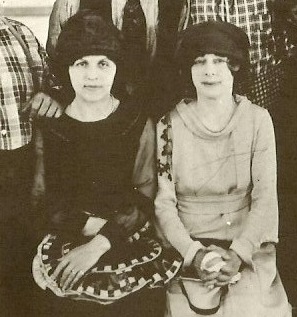
Banner AI generated.
Showing posts with label Marie Blood. Show all posts

Tuesday, April 14, 2026

Bonkers About Bessie!

Our friend Dean Carnegie at The Magic Detective Podcast has an episode devoted to Bess Houdini. Some stories here I've not heard. Enjoy.


Dean also has a lengthy post about Bess on his Magic Detective blog: The Life of Bessie Houdini. As Dean says, we're "Bonkers About Bessie" for this month! 


Thursday, August 14, 2025

News 10 on Houdini's Rochester bridge jump

Here's a terrific report from WHEC News 10 in Rochester about Houdini's jump from the Weighlock Bridge and the film footage that captured that leap. It's well-researched, and we get to see our friends Jeff and Debbie Blood. I love that they pinpointed the location and identified one of the still-standing buildings glimpsed in the footage. Enjoy.


I think this footage is an excellent candidate for the National Film Registry, which every year selects 25 films that showcase American film heritage and increase awareness for film preservation.

Thanks to Jeff and Debbie Blood for the alert.

Monday, July 1, 2024

Guest Blog: Houdini's mysterious safe

Today, I'm happy to share a guest blog from our friend Johan Ahlberg in Sweden about Houdini and his safes. Take it away, Johan!

HOUDINI'S mysterious SAFE

By Johan Ahlberg 

Harry Houdini had a great mechanical interest in complicated locks and safes. On his tour in Germany, he saw several safes and strongboxes that not only had complicated locks but also secret mechanisms to even find the keyhole. Some safes had combination locks, where secret levers needed to be operated in a secret manner to open the lock.

Houdini claimed he was challenged by a judge to open a big safe, which was kept in the judge's chamber with a combination lock, when he sued the German police for slander in Cologne, Germany.

The French magician Robert-Houdin made a desk with secret compartments. For extra security, there was a complicated lock in which you had to put your finger in a hole and touch a secret lever to open the lock. If you did it in the wrong way, a razor-sharp knife with a strong spring was activated, and the finger was cut off immediately. It was so the thief could easily be identified.

On December 4th, 1908, at the Euston Palace in England, Houdini was challenged to escape from a monster safe.

The safe was brought on stage. Houdini was searched and locked inside. He escaped in just 14 minutes, leaving the safe still secure and locked.

The terror of being locked up inside an airtight safe must have thrilled the audience. Houdini had planned the escape in detail, and it was probably one of Houdini's easiest escapes. But anything could have gone wrong; it took Houdini's nerves of steel to pull it off. If Houdini had fainted inside the safe or the lock mechanism had interlocked, it could have ended in disaster, like it did for Genesta when he tried to copy Houdini's milk can escape.

James Randi escaped in a TV show from a safe that was shown to be empty and locked. Suddenly, the combination dial started to spin. The door flew open, and out jumped Randi. The safe was so incredibly small that it seemed to be impossible for a human being to be inside. David Copperfield was handcuffed and locked in a safe with a combination lock. A chain was wrapped around the safe and padlocked. The clock started ticking, the combination dial started to rotate, and suddenly, a blast, the building was blown up, and everything was buried. David emerged on a table outside unharmed, smiling mysteriously. The effect was stunning, but Houdini was the first escape artist to escape from a borrowed safe under test conditions.

Houdini told a story in which he visited his lawyer in New York he was left alone with the lawyer's safe. He managed to manipulate the combination lock and his lawyer was dumfounded. Houdini claimed he had a micro meter in a watch that could register the small movements of the tumblers. To manipulate a combination lock can take hours or days to open even for a expert locksmith.

There was a rumor about a safe or a vault in Houdini's house. I once asked Marie Blood, Houdini's niece and the last link to Houdini's home, if she ever saw or heard anything about a vault? She said no! She never went down in the cellar. After Houdinis death there was another story about a safe that Bess couldn’t open. A locksmith, Charles Courtney, was called in an after working for hours on the combination lock it wouldn’t open. When Courtney asked Bess how Houdini opened the safe she said he just waved his hand over the lock and it opened like magic. Courtney bought a strong magnet and the lock opened or so he claimed.

The problem with that story is that a magnet can’t operate a lever through the safe's thick steel plates. In the safe, there were several love letters from women written to Houdini and the silver Mirror handcuffs. However, it’s a fantastic story.

Houdini's safe that Courtney claimed he opened with a magnet. The safe has the text “HOUDINI” on top. The Mirror handcuffs were stored inside.

An article in the Swedish newspaper KvP in 1974 described how Houdini had left a locked safe with his attorney in New York that contained his secrets. The safe was to be opened on Houdini's 100th birthday. With the press present, the safe was opened, but it was empty! 

I bet Houdini was laughing in his heaven.


Thank you, Johan.

If you'd like to share your own Guest Blog here on WILD ABOUT HARRY, feel free to get in touch and let's talk about what you have in mind. I know there's a lot of untapped Houdini wisdom out there!

Related:

Monday, January 25, 2021

The ship(s) from Haldane of the Secret Service

The "Carvania" as seen in Haldane of the Secret Service.

In Houdini's 1923 film, Haldane of the Secret Service, Gladys Leslie's Adele Ormsby travels to Europe via the ocean liner Carvania. Houdini's Heath Haldane, after dealing with some thugs in a warehouse, literally "catches" the ship by grabbing hold of a tow cable and being hoisted aboard. Several scenes then play out on the ship itself.

So what do know we about the Carvania? Well, for starters, it didn't exist. In the movie we get several establishing shots of the ship at a distance. But those shots appear to be the RMS Aquitania. 

RMS Aquitania (Wikipedia)

The RMS Aquitania was a British ocean liner launched in 1914. Aquitania was the third in Cunard Line's grand trio of express liners and the last surviving four-funnelled ocean liner. After being used as a troop transport and a hospital ship in World War I, she was returned to transatlantic passenger service in 1920, earning the nickname "the Ship Beautiful" from passengers. Houdini captured his shots of the "Ship Beautiful" in 1921.


The Aquitania was retired from service in 1949 as was scrapped the following year. Houdini never sailed on the Aquitania. But he did sail on her sister ship Mauretania in 1920.

While the Aquitania may be the ship we see in Haldane, I recently I found evidence that Houdini used a different vessel to film the scenes aboard the ship itself. The below is from the August 12, 1921 Variety.


This makes it pretty clear Houdini shot his scenes aboard the America. In fact, it appears to be the final "CA" in the name AMERICA can be glimpsed on the lifeboat in this shot from the film.

USS America (Wikipedia)

The SS Amerika was launched in 1905 as part of the Hamburg America Line of Germany. She sailed primarily between Hamburg and New York. On the night of April 14, 1912, Amerika transmitted a wireless message warning about icebergs near the same spot where RMS Titanic would sink less than three hours later. 


At the outset of the war, the Amerika was seized by the United States Shipping Board and became a Navy troop transport with her name Anglicized to America. In 1920, the ship was assigned to the United States Mail Steamship Company and returned to passenger service. Houdini filmed his scenes aboard the ship in August 1921. The America remained in service until 1949. She was sold for scrap in 1957. 

This means we now know the famous photo that Marie Blood used to sign and give out to fans (including yours truly) was taken aboard the America. I wonder if Marie recalled the name of the ship as those years later? If not, it would have been fun to have been able to share it with her. Alas, Marie passed away in 2004.


Finally, I don't know which vessel was used for the stunt in which Heath Haldane is dragged along the side. It certainly appears to be a real stunt using a real ship, but I find it hard to believe any in-use passenger ship would allow this. So it's possible this may have been a third yet identified Haldane ship.


Below are some more locations from Haldane of the Secret Service.

Wednesday, August 12, 2020

10th Anniversary: The Marie Blood book

Ten years ago Greg Edmonds shared with us details of a book he was writing about Marie Blood and her experiences with her uncle Harry and aunt Bess. Greg was very close to Marie in the last years of her life and is well suited to tell her story. You can revisit what Greg had to say below:


TEN YEAR UPDATE: Unfortunately, Greg suffered technical setbacks when his computer crashed, not once but twice, and he lost the manuscript both times. After encountering more obstacles, such as being unable to secure key photos for the book, Greg set the project aside.

Here's hoping Greg picks it back up someday because Marie memories are wonderful and her story is a part of Houdini history that deserves documentation.


Related: 

Saturday, January 11, 2020

The A&E Houdini Biography

For some reason I'm feeling nostalgic for the documentary Houdini: The Great Escape, which first appeared as part of the popular A&E Biography series in 1994. But this doc, which was once so ubiquitous, is now among the hardest to see (unless you held onto your VHS machine).

Launched in 1987, A&E's "Biography" series offered up hour long profiles of famous figures in history. The series was hosted by Peter Graves and later Jack Perkins. It took them a while to get to Harry, but they finally did so with Houdini: The Great Escape, first airing on June 20, 1994.

The documentary is well written by Alan Goldberg and is narrated by Jack Perkins. It includes interviews with Patrick Culliton, Harry Blackstone, Jr., James Randi, John Bohannon, Charles Reynolds, Penn & Teller, Mark Edward, Dorothy Young, and Marie Blood. It's especially nice to see Marie as she did not do many onscreen interviews. There's plenty of Houdini footage and photos to enjoy. It's also interesting to see Ken Silverman in the credits as this was well before the release of his book. The documentary was dedicated to Manny Weltman, "In memoriam for his extraordinary archive and love for Houdini." Manny had passed away a month before the first airing.

A&E released select episodes of Biography on home video in the 1990s, and Houdini was among the first. I always felt the photo they used on the box (above) was an odd choice--certainly they could have found something more iconic? But I was also happy for this odd choice as it was a pic I had never seen. And if there's anyone out there who collects VHS, know there was an earlier release with a plain purple box with just Houdini's name on the cover.


With many repeats on cable and the home video always in stock in big bookstore chains like Barnes & Noble and Borders, Houdini: The Great Escape was inescapable. I suspect for many it was their introduction to Houdini's (non-fictional) story. It was later revamped with new narration for the Biography Channel's "Bio 4 Kids" series.

But the doc did not make the jump to DVD, and as far as I know, it has yet to appear on any streaming platform. And while some of the Biography episodes can be found on YouTube, Houdini is not among them. So now seeing this classic documentary is a magic trick in itself.

Here's a bit of related trivia. In a May 1998 interview in Movieline magazine, actor Jim Carrey was asked, "If you could dine with any group of people who have been featured on A&E's Biography, who would you choose?"

Carrey's answer: "Harry Houdini. Benjamin Franklin. Gandhi, I suppose. Jesus."

Related:

Wednesday, October 30, 2019

Was there a ghostly occurrence during the live 1987 Houdini seance?

Continuing my special Halloween week of resurrected GHOST POSTS, here's a post from November 16, 2012 that explores a strange claim that Houdini at least tried to come back from the grave in 1987, and on live television.


In 1987 The Official Houdini Seance was incorporated into a live television special hosted by William Shatner called, The Search for Houdini. Essentially, it was a magic variety show featuring performers like The Pendragons and Penn & Teller, with the conclusion of the show being that year's Official Seance held by Sidney Radner. As always, Houdini failed to appear.

Or did he?

Mark Alberto Holt, who worked behind the scenes doing lighting effects, has come forward with a remarkable story. Mark posted the following comment on my blog about the Seance back in February and has allowed me to repost it here. Here's Mark's story:

"I was there doing the special lighting effects. One such effect was lighting inlaid into the seance table with plexi glass over the top for dramatic effect on each person around the table. During rehearsals it was determined to bring the levels of the lights down from 70% full to 25%. Just perfect for that glow effect up the faces. So starts the seance. I was told that the people around the table were relatives of Houdini and seance experts. This part of the show was not scripted. (I still have Shatner's script). Towards the end of the seance, one end of the plexi glass started to warp, Live on TV. This must have raised 6 inches above the table. It could not have been from the heat of the lights under. They were barely on. Producers screamed to go to commercial. The people at the table wanted to continue do to the fact there was a sign. Mr. Shatner had no choice other than to listen to the producers and go to commercial. I left the lighting board that was in the audience and dashed on stage. There was shear Chaos on the stage. The plexi was cool but it was lifted. The crew started clearing the stage and the screams from Houdini's family rang through the theater to continue the seance. That was the last anyone spoke of this. I was there and so was Harry."

I recorded the seance and still have the VHS in my collection. Below is the moment during the seance when they abruptly went to commercial. While I can't see any phenomena myself, you can see that Sidney Radner starts to look to the left end of the table as they cut to Shatner at 0:44.


When the show returned from commercial, the seance had wrapped up with each Inner Circle member expressing their doubt that Houdini would or could return.

The inner circle that year was made up of: Sidney Radner, Marie Blood, James Randi, John Gaughan, Henry Mueller, Todd Everett (L.A. Herald Examiner reporter), and William Shatner. The medium was Bob Steiner.

Maybe someone can come forward and corroborate Mark's strange tale?


Related posts:

Wednesday, August 7, 2019

Mystifier, Fourth Quarter 1998

Continuing my issue by issue look back at the Mystifier, the newsletter of the Houdini Historical Center that ran from 1991-2003.


The bulk of the Fourth Quarter 1998 Mystifier is taken up with a delightful Q&A interview with Houdini's niece Marie Hinson Blood. In it Marie shares many memories of her Uncle Harry and Aunt Bess. Some of the stories are familiar ones, but at the start she reveals some biographical details about Bess and the Rahner family that I don't believe have appeared elsewhere.

Marie: Well, there were eight children, one boy. The father died when Bess was twelve years old, and my mother was 8 months old. The oldest child in the family was engaged to a young man that was a tailor. They married, and luckily he had a big tailor shop. All the girls, when they were old enough, worked in the tailor shop. Aunt Bess hated this. She hated sewing... it was to her advantage, because she made patterns and she designed them, and she was very, very good. Aunt Bess designed the clothes that [she and Houdini] had in the show. So it did help them. At the beginning she sewed the costumes, but later she had other people sew them.

There's also this interesting exchange:

Mystifier: What kind of person was your Aunt Bess? Was she optimistic and positive, or moody? Could you describe her? 
Marie: Never moody. Oh, no. Very vivacious. In fact, he [Houdini] was the one who was quiet. I don't think I ever heard him tell a joke in his life.

It's interesting how Marie and Dorothy Young, who both experienced the private Houdini, describe him as "quiet."

The newsletter also contains an article by Mick Hanzlik describing his work on a half-scale replica of the Water Torture Cell that's part a new Houdini display at The Magic Circle headquarters in London. The model was created by art design student Andrew White as a school project and purchased by The Magic Circle. Mick added special lighting effects and a motor that allows the feet of a figure of Houdini inside to move. Mick says the straitjacket Tony Curtis wore in Houdini (1953) is also part of the new display. Is that display still there, I wonder?

The museum shop then announces the arrival of new Houdini mouse pads and a 80-piece puzzle depicting the Water Torture Cell.

Sid Radner begins his "Backstage" column with a reproduction of a poem about Houdini by Sharon Olds. It's called "My Son the Man" and appears in the book The Wellspring (1996). Sid says it was brought to his attention by Ken Silverman.

Sid then reports on that year's Official Houdini Seance held in Las Vegas. Attendees included actor Johnathan Schaech and director Pen Densham who premiered their new TNT Houdini biopic at the seance. Sid says it was "very well received." As always, Sid is proud of the publicity the seance generated, noting that it got an "exceptional story in USA Today."

Sid closes with the news that a new play, The Great Houdini, is set to open at the Stella Adler Theater in Hollywood in April 1999. Sid reports that playwright Alan London spent 12 years writing the play. [!]

Mystifier
Volume 8, Number 4
Fourth Quarter, 1998
6 pages

Contents:
A Conversation With Houdini's Niece, Marie Hinson Blood
The Houdini Exhibit at the Magic Circle, London
Museum Shop News
Backstage with Sid Radner


Related:

Thursday, May 9, 2019

Is that Julie Karcher in The Grim Game?

While enjoying The Grim Game at the Sierra Madre Playhouse last Friday, I spotted something--or rather, someone--I've never seen before. When Houdini/Harvey Hanford is being arrested and wrestled into a police car, among the bystanders is a woman who appears to be Julie Karcher.


Julie Karcher was a fixture in the Houdinis lives. She can be spotted in many photos, and when the Houdinis has their first lunch with Sir Arthur and Lady Conan Doyle in England, it's recorded that Julie was there as well. According to Marie Blood, Bess and "Aunt Julie" knew each other from school days. She was Bess's "companion abroad and on shopping expeditions" as well as the Houdinis housekeeper (she lived in 278). As with the rest of the family, she was fluent in German. She later joined Houdini's 3 Shows and One as an assistant and helped Bess make the costumes.

Julie did accompany the Houdinis to Hollywood for the making of The Grim Game and Terror Island, so I think it's entirely possible she got a little cameo in the film. The woman in the film has her same jaw line and she's very small in stature, just as Julie was (smaller than Bess, in fact). Alas, no Bess in sight.

So what do we think? Is the woman in The Grim Game the ever present Julie K?

Julie Karcher and Bess in Hollywood (1919).

After Houdini's death, Julie remained by Bess's side. In 1927 she moved with Bess and the family into 67 Payson Ave. But after Bess met Ed Saint and moved to Florida in 1932, Julie seems to vanish from her life. According to Marie Blood, she went to live with Julia Sawyer's mother. I'm not sure what ever become of her. But as she was intimately involved with the Houdinis for so many years, what an amazing interview subject she would have been!

UPDATE: Just a little update on the relationship of Julie to the Houdinis. In a 1920 letter to Sir Arthur Conan Doyle, Houdini refers to Julie as Bess's "cousin."

Related:

Saturday, September 22, 2018

Daniel Stashower on his Harry Houdini Mysteries

Today is author Daniel Stashower's birthday. To mark the occasion, Mr. Media has re-tweeted this excellent 2012 interview in which the author discusses his Harry Houdini Mysteries as well as Sherlock Holmes. Enjoy. And Happy Birthday, Daniel!


As mentioned in the interview, Mr. Media has also interviewed Paul Michael Glaser. You can also search and find interviews with Milt Larsen and Larry "Ratso" Sloman.

Related:

Monday, August 17, 2015

Houdini Headquarters

Here's another incredible unpublished image from the collection of the American Museum of Magic in Marshall, Michigan. This shows Houdini dealing with his correspondence, presumably somewhere inside 278. This is the only glimpse I've ever seen of what could be called "Houdini Headquarters."


The man on the left side of the photo is Bess's brother, John Rahner. The woman on the far right appears to match photos of Julia Sawyer. I'm unsure of the identity of the young woman in the center. Possibly Julie Karcher.

Thanks to Keli Hindenach of the American Museum of Magic. This photo was supplied to the museum by Jon Oliver.

Related:

Saturday, June 20, 2015

The Brandon book

Continuing my examination of books about Houdini using images and insights from my own collection.

The 1993 biography The Life and Many Deaths of Harry Houdini by Ruth Brandon is maligned by Houdini buffs. This is largely due to Brandon's pet theory, as expressed in the book, that Houdini was impotent. Brandon admitted this notion was not based on any evidence, just a "guess." But she believed it was the best explanation of why the Houdinis never had children. This was promoted as the sensational revelation of the book, and the author repeatedly shared her theory on TV and in documentaries. It even found its way into popular culture via a mention on Seinfeld.
Of course, the reason the Houdinis didn’t have children had to do with Bess's inability to do so, something her niece, Marie Blood, said she would have shared with Brandon had the author shown any interest (I got the feeling that Brandon had rubbed Marie the wrong way). I’ve also heard whispers over the years that Brandon, who authored the 1984 book, The Spiritualists, had a pro-spiritualist agenda. However, I see no real evidence of this in the book itself. (Unless the idea of robbing the great debunker of his sexual power could be considered an attack?)

But if we move beyond the bedroom, I think The Life and Many Deaths of Harry Houdini has a lot to recommend it. Certainly in 1993 it was a very welcome book. It had been 24 years since the last major Houdini biography (Houdini The Untold Story by Milbourne Christopher), and while Brandon didn’t really break new ground, she nicely consolidated a lot of the important new research from smaller, individual studies. It provided Houdini buffs with a nice "everything we know up to now" biography while we waited for the great game changer, Houdini!!! The Career of Ehrich Weiss by Kenneth Silverman.

It's also a very well written book. In fact, for people who want an easy read on Houdini, it's still a biography I'd recommend, impotency theory and all.

Publication

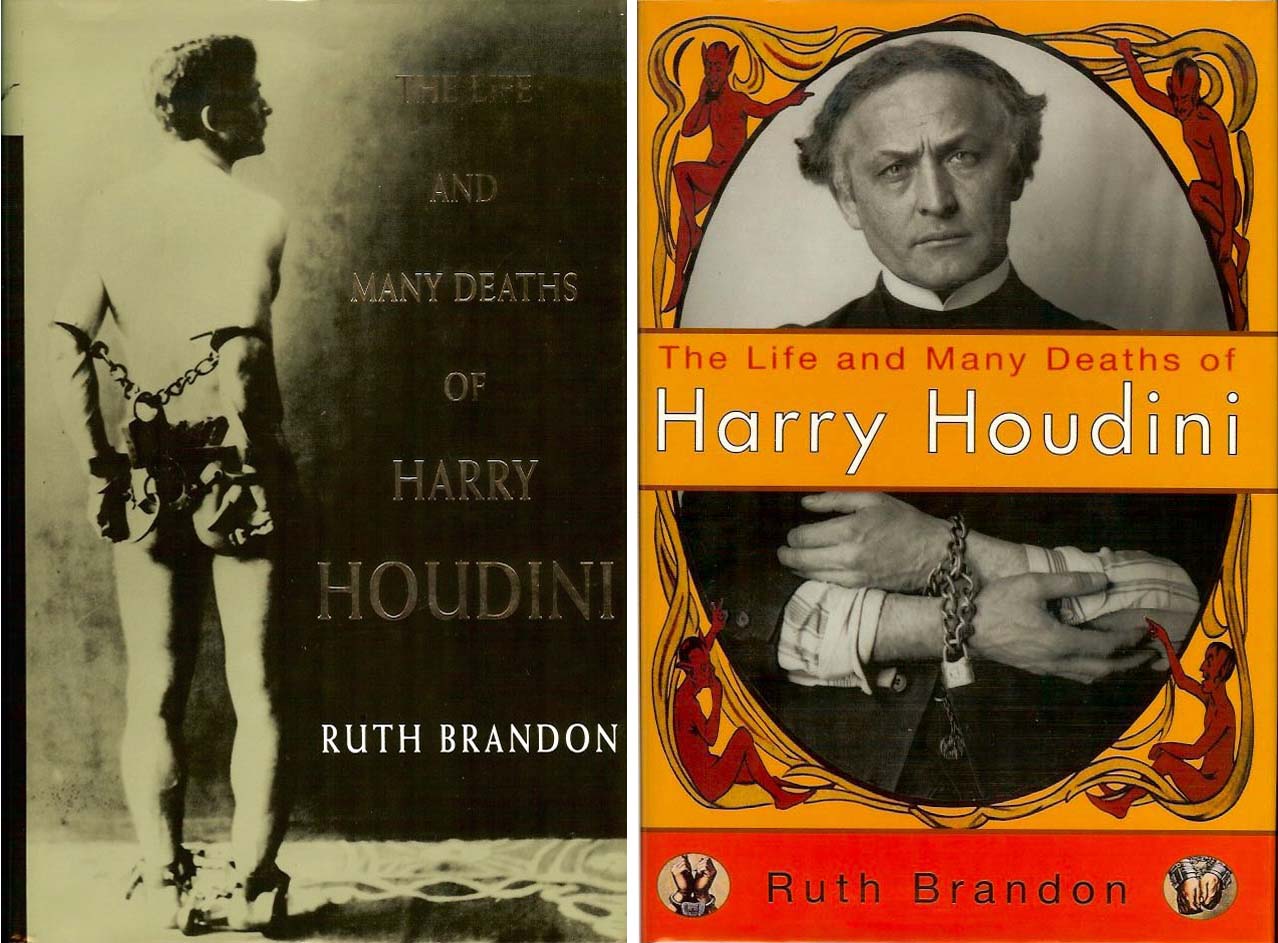
The Life and Many Deaths of Harry Houdini was first published in Great Britain by Martin Secker & Warburg Limited in 1993. It would take a year for the book to find its way "across the pond" to the U.S. where it was published by Random House in October 1994 (although the U.S. first edition shows only the 1993 copyright date). Both hardcover editions featured very nice cover art. The UK art was designed by William Webb with a photo credit to the Radner Collection. The U.S. cover was by Mike Lam with photo credit to UPI and poster images from the Granger Collection.

UK and U.S. hardcover first editions.

The Life and Many Deaths of Harry Houdini has so far seen two paperback editions in the UK. The first was published in 1994 by Mandarin and featured a shirtless Houdini on the cover. The second came from Pan Books in August 2001 and offered up more conventional cover artwork. This later edition also separated the photos into two sections instead of having all in one central section as in all other editions.

UK paperbacks.

The first U.S. paperback edition was published by Kodansha Globe in 1995. It had an attractive cover designed by Lilly Langotsky. A later reprint from Random House appeared in October 2003. It featured an entirely new cover design by Tamaye Perry, who made nice use of stills from Houdini's movies. This paperback is still in-print today and is available on Amazon.

U.S. paperbacks.

In my collection, I also have two U.S. pre-publication editions of the Brandon book. The first is a proof from publisher Random House. A very different cover concept is shown inside along with a review from the London Times. The second is a curiosity; a trade paperback edition featuring artwork that would appear on the U.S. hardcover. It's likely this is an early export edition, typically sold in airports and overseas markets, although there's nothing on the book to indicate it as such.

U.S. proof and early export paperback.

Despite the controversy, The Life and Many Deaths of Harry Houdini, "the Brandon book", is a worthy biography that deserves a place on any shelf of Houdiniana, if for no other reason than for these great cover designs.

Enjoy these other selections from the WILD ABOUT HARRY bookshelf:

Wednesday, November 19, 2014

LINK: Houdini and his niece have NC connection

Click the headline to read an article by Teresa Leonard at the Past Times Blog about Houdini in North Carolina and the connection the state has with his niece Marie Blood.

Related:

Saturday, April 12, 2014

Why does Jerry Seinfeld think Houdini was impotent?


Seinfeld is a television classic that will probably run in syndication forever. This is not the best news for Houdini. Because in Episode #65, "The Mango", there is this exchange between George and Jerry on the topic of erectile dysfunction:

JERRY
You know it happens to everybody. Happened to Houdini, and he could get out of a trunk underwater with his hands in chains. But he had a problem with that.

Later George returns to the subject...

GEORGE
Hey, is that a joke about Houdini?
JERRY
No.
GEORGE
Well if Houdini couldn't do it, what chance do I have!?

So why does Jerry Seinfeld think Houdini was impotent?

The answer has everything to do with when this episode was made. "The Mango" was taped on Tuesday, August 17, 1993 (directly across the street from where I'm writing this now) and aired on September 16, 1993. At that time a new Houdini biography had just been released in the UK, The Life And Many Deaths of Harry Houdini by Ruth Brandon. This was the first major Houdini biography in several years, and in it Brandon engaged in some amateur psychology as to why the Houdinis didn't have children and why Harry wrote love letters to Bess. On page 52 the author states:

One can only conjecture as to the reason for this childlessness. […] Infertility is not uncommon. But my own guess, based on his effusive daily--sometimes thrice-daily--outpouring of love-declarations--is that Houdini may have been impotent. Why all those protestations? What was so wrong that he had to keep proclaiming his devotion? Was this constant need to reassure both Bess and himself?

This salacious "revelation" was used as a selling point and featured in book reviews and in interviews with the author. Brandon also shared her theory in the 1993 BBC documentary, Houdini, The Life of the World's Greatest Escapologist. It was in this environment that the Seinfeld writers wrote what at the time was a topical reference to Houdini's "impotency."

Of course, the reason the Houdinis didn't have children was because Bess suffered from a medical condition that prevented it, information that was shared with me by her niece, Marie Blood. (You can read more about that here.)

Brandon's theory received a dose of cold water just a few year after the publication of her book when Kenneth Silverman revealed evidence of an extramarital affair Houdini had with Charmian London in his own biography, Houdini!!! The Career of Ehrich Weiss (1996). Now the pendulum may have a swung a bit too far the other way with Houdini sometimes portrayed as a bit of a Lothario (we'll see how the upcoming Houdini miniseries handles all this).

It's too bad this blip in Houdini history had to be immortalized in pop culture. True or false, it's just not the kind of thing you want people to know!


Related:

Tuesday, September 3, 2013

BONUS: Marie Hinson remembers the generosity of Houdini

Today we have a special BONUS clip from the amazing audio interview with Bess Houdini's sister, Marie Hinson (Rahner), recorded by Stanley Palm around 1980. These excerpts come courtesy of Jon Oliver and are shared here with the blessings of John C. Hinson, the great nephew of Harry and Bess Houdini.

Here Marie remembers the generosity of her famous brother-in-law, Houdini, on stage and off. She talks about bringing her daughter Marie (Blood) to Houdini's show to do the shimmy; Houdini fondness for the shirts she made; his habit of doing magic at the dinner table; and how Houdini paid for her wedding to John Hinson on June 28, 1911.

The audio concludes with the untold story of Beatrice, the daughter of Bess's sister, Stella, who suffered from polio. This is not something that has ever appeared in any Houdini book and is a true testament to just how generous Houdini could be with his extended family. But I'll let Marie tell you all about it herself. Enjoy.


Speaking of generosity, a very big THANK YOU to Jon Oliver and Stanley Palm for making this possible. Also thanks to John C. Hinson and the Hinson family for allowing me to share these extraordinary memories from an extraordinary lady.


Friday, May 3, 2013

Rare 1986 Houdini documentary available on DVD


In 1986 Wisconsin PBS produced what I think is still one of the better Houdini documentaries. The 30 minute doc features many unpublished photos (below is a screencap of one) and provides a nice look inside the Sidney Radner collection at his home in Holyoke. Watch Sid page through Houdini's crumbling first scrapbook and try to yank a pair of handcuffs from a massive tangle of cuffs in an old suitcase! Wild stuff.

The documentary also features wonderful footage of Doug Henning performing Metamorphosis in Appleton's Houdini Plaza, and nice footage of the Houdini Hall of Fame in Canada. We also get the full story of how Harry Blackstone's overboard box wound up in the basement of 278, as told by Harry Blackstone Jr. The documentary also contains what might be the first ever on-camera interview with Marie Blood, giving us a nice look inside her home with photos of her "Uncle Harry" covering one wall.

And apart from making the common narrative error of conflating Houdini's mother's death with his anti-spiritualist crusade (and thereby jumping over 10 years of his life), the documentary does a very good job of getting the facts right.

The documentary was first released on VHS in 1988 by Congress Home Video as Houdini: The Greatest Illusionist of All Time (which you can still buy on Amazon). In 2008 Chip Taylor Communications released this digitally enhanced DVD which, believe it or not, I only now discovered.

Chip Taylor sells their DVDs with various licenses, including broadcast, but the most requested is for "Home/Personal Use," which is how you can get a copy of Houdini for $24.95.

Just click on over to Chip Taylor Communications and email for details on how to order and arrange payment.

Monday, April 1, 2013

No joke! Never before seen footage of Houdini and Marie Blood

It may be April Fools Day, but this is no joke. Recently our friend Jon Oliver -- the man who sleeps in Houdini's bed -- shared with me a remarkable 40 second fragment of film showing Houdini and Haldane of the Secret Service co-star Gladys Leslie cuddling and cooing over a small child with a puppy. The child, it turns out, is none other than Houdini's niece, Marie Hinson, who many Houdini buffs came to know as Marie Blood later in life. While there are photos of Houdini with young Marie, this is the only film footage that is known. Wild indeed!


But this footage is fascinating even apart from Marie. What is this exactly? It could just be Houdini, Leslie, and Marie relaxing on the set of Haldane having some fun before the camera. But I think this is much more. The head of the footage also contains a slate. This tell me this was shot specifically for the movie and looks like it could have been an alternate or even lost original ending. Terror Island had a similar ending; there Houdini and co-star Lila Lee are brought together for the final screen kiss by a small child. As it exists now, Haldane ends rather abruptly with a still photo of a ship presumably bringing Houdini/Haldane back to the United States.

The slate is also curious in that it shows the director as "King." This is almost certainly Burton King, director of The Man From Beyond. Houdini is credited for directing Haldane, but this shows that King was involved at some point. That's a bit of a game-changer. The name Zuker refers to Frank Zuker, one of two cameramen on Haldane. Note that the slate calls the film "Houdini Pro 2" (Production #2).

But enough of my yapping. I know what you want, and Jon has graciously allowed me to post the full footage here. So click below and watch film of Houdini and Marie Blood that has never been seen before (sorry for the time code). Action!


Marie Blood retained a handful of vivid memories of her "Uncle Harry" and spent the last decades of her life touring and talking about Houdini and "Aunt Bess." Marie also penned a delightful afterward in Ken Silverman's Houdini!!! The Career of Ehrich Weiss. I had the pleasure of meeting Marie in 1995, at which time she shared some family secrets. Marie Blood passed away in 2004 at the age of 87.

Monday, August 20, 2012

Genii & Houdini: October 1961

A magnificent photo of Harry and Bessie Houdini graced the cover of Genii The Conjurors' Magazine Vol. 26, No. 2 in October 1961. It had been five years since the last Houdini memorial issue. This issue would make up for lost time, and also kick off a new era in the Houdini-Genii relationship.


In many ways, this is one of my favorite Houdini issues of Genii. And not just because I love the cover pic. This issue announced the arrival on the scene of 17-year-old Patrick Culliton. Editor Bill Larsen Jr. writes that Patrick is "young in years, but old in the history of magic in general and Houdini in particular." Patrick would assume the role that Edward Saint played in the 1930s, motivating Genii to produce an annual Houdini issue by providing unique content. Says Patrick, "Bill hadn't done one in a couple of years and the Houdini issues always sold a few more magazines."

In this issue, Patrick writes two articles; one on "Houdini's Thumb Racket" and another about "Houdini's Assistants". Patrick had written both articles when he was only 15. (The latter article was reprinted in Walter Gibson's The Original Houdini Scrapbook in 1976.) Patrick also provided the cover portrait and the photo of Houdini's assistants "after the beer challenge." Both had come from the collection of Jacob Hyman. "Marie Hinson wrote a nice note to Bill about the Houdinis on the cover," says Patrick.

This issue also contains an impressive Houdini bibliography by Dave Price of the Egyptian Hall Museum. The contents reflect what is in the Egyptian Hall collection, and covers three pages with some 211 individual listings. It includes sections on books, articles, handbills, letters to and from Houdini, letterheads, photographs, posters, programs and more.


Notable non-Houdini items include a nice photo and announcement of the debut of Mark and Darnell Wilson's The Magic Land of Allakazam TV series (which featured a vanishing elephant), and the re-naming of Main Street in Colon Michigan to Blackstone Avenue in honor of Harry Blackstone Sr.

In his Genii Speaks column, editor Bill Larsen says, "I hope next year to really put out a collectors item in the way of a Houdini issue with Pat's help." It was a promise he would keep.

Coming next: October 1962

Tuesday, July 3, 2012

Meet the man who sleeps in Houdini's bed

Jon Oliver and Ruth Kavanaugh in 1975.

There are a handful of Houdini mega collectors out there who have some beautiful items to be sure. But only Jon Oliver sleeps in Houdini's bed every night!

That's because Jon, who is a magician and escape artist in his own right, became friendly with the Houdini family in 1975 when he met Houdini's niece, Ruth Kavanaugh (who passed away last year). Over the next three decades not only did Jon acquired a great deal of first hand knowledge about Houdini from the family, but he was also able to acquire incredible personal artifacts, such as Bessie's jewelry, the French Letter Handcuff (from the Kleppini challenge), and, yes, Houdini's bed!

Jon is now sharing his formidable collection (as well as artifacts from his own career) at his website, jonolivermagic.com. Not only can you view the Houdini furniture and the French Letter Cuff, etc., but Jon has also posted an album of photographs that will melt your brain. On these pages are shots of Houdini I have never seen, such as Houdini being bound to a stake by two indian chiefs; Houdini and Bess with Gloria Swanson; and Houdini in his mail room with the two Julies (Karcher and Sawyer) and Bessie's brother, John Rahner. The pics are small and low res, but gold flakes are still gold!

I also can't help but notice what Jon has written in the website's footer: "There is no copyright to this site. Magic and the memory of Houdini's contribution to magic and escapes belong to the world!"

When I myself met Houdini's niece, Marie Blood, this was very much her attitude, and one of the reasons there is no legal "Houdini Estate" today. She believed her Uncle Harry belonged to the world. She might have even used those exact words. It's nice to see Jon carrying forward the generosity and openness of the Houdini family. Maybe that's why they have entrusted him with so many of their family treasures.

Click here to browse Jon Oliver's website.

Tuesday, June 19, 2012

Bessie's last address

While doing some research in the Magic Castle library, I stumbled on this item from the February 1943 issue of Genii magazine. This is the last thing written about the living Beatrice Houdini in Genii, who died on February 11 of that year.

Genii, February 1943

What I like about this is it gives Bessie's last Los Angeles address: Cedar Lodge, 2030 Griffith Park Blvd. Cedar Lodge was actually "Cedar Lodge Sanitarium." Back then, a sanitarium (or sanatorium) was a hospital for long-term illness, most typically associated with the treatment of tuberculosis. While the exact cause of Bessie's death has always been vague, Bess's niece Marie Blood told me that both she and Ed Saint died from TB.

A modern condo building stands at the site today. While the address has changed to 2018 Griffith Park Blvd., the complex still carries the name Cedar Lodge, as you can see in the Google map photo below.

Translate