Showing posts with label Deep Dives. Show all posts

Thursday, January 6, 2022

Houdini in 1922

Let's kick off 2022 with a deep dive into what Houdini was up to 100 years ago.


Houdini had a foot in two worlds in 1922. He had returned to vaudeville with his tried-and-true escape act while also preparing to release his first solely produced motion picture. But it was a visitor from England who would set Houdini on the path to a remarkable third act of his life and career.

The new year began with Houdini playing the Palace Theater in New York's Times Square. To herald his return, he performed a suspended straitjacket escape from the theater's facade on January 5. Just like old times, he ran afoul of the New York City police who tried to stop the escape. But Houdini got into the air before the police could push their way through the crowd. On his assent Houdini yelled down to an irritated officer, "Talk to the theatre manager. I'm busy." Before the week was out, Houdini and press agent Walter J. Kingsley found themselves at the West Side courthouse facing a charge of blocking traffic.
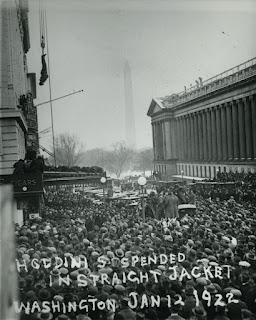
The next stop was Washington D.C. where a suspended straitjacket escape from the Albee building at 15th and G Streets drew a massive crowd. Houdini and Bess met President Harding at The White House, and former President Woodrow Wilson saw Houdini escape his Water Torture Cell at Keith's. The Maryland Theater in Baltimore followed. A review in the Evening Sun complained: "Houdini spends about 10 minutes telling of his greatness...performs two tricks that he has been showing for years." But the old tricks seemed to be just what audiences wanted, and Houdini's suspended straitjacket escape from the Munsey Bldg. in downtown Baltimore drew the usual throng.

The tour continued at a pace with Houdini playing the major Keith houses in Philadelphia, Cleveland, Chicago, St. Louis, and Pittsburgh. In almost every city he performed a suspended straitjacket escape and drew sold out houses. Houdini credited the publicity generated by his films as the reason for his continued popularity on stage. He was right. Even though he had been absent from American stages for three years, his name was never out of the newspapers and the Jazz Age had embraced him as a cultural icon. Flappers even adopted his name into their vernacular; "A Houdini" meant to be on time for a date.

The tour also brought Houdini into contact with the local chapters of a thriving S.A.M., and many would host banquets for their Most Illustrious President. While attending one of these "Houdini Nights" at the Great Northern Hotel in Chicago, Houdini was fooled by a young Canadian sleight of hand artist who employed a clever manipulation of the Ambitious Card. The incident didn't warrant further mention from Houdini, but the young magician, Dai Vernon, would for the rest of his life tout himself as "The Man Who Fooled Houdini."

That same week Houdini attended a monkey gland transplant operation on an 80-year-old man. The procedure, pioneered by Dr. Serge Voronoff, involved inserting thin slices of monkey testicles into a man's scrotum where the graff would fuse with human tissue. Voronoff promised his treatment would restore vitality, enhance libido, improve eyesight, and even prolong life. Houdini's interest in the procedure and its surgeon, whom Houdini playfully called "Transplantor," isn't entirely clear. Was he merely investigating a modern "miracle monger", or was he considering having the procedure to restore his own flagging vitality? After the operation Houdini wrote to a friend: "It looks as simple as rolling off a slippery log."

While performing at the Davis Theater in Pittsburgh, Houdini was saddened to learn of the death of Harry Kellar in Los Angeles. Kellar had become a mentor and father figure to Houdini. Unable to attend the funeral, Houdini sent a telegram of condolence to Kellar's niece and arranged to have the funeral filmed. He also wrote a eulogy for the magician on the train back to New York where he would wrap his tour with an engagement in Brooklyn. That month also saw the release of his new book, Houdini's Paper Magic, a collection of magic tricks and puzzles largely compiled by his late secretary, John Sargent, for whom Houdini dedicated the book.

Houdini wasted no time in surging to his next venture. Having failed to entice Paramount into releasing his first Houdini Picture Corporation production, The Man From Beyond (filmed in 1921), Houdini decided to distribute the movie himself. To generate awareness, he booked an exclusive engagement at the Times Square Theatre, which stood across the street from the Houdini Picture Corporation offices. To ensure packed houses, Houdini developed 30 minutes of stage magic that he would perform after each showing. He even revived the vanishing elephant which had so thrilled New Yorkers back in 1918.
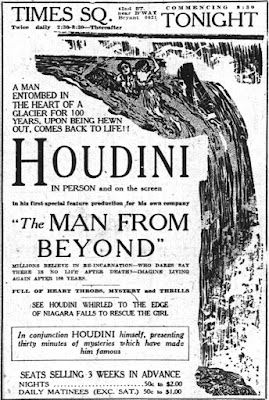
The day of the premiere, April 2, Houdini paraded his two Ringling Bros. elephants, Lucy and Fannie, along Broadway. But in an oversight that betrayed his inexperience as a distributor, Houdini was informed that the film still lacked the necessary certificate from the New York Censor Board. The premiere went ahead as planned, but Houdini was unable to charge admission. (The film received its certificate the following day.) The elephants also proved to be harder to handle than the affable Jennie from the Hippodrome. One of the elephants spooked when a loading dock ramp cracked beneath its feet and refused to enter the theater. Faced with an unbudging elephant on 42nd Street, a new door was cut in the theater wall which the elephant found acceptable. While both elephants were smaller, Houdini reportedly still used his gigantic Hippodrome cabinet to do the vanishing.

The Man From Beyond with "Houdini in Person" would run three weeks at the Time Square. Reviews of the movie were mixed. Many questioned how Houdini's 100-year-old man could remain blissfully unaware of the passage of time until he was told, despite riding in an automobile. However, there was wide agreement that the climatic action at Niagara Falls was thrilling and in league with the climax of the D.W. Griffith hit, Way Down East. They were right. For all the film's flaws, Houdini and his editor had created a powerful piece of cinema magic with a skillful combination of footage shot at various locations. Houdini showcased the reviews in a half-page ad in Variety as "The greatest praise ever accorded any screen production."

That same month Sir Arthur Conan Doyle arrived in America for a lecture tour proselytizing Spiritualism. Doyle showcased spirit photographs and spoke of his own personal experiences with the Other Side. Audiences packed his lectures and gasped as his slides flashed across the screen. Houdini attended one of the first lectures at New York's Carnegie Hall. Doyle, in turn, saw The Man From Beyond at the Times Square and gave the film a glowing endorsement. On May 10th Sir Arthur and Lady Doyle visited Houdini at 278 and had lunch. Houdini took great pride is showing Doyle his library. As he saw them off in a cab, Houdini performed his thumb racket trick. For Doyle it was further evidence that his friend possessed supernatural powers. For Houdini it was evidence that his friend could be fooled by anything.

But Doyle had some tricks of his own. Houdini invited him to attend an S.A.M. banquet at the McAlpin Hotel in New York. There Doyle ran test footage from the upcoming movie adaptation of his book, The Lost World, which showed dinosaurs in action via the magic of stop motion photography. Doyle believed he had fooled the magicians into thinking he had somehow captured film of real dinosaurs. "I left them, as I had intended, utterly mystified," Doyle would chortle. This seems unlikely. Special effects photography was pioneered by magicians such as George Méliès, and Houdini had used camera trickery in all his films. But, as always, Houdini indulged his honored guest from England. The evening also saw Harry and Bess performing Metamorphosis using Doyle's mammoth coat.
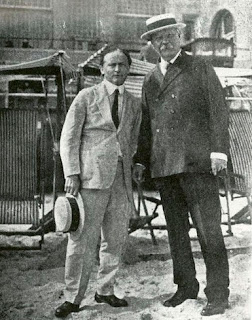
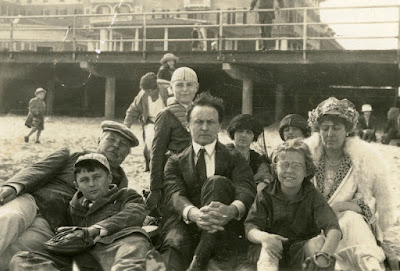
That same month the Doyles invited the Houdinis to join them for a weekend in Atlantic City. "Why not come down–both of you?" wrote Doyle. "The children would teach you to swim ! and the change would do you good." The Houdinis accepted and joined the Doyles at the Ambassador Hotel on June 17. The couple relaxed on the beach and Houdini taught the Doyle boys to dive in the hotel pool. That evening they attend a swimming contest that dragged on interminably.

The following day came an event that would forever have an impact on their friendship. Lady Doyle, herself a medium who communicated via "automatic writing", offered to give Houdini a private seance to contact his mother. Bess was kept from the proceedings, but she reportedly gave her husband a warning (via their old mind reading code) that Lady Doyle had been peppering her for information about Mama the day before. The three settled into Doyle's Ambassador suite where Lady Doyle quickly contacted Cecelia Weiss and dashed off several pages of communications in English instead of Mama's native German. Houdini did not betray his skepticism and Sir Arthur firmly believed his friend had been convinced and converted. But what Houdini had experienced was just more Doyle dinosaurs.

Besides attending a 4th of July party at the Seacliff home of his lawyer Bernard Ernst--where he inexplicably commanded a rain storm to stop and start (he later called this "the most remarkable coincidence that ever happened to a mortal man")--there is no record of Houdini's activities in July. Did he decide to go under the knife of "Transplantor" and receive his monkey gland enhancement?

Whatever he did, it's likely Houdini had time to reflect. If he compared himself to Doyle, and he most certainly did, Doyle was having the career Houdini coveted. He was a respected author drawing sold out houses with a lecture showcasing his intellect. And on a topic that Houdini felt he knew far more about! Here Houdini was stuck in a cycle of turning out melodramas and books of magic tricks while occasionally having to dip back into the fading world of vaudeville to make ends meet. And despite expanding and installing new equipment at his Film Developing Corporation that year, the business continued to operate at a loss. It's therefore not surprising that when Houdini did reappear after his mid-summer disappearance, he does so with a new identity and ambition.
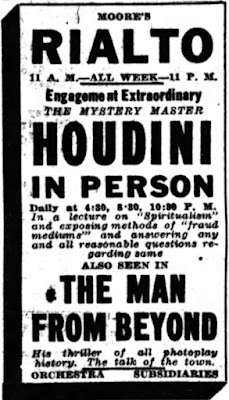
In August Houdini brought The Man from Beyond to the Rialto Theater in Washington, D.C. Once again the show would feature "Houdini in Person". But he left the elephants and magic behind. Instead when Houdini took the stage on Sunday, August 20, he gave a lecture on spiritualism. It was the inverse of Doyle's lectures, exposing the methods of fraudulent mediums, and offered audiences their first look at a new Houdini. Variety carried the news on its front page ("Houdini on Spiritism in Personal Appearance") and the Washington Times reported: "He doesn't intend to go back to Jail-breaking or other forms of escape until he has won a victory over ignorance and delusion in the world of spiritualism."

The Rialto lectures also prompted his first attacks. In a letter to the Washington Herald, a member of the audience, N.H. Holmes, wrote: "Houdini's picture, The Man From Beyond, is beautiful, thrilling and most wonderful. His exposure of séances and mediums are ridiculous, unscrupulous and preposterous." 

The battle was on. 

The Rialto run grossed an impressive $9000. The next engagement in Detroit brought in $12,000 (aided by a suspended straitjacket escape in Grand Circus Park). Having found the formula for success exhibiting his movie along with a live show, Houdini created several roadshow units called The Houdini Wonder Show. These were headed up by magicians Fredrick Eugene Powell, Mystic Clayton, Virginia Carr, and the escape artist Gemester. Houdini would make special one-day appearances at select theaters. In Hoboken a crowd gathered to greet him at the stage door. When Houdini appeared in a straw hat, some boys shouted that straw hats were out of fashion. Houdini removed his head gear and tossed it into the crowd where it was shredded by souvenir seekers.
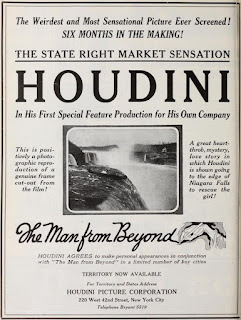
Houdini then went about the business of selling The Man From Beyond via the independent State Rights market. This general release version was cut down from seven reels to six. (This is the only version that survives today.) Houdini had long feuded with theater managers whom he felt tried every trick in the book to withhold proper payment from talent. Now he would need to collect from cinema houses where managers were largely unchecked in their reporting on box-office receipts. But having just won his latest lawsuit against Octagon Films for unpaid salary on The Master Mystery totaling $32,795.18, Houdini may have felt confident that he could swim with sharks.

In October newspapers began serializing a new book by Sir Arthur Conan Doyle titled, My American Adventure. In it he spoke openly about the Atlantic City seance. That same month Houdini denounced the danger in psychic phenomena at an S.A.M. dinner in Boston. His statements received national coverage. But he also found himself in hot water with the organization over an exposure he supplied to Popular Radio magazine. The article portrayed The Talking Tea Kettle as a tool of fraudulent mediums and revealed its workings. But The Talking Tea Kettle was the invention of magician David P. Abbott who performed it as a spooky stage illusion. Houdini had once forced an S.A.M. member to resign over exposing his Milk Can escape. Now Abbott's local assembly in Omaha voted for Houdini's resignation as President. The controversy swept the S.A.M.

Houdini claimed Popular Radio had added the exposure to his text without his consent and threatened to sue the magazine for damage to his reputation. To prove his case, he published his correspondence with Popular Radio's editor in MUM. He then went out of his way to patch things up with Abbott personally. Houdini's presidency survived and the S.A.M. formed a committee to decide on a formal code of conduct that would govern the exposure of secrets, devoting a special section to spiritualist trickery. "The Magicians Code" remains in force to this day.
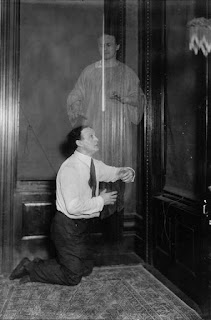
On Halloween Houdini gave a mock séance at the home of Sophie Irene Loeb at Harmon-on-Hudson which included a spirit message from the late Jack London. That
night he wrote in his diary: "I must put on record that it was done wholly by dexterity." He also tried his hand at a new medium by taking part in a debate on spiritualism live on WOR Radio in Newark. When the Scientific American magazine offered $2000 to anyone who could take a spirit photograph under test conditions, Houdini took a series of photos in the parlor of 278 showing him conjuring his own ectoplasmic spirit. The photos were syndicated in an article by Heward Carrington which quoted Houdini as saying, "Spirit pictures—yes—I make them almost every night."

Doyle and Houdini kept up their steady correspondence, but the dinosaur in the room was Atlantic City. Doyle would finally ask Houdini directly how he could continue to express public skepticism of Spiritualism when he had experience the real thing via Lady Doyle?

On December 15th Houdini sat down to confess his doubts about the seance to his friend. He cited his mother's use of English and also that a cross had been drawn at the top of the page, which one would not expect from the wife of a rabbi. He concluded as delicately as he could: "I trust my clearing up the seance from my point of view is satisfactory, and that you do not harbor any ill feeling, because I hold both Lady Doyle and yourself in the highest esteem." A few days later he wrote and had witnessed a document entitled: "THE TRUTH REGARDING SPIRITUALISTIC SEANCE GIVEN TO HOUDINI BY LADY DOYLE."

By entering into the spiritualistic arena Houdini had caught a new and popular wave. The press lauded him as an authority on the subject, which no doubt gave him great pleasure. But it was not going to pay the bills. Not yet at least. So by the end of the year he was once again headed back into vaudeville. Also released in time for Christmas was The Stag Cook Book—A Man’s Cook Book for Men. Inside was a recipe for "Scalloped Mushrooms and Deviled Eggs" by Harry Houdini.

Related:

Thursday, April 8, 2021

Houdini's Melbourne bridge jump (sans corpse)

Houdini's tour of Australia in 1910 is most celebrated for his aviation exploits. But he also wowed audiences with escapes, including a leap from the Queen's Bridge into the Yarra river in Melbourne on Thursday, February 17. What makes this particular stunt so famous is the story of how Houdini's jump dislodged a suicide from the river depths, causing the corpse to float to the surface. The crowd feared the dead man was Houdini himself, until the escapist surfaced beside it. But did that really happen?

Below are a set of photos and an account of the stunt from the Melbourne Weekly Times. As you can see, no corpse involved, but some nice details, including that Houdini wore a blue bathing suit instead of his usual crimson.


A DARING DIVE
_______________

A PUBLIC SPECTALE

MELBOURNE, Thursday.
The announcement that Houdini, who is at present appearing at the Opera House, would dive from Queen's Bridge into the Yarra attracted many thousands of people this afternoon. Every point of vantage on the Bridge was quickly occupied by spectators, as were also the roofs of the sheds lining the north and south banks of the river and the various steamers lying in the stream. On the river itself were craft of all kinds, densely crowded with men women and children, eager to view the sensational spectacle. It was with the greatest difficulty that a large force of mounted and foot police could secure even space enough for a narrow line of vehicular traffic.
    At about 1.30 Houdini drove up on to the center of the bridge in the motor car. Making his way through the crowd he mounted the parapet, where he was manacled with stout chains. After being handcuffed his hands were fixed behind his back. The chains were passed over his neck and round his body, and were fastened with a stout brass padlock in the middle of his back.
    Clad in a blue jersey and blue trunks but with his arms and head bare, he stood unconcernedly in the blazing hot sunshine. When the manacling arrangements have been completed he looked quietly down on to the lower wharf, and asked "Is it already Jim; is the way clear?" Receiving a reply in the affirmative he first took several long breaths, then, without the slightest hesitation, dived into the river. In about sixty-five seconds he came to the surface again free of his chains, which, by the way, weighed about 26 pounds. The chains themselves he brought up in his hand. As he mounted the steps, Houdini was loudly and continuously cheered, the spectators thronging round him as he again made his way to the waiting motor car. From the time he mounted the bridge until he was driven off again in the car only about seven minutes elapsed.

There are some other details that didn't make this report. The temperature that day was a scorching 101 degrees. Several onlookers fell into the river. Following the escape, reporters on the dock asked Houdini how he liked the taste of the water. He replied by grimacing and saying it was "the least toothsome" he had ever sampled. Later news accounts made light at the idea of Houdini "insulting" their river water.

Houdini's Queen's Bridge jump was his first outdoor stunt in Australia. He told reporters he had considered making a leap from the deck of the ship Malwa when it first arrived in Fremantale, but talk of shark infested waters convinced him otherwise. He later made a 31 foot handcuffed jump into the Domain Municipal Baths in Woolloomooloo Bay in Sydney (below). That jump resulted in him hitting the water wrong and blackening both eyes.


So what about the whole floating corpse thing? If this happened, not a single newspaper (that I've been able to find) reported it, which does not seem likely. The story appears to be a Houdini invention. I'm not sure when he first started telling it, but it appears in a 1918 Boston Post interview along with his famous trapped under the ice story. In it Houdini emphasizes his shock at finding himself beside a dead body. "As long as I live I will not forget that incident. It was the worst thing that ever happened to me."

Like reporters in Houdini's day, biographers can't seem to resist this story. The Australian corpse surfaces in Kellock, Gresham, Christopher, and even Kalush. Only Ken Silverman leaves it out of his account of the escape.

With or without the corpse, I still enjoy the story of Houdini's Melbourne bridge jump, especially as the Queen's Bridge is still there today!

Thursday, March 18, 2021

Houdini's LAST Australian flight was the wild one


Today marks the 111th anniversary of Houdini first successful flight in Australia on March 18, 1910. Certainly this was his most famous aviation exploit, and it's one that has been covered pretty thoroughly. So today I thought I would talk instead about Houdini's last flight in Australia on May 1, 1910. This was the flight that truly showcased his skills and nerve as a pioneer aviator, and may have been the greatest risk he ever took in a life full of risks!

Houdini completed several successful flights at Diggers Rest in Melbourne after his first historic flight on March 18. Some of these flights were captured on film. At the end of the month Houdini moved on to the Tivoli Theater in Sydney. He had his Voisin bi-plane trucked to the city where it was made ready for flight at Sydney's Rosehill racecourse (which is still there).

Houdini made several private flights at Rosehill. His first flight of 300 yards on April 18 constituted the first controlled airplane flight in New South Wales. Later that same day Houdini flew three quarters of a mile, but he came down hard he was thrown from the plane. Another hard landing broke a wheel.

News of Houdini's successful flights had reached the residents of Sydney who were eager to see Houdini fly for themselves. So during his final week in the city, Houdini advertised that he would give public exhibitions every day between the hours of 9 AM and 3 PM (conditions permitting). Bess and Houdini's assistants were tasked with providing tea and cakes for the crowds.


Bad luck set in. The weather would not cooperate, and even when conditions were right mechanical problems would shut down the day's attempt. At one point a tube supplying coolant to the Voison's cylinders slipped off and hot water scalded Houdini's mechanic Brassac on his shoulder and thigh. Later in the week two aviators named Kotta and Newman arrived at Rosehill with their own Australian made plane to compete with Houdini. But their chassis broke while wheeling it out onto the field. The April 27, 1910 Parramatta Cumberland Argus And Fruitgrowers Advocate captured a typical day's disappointment:

CHEAP TO TALK
There were several hundred people at Rosehill racecourse on Sunday morning when it was announced that Houdini would go aloft on his aeroplane. The charge for admission was a silver coin. The day was very calm, but there were ominous streaks in the clouds, indicating confused currents. At about 11 o'clock Houdini announced it was too windy to fly, and this statement was met by shouts of derision from those who had paid to see the performance. He again announced that an accident cost in repairs from £50 to £300, and there was also a risk of life, which he did not feel disposed to take. Still there was banter, and Houdini then remarked: "It is cheap to talk, but it has cost me £3000 to learn to fly, and I know what I am talking about." Then the crowd melted away, feeling rather disgusted.

Houdini closed at the Tivol on Saturday, April 30. The next day was the last he could fly before the plane needed to be dismantled and made ready for shipping back to England. Conditions were still not ideal, but Houdini climbed behind the wheel of his Voisin anyway. Newspapers recorded what happened next:

Kalgoorlie Miner, May 2, 1910.

It was a wild ride and a fitting end to Houdini's Australian adventure. It would also turn out to be his last flight ever. And who can blame him?

After he had left the country, an aviation journalist discussing Houdini's Australian flights in the Brisbane Queensland Country Life remarked:

I think Houdini is one of the pluckiest men I have ever seen. And one of the rashest! The things he was trying to do at Rosehill! It was a small area, there were fences everywhere, and a stiff wind blowing. It was trying to fly under conditions in which Latham, for instance, would never have allowed his pupils to try to get off the ground. How that man escaped breaking his neck I don't know! But he did one good flight. Give him a month and a decent open plain and he would make a splendid one.


Related:

Monday, March 8, 2021

Guest Blog: Author-Lecturer-Mystifier-Mason

Recently I shared a link to an article about Houdini in the Jan-Feb 2021 Scottish Rite Journal, a magazine devoted to Freemasonry. The author, Maynard Edwards, got in touch, and explained that in the time it took to the publish that piece, he had continued his research and made several new discoveries and some corrections. So today I'm excited to share his updated article which rewrites what we know about Houdini the Mason. Enjoy.


Author-Lecturer-Mystifier-Mason
Recent Revelations in the Masonic Career of Brother Harry Houdini 
by Maynard Edwards, KCCH

On any list of famous Freemasons, Brother Harry (Houdini) is sure to be found. He was raised in St. Cecile Lodge #568 in New York on August 21,1924. St. Cecile Lodge was (and still is) a Daylight Lodge, geared specifically towards those in the performing arts, who often would not be able to attend evening meetings.

For at least the last thirty years, it has been reported that Harry became a Shriner shortly before his untimely death in 1926 and dates for his Scottish Rite Membership were not recorded publicly. However, a recent discovery at Mecca Shrine allows us to cement both his Scottish Rite and Shrine initiation dates much earlier than previously reported.

Mecca & The Mystifier

In March 2019, while cleaning up their office in the Grand Lodge of New York, Members of Mecca Shrine discovered a door hidden behind an old filing cabinet. The door led to a locker room and a curious discovery. The Current Assistant Rabban of Mecca Shrine in New York City, Noble Zachary Ostrow (right) explains "There was a big green locker that just had Mecca Shrine scribbled on the front of it. I don’t think anyone knew it had noticed it at least since the eighties. In there we found books full of Lodge records including petitions. The petitions were all numbered so we knew which ones were missing. After a few days of going through those books I found Houdini’s petition and it shows that he became a member in 1924. All the history books say 1926, and so people have gotten upset with me for finding this and making them have to re-write the history books."

The petition is signed by Houdini, and in his own handwriting he states his occupation as "Author – Lecturer - Mystifier". Conclusively we can now document that Harry Houdini became a Noble of Mecca Shrine on December 29th, 1924. Houdini became a Scottish Rite Mason in the Valley of New York Lodge of Perfection on October 7th 1924, joined the Council of Princes of Jerusalem on December 16th, and entered the Consistory on December 23rd.

Image courtesy Maynard Edwards.

Houdini was 50 years old when he became a Mason, but his experience in fraternal organizations began in 1903 when he became a member of the fledgling Society of American Magicians. The group had started only the year before with just 24 members in the back of a New York City magic shop. A rift with another prominent member of the club would cause Harry to resign in 1908, but by 1915 fences had been mended and Houdini was from then on an avid supporter of the group. He would be elected SAM President from 1917 until his death (interestingly, as President of S.A.M., Harry and other officers were referred to by the the title Most Illustrious).

When performing in a particular town, it was often Harry’s habit to connect with the local magicians and there are many surviving letters of his correspondence with fellow illusionists. It may have been such a connection that caused Harry to first mention an interest in Freemasonry.

My Dear Buckle

A postcard sent from Harry Houdini to a Mr. A. Buckle in 1904 was recently sold by the world famous Potter & Potter auction house in Chicago. The type written postcard, which sold for $900, reads:

My Dear Buckle,
Am very busy, have a very big task Tomorrow, and do not feell [sic] very much like writing. Regarding me being a Mason, I regret to inform you that I am not a Mason, and hope some day to belong to that Order. I do not belong to any secret order, and am a member of the S. of A. Magicians, and an Artist club in Germany.
Regards
Houdini.

The “A. Buckle” in this case was 20-year old Manchester Magician Arthur Buckle, sometimes billed as the Manchester Wizard. Buckle’s career consisted of mostly of private performances and writing for magical trade publications. The relationship between the then 30-year old Houdini and the younger conjurer isn’t well-documented, but it would not be a stretch to assume that as magicians they would have made each other’s professional acquaintance and become friends. The postcard salutation “My Dear Buckle” and another surviving letter from Houdini to Buckle indicate a personal relationship.

The postcard itself is remarkable for several reasons. First, the date of the postcard is March 16th, only a day before the famous Daily Mirror Handcuff Challenge, and the writing clearly indicates the challenge was on his mind. Also, Houdini expresses that he did not feel like writing. We know Houdini was troubled by an unknown illness during the end of his Hippodrome engagement and not long after the handcuff challenge, Harry was forced to take 12 days bed rest, canceling a number of engagements. Does this note indicate he was already feeling ill? Finally of course, it does seem to be the first documented expression of Houdini’s interest in Freemasonry.

While the postcard only reveals one side of the conversation between the two magicians, from it we can suppose that Arthur Buckle was a Mason and had asked if Houdini was a Mason, perhaps even inviting him to Lodge. In a collection of Houdini papers at the University of Texas in Austin, there exist other letters between Houdini and Buckle that may reveal more details, however as of this writing, those letters are not accessible due to the COVID-19 crisis.

Masonic & Magical Legacy

It would be another twenty years before Houdini’s interest in Freemasonry would manifest itself into his petitioning a lodge. Perhaps the business of being an international celebrity kept Houdini from joining the Brotherhood sooner rather than later? Or perhaps being elected President of the Society of American Magicians in 1917 increased his interest in fraternal organizations? We can only speculate as to why two decades elapsed before he was raised, his reasons are just one of the many secrets the Great Harry Houdini took to his grave.

There are no known photos of Harry in any Masonic garb, and his blue lodge petition, though not in question, has yet to be located. According to several Masonic sources, it is alleged that sometime after he became a Mason, Harry gave a benefit performance for for the Scottish Rite Valley of New York before a sold-out crowd of more than 4000 spectators at the Scottish Rite Cathedral (formerly the Manhattan Opera House, currently the Manhattan Center). However, no contemporary reports of this performance have been located, and no references to any such fundraiser has been found in any official Scottish Rite transaction. This leaves much doubt as to whether or not the performance truly occurred or perhaps was somehow conflated with another similar performance at some other time and place.

However, after his untimely death in 1926, Masonic funeral rites were performed by the Brothers of St. Cecile’s Lodge- which incidentally was held at the Elks clubhouse in New York (Harry became an Elk in 1912).

A great many vaudevillian performers were members of the Craft. Several of Harry’s Magical contemporaries were taken and accepted including Harry Kellar, Howard Thurston and even William Ellsworth Robinson- better known by his stage name Chung Ling Soo. As traveling performers, the Masonic Brotherhood would have provided vaudevillians with sort of safety-net while on the road. So too, the fraternity may have lent some of its dignity to a professional class that had historically been looked down upon.

Today the legacy of Houdini and the other Magical Masons of his era lives on in the Invisible Lodge, a Masonic club specifically for Master Masons who are either professional or amateur magicians. Founded in 1953 the club meets annually at midnight either at local Magician’s conventions or more recently at the Magic Castle in Hollywood. The Magic Castle itself is a private club for magicians and regularly members gather to hold a séance in an effort to contact the spirit of none other than Harry Houdini; so far the even the Great Houdini has not managed to reach back from the other side.

*Ill. Brent Morris, 33 and Jeff Croteau, Director of Library & Archives at the Scottish Rite Masonic Museum and Library in Lexington Massachusetts contributed to this article.

Related:

Tuesday, February 9, 2021

Did Houdini really almost drown in beer?


On February 9, 1911, Houdini was challenged by the Joshua Tetley & Son Brewing Company in Leeds to escape from his Milk Can filled with beer. This was the first of his popular "beer challenges." But the reason the Tetley challenge is so famous is not because it was first; it's because Houdini is reported to have failed. In Houdini His Life Story by Harold Kellock, it's said Houdini, a teetotaler, became "stupefied" by the beer fumes and passed out before he could free himself. Only the quick action of an assistant "who entered the cabinet and hauled him out" saved his life.

Tetley's is still around today and they've not forgotten this night. They even feature the following on their official website:


But there's a problem with all this. If Houdini really had such a dramatic on-stage failure during such a well-publicized challenge escape, one would think it would have been big news at the time. But I have yet to find any newspaper account of any accident or failure that night. Furthermore, in his book The Great Houdini: His British Tours, author Derek Tait reproduces an eyewitness account from audience member who says the escape went as planned.

So what really happened at the Leeds Empire exactly 110 years ago? They can't both be right. Or can they? 

I think the truth is actually hidden in the eyewitness account itself, which is also filled with nice details about how the challenge was staged. I'm reproducing it below with Derek's permission. This comes from the Yorkshire Evening Post, December 22, 1928:

"When the curtain went up, the barrel of ale was on a gantry and four brewers' men were on the stage. To a lively tune by the orchestra, they tapped the barrel and filled a jug. They poured out a glass and handed it to Mrs. Houdini and she put it to her lips but did not drink any. Then Houdini pretended to take a drink. Then the brewers' men had a glass each. After that, they filled up a tin (which was something like the milk churns you see on the railway) with beer.

Houdini, who in bathing costume, kissed his wife, and went head first into the tin. Immediately, half-a-dozen men, who were are on the stage as a committee, fastened the lid on with padlocks all around the lid, the padlocks being locked to staples that were on a collar on which the lid fitted. The can was then lifted into a cabinet and the curtains closed. In a very short period, one of the attendants went into the cabinet and almost immediately opened the curtains and Houdini walked out. The tin was then brought out and the padlocks were still fastened.

Although I met Houdini many times, I never heard of him being stupefied by the beer as his biographer says. And, by the way, a few nights after the beer episode, he did the trick in the can filled with milk."

While the eyewitness said nothing went wrong, it seems clear to me that something did. Notice he says "one of the attendants went into the cabinet" shortly before Houdini appeared. This may have appeared normal, but it was not. The only reason I can think of an assistant going into the cabinet is if something was wrong. This also comports with the Kellock account. But the speed in which Houdini appeared suggests he wasn't fully unconscious and was able to cover. So the accident appears to have happened. It's just no one in the audience knew it!

There are a few other things that stand out here. It's interesting to see Bess present, suggesting that while she retired from performing in 1908 she still appeared on stage during select escapes. I also love the whole staging of the challenge with the tapped cask and everyone taking a drink. It's also striking that the eyewitness says Houdini went into the Milk Can "head first." This was not typical. Could this have been the real reason Houdini had difficulty escaping and not the fumes?

Houdini went on to do the beer challenge (successfully) many times. Below is a list of brewers who challenged Houdini to either escape from his Milk Can or a beer-filled cask. Is your brand among them? Cheers!

Joshua Tetley & Son Brewing Company, Leeds, UK (1911)
Independent Brewing Co., Pittsburgh, PA (1911)
Hoster-Columbus Associated Breweries Co., Columbus, OH (1911)
Moerlbach Brewing Co., Rochester, NY (1911)
Jacob Ruppert, Brewers, Knickerbocker Beer, New York, NY (1912)
Hauck's beer, Atlanta, GA (1912)
Louis Bergdoll Brewing Co., Philadelphia, PA (1912)
Fink's Brewery, Harrisburg, PA (1912) 
Schlitz Brewing Company, Milwaukee, WI (1912) 
Hacker Brewery, Munich, Germany (1913) 
Burkhardt Brewing Company (Tivoli beer), Boston (1914) 
The Louis Bergdoll Brewing Company, Philadelphia, PA (1914)
Haberle Brewing Co., Syracuse, NY (1915) 
Dow's Brewery, Montreal, Canada (1915)
Standard Brewing Co. (Tru-Age Beer), Scranton, PA (1915) 
Hanley Brewery (Hanley's Peerless Ale), Providence, RI (1915)
Indianapolis Brewing Co., Indianapolis, IND (1915) 
Frank Fehr Brewing Co., Louisville, KY (1915)
The Cleveland & Sandusky Brewing Co., Cleveland, OH (1915)
Interboro Brewing Co., New York, NY(1916)
Abner and Drury's - Washington D.C. (1916) 
G-B-S Brewing Co. (Arrow Beer), Baltimore, MD (1916)
Phoenix Brewery, Buffalo, NY (1916) 
Olt Brewing Co., Dayton, OH (1916)


Thanks to Allan J. Taylor of the UKEA (United Kingdom Escape Artists) for his help with this post.

Related:

Friday, December 4, 2020

Did Houdini really escape a packing case made from Titanic's timber?


It's part of Houdini lore that he escaped from a packing case made of wood used for the construction of the ill-fated Titanic. The idea of linking these two icons of the early 20th century is irresistible. But is it true? Let's dive in and find out.

The story of the Titanic packing case challenge appears to have its origins in Harold Kellock's Houdini His Life Story (1928), which is bad start for any investigation. As we know, Kellock is notorious for pushing and creating Houdini mythology. And on page 205 we find:

One of the toughest challenges was in Belfast, Ireland, where employees of the Harland and Wolff shipyards nailed up Houdini in a chest made of the timber which was being used in the construction of the Titanic. Houdini slipped out in a few minutes, leaving the chest intact, and added Ireland to his list of conquests.

Strangely, the Titanic packing crate challenge doesn't get mentioned in most of the major Houdini biographies. This doesn't bode well for its legitimacy. Then in 2017 the old story got a fresh twist when The Irish News ran a story about the escape, saying it was made underwater!

They built a huge packing case around him, interestingly when they were building the Titanic at the time, and used wood from the Titanic to build this case. It was lowered under the water at Donegall Quay and he had to escape.

This would pre-date Houdini's first known overboard box escape in New York in 1912 (the year Titanic sank) and, if true, would be a game changer indeed! However, the article identifies the source as "his wife memories", meaning Kellock, and the idea that it was an underwater escape appears to be an assumption that all of Houdini's packing case escapes were done this way. But Houdini's challenge packing case escapes were done on stage.

Happily, the facts are not hard to nail down if we turn to primary sources, namely newspapers. It turns out Houdini did indeed accept a challenge from Harland and Wolff on January 29, 1909 during his one and only engagement in Belfast. It was billed as the "Queen’s Island Challenge" and took place on the stage of the Royal Hippodrome Theater. The challenge was well advertised and a full account of the escape appeared in the Irish News and Belfast Morning News the following day:


I love how Houdini poured on the theatrics at the close of the escape: "He attempted to speak: but his voice failed him, and he tottered rather than walked to the wings, and disappeared from view." But notice how this article doesn't say anything about the lumber coming from Titanic. But why would it? Titanic was not yet famous, and according to Wikipedia, Harland and Wolff began construction of Titanic on March 31, 1909, two months after this challenge.

Harland and Wolff had laid the keel for Titanic’s sister ship Olympic by this time. The two ships were famously built side by side. So it would seem more likely this lumber was from Olympic. That is if the lumber came from any ship at all. Again, no newspaper (that I've seen) reported this particular aspect of the escape.

But just when I thought the famous Titanic wood might be all wet, our friend Joe Fox uncovered an intriguing item in the August 1957 MUM that offers up an eyewitness to the events of January 29, 1909.


Okay, so this mystery man doesn't refute the idea that the lumber came from Titanic (although "left over" it certainly wasn't). And while we know Titanic's keel wasn't laid until March 1909, this doesn't mean the wood for the job wasn't already onsite. So, yes, I can see a scenario in which lumber earmarked for the soon to rise Titanic was sent to the Royal Hippodrome that evening. I think the above article gives us permission to believe it (with some careful qualifiers). And it just sounds so good!


What do you think? Was this wood from Titanic, Olympic, or Houdini's own workshop? Feel free to build your own case in the comments below.

Thanks to Joe Fox for kicking off this investigation and for Joe Notaro for uncovering the 2017 article.

Saturday, October 31, 2020

The secret origins of the annual Houdini Seance

Today is the 94th anniversary of Houdini's death in 1926. To mark this occasion, let's take a deep dive into a Halloween Houdini tradition.


Halloween typically means Houdini seances galore! But due to the Covid pandemic, many of the annual Houdini seances are skipping this year. So does this break a chain that links all the way back to the first anniversary of Houdini's death? Not really. In fact, the origins of the annual Houdini seances as we've come to know them do not really link back to Houdini nor even Bess, but to a group of magicians in Detroit in 1946. But let's start from the top.

The general belief is that Bess Houdini held seances on the anniversary of her husband's death for 10 consecutive years. This was per an agreement made with Houdini on his deathbed. But even this "10 year compact" is not as clear cut as it seems. For starters, it does not appear Bess held her seances on Halloween at all! The only Bess seances I've been able to uncover were held on April 18, 1928, January 8, 1929 (the Arthur Ford seance), and July 25, 1935.

In fact, all the formality and traditions of the Halloween Houdini Seance really come into existence in the promotional material hyping the Final Houdini Seance of 1936, which in itself evolved from the original idea of being a seance that would try and contact Houdini, Thurston, and Carter with all three widows in attendance. So was there ever a 10 year compact? It's possible Bess elected to do these seances in private. But the public Halloween Houdini Seances as we've come to know them started with this "last" seance of 1936.

It should also be noted that the Final Houdini Seance was, for Bess, FINAL. She wasn't kidding when she announced, "It is finished." In the following years there where several attempts to interest Bess in another seance, one at the famous Winchester Mystery House. But Bess and Edward Saint turned them all down. They were done.

For the next ten years the world seems largely devoid of Houdini seances. Bess and Ed Saint passed away, as did others in Houdini's inner circle. Then in 1946 a group of magicians in Detroit decided to hold a seance to mark the 10 year anniversary of the Final Houdini Seance of 1936. The seance was the idea of Karrell Fox, a popular Detroit magician who would appear on the Ed Sullivan Show and became known as the King of Korn.

Fox told the papers, "Mrs. Houdini saw fit to select intelligent men, with above-average minds, who were not, however, magicians. We believe magicians, of which Houdini was one, will have a better chance of reaching him. For example, Mrs. Houdini had a lot of politicians in the audience. What ghost would want to talk to a politician?"

Fox's idea for a seance may have been prompted by another gathering in Toledo that same month. On October 16, the Rev. Howard Plummer told members of the Toledo Magician's Society that he had made contact with Houdini, and that the escapist had promised to return during a full moon. The Society announced they would make a new attempt in January.

Meanwhile, Fox's seance went forward on Halloween as planned. It was held in the basement of a downtown hotel where Fox operated his shop. His inner circle was made up of 13 men with a 14th chair left empty for Houdini. A pair of handcuffs said to have been used by Houdini and an autographed book and photo were placed on a table.

Exactly at midnight, the men joined hands and Robert Ungerwitter, another Detroit magician, called out to Houdini to show himself. After five minutes of silence, it was concluded the test was unsuccessful and Houdini had not come through. Only magician Al Monrie claimed to have seen something. But on reflection he concluded, "It must have been the flicker of the candle."


As with the announcement of the seance itself, news of the unsuccessful attempt, together with a photo of the 13 magicians, went national. As with the Final Seance of 1936, the Fox seance seemed to prove that Houdni seances, while unsuccessful in contacting Harry, where VERY successful in conjuring publicity.

This publicity did not go unnoticed by other magicians, and the following year, 1947, saw a boom in Houdini Seances. The Mystical Order of Magicians of the Orient (MOMO) held a seance in Japan that garnered news as far away as Massachusetts. A.L. Caroselli, a magic dealer who claimed to have been a close friend of Houdini, held a seance in his Detroit home and also captured headlines. But the two men who really embraced the Houdini seance idea (and publicity) were the two leading magicians of the day, Harry Blackstone and Joseph Dunninger.


Blackstone held his 1947 Houdini seance on the stage of the Nixon Theater in Pittsburgh with a group of magicians and newspaper men. In the center of the table was a lock that Blackstone said Houdini had given him as part of their own compact. If the lock opened, it was a sign that Houdini had returned. But the lock remained closed. As with the Fox seance the year before, the attempt began at midnight.

Meanwhile, in an office of a Manhattan skyscraper, Dunninger headed up what he called the "Waiting for Houdini" committee. The seance was also held at midnight. Dunninger possessed a 10 word code that Houdini had promised to communicate if he could. But the only manifestation during the seance was a telephone call from a man on the other end saying, "Hello this is Harry."

Both the Blackstone and Dunninger seances received press and both men vowed to try again the following year. The annual Houdini seance was on!

In 1948 a new group entered the scene with a seance held in the Greenwich Village apartment of Walter B. Gibson. The seance was sponsored by the recently revived Conjurer's Monthly Magazine, of which Gibson was editor. In attendance was collector Sidney Radner who brought along his "seance cuffs". These were yet another pair of handcuffs Houdini reportedly vowed to open in spirit form. Their attempt was unsuccessful, but the group vowed to make their seance an annual tradition. (This seance is generally seen as the genesis of what is today known as "The Official Houdini Seance".)


Dunninger was back in 1949 for a seance held in Houdini's Harlem home, which brought another dubious phone call from "Harry". Dunninger would continue his seances for the rest of his life, sometimes merging it with members of the 1948 group. Always the showman, Dunninger arrived in a hearse for what would prove to be his final seance at the Houdini Magical Hall of Fame in 1974. 

Blackstone continued his seances as well. But his enthusiasm for the ritual seems to have diminished along with the press. In 1951 he held his seance in a well lit room of the Omaha Herald Building. Sitting with his hands on his padlock and a deck of cards, Blackstone called out, "All right Harry, if you're around, let us know." After a minute and a half, Blackstone decreed the seance concluded. Blackstone entered the great beyond himself in 1965.


Today there are several annual Houdini Seances that have been around long enough to claim their own proud lineage and traditions. And while some claim to link back to Bess, Hardeen, and even Houdini himself, as far as I can tell, they ALL owe their start to the 1946 seance by the King of Korn, Karrell Fox. The secret origin of the annual Houdini Seance.

Monday, October 26, 2020

Everyone's first Houdini poster

Recently I was going through boxes of posters in my garage and was delighted to discover my old "Harry Houdini - King of Cards" poster reproduction. This hung on my bedroom wall from around 1976. I suspect this was the first Houdini poster for many. It sure was mine!


This reproduction is now iconic in its own right. So what's the story behind it? To tell the story right, we should probably start with the original.

King of Cards is often said to be Houdini's first poster and leads some to conclude that he started his career as a card magician. Neither is correct. While it could be said this is his first known solo poster, there are posters for "The Houdinis" that pre-date this. Houdini actually had this printed around 1898, probably at the same time as his full color Metamorphosis poster. Both posters were printed by the National Printing and Engraving Company of Chicago and both were used during the Houdinis 1898 tour with the Welsh Bros Circus. But the following year Houdini received his big break via Martin Beck and forever became the King of Handcuffs, making his King of Cards poster obsolete. Ironically, this poster, which is today is seen so often, it probably the poster Houdini used the least of any during his career. But that could be why so many copies survive.

In 1941 an original King of Cards poster featured on the cover of Genii magazine. Editor William Larsen noted: "The poster which is reproduced on the cover was found in the Houdini files by Edward Saint, Houdini Archivist, and especially rephotographed, on his instructions, for our use." The poster became known in magic circles. A mockup King of Cards poster with the image of Tony Curtis can even be spotted in Houdini (1953).

An original King of Cards and the 1941 rediscovery.

In November 1961, magician Tommy Windsor created the first reproduction of the King of Cards poster. This was well before magic poster reproductions were common, and it may have even been the first? Windsor's reproduction was printed on heavy 80 pound book paper and sold for $2.00 (postage paid). In his adverting Windsor dated the poster as 1895 and began touting it as Houdini's first. He also promoted it as a great deal, seeing as originals were known to sell for $25 and up! It appears Windsor only sold his poster for a limited time as his advertising dries up after 1961.


In 1968 Lee Jacobs again offered "Tommy Windsor's Harry Houdini King of Cards Poster" along with his own magic poster reproductions. Jacobs was a magician and publisher who operated a mail order magic business out of Pomeroy, Ohio. Presumably Jacobs had acquired Windsor's unsold stock, or he was selling them on Windsor's behalf. But in 1973 Jacobs announced that he had acquired the rights to the poster from The Tommy Windsor Studio. In the August 1973 Linking Ring Jacobs stated: "This is our finest hour. We have just completed the most beautiful poster reproduction ever and at a price you won't believe."

It's probably no exaggeration to say the Lee Jacobs King of Cards poster sold in every magic shop in the country. (I believe I got mine at Hollywood Magic.) And it was just in time for the great Houdini renaissance of the 1970s. It may have even been a contributing factor. It frequently shows up as background art in film and television. In The Life and Afterlife of Harry Houdini, Las Vegas magician Jen Kramer is quoted as saying, "I'll bet ninety percent of the kids who dream of becoming a magician have that poster on the wall, and we stare at it endlessly."

Unlike some of Jacobs other reproductions, King of Cards is approximately the same dimensions as the original. The quality of the reproduction is also excellent and the book paper gives it a lithograph look and feel. Ironically, it's now old enough that it could be confused as being an original! But there are obvious tells. Original King of Cards posters have wider borders and a large empty space at the top where performance details would be placed. Also, "NATIONAL PR. & ENG. CO. CHICAGO" is omitted from the lower right border of the reproductions. Jacobs also stamped his name and address on the backs.

As for telling the difference between the Lee Jacobs and Tommy Windsor reproductions, I'm afraid I've not seen a confirmed Windsor poster, so I don't know the differences for sure. But it's possible Jacobs trimmed the borders tighter on his posters. I did spot a "vintage" repro on eBay that had larger borders and no Lee Jacobs stamp on the back. So maybe this was a Tommy Windsor? If anyone has a confirmed Windsor, I'd love to see it.


In 1980 Jacobs issued a "NEW" King of Cards reproduction. This new poster was done on 100 pound glossy enameled stock with the color being closer to the original. While the borders are still trimmed, the Chicago Printing Company credit is restored. On the back are reproductions of two Houdini photos and a letter along with an essay by Jacobs dated February 22, 1980. The essay furthers the myth that the poster "dates from before the days when Houdini began doing the escape feats."

Even though the paper quality on the 1980 poster is heavier and less susceptible to aging, to my eye the image is slightly inferior to the earlier poster. And it's a shame to loose the lithographic look and feel. In 1980 I was excited by the extras on the back and the restoration of the printing company's name. But today I prefer my pre 1980 poster. Below you can see the two reproductions side by side front and back (original on left and 1980 on the right).


Lee Jacobs would go on to release a reproduction Buried Alive poster in 1986 which featured material on the back related to "Harry Houdini, Motion Picture Star". Jacobs died in 2003. Of his magic poster reproductions, his widow Ramona Compton said, "This may have been Lee's greatest contribution to the field of magic. And he had always wanted to be remembered for this contribution."

In 2014 the original King of Cards poster that Tommy Windsor used for that first reproduction in 1961 sold at a Potter & Potter auction for $17,000.

Today you can get beautiful King of Cards poster reproductions with the full borders and accurate colors from Nielsen Magic and others. But for me there is something magical and, yes, collectible about these earliest King of Cards reproductions from Tommy Windsor and Lee Jacobs that started it all.

Did you have a King of Cards poster? Do you remember where you got it? Please feel free to share your own King of Cards memories in the comments below.

Thanks to Magic Castle librarian extraordinaire Joe Fox for all the information and great images that turned this post from a one paragraph quickie to a King of Cards deep dive!

UPDATE: Mark Horowitz has sent this image of his original Tommy Windsor King of Cards poster. As you can see, the borders are indeed a bit wider than the Jacobs repro. These were sent to buyers folded and with an "Insurance Poster Trick." Thank you Mark for providing this final piece of the puzzle!

Translate