Showing posts with label Randini. Show all posts

Thursday, November 21, 2013

Suspended straitjacket escape in 1913, but it's not Houdini

It's been said that Houdini got the idea for his famous suspended straitjacket escape from a super fan, Randolph Douglas (a.k.a. Randini), during a visit to the Douglas home in England in June 1914. The most recent biography, The Secret Life of Houdini (2006), even goes as far to state that Randini "changed the course of magic history" that day. Houdini would first perform the suspend straitjacket in Kansas City on September 8, 1915. It would become his signature outdoor escape.

But now reader Bill Mullins sends in a clipping that throws us a curve in regards to where Houdini might have gotten the idea for the escape and how original it was to the escape king.

Here we have a magician named "Mysterio" performing a suspended straitjacket escape in 1913, a full year before the Douglas demonstration and two years before Houdini first did the escape himself. Furthermore, it appears that Mysterio did this escape a number of times. Digging a little deeper (via Ask Alexander) reveals that Mysterio is actually "The Great Alvin." Alvin would come into conflict with a magician named L.L. Gaffney who performed magic and handcuff escapes as "Mysterio" in Europe and the U.S. and objected to the use of his name.

Here's the full clipping from the Buffalo Evening News which ran 100 years ago today on November 21, 1913.


So did Houdini know about Mysterio and his suspended straitjacket escape? It seems unlikely that he wouldn't. Mysterio's escapes were well reported in the pages of The Sphinx. It appears he last did the escape in 1914, so perhaps by 1915 Houdini felt enough time had passed that he could do the escape himself. Funny to think that Houdini would imitate an imitator who was himself impersonating an imitator. (Did you get all that?)

To be fair, I don't believe Houdini ever claimed the suspended straitjacket escape to be an "original invention" the way he advertised the Milk Can and Water Torture Cell as such. Of course, he also never said it wasn't. But Houdini had the foresight and courage to be raised over 100 feet, which truly made this a spectacular escape. When it comes to suspended straitjackets, height does matter.

The loser here may be Randolph Douglas and the notion that he introduced Houdini to the idea of the suspended straitjacket escape. Magic history was not changed that day. But it could be that Houdini let the young man believe that he had indeed showed him something new. Heck, it took us 100 years to discover otherwise.

Thanks to Bill Mullins for this revelatory discovery.

UPDATE: Only after I finished this post did I learn that Joe Notaro revealed this news on his blog Harry Houdini Circumstantial Evidence in October. Joe also discovered that Mysterio/Alivn's real name was Al Pitroff. Good work, Joe!

UPDATE 2: It appears Pitroff is still doing the suspended straitjacket escape in 1915, as can been seen in the below ad from the Perth Amboy Evening News, February 12, 1915.


Saturday, January 23, 2010

Houdini artifacts once owned by Randini on display in Buxton

PRESS RELEASE: Locks and handcuffs used by famous escapologist Harry Houdini are about to go on display at Buxton Museum and Art Gallery in Derbyshire, England.

The amazing artifacts are on show as part of the BBC’s History of the World in 100 Objects project.

Randini
They were once owned by Sheffield-born Randolph Douglas (right), an expert lock picker and magician who performed in the early 1900s as Randini .

Douglas was a friend and adviser to Houdini and helped devise one of his most famous escapes – from a straitjacket while hung upside down.

The locks, manacles and keys were displayed in Douglas’s House of Wonders museum in Castleton before becoming part of Derbyshire County Council's Buxton Museum and Art Gallery’s permanent collection in the early 1980s.

Other items in the collection include old photographs of Randini the “self liberater” (sic), shackles and a key from a castle where Mary Queen of Scots was held.

They are on display at the Terrace Road museum and art gallery from Saturday 16 January to Monday 5 April.

Once the exhibition is finished, a case of patent locks will remain on display for the rest of the year as part of the BBC's national project which will see a total of 600 man-made objects – including 10 from Derbyshire – on display across the country for 12 months.

From January 18, Radio 4 is broadcasting the series a History of the World in 100 Objects using man-made objects from the British Museum, including a helmet from the Sutton Hoo treasures found in Suffolk in 1939 and the Rosetta Stone, the key to translating Egyptian hieroglyphics.

Derbyshire County Council leader and cabinet member for culture Councillor Andrew Lewer said he was pleased to be taking part in such an interesting project and is urging people to take the opportunity to see the Houdini artifacts for themselves.

He said: “The last time we put the Douglas Collection on display, people came from far and wide to see it, including from abroad.

“This time our exhibition is part of a major project and I invite people to come and see the items created by a local man for Houdini – the most famous escapologist in the world.”

He added: “These items are not on display all the time, so come and make the most of this opportunity.”

Douglas was an early admirer – and life-long friend - of Houdini. They met at The Empire in Sheffield and worked together on a number of tricks.

Although not as famous as his friend, Douglas was also a skilful magician and worked in his younger years as an escapologist under the stage name Randini.

He devised one of Houdini's greatest escapes – from a straitjacket while hanging upside down.

After leaving the stage due to ill health, Douglas began creating amazing miniatures.

The other nine objects chosen by the BBC for the Derbyshire selection include a Rolls Royce Merlin engine, a painting by Joseph Wright of Derby, a 40,000 year-old Palaeolithic axe from Creswell Crags and a lead pig from the Peak District mining museum.

Tuesday, October 20, 2009

House of Wonders reveals Randini

It appears the recently published Randini The Man Who Helped Houdini was not the first book to uncover the story of Randolph Douglas (a Houdini superfan and contemporary who gave Houdini the idea for the suspended straight-jacket escape).

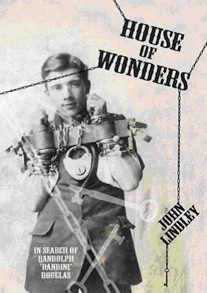
Published last year, House of Wonders by award wining Cheshire Poet Laureate John Lindley goes in search of Douglas in a series of twenty-five poems, illustrated and illuminated by a fascinating array of images. The search takes him into the halls where Randolph Douglas staged his escapes, the caves he explored and the amazing House of Wonders he built around him.

Signed copies of House of Wonders are available direct from the author at 26 Albert Place, Havannah St., Congleton, Cheshire, CW12 2AJ. Price £7.95 + £1.15 post & packaging. Cheques (sterling only) payable to “John Lindley” For more information, visit John Lindley’s official website.

Saturday, September 5, 2009

Randini: The Man Who Helped Houdini

Author Ann Beedham has just published a remarkable piece of Houdiniana, Randini: The Man Who Helped Houdini. This fully illustrated 236 page book reveals “the untold story of Randolph Douglas,” a Houdini fan living in the UK who created his own escapes and eventually become friends with Houdini himself.

The book features many period photos of “Randini” and a never before published photo of Randolph and Houdini in 1920. It also includes correspondence between the young escapist and the great magician, rare scrapbook clippings, and some fascinating sketches Randolph made of Houdini apparatus, including the Water Torture Cell.

I’ve only just received a copy so I haven’t read it yet, but this sure appears to be a fascinating look at a Houdini contemporary, and a wholly unique point of view on Houdini himself. This is easily a MUST for Houdini buffs.

Translate