It was 100 years ago today on July 17, 1913, that Houdini's mother, Cecelia Steiner Weiss, died after
suffering a stroke. When the news of her death reached Houdini who was performing in Copenhagen, he fainted.
It took Houdini several days to make it back to New York. The family delayed burial (against Jewish custom) so Houdini could have one last look at his mother. He placed in her casket a pair of woolen slippers which she had asked him to get her in Europe.
Houdini's mother's death might have been the single most important event in his life. His worship of his mother is well-known, and those who knew him said he was never quite the same man after her death. He mourned for months, even ordering new stationary rimmed in black. On November 22, 1913, he wrote to his brother Theo (Hardeen):
Dash its TOUGH, and I cant seem to get over it. Some times I feel alright, but when a calm moment arrives I am as bad as ever.
Even a full seven months after Cecelia's death, Houdini was still struggling with his grief. On January 19, 1914, he again writes to Theo:
I can write alright when I keep away from that heart rendering subject so will try and avoid it, if possible. But I have to write to my brother once in a while about HER whom we miss and for HER with whom I feel as if my heart of hearts went with HER.
Now, every Hollywood Houdini biopic, most documentaries, and even some magicians will tell you that after his mother died Houdini attended seances in the hopes to communicate with her. But all he found was fraud. He then set out to expose fraudulent mediums and launched into a new wave of his career as an anti-Spiritualism crusader and debunker.
It's a good story. Trouble is, it's not strictly true. In fact, the notion that Houdini's mother's death lead directly to his anti-Spiritualism crusade has grown to become one of the most permissive of all Houdini
myths.
So what did Houdini do after his mother died? We know he took three months off and he and Bess travelled to the South of France (where he took a morbid interest in a cemetery for suicides). He also spent
a lot of time at her grave site in Machpelah Cemetery. But unless it's found in dairies or letters that I haven't yet read, there is
nothing to support the idea that Houdini attended a single séance after his mother died. In fact, it would be 10 years before Houdini unmasked his first medium. And to suggest that his interest in Spiritualism was sparked by her death is clearly false.
Houdini's interest and attitudes toward Spiritualism goes all the way back to his childhood. In the excellent book,
Houdini and Conan Doyle, author Christopher Sandford says that Houdini attended a series of seances at age 11 in an attempt to communicate with his recently deceased half-brother, Hermann. Later, when his father died, Houdini sold his watch to attend a "professional psychic reunion" with Rabbi Weiss. But even at this young age, the boy who would become Houdini sensed fraud. Certainly these experiences could be seen as the psychological fodder for his later hostility towards fraudulent mediums.
In his teens Houdini and his friend Joseph Rinn attended séances and smoked out the methods of mediums. Houdini even suggested some pretty aggressive ideas for exposures (see:
That time Houdini threatened to shoot all the psychics). Later Houdini and Bess would dabble in performing as psychic mediums themselves, something Houdini eventually found too distasteful to continue. But he continued to collect books on Spiritualism and eventually amassed a large library on the subject. He even attended the trial of Anne Rothe,
The Flower Medium, in Germany in 1902. This is all
well before his mother dies.
Just the notion that Harry Houdini would turn to a medium in 1913 is pretty improbable in itself. Houdini had by this time amassed a lifetime of experience that told him Spiritualism was hokum. Also, Spiritualism itself was somewhat in eclipse at this time, stuck between the stage shows of the Davenports and later parlor masters like Margery. It would take a World War to give the old act a boost and new relevance. Not only does Houdini not turn to Spiritualism after his mother dies, this is actually a time when he seems least interested in the subject, along with much of America.

The true genesis of Houdini's anti-Spiritualism crusade is rooted in his friendship with Sir Arthur Conan Doyle. After World War I Spiritualism was suddenly back in vogue. Doyle, who lost his son in the War, became a passionate champion of "the movement." Houdini has a lifetime of experience with the tricks of the trade, so he and Doyle had a topic to discuss when they met in 1920. This was thrilling for Houdini who always craved attention as a scholar and intellectual.
In fact, there is some evidence that Houdini was toying with a pro Spiritualism position at this time. His 1922 film,
The Man From Beyond, ends with his character reading a book by Doyle and nodding in agreement. It is a major endorsement of Doyle that can't be ignored. But maybe Houdini was just trying to get closer to his new intellectual friend (he was thrilled that Doyle endorsed the film). This could have also had more to do with Houdini's belief in reincarnation than Spiritualism. But I digress.
It's in the company of Doyle that the major link between Cecelia Weiss and Spiritualism occurs. On June 17, 1922, Lady Doyle gives Houdini a séance in which she channels "HER" via Automatic Writing. Lady Doyle makes embarrassing mistakes (like writing in English and making the sign of the cross), but Houdini is polite and keeps his thoughts to himself. Sir Arthur takes this as a sign that Houdini has been swayed to the side of the spirits and says so publicly.
Now Houdini
has to speak out on the topic, and what he has to say isn't complimentary. Doyle responds defensively, and suddenly Houdini is in a public debate with one of the great intellectuals of the age. THIS is what drives him to go after mediums. He is going to win this fight at all costs, which is very Houdini. He also discovers that it makes for fantastic theater and gives his career the boost that he didn't get with his movies. So Houdini becomes a debunker of fraudulent mediums. This is 10 years after the death of Cecelia Weiss.
The reason for the direct linkage to his mother's death may come from the Doyle séance, and Houdini's own statements that he did long to speak with his mother again. As with many myths, Houdini had a hand in shaping it. It's also just irresistibly convenient storytelling, which is why every Hollywood movie and quickie documentary takes this narrative bridge. However, in crossing that bridge, what gets lost is 10 important years of Houdini's life. We don’t hear about his World War I activities, the vanishing elephant, and his entire movie career. Ten years lost! Don't you hate it when that happens?
So today as we remember the great Cecelia Steiner Weiss, mother of Houdini, lets also begin to unravel years of mythology about her death sending her son among the spirits. They both deserve it.
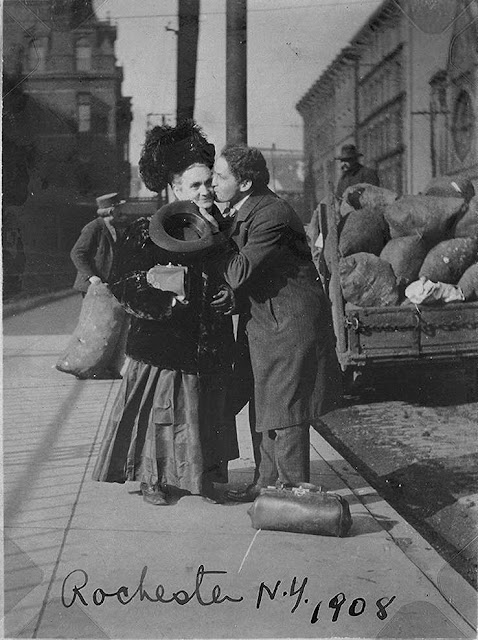 |
| Goodbye Mama. |


