Showing posts with label Arthur Moses. Show all posts

Monday, January 19, 2026

The Amazing Exploits of HOUDINI, Vol. 3 released

Joe Notaro and Arthur Moses have the honor of being the first to publish a new Houdini book in 2026. Their third volume, reprinting the Kinema Comic series The Amazing Exploits of Houdini, was released on January 15. Details below.

The British Boys weekly “The Kinema Comic” ran a serial “The Amazing Exploits of HOUDINI” (“Written by Houdini Himself” – or so it says) from April 24, 1920 to November 27, 1926. In these yarns, which no one should miss, the Master of Mystery chronicles his most amazing exploits. Surviving copies are almost impossible to come by these days. Joe M. Notaro and Arthur Moses have been tracking down these rare issues and are making them available to you in a book series by year (and months). 
In this newest offering, they have compiled the 1922 (Jul – Dec) weekly serials (27 issues) of “The Amazing Exploits of HOUDINI” into a single book (with original illustrations).

You can purchase Kinema Comic 1922 (Jul-Dec) The Amazing Exploits of HOUDINI from Amazon.com and Amazon.co.uk in hardcover or paperback.

Related:

Sunday, July 20, 2025

The Amazing Exploits of HOUDINI, Vol. 2 released

The second volume in Joe Notaro and Arthur Moses's reprints of the Kinema Comic series The Amazing Exploits of Houdini has now been released. Details below.

From April 24, 1920 to November 27,1926, The Kinema Comic in England published a serial called "The Amazing Exploits of HOUDINI, Written by Houdini Himself." In these yarns, the Master of Mystery chronicles his most amazing exploits. Surviving copies of these issues are almost impossible to come by these days.
Now, Joe M. Notaro and Arthur Moses are tracking down these rare stories and making them available in book form for the very first time!
This second volume compiles the stories that ran from January to June 1922 (25 issues) along with all the original illustrations.

You can purchase Kinema Comic 1922 (Jan-Jun) The Amazing Exploits of HOUDINI from Amazon.com and Amazon.co.uk in hardcover or paperback.

Related:

Monday, February 10, 2025

Now you can read "The Amazing Exploits of Houdini"

This is exciting. Joe Notaro and Arthur Moses have teamed up to bring the elusive Kinema Comic series The Amazing Exploits of Houdini to print in a collected edition for the very first time. This first book contains the stories from 1920 with the original illustrations. Details below.

The British Boys weekly The Kinema Comic ran a serial “The Amazing Exploits of HOUDINI” (“Written by Houdini Himself” – or so it says) from April 24, 1920 to November 27,1926. In these yarns, which no one should miss, the Master of Mystery chronicles his most amazing exploits. Surviving copies are almost impossible to come by these days.
Joe M. Notaro and Arthur Moses have been tracking down these rare issues and are making them available to you in a book series by year. In this offering, they have compiled the 1920 (Apr – Dec) weekly serials (36 issues) of “The Amazing Exploits of HOUDINI” into a single book with original illustrations.

You can purchase Kinema Comic 1920 (Apr-Dec) The Amazing Exploits of HOUDINI from Amazon.com and Amazon.co.uk in hardcover or paperback.

Related:

Friday, November 1, 2024

LINK: Still no sign of famed magician

WTAQ has a nice report on yesterday's Official Houdini Séance held in Appleton, Wisconsin. Did Houdini return? Click the headline or the image below to find out.


You can also watch a report on the seance at WLUK-TV on YouTube.

Monday, April 22, 2024

Houdini Periodical Bibliography Revised 3rd Edition

The mighty Arthur Moses has released Houdini Periodical Bibliography References From 1898 - 2023: Revised Third Edition. First released in 2006 and revised in 2015, this latest edition includes over 3700 citations in 40 languages.

Few legendary men, real or imagined, retain their celebrity nearly 100 years after their passing. However, Harry Houdini was one such man. Covering a time period from 1898 through December 2023, this third - revised bibliography includes more than 1400 individual title listings with over 3700 entries from 68 countries which chronicle all significant articles by or about Houdini in magazines, periodicals, journals, etc. This is an increase of citations of over one-third from the last edition ending in the year 2015. A must for any collector, historian, and researcher of "Houdiniana". There is no greater Houdini literary reference bibliography than this extensive resource. 200 Pages with 135 Black & White and Full Color images of Houdini featured covers.

Houdini Periodical Bibliography References From 1898 - 2023: Revised Third Edition
 is availible in hardcover and paperback and can be purchased now at at Amazon.com (U.S.) and Amazon.co.uk (UK).

Related:

Monday, April 24, 2023

Tuesday, November 8, 2022

'Houdini March Two-Step' sheet music (update)

This 1906 sheet music entitled HOUDINI March Two-Step For Piano by Harrie A. Peck recently sold on eBay for $285. This was published by the White-Smith Music Co. and on the first page is written: "Dedicated by permission to Mr. Harry Houdini."

There is a photo of this sheet music in the Ken Silverman book, Houdini!!! The Career of Ehrich Weiss, credited to the Morris Young Collection. But I don't recall ever seeing one for sale and I've never seen it in color. It's a beauty and really speaks to Houdinimania of the day (I can see this selling in Boston). I'd love to hear the tune itself.

Thanks to Kevin Connolly at the Conjuring History Facebook group for the find.

UPDATE: Here's the winner of this mega rarity; the mighty Arthur Moses! Says Arthur, "Been looking for that for 20+ years."

Sunday, July 17, 2022

New book! The Houdini Pitchbooks by Arthur Moses

A new book by mega collector Arthur Moses has just appeared on Amazon. This is an exciting and essential new Houdini resource from the man who has it all! Here's a description of The Houdini Pitchbooks.

Harry Houdini (1874-1926) was the quintessential immigrant success story. Brought to America as a small boy, his family had little means of financial support. Yet young Erik Weisz (birth name) rose above his family’s poverty and became the world’s most renowned escape artist, magician, and debunker of spiritualists. He was fearless when taking on a challenge and incapable of accepting defeat.

Pitchbooks, as they were known, were commonly used by performers and businesses in the latter 19th and early 20th centuries as an expansion of early playbills or advertising. Instead of a single sheet flyer, these multi-page pamphlets enabled the advertiser or performer to further extol their talents or products while generating additional financial revenues.

Includes all the known Houdini pitchbooks and their variants. This body of work includes over 40 different rare pitchbooks, including their cover images, along with the history of each. Variants include such differences as cover colors, page counts, minor text changes, revised editions, publication dates, printers, etc. An unmatched and valuable resource guide.


Arthur dedicates the book to our late friend John Bushey, who always wanted to publish a work such as this.

You can purchase The Houdini Pitchbooks in hardcover or paperback at Amazon.com and Amazon.co.uk.

Friday, April 15, 2022

LINK: Arthur Moses in Departures

Our great friend Arthur Moses and his formidable Houdini collection are featured in an excellent profile in Departures Magazine. Some wonderful images of his collection here. Click the headline to have a read.

"When people come over, I always say that if there’s something you want to see or to touch, just ask. You’re not going to hurt anything. Part of why I have all of this stuff is because I also love showing it off."

 Related:

Monday, October 18, 2021

Houdini's "near perfect mystery"

This piece of surviving Houdini apparatus has always baffled and intrigued me. I've heard it said Houdini called it a "near perfect mystery." Sidney Radner, who acquired it from Hardeen, told me Houdini planned to make this the featured escape in his "3 Shows in One" replacing his Water Torture Cell. But what the heck is it?


For what I understand, this idea here is Houdini would be encased within these four nested wooden boxes. Iron rods were then placed down the length of the four corners, locking the boxes in place. He may have also been restrained in ropes or chains strung though the holes on either side of the boxes.

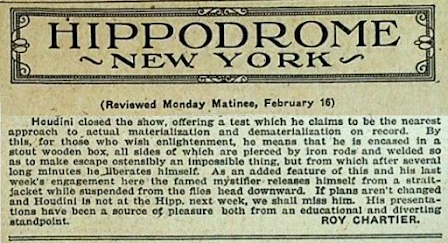
Recently I uncovered a review of Houdini's act at the New York Hippodrome during the week of February 16, 1925 (this is before the "3 Shows on One"). What's described here is almost certainly this escape and it's the only record of it that I've ever encountered.

Houdini closed the show, offering a test which he claims to be the nearest approach to actual materialization and dematerialization on record. By this, for those who wish enlightenment, he means that he is encased in a stout wooden box, all sides of which are pierced by iron rods and welded so as to make escape ostensibly an impossible thing, but from which after several long minutes he liberates himself.

The "near perfect mystery" was sold in "The Great Houdini Auction" of 2004 and resided in the collection of Arthur Moses for several years (where the above photo was taken). Today it is in another private collection.

If you're interested in learning about more surviving Houdini apparatus, please join me this Wednesday, October 20, for an online ZOOM lecture, "Houdini Lost and Found," part of the 2021 American Museum of Magic Speaker Series. I'll have some exciting and unusual things to share and hope to see you there. Click here for details and tickets.

Friday, March 12, 2021

Arthur Moses Presents Harry Houdini, Sunday

If you missed last month's Zoom conference with mega collector Arthur Moses, you'll have another chance this Sunday, March 14 at 7:00 PM (Central) via the Congregation Beth Israel.

Learn about Houdini's amazing life when CAS congregant Arthur Moses, renowned Houdini collector, bibliographer, lecturer, and archivist, presents a fascinating Zoom program. You will be treated to an exclusive personal video tour of Arthur's collection of more than 6,000 items of Houdini memorabilia. From straitjackets and handcuffs to photographs and rare posters, some of these items have been displayed at museums all over the US. 

Arthur will also gladly answer all your Houdini-related questions. 

Click here for the Zoom link and passcodes. Participation is limited to 100, but you can also watch the live stream via the Synagogue's Facebook page.

Related:

Tuesday, February 2, 2021

The Great Harry Houdini presented by Arthur Moses

Our good friend Arthur Moses will be giving a Houdini presentation on Zoom this Thursday, February 4, at 4:30 PST for the Congregation Beth El - Norwalk. Presumably we'll be getting a good look at Arthur's Houdini room and collection, which has to be seen to be believed!


Facebook event page:

Zoom link

Friday, November 13, 2020

Houdini happenings at the first virtual Yankee Gathering


This weekend sees the first virtual "Yankee Gathering" from the New England Magic Collectors Association (NEMCA). Houdini will be part of the annual conference with four Houdini-centric presentations (details below). So if you're like me and have never been able to attend one of these storied Gatherings, here's your chance to do it from home! 

Saturday 14 Nov 
10:30 AM EST / 7:30 AM PST 
Lecture #2: Houdini Deltiology 
Kevin and Susan Connolly, Houdini Collector/Historian 
Deltiology is defined as the hobby of collecting postcards, especially picture postcards Like most collectors, Kevin collects items that he enjoys. This was his initial incentive to start collecting postcards. Kevin's presentation will focus on his Houdini-related postcard collection which he has compiled over many years. He hopes that you enjoy viewing them as much as he has enjoyed collecting them. 

Saturday 14 Nov 
1:55 PM EST / 10:55 AM PST 
Lecture #6: Dazzled By Diamonds: Evanion and Houdini 
Jim Hagy, Magic Historian/Author 
Of the many legends concerning collections of conjuring material, none may be as renowned as the acquisition by Harry Houdini of playbills and ephemera from Henry Evanion. Houdini’s published recollections told only a small part of Evanion’s story as Harry unquestionably knew it. This presentation, based on the upcoming new and enlarged edition of Jim Hagy’s groundbreaking 1985 Early English Conjuring Collectors, will trace how Evanion fits into the Houdini narrative, the Evanion legend crafted by Houdini himself, and the broader reality of the life, performing career, and collecting habits of Evanion and fellow magician, collector, and friend, James Savren. 

Saturday 14 Nov 
3:20 PM  EST / 12:20 PM PST 
Gallery of Collections #2: Arthur Moses shares his Houdini Collection with a Video Tour 
Arthur Moses, Houdini Collector/Historian 
Harry Houdini became famous for his stage illusions: vanishing an elephant, walking through a brick wall, metamorphosis, escaping from a milk can, and of course the water torture cell. Can you hold your breath for four minutes; Houdini could. He was fearless to accept the unknown and belief in his own abilities to overcome: ''my brain is the key that sets me free'' was his favorite truism. A magician – an escape artist – a silent movie actor – first man to fly a plane in Australia (1910) – spiritualism debunker – basically one tough fella! Here was an amazing individual who defied all to try to bind him with ropes or chains or handcuffs or straitjackets or in wooden boxes ---he never lost a challenge to escape or to let his audiences down. 
 
Sunday 15 Nov 
3:20 PM EST / 12:20 PM PST
Special Bonus Presentation - Houdini's Blooming Rose Bush
Take a step back in time and enjoy a candid conversation between Ray Goulet and Charlie Cambra. Charlie and Ray talk about the history of the apparatus, how Charlie came into possession of it and ultimately how it was passed on to Ray’s Mini Museum of Magic in Watertown, MA. They also discuss the inner workings of piece by breaking it down and then ultimately setting it up and walking through a presentation of the piece. It is something amazing and has to been seen!!!

For more information, including the full schedule, visit the official Yankee Gathering 2020 website. All presentations will remain available for viewing until November 22, 2020. 


Sunday, May 31, 2020

Arthur Moses reprints the first Houdini & Holmes adventure

Here's something exciting. Arthur Moses has released a new book that examines the 1908 story "Auf den Spuren Houdinis" (On The Trail Of Houdini). This marked the first fictional pairing of Houdini and Sherlock Holmes. The book includes the original German text as well as a never before published English translation. Below are details.

After a performance in Berlin, Germany, Houdini is kidnapped by his lesser rivals. Sherlock Holmes is urgently summoned to Berlin to investigate. Through his masterful deductive reasoning he tracks down the dangerous perpetrators in the nick of time. 
A recreation in its entirety of the German language pulp magazine series Aus den Geheimakten des Welt-Detektivs, featuring the 1908 issue number 101 "Auf den Spuren Houdini's" (On The Trail Of Houdini). Uniting Harry Houdini and Sherlock Holmes, formidable protagonists together, one being a fictional character and the other a living legend of history, is a masterful stroke synchronizing their uniquely charismatic identities. This text focuses on a single 1908 German language publication which brought them together, along with its never before published English translation in addition to later translated foreign language editions based upon the German work. Their two personas are as popular today as ever, with many modern pastiches, comic books and films successfully pairing Houdini and Holmes. 
Other reprints of this title in other foreign languages are represented by reproducing their covers; France, Belgium, Denmark, Mexico, Netherlands, Portugal, Romania, and Spain. Sherlock Holmes was the creation of Sir Arthur Conan Doyle.

But it gets even better! Arthur has also released two other separate volumes containing the rare Portuguese versions of this story from 1911 and circa 1920.


Says Arthur, "All 3 will have a great interest for both Houdini and Sherlock Holmes collectors." He has launched a website devoted to the books. All can be purchased from Amazon:

Harry Houdini & Sherlock Holmes Together Again In 1908: Auf Den Spuren Houdinis (On The Trail Of Houdini) 

Harry Houdini & Sherlock Holmes "Extraordinary Adventures of a Secret Police - The Missing Athlete" (Portuguese Edition 1911) 

Harry Houdini & Sherlock Holmes "Extraordinary Adventures of Sherlock Holmes - The Missing Athlete (Portuguese Edition 1920) 
The books can also be found on Amazon.de, Amazon.fr, Amazon.es, Amazon.it, Amazon.jp, and Amazon.ca.

Related:

    Saturday, April 25, 2020

    Mystifier, Winter 2001-2

    Continuing my issue by issue look back at the Mystifier, the newsletter of the Houdini Historical Center that ran from 1991-2003.


    The last issue of Mystifier for 2001 eliminates the "Quarterly" denotation and announces itself as the "Winter 2001-2" issue. It begins with a review by HHC curator Kimberly Louagie of the new book Houdini, Tarzan, and the Perfect Man. The White Male Body and The Challenge of Modernity in America by John F. Kasson. It's a book she recommends as "a great example of how authors can peel away specific aspects of Houdini's life and interpret the magician in a larger historical context." Louagie nicely summarizes the chapter on Houdini as:

    Its 78 pages explains how how Houdini helped alleviate some of the tensions felt by men living in new urban communities. Kasson argues that men felt they were losing their independence to industrialization. Their environment has changed from an idealized frontier society to one dominated by corporate capitalism. Kasson sees Houdini's appeal and subsequent fame as an expression of men's need to reclaim and redefine their manhood in a modern world.

    The newsletter, which only runs 4 pages this time, continues with an alert for visitors to Appleton about construction along College Ave. It notes the Travel Channel documentary featuring the HHC is set to air April 15, 2002. It also reveals the artwork for the upcoming Houdini stamp as the famous 1911 lithograph, a copy of which the museum has on display from the Tom Boldt collection.

    A sign of the times, Sid Radner begins his "Backstage" column discussing the impact of 9/11 on friends of the HHC, including Anna Crankshaw, the great granddaughter of Margery, who lives near Ground Zero and actually witnessed both planes fly into the towers. Sid notes that many regulars could not travel to the Official Houdini Seance that year at the Henry Ford Museum in Detroit. But one welcome new attendee was George Hardeen, the grandson of Theo.

    Sid also amusingly points out that he contacted John Edwards, who was finding popularity with his Crossing Over program at this time, and invited him to attend. To no one's surprise Edwards never responded.

    Sid continues with a rundown of publicity the seance received, including various radio interviews he gave and coverage in the Fort Worth Star-Telegram featuring Arthur Moses. Sid closes with news of the official announcement of the Houdini stamp ceremony to be held on July 3, 2002.

    Mystifier
    Volume 11, Number 4
    Winter 2001-2
    4 pages

    Contents:
    Houdini, Tarzan, and the Perfect Man: A Review
    Travel Channel Documentary to Air
    Stamp Artwork Announced
    Backstage with Sid Radner


    Related:

    Saturday, February 9, 2019

    Houdini claimed he was building a "health house"

    Recently Arthur Moses uncovered a remarkable interview with Houdini in the Dec/Jan 1923-24 issue of Back To Nature magazine (right). It contains lengthy quotations from Houdini about health and fitness and, most curiously, how he is building a special "health house."

    The article kicks off with Houdini saying: "If we expect to have the health of the nation, we will have to make some radical changes in our present mode of civilization." He then describes his own health rituals.

    "I believe that I owe my tremendous strength, health and success to 'CLEAN LIVING.' I have never used tobacco, alcohol, or liquors of any kind in my life. I drink all the water I can possibly take, and particularly in the morning upon arising and at night upon retiring. I have never eaten salt or pepper, and I have always considered it a matter of common sense that condiments of all kinds would irritate the delicate membrane and tissues inside the body. I always eat whole grain bread, never white, and I have found that the eating of raw bran is especially fine for the bowels. I never eat white bread or drink coffee and a large part of my diet consists of fruits of all kinds. I always carry oranges when traveling and for my lunch in rush hours I eat bananas. I find that raw foods give me greater strength than cooked foods.

    In my home in New York, which is a four story building, I have my library and office on the top floor. I am quite a book-worm, and I do a great deal of studying. I have to walk down the four flights for my meals, and that gives me exercise which strengthens the muscles in my limbs and keeps my wind in shape. In  fact I never use and elevator when I can use the stairway. I have my desk built high so that I am obliged to stand while using it, and this prevents me from becoming stiff and sluggish from sitting down too much. I take a great deal of exercise in the form of hikes and swimming, and I am especially fond of tennis.  When I am on the road I always try and secure a room on the top floor, whenever possible, for the air is fresher and purer and I get away from the smoke and dirt. When sleeping, my windows are always wide open and I open them when I go out in order to ventilate the room while I'm away."

    After expressing his belief that all children should be taught to swim (by law) and be trained to be ambidextrous (as he claims he is), Houdini turns his attention to health and architecture.

    "Our present-day architecture is all wrong from a health standpoint. Most of the homes today get very little, if any, sunlight. The landlords of today build their houses in such a manner as to utilize every inch of space, making most, if not all rooms inside, so as to squeeze all the rent out of their tenants and the sunshine, air and health as well. If we are to have real health, we must make radical changes in the building of our homes. I am building an eight-room house for myself in the country near New York. It will be two stories, and the top of the house will be built so that it revolves, every room getting two hours of sunlight each day. The closets will be built in the center of the house on the first floor, making all rooms outside rooms. Sunlight kills microbes and germs. The Aborigines, or prehistoric savages, lived within the natural forces. They made their cures through nature's remedies--sunlight, air, water and foods in their natural state as God grew them, and I believe those things we must use if we hope to have health, strength, and I might add happiness, for one cannot be happy if he is in ill-health. When I have finished the building of my health house, I will be happy to have any of the Back To Nature readers come and see it, and if they like, pattern one after it for themselves."

    There's so much to love here!

    First, I've never heard anything about this "health house" before. I suspect it only existed in Houdini's mind. I've also seen many references to Houdini drinking coffee. His rejection of condiments seems a little wacky. But his swearing off of white bread in favor of whole grains is downright modern. So too his belief in the benefits of fruit and raw foods. One wonders how radical these ideas were back then?

    But I do think Houdini is playing a bit to his audience here. In a 1907 letter to Bess, he describes a meal in Chicago that hardly sounds like the diet of a health nut:

    "Had spaghetti dinner, roast beef and mashed potatoes, washed down with excellent coffee and lady fingers inserted in cream."

    Thanks to Arthur Moses for sharing this healthy find.

    Related:

      Monday, January 28, 2019

      Houdini's Last Secrets ep. 4 unearths Buried Alive


      Houdini's Last Secrets goes out on a positive note with an investigation of Buried Alive. This was a good choice of subject for the final episode. Apart from two posters, very little is known about this feat, so it was not only interesting to see how Houdini might have accomplished the escape, but it was interesting just to see how he might have presented it in the first place!

      One can easily get buried in the history of Buried Alive as there were multiple versions. The show does a nice job of separating Houdini ill-fated outside buried alive stunt and his later stage-bound version. (They avoid the Shelton Pool Test.) The episode sticks with the conventional wisdom that Houdini never performed his stage-bound version. But in recent years, evidence has surfaced that shows he actually did perform it at least twice at the start of his 1926-27 season.

      Interviews are again a highlight. This time George Hardeen visits Antony Britton in England, who attempted the outdoor casket-free buried alive and, like Houdini, nearly died. Roger Dryer shows us his magnificent Houdini Museum of New York which holds a casket Houdini escaped from in 1907 (unburied). It's a treat to see David Merlini and his own House of Houdini museum in Budapest, Hungary. I don't believe David has appeared in a Houdini documentary before, but his knowledge of Houdini history and his first hand experience with escapes--including being buried alive--make him an ideal interview subject. Finally, we get to see the mighty Arthur Moses in his own temple of Houdiniana in Fort Worth. Arthur handles his Houdini history with great authority.

      In fact, this episode is probably the best yet as far as Houdini history is concerned, expanding it with mentions of his movie career and crusade against fraudulent spirit mediums. The idea that George is uncovering the story of his great uncle for himself and the audience is best realized in this episode. Of course, it wouldn't be "reality" TV without talk of a murder conspiracy! But the episode doesn't go too deeply into this and is not significantly derailed by it.

      But the meat of the episode is the Buried Alive itself. Steve Wolf at Stunt Ranch constructs a theoretical version of Houdini's stage apparatus for magician Lee Terbosic to attempt. Both the conception and method is ingenious, and because we don't even know exactly how Houdini presented it, there's no danger of exposure. But in bringing the escape to life, one can appreciate how it was an effective stunt, and maybe even a lost Houdini masterpiece. So the episode has provided a real service to Houdini history by showing us what may have been.


      Overall, this series turned out to be a mixed bag. It contained a disappointing amount of speculative hokum about Houdini being a spy at the expense of a more fact based exploration of his life. But the team's investigations and recreations of Houdini's feats were all very well done, and the series provided great interviews with fresh faces. And above all, it was respectful to Houdini and made him ever more fascinating!

      It also did not turn out to be an exposure show as many had feared. They did indeed successfully ride the line between exposure and investigation, and in the case of a few genuine secrets, such as the Water Torture Cell, they went out of their way to protect the real method. So I'd say this series was a cut above and a worthy addition to the growing list of Houdini documentaries. I would be happy to see a second season.

      The complete Season One of Houdini's Last Secrets is available for purchase at Amazon and iTunes.

      If you're interested in more information on Buried Alive, check out the below links:

        Friday, January 25, 2019

        Houdini arrives in Los Angeles

        Arthur Moses sends over this gem of photo that I've never seen before. This shows Houdini arriving in Los Angeles on April 20, 1919 to begin work on The Grim Game.


        This comes from the Exhibitors Trade Review, May 17, 1919, which also contains the following report.

        Houdini in California 
        Harry Houdini, monarch of mystery, has arrived in Hollywood, CAL., where he started work immediately at the Lasky studio under the direction of Irvin Willat in the big six-reel mystery picture written specially for him by Arthur B. Reeve, author of the "Craig Kennedy" stories, and John Grey. 
        Houdini was met at the Santa Fe station in Los Angeles by Studio Manager Fred Kley and others, including a number of newspaper and publicity men who had been lying in wait for him with a number of stunts of extrication which they figured he would be unable to perform. They wasted no time in setting the famous escape artist to work, but he managed to wriggle out of every single one of the schemes they had prepared for him.

        What I especially like is this tells us the train station where Houdini arrived. The Santa Fe station (or La Grande Station) was located on 2nd Avenue and Santa Fe and was the main passenger terminal in Los Angeles before Union Station opened in 1939. It was demolished in 1946.


        Thank you Arthur.

        Related:

        Monday, August 20, 2018

        Mystifier, Third Quarter 1994

        Continuing my issue by issue look back at the Mystifier, the newsletter of the Houdini Historical Center that ran from 1991-2003.


        The Third Quarter 1994 Mystifier features a lengthy review of the biography Barnum by Morris R. Werner, written by Houdini for the May 1923 Literary Digest International Book Review. It's pretty interesting to hear Houdini discuss his great predecessor in self-promotion. He even says that he read Barnum's autobiography as a youth. Here's a taste:

        It would pay every one, in an educational way, to read Barnum's "Life" and then pick up Mr. Werner's book and see how hard the latter tries to show us Mr. Barnum as he really was. He does it very ably, but there is one curious oversight: he seems to have forgotten entirely the publicity promoters of Barnum. I was fortunate enough to become acquainted with Kit Clark, one of the original "abusive bill writers." No one man, without lieutenants, I believe, has every projected a publicity campaign to equal that which Clark carried through for Jenny Lind. Outside of the presidential campaigns, in my humble estimation, the Jenny Lind exploitation will rank with the greatest ever seen in this country.

        By the way, Houdini's copy of the Werner book, inscribed to Houdini by the author, is today in the Harry Ransom Center collection. [see update below]

        The newsletter continues with the news that "Harry Houdini and Family" will be added to the Ellis Island "Wall of Honor" in New York, thanks to the sponsorship of HHC member Paul Rosen. Rosen said he elected to use the name Houdini instead of Ehrich Weiss as Houdini "is how the public knows him." The newsletter says the name is expected to be added to the Wall in 1995. (It's worth noting that the Weiss family likely came through Castle Garden at the Battery, not Ellis Island.)

        Benjamin Filene is announced as the new curator of the Houdini Historical Center. Filene says he's "eager to immerse himself in Houdini lore." A fundraising campaign for repairs to Houdini's grave is also announced. The grave site was vandalized on May 25, 1994.

        In "Backstage with Sid Radner," Sid welcomes to the HHC Raymond Corbin, a great proponent of the Spook Show genre. "It's too bad the new generation of magicians and the public can't experience the thrilling piece of Americana that was the midnight spook show," says Sid. He also thanks Arthur Moses and the late Manny Weltman for uncovering the Houdini Barnum review.

        Sid then reports that he, David Baldwin, and Henry Muller of the Houdini Magical Hall of Fame have acquired the Walter B. Gibson/Great Raymond Collection. He says it took nine people an entire weekend to clear it out of the barn in which it had been stored. Among the treasures is an original Miss Undina poster, said to have been the very poster used by Houdini in his 1912 trial against her. Sid promises more about the collection in a future issue of Mystifier.

        Mystifier
        Volume 4, Number 3
        Third Quarter, 1994
        6 pages

        Contents:
        Houdini Discusses P.T. Barnum
        Houdini Name on Ellis Island Wall
        Curator Welcomed at HHC
        Funds Needed to Repair Houdini's Gravesite
        New Book at Museum Shop
        Backstage with Sid Radner


        UPDATE: Our friend Eric Colleary of the Harry Ransom Center has tweeted images of the book itself. Dated on Houdini's birthday! Check it out here.

        Related:

        Wednesday, August 1, 2018

        Mystifier, Second Quarter 1994

        Continuing my issue by issue look back at the Mystifier, the newsletter of the Houdini Historical Center that ran from 1991-2003.


        The Second Quarter 1994 Mystifier kicks off with the news that Morris N. Young has donated his collection of books and materials related to cryptography to the HHC. Young had penned and article in the Fourth Quarter 1993 Mystifier about Houdini's own fascination with the subject. An article by Arthur Moses about The Master Mystery follows. This piece originally appeared in the Texas Magic Collectors Newsletter.

        We then get a surprise; an obituary for Houdini's nephew, Samuel M. Weiss. This is a family member I had not heard of before. The obituary is short enough to reproduce in full here:

        Houdini's Nephew Passes Away
        Samuel M. White (Weiss), age 86, passed away on April 4, after a battle with cancer. Samuel was born in New York in 1908, and was named after his grandfather, Rabbi Samuel Mayer Weiss [sic]. The son of William Weiss, Houdini's brother, Samuel was the last of the second generation of Houdini's family.
        A a young man, Samuel attended medical school and became a cardiologist. His schooling was sponsored by another Weiss brother, Leopold. The young Samuel Weiss changed his name to "White" when he joined the United States Army.
        Samuel was known to have been very fond of his uncles Theo and Ehrich (Houdini). As Manny Weltman, an acquaintance of Samuel's, recalled during a May phone interview, "Samuel said that throughout his childhood, he always referred to Houdini as 'Uncle Houdini,' never 'Uncle Harry' or 'Uncle Ehrich'." Samuel also remembered fondly an occasion upon which Houdini gave him a military outfit. The young boy would march for and salute his "Uncle Houdini." We extended our sympathies to his wife, Barbara.

        The issue continues with another obituary, this one for the great Houdini historian, author, and collector Manny Weltman, who died on May 16, 1994. It chronicles Manny's many varied interests and achievements, and includes a nice photo of Manny with Patrick Culliton, Sidney Radner, Stanley Palm, and Diego Domingo at Pat's home in Laurel Canyon. (Some day I will do post about my own memorable first meeting with Manny in 1980.)

        A very good article from the 1989 Delavan Enterprise by W. Gordon Yadon about Houdini's connection to the Flitcroft family of Delavan follows. The Flitcrofts famously took in the 12-year-old "Harry White" during his runaway days. The article includes a letter, reproduced in full, that Houdini wrote to Mrs. Flictcroft in December 1907. It also states that their house at 328 S. Sixth Street is still standing!

        Benjilini contributes a fine article called "What Houdini Means to Me," which includes a poem by 11-year-old Yaniv Amar, a member of The Great Benjilini Society of Young Magicians, Assembly 33.

        A Clio Award winning poster designed for the HHC by Birdsall Voss & Kloppenburg, Inc. of Milwaukee is showcased. The poster features the iconic 1903 image of Houdini in loincloth and chains with the superimposed text: "Handcuffs, Chains and Leather Restraints. No, It's Not Another Madonna Video." (For context, this was during Madonna's controversial S&M period.)

        In "Backstage with Sid Radner," Sid tells the story of Mario Cockrell who saved 20 trapped miners in South Africa by using a trick "he had learned from a book by Houdini." Cockrell was able to make his body rigid, creating a bridge that allowed the miners to cross to safety. Sid says, "Of course, all Houdini buffs know where Houdini described this stunt." Do we? Miracle Mongers and Their Methods, I'm guessing?

        Sid then reports on the annual Magic Collectors Convention, held this year in Eureka Springs, Arkansas. "Houdini items disappeared first, as always." He then reflects on the sad news of Manny Wetlman's passing, and thanks Arthur Moses and Benjilini for their contributions to the newsletter. He finishes with his usual sign off: "Houdini Lives!"

        Mystifier
        Volume 4, Number 2
        Second Quarter, 1994
        6 pages

        Contents:
        Code, Cipher Collection Comes to HHC
        Each Week a New Title
        In Memoriam: Manny Weltman
        Houdini Came to Delvan
        What Houdini Means to Me
        Backstage with Sid Radner


        Related:

        Translate