Banner AI generated.
Showing posts with label Slicing a Girl. Show all posts

Friday, December 10, 2021

Deconstructing Houdini '53: Wedding night

Today I continue my scene by scene dissection of Paramount's 1953 biopic Houdini, in which I attempt to make the case that it's much more historically accurate than it is given credit. And anything else that comes to mind. Last time Harry and Bess finally connected at Tony Pastor's. Today we join them on their...
Chapter 5: Wedding Night

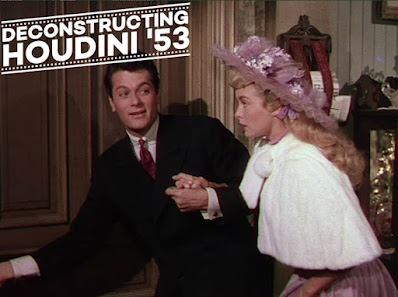
Just as in real life, the courtship of Harry and Bess in Houdini (1953) is a short one. Whereas the real Houdinis dated for around four days before tying the knot, in the movie it appears to happen all in one night! But they are meant to be and we got a lot of life to cover, so...

The wedding night sequence starts off with a nice visual beat in which Harry guides his new bride to his family home. Bess assumes they will be ascending the stairs of a handsome brownstone. But Harry shakes his head and guides her down to a basement level dwelling. Rich he ain't!

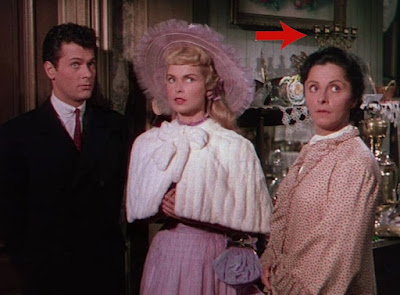
Not wanting to wake his mother, Harry attempts to sneak Bess into his bedroom. But it doesn't work. Mama, played by Angela Clarke, catches the young couple who then scramble, unsuccessfully, to explain themselves. Clarke was only 44 when she starred in Houdini. The real Cecelia Weiss was 53 when her son got married. Clark is actually a better age match than some succeeding mamas who tended to be portrayed as elderly from the start (most notably Ruth Gordon in The Great Houdinis). Clarke's mama is welcoming of her new daughter-in-law, which is also true of the real Cecelia Weiss.

One of the most interesting aspects of this scene is what can be seen in the background. Look closely and one can spot no less than two Menorahs, thus establishing Harry as Jewish. We've already discussed how Bess's introduction suggests a Catholic school (which is again mentioned here), so the mixed faith marriage of the Houdinis is indeed part of this film...if you look hard enough.

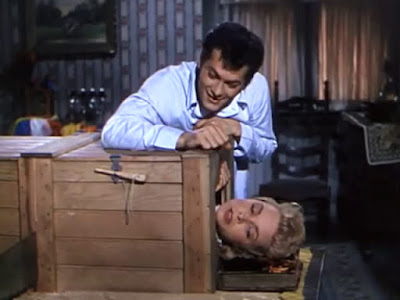
After mama gives her blessing, we dissolve to Harry's bedroom where a sleeping Bess is startled awake by Harry, in pajamas, bringing out a large box. He insists that Bess climb into it. Both actors are exceptional in this moment, almost seeming to ad lib some of their playful dialogue. Once Bess is locked inside, Harry retrieves a large saw and announces, "I'm going to saw you in half."

The famous Sawing in a Woman in Half illusion, as presented here, was first performed by Horace Goldin in 1921. It caused a sensation and ignited controversy over who invented the effect (which is covered in Mike Caveney's acclaimed new book, 100 Years of Sawing). Putting this in the hands of Harry Houdini in the 1890s is a howling anachronism, although Houdini would eventually perform his own version of this effect in 1926 called "Slicing a Girl in Eight."
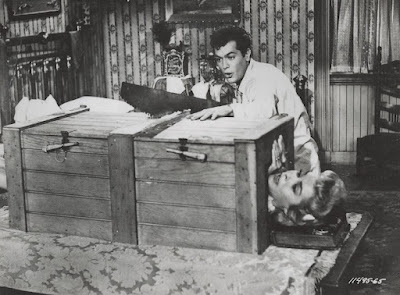

However, the idea of showing a nascent Houdini working on an effect that would become a classic of magic is entirely accurate. That trick was Metamorphosis. But the Sawing works great here to terrify Bess, which is also true of their early life. In Houdini His Life Story Bess relates at least two stories about how her new husband frightened her with his magic tricks and strange behaviors. He would then soothe her by showing her the secrets, which is exactly what we see play out here in the movie.

While there is no account of what the real Harry and Bess did on their wedding night (I can make a guess), this classic scene became a template for later biopics with events playing out in a very similar manner. In The Great Houdinis (1976) Sally Struthers ends up handcuffed to Harry. In the Houdini Miniseries (2014) Kristen Connolly finds herself locked in a trunk.

Harry: Was it so awful?
Bess: No, but I expected something different on my wedding night.

Thursday, October 14, 2021

Three days in Schenectady


It was 95 years ago today that Houdini arrived in Schenectady, New York, for a 3-day engagement at the Van Curler Theater. This would be his first and last appearance in the city. This was a rare split week for Houdini's "3 Shows in One." He had played the first half of the week at the Capitol Theater in Albany, where on October 11 he broke his ankle doing the Water Torture Cell. News of the accident reached Schenectady and the theater ran special ads assuring audiences that Houdini would still appear as planned.


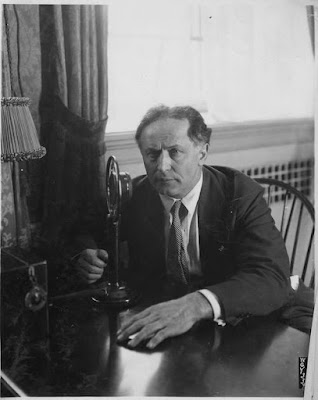
Houdini began his first day in Schenectady with a 10AM lecture to students at Union College. In the afternoon he gave a radio address over station WGY where he was photographed. This is one of the last photos ever taken of Houdini.


Houdini's show that night played to an "overflowing house." A review of the show in the October 15, 1926 Schenectady NY Gazette noted that his injury caused him to "limp slightly" and "because of this he announced that he had to discard one of his best tricks and replace it with five others." (No doubt that best trick was the Water Torture Cell.) Singled out for special attention is a trick that was largely unknown to Houdiniphiles until recently. This review offers the best description yet:

The slicing of a woman, a trick derived from the ancient torture machines of China, is one of the big features of the first act. With the aid of assistants, Houdini places a young woman in a casket. Several knives are suspended above her body. The blades descend at a fast rate and seemingly slice the body of the girl. But when the casket is opened she steps out from the box, bows, and makes her exit none the worse for the experience.

The show this night was divided into two acts instead of three. Before the close of the first act, Houdini announced that he would donate several books on spiritualism to the library at Union College. He then invited a student on stage to receive the books. Are those books still there, I wonder?

The second act featured exposes of fraudulent spirit mediums. According to the review, Houdini introduced a woman (possibly Rose Mackenberg) who revealed she had visited several mediums in Schenectady and spoke to several dead children and dead husbands in heaven. "A chuckle broke over the audience when she further stated that she is single and never had a husband."

Houdini played three evenings and two matinees in Schenectady before the company moved on to Montreal, Canada, where he would have his fateful encounter with J. Gordon Whitehead.

The Van Curler theater was located at 430 Franklin Street at the corner of Franklin and Jay Streets. Opened in 1893, it sat 1600 and was said to be one of the largest and best appointed theatre in the country. In 1910 the Van Curler become one of the first theaters in Schenectady to play movies. The theater closed in 1943 and in 1959 was replaced with a modern office building that still stands today.

Saturday, May 2, 2015

When Jim Collins went solo


Our good friend Joe Fox has uncovered an interesting nugget of information about Jim Collins, Houdini's trusted chief assistant and engineer. It appears that after Houdini's death, Collins performed a solo act in a tent show doing Houdini's effects. Here's the item Joe found in the December 1931 issue of The Sphinx.

Magic Under Canvas
By Julien J. Poskauer

Carnivals and circus side-shows have used magic as drawing card during the summer season which has just closed, to an extent never before reached in the outdoor show business. About two hundred and thirty professional and semi-professional magicians have been working under canvas.

Indicating the extent of magicians' popularity is the fact that at the Connecticut State Fair which closed October 16th at Danbury, Conn., there were six magic acts working at the same time. James Collins, for many years assistant to Harry Houdini and the only man in the word that knows the secret to the last master's "Upside Down" trick, is featured in a tent of his own.

Collins is working a large illusion owned by Hardeen and himself, the Houdini Chinese Execution Trick in which eight steel blades "penetrate" the body of a beautiful assistant, the Flying Bird Cage and escapes from restraints of all kinds.

This "Chinese Execution Trick" is almost certainly the "Slicing A Girl in Eights" illusion that Houdini featured in the second season of his full evening show.


So what should we make of this tent show appearance? In 1931 Collins was working with Hardeen. However, this may not have been a full time job as it had been with his brother. This was during the depression and Collins probably needed to make extra money during the summer. Hardeen was playing the RKO-Pantages Circuit, so performing a State Fair tent show would not have been a conflict. Or it could even be that Collins was fulfilling this engagement on behalf of Hardeen. How Collins was billed might provide us with more clues, but I've not been able turn up anything more on this performance.

I'm wondering if this was a one off, or if Collins had a minor career in tent shows and small venues under the radar. If anyone has any additional info on Collins' solo act, please share in the comments below.

By the way, the author of this piece in The Sphinx, Julien Poskauer, later performed the Milk Can escape himself, assisted by none other than Jim Collins.

Thanks to Joe Fox and Paul Zenon.

Tomorrow our special Jim Collins Weekend continues with: YES!--"Jim Collins is still with me".

Related posts:

Monday, April 28, 2014

"Slicing A Girl" in Worcester

Following up on my post last week about Houdini's performance of Buried Alive at the Worcester Opera House in Sept. 1926, John Hinson, the great-nephew of Harry and Bess Houdini, has done some leg-work at the Worcester library and has uncovered this terrified newspaper ad for that very week of performances.


I love the illustration of Houdini here, and the fact that it notes this as his "Second Annual Tour." But what's especially interesting is this ad references "Houdini's Newest Sensation." No, it's not Buried Alive, but something called "Slicing A Girl." I've also seen this advertised as "Slicing a Woman in Seven Parts." But exactly what this effect was (apart from the obvious description) appears to be another Houdini mystery.

Thank you, John.

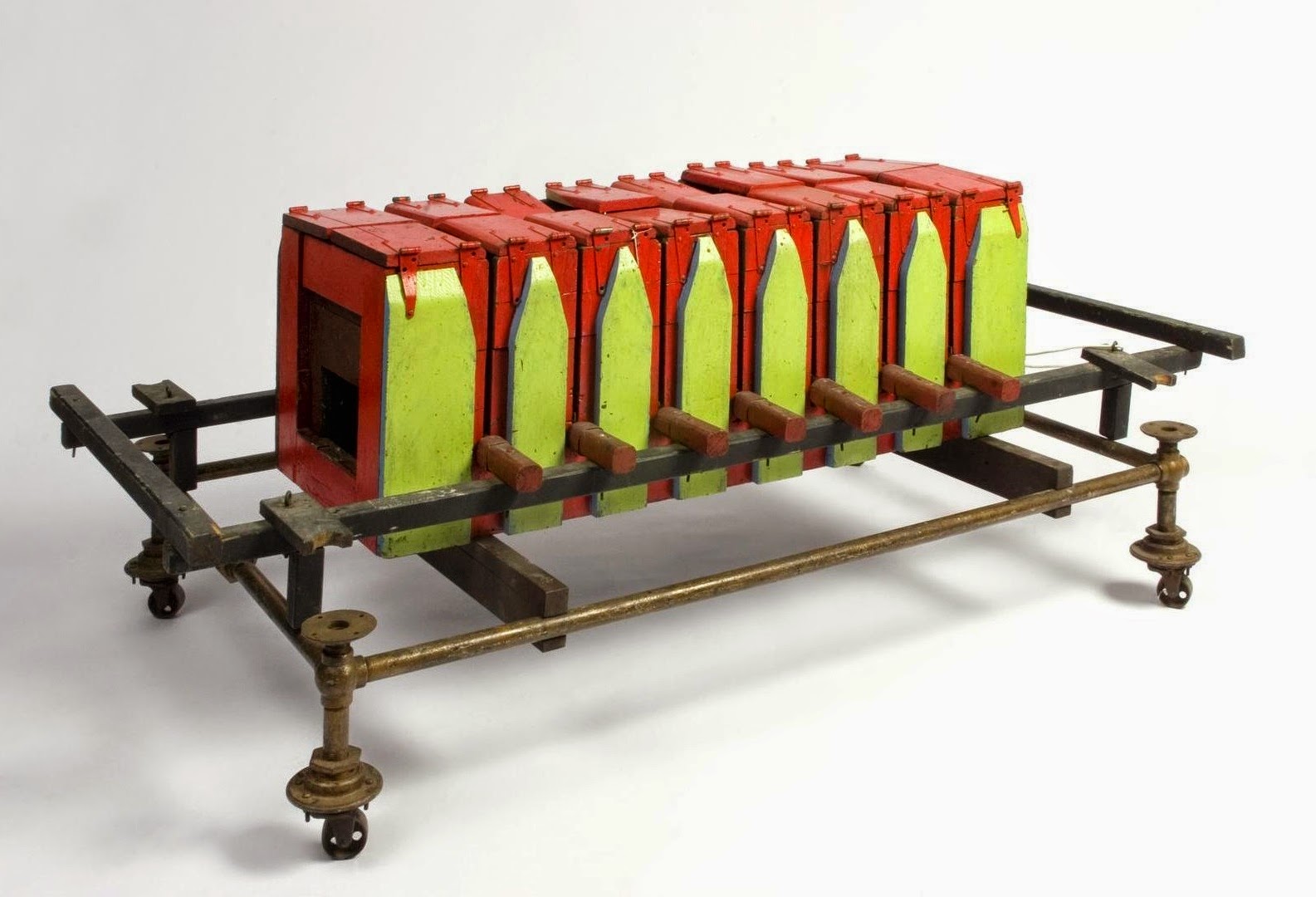
UPDATE: So it appears this wasn't such a mystery after all (just a mystery to me). Thanks to Joe Notaro and Tom Interval's Houdini Magical Hall of Fame Facebook page, here is a photo of the effect, along with a description from the great Patrick Culliton:

"The Cutting a girl into eight pieces apparatus was in the Niagara Museum from its opening until the fire. I put it together (not to perform, but, to display) for the Butterfield auction. I was not impressed with the illusion which Dunninger made, and Kevin Connolly has a letter from Houdini to Dunninger in which Houdini really complains about the shoddy workmanship. He says his men had to completely tear it down and rebuild it. It was really to take advantage of the Sawing a Lady in Half fad of a few years before. Hardeen performed it, and in a very rare professional appearance as a magician, Jimmy Collins performed it (and handcuff escapes and a straight jacket escape) around 1928."

- Patrick Culliton

It's said Dunninger's original design for the effect had the assistant fully concealed inside the box. But Houdini felt this would arouse audience suspicion, so he redesigned it to display the girl's head and feet.

The original "Slicing A Girl in Eight" apparatus sold for $3,450 at Butterfied & Butterfiled's auction of memorabilia from the Houdini Magical Hall of Fame held in Los Angeles on November 15, 1999. The restored effect was resold at a Bonhams auction of Entertainment Memorabilia on June 16, 2008 for only $2,700.

UPDATE: A December 5, 1926 article in the New York Daily News reveals that the women in the box was Houdini's niece Julia Sawyer.

Related:

Translate