Showing posts with label Series: Leading Ladies. Show all posts

Thursday, July 14, 2022

Before Beyond

Recently I stumbled on an advertisement showing Houdini on the same vaudeville bill as his future co-star in The Man From Beyond, Jane Connelly. Jane had never appeared in a movie before, and I've often speculated that Houdini may have known her and her husband, Erwin, who also appears in the movie as Dr. Gregory Sinclair, from vaudeville. This clipping seemed to confirm that.

This led me to do a little investigation into Jane's career before she went Beyond. Here's what I found.

Jane and Erwin Connelly appear to have started their vaudeville careers around 1907. Their act was a presentation of the popular english sketch, "Sweethearts," written by W.S. Gilbert. Here's a review from the January 26, 1907 Birmingham News:

"Sweethearts," as presented by Mr. and Mrs. Connelly, seems really more than a vaudeville turn, for the audience feels, as the curtain slowly descends upon the reunion of sweethearts of long ago, true to each other for forty years, as though a drama of several acts was just closing. It is called a "dramatic contrast," for it shows not only the bashful lover filled with the vigor of youth pleading his cause with a maiden, for after forty years waiting they are united, showing a pretty picture, old as love itself. The sketch was written by W.S. Gilbert famous for his composition of "H.M.S. Pinafore."
The Fort Wayne Journal Gazette, Dec. 15, 1912.

Unlike Houdini, most vaudevillians did not change their act. That was certainly the case with the Connellys who toured with "Sweethearts" for over 10 years. The first time I find them sharing the bill with Houdini is at Shea's Theater in Buffalo in October 1911. They appeared together again at the Maryland in Baltimore in 1912 and at Keith's Theater in Rhode Island in 1915.

The Connellys on the bill with Houdini....

But it wasn't just Houdini who shared the bill with the Connellys. Check out this appearance by Hardeen at the Columbia Theater in Davenport in April 1916.

...and Hardeen...

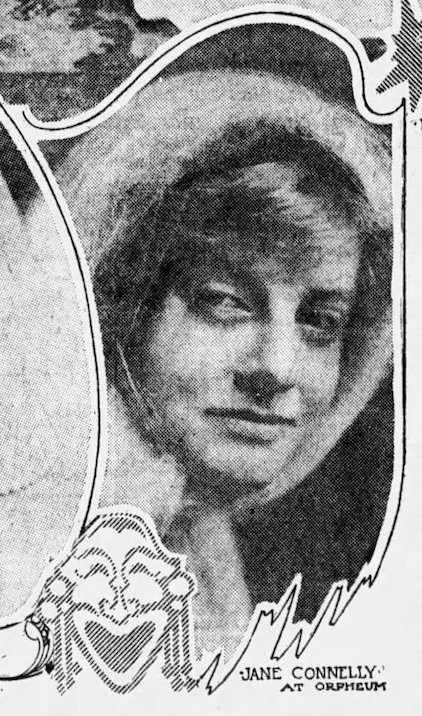
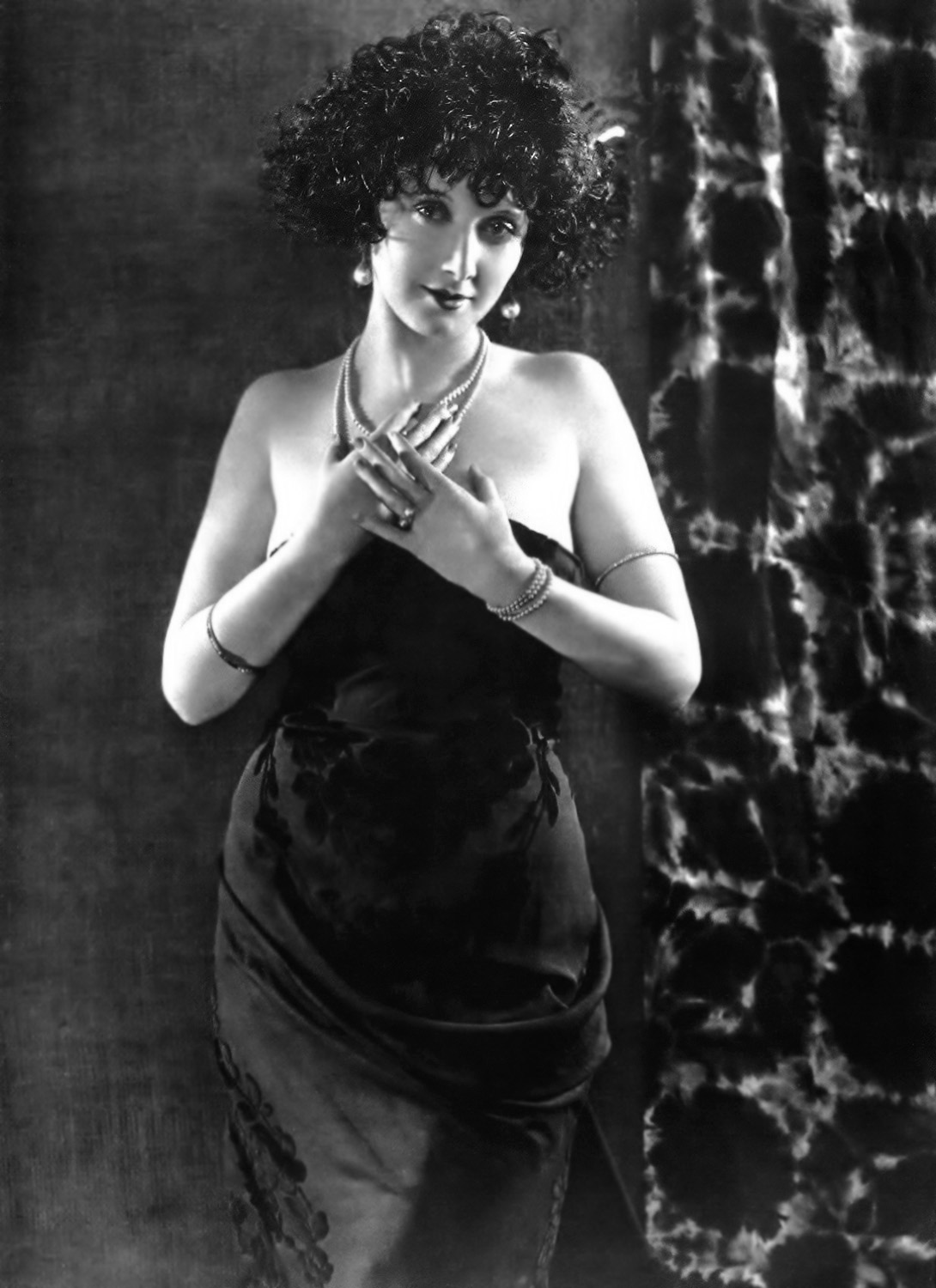
You'll notice the act is now billed as Jane Connelly & Co. Ewrin was still part of the act, but Jane was now featured more prominently in advertising. (I can't help but be reminded here of Bess Houdini's belief that billing an act as husband and wife was a bad idea.) The photo at the top of this post is from San Fransisco in 1915 and is a good example of this. Interestingly, that engagement saw the Connellys on the same bill as the Marx Brothers.

...and the Marx Brothers!

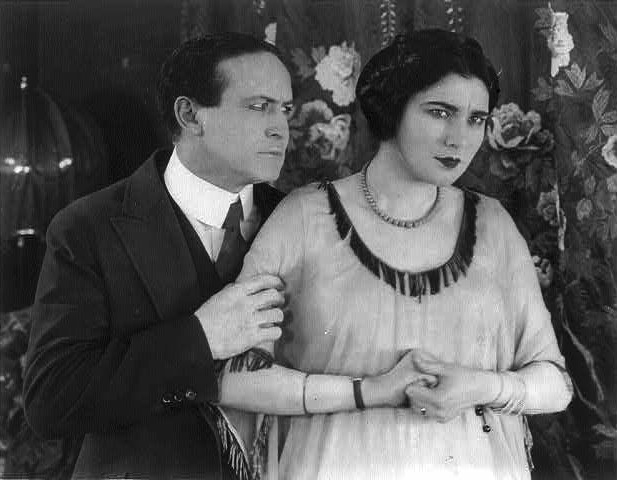
Despite a story in The Man From Beyond press book that says Houdini cast Connelly because she perfectly matched a composite photo of famous "psychic types" (you can read about that here), I think it's pretty clear Houdini knew the Connellys from vaudeville and felt comfortable casting the experienced actors in these important supporting roles. It's even possible the Connellys would have been familiar to audiences of the time and that offered some additional appeal. This was their first appearance in a film, and the movie does provide them with a nice scene together.

Erwin and Jane in The Man From Beyond.

The Connellys continued to perform in vaudeville into the 1920s, broadening their repertoire with new comedic sketches written by Erwin such as "A Tale of a Shirt" and "A Strong Cup of Tea". The only other film Jane would appear in was Buster Keaton's classic Sherlock Jr. (1924), again with Erwin.

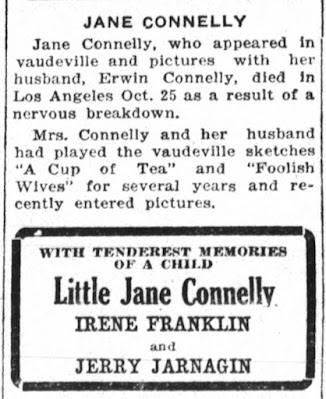
In 1925 Jane died at her home in Los Angeles. She was only 42. The below is from Variety. I'm not sure what to make of the cause of death being "a nervous breakdown."


After Jane's death, Erwin continued to appear in films, including an uncredited appearance as The Zouave in Rudolph Valentino's final film, The Son of the Sheik (1926). He died from injuries suffered in a car accident in 1931.

Chicago Tribune, Feb. 12, 1931.

Clippings: Newspapers.com

Tuesday, April 19, 2016

USD, Needles, and a future co-star?

This ad from a 1915 Rhode Island newspaper not only nicely features Houdini's Needles and the Water Torture Cell, but there's something else here that escaped my notice until now. Can you spot it?


Notice the name of Jane Connolly, "The Dainty Comedianne", just below Houdini. I'm wondering if this is Jane Connelly, Houdini's co-star in The Man From Beyond? As I noted in my Leading Ladies profile, Connelly and her husband were vaudeville performers, and it's likely Houdini's friendship with the Connellys was behind the casting. (Mr. Connelly was also in The Man From Beyond.)

Of course, the name on this ad is spelled Connolly, not Connelly, so this could be a completely different Jane. But misspellings in newspaper ads are not unheard of, even for the most famous of headliners:


UPDATE: I'm now certain this is Jane Connelly from The Man From Beyond. "A Strong Cup of Tea" was written by her husband Erwin who also appeared in the cast. But this wasn't the first time Houdini and the Connellys shared a bill. I will have more about that in an upcoming post.

Friday, April 10, 2015

Houdini's leading ladies: Mae Busch

Until I saw The Grim Game last month, I had no idea how big a role actress Mae Busch played in the film. Because of this, I didn't include her in my Houdini's Leading Ladies series in 2012. I'm correcting that mistake today.

Mae Busch was born on June 18, 1891 in Melbourne, Australia. Mae was famous in her day for playing "vamps." While she doesn't do any vamping in The Grim Game, she's still a beauty and a scene stealer as Ethel. A great moment is when she and leading lady Ann Forrest both beat up on a bad guy.

Here is Mae's biography on Fandango:

Australian-born Mae Busch was the daughter of an opera singer mother and a symphony conductor father. Her family came to the U.S. when Mae was 3 years old, and she was placed in a convent school while her parents toured the world. While still a teenager, Mae achieved stage stardom by replacing Lillian Lorraine in the musical comedy Over the River. In 1915 she became a Mack Sennett bathing beauty at the invitation of her close friend, Sennett-star Mabel Normand. Later, Mae was hired by Eric von Stroheim to play a lusty Spanish dancer in Stroheim's The Devil's Passkey. The director used her again in Foolish Wives (1922), casting Mae as the amoral--and fraudulent--Princess Vera. She was later signed by MGM, where she was billed as "the versatile vamp." Upset at the nondescript leading-lady roles she was getting, Mae walked out of her contract; this action caused producers to hesitate casting Mae in major productions. While free-lancing at second-rate studios, Mae accepted a comedy-vamp role in the Hal Roach 2-reeler Love 'Em and Weep (1927), which represented her first appearance with Stan Laurel and Oliver Hardy. Though she made an impressive sound feature-film debut in Roland West's Alibi (1929), the steely-voiced Ms. Busch's stardom had passed, and for the most part her talkie assignments were bits and secondary roles. Her best opportunities in the 1930s came in the films of Laurel and Hardy, where she was often cast as a shrewish wife or sharp-tongued "lady of the evening." In the team's Oliver the Eighth (1934), she essayed her most flamboyant role as an insane widow with a penchant for marrying and murdering any man named Oliver--which happened to be the first name of the hapless Mr. Hardy. Ms. Busch went into semi-retirement in the 1940s, occasionally resurfacing in small roles in such films as Ziegfeld Girl (1946); she died of a heart attack at the age of 49. Formerly married to silent-film star Francis McDonald, Mae Busch was also the aunt of 1960s leading lady Brenda Scott. ~ Hal Erickson, Rovi

Mae Busch has a star on Hollywood's Walk of Fame at 7021 Hollywood Blvd. This makes her Houdini's third leading lady on the boulevard (Nita Naldi and Lila Lee being the others).


The Grim Game will screen at the Wisconsin Film Festival next Thursday, April 16. It will air on TCM later this year.

More Houdini leading ladies:

Sunday, February 26, 2012

Houdini's leading ladies: Ruth Stonehouse

The other female star in Houdini's 1918 serial The Master Mystery was Ruth Stonehouse, who was born on September 28, 1892 in Denver, Colorado. Stonehouse played the deliciously named Zita Dane, confederate of the villainous Balcom, and is later revealed to be the sister of Houdini's Quentin Locke (if I remember my Master Mystery plot twists correctly). Her character is somewhat dour, and it's hard to believe that Stonehouse is actually five years younger than leading lady Marguerite Marsh.

In addition to being an actress, Ruth Stonehouse was also a director of early silent film, which certainly made her a cinema pioneer. When she did The Master Mystery, Stonehouse was a big enough name to share billing alongside Houdini (see below). Today her participation in the film is overshadowed by the more sensational aspects of the story -- not to mention Houdini himself -- and is all but forgotten. This is a shame because Stonehouse's presence must have added a measure of legitimacy to this first production from Octagon Films.

Here is her biography on Fandango:

Pioneering American silent screen actress Ruth Stonehouse was the first leading lady of Chicago's Essanay Co. She stayed with Essanay for close to four years -- often appearing opposite the era's great matinee-idol Francis X. Bushman -- before seeking greener pastures at the newly inaugurated Universal City. This rambling, somewhat chaotic studio offered Stonehouse the chance to write and direct some of her vehicles, mostly polite situation comedies but also melodramas with intriguing titles such as A Limb of Satan (1917) and The Saintly Sinner (1917). Stonehouse's popularity was on the wane by 1920, and she spent the remainder of her screen career playing fallen women. She retired in 1927. ~ Hans J. Wollstein, Rovi

Ruth Stonehouse died in Hollywood, California of a cerebral hemorrhage on May 12, 1941, at the age of 48.


More Houdini leading ladies:

Saturday, February 25, 2012

Houdini's leading ladies: Marguerite Marsh

I'm going to wrap-up my series on Houdini's leading ladies this weekend by looking back at two co-stars from his 1918 serial, The Master Mystery. First up is Marguerite Marsh, who was born on April 18, 1888 in Lawrence, Kansas. At age 30 Marsh played Eva Brent, daughter of the unfortunate Peter Brent and the love interest to Houdini's Quentin Locke.

Here is her biography from Fandango:

According to legend, D.W. Griffith spotted this dark-haired beauty on the beach at Santa Monica, CA, in the winter of 1911. He could hardly have missed her, according to Linda Arvidson, the director's wife, who, with but a tinge of jealousy, later reported that Marguerite had sported "the most modern black satin bathing suit and high-heeled French slippers." Also according to legend, the newcomer did not entirely believe in the possibilities of film acting and when asked to appear on set for a comedy with Fred Mace instead sent her younger sister, Mae. And it was the blond, waif-like Mae Marsh who went on to cinematic fame and fortune, briefly at least, while Marguerite, who used her middle name of Loveridge at the time, drifted north to Niles, CA, and played in Broncho Billy Anderson Western programmers.

By 1914, Marguerite Loveridge, nicknamed "Lovey," was appearing as second fiddle to real-life cause célèbre Evelyn Nesbit (Thaw) in a Lubin three-reeler, Threads of Destiny, when rescued from near-oblivion by rotund comic Fred Mace, who starred her in his own comedies and wanted to marry her in real life as well. Marguerite routinely turned him down, however, a sad state of affair that reportedly caused the comedian's early death in February of 1917, either by suicide or from a heart attack attributed to crash dieting in a last ditch effort to win her back.
Her own screen career uninspiring at best, Marguerite changed her last name from Loveridge to Marsh in an obvious attempt of riding on her sister's coattails. She was briefly back with Griffith at Fine Arts but then drifted from one studio to another, rather aimlessly and earning reviews that ranged from lukewarm to poor: "While slightly amateurish at times, Marguerite Marsh did rather well in a few well-chosen scenes"; "Miss Marsh did the best she could with an impossible theme"; "Miss Marsh glides through her part mechanically." It was not enough to sustain a career, not to mention a rather extravagant social life, and by the mid-'20s, she was finished, professionally as well as emotionally. When she died from bronchial pneumonia in New York in December of 1925, Marguerite Marsh was all but forgotten. ~ Hans J. Wollstein, Rovi

Houdini cozies up to Marguerite in The Mastery Mystery

Sunday, February 19, 2012

Houdini's leading ladies: Rosemary Theby

The most overlooked of all Houdini's leading ladies (for reasons I will explain below) is Rosemary Theby, who was born Rose Masing on April 8, 1892, in St. Louis, Missouri. Theby played Stella Mourdant, wife of the villainous Guy Mordaunt (described as being "no better than her better-half"), in Houdini's second feature for Famous Players-Lasky, Terror Island.

Here is her biography from Fandango:

Slender, sad-eyed leading lady Rosemary Theby made her film debut in 1912, and that same year starred as Celia in a greatly abbreviated film version of Shakespeare's As You Like It. In her heyday (1915-1922), Theby often co-starred with her husband, actor/director Harry C. Meyers; among other roles, she played Morgan Le Fey in Meyers' lavish version of A Connecticut Yankee in King Arthur's Court (1921).
Professional and financial reverses forced both Theby and her husband into bit parts and extra roles during the talkie era. Several of Theby's 1930s assignments were obtained through the kindness of comedian Oliver Hardy, who'd been a minor player in some of the actress' pre-WWI vehicles. Rosemary Theby's best talkie role was the laconic Mrs. Snavely in the classic W.C. Fields two-reeler The Fatal Glass of Beer (1932). ~ Hal Erickson, Rovi

Theby is present throughout Terror Island, and even has the distinction of being the only Houdini leading lady to die onscreen (she's shot on the sinking submarine -- blink and you'll miss it). However, Theby's best scene, in which she vamps Houdini's Harry Harper in an attempt to get a map from him, is contained on one of the two reels that are missing from the only known print of the film. There isn't even a description of this scene on the explanatory cards that summarize the missing action on the DVD. All we have of Theby's performance here are a few stills, including a lobby card that reads: "Are you crazy, madam?".

This may be why she is often forgotten among the pantheon of Houdini's leading ladies. In fact, poor Theby's photo in The Secret Life of Houdini is misidentified as being Nita Naldi in The Man From Beyond (wrong vamp, wrong film).

Rosemary Theby died on June 10, 1973 at the Virgil Convalescent Center in Los Angeles, CA.

Rosemary Theby and Houdini in their lost scene from Terror Island.

Saturday, February 18, 2012

Houdini's leading ladies: Nita Naldi

While the leading lady of Houdini's 1922 The Man From Beyond was Jane Connelly, the more famous actress in that film was Nita Naldi. Born Mary Nonna Dooley on March 1, 1895 in New York City, Nadi was probably the biggest female star Houdini ever worked with. She had played opposite John Barrymore in Dr. Jekyll and Mr. Hyde, and would famously vamp Valentino in Blood and Sand, released the same year as The Man From Beyond.

In the film Naldi played Marie Le Grande, "the vamp", which was her specialty. Even though she doesn't actually appear in a scene with Houdini (at least in the existing print), she was featured in The Man From Beyond publicity, which played up the fact that she had just signed a five year contract with Famous Players-Lasky/Paramount.

Here is Nita Naldi's biography on Fandango:

The "female Valentino," as she liked to call herself, Nita Naldi became the most outrageous vamp of the 1920s -- reportedly both on and off the screen. Born Anita Donna Dooley and convent-educated, Naldi took her professional name from a school chum (Mary Rinaldi) and set out to conquer the world of show business with a vengeance. A chorus girl in The Passing Show of 1918 and The Midnight Whirl (1919), Naldi was appearing in Morris Gest's Aphrodite (1919) when approached by John Barrymore, who cast her as Gina in Dr. Jekyll and Mr. Hyde (1920). Although Barrymore would later dismiss her as his "dumb Duse," Naldi is surprisingly modern in her flamboyant role as Hyde's would-be seducer and she steals every scene she's in. She was personally selected by famed writer Vicente Blasco-Ibanez (who, Naldi claimed, dropped his dentures down her cleavage while engaged in a tirade against the Catholic church) for the role of the temptress Doña Sol in Blood and Sand (1922), outrageously vamping Rudolph Valentino who seems to be literally energized by her lustful behavior. The florid melodrama became her signature film and was so popular that she was reunited with Valentino twice in A Sainted Devil (1924) and Cobra (1925). Gertrude Olmstead met Naldi while filming the latter and later told the film historian Anthony Slide that the notorious femme fatale was "so sweet to me and so very interesting."

Contrary to popular belief, Naldi did not play the native girl in Alfred Hitchcock's directorial debut, The Pleasure Garden (1925), but she did turn up somewhat unexpectedly as the schoolteacher in his second film, The Mountain Eagle (1926), a presumably welcome respite from vamping. A few more European films followed, including Léonce Perret's La Femme Nue (1926), but her type had become an anachronism by then and she wisely retired at the advent of sound. There were brief returns to Broadway -- The Firebird (1932), Queer People (1934) -- and Naldi became one of the former Hollywood luminaries featured at Billy Rose's Diamond Horseshoe nightclub in the early '40s, where, quite appropriately, she recited Rudyard Kipling's famous poem A Fool There Was backed by a line of chorus boys. Naldi's final public appearance came opposite Uta Hagen in the 1952 stage comedy In Any Language.  
One of the last of a breed, Naldi brought old-fashioned screen vamping into the more liberated age of the Roaring Twenties, the true heiress to the throne vacated by Theda Bara. But screen vamps rarely took themselves too seriously, she confessed in a later interview. "At least I didn't and I know some of my best friends and rivals didn't either." Spending her final years as a recluse, Nita Naldi died of a heart attack in her room at Manhattan's then-shabby Wentworth Hotel in 1961. Sadly, she had been dead for at least 48 hours when her body was finally discovered. ~ Hans J. Wollstein, Rovi 

Interestingly, Nita Naldi has several things in common with Houdini's Terror Island leading lady, Lila Lee. Both appeared in Blood and Sand and both have the honor of being the only Houdini leading ladies to have stars on the Hollywood Walk of Fame. Naldi's star is at 6316 Hollywood Blvd., directly across the street for Bess Houdini's Hollywood hangout, Sardi's.

For more on Nita Naldi, vist the excellent nitanaldi.com.

Houdini and Nita get serious in a moment not in the existing film.

More Houdini leading ladies:

    Sunday, February 12, 2012

    Houdini's leading ladies: Gladys Leslie

    Having cast the unknown Jane Connelly as the leading lady in his first independent feature, Houdini would turn to an established actress as his co-star for his next film, Haldane of the Secret Service (1923). Born in New York City on March 5, 1899, Gladys Leslie was a 24-year-old starlet when she played Adele Ormsby in what was to be Houdini's last movie.

    Here is Gladys Leslie's biography on Fandango:

    "The Girl With the Million Dollar Smile" and at one point a rival to Mary Pickford, blonde Gladys Leslie had begun her screen career in the early 1910s as an extra in Edison one-reelers. She became a star with the Thanhouser company in 1916, appearing as winsome waifs in Falstaff brand comedies.
    The following year, she played the youngest daughter of Frederick Warde's The Vicar of Wakefield and starred in the title-role of An Amateur Orphan (1917), a Pickford-esque fairytale filmed on location in upstate New York.
    Switching to Vitagraph, Leslie continued to play dimpled ingenues, but her career was already waning by the early '20s. She always maintained that she would quit films once her bank balance "has mounted high enough" and by 1925 she did just that, apparently never looking back. ~ Hans J. Wollstein, Rovi

    Gladys Leslie (Moore) died in Boynton Beach, Florida on October 2, 1976 at age 77.


    More Houdini leading ladies:
    Saturday, February 11, 2012

    Houdini's leading ladies: Jane Connelly

    A mystery of Houdini's movie career is why he chose an unknown, first-time film actress as the leading lady in the first feature for his Houdini Picture Corporation, The Man From Beyond (1922).

    We know almost nothing about Jane Connelly -- who played Felice Strange and her past life incarnation, Felice Norcross -- except that she was born on May 2, 1883 in Port Huron, Michigan, and died on October 25, 1925 in Los Angeles. She only made one other appearance in a film, Sherlock Jr., for which she was uncredited. Even more perplexing is that Connelly was 38 when she was cast in The Man From Beyond, which made her an unlikely starlet in the silent era which saw ingenues as young as 15.

    So why after working with established names like Ann Forrest and Lila Lee did Houdini go for a complete unknown? It's possible the budget was limited by his choice of emerging star Nita Naldi to play the vamp in the film. It's also possible Houdini knew Connelly from the past, as she was have said to have performed in Vaudeville with her husband, Erwin Connelly (who played Dr. Gregory Sinclair in the film).

    But another, much stranger answer can be found in The Man From Beyond pressbook. In an article titled "Houdini's Perplexing Problem" it says that the production was "confronted with the strange problem that Houdini had to solve in order to engage the proper type of leading woman to support him." It continues:

    The story of "The Man from Beyond," dealing with the theory of reincarnation, the psychic type was required for the leading feminine role. Houdini, determined to secure exactly this type, made composite photographs of Paladena and Eva Fay, Mrs. Piper, the Gohlier Girl and Mme. Tomychik, names, all of them, that are familiar in the field of psychic phenomena.

    Equipped with this composite photograph, Houdini knew exactly what was needed in the way of type for his leading woman and after a long and exhaustive search through all the available talent among screen leading women, he selected Jane Connelly as being precisely the type required to interpret the role.

    So much like the composite photograph was Miss Connelly's own portrait that it seemed as if she had posed for it.

    Pretty wild, eh? And while this could just be typical ballyhoo (The Man From Beyond pressbook is filled with references to reincarnation, psychic matters, and even pro-spiritualist remarks), it does explain the unusual choice, and in light of my recent posts about Houdini's apparent belief in reincarnation, maybe he really did cast Connelly for her "psychic" quality.

    Or maybe she was just willing to work cheap and didn't mind getting wet.


    UPDATE: We now know quite a bit more about Jame. Check out Before Beyond.

    Sunday, February 5, 2012

    Houdini's leading ladies: Lila Lee

    Continuing our look back the leading ladies who shared the bill with Houdini in his silent movies, today we meet the lovely Lila Lee, who was born Augusta Wilhelmena Fredericka Appel in Union Hill, New Jersey, on July 25, 1901.

    At age 18 Lee landed the part of Beverly West in Houdini's second feature for Famous Players-Lasky, Terror Island (1920). Lee is the most physical of all of Houdini's leading ladies, finding herself in the middle of much of the action. Her leap through a barn door on her horse is as impressive as Houdini's own spectacular stunts in the film (and it appears it's really Lee who did the stunt). She even appears alongside Houdini in a rare three sheet poster (below).

    Here is Lila Lee's biography on Fandango:

    A pretty, apple-cheeked WAMPAS Baby Star of 1922, Lila Lee had been a performer since childhood and was widely known as "Cuddles," one of the stars of Gus Edwards' kiddie troupe. She was brought to Hollywood by Paramount's Jesse Lasky and headlined in her very first film, The Cruise of the Make Believe (1918). In typical silent screen style, she played a poor girl secretly supported by a rich admirer and the New York Times thought she had a "limitless future before her."

    After appearing as the servant wench in Cecil B. DeMille's Male and Female (1919), Paramount began to see the newcomer as a potential successor to that popular film's star, the elegant Gloria Swanson, and embarked on a hefty publicity campaign. Lee's detractors, however, were quick to point out that her work never really lived up to the ballyhoo. "She seemed permanently neutral," as one critic pointed out. Her co-starring turn opposite Rudolph Valentino in the immensely popular bull-fight melodrama Blood and Sand (1922) was still far from persuasive but her jet-black hair, severely braided in coils over each ear, created a trend and the fan mail kept pouring in. Her tumultuous marriage to matinee-idol James Kirkwood, very much an "A Star Is Born" affair, created additional headlines that lasted until their divorce in 1931.

    Lila Lee's up-and-down screen career was bedeviled by severe bouts with what was euphemistically referred to as tuberculosis but whispered to be the results of acute alcoholism. As Lon Chaney's leading lady in The Unholy Three (1930), she was positioned to become one of the new sound era's first major stars but a series of bad judgments and, again, highly publicized bouts with illness, led to supporting roles in Grade-B films. In 1936, she was a witness to the suicide of playboy Reid Russell and the resulting headlines reportedly made her camera shy. There were several aborted stage comebacks in the 1940s, a short-lived marriage or two, and appearances on early television soap operas in the 1950s. Her son with Kirkwood, James Kirkwood Jr., became a noted author and playwright but Lee did not live to see his crowning glory, the legendary Broadway musical A Chorus Line. Retiring from performing after playing country singer Margie Bowes' hayseed mother in the Florida-lensed Cottonpickin' Chickenpickers (1967), the veteran star died of a stroke at Saranac Lake, NY, in November of 1973. ~ Hans J. Wollstein, Rovi

    Lila Lee is one of only two Houdini leading ladies to have a star on the Hollywood Walk of Fame at 1716 Vine Street, very near the original location of the Famous Players-Lasky Studio where she worked with the Great Houdini.


    More Houdini leading ladies:

    Saturday, February 4, 2012

    Houdini's leading ladies: Ann Forrest

    Today I'm launching a series of blog posts featuring a look back at the leading ladies who shared the bill with Houdini in his silents movies. I thought I'd start off with Ann Forrest, who was born Anna Kromann on April 14, 1895 in Sønderho, Denmark. At age 24 Ann landed the plum role of aspiring reporter Mary Cameron in The Grim Game, Houdini's first feature film for Famous Players-Lasky.

    Here is Ann Forrest's biography on Fandango (a terrific resource for bios of silent stars):

    Danish-born silent screen actress Ann Forrest began her film career in 1915 performing diving stunts for the American "Flying-A" company under her real name, Ann Kroman. She became a star three years later opposite William Farnum in the first screen version of Zane Grey's The Rainbow Trail (1918), a major success for Fox, who would film the story twice more. It was Farnum who on the film's Grand Canyon location grandly rechristened the Danish actress as Ann Forrest; Kroman, according to Farnum, was too foreign for an American star. The brawny actor picked Forrest because, he explained, the name "signified something big, yet short and snappy." 
    The newly christened Ann Forrest was Harry Houdini's beleaguered leading lady in the action melodrama The Grim Game (1919) and earned rave reviews for playing a pathetic kitchen maid in The Prince Chap (1920). Blonde and "cute" rather than beautiful, Forrest made a strong impression on director Cecil B. DeMille who signed her to a five-year personal contract. Not exactly the type to loll about on a tiger skin like DeMille's usual coterie of leading ladies, Forrest never actually appeared in a DeMille film but was instead shipped overseas for Love's Boomerang (1922) in which she earned above-title star billing. Filmed in both England and France, the melodrama was a major success but her return to Hollywood proved anticlimactic and she left films in 1926 in favor of the legitimate stage. 
    In 1930, along with her director and leading man, Forrest was arrested and charged with "indecent exposure" during rehearsals for the then-controversial play Frankie and Johnny. That incident, along with a severe car accident, curtailed Ann Forrest's stage career and she retired completely from show business in 1931. ~ Hans J. Wollstein, Rovi

    According to her Wikipedia entry, Ann Forrest died on October 25, 1985 in San Diego, CA. That would have put her at age 90. Of all of Houdini's leading ladies, Ann enjoyed the longest life. It's a shame she was never interviewed (as far as I know) about her recollections of working with the Great Houdini.

    Houdini and Ann in a publicity pic for The Grim Game.

    More Houdini leading ladies:

    Thursday, February 2, 2012

    Coming: Houdini's leading ladies

    This weekend I will launch a new series, "Houdini's leading ladies", which will look back at the life and careers of the actresses who shared the silver screen with our Harry. Get ready to meet the ladies!

    Translate