Showing posts with label Buried Alive. Show all posts

Friday, December 6, 2024

Off to see Harry...


I'm going to wrap up 2024 with a speculative journey. I often think about time travel. Well, more specifically, I think about time traveling to see Houdini. I know I'm not alone in this. So if time travel were possible, and, say, you could select 3 specific days in the past in which to see Houdini, what days would those be? Here are the 3 days I would program into my flux capacitor:

Saturday, May 14, 1898
On this day, the Welsh Bros. Circus was playing in Harrisburg, Pennsylvania. The young Harry and Bess Houdini were traveling with the circus performing Metamorphosis in the circus concert tent, where Bess would also do her seriocomic songs. It's also possible I could find Harry doing his King of Cards act in the sideshow. While all this would be enough, this day marked Houdini's debut as a "clown on bars" in the Big Top show. "Went big and funny," he wrote in his diary. So, yeah, a chance to see so many aspects of the young Houdini and Bess and experience the entire Welsh Bros. show... What a day! Also, if the rules of time travel allow, it would be easy to approach and talk to him.

For my second date, it's very hard to not select March 17, 1904, as that was the day of the famed Mirror Handcuff Challenge in London. Very hard! But the Mirror Challenge was just one performance, and I want to maximize my Houdini time. Besides, I know Joe Notaro will choose the Mirror Challenge, so I can learn all about it from him. Instead, I'm going to...

Saturday, March 2, 1918
This time, I'm landing in New York City to see Houdini vanish his elephant and escape from an underwater packing case at the Hippodrome. In fact, I could see it twice as the Hippodrome had a matinee (at 2:15) and an evening show (at 8:15). After the evening show, I could zip over to Martinka's magic shop and, using a 1918 S.A.M. card borrowed from one of my collector friends, I could attend the 174th regular meeting of the S.A.M. which Houdini presided over as President. But there's more! This was the week Houdini was giving World War I soldiers lessons on how to escape from German handcuffs. So, disguised as a soldier, I could get a lesson in escapes from the Handcuff King himself! Although, a 60-year-old private might seem a bit suspicious. He might think I'm an imitator come to steal his secrets! Maybe I need to rethink this one.

My last choice has to be a performance of the 3 Shows in One. But which one? While it is tempting to see Houdini's final show in Detroit, I think it would be too upsetting. So I'll leave that to others. Instead, I'm going to...

Thursday, September 30, 1926
This was when Houdini was playing his 3 Shows in One in Worcester, Massachusetts. This is also the day of the Summerfield's Department store test, in which he was sealed in a glass casket for an hour propped up on view. Unlike his other outdoor stunts, which were over relatively quickly, this is one I could savor. I'd get to stand and look at the 52-year-old Houdini for an hour! Heck, maybe I could even strike up a conversation with Jim Collins. Maybe get a backstage pass to the show that night! And speaking of that show, Houdini was doing the onstage Buried Alive in Worcester at this time. So I can see exactly how he presented this still largely mysterious escape. Yes, this means I would not see the Water Torture Cell, but I want to learn during each jump. I would also get to see all the new and improved magic for the 1926-27 season, including Slicing a Girl. And how poetic to see Houdini at age 52 doing his King of Cards routine, just as I had seen him do it three days and 28 years earlier.

How about you? What would your three days with Houdini be? Let us know in the comments below. I've also launched a POLL on my Patreon.

Thank you for your patronage and support this year. It was a big year for centennials and celebrations, and I expect more of the same in 2025. Happy holidays. I'll see you all in the future!
The Houdinis 1924 Christmas Card.

2024 in Review:
January (23 posts)
February (20 posts)
March (20 posts)
April (20 posts)
May (21 posts)
June (19 posts)
July (11 posts)
August (18 posts)
September (19 posts)
October (22 posts)
November (19 posts)
December (8 posts)

Most Viewed New Post of 2024

Tuesday, October 10, 2023

Houdini's final outdoor stunt described at last


Houdini's last outdoor stunt occurred in Worcester, Massachusetts, on September 30, 1926. At least we think it did! Not a single book mentions this air-tight coffin test, and while I've found advertisements and newspaper articles promoting it, I've never found an actual account of the stunt itself. Also, no photos have ever surfaced. At times, I've wondered if, for one reason or another, it never took place.

Well, I can now put those doubts to rest because I've finally found the proof I've been looking for. It happened! Below is an account from the September 30, 1926 Worcester Evening Gazette which offers some terrific details.

Evening Gazette, Sept. 30, 1926

I love the detail about Houdini blinking his responses to Collins and also that he wrote on the fogged glass. I believe this would have become Houdini's new go-to outdoor stunt, forever replacing the suspended straitjacket, and it's striking how similar this is to what David Blaine would be doing 70 years later. It's also chilling to hear Houdini declaring this would be the casket in which he would be buried. Only a month later that would prove to be the case, so the people who saw Houdini on this day saw something darkly prophetic.

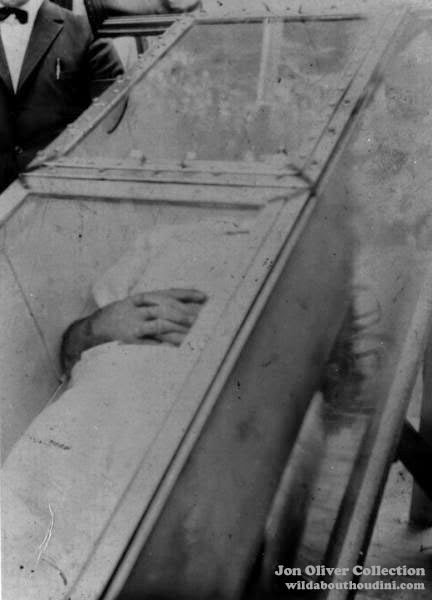
Now that we know this happened, I am more hopeful than ever that a photograph will one day surface. Considering this took place outside and lasted for an hour, it seems certain that photos were taken. Yes, there's the mystery casket photo that could be the Summerfield's test, but we need another photo to confirm this.

The building that housed Summerfield's still stands at 184 Main St. in Worcester and doesn't look all that different than it did in 1926.


Speaking of Worcester, our friend Jessica Jane and The Foolers will appear tomorrow at The Hanover Theatre and Conservatory for the Performing Arts in Worcester. So if you see the show, why not swing by the location of Houdini's last outdoor stunt?

Want more? You can read all the newspaper clippings and images I've gathered about the Summerfield's test as a "Scholar" member of my Patreon.

Monday, June 19, 2023

LINK: Houdini's favorite casket maker

Here's a well-researched post about the Boyertown Burial Casket Company on the blog MarkerQuest by Laura Klotz. Boyertown made the caskets for Houdini's final buried alive tests and, presumably, he's in a Boyertown casket today! So click below or on the headline to read all about Houdini's favorite casket maker.

Wednesday, December 7, 2022

Buried Alive surfaces in 1922

While at the Harry Ransom Center last summer I found this invoice among papers related to the Houdini Picture Corporation. It's from the Theodore Reisig Co., makers of "high grade scenery," and is dated January 4, 1922. I suspect those who saw this before me might have passed it by as just scenery for one of Houdini's movies. But Houdini was not making any movies at this time. And what's described here is, to my eye, something very different and very exciting!

Click to enlarge.

This "Sand Box with heavy ornamental iron hinges" and "apparatus for loading and unloading sand" can only be Houdini's Buried Alive escape. What we don't see here is the casket Houdini would also use in the effect. The bill is for $420, which in 2022 would be $7,450.30. Houdini settled the bill for $300.

The Buried Alive is one of Houdini's most elusive escapes. Houdini himself claimed to have performed it as early as 1908 in Germany. In 1914 he had a lithograph made for the effect, but there's no record of him performing it at this time. In 1918 he announced Buried Alive for his return to the Hippodrome in Everything, but when he broke his wrist making The Master Mystery he had to substitute it with a suspended straitjacket escape. There's also his famous 1919 accident while rehearsing a Buried Alive stunt in California, but that was an outdoor stunt, not the stage version.

Now here we have evidence of the apparatus being built in 1922. This contradicts Houdini's claim the he had the apparatus "rebuilt" in 1916. But the date does make sense career-wise. Needing money after a year of producing films, Houdini had just embarked on a 9-week vaudeville tour. It's possible he intended the Buried Alive to be his new escape for this and the tours to come. But for whatever reason, it didn't happen. The Water Torture Cell remained his marquee escape and Buried Alive wouldn't surface until 1926, and then only for a couple performances.

Maybe the biggest frustration about the Buried Alive is there are no photos of the apparatus and no good description of Houdini's presentation. The 1914 poster (right) is all there is to go on, and I'm not convinced the "Sand Box" was as large as this poster depicts. In fact, I suspect it was only a little larger than the coffin that fit inside.

Perhaps the records of the Theodore Reisig Co. survive and within them we could find the specs on the Buried Alive they built for Houdini in 1922. I could dig that!

You can unearth my Buried Alive research and see the envelope for the Reisig bill as a "Scholar" member of my Patreon below:


Related:

Monday, September 19, 2022

David Blaine shares his Houdini posters

Here's a YouTube video that's been generating some excitement. This provides a look at David Blaine's magic poster collection. Houdini has always been an inspiration to Blaine, so the Handcuff King is well represented. Enjoy.


David says Houdini never did the Buried Alive, but we now know that he did it at least twice on his final tour. By the way, I made an interesting discovery about the Buried Alive apparatus while at the Harry Ransom Center. I will be sharing that gem in time.

Thanks to Lance Rich at the Magic Collectors Corner for the alert.

Thursday, June 17, 2021

Houdini's tie-cutter manual and other rarities sell at Bonhams

A nice selection of Houdini rarities sold today in Bonhams Fine Books and Manuscripts auction. While an original annotated typescript for A Magician Among the Spirits was promoted as the auction highlight  (it even made the catalog cover), the item that struck me as the true gem was Houdini's very own 1891 union employee manual from his days as a New York tie-cutter.

HOUDINI'S OWN COPY OF THE TIE-CUTTER'S MANUAL. [HOUDINI, HARRY. 1874 – 1926.] Constitution and By-Laws of the Neckwear Cutters Association of the City of New-York. New York: Wm. B. Bromell, 1891. 32mo (124 x 78 mm). Publisher's printed wrappers, center fold to front cover, two paragraphs bracketed in the margins, possibly in Houdini's hand, pencil note "HOUDINI" to upper cover, portrait of Houdini pasted to rear cover. Provenance: Harry Houdini (letter of provenance from Charles Reynolds, dated May 26, 1999, addressed to:) Doug Edwards; John A. McKinven (sold his sale, Potter & Potter, Chicago, May 13, 2012, lot 240).

HOUDINI'S OWN COPY OF THE REGULATIONS OF THE NECKWEAR CUTTERS ASSOCIATION. From the letter of provenance from Charles Reynolds: "[this manual] was Harry Houdini's own manual when he worked as a tie-cutter for H. Richter's Sons at 502 Broadway, New York City. A page of this manual is picture in the book Houdini, His Legend and His Magic that I co-authored with Doug Henning in 1977. Houdini took special interest in the union's protection of secrecy—an attitude that later affected his outlook on magic." Henning and Reynold's book was heavily illustrated with items from a collection given to Henning by Ruth Kavanaugh, Houdini's niece.

The manual sold for $3,187 including premium.

The annotated A Magician Among the Spirits manuscript sold for $20,312 (inc. premium). A facsimile edition of this manuscript was published in 1996 by Kaufman and Greenberg.


A copperplate for what may be the first illustrated advertisement for "The Houdinis" sold for $5,737 (inc. premium). Bookending that is Houdini's last known full color poster, "Buried Alive!", which sold for $7,650 (inc. premium). 


Congrats to the winners!

Related:

Saturday, May 16, 2020

At last! Evidence of Houdini's near fatal buried alive surfaces

The story of Houdini nearly dying during a buried alive stunt in California is one that appears in most biographies. As told by Houdini in a 1925 Collier's article ("When Magic Didn't Work") he was trying the escape at different depths. But when it came to six feet, he found the weight of the earth too much and for the first and only time in his career he panicked and shouted for help. But he could not be heard under the soil. By sheer will he was able to claw his way to the surface and collapsed as his assistants hauled him from what had almost been his real grave. Houdini called it "the narrowest squeak in my life."

Illustration by Noa Kelner.

It's a great story, but there has always been a problem with it. There's no evidence that it actually happened. Exactly where the stunt took place has never been clear. Houdini first said it happened "in Hollywood." But it later became "Santa Ana", which is a good 30 miles from Los Angeles. Nor has a date ever been established. Most biographies, while never explicitly dating it, place it in their chapters covering the years 1915-16. But in Collier’s Houdini wrote that it occurred "six years ago," which would make it 1919. But Houdini was famously bad with dates.

The only thing that has kept me from dismissing this story as Houdini-generated mythology is a handwritten annotation Houdini made on some Buried Alive notes which appears (undated) in Walter B. Gibson's Houdini's Escapes (1930):

"I tried out 'Buried Alive' in Hollywood, and nearly [?] did it. Very dangerous; the weight of the earth is killing." 

So this is where things have stood on the Buried Alive story for decades.

But last Wednesday while doing some unrelated research, I stumbled on the following from the May 16, 1919 Los Angeles Times and nearly fell out of my chair!

Los Angeles Times, May 16, 1919.

So is this THE buried alive? Let's dig deeper.

Houdini had arrived in Los Angeles in late April 1919 to begin work on The Grim Game. By mid May he had already performed with the Lasky players at two Liberty Loan drives in Pershing Square (in which he was tied to a cannon). So this is right in line with his activities at this time. And it looks like Houdini had the year right after all!

The Air Memorial Day circus was a major event featuring over 50 airplanes and staged dogfights. The grand finale was to be the bombing of a German balloon, but it broke loose and drifted off over Hollywood. The crowd was estimated at 100,000.

The location, De Mille Field, sat at Crescent and Melrose Avenue between the cities of Hollywood and Santa Monica, which is likely what Houdini meant when he wrote Santa Ana. If DeMille Field sounds familiar, that's because it's where The Grim Game airplanes were leased and took off on their own fateful flights.

DeMille Field.

But there are some problems. In Houdini's telling it was a private test done on a bet with the magician trying the escape at graduating levels. I was also able to find several accounts of the Air Memorial Day event itself, including a detailed schedule, and there is no mention of Houdini, let alone a near death experience. Not something you'd expect a newspaper to ignore! So it appears Houdini did not do the escape at the event itself. Nevertheless, I still think we've found it.

My thinking is Houdini's close call occurred while he was practicing the escape, likely a day or two before the event. This fits with the graduating levels. He then cancelled the performance when he discovered six feet, as announced, was not feasible and damn dangerous. For it to be announced on the 16th, and then the papers show Houdini removed from the lineup on the 18th, suggests this test happened on the 16th or 17th. It seems logical Houdini would have tried it at DeMille Field itself, although we can't know that for certain. But a test before the event makes sense, and the fact that he didn't do the escape as announced only reinforces the idea that something happened.

So there we have it! Houdini's near fatal buried alive stunt is not the stuff of mythology but appears to have happened in mid May 1919. Maybe even 101 years ago today?


The illustration at the top of this post is by Noa Kelner and used with permission. Bottom illustration is from Patrick Culliton's Houdini The Key.

Related:

Friday, April 3, 2020

Houdini under doctor's care in September 1926?

The final days and weeks of Houdini's life continue to fascinate, largely because we keep discovering new information that kicks off fresh speculation. Much of that speculation has to do with exactly when he first became ill. Well, here's another new morsel for us to chew on.

On September 24, 1926, Houdini appeared as part of special "Midnight Benefit" show to aid the Red Cross and victims of the devastating 1926 Miami hurricane. The show was given at the Metropolitan Theatre in Boston. In the advert on the right you can see Houdini's name below Al Jolson and Georgie Jessel. Houdini was playing his 3 Shows in One for the third and final week at the Majestic Theater at this time (featuring Buried Alive).

On the day of the benefit the Boston Globe ran an article ("GREAT BENEFIT SHOW FOR FLORIDA TONIGHT") that singled out Houdini for a mention. But what's curious is the paper states he "is under the care of his physician."

The surprise of the evening will be the appearance of Harry Houdini, who promises the committee that he will show them how to extract more donations from the audience. Houdini, who is appearing at the Majestic, is under the care of his physician, but despite this handicap the mystifier will be on hand to do his stuff for this call of charity.

This is the first I've heard of Houdini being ill or injured in September 1926. This was before his accident in the Water Torture Cell and well before the famous punch. Two days earlier he spoke at an Advertising Club of Boston luncheon at the Hotel Bellevue, and the Boston Globe's detailed account of that gathering makes no mention of a doctor. Indeed, Houdini seemed to be in top form, even stating, "I'm 52, but physically I'm 35."

One possibility is this physician was with him for training purposes as this was only a few days before his second submerged casket test at the Worcester YMCA. Other than that, this one has me stumped and, of course, intrigued!

Related:

Monday, January 27, 2020

Four photos from Houdini's Worcester YMCA test

Here's an exciting followup on yesterday's anniversary flashback post about Houdini's little known underwater test at the Worcester YMCA on September 28, 1926. Reader Jay Hunter has generously provided four remarkable photos of this stunt from his collection. Until now, we've only had is a single poor quality newspaper image of this stunt. Now, thanks to Jay, we finally see it all!


I'm especially excited by this first image that shows Houdini being examined by a doctor before the test. Not only is this a great photo from the stunt, but it instantly joins an elite group of pics that are the last ever taken of the magician. He looks fit, healthy, and fantastic in this shot. In fact, he looks better here than in many of the Shelton pool test pics. It's heartbreaking to think he's only a month away from death.

The other photos show the test in progress. Note Jim Collins poolside.


Here is an article from the Worcester Daily Telegram describing the YMCA test.

Houdini Defies Suffocation in Y Stunt

Sealed in a small casket, Houdini, wizard extraordinary, remained at the bottom of the Y.M.C.A. tank one hour, 11 minutes, Tuesday morning, proving to an audience composed largely of physicians in scientific men that the seemingly impossible feat could be done. While Yogis of India claim to be able to stay buried indefinitely and come up alive by means of spiritual power, the great American performer accomplished his stunt, he asserts, by simple natural means.

Houdini was placed in the iron casket, measuring about 6 feet and containing not more than 10 cubic feet of space. The lid was then soldered on and the casket submerged and held down by weights and sight men sitting on it. While thus imprisoned the master wizard communicated with the outside by means of the telephone and electric bell.

Houdini was examined before entering the casket by Drs. Samuel C. Gwynne, F.L. Maguire and Clarence Usher.

The secret of the stunt, Houdini claims, was in banishing fear and in taking shallow breaths. By remaining quiet he was able to control in a measure the consumption of air.

The original impetus for the Worcester test was so Houdini could answer critics who claimed his telephone system somehow provided him with air during the Shelton test. Papers reported that Houdini would do this test in new glass topped casket which would not require communication. However, we can see in these photos that the casket Houdini used is almost identical to the one he used at Shelton. A few hours after this test he received his new glass topped casket from the Boyertown Casket Co. of New York which he used for a third (non submerged) test at the Summerfield's Furniture store in Worcester on September 30.

With these three stunts we can see that Houdini was clearly moving in the direction of endurance tests being his primary "outdoor" publicity stunts. Very much the kind of thing that David Blaine performs today. It's another reason I find photos like these so exciting. We're catching a glimpse of Houdini's final career metamorphosis.

A monumental thanks to Jay Hunter for sharing these gems from his collection.

Related:

Sunday, January 26, 2020

10th Anniversary: The Worcester YMCA pool test

As part of WILD ABOUT HARRY's 10th anniversary, I will post links back to significant stories from 2010 with a ten year follow up. Today I share the first of these flashbacks from January 26, 2010.

Houdini's famous Shelton Pool test is well known. But you'll barely find any mention of his second underwater endurance test performed at the Worcester YMCA a month later. So click the link below and travel back 10 years to read all about:

Uncovering Houdini’s SECOND underwater test

TEN YEAR UPDATE: This still remains a largely unknown Houdini stunt and the photo above is still the only known image. I wish I had more to share. But what I had 10 years ago is still pretty much all I know.


UPDATE: Reader Jay Hunter has provided four remarkable must see photos from this test, SO GO!

Related:

Tuesday, January 29, 2019

Houdini said he first did Buried Alive in 1908


On February 23, Potter & Potter will auction the first part of The Magic Collection of Jim Rawlins. Jim is a very nice guy who has a formidable collection, including some very nice Houdini items. Jim recently shared selections from his collection in two videos on his YouTube channel.

While I encourage you to watch both videos in full, what will be of special interest to Houdini nuts is what Jim shares at 15:30 in the below video. It's a signed copy of Miracle Mongers and Their Methods in which Houdini states he first performed the Buried Alive in Berlin in 1908! [Jim also blogged about this last year.]


I'm always leery of accepting any date from Houdini, especially when written from a distance (this was written in May 1926). However, 1908 makes sense as Houdini spent two months at the Circus Busch in Berlin. Saying that he rebuilt the apparatus in 1916 gives me some pause as it seems logical the rebuild would have happened in conjunction with the poster he had made in 1914. But I don't think we have any reason to doubt Houdini here. He performed the Buried Alive much earlier than anyone thought.

Houdini saying that he still has the apparatus changes how I think we should perceive his 1926 Buried Alive. Far from being a "new" effect developed for his new season, it appears it was an old effect he was dusting off. This is likely because the publicity windfall he received for the Shelton Pool Test suddenly made adding Buried Alive to the 3 Shows In One a great idea. In fact, you can almost imagine him getting that idea right after he writes this inscription.

This find also illustrates something I've been thinking about lately. Houdini's performances in Germany are a historical blind spot. Houdini spent a lot of time in Germany, and his engagements would last for months in a single theater. This gave him time to build apparatus and try out new ideas. But we know almost nothing about these German performances, probably because the newspaper accounts and playbills are all in German! But here's an indication of what we've been missing.

This particular book is not part of this first Potter auction of Jim's collection. For more information and to view the catalog visit Potter & Potter Auctions. Jim also sells items direct at his website Magic Collectibles.

Thanks to Joe Fox for this tip.

Related:

Monday, January 28, 2019

Houdini's Last Secrets ep. 4 unearths Buried Alive


Houdini's Last Secrets goes out on a positive note with an investigation of Buried Alive. This was a good choice of subject for the final episode. Apart from two posters, very little is known about this feat, so it was not only interesting to see how Houdini might have accomplished the escape, but it was interesting just to see how he might have presented it in the first place!

One can easily get buried in the history of Buried Alive as there were multiple versions. The show does a nice job of separating Houdini ill-fated outside buried alive stunt and his later stage-bound version. (They avoid the Shelton Pool Test.) The episode sticks with the conventional wisdom that Houdini never performed his stage-bound version. But in recent years, evidence has surfaced that shows he actually did perform it at least twice at the start of his 1926-27 season.

Interviews are again a highlight. This time George Hardeen visits Antony Britton in England, who attempted the outdoor casket-free buried alive and, like Houdini, nearly died. Roger Dryer shows us his magnificent Houdini Museum of New York which holds a casket Houdini escaped from in 1907 (unburied). It's a treat to see David Merlini and his own House of Houdini museum in Budapest, Hungary. I don't believe David has appeared in a Houdini documentary before, but his knowledge of Houdini history and his first hand experience with escapes--including being buried alive--make him an ideal interview subject. Finally, we get to see the mighty Arthur Moses in his own temple of Houdiniana in Fort Worth. Arthur handles his Houdini history with great authority.

In fact, this episode is probably the best yet as far as Houdini history is concerned, expanding it with mentions of his movie career and crusade against fraudulent spirit mediums. The idea that George is uncovering the story of his great uncle for himself and the audience is best realized in this episode. Of course, it wouldn't be "reality" TV without talk of a murder conspiracy! But the episode doesn't go too deeply into this and is not significantly derailed by it.

But the meat of the episode is the Buried Alive itself. Steve Wolf at Stunt Ranch constructs a theoretical version of Houdini's stage apparatus for magician Lee Terbosic to attempt. Both the conception and method is ingenious, and because we don't even know exactly how Houdini presented it, there's no danger of exposure. But in bringing the escape to life, one can appreciate how it was an effective stunt, and maybe even a lost Houdini masterpiece. So the episode has provided a real service to Houdini history by showing us what may have been.


Overall, this series turned out to be a mixed bag. It contained a disappointing amount of speculative hokum about Houdini being a spy at the expense of a more fact based exploration of his life. But the team's investigations and recreations of Houdini's feats were all very well done, and the series provided great interviews with fresh faces. And above all, it was respectful to Houdini and made him ever more fascinating!

It also did not turn out to be an exposure show as many had feared. They did indeed successfully ride the line between exposure and investigation, and in the case of a few genuine secrets, such as the Water Torture Cell, they went out of their way to protect the real method. So I'd say this series was a cut above and a worthy addition to the growing list of Houdini documentaries. I would be happy to see a second season.

The complete Season One of Houdini's Last Secrets is available for purchase at Amazon and iTunes.

If you're interested in more information on Buried Alive, check out the below links:

    Sunday, January 27, 2019

    LINK: How Harry Houdini might have pulled off his most daring trick

    This is a bit of a spoiler for tonight's fourth and final episode of Houdini's Last Secrets, but it's a good article by Mental Floss (an excellent website) with some nice details about the team's Buried Alive build. Click the headline to have a read.

    Stunt expert Steve Wolf considers the buried alive illusion Houdini's most daring trick. "The margin for failure on that is zero," Wolf tells Mental Floss.

    Houdini's Last Secrets airs on the Science Channel and the SciGO app. You can also stream episodes at their website or purchase the series at Amazon and iTunes.

    I'll share my review of episode 4 tomorrow.

    Related:

    Saturday, December 15, 2018

    First promo for 'Houdini's Last Secrets'

    The first promo for the Science Channel's new 4-part series Houdini's Last Secrets is below. The series features George Hardeen and magician Lee Terbosic investigating some of Houdini's enduring mysteries. (I may even show up as well.)


    Despite what this promo implies, I've been assured that the show will not actually expose Houdini's secrets.

    Houdini's Last Secrets premieres Sunday, January 6 on the Science Channel and the SciGO app.

    Related:

    Saturday, October 20, 2018

    Rare pitchbooks highlight 'Houdiniana' auction


    Today saw Potter & Potter's auction of "Houdiniana" featuring many items from the collection of our late friend John Bushey. John's specialty was Houdini pitchbooks, and the rarest of those sold for big bucks.

    The top seller was Houdini's ultra rare 1898 Magic Made Easy pitchbook at $9,600 (all prices quoted here include 20% premium). This doubles the price of one that sold on eBay in 2007. Another rare 1907 pitchbook titled The Famous Houdini (the only one I think I've ever seen) came in at $7,200.

    Magic Made Easy - $9,600 | The Famous Houdini - $7,200.

    The Adventurous Life of a Versatile Artist with a rare variant cover grabbed $5,040. A copy of Houdini's The Mystery of the Jewel movie treatment brought in $4,080.

    Adventurous Life - $5,040 | Mystery of the Jewel - $4,080.

    But the auction had more than just pitchbooks. A Buried Alive poster fetched $7,800. A pair of Providence Tool Co. handcuffs with good provenance sold for $11,400. An unpublished photo of Houdini jumping handcuffed from a gazebo sold for $3,600. Another unpublished photo of Houdini, Bess, and Mama in Germany brought in $1,560. I actually thought this latter photo could have gone higher as Mama pics are few and far between.


    Congrats to all the winners and to Potter & Potter for another great auction.

    Related:

    Wednesday, April 18, 2018

    Rough Riders: Ride or Die #3 digs Houdini

    The third issue of Adam Glass's Rough Riders: Ride or Die! is out today. It features a nice "buried alive" Houdini cover and storyline with the familiar title "Under the Pyramids".

    Volume Three of the hit AfterShock Series continues! In 'Under the Pyramids', Harry Houdini walks on through to the other side and discovers that the Rough Riders are up against the legendary Dutch 'Bokkenrijders 'who have returned to this earthly plane to settle a score with one of his teammates! But Harry's truest challenge may be a visitor from his past who can spell his end...unless he listens to his newest teammate H.P. Lovecraft! Created and written by Adam Glass (executive producer of Supernatural and writer of Suicide Squad) with artwork by Patrick Olliffe (Untold Tales of Spider-Man).

    You can buy Rough Riders: Ride or Die #3 at Midtown Comics.

    Related:

    Sunday, April 1, 2018

    LINK: Houdini In His Own Words

    Jim Rawlins has a terrific post on his Magic Collectibles website and blog about Houdini's relationship with Walter Lippman, "The Father of Modern Journalism." But it's near the end that Jim drops a bombshell in regards to Houdini's Buried Alive--in Houdini's own words--which radically changes our current understanding of the timeline of that still mysterious escape. I won't spoil it here, so head on over to Jim's site by clicking the headline and dig in!

    Related:

    Tuesday, June 21, 2016

    REVIEW: Houdini & Doyle (ep. 8): Strigoi

    In Houdini & Doyle episode 8, "Strigoi," Dracula author Bram Stoker is at the center of vampiric mystery and horror story. But it's the ending that will give Houdini fans with the biggest shock. First, the mystery...

    Vampires! Or rather, Vanatoarea, those who hunt vampires, are now hunting those who glorify vampires, and there's no greater offender than Bram Stoker (Paul Ritter). Stoker seeks the help of his good friend, Arthur Conan Doyle, when the murder of his maid raises the stakes (wooden and otherwise).

    The current situation is stirred up by the "paperback" publication of Dracula. Houdini takes delight in tweaking Doyle, the creator of Sherlock Holmes, by proclaiming Dracula as "the most famous character in all of fiction." Houdini even invites Stoker to stay in his hotel suite. But Stoker starts showing signs that he might be a vampire himself; his nocturnal sojourns witnessed by Houdini's own mother.

    This action this time takes place in an assortment of Gothic settings, including a graveyard in which Houdini finds himself buried alive. This is a highlight of the episode, but it also shows up what I believe is the series greatest flaw. Houdini doesn't escape.


    In my opinion, part of the appeal and promise of this entire series concept is that we have in Houdini a "detective" who has the ability to free himself from all forms of restraint. This is built into the idea, just as it is built into Houdini's own silent movies. While this was somewhat exploited in early episodes (mainly with lock picking), in the second half of the series, Houdini's skills as both a magician and escape artist have been largely absent. The series has turned Houdini into a detective with no special abilities other than cocksureness.

    But now we have an opportunity for a showcase Houdini escape [see below]. Instead, they opt to have Houdini rescued by Doyle and Adelaide. If the writer couldn't figure out a way to have Houdini escape (there are methods), then he could have had him mysteriously free by the time Doyle and Adelaide arrive. He's Houdini. He did that! Also recall that in real life Doyle came to believe Houdini himself possessed supernatural powers that he concealed. This would have been a perfect way to begin to build that belief in Doyle's mind. A missed opportunity.


    In the end, Stoker's mysterious vampiric predilections turn out to be the advanced stages of Syphilis. But it's the very end of the episode that provides the biggest shock when Houdini returns to his hotel suite to find his mother has passed away in her sleep. And that brings us to...

    Just the Facts

    Before we get into mama's death, lets tackle some of the other Houdini history in this episode. The episode shows Houdini as a gushing fan of Dracula and Stoker's work. While it's likely the real Houdini read Dracula, we unfortunately don't have anything that records his thoughts on the famous vampire. All we have of Houdini and Dracula is a fictional meeting in the 1991 comic The Ghosts of Dracula. As far as Houdini not being able to whistle...that's one I've never heard.

    As discussed, Houdini finds himself buried alive in this episode. The idea of a buried alive escape fascinated Houdini and was something he worked on throughout his career. In 1914 he conceived of a stage-bound version that had him buried in a casket under "tons of sand." While a poster was created for the new feat (right), it's unclear if he ever performed it at this time.

    Houdini attempted an outdoor buried alive escape in Santa Ana, California, in which he was buried without cover in a grave six feet deep. Much to his horror, Houdini discovered the "weight of the earth is crushing" and called for help. But he couldn't be heard. He had to claw his way to the surface where he passed out. It was a his closest brush was death.

    [Interestingly, when I met Michael Weston at the Magic Castle, he told me about shooting the buried alive sequence and, without realizing it, used Houdini's exact phrasing about the weight of the earth being crushing.]

    Finally, in September 1926, Houdini perfected his stage-bound Buried Alive and performed it in Boston and Worcester. It would have become a regular feature of his full evening show, but he died the following month. His body was shipped back to New York in the casket he created for this escape.

    The death of Houdini's mother was a seminal moment in his life. "He was never the same man after his mother's death," wrote one acquaintance. Houdini & Doyle is set in 1901. Cecelia Weiss died in 1913. But it is correct that she died in a hotel while on the road. Except the son she was traveling with was Houdini's brother, Theo Hardeen, who was also an escape artist. Hardeen brought Mama with him to Asbury Park, New Jersey, where she suffered a stroke upon their arrival and died 3 days later in Room 18 of the Imperial Hotel. Houdini, who was performing in Copenhagen, fainted when he received the telegram from Hardeen informing him of her death.

    Finally, there is a nice line when Houdini and Doyle are debating the possibility of vampires. Doyle suggests immortality might be tied to evolution. Houdini dismisses this by saying, "The only path of immortality is fame. People will be talking about me for hundreds of years."

    Fact!

    Next Monday: Houdini & Doyle meet Thomas Edison in "Necromanteion."

    Related:

    Monday, September 7, 2015

    Escape artist rescued during Buried Alive stunt


    The Huddersfield Examiner reports that escapologist Antony Britton is "lucky to be alive" after losing consciousness during a Buried Alive stunt at Slaithwaite Spa in the UK. Britton had hoped to escape after being handcuffed and buried in a standard-sized grave under six feet of soil. He was hauled out unconscious by crew members when he failed to appear after almost nine minutes.

    "I almost died," he said. "I was just seconds away from death. It was scary. The pressure of the soil was crushing around me. Even when I found an air pocket, when I exhaled the soil around me was crushing me even more. I could feel myself losing consciousness and there was nothing I could do about it. I was pretty much dying."

    "But everyone was on the ball and the crew was well-drilled. They knew pretty much where I would be under the soil and after the digger had moved in behind me, the team were hand-balling the soil until they could reach me."

    Britton's stunt was a duplicate of a Buried Alive escape Houdini performed in California. Houdini had much the same harrowing experience. He quickly discovered the "weight of the earth is killing," and after failing to be heard when he called for help, his was able to just break the surface before losing consciousness. His assistants then pulled him from the ground.

    In 1949, escape artist Alan Alan also attempted a Buried Alive escape without a container, and also had to be rescued. On Halloween 1990, magician Joseph Burrus was killed during a Buried Alive stunt when his casket collapsed under the weight.

    Britton was taken to a waiting ambulance where he was given oxygen before regaining consciousness. He sustained a cracked rib and several scratches. He says he won't be attempting the Buried Alive escape again.

    Related:

    Saturday, July 11, 2015

    Houdini death photo keeps us guessing

    Discussion has once again flared-up over this remarkable photo of what is said to be Houdini in death. This photo comes from the collection of Jon Oliver who says it was once part of a private scrapbook put together by Bess Houdini. Jon received the photo from Bessie's niece, Ruth Kavanaugh, and on the back Bess herself has written: "This is the last photo of Houdini."

    There was some speculation that this could be Houdini alive during his Summerfield's furniture store test in September 1926, which was a repeat of his Buried Alive test out of water (more on that here). However, Perry from NJ comments that Houdini's fingers appear to be bound together with "some sort of elastic material" to hold them in place, which certainly suggests this is a corpse.


    What do we think? Alive or dead? I'm afraid I'm the one who suggested the possibility that this was the Summerfield's test, but I'm coming back toward the belief that this is indeed the dead Houdini, most likely taken in Detroit before or during his return trip to New York. (It was widely reported that Houdini was returned to NY, and later buried, in his glass-topped Buried Alive casket).

    But the circumstances of this photo are still puzzling. Why is he propped up as if on display? What is he wearing? Are his fingers bound? Who is the man in the background? And who took this photo and why?

    I'm preempting my planned post today to re-share this photo for those who might have missed it on the first round, and provide a place for comment and discussion. It is a weird and remarkable image. Alive or dead, Houdini always keeps us guessing!

    Thanks to Jon Oliver and Patrick Culliton.

    Related:

    Translate