Showing posts with label Injuries. Show all posts

Friday, September 19, 2025

Deconstructing Houdini '53: A man in love with death

Continuing my scene-by-scene dissection of Houdini (1953). Last time, Harry and Bess had a falling out over the Pagoda Torture Cell. Now, Houdini is alone with his creation. Or is he?

Chapter 23: A man in love with death

The entire premise of this series is to show how Houdini (1953) is more accurate than it is generally given credit for, and that nearly every scene contains embedded within it some real Houdini history. Now we come to a scene that contains no Houdini history whatsoever. It is entirely fictional. And it's my favorite scene in the film. It's just a beautifully written, directed, and performed piece of peak Hollywood cinema. So let's glory in it!

We open with Houdini walking down the street in front of the theater. He passes the large poster advertising his Pagoda Torture Cell, then heads for the backstage entrance. Dissolve to Houdini walking onto the stage of the empty theater. He approaches the finished Pagoda Torture Cell. He turns on a bubble effect, a perfect way to communicate its completion.

For the record, the real Water Torture Cell had no bubble effect. But maybe it should have! It looks pretty cool. When the real cell was displayed at the Houdini Magical Hall of Fame in Canada in the 1980s, a fish tank was placed inside to give it this bubble effect. However, the tank leaked, causing damage to the cell.


Houdini stands back, admiring his masterpiece. That's when he hears clapping. It's Bess, sitting far back in the seats. "I didn't want you to be without an audience," she says coolly as she continues to deliver a slow, mocking clap. The scene continues:

Harry: Cut it out.
Bess: Why? It's what you live for, isn't it?
Harry: What do you want me to do? The theater's sold out for tomorrow night.
Bess: Wherever you go, the theater will be sold out.
Harry: You make it sound like it's something terrible.
Bess: It is. People paying a dollar to see a man in love with death.

She resumes clapping.


This beautifully written exchange is shot in two single shots, further separating the characters. After a further exchange, Bess gets up to leave, but Harry calls out for her to wait.

We then get an extraordinary single shot. We're behind Bess as she stands, and can see all the way to the stage where Harry and the Pagoda Torture Cell stand. Harry grabs his coat, dashes off the stage, down the stairs, crosses the front row, and comes up the aisle directly towards Bess. As he nears, he throws his coat into the seats, grabs Bess by the shoulders, and turns her into a perfect profile two-shot, with the Pagoda Torture Cell visible on the stage behind them. They then deliver their dialogue with building emotion. In the end, Harry admits that without Bess, he wouldn't want to go on and agrees to "cut it out of the act."


If this were a modern movie, this would have been done in a series of shots. Heck, some modern directors would have covered it in several dozen quick cuts (you know who you are). But here, it's all done in one perfectly composed and perfectly performed shot. Yet there is no loss of momentum. In fact, the tension only heightens as Houdini nears Bess, and we see the determination on his face. And then for the actors to complete an entire page of dialogue is even more impressive. I'm amazed Tony Curtis isn't out of breath!

For many years, I wondered what theater this was filmed in. But recently, collector Ken Trombly showed me a collection of rare behind-the-scenes set photos, and I can now confirm that this wasn't a real theater at all. It was all built on a Paramount soundstage. In fact, all of Houdini (1953) was shot on the Paramount lot in Hollywood.

The final beat of this sequence is something I think many people forget is even in this movie. In fact, it's unclear whether it belongs to this scene or the following sequence. It seems to sit strangely on its own. But it is critical.

In Houdini's dressing room, we see Otto giving Harry a massage. Harry winces when Otto touches his stomach. Otto questions him about the pain, and Harry assures him, "It's nothing. It comes and goes." Otto suggests it might be his appendix. After first brushing it off, Harry agrees to have it checked out "after the tour."


In 1911, Houdini was diagnosed as having broken a blood vessel in his kidney. He suffered intermittent pain for the rest of his life. On one level, we could see this as a reference to that injury ("comes and goes"). However, the suggestion of it being his appendix is a different matter. Appendicitis is not something that comes and goes, and it's not something that should be delayed.

We are now back in the realm of real Houdini history. Famously, we know Houdini was suffering from appendicitis in the final days of his tour. We know Houdini delayed treatment, believing the pain in his stomach was caused by a punch. Therefore, the phantom pain here is vital to understanding what happens next.

It's the grand finale of Houdini (1953) and our series, but I will save that for Halloween.

Wednesday, November 1, 2023

When did Houdini discover his lockpicking skills?

There are two often-told origin stories about how and when Houdini discovered his skills as a lockpicker. There's the "pies in the cupboard" story and the "convict in cuffs" story. But I recently discovered a third entirely different story told by Houdini himself in 1899. Intriguingly, it involves a hand injury as a boy.

This is a Patreon History Exclusive, so click below to unlock this latest lockpicker's tale.


Thank you to my patrons for supporting my research and content like this.

Saturday, August 7, 2021

Review: Man Vs History Vs Houdini


Houdini is the subject of the third episode of the new series Man Vs History with Bil Lepp. The show had its first airing last Tuesday on HISTORY and offered up a new and refreshing approach to the Handcuff King.

Instead of a standard biography or rehash of the well-trodden spy and murder conspiracies, this episode tackles two specific claims, both rooted in reality, of how Houdini may have accomplished his feats. This first is Houdini's own claim that he dislocated his shoulders to escape from a straitjacket. The second is the recently uncovered claim by Hardeen that a bullet in his brother's hand allowed him unique dexterity in slipping off handcuffs.

Lepp's investigation brings him to Houdini collector Roger Dreyer and escape artist Matt Johnson. The interview with Roger gives us our first look inside his new Houdini Museum. Lepp also consults with a hand specialist, Dr. Daniel Osei, regarding Houdini's famous bullet injury.


Matt Johnson performs a suspended straitjacket escape at the Garret Mountain Reservation in New Jersey. I'm happy to report that he puts the jacket on as Houdini did and does not cheat it with a straitjacket fail. Good work Matt!


Lepp ultimately concludes that both claims are likely more showmanship than fact. He also quotes Houdini himself as saying, "I can dislocate my shoulders. But I do it the more complicated way without dislocating my shoulders."

Overall, the show was well researched with nice use of photos and film footage. If I had any complaint it would be that the episode wasn't all about Houdini. There is a second segment about Annie Edson Taylor's plunge over Niagara Falls in a barrel. However, this was pretty interesting in itself, and there is a Houdini-Annie connection which you can read about HERE.

No doubt this episode will repeat on HISTORY. But you can also stream it at the Man Vs History website or purchase it at Amazon Prime Video.

Related:

Friday, July 23, 2021

Sling shot

Here's another unpublished (reproduction) photograph I recently acquired. This one shows Houdini with co-star Ann Forrest and director Irvin Willat on the set of The Grim Game in 1919. But what makes this image special is it shows Houdini with his arm in a sling. This is only the second shot I've ever seen that captures Houdini in his sling.


Houdini had broken his wrist while making the movie in late June and wore a cast for a number of weeks. In most photos taken at that time he is careful to remove the sling and cover up his cast. But not this time. Maybe that's why he doesn't look happy. Ann Forrest, on the other hand, looks lovely.

Monday, November 9, 2020

Houdini breaks his wrist (the first time)


It's well-known that Houdini broke his wrist while filming The Grim Game in Hollywood in 1919. But what isn't as well-known is that Houdini fractured that same wrist a year earlier while making The Master Mystery in Yonkers. Below is an article from the August 13, 1918 Yonkers Statesman reporting the accident.


This offers some interesting new details. First off, it identifies the film as The Master Mystery long before the title was officially announced in October. It reveals the location of the shoot as the Unexcelled Film Company (which I covered in more detail here). And it pegs the date of the accident as Saturday, August 10, 1918. I also don't believe I've ever heard that it happened while Houdini was doing a stunt on a chandelier. I'm assuming this was the stunt we see in Episode One (below).


The fracture was a bad one. According to Ken Silverman in Houdini The Career of Ehrich Weiss:

Broken in three places, the wrist had to be set in a plaster cast, and remained weak and painful when the cast was removed. Adhesions developed in the joint, which had to be rebroken by a physician, then subjected to a "new baking electrical treatment." After six months the wrist seemed him stronger than before, "as a ring has grown around the break," but still have not regained flexibility.

As the article mentions, Houdini was a week away from making his debut in the new Hippodrome revue show Everything (Charles Dillingham's follow-up to Cheer Up!). He would go ahead with the show as on August 22 as planned. But because of his injury he would feature a suspended straitjacket escape instead of an announced buried alive escape.


Related:

Sunday, November 8, 2020

Yonkers studio where Houdini filmed The Master Mystery found


We know Houdini filmed interiors for The Master Mystery at a studio in Yonkers. But exactly which studio has never been identified (to my knowledge). That's why I was so excited yesterday when I found an article in the August 13, 1918 Yonkers Statesman about Houdini breaking his wrist while filming the serial. The article provides several unknown details, including the location! It says the film was being shot at the "Unexcelled Film Company at 120 School Street, Yonkers."

Below is a 1918 advertisement for the Unexcelled Film Laboratories and Studios ("For Rent by Week, Month or Yearly Leases"). As The Master Mystery was an independent production, it makes sense they would be renting studio space.


The Unexcelled Film Laboratories and Studios started business in March 1918. Its directors where Joseph E. Cavanaugh, John B. Brown, Charlies J. Volpe, Inez M. Collins, and William E. Murphy. They purchased and renovated a building at the intersection of School Street and Herriot Street, which at one time had been Canepi’s Skating Rink. The building spanned the addresses 120, 122, 124 School Street, and included a working film lab, fire-proof vaults, and studio rental space. It was described as being a three story frame structure with a stone base.

It's not known how long The Master Mystery used the studio space. But the 15-part serial filmed intermittently from mid July to the end of November 1918, so it's conceivable they may have been there for some time. Houdini would commute between the studio and Manhattan where he was appearing at the Hippodrome.

The Unexcelled Film company caused fiction with its neighbors as fire insurance rates for the residential buildings on the block soared. And for good reason. On the night of June 27, 1919, lightening struck the building and ignited a spectacular fire. Despite a downpour of rain, by the time fire fighters arrived the building was lost. They instead concentrated on saving other buildings on the block.

The fire marked an end to the Unexcelled Film company after only a little more than a year in business. One wonders if any props from The Master Mystery had remained behind and were destroyed?


Today an empty lot marks the site of where Quentin Locke battled the Automaton 102 years ago. However, remains of the "stone base" appear to survive. (The white structure, which I do not believe was there in 1918, today carries the address 118-122 School Street.) Below you can explore the site and street via Google Maps.


Stay tuned for more details about Houdini's accident while filming The Master Mystery at the Unexcelled Film Company in Yonkers.

Sunday, October 11, 2020

Did Smithsonian land a punch or poison the well?


By now those who are interested have probably watched the Houdini episode of The Curious Life and Death of... which aired last week on the Smithsonian Channel. Typical of these shows, it offered a salacious blend of pseudo-history, conspiracy theories, and insinuation, coupled with lots of ominous music to tell us how serious all this is. And why drag poor Bess into it!? It's also important to point out that George Hardeen did not "file a petition" to exhume Houdini's body in 2007 as the show claims. This was a publicity stunt organized by others and a serious error on the part of the writers of this episode. [If you want to dive back into all that, check out my related link below.]

However, there is still plenty to enjoy here. I'm a sucker for the graphics these shows cook up (such as the one that tops this post). The host, Dr. Lindsey Fitzharris, seems nice and appears sincere in her work. Author Joe Posnanski did a great job being the key interview for Houdini's biography. And we see some nice photos and film clips.

The episode also featured an interesting piece of Houdini history that struck me as new. (I've since learned it was discussed in the comments of this post at HHCE.) Apparently, Houdini was injured doing a straitjacket escape at a charity show in the summer of 1926. This is presented as the first of the series of unfortunate events that would end in his death. We see two on-screen sources for this accident, the first being part of a newspaper story:


The second source is a letter by Gertrude Hills written to Sir Arthur Conan Doyle on November 22, 1926. Hills closes with a mention of this same accident:

If you do not know what caused our friend's death, you will be interested to learn that he injured himself this summer while presenting for charity his straight jacket act. The injury was not taken seriously by himself, or his physician, I imagine, since the pain resulting from it was diagnosed as forms of "indigestion."

Unfortunately, the show didn't specify when this "summer" charity show took place, and I have no match in my chronology. But I'm reminded of this post which suggested Houdini was under the care of a physician during a charity event in September 1926. Related?

Something else that struck me as new was the mention of a "high society spiritualist" named Madame Marcie who accosted Houdini after his D.C. hearing, predicting he would be dead by November. This nugget of info is dropped by the show's crime expert, former detective Brian Hook, who delivers many of the show's more salacious assertions, such as his belief that Bess may have killed her husband for the insurance money. Oh my.

Okay, but what of the show's core premise that Houdini might have been murdered?

While I do not believe the age old claim that Houdini's doctors poisoned him with experimental serum, I'm not averse to the idea that Houdini could have been slipped arsenic or some other poison by fanatical spiritualists on one or more occasions. Of course, evidence would be nice. Right now there's only speculation. But I don't find it impossible and I'm open to any serious investigation. Heck, I'd even support exhumation if some new evidence compels it. (Curiously, the show didn't mention Bess's attack of food poisoning, which is the one place I see smoke.)

So as far as advancing the murder theory, The Curious Life and Death of... provides nothing new and maybe even sets things back by flogging silly conspiracy theories. But as a dose of superficial yet entertaining Houdini-themed TV, it gets the job done.


You can stream The Curious Life and Death of... on HULU, iTunes, and Amazon Prime.

Friday, April 24, 2020

Houdini and the 1918 flu pandemic

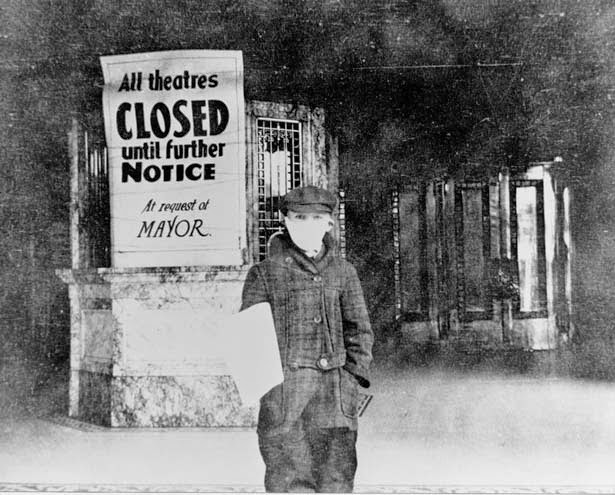
I'm reviving this post from January 2015 as it certainly has taken on new meaning in this time of Covid-19.

Our friend Leo Hevia has found an interesting nugget of information about Houdini and the 1918-19 Spanish Flu pandemic. Between 1918 and 1920, the flu infected 500 million people across the world and killed 50 to 100 million of them, making it one of the deadliest natural disasters in human history. Says Leo:

"I just finished reading David Ben's captivating bio of magician Paul Fox [in Magicol No. 188] and encountered an interesting tidbit on Houdini. Fox caught the virus near the end of 1918 and was discharged from the Army in December 1918. In January of 1919, his application for membership in the S.A.M was approved at the 182 regular meeting of the Parent Assembly at Martinka's magic shop on 493 Sixth Avenue, New York. Houdini was there and signed Fox's application card. According to Dr. Wilson of The Sphinx, Houdini had also contracted the flu.
He must have shrugged it off fairly quickly because there is no mention of it in any of the bios I know. The virus mainly attacked healthy young men because their strong immune systems overreacted to the viral infection and would kill them. The young and middle-aged survived better because of their weaker immune systems. Houdini was about middle-aged by then. Could this have saved him?"
So it looks like we can add the 1918 flu virus to Houdini's death-defying escapes. One wonders if Bess also contracted it? She was not as strong as Houdini health-wise, and had bouts with illness her entire life.* Luckily, both Houdinis seemed to come through this frightening time.


* UPDATE: I recently discovered that Bess did contract the flu in early October 1918.

Related:

Tuesday, April 21, 2020

Houdini's poor eyesight?


Potter & Potter have posted the online catalog for their May Magic Auction and it contains a generous selection of terrific Houdini rarities. But it's Lot 238 that really caught my eye. It's a letter written by Houdini to Arthur Buckle on November 28, 1903, in which he makes a startling admission:

"And to make matters worse, my eyesight, which has never been any too good, keeps me from writing after the daylight, and for me to attempt to write with the lights, that you generally find in the Provincal digs, it would only be foolhardy. So I am compelled to do all my writing by daylight!"

This is the only time I've ever heard Houdini say anything about having poor eyesight. And this is Houdini at age 29, so one can assume it only got worse. Of course, he had a blind sister (there are conflicting stories as to the cause), and his brother Leopold eventually went blind, so faulty vision may have run in the Weiss family.

I can only recall two other references to Houdini's eyesight being faulty. While I've never seen a photo of him in glasses, it's said Doug Henning owned a pair of Houdini's reading glasses given to him by Ruth Kavanaugh. And in his 2010 book, Houdini Question Reality, Dixie Dooley says magician Jimmy Grippo told him Houdini was blind in his left eye for the last two years of his life due to an accident.

Just another fascinating Houdini tidbit for us! Let's keep an eye out for anymore references to his Houdini faulty vision.
Potter & Potter's upcoming Magic Auction which will be held on Saturday, May 2nd starting at 10am, CDT. Due to Covid-19, the sale will be streamed live from Potter & Potter's gallery and held on www.potterauctions.com.

Related:

Wednesday, November 27, 2019

Houdini's close call on Catalina 100 years ago today


It was on Thanksgiving day exactly 100 years ago that Houdini tried to play a real life action hero on Catalina Island. Houdini was there filming Terror Island and staying at the Hotel St. Catherine. The production was using the Catalina Flyer to shuttle crew and equipment between Avalon and the native village set at Banning's Beach (today Toyon Bay). But this day was stormy and the seas were rough, and a drama would unfold in front of the hotel that would call Houdini into somewhat fool-hearted action.

The Los Angeles Examiner on November 29, 1919 reported what happened:


A note about the date of this incident. The Examiner's dateline indicates this happened the morning of November 28, which was a Friday. But in preparing their 2018 Terror Island exhibition, the Catalina Island Museum discovered an account of the incident in the local Catalina Islander newspaper. That article and a letter to the editor by Captain McAfee thanking everyone for their help both state that it happened on Thursday, which was November 27 and Thanksgiving. Just think, had Houdini perished, he would have been known for dying on Thanksgiving! (Somehow not as good as Halloween.)

Intriguingly, both papers report that the incident was filmed. Perhaps if Houdini had been successful in his rescue attempt it would have been worked into the plot of the film as airplane accident was worked into The Grim Game. Unfortunately, this 300 feet of footage has never surfaced. But the Examiner did run a spectacular photo of the action on their front page.

Click to enlarge.

The Hotel St. Catherine was demolished in 1966 and today is know as Descanso Beach. The rocky outcrop where Houdini attempted his rescue remains. There's even talk of renaming it "Houdini Point"! Below are photos I took during my visit to Catalina earlier this year. As you can see, the low tide reveals the real danger both the Catalina Flyer and Houdini faced on that stormy Thanksgiving day 100 years ago.


Wishing everyone a happy and safe Thanksgiving.

Related:

Tuesday, October 22, 2019

Conan Doyle did not believe a punch killed Houdini

Today marks the 93rd anniversary of Houdini being punched in the stomach by J. Gordon Whitehead in the dressing room of the Princess Theater in Montreal. Even though Houdini's doctors concluded that his fatal appendicitis was caused by the blows, today many question that diagnosis, thinking Houdini must have been suffering from the disease prior to the incident on October 22. The debate continues.

Recently I was surprised to discover that Sir Arthur Conan Doyle offered up his own medical opinion in a 1929 letter to Houdini biographer Harold Kellock:

"Now, I will take what you say about Houdini's death. So far as the prophecy goes, what the cause of the death was is quite immaterial. My remark about the alleged cause being probably apocryphal is due to the fact that, as a doctor, I should not think it possible that gangrene of the appendix could result from an outside blow of the fist. If so, one would expect many of our boxers to die in that way, since such blows are common. I have no doubt at all that Houdini died as the doctors said, but what the cause of the gangrene was is quite another matter. However, as I say, the cause of the death is immaterial. What is material is that the prophecies were fulfilled."

The prophecies Doyle is referring to were those predictions from mediums who claimed Houdini's denouncement of the supernatural while being supernatural himself (or so Doyle believed) were angering the spirits and would bring about his "doom." So Conan Doyle did believe that.

For more punch talk on this Punch Day, check out the links below.

Related:

Friday, August 2, 2019

Houdini's broken wrist and the San Diego connection


I'm always excited when I discover a new date for my ever growing New Houdini Chronology. But it's even more exciting is when that discovery unlocks a new story or solves an old mystery. And this one does all of that!

We all know Houdini re-broke his wrist while filming The Grim Game in 1919 (he had first broken it while making The Master Mystery). But the exact day of the accident was unknown. Houdini wrote to Oscar Teale on June 30, telling him of the accident and saying it would delay completion of the movie by two weeks. So the best we had was that it was sometime around the 30th.

But recently I discovered a news item in the San Diego Union that finally provided the exact date: June 28, 1919 [or not, see UPDATE]. Why was this in a San Diego newspaper? Because Houdini was scheduled to make a personal appearance at the Pickwick Theater in downtown San Diego for the opening of The Master Mystery. But as the paper reports:

The San Diego Union, June 29, 1919
HOUDINI IN ACCIDENT; UNABLE TO APPEAR HERE 
Managing Director H. E. Malaby of the Pickwick theatre was informed late yesterday morning, by wire, that Houdini the king of entertainers and star of The Master Mystery, who was to be this week's feature at the Fourth street playhouse, had met with an accident when he first began work at a Los Angeles studio Saturday morning and would be unable to make his appearance in this city until June [sic] 6. Houdini had wrist broken.
However, Mr. Malaby has provided a musical act to complete the bill and Fred Olsen, violinist, and Richard Malaby, pianist, play during the coming week.

The manager of the Pickwick also published a special notice to patrons explaining why Houdini was unable to appear, which nicely confirms the date.

Click to enlarge.

The Pickwick Theater opened in 1905 as a vaudeville house. It stood at 1029 4th on the East side of Fourth Avenue between Broadway and C Street in downtown San Diego. By 1919 it featured a combination of movies and live performance. In 1922 it switched to movies only. It was demolished in 1926. An office building now stands at the site.

Now let's move on to the mystery that I believe this finally solves.

The Pickwick manager says Houdini would appear on July 6. While I couldn't find confirmation that this happened (but I'd like to think Harry kept his promise), I did remember this photo from Doug Henning's Houdini His Legend and His Magic (right).

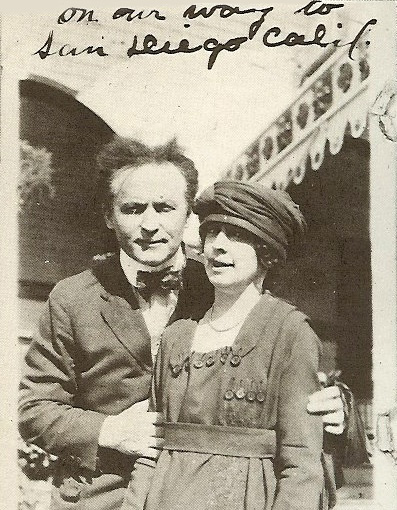
Back in 2012 I did a post explaining how this photo had me and San Diego historian Richard Crawford, author of The Way We Were in San Diego, stumped. On it Bess has written: "On our way to San Diego Calif." But Houdini's only recorded appearance in San Diego was in 1907, and this is clearly Harry and Bess at a later time.

I'm now thinking this is Harry and Bess in 1919 when Houdini traveled back to San Diego to make his appearance at the Pickwick. That is clearly his dyed movie hair, and you'll also note his left hand is concealed behind Bess. In many photos taken at this time he conceals that hand because he had a cast on it. In fact, you can see there's some kind of dark cloth draped over his wrist. I think this might be his sling. In the one photo of the sling that I have seen (below), it was dark in color just like the cloth we see here.


Finally, this refutes the idea that Houdini's broken wrist was the reason he couldn't perform The Grim Game airplane stunt. This had been an assumption made Houdini historians, myself included. But the airplane crash occurred on May 31, 1919, a month before Houdini's accident. So his broken wrist didn't keep him out of the sky. It kept him out of the Pickwick!


UPDATE: I recently found an account of the wrist break accident reported in the June 27, 1919 Los Angeles Times suggesting it actually happened on June 26.

Related:

Tuesday, July 30, 2019

"For a minute the air was full of flying bracelets"

Here's a wonderful cartoon from The Philadelphia Inquirer illustrating Houdini's act at B.F. Keith's Theater on January 8, 1912. What I especially like here is that it tells us Houdini would throw handcuffs from his cabinet as he freed himself from each pair. I can imagine the applause with the appearance of each cuff, and how it would build as a rain of cuffs appeared. And then Houdini would bound free at the end. Fantastic.

Click to enlarge.

You might be wondering how it's possible that this shows Houdini doing handcuff escapes in 1912 when he had famously abandoned the Handcuff Act years earlier. This is not a mistake. In November 1911, Houdini broke a blood vessel while doing a straitjacket escape in Detroit. The injury was serious enough that he cancelled a week's engagement in Toledo and rested on doctor's orders.

When he returned in the first week of December, he brought back the handcuffs to replace what was normally an opening straitjacket escape. So this cartoon also nicely captures a unique moment in time. The temporary return of the "flying bracelets."

Related:

Saturday, June 15, 2019

A close call in Atlantic City

It was on this day in 1908 that Houdini suffered a mishap while doing a handcuffed dive from "Young's Pier" in Atlantic City. The clipping below is from the June 16, 1908 Wilmington Delaware News Journal.

News Journal, June 16, 1908

The only other mention of this accident I can find is in The Secret Life of Houdini by William Kalush and Larry Sloman. That book dates it as having happened on June 17, but the News Journal clipping shows that can't be correct. It also lays the blame for his injury on the ocean floor rather than a post:

"On June 17 [sic], 1908, Houdini, heavily manacled, dove off Young’s Pier at Atlantic City, New Jersey, before a crowd of more than twenty thousand. He usually jumped feetfirst into waters that he was unfamiliar with, but on this day, he decided to dive, despite being warned against that by the lifeguards. He knifed through the water perfectly but then struck his head on the bottom of the ocean floor. Dazed and bleeding, he somehow managed to remove his handcuffs."

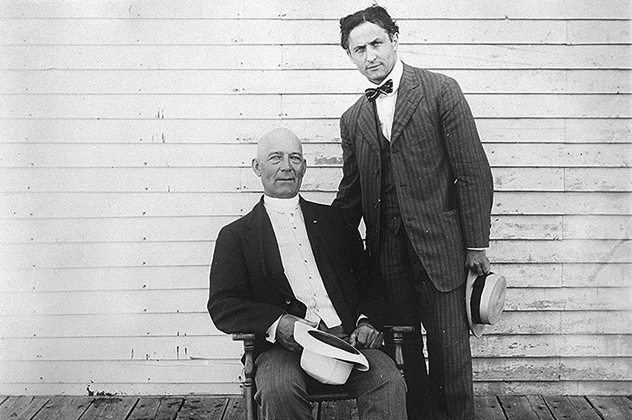
The below photo of Houdini and Harry Kellar, who had recently retired to Atlantic City, was taken by Franz Kukol three days after the jump. Houdini doesn't appear to be any worse for wear from his mishap.


Houdini was appearing at Young's Ocean Pier Theatre this week. It's not entirely clear if Houdini's jump was made from Young's Ocean Pier built in 1891 or Young's Million Dollar Pier built in 1906. But I think the newspapers would have specified if it was the newer pier, so I'm guessing it was the original (below).


This is an updated post that first appeared on Sept. 25, 2016. Thanks to Bill Mullins for additional info.

UPDATE: You can see a photo of Houdini's jump along with other research material related to Houdini's eventful 1908 Atlantic City engagement as a "Scholar" member of my Patreon below.

Monday, April 30, 2018

The time Houdini swallowed needles...for real

One doesn't think of Houdini's East Indian Needle Trick as one of his more death-defying feats, but it apparently has its dangers. This comes from the November 11, 1940 Chicago Tribune, and is a story I've never heard before.

Click to enlarge.

Based on the description, this appears to have happened during Houdini's 8 week run at Princess Theater in Chicago in early 1926. A bad year for accidents!

Houdini wasn't the only magician to have a mishap with the Needles. In 1946 an amateur magician named Stanley McAuley garnered headlines when he swallowed a needle during his own performance of the trick. It took two operations to retrieve it.

Related:

Tuesday, October 24, 2017

Why Houdini's last show was a killer

Today marks the 91st anniversary of Houdini's final performance at the Garrick Theater in Detroit.

Much has been written about Houdini's refusal to go to the hospital and instead take to the stage with a 104 degree temperature and what turned out to be a ruptured appendix. Some chalk it up to a stalwart "the show must go on" attitude. Other condemn him for sheer stubbornness.

But there might have been something else effecting Houdini's decision making that night, something uncovered in 2015, but that has yet to appear in any biography. So on today's anniversary, I'll direct you back to what I think is an important piece of the final days puzzle.


Related:

Saturday, September 16, 2017

Did Hardeen reveal Houdini's most secret secret?


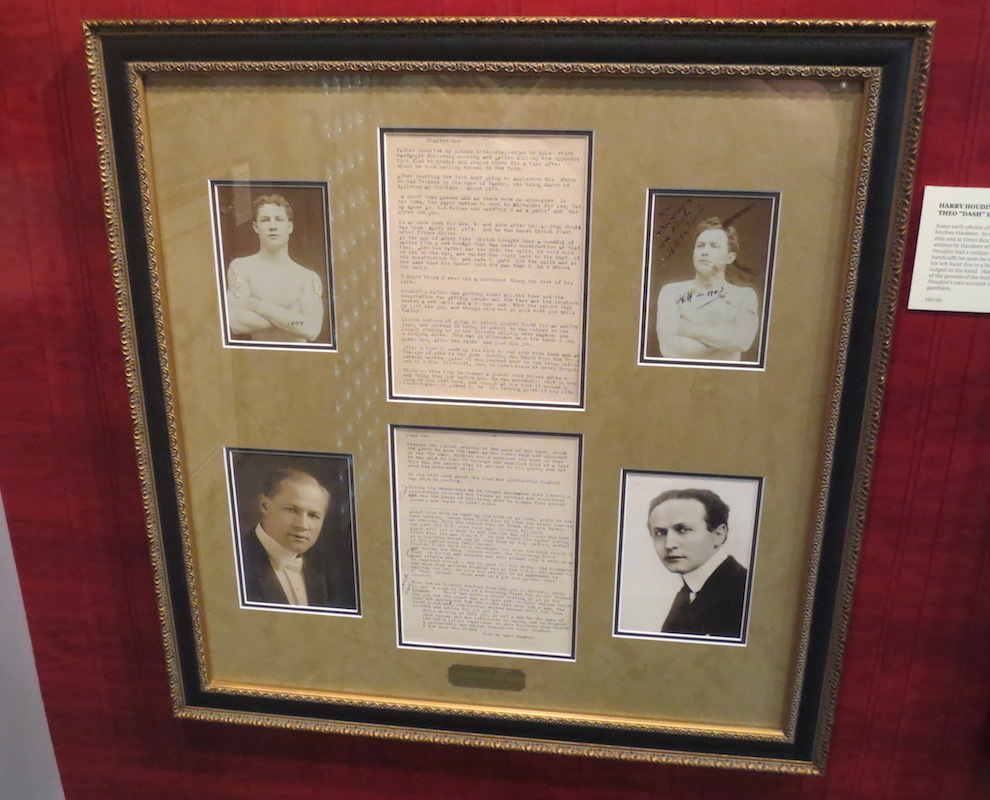
While visiting the Houdini Museum of New York last June, I saw a remarkable document on display. It consisted of two typewritten pages by Hardeen from a biography he was writing about his brother at the time of his own death. That book was to be called The Truth About Houdini, and if anyone knew that truth, it was Dash!

Among several fascinating tidbits is the following paragraph in which Hardeen apparently spills the secret of Houdini's escape abilities, which I share here with the permission of museum and document owner Roger Dreyer. [UPDATE: Bruce Averbook and The Averbook Magic Art Museum & Library now own these framed manuscript pages and photos.]

Hardeen first explains how Houdini ran away from home at the age of nine, then follows with this bombshell [spelling errors as written]:

While on this trip he became a jockey rode horses and mules &...any thing they put before him. He was accidentally shot in the palm of his left hand, and though at the time it seemed a misfortune--it proved to be the turning point of his life. Because the bullet remaing in the palm of the hand, caused the groth to seem the same as the other hand and apparently was the same. Houdini could contract the hand so that he was able to pull it through the smallest kind of hole. This was the secret that he carried to his grave, and not even his wife knew of it.
No one ever knew about the musclare contraction Houdini was able to perform.

The story of Houdini being shot in the hand is one Houdini himself told, although he set it later in his life. According to Harry, early in his career, he was taken at gunpoint by gamblers and forced to unlock the door of a casino after hours. But Houdini flung the door into the crooks and ducked inside. They took at shot at him through the door, and when Houdini threw up his hand to shield his face, the bullet lodged inside his hand, where it remained for his entire life.

Also displayed at the museum is an original x-ray photo showing the bullet in Houdini's hand. This photo has appeared elsewhere, but seeing the original is a revelation. That's because one can see the "bullet" has clearly been added or at least filled in with black ink. Possibly this was done to enhance the image. Or could it be a fake?

I admit I've never entirely bought the story of the gangsters. Seems like a bit of Houdini fiction. But possibly it was a way to romanticize or misdirect from what Dash claimed was a childhood accident. But I'm still not sure how an object inside Houdini's hand could aid in his escapes. Seems to me it would actually impede his ability to slip out of cuffs, etc.

That brings me to this intriguing footnote in Houdini's Fabulous Magic (page 19) by Walter B. Gibson and Morris N. Young:

Many people thought that Houdini could slip cuffs that were locked about his wrists, but he found that impossible. He even tried compressing the knuckles of his hands in special clamps for hours at a time, hoping to reduce their girth, but it was no avail; so he gave it up.

I've never heard about these clamp compression experiments, but it's likely the source was Walter Gibson, who knew Houdini personally. Was this Houdini once again misdirecting from his big secret? It should be noted that Houdini did slip handcuffs on occasion, sometimes in full view of the audience, and he can be seen slipping cuffs during the jailbreak sequence in The Grim Game.

Finally, it's worth noting that Houdini's left hand gave him problems as he aged. He repeatedly broke his wrist, and in 1926, he told a doctor that he only had "50% strength" in his left hand. Could all this be related to the big secret?

While Dash was not above myth-making when it came to his own career (he also claimed to have been once trapped under an ice sheet), he seemed to be the most candid of all the Weisses. He also famously took umbrage to the Harold Kellock biography, Houdini His Life Story, as being "full of lies."

Unfortunately, Hardeen never completed his Houdini biography, so all we have is this tantalizing tidbit. But what a remarkable thing to hear from the man who knew all of Houdini's secrets.

Related:

Saturday, November 12, 2016

Master Mystery episode 3 poster sells for $28,080

An original poster for episode 3 of Houdini's The Master Mystery sold for $28,080 at today's Haversat & Ewing Galleries November magic auction.

The poster came from the collection of Dorothy Dietrich and Dick Brookz of the Houdini Museum in Scranton, who own a complete set of all 14 posters from the serial. An Episode 3 ("The Water Peril") has never come up for auction before.

The auction contained several unique and desirable Houdini rarities. A cabinet photo of Houdini and his mother fetched a remarkable $16,380. This appears be an all-time record for a Houdini photo at auction. A "King of Cards" poster brought in $11,700. A letter on unique stationary in which Houdini talks about his bi-plane in Australia went for $10,852. A letter to Will Goldston in which Houdini discusses an early injury took in $7,575.

One item that I had my eye on was a business card for Houdini's first chief assistant Franz Kukol. But it looks like it caught the eye of others as well. It beat the auction estimate of $250-$300 and went for $2,661. (All prices include the 17% buyers premium.)


As always, congratulations to the buyers and sellers and to Haversat & Ewing Galleries for another stellar auction.

Related:

Wednesday, August 24, 2016

Houdini's hands

Here's a rare close-up look at Houdini's hands. This incredible unpublished image comes from the collection of Mario Carrandi, Jr. Mario shared this on his Facebook group, THE MAGIQUARIAN, and generously allowed me to share here as well. The photo is from the 1920s.

Click to enlarge.

I don't believe I've ever seen a better shot of Houdini's hands, certainly not with a palm up. You can also see what appear to be long scars running down and across his inner arm. Souvenirs of years of damaging handcuff escapes maybe?

Speaking of Houdini's hands, in 1900 a Kansas City newspaper reported that Houdini had his "hand examined" by a local palm-reader named Professor Paul Alexander Johnston (reproduced in Houdini His Legend and His Magic). The article featured an image of "Houdini's palm", and the professor was reported to have prophesied:

"Unless you are exceedingly careful during your thirty-seventh year a violent death is written in this Line of Life," said the palmist. "Your money making period began, I should judge, last year. Provided you save, you will attain great wealth."

For the record, Houdini turned 37 in 1911, a year notable for no close calls. I guess Houdini must have been "exceedingly careful"!

Thank you Mario. 

Related:

Translate