Showing posts with label 1914. Show all posts

Friday, January 30, 2026

Searching for Houdini at "The Old Vic"

The Old Vic near its end. Strourbridge.com

I recently found an article in the April 5, 1958, Stourbridge News about the restoration of "The Old Vic" theater (aka Victoria Music Hall, aka Victoria Cinema) in Lye. The paragraph below is what caught my eye.

Stourbridge News, April 5, 1958.

Unfortunately, I have no record of Houdini at the Victoria in Lye or anywhere in Stourbridge. I am a bit skeptical. This was a very small theater, not affiliated with any of the music hall circuits Houdini played. And as far as I can find, it opened in January 1914. This doesn't leave much time for Houdini to have been there. I have two open weeks for him in 1914: January 5-11 and March 9-15. After that, he was back in the U.S. for the duration of the war.

One possibility is that Houdini could have made a personal appearance at the theater when it was showing The Master Mystery during his 1920 return tour of the UK. But now I'm reaching.

If any research bloodhounds are able to find Houdini in Lye, please give me a bark!

Want more? On my Patreon, I recently shared a list of dates for which I don't have a record of where Houdini was performing (if at all). You can did into that by clicking below.


Related:

Friday, April 26, 2024

Saga of S.S. Imperator

One of my favorite YouTube channels is Oceanliner Designs with Michael Brady. This guy is wild about boats! In the video below, Michael takes a look at three German superliners, including SS Imperator. Houdini fans will recognize this as the ship Houdini was on when he met and mystified President Theodore Roosevelt with the spirit slates. It's fascinating to learn the full story of this great ship and her sisters. Enjoy.


Want more? You can see an unpublished photo of Harry and Bess Houdini aboard Imperator on my Patreon below. This comes courtesy of the Magic Castle's William Larsen Memorial Library.


Tuesday, July 18, 2023

The aeroplanist in Nottingham

The Football Post in Nottingham, England, announces Houdini's upcoming appearance at the Empire Theater for the week of January 9, 1911. Nothing groundbreaking here. I just really like the photo and the use of the word "aeroplanist."

The Football Post, Jan. 7, 1911.

Houdini first appeared in Nottingham in 1909 at Barrasford’s Royal Hippodrome. Now he was at the Empire. During his run he was challenge by joiners from Henry Vickers & Son to escape packing case. Houdini returned to the Nottingham Empire in 1913, 1914, and 1920. During his 1914 engagement he presented his Grand Magical Revue, making the Empire one of only a handful of stages to have featured Houdini short-lived magic show.


The Nottingham Empire stood on S. Sherwood Street and saw many famous entertainers during its long life. It closed in June 1958 and stood empty until it was demolished in 1969. Today a modern extension of the Theatre Royal occupies the site.

Here's the outside of the Empire in its final year. Home of the aeroplanist!

Wednesday, March 29, 2023

ALL the Houdini wax cylinder audio has been saved!

This is news that I've long dreamed of being able to report. This may be the biggest news I've ever reported here on WILD ABOUT HARRY. Little did I dream that I would play a role in this moment of Houdini history, but a role I did play! But to share this news right, I need to tell the whole story.

One of the great treasures inside David Copperfield's International Museum and Library of the Conjuring Arts in Las Vegas are the original wax cylinders containing the only known recordings of Houdini's voice. These were discovered in 1970, and only two of the three Houdini cylinders were ever transferred to a playable media. (Only a short clip has ever been released.) The cylinder said to contain Houdini and his sister Gladys reading poetry written by their father was never transferred and has not been heard since 1970. There are also five other cylinders in the collection with no record of what's on them. So there's still a lot of mystery surrounding these cylinders.

For the past two weeks I've been doing work and research inside the museum. I shared some of my adventures here. But I was keeping a secret this whole time. Mike Caveney was also at the museum. Years ago Mike and I pitched David on the idea of making new digital transfers of all the wax cylinders. The purpose was to finally hear the fabled poetry cylinder, document what's on the mystery cylinders, and digitally preserve all the recordings for the future. David tasked us with investigating how this could be done safely.

It's been a long journey, years in fact, but all roads lead to Dr. Michael Khanchalian, aka "The Cylinder Doctor," who just happens to live 20 minutes from Mike. Not only can Michael repair damaged cylinders, but he has developed a player that can safely play old recordings. He was clearly the man for the job. So we once again pitched the idea to David.

Any reluctance on David's part was understandable. He has the original cylinders and the original tape transfers from 1970 (which, ironically, may no longer be playable), so why risk damaging the cylinders or discovering they had gone bad or, worse, that some slippery collector in the 1970s had pulled a switcheroo and he actually owned nothing. The value of these cylinders could be wiped out entirely. But David Copperfield is dedicated to preserving magic history, and if there was a chance of capturing a new piece of Houdini's voice, he would take the risk. He gave us the go-ahead and trusted us to get the job done.

Lifting the heavy glass off the display case in the museum to retrieve the cylinders was pretty nerve-wracking. And it was about to get worse. Mike had left the museum by the time all the arrangements had been made, so it fell to me to bring the cylinders to Los Angeles. Without revealing what I was doing to anyone besides those in the museum, I loaded all eight cylinders into my car and made the trek back to LA, battling a three-hour traffic jam and two hellacious downpours along the way. But I made it!


The next day (March 16, 2023) Mike and I arrived at Michael Khanchalian's beautiful home. He has an amazing collection of players and cylinders and is clearly an expert and enthusiast in this field. "He's the John Cox of wax cylinders," joked Mike. After a fabulous tour of his collection, we got down to work in his "lab."


The first three cylinders, which had come from David's vault and were labeled as containing Houdini's voice, did not contain Houdini's voice. Michael knew this instantly as he could tell they were commercial recordings and not the type of "blank" cylinders one would use for recording. Instead what we heard were vaudevillians Will Oakland ("When You and I Were Young, Maggie"), Billy Murray & Ada Jones ("Whistling Coquette") and a musical march (Queen of Sheeba). It was fun to hear these sounds from the past, but it was a little disconcerting, and the switcheroo theory was dancing in my head. But we still had five cylinders to go.

The cylinder labeled "Pa's Poems" (in Houdini's handwriting) was up next. Michael was encouraged by what he saw. At least this was the correct type of "blank" cylinder. This was the moment of truth. Houdini history was about to be made, for better or worse.


Michael slid the cylinder on his player, carefully calibrated the needle, hit the record button (we were making direct transfers to CD, no computers or hard drives involved), and lowered the needle. Then this happened.


Houdini's powerful voice boomed out over the room in a recording that had not been heard in 53 years. He introduces "an original German recitation" of poetry written by his father, "Reverend Doctor Mayer Samuel Weiss," to be spoken by his sister, "C. Gladys Weiss." There is a fantastic candid moment when Houdini is about to state his father's birthday and he has to ask Gladys, "What was the year?" It's very faint, but it's there, and we all looked at each other in delighted disbelief at what we had just heard.

Gladys then recites the poem in German. Gladys was blind, so she's doing this from memory. As Houdini says on the recording, the poem was "taught to her" by their father. I believe she makes a mistake and starts over after a small gap in the recording. Houdini then comes back on and says he will repeat the poem "in case you did not understand it." This seems to be his true speaking voice and not the "presentational" voice he uses on the other recordings. He then proceeds to recite the poem also in German. He speaks faster and, to my ear, more confidently in German, with great flair and rolling R's. Gladys signs off with the date, October 30, 1914, which is a day after the other recordings were made. The fact that this recording was made on a different day has never been documented.

Next up were the two full recordings of Houdini's Water Torture Cell patter. As with the poetry cylinder, each of these run just over four minutes. The quality of these transfers is much clearer than what exists currently. For years I believed Houdini says "I, Houdini" as his sign off. I've been wrong. "Harry Houdini" is now sparkling clear. There was also a big surprise waiting at the end of the first speech. After Houdini signs off, the cylinder seems to end. But then Gladys comes back on and "certifies" that she heard her brother "make this record" on October 29, 1914. This certification was never transferred in 1970 nor have I ever seen any mention of it. It's possible it was missed or the machine they used couldn't pick it up.

Speaking of the machine(s) from the 1970s, our expert Michael said he was amazed the recordings weren't destroyed back then, as you can't play these Edison Blanks on a regular machine. They are much softer and the weight of the needle can wipe them clean. Several times he said it was miraculous that the recordings survive and in such great fidelity.

The final two cylinders were commercial recordings of German songs. It was still exciting to hear these as all the cylinders belonged to Houdini and it's wild to hear the music he played at home for pleasure.

Over the next few days I prepared notes and transcriptions of all the cylinders and reunited them with their correct cases. I was helped in this by magician Jessica Jane Peterson who became the fourth lucky person to hear the poetry recording.


I then drove the cylinders back to Las Vegas and played the new recordings for David. He was thrilled by what he heard. He instantly picked up on all the same moments that had so excited us in LA, especially the moment when we hear Houdini's more natural speaking voice. Even before the recordings ended he was working on the next steps. Audio work will be done to clean up the recordings and the German will be translated. It was mission accomplished and everyone was delighted and relieved!

I took myself out to dinner that night and thought about what had happened. Not only had I finally heard the "Pa's Poems" cylinder, but I now understood it was always the most precious and personal recording of them all. Houdini loved and and honored his father and you can hear that. He loved his sister and you can hear that. The family language was German and you hear that. If Houdini ever came back, this would be the cylinder he would want to hear. Preserving it was more important than I ever understood. I felt like I had done a service for both Houdini and David Copperfield, and I was overwhelmed with gratitude at the amount of trust that had been placed in me.

I then sent David a text with one last request. Could I share this momentous news? His response came back quickly: "Sure."

As I said, David didn't need to do this. This headline could have easily read, "The Houdini wax cylinders are no more." But this is what makes David Copperfield a titan of magic. He took the risk, extended extraordinary trust, and now deserves the credit for saving this important piece of Houdini history. Maybe even the most important piece. When and where the general public might hear these I can't say. But the fact that we can now hear them was the purpose of this incredible journey.


Thanks to David Copperfield, Mike Caveney, Michael Khanchalian, Jessica Jane Peterson, Glenda Wellendorf, and everyone who helped bring Houdini (and Gladys Weiss) back to life. 

Want more? You can view additional images from this adventure as a "Scholar" member of my Patreon by clicking below.

Sunday, January 29, 2023

LINK: First golf lessons in the UK

Joe Notaro has discovered and shared to his blog Harry Houdini Circumstantial Evidence a photo of Houdini on a UK golf course in January 1914. This would be only the second image of Houdini on a golf course that I'm aware of.

I actually don't think Houdini was a golfer. I suspect these photos were staged for the cameras. But great stuff all the same!

Click the headline to hit the links with Harry at HHCE.

Related:

Thursday, September 23, 2021

Hardeen at the Prospect

Here's a nice shot of Hardeen with a challenge packing case from the March 24, 1933 Brooklyn Daily Eagle. This is when Hardeen was appearing at the RKO Prospect Theater in Brooklyn not too far from where he lived. I'm always surprised how tall these boxes were, and this image shows that clearly. Note the mention of a Houdini display in the theater lobby.


Houdini himself played the Prospect in November 1914 and April 1916 (accepting a beer challenge from the Interboro Brewing Co. on April 13). The theater was converted to retail space in 1967, but the building still stands today. In fact, remains of the theater can still be found inside.


Below are posts with some more images of challenge packing crates.

Related:

Thursday, September 16, 2021

Poster for Houdini's Grand Magical Revue

Over the weekend a poster for Houdini's 1908 appearance at the Circus Brusch in Germany sold on eBay. I mentioned that I had seen that poster along with another for Houdini's "Grand Magical Revue" at Wilshire Coin in Santa Monica in 2016. Here's a photo I took that day of that other poster.


The Grand Magical Revue with a short-lived attempt by Houdini to mount a straight magic show in England in 1914. He only presented it a dozen times. This poster is for the last known performance at the Empire Theatre in Nottingham on June 12, 1914.

Both this and the Circus Brush poster came from the Houdini Magical Hall of Fame in Canada. Both are heavily lacquered. There are a few surviving Grand Magical Revue posters, but what's nice about this one is it lists "De Kolta's Marvellous Cube" among the illusions to be performed. This poster appears on page 101 of Houdini His Life and Art by James Randi and Burt Randolph Sugar.

I've not seen this poster since that day back in 2016, but it was for sale along with the Circus Brush poster. Perhaps that means we will see it appear on eBay as well?

UPDATE: Looks like this poster has inspired some reproductions over the years, as seen below. The one on the left was part of a "Houdini Portfolio" from the 1970s. On the right is a reproduction created by the Houdini Historical Center in 1995 (thanks to Chunk Romano for the image). Looks like the HHC felt the need to add a photo of Houdini in chains, which is incongruous on a poster advertising him as a straight Magician.


Related:

Tuesday, July 13, 2021

FLASHBACK: When Houdini walked through a brick wall

It was 107 years ago today that Houdini debuted his "Walking Through A Brick Wall" at Hammerstein's Roof Garden and Victoria Theatre in New York City. He would only do the effect for single week, but it remains one of his most famous feats of magic.

CLICK HERE to revisit a post I did on the 100th anniversary of Walking Through A Brick Wall.

Sunday, May 16, 2021

LINK: Houdini and Roosevelt group photo gets bigger

Our friend Joe Notaro at Harry Houdini Circumstantial Evidence shares an exciting find today. We are all familiar with the famous photo showing Houdini alone with former President Theodore Roosevelt aboard the Imperator on June 23, 1914. But most of us know the original photo (right) contained a group of seven men.

But now Joe has discovered a fully un-cropped version of the original photo that shows an eighth man! I never knew a more complete version of this photo even existed.

Click here or on the headline to see the full group at HHCE. Thank you Joe!

Saturday, March 13, 2021

Houdini's Monmouth County mystery

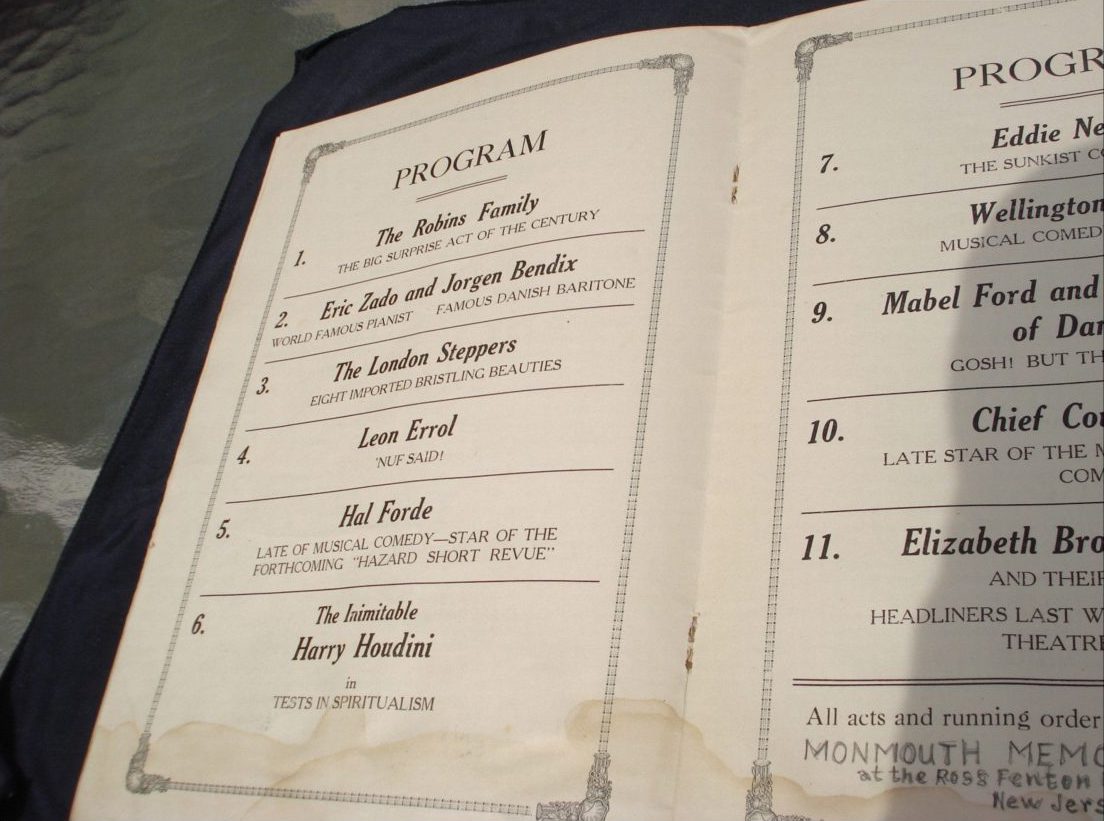
John Barrows at This Day in Monmouth County History has written a terrific article about Houdini's known and possible appearances in Monmouth Country, New Jersey. I actually helped send him down one particular rabbit hole, which opens his piece:

On Monday, August 11, 1924, the legendary escape artist and entertainer Harry Houdini gave what may have been his one and only performance in Monmouth County.

Unless it never happened. 
Click to read:

An entry into my own Houdini chronology hangs in the balance, so if we can help John confirm or deny this appearance at Ross-Fenton Farm in Wannamassa, that would be great. Or find any other Houdini appearances in Monmouth Country.

Related:

Wednesday, June 17, 2020

LINK: TR vs. Houdini (History Vs. podcast)

This is a very well done telling of the famous story of Houdini fooling President Theodore Roosevelt aboard the Imperator in June 1914. Click the headline to have a listen at the History Vs. podcast at Mental Floss.


Related:

Friday, May 29, 2020

The hidden meaning of Houdini's iconic suit

Last night I had the pleasure of joining Mike Caveney and Jonathan Levit "Behind the Bookcase" at the Academy of Magical Arts, where I shared some things I haven't yet posted to the blog. First and foremost was "the secret of Houdini's suit." So today I wanted to share with all and lay out my theory in full. Enjoy!


This is a famous photo of Houdini likely taken in early 1918. Here we see him in a black suit of clothes that appears in many other photos. And I mean many. In fact, I have not seen a photo or film clip of Houdini in everyday life taken between 1914 and 1918 in which he isn't wearing this same black suit. There's even a photo of him wearing it on a golf course!

So what's the story? Was this just a favorite suit? Or is there something else going on? I believe there's something else going on, and I have a theory of what that something might be.

Whenever Houdini does something inexplicable in his personal life, I always consider the possibility that it has something to do with his mother. Because it always does! At first I thought this was maybe a suit she bought for him. Or maybe it was one she simply thought he looked good in. That would probably be enough for Houdini to wear it everyday for four years. But as far as I can find, this suit first appears a few months after his mother's death. And that's the key.

This was a time when Houdini was displaying his grief in any number of ways. He even had new stationary and greeting cards made rimmed in a black boarder. I believe this suit was another part of his formalized grieving. I believe what we've been looking at all these years is Houdini in a mourning suit.

Mourning clothes are typically associated with women, but it was not unheard of for men at this time. Women's fashion dictated veils, etc., but the only real requirement for men was that it should be black. Also, in Jewish tradition, someone in mourning is not allowed to wear new clothes for a year. And that's another aspect of this suit that has always struck me as peculiar even before I landed on this idea. Houdini was fairly modern, even dashing, in his dress leading up this time. (Just look at him here.) But this is a very Victorian suit.

Houdini also had a specific hat that went with this suit with a thick hatband that can be seen in several photos. Turns out hatbands, typically made of crepe, were a feature of Victorian male mourning clothes. And according to The Vintage News, "widows were expected to wear special clothes to indicate that they were in mourning for up to four years after the death." Houdini appears to have worn this suit for, yes, a little over four years.

But I think the most convincing evidence is that he wore this suit to the 1916 dedication ceremony for the exedra he created for his parents at Machpelah cemetery. In a photo from the event we see others dressed formally in tail coats and top hats. But not Houdini. Obviously Houdini would have thought very carefully about how he dressed for such a sacred occasion, and it's unthinkable that he'd wear his old "everyday suit" if it didn't broadcast special meaning. Wearing this suit was making a statement which now seems abundantly clear. He was a man in mourning.

Below are a few choice images of Houdini in the black suit.

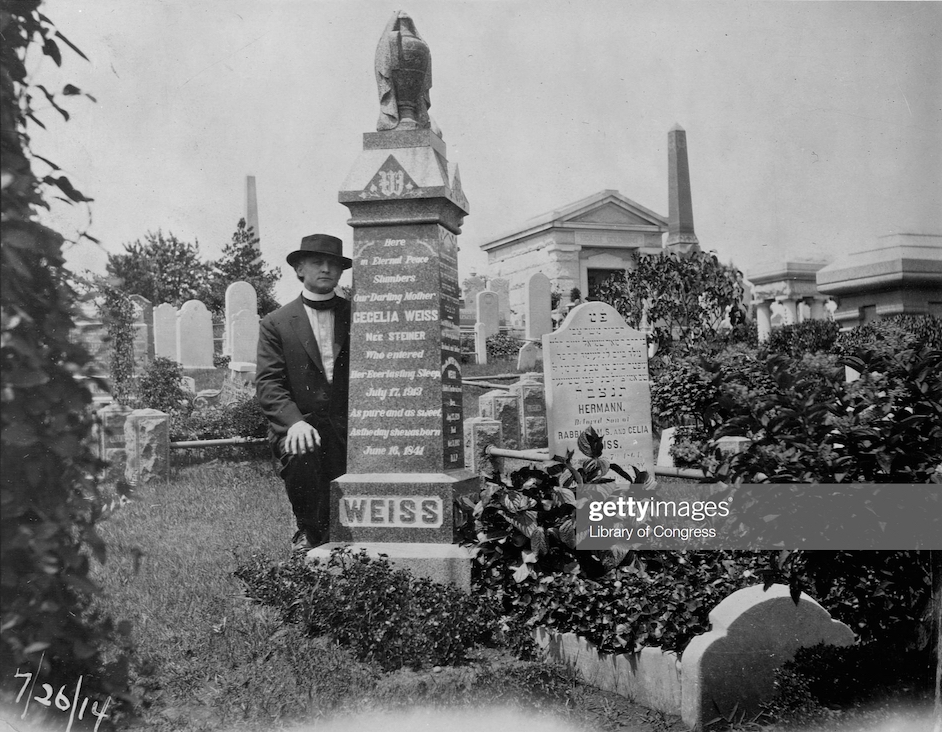
In the graveyard (1914).
In California with Jack London (1915).
At the exedra dedication (1916).
On the golf course (undated).
With Harry Kellar (1917).
Traveling to Hollywood (1919).

The last images I've found of Houdini in the suit are from his early days in Los Angeles in April 1919 when he came to work on The Grim Game. It may be telling that a young starlet commented in a fan magazine on the strange suit Houdini was seen wearing around Hollywood. So maybe he decided to it was time to give up the ghost. By May 1919 he is sporting a new suit and a youthful straw hat. This old suit appears to vanish.

But Houdini wore this suit for so long and in so many photos that it has become part of his iconography. It inspired Harvey Keitel's wardrobe in 1998's FairyTale: A True Story. It also appears in the 1976 biopic The Great Houdinis in the scenes following his mother's death. It's telling that the costume designer instinctively associated this look with mourning. The suit is not described in the screenplay, but in the novelization it says: "That coat he's wearing, she thought, that had to be thrown out. And that terrible hat. He looks like an immigrant. One more week without shaving, he'll look just like his father, the Rabbi."


So what do we think? Was this Houdini's mourning suit? Sound off in the comments below.

Related:

Thursday, April 9, 2020

Houdini enhanced by Matt Loughrey

The UKs Daily Mail has a report on Matt Loughrey who has spent the last four-and-a-half years working on a technology to redefine and color portraits of well-known historical figures. The story shares several of Loughrey's creations, starting with Houdini! It's a truly remarkable image.


(The caption dates this image as 1912, but it is actually a 1914 shot.)

You can see more of Loughrey's work on his Instagram. Below are a few more glimpses of Houdini in color.

Related:

Thursday, July 11, 2019

Mystifying man in St. Louis

Here's a terrific caricature of Houdini from the St. Louis Star and Times dated December 15, 1914. Once again this shows that, in his own time, Houdini was as identified with his Needles trick as he was with his escapes.


Houdini appeared at the Columbia during the week of December 14-20, 1914. On December 16, he accepted a challenge from the packers of the Famous-Barr Co. to escape packing case built on stage. On the December 18, Stix, Baer & Fuller Dry Good Co. challenged him to escape their own packing case after being searched and having a carpet laid below case on stage to prevent use of traps.

Needless to say, the "mystifying man" escaped both times.

Related:

Tuesday, June 19, 2018

To Gladys from brothers Leopold and Nathan

Fifteen years ago Bill Bremer, a postcard collector in Texas, unearthed a cache of 36 postcards sent to Houdini's sister, Carrie Gladys Weiss. All this week I am sharing select cards from this remarkable collection. [Read the full story of Bill's find here.]

Today we have a two postcards sent to Carrie Gladys from her brothers Leopold and Nathan Weiss. The first card from Leo was sent from the White Mountains in New Hampshire and is postmarked Sept. 1, 1912. Leo addresses it to Gladys at 278, where she and Leo were living at the time. As you can see, "Doc" enjoyed his nature hikes.


This next card from Nathan is the only correspondence I've ever seen from him. It's sent from Jacksonville, Illinois, and postmarked April 8, 1914. This one is addressed to Gladys at 250 West 54th St. in New York. This appears to have been her workplace, Zieglers Magazine, a monthly periodical written in Braille for the blind. (The E. Matilda Ziegler Foundation still exists today). Not sure what the reference to Nesselrode Pudding is all about. I suspect Gladys was a fan!


Tomorrow I'll share postcards to Gladys from the "Monarch of Manacles" himself...

Related:

Saturday, May 20, 2017

LINK: When Harry Met Teddy: How Houdini Fooled a President

While there's nothing new here for the seasoned Houdiniologist (hey, word invented!), this is still a well-done article by Sean Braswell about how Houdini fooled President Theodore Roosevelt aboard the SS Imperator in June 1914.


Click the headline to have a read at OZY.com.

Related:

Sunday, July 24, 2016

A day at the pool (UPDATE)

After last week's experience with the questionable Houdini tintype, I think it's time we all took a Houdini eye test. Luckily, the American Museum of Magic Research Center in Marshall, Michigan provides an unpublished photo that suits our needs perfectly.

This photo is credited as being the pool at Hotel Shelton in New York, but it doesn't match other images of the Shelton pool, so I believe this is another location. Nevertheless, on this day there appears to be some kind of water-spot activity with Houdini in attendance. Can you find Harry?

Click to enlarge.

Thanks to Alex and Keli Hindenach of the American Museum of Magic. Click the links below for other rare unpublished images from their collection.

UPDATE: Our good friend Perry from NJ has discovered the location of this photo. It's not the Shelton, but it is a location with a strong Houdini connection. This is the "Roman Bath and Swimming Pool" aboard the S.S. Imperator, the ocean liner on which Houdini performed for Teddy Roosevelt in June 1914. Below is a photo from the website GG Archives.


Thanks Perry!

Related:

Sunday, May 15, 2016

A forgotten Houdini assistant?

Recently I received an email from Ruth Owen in the UK who tells me family lore claims her grandmother, Ellen Cook, assisted Houdini while he was performing in Yorkshire in 1914.

Had Ruth mentioned any other year, I would have been skeptical. As we know, Houdini primarily used male assistants or Bess during the bulk of his career. But 1914 was the year Houdini experimented with his "Grand Magical Revue" in the UK, and in that show he would have used female assistants for illusions such as "Goodbye Winter" and "The Arrival of Summer." So was Ellen Cook one of them? Here's what Ruth's mother recorded:

"Eventually Mum obtained a post at Barnsley Empire Theatre. She used to tell us that one of the highlights was when she assisted Houdini in his spectacular escapology feats. Photographs of her then show fine features and long, thick, black hair styled in a bun. 
Lucky for me that she was in that place, at the time, or I would not be writing this! For it was at the Empire that my father, Christopher Musgrave, first saw her assisting Houdini."

To investigate this further, I turned to Derek Tait, the true expert on Houdini in the UK (watch for Derek's The Great Houdini: The British Tours coming this year). Derek tells me Houdini did appear twice in Yorkshire in 1914. Between February 16 and 21 he played the Empire Theater in Leeds. Later he played the Palace Theatre in Hull from April 27 to May 2, where he did indeed present the Grand Magical Revue. However, there is no record of Houdini in Barnsley.

So we have the right time, the right region, the right type of act, but not the right theater. But that doesn't preclude the possibly that Ellen Cook is a forgotten Houdini assistant. We'll just need to keep digging

This has also set me to thinking about Houdini's Grand Magical Revue. The idea that Houdini would have had to have used new female assistants never occurred to me before. (Unless Bess worked each illusion with him?) Houdini may have hired his "box jumpers" regionally, so there may be a few Ellen Cook's out there.

Thanks to Ruth Owen and Derek Tait.

Related:

Friday, March 11, 2016

The Flatbush years


One hundred years ago, Houdini returned home after an exhausting seven month coast to coast Vaudeville tour. But the New York home he returned to was not his famous brownstone at 278 W 113th Street in Harlem. It's not generally known, but Harry and Bess Houdini lived in Flatbush for 3 1/2 years between 1914 and 1918. In fact, it was in this Flatbush house at 394 East 21st Street (pictured above) that Houdini produced what today might be considered his single most important surviving artifact, but I will get to that.

When Houdini purchased his Harlem brownstone in 1904, it was to serve as a new Weiss family home and, primarily, a new home for his mother. At the time, Houdini was performing in Europe and only returned to New York for short periods. As a family home, 278 saw a steady rotation of resident Weisses (and Rahners). Houdini's brother Leopold even set up his radiology practice in the parlor.

When Cecelia Weiss died in 1913, Houdini was devastated and reportedly didn't like the memories that came with the house. At least that's the official story. Jon Oliver, who spoke with Harry Hardeen Jr., claims the real issue with 278 was that mama's corpse had been left inside the house for the week it took Houdini to return from Europe, and it had become uninhabitable (and unsellable). Whatever the truth, Houdini felt the need to escape.

Houdini's brother Dash, who performed as Hardeen, had purchased a home in Flatbush in 1912. Hardeen's pitchbook identified the address as 394 Kenmore Place, but in reality it was located at 394 East 21st Street. However, it was more house than Dash required (or could afford?) and in July 1914 he put an ad in the Brooklyn Daily Eagle looking to sublet the top floor:


The tenants Hardeen ended up with were the Houdinis. Houdini moved to 394 East 21st Street in September 1914. On his new stationary (rimmed in black to show he was in mourning) he wrote to a friend:

Click to enlarge.

The Flatbush house became the hub of activity during the years Houdini was land-locked in North America because of the war in Europe. It was during his time that Houdini began to build what he hoped would be one of the world's greatest dramatic collections, and the mounds of new material he acquired flooded into Flatbush. When Houdini met Harry Kellar in 1916, he invited him to the house where he showed off his collection and also amazing the great magician (according to Kellar himself) with card magic.

But it was on October 29th, 1914, that the Flatbush house became the sight of what might arguably be the single most important Houdini artifact of them all. It was here that Houdini used an Edison wax cylinder phonograph to record his voice, now the only recording of Houdini's voice in existence. While I can't say conclusively that he made the recording in the house itself, he identifies his location as "Flatbush, New York" and his sister Gladys is with him, so I'm thinking it's likely this was done at home.

The Houdinis (and, presumably, their many pets) lived on the top floor of 394 while the Hardeens (and their children) lived below. Was living in such close quarters a strain? Possibly. In his book, Houdini!!! The Career of Ehrich Weiss, Kenneth Silverman identifies a few cryptic references in Houdini letters and diaries that suggest tension. "I do not like atmosphere re certain things in Flatbush" Houdini wrote to Oscar Teale. And when Houdini was honored at an S.A.M. banquet, he noted curtly in his diary: "Dash and Elsie did not wish to go."

The shared residence also caused some amusing confusion. When Hardeen was arrested for speeding, the Brooklyn Daily Eagle reported that it was Houdini who received the $25 fine. The paper later printed a retraction, quoting Houdini himself as saying that he had "never been arrested nor fined, and does not drive a motor car."

1929 map showing the location of 394.

Harry and Bess moved back to 278 in February 1918. His magic and drama collections alone filled six moving vans. Some of the papers mistakenly reported that Houdini had recently bought the house. Houdini transferred legal ownership of 278 to Bess on July 22, 1918. He would go on to make 278 the home that it really never was to him before.

Hardeen moved out of 394 in 1921, relocating a few blocks to 537 East 21st St. This would be the home he and Elise would live out the remainder of their lives.

Today a modern apartment block sits at the site of Houdini's forgotten Flatbush residence.


A very big thanks to Bill Mullins for his invaluable help in locating Hardeen's house and for the Brooklyn Eagle classified ad and map.

Also thanks to Joe Notaro of Harry Houdini Circumstantial Evidence and Jon Oliver. The Houdini Flatbush letter is reproduced from the collection of James Crossini on page 29 of The Illustrated Houdini Research Diary, Part 4: 1911 to 1915 by Frank Koval.

Related:

Friday, May 1, 2015

The color of Houdini's bathing suit?

Here is a colorized image of Houdini created by Dana R. Keller (danarkeller.com). Dana previously colorized another image of this same escape -- Houdini's 1914 overboard packing case escape off Battery Park -- but this time the artist has made an interesting new choice in regards to the color of Houdini's bathing suit.


As you can see, Houdini is wearing red bathing trunks here. In Dana's earlier image it was gray and black. While we know Houdini wore an all-white bathing suit during his 1912 NY overboard box escape, the color of the 1914 suit was never recorded (as far as I know.) But in a description of a 1908 bridge jump in Philadelphia, a newspaper described Houdini as wearing "a bright red swimming suit," so red is a possibility here. It also makes sense that Houdini would wear a color that would make him visible among the crowd and in the water.

The color of the bathing suit Houdini wore onstage during his Water Torture Cell is recorded as having been a light blue.

You can buy a print of the above image at Dana Keller's Redbubble page.

UPDATE: We now know Houdini wore a "cerise-colored" bathing suit during his famous jump from the Harvard Bridge in 1908.

Related posts:

Translate