Showing posts with label Walking Through Brick Wall. Show all posts

Friday, October 14, 2022

The Houdini Experience in Salem

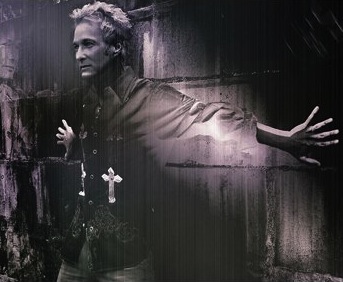
The Houdini Experience featuring Master Mentalist Jon Stetson opens today at Emerson Hall Theater in Salem, Massachusetts. The show is in partnership with the Salem Haunted Magic Show and runs through Halloween. Below are details.

Join us in Salem for an evening of intelligent, Interactive, Halloween Hijinks! Throughout this 75 minute engaging performance you will experience the spirit of Houdini and the secrets he tried so desperately to take to his grave. Jon Stetson will guide you into the mysteries surrounding the life & death of America’s first master showman. Will Houdini’s secrets be revealed?

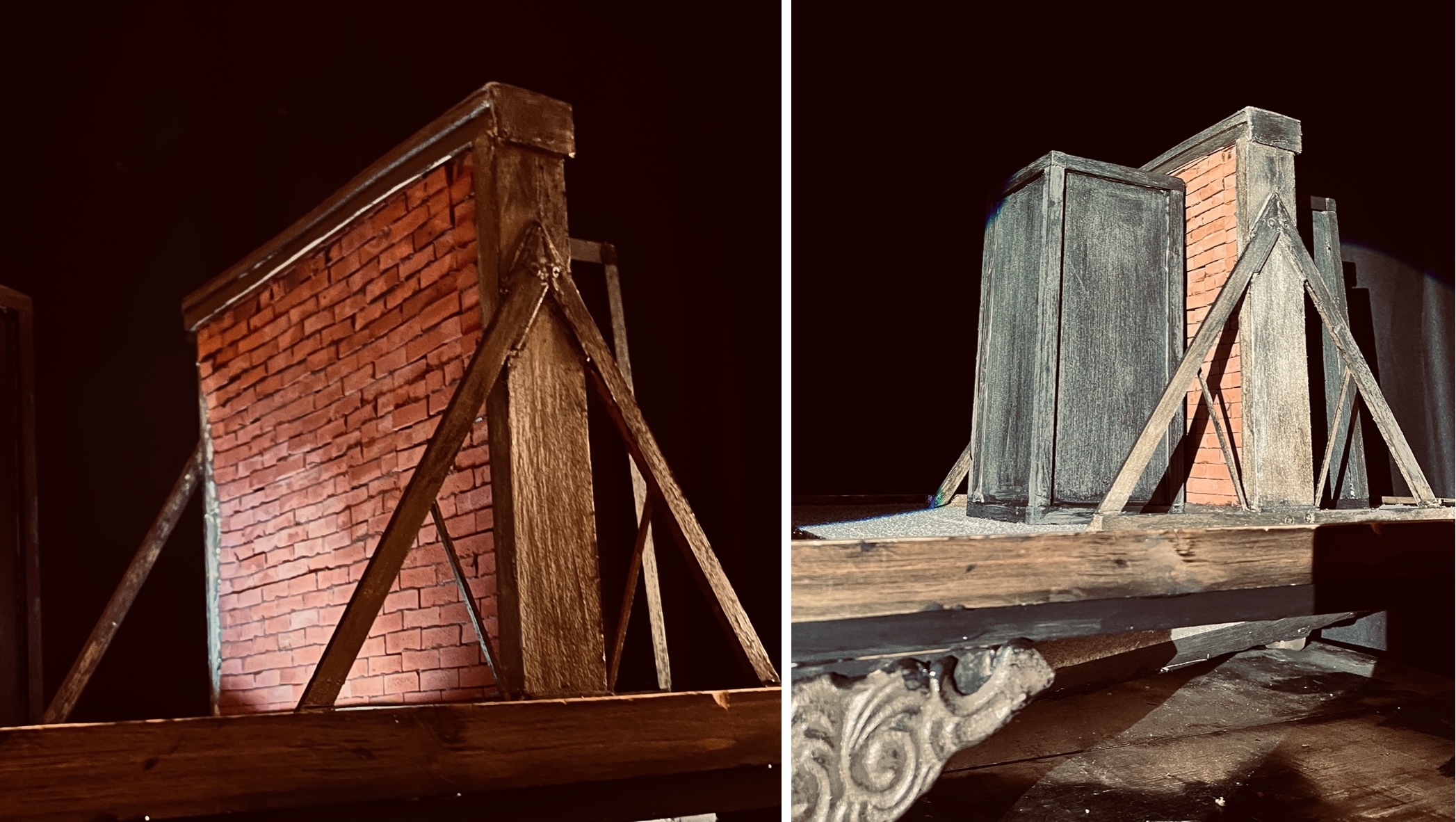
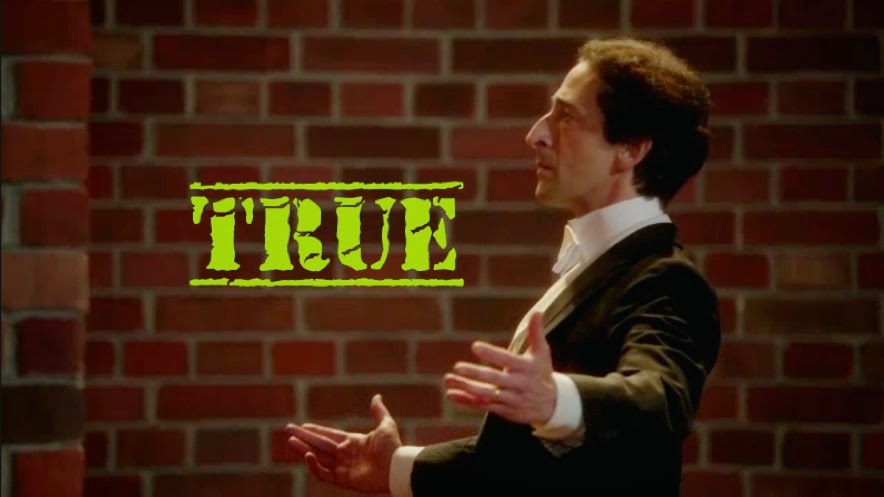
A 1/6th scale working reproduction of Houdini's Walking Through a Brick Wall will play a part in the show. Here's a peek courtesy of producer Chris Bolter.


You can book tickets to The Houdini Experience via the official website. You can also follow the show on Facebook.

Thanks to Christopher Bolter.

Monday, September 12, 2022

Houdini penetrates the New York Times Crossword


The New York Times Crossword yesterday (9/11/22) had a clue referencing Houdini's Walking Through A Brick Wall illusion. This caused a surge of traffic to this post from 2014. However, as I didn't reveal the secret, I don't think that post would have been any help.


If you want the answer, you can find it here.

Thanks to Matt Guzman and Diego Domingo for the alert.

Friday, March 4, 2022

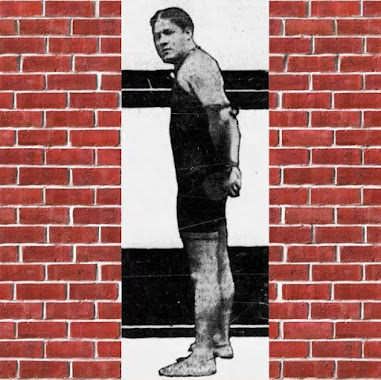
Hardeen: The Man Who Walked Through Walls

Let's celebrate Dash's 146th birthday today with a bit of forgotten Hardeen history.


We are all familiar with Houdini's famous Walking Through a Brick Wall illusion. It's one of the tricks that has become iconically associated with him -- "The Man Who Walked Through Walls". However, not many people realize Houdini only did the effect for a single week at Hammerstein's Victoria theater in New York in July 1914. And that was it! For Houdini, at least.

Houdini passed the effect to his brother, Hardeen, who appears to have first performed it at the Bowdoin Square Theatre in Boston in January 1915. He then continued to periodically feature it on his 1915 tour. Hardeen penetrated walls in: Hartford, Connecticut; Bridgeport, Rhode Island; Wilkes-Barre, Pennsylvania; Spokane, Washington; Calgary, Alberta; and Victoria, British Columbia. The last performance I can find was in Fort Wayne, Indiana, in March 1916. This means Hardeen did Walking Through a Brick Wall many more times than Houdini!

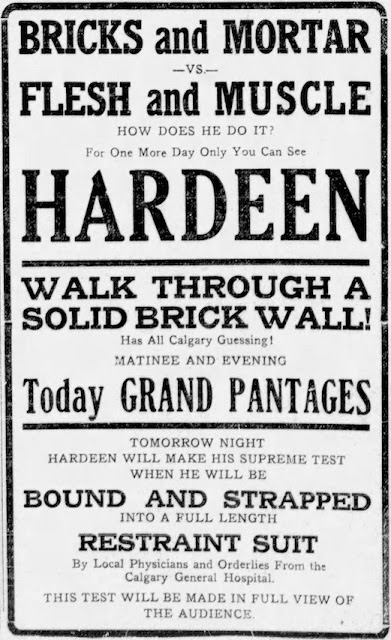
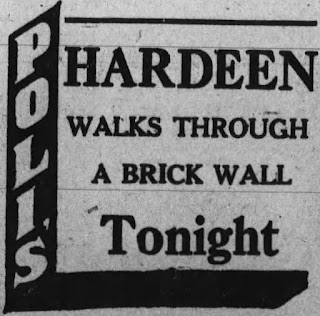
Below is a nice ad for Hardeen's performance of the effect in Calgary. I love the headline: "BRICKS and MORTAR vs. FLESH and MUSCLE."

Morning Albertan, Sept. 22, 1915

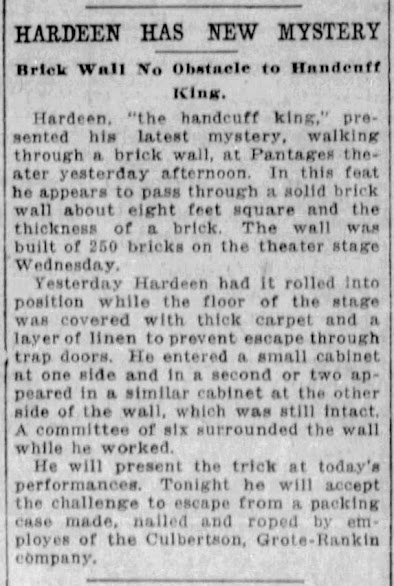
Below is the best overall description of the effect as Hardeen performed it. It's pretty much exactly as Houdini did it, right down to the two rug coverings. Wonder if he also wore the white duster? Unfortunately, I don't know of any photo showing Hardeen and his wall.

The Spokesman Review, Oct. 1, 1915.

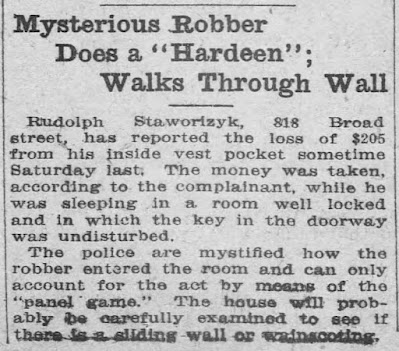
Here's some evidence showing how Hardeen became independently associated with the effect.

Bridgeport Times and Evening Farmer, Feb. 23, 1915.

Walking Through a Brick Wall was not without controversy. Houdini had purchased the secret from magician Sidney Josolyne in England. However, P.T. Selbit claimed to have invented it and accused Joselyne and Houdini of theft. Along with the wall Hardeen inherited the controversy and continued to exchange barbs with Selbit into the 1920s. I'm not aware of Hardeen performing the effect after Houdini's death, but Sidney Radner recalls seeing the apparatus among Hardeen's belongings in the 1940s.

In 1939 Hardeen appeared as a guest on WNYC's "Voice of the Theatre" radio program (which you can listen to HERE). The interview begins with Hardeen seeming to make a mysterious appearance in the studio. Host Ezra Macintosh asks how he got in with the door being closed the whole time. Hardeen's answer: "Why I'm the man who walked through brick walls."

Indeed!


Related:

Tuesday, July 13, 2021

FLASHBACK: When Houdini walked through a brick wall

It was 107 years ago today that Houdini debuted his "Walking Through A Brick Wall" at Hammerstein's Roof Garden and Victoria Theatre in New York City. He would only do the effect for single week, but it remains one of his most famous feats of magic.

CLICK HERE to revisit a post I did on the 100th anniversary of Walking Through A Brick Wall.

Tuesday, June 2, 2020

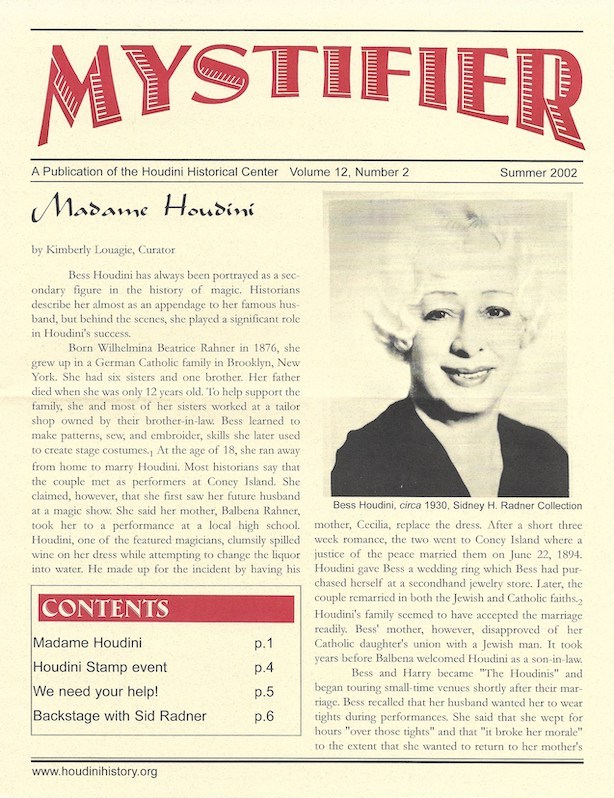
Mystifier, Summer 2002

Continuing my issue by issue look back at the Mystifier, the newsletter of the Houdini Historical Center that ran from 1991-2003.


The Summer 2002 Mystifier features a lengthy profile of Bess aka "Madame Houdini" by HHC curator Kimberly Louagie. It contains mostly known information, but a gem is the reproduction in full of a letter Bess wrote to Hardeen on April 21, 1911. Letters written by Bess during Houdini's lifetime are uncommon, so this is something special. It's written to Dash in secret after Harry and his brother appear to have had a fight. I'm taking the liberty of reproducing it here:

    My dear Bro. Dash,
        Just heard that you were not coming over here, and the reason why. Now Dash, please do come over and if Harry does not pay the difference I will. Harry does not know I'm writing this. Now I want to tell you why he is sore. You know we are playing all the towns that you played, and of course there are plenty of guys always ready to tell H. about your challenges and what you did, and H. told me you had promised not to do challenges etc. Of course he is sore now, but I am sure if he sees you he'll forget all about it. Harry is working to death, he looks so old, he's quite gray and I am afraid he is over doing it all. Now please Dash come over. I'm looking forward with pleasure of seeing Elsie and Baby Harry, but I hope you will come with them, and I am ready to help to keep my word about paying the difference (you know I have a bank account). Please let me know at once if you come.
         I am as ever your loving sister Bess.

Following the Bess piece is a plea to "Friends of Houdini" for donations to the HHC by Executive Director JoEllen Wollangk. There are also details of a special party on July 5, 2002 to celebrate the upcoming Houdini stamp.

Page five contains another rare treat. It's a facsimile reproduction of an Oath of Secrecy signed by Houdini assistant John Boyd on May 7, 1913. I admit John Boyd is a new name to me.

Sid Radner's photo is omitted from his "Backstage" column this time. Sid discusses the above oath and how oaths such as these are why one doesn't read exposures from Houdini's assistants. Sid again claims all published accounts of how Houdini did his Water Torture Cell are incorrect. He then says something very intriguing regarding the Mirror handcuffs:

At the present time the secret of the London Daily Illustrated Mirror Handcuff escape is still unknown to the public. I know the answer but I am not convinced that revealing the secret serves any good purpose.

What exaclty did Sid know???

Sid finishes by saying he has been in touch with a newly discovered member of the Houdini family and that he will reveal more in a future Mystifier. (Sid sure loved to withhold, didn't he?)

The newsletter ends with the special announcement that the recently restored Water Torture Cell will be unveiled at the American Jewish Historical Society of New York. There's also a reproduction of Josolyne's illustration of Houdini's Walking Through a Brick Wall from Weird Wonders for Wizards (1925), which is a correction to the last issue which mistakenly used Gibson's illustration from Houdini's Escapes and Magic.

Mystifier
Volume 12, Number 2
Summer 2002
6 pages

Contents:
Madame Houdini
Houdini Stamp Event
We need your help!
Backstage with Sid Radner


Related:

Thursday, May 14, 2020

Mystifier, Spring 2002

Continuing my issue by issue look back at the Mystifier, the newsletter of the Houdini Historical Center that ran from 1991-2003.


The Spring 2002 issue of Mystifier begins with a lengthy review by HHC curator Kimberly Louagie of the new book, Final Séance: The Strange Friendship Between Houdini and Conan Doyle by Massimo Polidoro. Louagie compares and contrasts the book to the Bernard Ernst and Heward Carrington's 1932 Houdini and Doyle: The Story of a Strange Friendship, of which it draws much inspiration. While somehwhat critical of Polidoro's work, in the end she recommends the book.

The newsletter continues with a good article about Houdini's Walking Through a Brick Wall by guest contributor Stephen Forrester. Jim Klodzen is a familiar name among the new HHC Members.

Sid Radner begins his "Backstage" column discussing how Houdini's fight against frauds continues with federal and Florida state officials recently cracking down on the Psychic Readers Network. Says Sid, "Strange, isn't it, that these people who claim to predict the future can't seem to avoid the authorities?"

Sid reports that Houdini appeared as a character in Dave Graue's and Jack Bender's comic strip "Alley Oop" from December 3, 2001 through January 9, 2002. He recommends Mickey Hade's New Encyclopedia of Escapes, but points out that the method Hade's gives for Houdini's Water Torture Cell is incorrect. And Sid would know!

Sid finishes with a reminder that the Travel Channel's Houdini documentary will air on April 15, 2002.

Mystifier
Volume 12, Number 1
Spring 2002
6 pages

Contents:
The Strange Friendship Between Houdini and Sir Arthur Conan Doyle
New Members
Houdini's "Walking Through a Brick Wall" Illusion
Backstage with Sid Radner


Related:

Sunday, February 4, 2018

Superboy does a Houdini

Here's a page from Adventure Comics featuring Superboy performing Houdini's Walking Through A Brick Wall. What interesting is that it's performed here pretty much just as Houdini did it with two screens on each side. I don't know the year of this, but it fun to think the writer or artist might have seen Houdini do it himself.


Below are links to a few other Houdini superhero encounters.

Related:

Thursday, May 4, 2017

German Houdini booklet and the brick wall exposure

Arthur Moses recently uncovered this 20 page German "Harry Houdini" biographical booklet from 2014. It runs 20 pages and is #8 in "Personlichkeiten" series. According Arthur, the booklet is nicely done with many photos and illustrations.

One curious thing the booklet contains is an illustrated "exposure" of Houdini's Walking Through A Brick Wall on page 18. The explanation is pretty far out. It includes mechanical hands and Houdini disguised as a brick layer to sneak around the structure.

This actually first appeared in the November 1929 issue of Modern Mechanics and Inventions in an article that professed to be an exposé of Houdini secrets by his "mechanic" R.D. Adams. I've never heard of R.D. Adams, and many of the explanations were wildly inaccurate, including the brick wall. This is all the more amusing because the real secret of Houdini's Walking Through A Brick Wall is one of his most widely known and published.


This booklet can be purchased as part of a bundle with The Houdini Code DVD at the website www.magiccenterharri.de.

Thanks Arthur.

Related:

Tuesday, September 2, 2014

Fact checking HISTORY's Houdini - Part Two


Part One established HISTORY's Houdini as the least accurate Houdini biopic ever made. However, the miniseries redeemed itself in Night Two which, finally free of the silly spy movie narrative, was able to focus on the events of Houdini's real life and even right some wrongs of earlier biopics. For those who'd like to separate fact from fiction, we continue our fact check of HISTORY's Houdini.

Was Houdini's brother also a magician and escape artist?
Houdini was very close with his younger brother Theo a.k.a. Dash. In November of 1900, Houdini invited Dash to come to Europe where he set him up with a complete act and named him Hardeen. The idea was for Dash to take bookings in theaters and circuits that Houdini didn't play, and the brothers could effectively shut out the many cheap imitators of the escape act. This worked well and Hardeen established himself as a popular and credible escape artist in his own right. While the brothers sometimes posed as "rivals" for the press -- and might have had a few moments of genuine competition -- they were not rivals as shown in the miniseries. Dash left show business to run Houdini's film developing lab in New Jersey in 1916. After Houdini's death in 1926, Hardeen inherited his brother's props and resumed his magic career until his own death in 1945. (Read: Houdini vs. Hardeen in Oakland.)


Did Houdini do his first suspended straitjacket escape in San Francisco?
Houdini's first suspended straitjacket escape was in Kansas City on September 8, 1915. He then did the escape in many cities across the U.S., including San Francisco. Houdini would typically do the escape in front of newspaper offices, and would attract crowds numbering in the tens of thousands. It's become one of his most iconic escapes. (Read: Uncovering Houdini's 1915 Los Angeles straitjacket escape.)

Did Houdini give up doing escapes for his wife Bess?
While Houdini would sometimes comment to reporters how his wife would like him to give up his dangerous work, there is no evidence that this was an actual issue in their marriage, and Bess was fiercely supportive of her husband in all his career endeavors. Houdini never stopped doing escapes.


Did Houdini make an elephant disappear?
Houdini performed his Vanishing Elephant during a record-breaking engagement at New York's Hippodrome Theater in 1918. But unlike in the miniseries, Houdini vanished his elephant in a gigantic box made to look like a circus wagon. Houdini later revived the illusion using a smaller elephant for live appearances at the Time Square Theater to promote his film, The Man From Beyond. How exactly Houdini made his elephant vanish is still debated today. (Read: 100 years ago Houdini vanished an elephant.)

Did Houdini walk through a brick wall?
Houdini did indeed walk through a brick wall in July 1914, although he performed the illusion at Hammerstein's Roof Garden Victoria Theater in New York, and not in London as shown in the miniseries. Houdini only performed the effect for a short time before turning it over to his brother Hardeen. Yet it left such a strong impression that he is still called "the man who walked through walls" today. As to whether the method shown in the miniseries is the correct one... I'm not saying. (Read: When Houdini walked through a brick wall.)


Was Houdini devastated by the death of his mother?
It's true that the death of his mother in 1913 (not 1914) devastated Houdini. However, the direct connection of his mother's death and his involvement in spiritualism is not entirely accurate. Houdini had an interest in spiritualism from the start of his own magic career, and his crusade against fraudulent mediums did not begin until 10 years after his mother died. Although the possibility of contacting his mother was always on Houdini's mind. (Read: Mama's death and the birth of a myth.)

Did The Houdinis perform as spiritualists early in their careers?
It is true that Harry and Bess worked briefly as spiritualists, and it's said Harry even called out the identity of a murderer from the stage one night. (The man jumped up and fled the room.) The parents who confront the Houdinis backstage are based on a mother who did accuse Houdini of black magic when he predicted that her son would fall from his bicycle and break his arm. Houdini had earlier seen the mother scolding the boy for riding recklessly, and prediction had inexplicably come true. After this, Houdini gave up the spiritualism act. (Read: Meet the Robinsons.)


Did Houdini star in silent movies?
Houdini did indeed have a career in silent movies between 1918 and 1923. He made a successful 15-part serial called The Master Mystery; two feature films for Famous Players-Laskey Paramount, The Grim Game and Terror Island (the clip we see in the miniseries is actual footage from The Grim Game); and two films for his own production company, The Man From Beyond and Haldane of the Secret Service. He also owned and operated a motion picture film lab in New Jersey. The Houdini miniseries is the first biopic to acknowledge Houdini's film career. (Read: Houdini's rough ride at Niagara Falls.)


Was Houdini ever tied to a cannon?
Houdini was bound to a cannon in almost exactly the manner as depicted in the miniseries (kudos to technical advisor David Merlini) on two occasions. The first was in England in 1911 when he was challenged by the Royal Navy. The second was in Los Angeles' Pershing Square in 1919. During this second challenge, authorities stepped in and would not permit the cannon fuse to be lit. (Read: Houdini's Cannon Challenge.)


Did Lady Doyle give Houdini a seance in which she contacted his mother?
It is true that in 1922 Sir Arthur and Lady Conan Doyle gave Houdini an automatic writing seance that supposedly contacted his mother. In fact, the words Lady Doyle speaks in the miniseries is largely verbatim. It's also true that Houdini did not accept the seance as legitimate. The three tells were that his mother's spirit made the sign of the cross (she was Jewish), wrote in English (she spoke German), and there was no mention that the day before was her birthday (not Houdini's birthday as shown in the miniseries). This seance was the beginning of the end of Houdini's friendship with Sir Arthur Conan Doyle. (Read: The Mama message.)

Did Houdini crusade against fraudulent mediums?
It is true that during the final years of his life Houdini exposed fraudulent mediums, both on stage and by going to seances in disguise. He also employed a small "secret service" of investigators who would go to seances on his behalf and bring back information. He testified in front of Congress in support of a bill to outlaw fortune telling in the District of Columbia. He published a book on his investigations called A Magician Among The Spirits. (Read: Houdini, the Hillstreet, and the birth of a ghostbuster.)

Did Margery try to seduce Houdini in his hotel room?
While Mina Crandon a.k.a. "Margery" fostered intimate relationships with some members of the Scientific American committee that investigated her in 1924, there is no evidence that she ever tried or even had the opportunity to seduce Houdini. Of her well recorded charms, Houdini said, "Her applesauce means nothing to me."

UPDATE: In the new book The Witch of Lime Street: Seance, Seduction, and Houdini in the Spirit World, author David Jaher reports that Margery did indeed attempt to seduce Houdini when she allowed the magician to take a nap in her son's bedroom. (Read: Houdini and Margery in the apple orchards.)

UPDATE: TRUE!

Did Margery put a curse on Houdini?
Following her exposure, it was widely reported in the press that Margery had put a "curse" on Houdini. Margery denied it and blamed Houdini for planting the story himself (which he almost certainly did). However, private correspondence shows that, during a seance, Margery's spirit guide Walter predicted that Houdini would die on December 25, 1925. Houdini survived the prediction by 10 months. (Read: Margery's curse.)

Did Houdini break his ankle in the Water Torture Cell?
It is true that Houdini broke his ankle while being raised from the stage during a performance of his Water Torture Cell at the Capitol Theater in Albany NY on October 11, 1926. Unlike what's shown in the miniseries, he did not continue with the escape, but was tended on stage by a doctor. Houdini cut the USD from his show and never performed it again. He died 20 days later. (Read: Houdini's Water Torture Cell accident.)


Did Houdini invite people to punch him in the stomach?
This has become an ingrained part of Houdini lore and is shown many (many!) times in the miniseries, but there is scant evidence that Houdini invited people to punch him in the stomach throughout his life. The first record of such a punch/challenge was a week before his death during a lecture at McGill University. This may have inspired the later punch in his dressing room that would prove to be so damaging. (Read: The Pickleman punch.)

Was the man who punched Houdini a supporter of spiritualism?
While Houdini historians love to debate the motives of J. Gordon Whitehead (named "Kelly" in the miniseries), the two eyewitnesses to the infamous dressing room punch did not indicate that there was any talk about spiritualism, and Whitehead did not scream out any accusations. The official record says that Whitehead asked if it was true Houdini could take a blow to the stomach, and then set about hitting him before he was ready. Even Houdini said it was an accident. However, Whitehead's later life revealed that he had tangential connections to the spiritualism movement and also suffered mental problems. He died in 1953 after living many years as a hoarder. (Read: Is this J. Gordon Whitehead at McGill in 1926?)


Did Houdini collapse on stage during his final performance?
Houdini actually made it through his entire final performance at the Garrick Theater in Detroit on October 24, 1926. Despite having a ruptured appendix and a 104 degree temperature, he concealed his illness from the audience (although some said they could tell something wasn't right). Even after the show, Houdini still refused to go to the hospital. He returned to his hotel and only after having a phone conversation with his own doctor in New York did he allow himself to be taken to Grace Hospital. (Read: 85 years ago: Houdini at the Garrick.)

Did Houdini die on Halloween?
Houdini did indeed die in Room 401 of Grace Hospital in Detroit on Halloween of 1926. The bedside conversation we see Houdini having with his doctor about being a "fake" is also true. Houdini died with his brother Theo (Hardeen) by his bedside at 1:26 p.m. (Photos of the hospital room here.)


I hope you found this Fact Check of HISTORY's Houdini helpful. If there's anything I didn't cover, please ask in the Comments below and I will answer you there. I will be posting my full review of the Houdini miniseries tomorrow.

#HOUDINItruth

Sunday, July 13, 2014

When Houdini walked through a brick wall


It was 100 years ago today that Harry Houdini first walked through a brick wall at Hammerstein's Roof Garden and Victoria Theatre in New York. Even though he only performed the illusion for a short time, it has become part of his legend, and he is still known as "the man who walked through walls" today. So on this anniversary, here's a look back at this spectacular magic effect.

When Houdini returned from Europe in late June 1914 to fulfill his regular July booking at Hammerstein's Roof Garden and Victoria Theatre in New York, he intended to make a splash. He promoted his appearance with a spectacular Overboard Box escape off Battery Park, and during his first week (July 6) he presented his Chinese Water Torture Cell, which was still relatively new to American audiences. But Hammerstein's required a performer change their act each week, so during his second week, Houdini revealed a dramatic new magic effect: Walking Through A Brick Wall.

Houdini first presented the illusion during the Monday matinee performance on July 13. It was an especially hot day in the city, and before the start of the show, a special announcement was made that any man might remove his coat. Many took advantage of this. Houdini was the 8th act on the 13 act Vaudeville bill -- the closing act before intermission.

What the Hammerstein's audience saw on that hot July day was a brick wall, 9 feet tall and 10 feet wide, rolled out and placed atop a carpet and a sheet of muslin laid out on the stage floor to insure no trap doors were used. Audience members were invited onstage to examine both the wall and stage coverings, some were even given hammers to test the wall's veracity. The audience members then surrounded the wall so that it was visible from all sides at all times. Houdini, dressed in a long white duster, took his place at one side of the wall "like a prisoner awaiting execution." A screen was placed over the magician and another screen was placed on the opposite side of the wall. Houdini waved his hands above the screen and said, "Here I am." Then his hands vanished and almost instantly reappeared from the screen on the other side. Both screens were pulled away to reveal that Houdini had seemingly walked through the wall.

Billboard reported that, "The audience sat spellbound for fully two minutes after this feat was accomplished. They were too dumbfounded to applaud."


It was a good effect, but unlike the Milk Can and Water Torture Cell, it was not an original Houdini creation. During a magic spending spree in England (where he had tried out his first all-magic show, the Grand Magical Revue), Houdini purchased the secret for £3 from magician Sidney Josolyne, whose original plans called for a wall of steel. Controversy would later erupt over whether the secret was Josolyne's to sell. Magician P.T. Selbit claimed to have invented it and accused Joselyne and Houdini of theft. Alexander also claimed to have performed a similar effect in the 1890s using blocks of ice. But the controversy remained largely on the other side of the Atlantic, and it was an inspired touch by Houdini to change Josolyne's steel wall into one made of brick.

As he had done with his Water Torture Cell, Houdini copyrighted his new effect by writing it into a short playlet he called (what else?), "Walking Through A Brick Wall." In the play, a young man named Jack comes to the home of wealthy Richard Sterling to ask permission to marry his daughter, Alice. As Jack is the son of Sterling's "mortal enemy," the man refuses, saying:

Sterling: Nothing. Not even if you had all of the money in the world. It would take a big miracle to make me change my mind; say fly though the air without a flying machine or walk through a brick wall.

Jack: Maybe I can do that.

Sterling: The day you can walk through a brick wall that separates our houses, I'll give you my daughter.

In Act II, Jack succeeds in penetrating the brick wall in Sterling's garden and wins the hand of fair Alice.

Alice: Jack, did you really walk through that brick wall?

Jack: Alice, whether I did or not, everything is fair in love and war. (Embrace. Curtain.)

It's unclear whether the play was ever performed. Houdini received his copyright on July 15. (The full text of the play appears in Houdini's Strange Tales by Patrick Culliton.)

Walking Through A Brick Wall proved to be a sensation during Houdini's run at Hammerstein's. During one performance, laborers from the bricklayers Union No. 34 "turned out in force." One man, dressed in his work clothes and "flashing a trowel, proceeded to hammer away at some of the bricks" until "several were pried loose." In a confrontation almost certainly pre-arrange by Houdini, the bricklayers challenged him to walk through a wall made of their own construction. Houdini accepted the challenge, and before a packed house on the following Friday, he beat the bricklayers wall.

Hammerstein's -- where Houdini walked through his brick wall.

It's interesting to note that Houdini also performed his Double-Fold Death Defying Mystery -- an enhanced version of the Milk Can escape -- during the same 29 minute act in which he featured Walking Through A Brick Wall (he also did the Needles). While the Brick Wall illusion grabbed the headlines, Houdini knew his audience still expected him to defy death.

Houdini may have only performed Walking Through A Brick Wall during this one week at Hammerstein's. During his third week, he featured a submerged box escape. Ken Silverman in Houdini!!! The Career of Ehrich Weiss said he later presented the illusion at Keiths Theater in Boston, where he was again challenged by the bricklayers union. However, I've not been able to find any evidence of this Boston performance (and some evidence to the contrary).

Hardeen takes over.
After this short run, Houdini passed Walking Through A Brick Wall to Hardeen, who would present it at the Bowdoin Square Theatre in Boston in January 1915. The press claimed that Hardeen "is the originator of it." Hardeen also inherited the controversy with P.T. Selbit, and they continued to exchange barbs into the 1920s. It might have been good research or a happy accident that in the 1976 TV movie, The Great Houdinis, Hardeen (played by Jack Carter) says as he's about to take the stage: "Excuse me. I gotta walk through a brick wall. Hope I make it."

Why did Houdini abandon Walking Through A Brick Wall so quickly? Some say the effect lost its appeal because the secret was known to so many, including stagehands. It's also possible Houdini was uncomfortable with the invention controversy. Curiously, the secret of Walking Through A Brick Wall was offered for sale in September 1914 by a company calling itself "New York Magical Exchange" located at 30 E. 42nd Street. The company even claimed to have a copyright. The fact that Houdini did not take legal action (or worse) leads Houdini expert Patrick Culliton to suspect that Houdini himself was behind the business.

The frame used in Walking Through A Brick Wall survived. It was passed to Sidney Radner by Hardeen along with so many other important pieces of Houdini apparatus. But Sidney revealed to Patrick Culliton that the frame was stored outside behind his house and eventually rusted away. What a loss.

Walking Through A Brick Wall has become a part of Houdini's legend. William Lindsay Gresham titled his groundbreaking 1959 biography, Houdini The Man Who Walked Through Walls (in which he also revealed the secret), and a 1975 paperback edition of Milbourne Christopher's biography, Houdini The Untold Story, featured on the cover a beautiful painted image of Houdini penetrating a brick wall (artwork at the top of this post).

There have also been some notable modern interpretations. After doing the Water Torture Cell and Vanishing Elephant on his first two live television specials, Doug Henning did his own version of Walking Through A Brick Wall in 1978. David Coppefield later upped the ante when he walked through the Great Wall of China. In both cases, these two modern masters of magic properly paid tribute to Houdini as the original "man who walked through walls."

Fort Wayne Journal Gazette, Sept 3, 1914. (Click to enlarge.)

Related:

Saturday, July 12, 2014

100 years ago tomorrow

Tomorrow WILD ABOUT HARRY will celebrate an important 100 year anniversary. Care to guess what it might be?

"The audience sat spellbound for fully two minutes after this feat was accomplished. They were too dumbfounded to applaud."

Sunday, February 16, 2014

The untold story of Houdini's 1914 Battery Park escape


On July 15, 1914, Houdini performed his overboard box escape off New York's Battery Park before a crowd of 15,000. It's an escape that, while well-represented in photos, receives scant attention in most Houdini biographies. This is surprising as it was a major event and also gave Houdini one of his closest calls (according to him). So I thought it was high time to shine a light on this uncelebrated but still spectacular Houdini escape.

Houdini returned from Europe in late June 1914 (famously entertaining President Theodore Roosevelt aboard the ocean liner, Imperator) to fulfill his regular July booking at New York's Hammerstien's Roof Garden and Victoria Theatre. The first week, July 6, Houdini performed his Water Torture Cell. But during the second week he revealed an all-new, semi-original magic effect, Walking Through A Brick Wall.

This was a significant time for Houdini, who has just turned 40. The previous month in England he had experimented with presenting his first all-magic show, the Grand Magical Revue, and he was making ambitious plans to embark on a world tour in a traveling caravan. What Houdini didn't know was that World War I would break out in Europe in just a few weeks, preventing him from traveling overseas for six years. It's also worth noting that July 17 marked the first anniversary of his mother's death, which still haunted him.

Houdini would promote his Hammerstein's engagement in a major way. On July 13 newspapers announced that he would make a "DARING DIVE!!" off Manhattan's Battery Park "near the aquarium." Houdini would be shackled and nailed into a packing crate and then thrown (always "thrown") into the harbor. The "special free test" would take place on Wednesday, July 15 at 12:30 p.m., "rain or shine." (As a side note, the Battery Park aquarim was once Castle Garden, where emigrants were processed in the years before Ellis Island, including the 4-year-old Houdini.)

This was actually Houdini's second overboard box escape in New York. On July 7, 1912, he performed the feat from a tugboat off Governors Island. (He was forced to hire a tug when police arrived and forbid the performance from the pier.) In that escape, his crate was sent down a seesaw plank into the water. This time Houdini would again use a tugboat, the J.A. McAllister, but a block and tackle would lower the box. It may have been the first time he used a block and tackle for the overboard box, and, as we'll see, it may have caused him some problems.

Clad in his bathing suit and accompanied by Hardeen, Houdini drove to the challenge in a 60-horsepower racing car. He was cheered all along the three-and-a-half-mile route from the theater district to the harbor. On his arrival, he found that 15,000 people turned out to witness the escape. The New York Tribune reported that the massive crowd "surged back and forth along the water front" with such force that police had to drive them back so those in the front wouldn't be thrown into the harbor. The paper also reported that Houdini had "an equally hard time driving away the moving picture photographers who insisted upon reeling off his feat despite the fact that he had his own staff of film-makers on hand."

It's a heartbreaking detail to learn that this escape was filmed because, as far as I know, not a frame of this film survives today. (However, we do have footage of another overboard box escape HERE.)

Photos show Houdini, dressed in a dark colored bathing suit (in 1912 he wore an all-white bathing suit), shackled in two pairs of handcuffs and leg-irons, with chains running from his hands to his ankles. He was then nailed into the packing box which was then roped and secured with what the Tribune called "steel tape." The box was then lowered over the side of the tug under the careful eye of Jim Collins. The unpublished photo below from our Hinson Endowment shows Collins using his foot to adjust the box's assent or keep it steady, which might indicate the first sign of trouble that Houdini later described.


The tugboat blew its horn as the box descended and disappeared below the water. One minute later, Houdini appeared at the surface to the cheers of the crowd. This was faster than his 2.5 minute escape in 1912. (The paper doesn't record whether the tugboat blew it's horn a second time to signal that Houdini was free, but it's very likely it did.) The paper said that "the spectators wandered off debating, some saying that he kept the keys in his thick hair; others that he had an evil genius."

But the escape had not gone as smoothly as it appeared from the surface. In an autobiographical article Houdini wrote in 1919 called "Dying For A Living," he related what had happened that day under the water:

Some of you who read this may have been at the Battery in New York on July 15, 1912 [sic]. The date is seared on my memory, and so is the picture of the crowd that I saw just before I lowered myself, manacled and handcuffed into a packing-box that stood at the water's edge. Into this box had been placed 200 pounds of lead so that it would quickly sink, and with the top securely nailed it was bound about with ropes, and held for a moment until I gave the word, and then thrown overboard.

Whatever happened I don't know until this day. It may have been that a passing boat disturbed the water, for as the box was sinking it seemed to be thrown about roughly. What I had to do to make my escape from the box had to be done in seconds, and even as I write of it now there comes to me a feeling of suffocation and I recall the moment of my discovery that the ropes had become entangled and I was face to face with the dreaded one chance of the thousand.

Always when under water, and of necessity holding my breath, my mind works just as freely and clearly as under normal conditions. On this day, down there under many feet of water, it became necessary for me to work faster than I had ever worked in my life before and my mental apparatus proved equal to the task. However I did it I am not quite sure now, but my time hadn't come and the thousands of persons who watched cheered loudly as I came to the surface freed of the manacles and handcuffs.

It should be noted that in this same article Houdini goes on to tell the tale of being trapped under the ice during an overboard box escape (post on that coming soon), so maybe this battle under the Battery is an invention as well? You never know with Houdini. However, there is some indication that it might be true. As I pointed out, the photo of Collins shows him steadying the box, and the papers report that there was a second boat, "P.D.7" on the scene, so this might have caused the disturbance Houdini talks about. The use of a block and tackle connected to the tug would have made the box highly susceptible to turbulence. Finally, Houdini rapid escape jives with the 1 minute escape time described by the paper.

So there we have Houdini's 1914 Battery Park escape. It's really a great stunt and it's odd that these details have been largely lost to Houdini history…until now.


With thanks to Mantoo, Dana Keller, Patrick Culliton, John C. Hinson, and especially Joe Notaro of Harry Houdini Circumstantial Evidence for providing me with the newspaper accounts of the Battery Park escape.

Related posts:

Wednesday, November 13, 2013

Houdini's Walking Through A Brick Wall in color

Harry Ransom Center, University of Texas at Austin.

As reported on Monday, the Harry Ransom Center at The University of Texas at Austin has made their Harry Houdini Scrapbook Collection available online for free. I've been flipping through these incredible scrapbooks and deep inside one titled "Scrapbook about snake charmers and other conjurers" I found this full page article from the August 2, 1914 New York World Magazine about Houdini's Walking Through A Brick Wall illusion...with COLOR photos! (Well, colorized.)

These are the only known photos of this famous illusion, which Houdini performed only a handful of times at Hammerstien's Roof Garden in 1914. As far as I know, the second photo of the screened wall has only ever appeared in Patrick Cullition's Houdini The Key, and there only in black and white.

Ransom Center, University of Texas at Austin.

Below is the full page article which the Harry Ransom Center has graciously given me permission to post (click to enlarge). You can see the original in the Harry Houdini Scrapbook Collection HERE; view by "Content" and go to: "Loose material (The World Magazine) - view 19".

Harry Ransom Center, University of Texas at Austin. (Click to enlarge.)

The World Magazine also did an article about Houdini's Vanishing Elephant in a 1918 issue. That article is said to show six (color?) photos of the illusion, including photos of the elusive cabinet. Unfortunately, the Ransom scrapbooks do not contain that article. In fact, The World's vanishing elephant article has vanished as thoroughly as Jennie herself.

Thanks again to the Harry Ransom Center at the University of Texas at Austin for allowing me to share this Houdini treasure.

Related posts:

Saturday, December 15, 2012

Doug Henning walked through his brick wall 35 years ago today

It was 35 years today ago on December 15, 1977, that NBC aired Doug Henning's third live "World of Magic" television special. Having performed the Chinese Water Torture Cell and Vanishing Elephant on his first two specials, Henning once again built his show around a Houdini classic -- Walking Through A Brick Wall.

In the superb book, Spellbound: The Wonder-Filled Life of Doug Henning, author John Harrison says the idea for doing Houdini's Walking Through A Brick Wall came to Doug while meditating. The book also reveals Henning's method (essentially the same method Houdini used, although with added complexities), and says that a mistake happened during the live broadcast. While the half-second timing error was most likely missed by general audiences, magicians who knew where to look could catch it.

NBC originally wanted Houdini himself, Tony Curtis, to guest host the third special (Bill Cosby and Michael Landon had been the hosts of specials I and II). But Curtis' lawyer demanded four times the highest salary ever paid for a guest host. NBC offered to pay double, but when that was refused, they went with Glen Campbell as host instead.

While maybe not the "event" of the original special, Doug Henning's third special was as successful as his first two. Show-stealer's this time were Henning's opening motorcycle vanish and his "Magic of Childhood" segment with co-host Sandy Duncan.

Original TV Guide ad for Henning's 3rd live special.

December 1977 also saw the release of Doug Henning's book, Houdini His Legend and His Magic, written with Charles Reynolds (I received it for Christmas that year). The coffee table sized book is filled with rare photos, including Houdini and Bessie's entire personal photo album, which has been given to Doug by Houdini's niece, Ruth Kavanaugh. (Click here for the story of another Henning-Kavanaugh artifact).

For his fourth Live special on December 14, 1978, Henning would not do a Houdini inspired illusion. Instead he created an original escape effect from a cage of tigers. "Henning is chained. The Tigers aren't!" read the ad in TV Guide. However, the fourth special was considered creatively inferior to the others (along with suffering a major on-stage gaff and backstage misfortune when the tigers got loose), and Henning would forgo live specials in favor of taped shows from that point on.

Also enjoy:

Wednesday, May 16, 2012

Houdini's pocket watch at auction

A 18K gold pocket watch given to Houdini by his English agent, Harry Day, will be auctioned by Bonhams on June 12, 2012. This watch is described as a "hunter cased minute repeating chronograph with calendar and moon phases" and carries an inscription showing it was given to Houdini by Day in May 1914.

This was right at the time Houdini was performing his "Grand Magical Revue" in England. In fact, it was in May 1914 that he purchased his famous Walking Through A Brick Wall illusion. It was also Houdini's last tour of the UK before the outbreak of World War I. In June he would sail home on the Imperator and not return until December 1919, so it's possible this was a farewell gift from Day (who would soon become Colonel Harry Day).

According to the auction, after Houdini's death the watch was given to his nephew, Harry White. I'm not sure who Harry White was.

The auction estimate is $10,000 - $15,000. The auction lot is #43 in the Fine Watches and Wristwatches Auction 20003.

Click here to view the auction page at Bonhams.

Thanks to Kevin Connolly and Dick Brookz for the alert.

Wednesday, January 25, 2012

The Spencers revive Houdini's Walking Through A Brick Wall


Magic duo The Spencers have added to their "Theater of Illusion" show a modern recreation of Houdini's Walking Through A Brick Wall. They will perform the illusion this Friday at the Performing Arts Center at Lincoln-Way Community High School in New Lenox, IL. Here's a description of their effect from Kevin Spencer and the The Courier News:

"One of the things we are featuring this year is a re-creation of Harry Houdini’s walking through a brick wall," he said. "In 1914, Houdini walked through a solid brick wall on the stages of Broadway. He did it for only a few months, and then he stopped. Lots of speculation about why he may have stopped, but nobody knows for sure. But since 1914, no other magician has ever attempted that illusion live onstage. So what we’ve done is taken that concept … and made it very hip, very sophisticated."
When audiences come into the Performing Arts Center at Lincoln-Way Community High School for the 7:30 p.m. show, walk in, they will see eight concrete cinderblocks. People are even invited to inspect the blocks and make sure they’re real.
Then, a member of the audience is invited onstage to watch the Spencers stack the blocks into place, with bars connecting the blocks. That audience member then holds onto the wall while Kevin Spencer visibly walks through the concrete to the other side of the wall.
"It’s not only a great piece of magic, but the fact that we get to use someone from the audience makes it a great piece of theater too,” he said. "It’s a really fun illusion for me to perform."

Sounds pretty cool. However, it isn't entirely correct to say that "no other magician has ever attempted the illusion live onstage." Doug Henning performed the illusion on his third live television special in 1977.

Houdini and his wall from Houdini The Key

You can check out The Spencers tour schedule and more information via their website spencersmagic.com. To buy tickets to this Friday's performance in New Lenox, visit the Lincoln-Way series website.

Translate