
Showing posts with label Jim Steinmeyer. Show all posts
Showing posts with label Jim Steinmeyer. Show all posts
Monday, May 25, 2026
Harry Kellar: The Magician Who Inspired Houdini
Here's an excellent new documentary from PBS station WQLN about Harry Kellar. Great interviews and good Houdini content as well. Enjoy.
In the reenactments, Houdini is played by Howard Lang. Kellar is played by Aaron Pacy.


Monday, February 3, 2025
GENII gets a magical makeover

To mark the occasion, I've put together a PDF of all the Houdini (and Hardeen) Genii covers from my own collection. It's cool to see how the magazine has evolved and celebrated Houdini over its 89-year history. I'm offering it as this month's free Patreon reward. You can uncover it by clicking below.

Might we see a new Houdini cover from the new team? Well...

You can subscribe to GENII via their website: geniimagazine.com. Also, keep an eye on their all-new space: geniimagic.com
Related:
Related:
Tuesday, July 19, 2022
LINK: What We Hide: Houdini's Final Illusion

This is great stuff, so click the headline to read this and other posts at jimsteinmeyer.com.
Related:
Related:
Tuesday, March 8, 2022
Jim Steinmeyer on Houdini’s North Pole mystery
Recently I was having a conversation with the great Jim Steinmeyer who brought up Houdini's "Walking Through the North Pole" illusion. I had to admit I had never heard of this! So Jim wrote up a terrific overview of this mysterious Houdini effect, which I'm excited to share today. Enjoy!
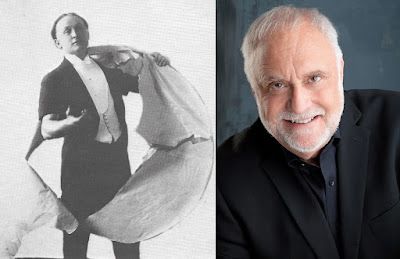
IS THIS HOUDINI’S LAST ILLUSION?by Jim SteinmeyerIn the June 1926 Sphinx, Max Holden described the Banquet of the Society of American Magicians which had been held on June 4, 1926, at the McAlpin Hotel in New York City.
In it, he described a trick that, it seems, was Houdini’s last creation, an unusual illusion. Houdini called it Walking Through the North Pole.
Here is Holden’s description:
"Harry Houdini next presented an illusion with two bare wood tables in the routh [“rough"?], and a piece of pole. He said it represents the North Pole. A dainty little miss was placed on one table, a screen placed round table; likewise a screen was placed around other table, and on screens being removed there was the dainty miss on the other table. After seeing Rubini, nothing is impossible, and how that dainty miss traveled invisibly through the air over that North Pole is beyond me. Miss Horwitz is the dainty miss, a daughter of my friend Sam. Maybe he will satisfy my curiosity."(Rubini was a mindreader who had just appeared on the show and impressed the magicians with his feats. Sam Horowitz produced the S.A.M. shows, so presumably Houdini recruited his daughter to help.)
Not everyone was as complimentary as Holden. Two other reviewers added sparse details. The MUM publication for July 1926 noted the illusion very briefly:
"[Next on the show was] Houdini, presenting his new illusion, ‘Walking through the North Pole.’”An article in Billboard described the performance this way:
"Houdini’s latest illusion [is] called * “Walking Thru the North Pole”. In full view of the audience he somehow managed to transfer a little girl from a table at one end of the log, which represented the North Pole, to a table at the other end.”Notice that Billboard’s reviewer categorized the pole as more of a log.
But the most definitive judgment may have been years later. Writing about his friend and associate Harry Houdini, the great magician, Servais LeRoy, used the North Pole trick as an example of Houdini’s poor judgment with illusions.
From LeRoy:
“[Houdini] had a pleasing stage presence but was in no sense a finished magician, although this detail never seemed to trouble him. His dexterity was out of the ordinary but never reached great heights. As an illusionist he never left the common place; his illusions were anything but subtle. His escapes were incomparable. I frequently wondered at the indifference of the one and the perfection of the other, and finally was forced to the conclusion that his want of originality was the answer. Using other men’s ideas, he was unable to improve on the original and was forced to let it go at that, or produce something still weaker. His illusion of the North Pole (shown at the meeting of the Society of American Magicians Annual Banquet, 1926) was an example. The Vanishing Elephant was another. Both were perfect in their utter weakness. On the other hand, the problems and stunts he was fond of showing in private or semi-privately were perfectly done; the whole informality and apparent impromptu performance suited his unusual style."As a fan of both LeRoy and Houdini, allow me to make a few observations about this criticism. LeRoy was legendary as an artistic illusionist, someone whose performances were perfect and mystifying, and he should be remembered as one of the greatest inventors of illusions in our history. He also writes honestly and insightfully, giving us a look at his taste and understanding of magic. But, like a lot of his contemporaries, he seemed to be frustrated by Houdini.
Still, LeRoy was wrong about dismissing Houdini’s innovations, for Houdini distinguished himself by inventing an entirely new class of illusions, called escapes. And, as LeRoy wrote, “His escapes were incomparable.” Houdini was not the finished, classical magician that LeRoy idealized, and he did not share LeRoy’s taste for stage illusions or innovative techniques. This really is an example of two incredible innovators—so very different—who couldn’t understand each other.
So where does that leave the Walking through the North Pole illusion?
Holden seems to describe a pole that connects the tables horizontally, as the lady supposedly travels “over it, invisibly.” But the action of the trick isn’t clear. The MUM and Billboard describe that the idea was a girl walking “through” the pole, and Billboard suggests that it was more like a long log. Presumably, the pole was used to connect the tables, either from tabletop to tabletop, or along the floor.
I have my own theories about it, and would hope, at some point, to try those out in a demonstration or a recreation. But the premise of the lady traveling invisibly over the pole, or through the pole, isn’t really a clear, interesting, or magical image. The North Pole would have been a topical effect in 1926, with recent headlines about Byrd and other explorers. But even that doesn’t quite work. The legendary North Pole suggests, of course, some sort of fanciful pole standing upright in the frozen tundra, not Houdini’s horizontal pole between two tables.
It’s worth noting that in England, Devant had briefly presented another North Pole illusion years earlier, tying it to topical explorations. He used an upright pole and the illusion was the transformation of a man to a polar bear!
And so, Houdini’s last illusion, given a topical name but a muddled plot, was exactly the sort of thing that inspired LeRoy’s criticism. Still, we have to admit, Houdini has us with a real mystery. With the apparatus long gone, with most in the audience shrugging off the mystery, it’s unlikely we’ll ever fully understand Houdini’s North Pole mystery.

Thank you Jim!
UPDATE: Jim continues his investigation of this effect at his own blog. Check out: WHAT WE HIDE: HOUDINI’S FINAL ILLUSION.
Related:
Tuesday, February 22, 2022
Houdini makes the cover of Genii's 1000th issue
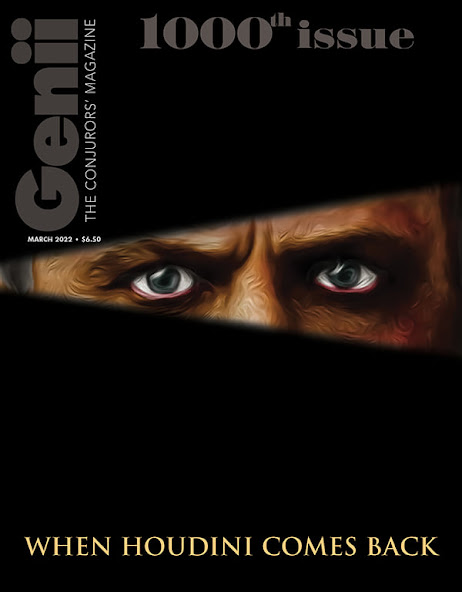
I'm already preempting my "Week of Weird" because we do have some breaking Houdini news today. After a decade's absence, Houdini once again graces the cover of Genii magazine for the March 2022 issue. This is actually Genii's 1000th issue, so how perfect to have Harry back out front. (His first appearance was on issue No. 2 in October 1936.)
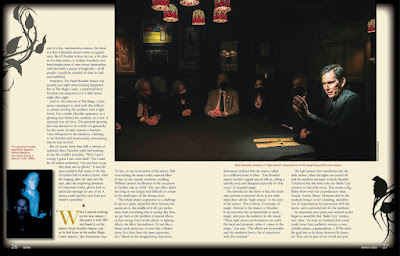
The article inside is an excellent and lengthy look at the new Houdini Seance at the Magic Castle written by Jonathan Levit with Jim Steinmeyer and Benjamin Schrader. Not only does the article tell the behind the scenes story of the seance's creation, but it also includes a nice history of the famous Final Houdini Seance of 1936 (featuring Mark Willoughby's rare photos), and Jim Steinmeyer has some elegant and insightful thoughts on Houdini and his everlasting legacy. Overall this makes for a terrific Houdini issue in the Genii tradition.
Oh, and there's a pic inside from our recent Houdini Nuts preview seance in which you can see Patrick Cullition, Jessica Jane Peterson, and myself. I like to think the image captures three generations of succeeding Edward Saints. What a treat and an honor!
You can subscribe to Genii magazine and Genii Online at the official website. You can also buy Genii in magic shops. This is one to get. Let's show the new editor, Dustin Stinett, that putting Houdini's mug on the cover moves some units!
Saturday, February 19, 2022
American Museum of Magic's 2019 Houdini print
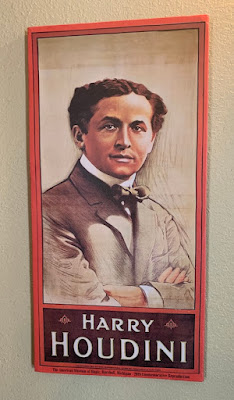
The print for a 2022 memberships is a Howard Thurston poster. However, when the museum offered me a choice of print as thanks for my talk last year as part of their Speaker Series, I had to go with Houdini! I've always been wild about this poster. In fact, this was the first image of the real Houdini I ever saw.
Speaking of the American Museum Speaker Series, the first lecture of this year will be the legendary Jim Steinmeyer giving a talk on Thurston the Great and How History Fools Us. It will take place live on Zoom on Wednesday, March 2, 2022 at 7 pm. All talks are free to members. Non-members can join for a $10 donation.
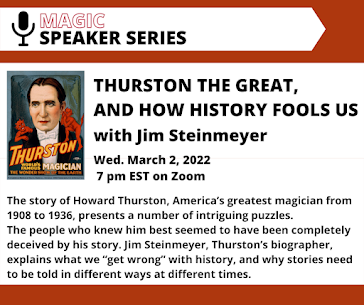
Visit the American Museum of Magic website for information, merchandise, and to become a member. We love our friends in Marshall!
Saturday, January 8, 2022
Secrets of the new Houdini Seance by Jim Steinmeyer

Enjoy this behind-the-scenes look at the new Houdini Seance. Your chair is waiting...

Related:
SECRETS OF THE SEANCEby Jim Steinmeyer
The challenge of the show, of course, was “how” we bring Houdini back, if we successfully reach his spirit, and what, if anything, he has to say. The problem, of course, is that if we fail to reach Houdini’s spirit, the theatrical point of the seance is foiled. And if we manage to get a message from Houdini, we’ve sort of messed up anything that Houdini represented during his lifetime. And… of course, the Magic Castle might be expected to show a little respect for Houdini’s firmly-held beliefs.
I can’t ruin the surprise, of course, but it’s fair to say that Houdini doesn’t come back from the dead, and Houdini ends up having quite a bit to say to us directly and offers us a gift. At one point, we actually hear Houdini explain that “anyone can be fooled in a dark room,” which turns the entire seance experience upside down and makes us question anything we’ve seen. I actually think that his message about eternity shows an understanding that only someone like Houdini would have been able to express. His insight is more enlightened than the usual ghostly messages or whispers in the dark.
The new seance room is a mix of design and function, history and “new legends” in order to set up their show. For those that are interested in the real history, here are few secrets of the new seance experience.
THE NEW SEANCE ROOM
The room was completely rebuilt, right down to the studs, with new electrical wiring, improved air ducting for the air conditioning, and better soundproofing. We concealed a lot of this by designing the room with its own history. For example, the new fireplace is a small, elegant Victorian bedroom fireplace, now bricked up. The wainscoting around the room has been painted over. Although these are new elements, they suggests layers of changes and generations of use. We picked out a rich Victorian teal blue for the walls. It’s actually very close to an original color of the room, from about a dozen years ago, which was dark green.
Disney art director, scenic artist and longtime Castle member Jim Piper added warm wood grained moulding around the ceiling. You’ll find that the theme of the woodwork and stained glass lighting fixtures is “roses.” There’s definitely a reason for that. We get a beautiful misty glow to the room when the rose colors play on the images and the walls. It feels haunted. Our lamps are all Edison bulbs, which flicker and flash at special moments of the seance.
THE PICTURES ON THE WALLSWe’ve added a number of interesting Houdini graphics to the walls, including authentic posters from his career, as well as a recent collectable reprint of the poster from his Grand Magic Revue. If you get a chance to look at the images, you may note some interesting nods to the Vanishing Elephant (including an antique Elephant lamp), images of Arthur Conan Doyle, Margery, her spirit guide Walter, and beautiful images of the Final Houdini Seance of 1936. Those 1936 images were kindly provided by Mark Willoughby. One of my favorite images in the room shows the assembled group on the Knickerbocker Hotel rooftop. The camera is pointed towards the Magic Castle (then, of course, the Lane Mansion). The Castle must be in the shot, although, at nighttime, it’s not illuminated. It’s a wonderful combination of “now” and “then."
There’s also a small picture above the fireplace of an actual spirit medium, circa 1920, in Chicago. That medium is tied to my family history, a friend of my grandparents, and the picture provided a lot of inspiration for me. Let’s just say that, if elements of the seance feel weirdly authentic, it’s because of that particular medium and what he actually did during his Chicago seances. Does that sound mysterious enough?
THE HOUDINI ROSESWe’ve added a sweet new Houdini myth, about the dried roses that Mrs. Houdini kept in her house in Los Angeles. The mediums will tell you the story when you experience the seance. Those Houdini Roses gave me a chance to introduce a brand new effect to the room, a sort of spirit photograph experience for the audience. John Gaughan built the effect for our seance room.
THE GHOSTS
I don’t want to spoil the seance for those that are about to see it, but don’t be surprised if you now see a few ghosts. Mike Elizalde’s company, Spectral Motion, expertly sculpted the special ghosts for us. They’re ghosts of recognizable people, so the project provided a particular challenge to achieve the perfect mixture of reality and fantasy. Let’s just say that you’ll meet some friends, and some enemies, in the seance room.
THE WATER TORTURE CELL
Another newly designed effect is one that strangely, supernaturally, tells the story of Houdini’s famous escape, and gives an account of the accidents that plagued the great magician at the end of his life. The demonstration uses a beautiful little model of Houdini’s Water Torture Cell. The apparatus for this was created by John Gaughan and Freddie Wong.SOME CLASSIC EFFECTS
We had a chance to reprogram the moments of the famous floating table, so now, when the Spirits take control, the table seems to vibrate and shudder before soaring into the air. Similarly, the famous tambourine still opens its case and rattles in the dark, and the Milk Can (the Irby Milk Can which was seen in the 1952 movie) rattles in the dark room.
OUR MUSIC AND SOUNDS
Fans of Houdini will get a chance to hear the 1936 Final Houdini Seance, played over Los Angeles radio and played through an antique radio set. They’ll hear Bess sing the actual Paul Dresser song, “Rosabelle,” that inspired the Houdini’s code; they’ll hear Houdini’s patter for The Water Torture Cell, recorded on a wax cylinder; they’ll hear from Arthur Conan Doyle, and his concern for Houdini. They’ll hear a snippet of “Souvenir,” Walter’s favorite song, a bit of “Pomp and Circumstance,” and a weird waltz—that the band played on the Titanic—that appears on the gramophone to welcome Walter into the room.
OUR CAST OF VOICES
One of the big secrets of our seance is that we’ve re-recorded every voice. Yes, every single voice! It was the only way to get the particular performances we needed. It means that, when the seance audience hears Houdini’s Water Torture Cell introduction, we are actually setting up the sound of his voice, so that we can control it. We can bring it back, with our own message, and the audience recognizes Houdini. We play tricks with that through the seance. It’s a very sneaky deception, especially because, to many people, the voice on the cylinder and the Final Houdini Seance recording will sound authentic. Here’s the celebrity cast that secretly took part in our production:
- John Cox (who occasionally has something to say about Houdini) at the beginning of dinner, the radio plays a number of 1920s songs. John is the announcer who promotes Houdini at the Garrick Theater in Detroit, then introduces the Detroit News Orchestra.
- Sara Ballantine (popular actress and AMA Board of Directors member) plays the part of Mrs. Houdini, who now explains the Rosabelle code during the Final Houdini Seance
- Neil Patrick Harris (star of stage and television, former AMA President) plays the part of Edward Saint, who serves as the medium imploring Houdini to return during the 1936 seance.
- Patrick Culliton (actor and Houdini author) plays the part of Arthur Conan Doyle, who explains that “Once you eliminate the impossible, whatever remains, however improbable, must be the truth.”
- Teresa Ganzel (comedy actress and voice-over talent) plays the part of Margery the Medium, who briefly returns in the darkened room to complain about Houdini and wrestle control of the seance away from the medium.
- Robert Clotworthy (actor and voice-over narrator who hosts Ancient Aliens and The Curse of Oak Island) plays the part of Walter, Margery’s brother and spirit guide, who returns with a wild, demonic laugh to challenge Houdini.
- Paul Reubens (the famous comedy star, Pee Wee Herman’s alter ego, and AMA member) plays the part of the radio announcer interviewing Houdini, who asks him about his pact with his wife to return from the grave.
And the person who plays Houdini… Well, I’m going to keep that a secret.
PUTTING TOGETHER ALL THE PIECES
Then we were able to add the considerable talents of our Magic Castle mediums, special lighting effects, sound effects, and a few tales of Houdini’s spectacular career and his mysterious adventures in the seance room, and you have the new Houdini Seance!
In January, the Magic Castle will begin booking the New Seance, with Rob Zabrecky in the medium’s chair.


You can get full details and pricing for The Houdini Séance Experience at the Academy of Magical Arts website.
Thank you Jim!
- The last original Houdini Seance
- Magic Castle Houdini Seance is coming back to life
- The Magic Castle unveils their new Houdini Séance
Tuesday, December 14, 2021
The Magic Castle unveils their new Houdini Séance
The Magic Castle in Hollywood has officially relaunched their popular Houdini seance as The Houdini Séance Experience. The seance shut down in 2018 for a total retooling which is now complete. Member reservations are now being accepted for 2022. They've also offered a first look at the completely redesigned Houdini Seance Room (below).
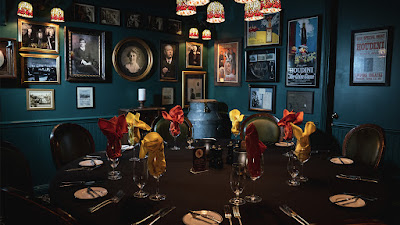
The Academy of Magical Arts is proud to present “The Houdini Séance” - Hollywood’s most famous and immersive theater experience, a Milt Larsen original, one-of-a-kind evening in the astonishing Houdini séance room at the Magic Castle®. We’ve prepared a sensational dining experience for you and your guests, and we’ve invited a world-class medium to sit at the table and conduct a special séance, an attempt to contact the great magician, Harry Houdini, who died on Halloween in 1926. You’ll witness dazzling artifacts from his amazing career; hear the story of his battles with fraud mediums, and enjoy an evening of magical mysteries with weird surprises that you’ll never forget.
I was lucky enough to get a preview of the new seance last month. I'm happy to report that it's a terrific overhaul with a wonderful new script by Jim Steinmeyer. There are some startling new high tech effects engineered by Spectral Motion. But the best old effects are also still in action. There are several celebrity voices worked into the new audio. I'm even part of the show announcing Houdini's appearance the Garrick Theater. The resident mediums have all worked up new "soft seance" pre-shows, and the entire evening is still very Houdini-centric, maybe even more so than the old seance.
I admit the new room will take me some time to warm up to. I've just had too many special experiences in the old room to not feel its loss. Some key artifacts have vanished. But others remain; including a set of three postcards Houdini sent to his sister from Europe. Yes, portraits of Houdini's arch foes, Walter, Margery, and Sir Arthur Conan Doyle now share the space. But that's all part of the show.
You can get full details and pricing for The Houdini Séance Experience at the Academy of Magical Arts website.

Saturday, September 26, 2020
October Genii goes inside the Houdini Seance Room

As you can see, the cover features a nice Halloween theme. But it's too bad the seance article wasn't featured as I think Genii is overdue for a Houdini cover. The last one was January 2011.
Saturday, September 5, 2020
Watch the Houdini episode of The UnXplained
Season 2 of the William Shatner series The UnXplained features a Houdini segment in episode 9, "The Greatest Escapes". I didn't see this when it first aired back in July, but I was finally able to check it out on Amazon. It's well done. It was respectful and I especially liked the colorized animated images of Houdini (below). It also did a nice job of mythologizing the Overboard Box as his most baffling escape. That might be debatable, but you'll need to take it up with Shatner!


The episode features interviews with the great Jim Steinmeyer, Dean Gunnarson (who knows the danger of the Overboard Box firsthand), investigative journalist David Whitehead, and yours truly. The interviews were shot at the legendary Brookledge in a room frequented by Bess Houdini, so that was a thrill.

Of course, it wouldn't be the "History" Channel without conspiracy, pseudoscience, or superstition, hence their conclusion that Houdini may have possessed supernatural powers. Even the filmmakers knew this was hokum, but that's the network. (If you're wondering what happened to the History Channel, check out this YouTube video.)
You can purchase The UnXplained season 2, episode 9, The Greatest Escapes, at Amazon.com. If you have cable you can stream it on the The UnXplained website.
Related:
Related:
Saturday, July 11, 2020
Houdini on The UnXplained tonight at 9/8c
Houdini will be featured on the Season 2 opening episode of The UnXplained which airs tonight at 9/8c on HISTORY. Below is a preview clip from "The Greatest Escapes" tweeted out by HISTORY. Yep, that's me in the distinguished company of Jim Steinmeyer and Dean Gunnarson. I did this interview last year at Brookledge.
Episodes of The UnXplained are also available to stream on the HISTORY website.
Related:
In 1891, Eric Weisz began a career on the Vaudeville stage. He would go on to perform death defying escapes, baffling audiences under a now legendary moniker: Harry Houdini.— HISTORY (@HISTORY) July 11, 2020
Learn about some of history’s greatest escapes when @TheUnXplained tonight at 9/8c. pic.twitter.com/SdYBPjyrn2
Episodes of The UnXplained are also available to stream on the HISTORY website.
Related:
Monday, October 21, 2019
REVIEW: A Houdini book for everyone

Or you can just read one book, The Life and Afterlife of Harry Houdini by Joe Posnanski. Because this is the first Houdini book that will appeal to everyone. And I mean everyone. If you love Houdini and think you know it all, this book will give you new insights. If you hate Houdini and have had enough of him already, you will find support and ammunition for your hatred. And if you just want to see what all the fuss is about, this book will tell you everything you need to know and just might hook you into Houdini World. And with the author's breezy observational style, it's just a great read!
The key here is that Joe Posnanski is an honest broker who approaches his subject as an outsider. He's also a sports writer with keen reporter instincts and an understanding of human nature and fame. The result is one of the most honest Houdini books ever written, one that treats Houdini mythology and biography with refreshing transparency. You always know where you stand with Joe. There's no manipulation of Houdini history for his own gain, no conspiracy theories or pseudo-history. Joe always lets the reader know when he's relating a myth, fact, or something that seems to exist in-between. In this way he's able to leave no compelling Houdini story untold, but also leaves no confusion in his wake. Bravo.

The Life and Afterlife of Harry Houdini is really a search for two enigmatic men; Houdini and Patrick Culliton. Patrick is a big part of this book. It even opens with a quote from him. Patrick has made no secret of the fact that he doesn't like his portrayal in the book. (Pat would like us all to know the cover of his book Houdini The Key is made of buckram, not vinyl.) But I think the book works beautifully as a tribute to this greatest of all Houdini historians and remarkable man. There's no "afterlife" of Harry Houdini without Patrick Culliton.
Some other highlights. Joe's description of going through the late Ken Silverman's research papers at Appleton's History Museum gives a real feel for how Ken himself struggled to discover Houdini. Joe's overview of the various theories and arguments about how Houdini may have escaped from the Mirror Handcuffs (or not) offers the most definitive examination of this escape ever put in print. Mike Caveney's unbridled dislike of Houdini is, yes, a highligh! Mike is one of the greatest magic historians alive and his take on Houdini is important and valid. But Mike doesn't write much about Houdini. Now, thanks to this book, we have Mike Caveney talking Houdini on the record. I'm also thrilled with what isn't in the book. Houdini a spy? Joe addresses this with a single word: Silly.
But this wouldn't be a proper review without a few criticisms. The notion that Houdini was a magician of limited ability gets a bit overstated and never properly refuted (and it can be). Joe allows Joshua Jay to tell the story of the punch and Houdini's death, which feels too important and subjective to be covered by someone other than the author himself. And while not really a criticism as it's a standout and somewhat heart-stopping moment, Jim Steinmeyer's partial exposure of the Water Torture Cell might be misunderstood by the layperson. (Without revealing anything, know Houdini could do the Water Torture Cell without an assistant in the building.)
But I keep coming back to the honestly. As to Houdini's spiritualism debunking, Joe admits: "I can't lie: It bores me. I prefer the escapes. I'd rather talk about the magic." It's this level of candor that makes this such a refreshing read. For me it feels cathartic, a clearing of the air. Sometimes it takes an honest outsider to show you the world that you've been living in. Joe Posnanski is that man and The Life and Afterlife of Harry Houdini is that book. And it's for everyone.
The Life and Afterlife of Harry Houdini can be purchased at Amazon.com and Amazon.co.uk.
Related:
Friday, June 14, 2019
Magic Castle Houdini Seance is coming back to life

As you'll recall, the original and long running Houdini Seance was retired last year so it could be retooled under the guidance of Academy of Magical Arts President, Jim Steinmeyer. Jim kindly invited me to make this little audio cameo. He also gave me a preview of the new seance.
The seance will remain centered on Houdini (even more so than the original) and Jim is taking pains to make sure all the history is correct. The original seance was always fun--if a little hokey. This new seance--which also sees a completely refurbished Houdini Seance Chamber--is going to be a high end experience for guests from start to finish. I'm not going to spill the details here, but know that it's going to be a vastly expanded evening with some pretty good scares. I can't wait!
I don't yet know the date of the new seance launch, but it's coming together quickly. Stay tuned.
Below is a pic of me recording my segment with Benjamin Schrader, who is working with Jim on the production. Ben recently played Houdini in a revival of Ragtime at the Pasadena Playhouse.

Related:
Tuesday, July 17, 2018
Jim Steinmeyer reveals The Secret History of Magic
The Secret History of Magic: The True Story of the Deceptive Art by Peter Lamont and Jim Steinmeyer is released today. Yes, I said Jim Steinmeyer. Yes, I said magic history. That means BUY NOW!
But if you still need to be sold, check out this description:
Jim Steinmeyer will be speaking and signing copies of the book today (July 17) at The Magic Apple in Studio City, CA, from 3pm to 6pm.
The Secret History of Magic: The True Story of the Deceptive Art can be purchase at Amazon.com and Amazon.co.uk.
Related:
But if you still need to be sold, check out this description:
Pull back the curtain on the real history of magic – and discover why magic really matters
If you read a standard history of magic, you learn that it begins in ancient Egypt, with the resurrection of a goose in front of the Pharaoh. You discover how magicians were tortured and killed during the age of witchcraft. You are told how conjuring tricks were used to quell rebellious colonial natives. The history of magic is full of such stories, which turn out not to be true. Behind the smoke and mirrors, however, lies the real story of magic.
It is a history of people from humble roots, who made and lost fortunes, and who deceived kings and queens. In order to survive, they concealed many secrets, yet they revealed some and they stole others. They engaged in deception, exposure, and betrayal, in a quest to make the impossible happen. They managed to survive in a world in which a series of technological wonders appeared, which previous generations would have considered magical. Even today, when we now take the most sophisticated technology for granted, we can still be astonished by tricks that were performed hundreds of years ago.
The Secret History of Magic reveals how this was done. It is about why magic matters in a world that no longer seems to have a place for it, but which desperately needs a sense of wonder.

Jim Steinmeyer will be speaking and signing copies of the book today (July 17) at The Magic Apple in Studio City, CA, from 3pm to 6pm.
The Secret History of Magic: The True Story of the Deceptive Art can be purchase at Amazon.com and Amazon.co.uk.
Related:
Sunday, July 1, 2018
Magic Castle announces changes to Houdini Séance

In the July Academy of Magical Arts newsletter, President Jim Steinmeyer announced that changes are coming to the Magic Castle's long time Houdini Séance. Says Jim:
"After years of expertly rattling chains and ringing tambourines, we thought that our spirits deserved a vacation. Our GM, Joe Furlow, is working on the schedule and details, but it looks like current séances will run through to December of this year and then officially cease."
For a while, the Séance Room will become a private dining room with "a special dining experience and a private magic show." Meanwhile, a committee of members, including Mike Elizalde, John Gaughan, and Max Maven, as well as the three resident seance mediums, Leo Kostka, Rob Zabrecky, and Misty Lee, will be working on an all-new seance experience. "We will be inviting a few additional spirits and installing astonishing, never-before-seen effects," says Jim.
And what about Houdini in all this? Jim continues:
"After he enjoys a little R&R at the beach, Houdini will be returning to the second floor, stage managing each performance, and taking his cues. (Once a performer, always a performer!) We’ve promised him that our séance will be “more Houdini” than ever, and he’s promised to slip a few real surprises up his ectoplasmic sleeve."
I'm both excited and spooked (ha!) by this announcement. No question updating the séance effects is great idea, and the members consulting on this project are top notch who no doubt will do amazing work. My concern is what this might mean for the room itself.
The Houdini Séance Room is a special place inside the Magic Castle, with a unique energy that has everything to do with the history on the walls and the power of Houdini. When guests enter this room, their voices lower and their eyes light up. It's clearly a place of worship. It's also a link to the Larsen family and their relationship to Bess Houdini. And a "Houdini Séance" is part of Hollywood history as well.
Hopefully the history and special energy of this famous space will be respected and Houdini will remain front and center. I'll be watching with interest and will share updates here.
Coincidently, here's an article that I just came across from June 23, 1969 that describes the then newly installed seance experience.
 |
| Click to enlarge. |
Related:
Sunday, January 7, 2018
100 years ago Houdini vanished an elephant

It was 100 years ago today, January 7, 1918, that Houdini first vanished a live elephant at the enormous Hippodrome Theater in New York. To this day, no one knows exactly how Houdini did it. But that hasn't stopped magicians from speculating.
In the effect, an elephant named "Jennie" was ushered into the rear of a large cabinet decorated as a circus wagon. The cabinet was closed and turned toward the audience, a task requiring a block and tackle and 30 men. On Houdini's command, both the front and back of the cabinet were opened so the audience could see through to the back of the stage. The elephant was gone. "No special background, in full glare of the lights, and it is a weird trick," Houdini proudly proclaimed.
The vanishing elephant was an instant hit and became the new highlight of the Hippodrome's "Cheer Up" revue. It also led to the longest engagement of Houdini's career (19 weeks). But some magicians thought the presentation was lacking. They complained that because of the semi-circular seating inside the huge Hippodrome auditorium, only people directly in front of the cabinet could see that the elephant had actually vanished. Others had to take Houdini's word for it. But while magicians might have criticized the effect, they could still not explain how Houdini did it.

Houdini's elephant was part of the "Powers Performing Elephants" troop, a regular feature of the Hippodrome show. Houdini claimed she was the daughter of Barnum's famous Jumbo and that she was "gentle as a kitten." He also pointed out, "I never allowed a hook to be used, relying on block sugar to make her go through her stunt, and she certainly is very fond of me." Some descriptions say Jennie wore a large blue ribbon around her neck and a giant wristwatch on her leg (so the audience could see her until the last second). Interestingly, Jennie would outlive Houdini by many years. An article from May 25, 1950 shows her alive and well at age 86.
Of course, with a trick the garnered as much attention as the vanishing elephant, competitors rushed to create their own versions. Always one to aggressively protect his effects, Houdini took out ads in the trades warning competitors of his copyright. This appears to have worked as no other vanishing elephants appeared during Houdini's lifetime (that I'm aware).


Houdini revived the elephant vanish in 1922 at the Times Square Theater in New York to perform after screenings of his film The Man From Beyond. Some say the trick was more effective in the smaller venue, in which Houdini alternated between two smaller elephants borrowed from the Ringling Circus. As little as we know of the Hippodrome vanish, we know even less about the Times Square version, which may or may not have employed the same method.
How did he do it?
No one knows exactly how Houdini vanished his elephant. But that hasn't stopped the publication of explanations. J.C. Cannell (The Secrets of Houdini) wrote that the elephant passed into a second hidden cabinet. Walter B. Gibson and Morris N. Young (Houdini's Fabulous Magic) described a method that employed the use of black art. Modern Mechanic claimed the elephant was hidden behind a false backdrop. Even the infamous "Masked Magician" revealed a method involving mirrors, but his presentation bore no resemblance to how Houdini presented his effect. Interestingly, Houdini must have revealed the secret one night when he invited a committee of engineers, in town for a convention, to enter the cabinet. He then vanished them to the delight of their fellow employees.
The theory that holds the most water was first put forth by Guy Jarrett, who had pitched his own vanishing elephant idea to the Hippodrome management and was turned down. Jarrett's explanation was based on the Disappearing Donkey, an effect Houdini had purchased from Charles Morritt in 1914. While Jarrett's theory was dismissed by many as unworkable at this scale, it was championed by Jim Steinmeyer, who demonstrated the feasibility of it at the 1983 Magic Collectors Convention in Chicago using a toy elephant and a scale replica of the cabinet. Steinmeyer later published his theory in his book Hiding The Elephant (2003). As for its flawed presentation, Steinmeyer wrote, "It might have been a great illusion disguised as a bad illusion."

However, the Jarrett/Steinmeyer theory relies on eyewitness accounts of how the trick was presented, specifically that the audience looked through a round opening in the front of the cabinet. But in a 1992 issue of the Mystifier, William M. Doerflinger, who saw the trick as a youth, specifically refutes this, saying:
"Some later commentators suspected that the audience had looked through a circular opening at the front of the cabinet as well as through the back, somewhat as though the cabinet was a huge Phantom Tube. My own visual image agrees with those who say there was no circular opening at the front; it was completely curtained until Houdini drew the curtains aside."
Frustratingly, there are no surviving photos of the cabinet or any of the apparatus Houdini used during his vanishing elephant to help settle the matter of exactly how it appeared to the audience. There's not even a known poster. So in more ways than one, the vanishing elephant remains one of Houdini's great mysteries. As Houdini himself said, "Even the elephant doesn't know how it's done."


The above illustration is from Escape King: The Story of Houdini (1975) by John Ernst.
UPDATE: David Haversat of David Haversat Magic has shared with me the unpublished notes of Milbourne Christopher explaining how he vanished his own elephant. Christopher writes that he believes his method is the same that Houdini used. As a rule, I don't expose secrets on this blog, so even though David has given me permission to share the notes, I'm reluctant to do so. But I will say I think Christopher's method makes sense, and it allows for the front of the cabinet to be fully opened as some eyewitness say that it was. I'm now thinking Milbourne Christopher may be the one who finally got it right.

Related:
Wednesday, May 24, 2017
The Doug Henning Project goes WILD
Neil McNally's new blog The Doug Henning Project is going strong with terrific interviews with Milt Larsen, John Gaughan, and Jim Steinmeyer. This week Neil is sharing a multipart interview with, gasp, me!

So only after you finish reading Neil's interview with those far more interesting and deserving members of the magic community, check out my blather. Neil and I did have a great time conducting this interview over Friday Lunch at the Magic Castle.
Thank you Neil.
Related:

So only after you finish reading Neil's interview with those far more interesting and deserving members of the magic community, check out my blather. Neil and I did have a great time conducting this interview over Friday Lunch at the Magic Castle.
Thank you Neil.
Related:
Friday, November 13, 2015
REPORT: Inside the L.A. Conference on Magic History
 Last week I had the great pleasure of attending the 14th Los Angeles Conference on Magic History (my first). So much went on during the 3-day conference that I'll leave it to traditional magic journals such as Genii to properly detail all that hosts Jim Steinmeyer, Mike Caveney and John Gaughan brought attendees this year. Instead, I'll focus on the Houdini highlights.
Thursday, November 5th
The conference had two major Houdini events this year. The first came on Thursday when Houdini himself made an appearance in the form of Casey Wong's amazingly life-like Houdini figure (which you might remember from this post).
Casey gave a talk Thursday afternoon and spoke at length about the creation of his Houdini figure. It was a excellent lecture with photos of every step in the process. The time and effort that went into creating Harry was tremendous -- every hair on his head was individually inserted, for example. Casey explained that he made his Houdini taller than life-size (he's 6-foot) because he wanted to depict Houdini "as he saw himself." Much has been made of Houdini's pale appearance. Casey explained that the idea here was to depict Houdini onstage, so his pale visage is pancake stage makeup.
The Houdini figure was set up in the conference museum. It was certainly a popular display, with attendees taking photos and selfies with the Master Mystifier all weekend.

Other Thursday lectures included Bill Becker on spirit photography; Trevor Dawson on Signor Arvi; Richard Hatch on Dr. Kurt Volkmann; and a thought-provoking talk by Peter Lamont on the history of magic and witchcraft, and why we may have been getting that history all wrong.
I should say that nearly every talk throughout the conference had a reference to Houdini. One of my favorites came during the Thursday lecture by Dean Arnold and Ken Trombly, who spoke about how they recently uncovered a large cache of Chung Ling Soo posters in England. Dean, a pilot, told an amusing story of how he inadvertently invaded an airport's airspace when he flew himself to the site of the find. When Ken asked if he had a photo of his plane, Dean brought up a photo of Houdini's Voisin.
Speaking of aviation, Joe Hanosek gave me a nice photo of Houdini flying his Voisin. It's not an original, but it's a nice clear shot of the plane in flight that I will use on future posts. Joe also gave me a copy of his new booklet, Houdini!!! in Columbus, Ohio.
Friday, November 6th

One of the perks of being invited to the L.A. History Conference is having access to the dealers' room. These are magic's top sellers, and the room is a museum in itself. But it's also where one can buy some rare pieces typically only encountered at auction. I hadn't planned on buying anything, but then I remembered my "Moses Buy" philosophy... Buy one quality Houdini item a year.
I found that item at the table of a legend himself, Ken Trombly, collector and proprietor of MagicPosters.com (flip through the Kalush book, and if there's a photo of Houdini you've never seen, chances are it came from Ken's collection). Ken shared with me a binder filled with original Houdini challenges. I could not resist what I considered the best in the book. You can see my new treasure below.

The Friday lectures were largely Houdini-free, but still fascinating. One of the reasons I go to magic conventions is to learn about other magicians. Bill Spooner discussed the long career of African-American magician Eugene Hellman. Dale Lorzo covered Edwin H. Brush. Bill Liles spoke on Raymond Phillips, Magician of the Radio Waves. Steve Valentine discussed the Cards to Pocket routine (he's wild about C2P!). Bill Becker talked Matthew Brady & Herrmann (more on this below), and our friend Bill Mullins gave a great lecture on gambler Kid Canfield.
The grand finale was Jim Steinmeyer's recreation of Kellar's Blue Room and Self-Decapitation Illusion, with Nicholas Night playing the part of Harry Kellar. Getting the opportunity to see lost illusions from the golden and pre-golden age of magic, recreated for one night only, is what the L.A. Magic History Conference is all about. Unforgettable.
Another highlight on Friday was the announcement of an amazing new find, and even though this isn't Houdini-related, it's too incredible not to detail. Speaker Bill Becker revealed he had discovered in a private collection the negative of a never-before-seen portrait of Alexander Herrmann, taken by the famous Civil War photographer Matthew Brady. What's even more incredible is that the photo is of such high resolution that one can make out Brady and his studio in the reflection of Herrmann's eye.
A large print was made for the conference and displayed in the museum after the Friday night talks. I don't know what the future holds for this image, but it was a beautiful thing to see. Even Herrmann expert James Hamilton said it was the best portrait of Alexander he had ever seen.

Saturday, November 7th
On Saturday we took a field trip to Spectral Motion in Burbank, owned and operated by Mike Elizalde. Spectral Motion is a practical special effects house that creates real movie magic, especially creature costumes and animatronics, for major films such as Hellboy and Hansel and Gretel. But magic fans might recognize Spectral Motion as the makers of a series of beautiful bronze busts of master magicians. During the tour of the workshop, I spied a familiar face looking down from a shelf of original clay molds.

The big Saturday night show saw lectures and performances by John Gaughan (Automata in the Movies), Gene Anderson and Jack Goldfinger (The Torn and Restored Newspaper), John Carney (as L'Homme Masqué), and Mike Caveney who performed John Daniel's "Sawing A Lady in Half" and Maurice Rooklyn's "Birth of a Pearl" using the original apparatus. Saturday also saw the second big Houdini feature of the conference. This was the surprise appearance of Q the Automaton from The Master Mystery.
I've already shared details and a film clip of Q's invasion HERE. Below is one more photo of the Automaton mingling in the courtyard of the Garland hotel after Friday's lectures. Q was played by Jeff Chang whose eyes you can see through the mouth. During his talk, John Gaughan showed how you could see this in the original film. I never realized that the actor was looking through the mouth, but this was a clever way to add a foot or more of height to the robot. Needless to say, the Automaton was a monster hit!

The conference itself was filled with magic luminaries. I was thrilled to meet Lance Burton, and I almost fell over when he said knew my blog and even specifically recalled my post on the Buried Alive. Other recognizable faces were: Ricky Jay, Mac King, Max Maven (who gave me a rivet that popped off the Automaton), Bill Kalush, David Ben, Julie Eng, Adele Friel Rhindress, Rob Zabrecky, Jonathan Pendragon, Erika Larsen, Lisa Cousins, Joe Fox, and many more names and faces familiar and famous. What a magical weekend it was.

Subscribe to:
Posts (Atom)