Showing posts with label J. Gordon Whitehead. Show all posts

Friday, July 17, 2026

Houdini: The Man Who (allegedly) Died Twice

I've just finished Dr. Larrian Gillespie's Houdini: The Man Who Died Twice, the new book that promises to reveal the truth of Houdini's death with sensational new revelations. The book is a Kirkus Indie Award finalist and has received positive reviews from Genii and others. It's a book that has already provoked a lot of discussion. So what did I think?


Well... I liked it! I especially like the hard-boiled detective tone and how Larrian steps us through her investigative process. I normally don't care for this kind of first-person approach in non-fiction, but it's so well written that it hooked me. Maybe it helped that I know all the players. (Full disclosure: I'm one of the "Watsons" in the book. But hopefully David Burke and not Nigel Bruce.)

There is definitely some new information here, and some known information that is nicely placed in context for the first time. I was most taken with the smaller discoveries. Houdini may have had color-changing eyes. Houdini wore a truss to support what he believed was an injured kidney, but may have been a herniated disc. And I have a new appreciation of Houdini's infected butt boil. Yes, no detail about Houdini is too small...or gross.

It's also nice to have all the various affidavits regarding his final days and the dressing room punch collected in one place. These are fascinating to read. The author has also uncovered fresh information about J. Gordon Whitehead, who comes off as the only blameless person in the book!

Ultimately, this is a well-told detective story with a lot of intriguing conjecture. But in the end, the mystery remains. No smoking gun emerges in the final chapter to prove any one of the many theories put forward. So for me, it didn't land a knockout punch (pun intended). As for the most provocative claim, that Houdini died on October 30th and not the 31st (hence the "died twice" title), I have long believed there could be something to this. But I'm somehow now less convinced of this than I was going in. Maybe it was just one cover-up too many.

There is a lot here to absorb, and I will definitely revisit this book when it comes time for me to tackle Houdini's death in my own books. Thankfully, that is still years away. Maybe by then a smoking gun will have emerged, or we will realize this was all smoke and mirrors.

But I encourage you to get the book and make up your own mind. You can buy Houdini: The Man Who Died Twice at Houdini True Crime. International buyers should use Cipher House Books.

Saturday, December 21, 2024

Sam Smiley drops the mic

Just a heads up that while I'm on a break from this blog, I am still active on my Patreon. And it's been a good month! The post below will be of interest to all who love to study and/or debate the infamous Houdini dressing room punch. It's a 1982 interview with eyewitness Sam "Smiley" Smilovitz with some interesting new details. He certainly didn't like Whitehead!


For those of you still circling my Patreon, this is a great time to take the plunge, especially if you want to do the lowest Handcuff King level ($5 per month). On January 1st, material from 2023 will become unavailable for Handcuff Kings, who get one year of archival content. Scholars and Angels can enjoy three years of archival content, which is currently everything.

Use the promo code SMILEY and get 30% off your first month. This end-of-year offer is good until Dec. 31st.

Hope to see you inside!

Thursday, March 31, 2022

The letter of apology

In 1976, the S.A.M.'s annual wand-breaking ceremony for Houdini was held inside Room 401 at Grace Hospital, where Houdini died. I recently saw video from that event, and during it, magician Jay Marshall said an incredible thing:

"One of the interesting things is J. Stuart Whitehead wrote a letter of apology to the family, and they destroyed that. But he had apologized for having struck Houdini."

Marshall didn't elaborate and I don't have any other information on this letter, but how I would love to have read it! By the way, Marshall really did say "Stuart" Whitehead instead of Gordon. But I think that was just an honest mistake.

If anyone has any more information on this letter, or remembers Jay talking about it in more detail, please let us know in the Comments below.

Monday, April 10, 2017

Killer first selection for the American Museum of Magic Book Club

The American Museum of Magic in Marshall, Michigan kicks off their new season this month. Along with a host of Spring activities, the museum has launched a book club with the first selection being Don Bell's The Man Who Killed Houdini.

This groundbreaking 2004 study investigates the life and mysteries behind J. Gordon Whitehead, that McGill University student who punched Houdini in his Montreal dressing room on October 22, 1926.

The American Museum of Magic is located at 107 E Michigan Ave, Marshall, MI. Many Houdini artifacts are on permanent display, including a Houdini-Hardeen Milk Can and Houdini's original overboard box. You can keep with the latest via their official website and Facebook page.

The Man Who Killed Houdini can be purchased on Amazon.com. Click the image above for details on how to join the American Museum of Magic book club.

Related:

Saturday, October 22, 2016

The beginning of the end

It was 90 years ago today that Harry Houdini was playing at the Princess Theater in Montreal, Canada. He had lectured a few days earlier at McGill University, where he boasted about his ability to withstand blows to his stomach. He even took a blow from a student as a demonstration.

On October 22, Houdini invited two McGill students, Sam Smilovitz (aka Smiley) and Jacques Price, to visit him at the theater. The boys arrived around 11:15 AM. Houdini was nursing a broken ankle, caused by an accident in the Water Torture Cell, so he reclined on his small dressing room couch and read mail while Smiley, an art student, sketched him. Smiley recalled that Houdini was kind, affable, and seemed to be trying "to impress upon us the he was 'one of the boys.'" He also recalled that Houdini appeared to be a man "much in need of a long, carefree vacation."

As Smiley sketched, Houdini spoke. He told them that even though he found film production "highly interesting," he would not return to it. He said that in a year or two he would write a book containing many of his secrets, but would withhold publication for a long time.

That's when a third student named J. Gordon Whitehead was shown into the dressing room. Whitehead was tall (six-foot-one) and spoke, as Smiley recalled, with "an exaggerated Oxford accent." He wore a blue gabardine coat that seemed too small for him. Whitehead was there to return a book Houdini had loaned him. Houdini invited him to have seat with the other boys.

The talkative Whitehead began peppering Houdini with questions. Eventually he asked Houdini his opinion of the miracles mentioned in the Bible. Houdini declined to comment on "matters of this nature." Whitehead then asked if it was true he could withstand blows to his abdomen without injury, a question Smiley said "came out of a clear sky." Houdini said that it was.

Whitehead rose up and started hitting Houdini in the stomach. He delivered several blows that Smiley described as being "terribly forcible, deliberate, well-directed." Eventually Houdini waved him off saying, "That will do."

After the bizarre incident, the boys settled back and Smiley finished his sketch, which Houdini signed and dated for him. Looking at the image, Houdini is reported to have said, "You made me look a little tired in this picture. The truth is, I don't feel so well."

Later that afternoon, Houdini's niece and show assistant Julia Sawyer found him in pain in the dressing room. Houdini explained that he had been struck in the stomach by a student before he had a chance to stand and get ready for the blow, "possibly because of a misunderstanding."

Nine days later Houdini would die on Halloween from complications of a ruptured appendix.

Here are collection of links related to Houdini's final days:

Monday, October 27, 2014

Two new Spanish language Houdini books

Here are two recently released Spanish language books that may be of interest to Houdini buffs.


El hombre que mató a Houdini ("The Man Who Killed Houdini") by Rufino Fernández is a fictional novel about Houdini and J. Gordon Whitehead. (This shouldn't be confused with the Don Bell book of the same title which was a non-fiction exploration of Whitehead.) It can be purchased in paperback or for the Kindle on Amazon.com.

Valle-Inclán y el insólito caso del hombre con rayos x en los ohos ("Valle-Inclán and the incredible case of the man with X-Rays in his eyes") is a non-fiction work about Joaquin Maria Argamasilla and his connection with Houdini and Spanish writer, Ramón María del Valle-Inclán. You might recall that Argamasilla's claim of having X-ray vision was exposed by Houdini in his Margery pamphlet.

You can buy Valle-Inclán y el insólito caso del hombre con rayos x en los ohos at the UK Amazon.co.uk. You can get more information on the book HERE.

Thanks to Javier Coronet.

Tuesday, September 2, 2014

Fact checking HISTORY's Houdini - Part Two


Part One established HISTORY's Houdini as the least accurate Houdini biopic ever made. However, the miniseries redeemed itself in Night Two which, finally free of the silly spy movie narrative, was able to focus on the events of Houdini's real life and even right some wrongs of earlier biopics. For those who'd like to separate fact from fiction, we continue our fact check of HISTORY's Houdini.

Was Houdini's brother also a magician and escape artist?
Houdini was very close with his younger brother Theo a.k.a. Dash. In November of 1900, Houdini invited Dash to come to Europe where he set him up with a complete act and named him Hardeen. The idea was for Dash to take bookings in theaters and circuits that Houdini didn't play, and the brothers could effectively shut out the many cheap imitators of the escape act. This worked well and Hardeen established himself as a popular and credible escape artist in his own right. While the brothers sometimes posed as "rivals" for the press -- and might have had a few moments of genuine competition -- they were not rivals as shown in the miniseries. Dash left show business to run Houdini's film developing lab in New Jersey in 1916. After Houdini's death in 1926, Hardeen inherited his brother's props and resumed his magic career until his own death in 1945. (Read: Houdini vs. Hardeen in Oakland.)


Did Houdini do his first suspended straitjacket escape in San Francisco?
Houdini's first suspended straitjacket escape was in Kansas City on September 8, 1915. He then did the escape in many cities across the U.S., including San Francisco. Houdini would typically do the escape in front of newspaper offices, and would attract crowds numbering in the tens of thousands. It's become one of his most iconic escapes. (Read: Uncovering Houdini's 1915 Los Angeles straitjacket escape.)

Did Houdini give up doing escapes for his wife Bess?
While Houdini would sometimes comment to reporters how his wife would like him to give up his dangerous work, there is no evidence that this was an actual issue in their marriage, and Bess was fiercely supportive of her husband in all his career endeavors. Houdini never stopped doing escapes.


Did Houdini make an elephant disappear?
Houdini performed his Vanishing Elephant during a record-breaking engagement at New York's Hippodrome Theater in 1918. But unlike in the miniseries, Houdini vanished his elephant in a gigantic box made to look like a circus wagon. Houdini later revived the illusion using a smaller elephant for live appearances at the Time Square Theater to promote his film, The Man From Beyond. How exactly Houdini made his elephant vanish is still debated today. (Read: 100 years ago Houdini vanished an elephant.)

Did Houdini walk through a brick wall?
Houdini did indeed walk through a brick wall in July 1914, although he performed the illusion at Hammerstein's Roof Garden Victoria Theater in New York, and not in London as shown in the miniseries. Houdini only performed the effect for a short time before turning it over to his brother Hardeen. Yet it left such a strong impression that he is still called "the man who walked through walls" today. As to whether the method shown in the miniseries is the correct one... I'm not saying. (Read: When Houdini walked through a brick wall.)


Was Houdini devastated by the death of his mother?
It's true that the death of his mother in 1913 (not 1914) devastated Houdini. However, the direct connection of his mother's death and his involvement in spiritualism is not entirely accurate. Houdini had an interest in spiritualism from the start of his own magic career, and his crusade against fraudulent mediums did not begin until 10 years after his mother died. Although the possibility of contacting his mother was always on Houdini's mind. (Read: Mama's death and the birth of a myth.)

Did The Houdinis perform as spiritualists early in their careers?
It is true that Harry and Bess worked briefly as spiritualists, and it's said Harry even called out the identity of a murderer from the stage one night. (The man jumped up and fled the room.) The parents who confront the Houdinis backstage are based on a mother who did accuse Houdini of black magic when he predicted that her son would fall from his bicycle and break his arm. Houdini had earlier seen the mother scolding the boy for riding recklessly, and prediction had inexplicably come true. After this, Houdini gave up the spiritualism act. (Read: Meet the Robinsons.)


Did Houdini star in silent movies?
Houdini did indeed have a career in silent movies between 1918 and 1923. He made a successful 15-part serial called The Master Mystery; two feature films for Famous Players-Laskey Paramount, The Grim Game and Terror Island (the clip we see in the miniseries is actual footage from The Grim Game); and two films for his own production company, The Man From Beyond and Haldane of the Secret Service. He also owned and operated a motion picture film lab in New Jersey. The Houdini miniseries is the first biopic to acknowledge Houdini's film career. (Read: Houdini's rough ride at Niagara Falls.)


Was Houdini ever tied to a cannon?
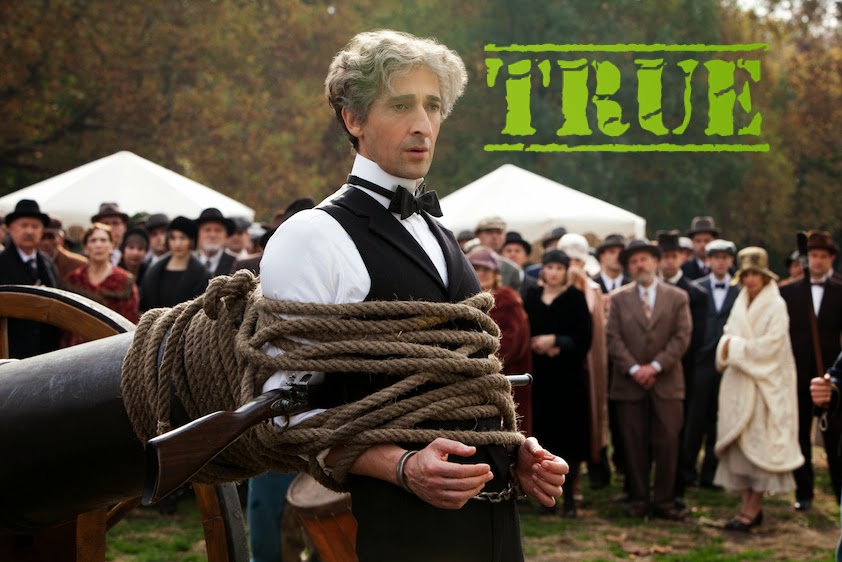
Houdini was bound to a cannon in almost exactly the manner as depicted in the miniseries (kudos to technical advisor David Merlini) on two occasions. The first was in England in 1911 when he was challenged by the Royal Navy. The second was in Los Angeles' Pershing Square in 1919. During this second challenge, authorities stepped in and would not permit the cannon fuse to be lit. (Read: Houdini's Cannon Challenge.)


Did Lady Doyle give Houdini a seance in which she contacted his mother?
It is true that in 1922 Sir Arthur and Lady Conan Doyle gave Houdini an automatic writing seance that supposedly contacted his mother. In fact, the words Lady Doyle speaks in the miniseries is largely verbatim. It's also true that Houdini did not accept the seance as legitimate. The three tells were that his mother's spirit made the sign of the cross (she was Jewish), wrote in English (she spoke German), and there was no mention that the day before was her birthday (not Houdini's birthday as shown in the miniseries). This seance was the beginning of the end of Houdini's friendship with Sir Arthur Conan Doyle. (Read: The Mama message.)

Did Houdini crusade against fraudulent mediums?
It is true that during the final years of his life Houdini exposed fraudulent mediums, both on stage and by going to seances in disguise. He also employed a small "secret service" of investigators who would go to seances on his behalf and bring back information. He testified in front of Congress in support of a bill to outlaw fortune telling in the District of Columbia. He published a book on his investigations called A Magician Among The Spirits. (Read: Houdini, the Hillstreet, and the birth of a ghostbuster.)

Did Margery try to seduce Houdini in his hotel room?
While Mina Crandon a.k.a. "Margery" fostered intimate relationships with some members of the Scientific American committee that investigated her in 1924, there is no evidence that she ever tried or even had the opportunity to seduce Houdini. Of her well recorded charms, Houdini said, "Her applesauce means nothing to me."

UPDATE: In the new book The Witch of Lime Street: Seance, Seduction, and Houdini in the Spirit World, author David Jaher reports that Margery did indeed attempt to seduce Houdini when she allowed the magician to take a nap in her son's bedroom. (Read: Houdini and Margery in the apple orchards.)

UPDATE: TRUE!

Did Margery put a curse on Houdini?
Following her exposure, it was widely reported in the press that Margery had put a "curse" on Houdini. Margery denied it and blamed Houdini for planting the story himself (which he almost certainly did). However, private correspondence shows that, during a seance, Margery's spirit guide Walter predicted that Houdini would die on December 25, 1925. Houdini survived the prediction by 10 months. (Read: Margery's curse.)

Did Houdini break his ankle in the Water Torture Cell?
It is true that Houdini broke his ankle while being raised from the stage during a performance of his Water Torture Cell at the Capitol Theater in Albany NY on October 11, 1926. Unlike what's shown in the miniseries, he did not continue with the escape, but was tended on stage by a doctor. Houdini cut the USD from his show and never performed it again. He died 20 days later. (Read: Houdini's Water Torture Cell accident.)


Did Houdini invite people to punch him in the stomach?
This has become an ingrained part of Houdini lore and is shown many (many!) times in the miniseries, but there is scant evidence that Houdini invited people to punch him in the stomach throughout his life. The first record of such a punch/challenge was a week before his death during a lecture at McGill University. This may have inspired the later punch in his dressing room that would prove to be so damaging. (Read: The Pickleman punch.)

Was the man who punched Houdini a supporter of spiritualism?
While Houdini historians love to debate the motives of J. Gordon Whitehead (named "Kelly" in the miniseries), the two eyewitnesses to the infamous dressing room punch did not indicate that there was any talk about spiritualism, and Whitehead did not scream out any accusations. The official record says that Whitehead asked if it was true Houdini could take a blow to the stomach, and then set about hitting him before he was ready. Even Houdini said it was an accident. However, Whitehead's later life revealed that he had tangential connections to the spiritualism movement and also suffered mental problems. He died in 1953 after living many years as a hoarder. (Read: Is this J. Gordon Whitehead at McGill in 1926?)


Did Houdini collapse on stage during his final performance?
Houdini actually made it through his entire final performance at the Garrick Theater in Detroit on October 24, 1926. Despite having a ruptured appendix and a 104 degree temperature, he concealed his illness from the audience (although some said they could tell something wasn't right). Even after the show, Houdini still refused to go to the hospital. He returned to his hotel and only after having a phone conversation with his own doctor in New York did he allow himself to be taken to Grace Hospital. (Read: 85 years ago: Houdini at the Garrick.)

Did Houdini die on Halloween?
Houdini did indeed die in Room 401 of Grace Hospital in Detroit on Halloween of 1926. The bedside conversation we see Houdini having with his doctor about being a "fake" is also true. Houdini died with his brother Theo (Hardeen) by his bedside at 1:26 p.m. (Photos of the hospital room here.)


I hope you found this Fact Check of HISTORY's Houdini helpful. If there's anything I didn't cover, please ask in the Comments below and I will answer you there. I will be posting my full review of the Houdini miniseries tomorrow.

#HOUDINItruth

Sunday, July 27, 2014

Brody among the spirits in 'Houdini'

Today we get our first look at Adrien Brody as an older Houdini in the second night of HISTORY's upcoming two part biopic of the famous magician. This one shows Brody/Houdini addressing the press during his later career crusade against fraudulent mediums.

Photo by Egon Endreyi © 2014 History (click to enlarge).

There are a few aspects to this photo that are worth examining a little closer. Notice that Brody is holding a copy of a book titled, "Harry Houdini: Fake Mediums and Their Methods." This is a mix of Houdini's own Miracle Mongers and Their Methods and A Magician Among The Spirits. Apart from a brief mention of the Robert-Houdin book in TNT's 1998 Houdini, this marks the first biopic to show Houdini as an author. Another box ticked!

You'll also notice actor Máté Haumann in the crowd looking rather intently at Houdini. As I reported back in December, Hautman is credited as playing "Kelly" in the film, a name I don't recognize from Houdini's life. Could "Kelly" be a renamed J. Gordon Whitehead? Might we be seeing Kelly/Whitehead stalking Houdini during his anti-spiritualism crusade? Hmmm.

Once again, kudos to the costume design. Houdini's pinstriped suit is right out of real life. His hair is grayer than Houdini ever let his get, but it does the job of aging Brody nicely.

Now, what is it everyone is looking at here? Guess that will have to wait until September.

Houdini co-stars Kristen Connolly as Bess and Evan Jones as Jim Collins. The 4-hour biopic is is directed by Uli Edel from a script by Nicholas Meyer and airs in two parts on September 1 & 2 at 9pm ET/PT and 8pm/C on HISTORY.

Related:

Monday, June 2, 2014

The Prince of Wales assault


We all know J. Gordon Whitehead punched Houdini in the stomach at the Princess Theater in Montreal on October 22, 1926. That punch started a chain of events that would lead to the magician's death on Halloween. But in his seminal work, The Man Who Killed Houdini, author Don Bell uncovered evidence of two other punches delivered by McGill University students during Houdini's stay in the city.

Recently we looked at the first of these, "the Pickleman punch," which took place at the McGill University Union Hall on October 19. Today we have what might be better described as an "assault" on Houdini in the lobby of the Prince of Wales Hotel on McGill College St., just a few blocks west of the Princess Theater.

In 1990, Gilles Larin, the grandson of the Prince of Wales owner, Francis Larin, related to Bell the remarkable story, which he said was part of family lore. He heard it from his father and grandfather, although the only eyewitness was the night clerk, Honore Larin (Francis' brother). Here's the story as told in Bell's book:

After giving a performance Houdini usually had a meal and relaxed in the Prince of Wales lobby, reading newspapers. In the back of the  hotel was a tavern [Pig & Whistle] frequented by McGill students. It had a door leading to the lobby, but when the hotel closed at 11 p.m., the students usually went out through the rear exit leading to the lane in back.

But that particular night when Houdini was there waiting to board the overnight train that would take him and his company to Toronto, Buffalo, etc. and then to Detroit, three or four students who were rather drunk spilled out of the tavern into the lobby. One of them, mimicking the act that Houdini presented in his show where he dared anyone to hit him in the stomach walked up to Houdini, who was sitting in a lounge chair reading a newspaper, and, without any warning, hit him through the newspaper in the stomach, a crunching blow. Houdini, doubled over in pain, said, "You shouldn't have done that," then got up, very slowly, and walked out of the lobby.

Larin goes on to say that while this incident was "much discussed" the next day, there was no police report filed and Houdini was already gone. The timing of this is interesting. If Houdini was waiting for the train to Detroit, then this happened after the Whitehead blows, which would have made this especially painful (and damaging?). It's generally accepted that Houdini's appendix ruptured while on the overnight train to Detroit.

It's also interesting to speculate whether Houdini's unidentified assailant that night suffered the same confusion and guilt that Gerald Pickleman experienced. After Houdini's death, it was only reported that he had died as result of being punched by a "McGill University student." The name J. Gordon Whitehead and the details of the dressing room punch did not become public until 1953. Any student who struck Houdini that week would assume they were the student in the news reports. Houdini's words, "You shouldn't have done that," would have certainly haunted this student. (Unless he was too drunk to recall the incident at all.)

This one is a bit harder to accept than the Pickleman punch, which still had living eyewitnesses into the 1980s. While I find no reason to not believe this happened, second hand accounts are by their nature unreliable, especially when they are over 80-years-old. Still, it's a curious piece of the puzzle that is the last week of Houdini's life.

Related:

Thursday, May 15, 2014

Sam Smilovitz at McGill

Here's another selection from the archive of McGill University yearbooks recently uncovered by our friends at the Houdini Museum in Scranton and Joe Notaro of Harry Houdini Circumstantial Evidence.

Below are images of Samuel J. Smilovitz a.k.a "Smiley." Sam was the art student who sketched Houdini during his lecture at McGill's Union Hall on October 19, 1926. Houdini was so impressed with the sketch that he invited Smiley to come see him backstage at the Princess Theater and do another for him. Smiley invited a friend, Jacques Price, and together they visited Houdini on October 22. It was during this visit that a third student, J. Gordon Whitehead, who was unknown to both Smiley and Price, joined the gathering. The rest is Houdini history.


Above is Sam Smiley's graduation photo from the 1927 yearbook. Below is a shot of Smiley with fellow members of the Maccabaean Circle, a student group devoted to Jewish culture and ideas.

Click to enlarge.

Unfortunately, I could find no photos of Jacques Price in the yearbooks. But you can see his photo in my recent interview with his daughter, Karen Mann. That post also includes a photo of Smiley in 1994.

Thanks again to Dorothy Dietrich, Dick Brookz, and Joe Notaro. You can check out all the McGill Yearbooks HERE.

Related:

    Friday, May 9, 2014

    Is this J. Gordon Whitehead at McGill in 1926?

    Recently our friends at the Houdini Museum in Scranton and Joe Notaro of HHCE turned up an amazing archive of yearbooks from McGill University. Of course, it was a student from McGill, Jocelyn Gordon Whitehead, who punched Houdini in his dressing room at the Princess Theater on October 22, 1926. Could these books give us our first look at Whitehead as a student?

    There is only one known photo of Whitehead, taken almost 25 years after the Houdini incident when he was in his 50s. Because he never graduated, there is no individual yearbook photo of him as a student. However, this group shot of the "Arts '28 Class" in the 1926 yearbook is said to include a "Whitehead, J.G." (as well as Gerald Pickleman, who also "tested" Houdini that week). Unfortunately, it doesn't specify which student is Whitehead.

    Click to enlarge.

    Sam Smilovitz (aka "Smiley"), who was also present in the dressing room, gave a good description of Whitehead. Smiley described him as: "At least six foot two – wearing a blue gabardine coat that seemed much too small for him. An oldish looking young man about 27 or 28 years of age [he was actually almost 31]. He impressed one as being the very genteel type of student. His face was ruddy, his hair very thin on top; his frame was powerful though loosely-knit, and his neck was inordinately long."

    My candidate for Whitehead is the individual below. He seems to match Smiley's description quite well -- right down to what might be his blue coat -- and I just feel like he might be our man.


    What do you think? If this is indeed J. Gordon Whitehead, it is only the second known photo, and the only one taken at the time of the Houdini punch. Wild indeed.

    Thanks to Dorothy Dietrich, Dick Brookz, and Joe Notaro. You can check out all the McGill Yearbooks HERE.

    Related:

    Monday, May 5, 2014

    The Pickleman punch

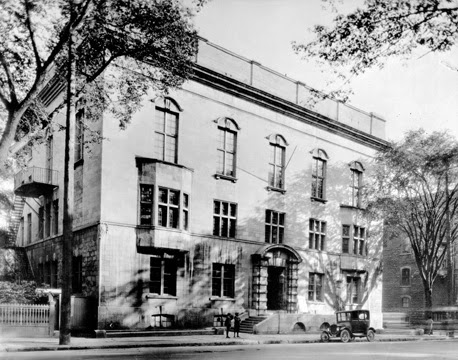
    McGill University's Union Hall.

    We all know J. Gordon Whithead punched Houdini in the stomach in his dressing room at the Princess Theater in Montreal on October 22, 1926. It's debated whether or not the punch caused or just masked his fatal appendicitis, but all agree that Whitehead's punch was the start of a chain of events that would lead to the magician's death on Halloween. But in his seminal work, The Man Who Killed Houdini, author Don Bell uncovered evidence of two other punches delivered by McGill University students during Houdini's stay in the city that might extend that chain a little further back.

    One of those punches is said to have occurred in the lobby of the Prince of Wales Hotel. However, that incident is questionable as it only comes via second-hand sources, so I'm going to save it for another time. The punch I want to discuss today is the first of the three for which there is strong evidence. This punch or "test" occurred on October 19, 1926, when Houdini was giving his lecture at McGill University. Bell calls it "the Pickleman punch."

    Bell first learned of the Pickleman punch from a former McGill University student named Dr. William Cohen. Dr. Cohen said that a student named Gerald Pickleman had tested Houdini with a blow at the McGill Union Hall (today the McCord Museum). Unfortunately, Dr. Cohen could not remember specific details, although he did recall Houdini putting a needle through his cheek during this same meeting with students.

    Eventually, Bell tracked down a key eyewitness to the Pickleman punch, another former McGill student named Jack Hausner. Bell interviewed the 84-year-old Hausner in Palm Beach, Florida in 1991. As you'll see, Hausner confused it with the Whitehead blow, as would others. Hausner recalled:

    "It was in a public room where students went to socialize -- to shoot a game of pool or snooker. Houdini was passing through and we engaged him in conversation. He was very warm when we met him.

    I remember clearly his challenge to anyone within the group to punch him -- with all his might! -- in his stomach so that he could demonstrate his powers of concentration to withstand physical pain and survive unharmed.

    I must differ with you concerning the identity of the person who delivered the blow which apparently resulted in his death a week or two later. That person was not Gordon Whitehead, as you believe. If my memory serves me correctly, it was an undergraduate known to many of us at the time, name Gerald Pickleman (or Pickelman). ... He came from a family who lived in upper New York State.

    Pickleman was a pretty burly fellow, but as far as I knew he wasn't a boxer and didn't work for the McGill Daily, although anyone could have contributed an article from time to time. Houdini had time to prepare himself. The blow wasn't unexpected. Pickleman was 170 pounds or so, five feet seven or nine. It was just one blow."
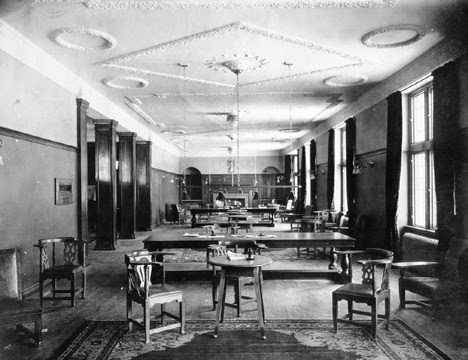
    Site of the Pickleman punch?

    Gerald Pickleman died in 1981, but Bell was able to find his widow, Annette Pickleman, who independently confirmed the events at Union Hall:

    "Gerry told the story many times," she said, "whenever Houdini's name came up, but in later years people hadn't discussed it with him as much. It wasn't a thing he boasted about, but nor was it a secret or anything he ever tried to hide. He had the normal guilt a person would have. He was a sensitive man, not the kind of person who would go around punching people. He wasn't aware [that the punch had caused Houdini's death] until after the autopsy. That's when he began to talk about it."

    What's tragic here is it appears Pickleman blamed himself for delivering the blow that "killed Houdini." But one can see how this happened. After Houdini's death, the newspapers only reported that he was struck by a "student of McGill University." In fact, the name of J. Gordon Whitehead did not appear in print until 1953. So it's understandable that Pickleman believed that he was the "McGill student" who fatally injured Houdini. Poor guy.

    Now, I'd be remiss in not mentioning that Dr. William Tait, head of the McGill psychology department, who had invited Houdini to give his lecture at the University that day, denied that Houdini was struck by a student at the meeting. He said Houdini left in a taxi immediately after the lecture. But he may have been unaware of the informal meeting with the students (which could have happened before the lecture), or was trying to protect the University. He also said Houdini appeared ill at the meeting.

    I do believe the Pickleman punch happened as independently described by William Cohen, Jack Hausner and Annette Pickleman (by way of her husband). I also believe it's likely that this "punch me as hard as you can" challenge and successful first demonstration at Union Hall is what motivated the drunken students at the Prince of Wales to test Houdini and, of course, J. Gordon Whitehead in the dressing room at the Princess Theater on the fateful day. You might even say Houdini's death began here.

    Union Hall is today the McCord Museum in Montreal.

    Related:

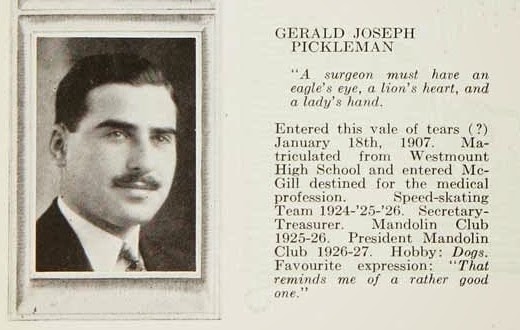
    UPDATE: Thanks to our friends at the Houdini Museum in Scranton and Joe Notaro, here is a photo of Gerald Pickleman from the 1929 McGill yearbook.

    Sunday, February 23, 2014

    Interview with Karen Mann, daughter of Jacques Price

    Karen Mann and her father Jacques Price.
    A highlight of last year's Official Houdini Seance in Nova Scotia was the attendance of Dr. Karen Mann, the daughter of Jacques "Jack" Price. Price was one of the three students in Houdini's dressing room in Montreal on October 22, 1926 and witnessed the punches by J. Gordon Whitehead. Those punches lead to Houdini's death nine days later on Halloween.

    Now I'm honored to share a Q&A interview I was able to conduct with Dr. Mann via email. While she isn't able to answer all our deepest questions or help confirm or dispel the many conspiracy theories that have grown up around this incident, it's still incredible to hear from someone personally associated with the most infamous moment in Houdini history. So without further ado, here's Karen!

    WAH: First, can you please tell us a little about yourself?

    KM: I am the only child, and only daughter of Jacques Price and his wife Margo. I live in Halifax Nova Scotia. I am a university professor in medical education, and although I have 'officially' retired, I still work at things I love, like teaching, and am probably employed about 75%of time. My husband and I live in Halifax, and he too is partially retired from the University. I have three grown children, and we have 8 almost 9 grandchildren.

    WAH: Can you tell us a little about your father, Jack Price, and what happened to him after McGill University?

    KM: After McGill, my dad found his way to University of Toronto, where he studied civil engineering, graduating in the late 30s. I think he worked for some time before he went to university. It was in Toronto that he met my mother, who was from Niagara Falls. They married in 1940, and moved to Nova Scotia, via Prince Edward island. My dad served in the Royal Air Force in the War, as a squadron Leader, who taught calculus to pilots. He spent his work life as a self-employed civil engineer, a profession which he loved.

    Jack Price sat center on Oct. 22.
    WAH: Do you remember when you first learned that your father was one of the students in the dressing room on Oct. 22, 1926, when Houdini was punched?

    KM: I learned about it from Donald Bell, who was researching and writing a book called The Man Who Killed Houdini. He contacted me as he had been trying to find my dad without success. He had gone to the UK, and found my dad's sisters who were still living in Blackpool and Preston, in the North of England. He found them through the local Synagogue, which was also how I learned that my dad was Jewish. Someone told him there, that my dad had a daughter in Halifax, and as Halifax is a small place, he found me without too much difficulty. I think it was sometime in 1992.

    WAH: Do you remember exactly what your father told you about that day?

    KM: I asked my dad about the incident, and the first thing he said was 'I didn't do anything wrong'. I think back on that now, and realize that there may have been a lot of questions around exactly what happened, and he was very cautious. He did tell me a little about it, just as the incident has been reported.

    WAH: Did your father ever hint that he thought J. Gordon Whitehead deliberately tried to injure Houdini that day?

    KM: WE didn't discuss it. At the time, I didn't know enough about the story to ask those questions.

    WAH: Some think that Houdini's lawyer, Bernard Ernst, manipulated the details of the dressing room incident to aid his insurance claim for an accidental death. Did your father ever say anything about being manipulated or that his affidavit wasn't the full truth of what happened?

    KM: No, he didn't. We didn't get to chat about it again. My mom died shortly thereafter and my dad within a few months. He was also a very private man all his life.

    WAH: Did you know if your father went to see Houdini's lecture at McGill, or if he had ever seen Houdini perform on stage?

    KM: I think he had. I think he was interested in meeting him, and so was happy to go backstage with his friend, Sam Smilovich.

    Sam Smilovich in 1994.
    WAH: Did your father stay in contact with Sam Smilovich after college? Did you know Sam?

    KM: I don't know for sure; however when I spoke with him, I remember his being aware of what had happened with Sam following their time together, so they must have done in some way, perhaps not directly.

    WAH: Did your father ever tell you what happened to the sketch Sam did of Houdini that day in the dressing room?

    KM: No- wouldn't it be wonderful to see!

    WAH: Did your father talk about the dressing room incident in public? Was it general knowledge among his friends that he was one of the eyewitnesses to the punch that may have killed Houdini?

    KM: Absolutely not! He was reluctant to talk about it even with me. And when Don Bell called him following my conversation with him, my dad told him he didn't want to discuss it. No one knew. My mother was unaware even, until I told her.

    WAH: Finally, how was the seance in Nova Scotia? Any strange phenomena occur?

    Karen Mann
    KM: The séance in Nova Scotia was a wonderful experience from start to finish. I felt very pleased to be there and really enjoyed meeting all the people who are so interested in and knowledgeable about Houdini. I'm not sure whether we actually heard anything, as our medium was unable to play back the tape very clearly. He (the medium) said that he could hear chains clanging- whether Houdini's or those of a ghost purported to live in the Citadel where the séance was held. My most enduring thought about the séance is that I really felt it connected me with my dad, who died in 1993. I especially appreciated the opportunity to say a few words about him.

    Please join me in thanking Dr. Karen Mann for sharing her recollections of her father with all of us here at WILD ABOUT HARRY.

    Photos from The Man Who Killed Houdini by Don Bell. Also thanks to Bruce MacNab for making this possible.

    Related posts:

    Sunday, November 24, 2013

    Getting punchy

    Last month I did a post about whether it was medically possible that the punches to Houdini's stomach delivered by J. Gordon Whitehead really did cause his fatal appendicitis (result: it's possible). That post kicked off a firestorm of discussion -- over 100 comments and counting -- about Whitehead and his motives in throwing those punches. The comments have proven to be more interesting and informative than the post itself!

    Front and center in the action is Houdini author and expert, Patrick Culliton. To aid in some of his points, Patrick has now posted to his website Houdini's Ghost the sworn affidavit of J. Gordon Whitehead. It's a remarkable read that contradicts the established account of what happened, right down to saying that it took place on October 21, not October 22.

    Whitehead goes on to say that Houdini not only encouraged the initial punch, but egged him on to punch him repeatedly, and that the other students in the room, Sam Smiley and Jack Price, didn't voice any objections. This wildly different from what Smiley and Price themselves reported in their own sworn statements. Whitehead also says he visited Houdini on two more occasions after the dressing room incident, and confirms that he was at Houdini's lecture at McGill.

    Most biographers discount the Whitehead affidavit when reconstructing the dressing room incident and instead rely on the statements by Smiley and Price. Therefore, this isn't a version that is generally known. It's fascinating stuff, so use the link below and have read at Houdini's Ghost:

    Tuesday, October 22, 2013

    Time to rethink the rethinking on the Houdini punch


    It was 87 years ago today that Houdini was punched in the stomach by J. Gordon Whitehead in the dressing room of the Princess Theater in Montreal. Those punches marked the start of a chain of events that would culminate in Houdini's death on Halloween eight days later. But did those punches kill him?

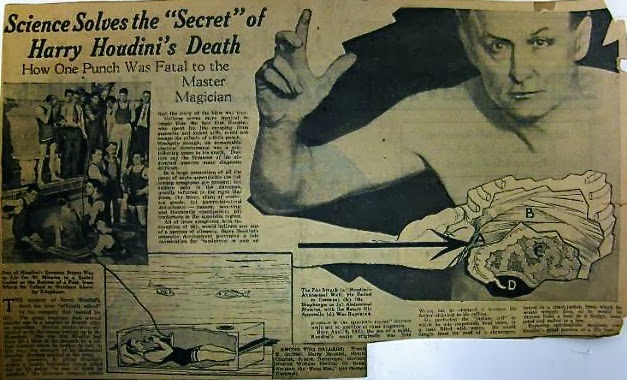
    After Houdini's death, it was widely reported that the punches (frequently misreported as a single punch) were the cause of his fatal illness -- "traumatic appendicitis." But in the past few decades, historians have questioned this on medical grounds, saying that it's more likely Houdini was suffering from appendicitis before the attack and the punch only worked to cover-up the serious infection developing in his abdomen. This opinion has been stated in many Houdini documentaries (even by yours truly), and even appears on the official McGill University website. In fact, the most recent Houdini biography, The Secret Life of Houdini, goes as far as to say that traumatic appendicitis as a medical condition "has never existed" (page 518).

    Eyewitness sketch
    But Houdini author and expert Patrick Culliton has pushed back hard against this thinking in recent years. He believes Houdini's appendicitis was caused by Whitehead's blows. Furthermore, he thinks Houdini was not struck unexpectedly. He believes Houdini was prepared for the blows, but because of his broken ankle, he elected to remain lying on his dressing room couch. But with his back against a hard surface, there was no "give" when the punches were struck, which is key to performing a feat of physical prowess such as absorbing blows to the stomach.

    Patrick cites the famous footage of Frank "Cannonball" Richards getting hit in the stomach with a cannonball. Having give in the body is essential. Had Richard's been standing with his back against a hard surface, well... Hence the blows from Whitehead were especially damaging to Houdini's internal organs.

    But what about the claim that traumatic appendicitis doesn't exist? Why are we asking magicians? Why not ask a real doctor?

    Marc Gellman, M.D., a Houdini buff and reader of this blog, has taken up this question for us and sent over a May 28, 2010 report by the RCS Advance Surgical Standard on Trauma Surgery on the "Systematic review of blunt abdominal trauma as a cause of acute appendicitis." Their conclusion; while rare, traumatic appendicitis absolutely exists. In fact, this report seems to confirm many of the conditions of Houdini's fast acting illness.


    Click to enlarge.
    Although rare, the diagnosis of acute appendicitis must be considered following direct abdominal trauma especially if the patient complained of abdominal right lower quadrant (RLQ) pain, nausea and anorexia. Appendicitis can be reasonably attributed to trauma if the presentation was early after the traumatic event and the patient has not suffered from suggestive symptoms prior to trauma.

    It's important to know that Houdini's doctors all signed off on the traumatic appendicitis diagnosis. The push back against the idea came from Houdini's insurance company. If they could establish that Houdini was suffering from the illness before the dressing room incident, they would not have to pay double indemnity for an accidental death. Some newspapers aided in this, reporting that Houdini was ill on his arrival in Montreal and was traveling with a nurse.

    But sworn affidavits from all of Houdini's crew refuted the idea that the magician was ill before Montreal. It's true that a nurse was traveling with the show, but she was looking after Bess who was still recovering from a serious bout of food poisoning. The insurance company failed to establish pre-illness and eventually paid out. That should have been the end of the story.

    So why have we all now taken up the cause of the insurance company? Why shouldn't we accept the word of Houdini's own assistants and the diagnosis of his own doctors? I believe it's because, at some point, someone suggested the medical improbability (and then impossibility) of traumatic appendicitis and we all took the bait. For some it appeals to a sense of logic; to others a predilection for conspiracy theories.

    But thanks to Marc, we now know traumatic appendicitis does exist. So the possibility that Houdini died from Whitehead's blows has to be seriously entertained, especially considering how the punches were delivered (Patrick's theory). In fact, I'd say the burden of proof is all on the opposite side.

    Now, whether Whitehead intended to injure Houdini or if the incident was truly accidental is something else that is argued by Houdini buffs, but I'm not opening that can of worms here. One controversy at a time! What I'm offering up here is proof that it is medically possible Houdini's fatal appendicitis could have been caused by the punches he received 87 years ago today.


    Thanks to Marc Gellman, M.D. for his help clarifying the medical side of this for us. If you'd like to read the full RCS report, shoot me an email and I will send you the PDF.

    UPDATE: Check out this post for a revelation that might shed some new light on Houdini's reluctance to seek medical attention. Read: Did a contract clause kill Houdini?

    Wednesday, August 14, 2013

    A sober recap of Drunk History's Houdini episode


    Last night Drunk History aired a segment about Houdini in an episode titled, "Detroit." For those who aren't familiar with the Comedy Central series, Drunk History features soused storytellers talking about real history while well-known actors perform their inebriated version of events. It's pretty funny stuff.

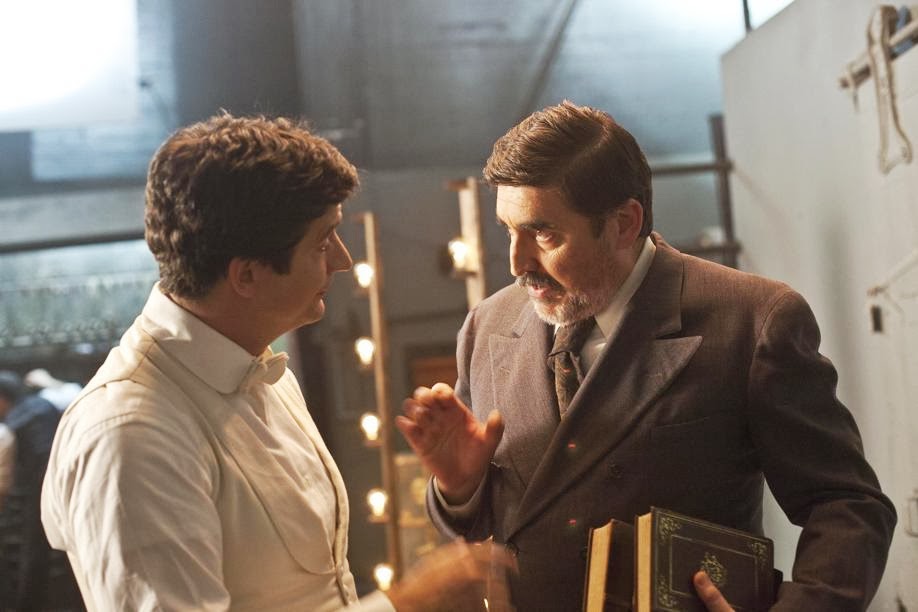
    In last night's episode, Ken Marino and Alfred Molina played Houdini and Sir Arthur Conan Doyle respectively. The storyteller was Lucius Dillon, who was very, very drunk. The Houdini segment was the last, longest, and drunkest of the show. It was broken up by a commercial break.

    For all the frivolity of their approach, Drunk History actually did a good job with their Houdini history -- far more responsible and accurate than some of the recent offerings from the cable networks (yes, Brad Meltzer's Decoded, I'm still talking about you). While there were no egregious inaccuracies, I can offer up a few picky points of clarification. So let's do this thing.

    1234...

    Houdini and Bess (played by Maria Blasucci) did indeed work briefly as spirit mediums early in their careers. However, they did a stage act, not private consultation as depicted in the reenactment. Also, I don't know where that bit about Bess posing as a "Bible salesman" to glean personal information came from. That must have been the booze talking.

    Atlantic City 1922 is the correct date and location of the Houdini-Doyle seance. However, the show depicted Houdini as performing there with Doyle visiting him backstage. In reality the Houdinis were vacationing with the Doyles when the big seance went down.

    The seance with Lady Doyle (played by Sarah Burns) was depicted as being spoken communication, whereas in reality it was all done via "Automatic Writing." In fairness, Dillon did say the communication would be done with "handwriting", but it was much funnier having the Burns/Dillon wildly articulate the ghostly words from Houdini's mother. Houdini did indeed ask if his mother's ghost could read his mind, and Lady Doyle did make the sign of the cross on the top of her notepad. The show depicted Houdini as blowing his top at the seance, but in reality he kept his feelings to himself at that sitting.

    Houdini did wear disguises to seances (here's one) and aggressively exposed mediums on the spot. Whether or not he flipped them a double bird on his way out the door...only the spirits know.

    1234...

    The dressing room assault by J. Gordon Whitehead (here played by show creator Derek Waters) was not quite as abrupt as depicted in the reenactment. Houdini was also reclining on a couch at the time of the blows. The reenactment suggested a stricken Houdini went right from his dressing room to his final performance, but in reality the assault happened while Houdini was in Montreal. He traveled to Detroit to give his last performance two days later.

    Houdini did indeed perform his final show at the Garrick Theater with a 104 degree temperature and a burst appendix (which probably ruptured on the overnight train ride to Detroit), although his appendicitis would not be discovered until he was operated on the next day. Houdini final performance was not as sloppy as shown in the reenactment, although the interior agony of it might have been very accurate for what Houdini himself was experiencing. There was indeed a man in the audience who had seen Houdini before (not sure about "8 times") who sensed that something was wrong. Others who had not seen Houdini thought the show was pretty good.

    Houdini did die in Grace Hospital in Detroit on Halloween, although the Doyles were not by his bedside. Houdini died with his brother Hardeen by his side. His doctors at the time were noncommittal about whether the blows caused the fatal infection. That would be fought about between his lawyer, Bernard Ernst, and the New York Life Insurance Co. for the next year. Ernst ultimately succeeded in pinning the cause of Houdini's final illness on the blows, which enabled Bess to collect double indemnity for accidental death. The debate as to whether Houdini was suffering from appendicitis before the blows continues to this day.

    The "10 year compact" is something that might need to be tackled in a fresh post at some point, because exactly what Harry and Bess arranged is not so straight forward as that. But for now, yes, Houdini and his wife arranged a codeword that would identify him should he come back. Bess did give up on seances after 10 years and she did say, "Ten years is long enough to wait for any man." And, yes, Bess's hair was white by then.

    So there's your sober recap of Drunk History. Kudos to the show for treating our man right and doing a good job with the history while still having a lot of fun.

    Cheers.

    Houdini and the Doyles in Atlantic City at the time of the seance.

    Translate