I currently don't have a subscription to Ancestry, so if someone wants to be a hero and try to suss it out for me there (or anywhere), I'll give you thanks in the book! You can leave it in the comments or shoot me an email.
- Home
- Life
- Escapes
- Magic
- Movies
- Houdini's Movies
- Les merveilleux exploits de Houdini à Paris (1909)
- The Master Mystery (1918)
- The Grim Game (1919)
- Terror Island (1920)
- The Man From Beyond (1922)
- Haldane of the Secret Service (1923)
- Velvet Fingers (1925-26)
- Medium Well Done (1937)
- Religious Racketeers (1938)
- Houdini Picture Corp.
- Film Developing Corp.
- Filming locations
- Unmade Movies
- Deconstructing Houdini '53
- Spiritualism
- People
- Beatrice Houdini
- Theo Hardeen
- Cecelia Weiss
- Mayer Samuel Weiss
- Jim Collins
- Franz Kukol
- Martin Beck
- Sir Arthur Conan Doyle
- Margery
- J. Gordon Whitehead
- Edward Saint
- Jacob Hyman
- Leopold Weiss
- Carrie Gladys Weiss
- Bernard M.L. Ernst
- Charmian London
- Jess Willard
- H.P. Lovecraft
- Sherlock Holmes
- Assistants
- Imitators
- Other magicians
- Media
- Full Bibliography
- By Houdini
- Biography
- Fiction
- Foreign
- For Kids
- Methods
- Wild About Harry Bookshelf
- Houdini His Life Story (1928)
- Houdini The Man Who Walked Through Walls (1959)
- Houdini The Untold Story (1969)
- The Life and Many Deaths of Harry Houdini (1993)
- Houdini!!! The Career of Ehrich Weiss (1996)
- The Secret Life of Houdini (2006)
- The Metamorphosis: The Apprenticeship of Harry Houdini (2012)
- The Witch of Lime Street (2015)
- The Life and Afterlife of Harry Houdini (2019)
Showing posts with label Elsie Hardeen. Show all posts
Friday, August 7, 2026
When did Hardeen marry Elsie Fozzard?
Saturday, October 1, 2016
The Houdini-Weiss exedra turns 100
It was 100 years ago today that Houdini unveiled the exedra that fronts the Weiss family plot at Machpelah cemetery in Queens. Houdini dedicated the monument in a special ceremony on Sunday, October 1, 1916.
The creation of the exedra (resting place) had taken over a year. Houdini entrusted the task to Oscar Teale, a past president of the Society of American Magicians whom Houdini employed as a private secretary. Teale worked throughout 1915-16 while Houdini was on tour. The job was not an easy one. The contractors deviated from Teale's model, a marble seat developed a crack, and faulty drilling broke large slabs of stone which had to be replaced. In the end, it cost Houdini a whopping $40,000 (that's close to a million dollars today).
The finished exedra was cut from a thousand tons of Vermont granite and ornamented with figures hewn from Italian marble. The original headstones for Houdini's parents were placed inside each end of the exedra. On the back was etched:
Erected By
HOUDINI
1916
In Sacred Memory
Of His
BELOVED PARENTS
About 250 people attended the dedication ceremony, which was conducted by Rabbi Bernard Drachman and Rabbi A.B. Tinter. Newspapers from as far away as Pittsburgh covered the event. The new plot had the Weiss family laid out under uniform headstones made from the same granite as the exedra, with Houdini's headstone in place beside his mother.
The exedra that was unveiled 100 years ago is slightly different from the one we know today. It did not have the bust nor the cut glass mosaic emblem of the Society of American Magicians. Those would be added a year after Houdini's death and unveiled during a special memorial service attended by Bess. I've never seen a close-up image of the original exedra, but glimpses of it can be seen in photos taken during construction and Houdini's funeral. (Which you can see below.)
However, the grave site has also seen rough times and controversy. In April 1975, the grave became the focus of attention when escape artist and Houdini provocateur Norman Bigelow claimed to have "deciphered a complex code" that revealed Houdini had hidden his secrets inside the exedra. That same month, cemetery revelers, high on PCP, dislodged and broke the original grave bust. The timing lead some, including James Randi, to believe Bigelow had committed the vandalism in an attempt to prove his theory.
The bust was replaced by the S.A.M. in a special ceremony on March 24, 1976, in time for the 50th anniversary of Houdini's death (Saturday Night Live would do a "broadcast" from the gravesite that year). However, the second bust was stolen in 1983. After two more replacements were stolen, the S.A.M. decided it was best to leave the monument headless. Then, on May 25, 1994, the entire gravesite experienced extreme vandalism with the destruction of two stone benches and the headstones of Leopold and Gladys Weiss.
With help from magicians, including generous donations from David Copperfield and James Randi, the S.A.M. repaired the gravesite (although Gladys and Leopold's headstones have yet to be replaced). In 2007, the site once again became of the center of controversy when a plan to exhume Houdini's body to test for poisoning drew nationwide attention. It was later dismissed as a publicity stunt.
In 2011, Dorothy Dietrich, Dick Brookz and Steve Moore of the Houdini Museum in Scranton took it upon themselves to restore the long missing Houdini bust with a reproduction made at their own expense. They also oversaw the upkeep of the gravesite during a time of dispute between the S.A.M. and the cemetery over costs.
But all disputes have now been settled, and the S.A.M. has resumed the upkeep of the grave of their "Most Illustrious" past president. In fact, this past May, the S.A.M. concluded a major cleaning and restoration of the entire exedra, just in time for its 100th anniversary today.
Below are photos of the exedra throughout the years.
![]() |
| Houdini takes a seat during construction. |
![]() |
| The dedication on October 1, 1916. |
| Houdini's funeral, November 4, 1926. |
![]() |
| Hardeen and Bess in the 1930s. |
![]() |
| Elsie Hardeen, Gladys Weiss, and Marie Hinson in 1954. |
![]() |
| On Saturday Night Live, October 30, 1976. |
| Me with the headless exedra in 2005. |
![]() |
| The bust is restored by the Houdini Museum in 2011. |
Last Monday, September 26, our magical friend Colleen Bak visited the gravesite and took these beautiful photos (as well as the image at the top of this post), giving us a nice look at the 100-year-old Houdini-Weiss exedra as it proudly stands today.
Background on the building of the exedra from Houdini!!! The Career of Ehrich Weiss by Kenneth Silverman.
Timeline:
- 1904: Houdini buys plot for $450. Moves grandmother, father, and half-brother Herman.
- 1916: Houdini dedicates exedra in memory of his parents on October 1st.
- 1926: Houdini is buried on November 4.
- 1927: S.A.M. holds memorial service and unveils Houdini bust and S.A.M. emblem.
- 1975: Houdini bust is smashed by vandals on night of April 8-9.
- 1976: S.A.M. replaces Houdini bust with replica on March 24.
- 1983: Second Houdini bust is stolen on August 14. Replaced by S.A.M. with replica.
- 1987: Machpelah Cemetery goes into bankruptcy. State takes ownership.
- 1988: Third Houdini bust is stolen. Replaced.
- 1990: Fourth Houdini bust is stolen in November. Not replaced.
- 1994: Benches are smashed and Gladys/Leopold headstones damaged on May 25.
- 1996: Grave is restored with funds raised by S.A.M. with help from David Copperfield and James Randi. Bust and Gladys/Leo headstones are not replaced.
- 2002: Police recover bust stolen in 1983. (Returned to S.A.M. in 2011 and now on display at the Houdini Museum of New York.)
- 2007: S.A.M. stop paying for the upkeep of the plot over dispute with cemetery owners.
- 2007: Book authors announce plan to exhume Houdini's body to check for poisoning.
- 2011: Dorothy Dietrich and Dick Brookz replace Houdini bust with replica on September 29.
- 2013: S.A.M. announces it will resume paying for the upkeep of the gravesite.
- 2016: S.A.M. rededicates the cleaned and restored exedra on May 9.
- 2016: Exedra celebrates 100th anniversary on October 1st.
Related posts:
Friday, March 11, 2016
The Flatbush years
One hundred years ago, Houdini returned home after an exhausting seven month coast to coast Vaudeville tour. But the New York home he returned to was not his famous brownstone at 278 W 113th Street in Harlem. It's not generally known, but Harry and Bess Houdini lived in Flatbush for 3 1/2 years between 1914 and 1918. In fact, it was in this Flatbush house at 394 East 21st Street (pictured above) that Houdini produced what today might be considered his single most important surviving artifact, but I will get to that.
When Houdini purchased his Harlem brownstone in 1904, it was to serve as a new Weiss family home and, primarily, a new home for his mother. At the time, Houdini was performing in Europe and only returned to New York for short periods. As a family home, 278 saw a steady rotation of resident Weisses (and Rahners). Houdini's brother Leopold even set up his radiology practice in the parlor.
When Cecelia Weiss died in 1913, Houdini was devastated and reportedly didn't like the memories that came with the house. At least that's the official story. Jon Oliver, who spoke with Harry Hardeen Jr., claims the real issue with 278 was that mama's corpse had been left inside the house for the week it took Houdini to return from Europe, and it had become uninhabitable (and unsellable). Whatever the truth, Houdini felt the need to escape.
Houdini's brother Dash, who performed as Hardeen, had purchased a home in Flatbush in 1912. Hardeen's pitchbook identified the address as 394 Kenmore Place, but in reality it was located at 394 East 21st Street. However, it was more house than Dash required (or could afford?) and in July 1914 he put an ad in the Brooklyn Daily Eagle looking to sublet the top floor:
The tenants Hardeen ended up with were the Houdinis. Houdini moved to 394 East 21st Street in September 1914. On his new stationary (rimmed in black to show he was in mourning) he wrote to a friend:
Click to enlarge.
The Flatbush house became the hub of activity during the years Houdini was land-locked in North America because of the war in Europe. It was during his time that Houdini began to build what he hoped would be one of the world's greatest dramatic collections, and the mounds of new material he acquired flooded into Flatbush. When Houdini met Harry Kellar in 1916, he invited him to the house where he showed off his collection and also amazing the great magician (according to Kellar himself) with card magic.
But it was on October 29th, 1914, that the Flatbush house became the sight of what might arguably be the single most important Houdini artifact of them all. It was here that Houdini used an Edison wax cylinder phonograph to record his voice, now the only recording of Houdini's voice in existence. While I can't say conclusively that he made the recording in the house itself, he identifies his location as "Flatbush, New York" and his sister Gladys is with him, so I'm thinking it's likely this was done at home.
The Houdinis (and, presumably, their many pets) lived on the top floor of 394 while the Hardeens (and their children) lived below. Was living in such close quarters a strain? Possibly. In his book, Houdini!!! The Career of Ehrich Weiss, Kenneth Silverman identifies a few cryptic references in Houdini letters and diaries that suggest tension. "I do not like atmosphere re certain things in Flatbush" Houdini wrote to Oscar Teale. And when Houdini was honored at an S.A.M. banquet, he noted curtly in his diary: "Dash and Elsie did not wish to go."
The shared residence also caused some amusing confusion. When Hardeen was arrested for speeding, the Brooklyn Daily Eagle reported that it was Houdini who received the $25 fine. The paper later printed a retraction, quoting Houdini himself as saying that he had "never been arrested nor fined, and does not drive a motor car."
1929 map showing the location of 394.
Hardeen moved out of 394 in 1921, relocating a few blocks to 537 East 21st St. This would be the home he and Elise would live out the remainder of their lives.
Today a modern apartment block sits at the site of Houdini's forgotten Flatbush residence.
A very big thanks to Bill Mullins for his invaluable help in locating Hardeen's house and for the Brooklyn Eagle classified ad and map.
Also thanks to Joe Notaro of Harry Houdini Circumstantial Evidence and Jon Oliver. The Houdini Flatbush letter is reproduced from the collection of James Crossini on page 29 of The Illustrated Houdini Research Diary, Part 4: 1911 to 1915 by Frank Koval.
Related:
Friday, April 24, 2015
Rick Schmidlin (Bonus): Where did Larry Weeks get The Grim Game?
Last week I had the pleasure of interviewing Rick Schmidlin who produced the TCM restoration of Houdini's The Grim Game. I posted my Q&A with Rick in two installments: Finding The Grim Game and Saving The Grim Game.
Today I have a BONUS excerpt in which Rick and I discuss the mystery of the original 35mm nitrate print. This was said to be the last surviving print of The Grim Game, and it was disposed of in 1959 when Larry had the film transferred to 16mm safety film. But where did he get it?
WAH: Did Larry tell you how he got the original nitrate print?
RICK: He said he got it from Bess. I don't... Where would Bess have been in 1943?
WAH: Dead. Well, she died in early 1943, she was in Hollywood before that.
RICK: Exactly. So I don't think he got anything from Bess. He kept on saying that he got it from Bess. But Larry was just a kid, he wasn't even in the army in 1943. He definitely wasn't in Hollywood and he definitely didn't go to Hollywood to get this stuff.
WAH: Right.
RICK: Now, my guess is this. And this is just educated. Houdini had the lab in New Jersey. And when The Grim Game and his other film projects came they went to the lab. Basically it was like, "I've done the projects, and, by the way, guys, can you give me a print, I want to keep it for myself." Because he was an archivist, he saved his books, he saved his scrapbooks, he's gonna save his films. He was interested in films and he had the facility to keep it. Now when the lab closed...what year was that?
WAH: It's unclear when he closed to lab, but it was by mid '20s.
RICK: 1922, wasn't it?
WAH: Well, Haldane of the Secret Service was released in 1923, so I've always thought the lab closed down around that time. It took a while for Houdini to unravel his movie businesses.
RICK: Right, so the lab closes down, and the film elements of his negatives go to...probably Hardeen's Estate?
WAH: Hardeen ran the film lab, so, yes, he might have taken possession of a lot of that stuff.
RICK: That's what I'm thinking. So he took the films. Now if you look at what was said on the Kino, and you look at the history of the film, which makes perfect sense, around 1947 all this nitrate film is sitting in New York, and they have their house inspected. And they have a young Larry Weeks who's been in This Is The Army trying to buy everything he can. He may have bought a bookshelf [Larry had a Houdini bookshelf in his apartment], he may have gotten a scrapbook, he had a little money. Remember, he had been in an Irvin Berlin play on Broadway.
WAH: Now when you say this, you mean he's at Hardeen's home, correct?
RICK: Yes, that's what happened.
WAH: And Hardeen died in 1945, so Elsie Hardeen was unloading stuff.
RICK: Right. Again, this is where the detective works comes in, and where we think logical.
So the film is sitting in New York, and the insurance man comes in to inspect the house, knowing nitrate in this day...people are watching it. I know many people who in the 1940s had to throw away many great nitrate films because, you know, they could explode an entire city block. So they have to get rid of them. And they were probably told they had to bring them somewhere that would have cost them money. So they call this kid who been pestering them for anything he can get on Houdini, and ask if he wants them. And he was up there like a flash. So Larry in 1947 obtains the films. That's my hypothesis. But if you think about it -- lab, Hardeen, the location...that's why I say "Houdini heirs" in the beginning. Does that make sense to you?
WAH: It makes sense to me. When Bessie sold 278, much of her stuff went with her to her sister's house -- the Hinsons. A lot of it remained with them when she went to Hollywood. The Hinsons did have a great many Houdini movies, and they were visited by the insurance man. That's where that story comes from. Marie Blood tells it. So when Larry said he got his stuff from "Bess", I always felt what he was saying was that he got it from the Hinsons. But the Hinsons say they threw out all their films after the visit from the insurance man and that Larry did not get The Grim Game from them. They are clear on that to this day. So, like you, I think Larry could only have gotten it from Elsie Hardeen, especially at that time. I heard that's what happened. And then he later acquired some things from the Hinsons because I do know that he visited them in 1956. And eventually it just all sort of melded together. That's why there's a confusion of when and where he got what. It all just became one collection of artifacts from the "Houdini family."
RICK: Right.
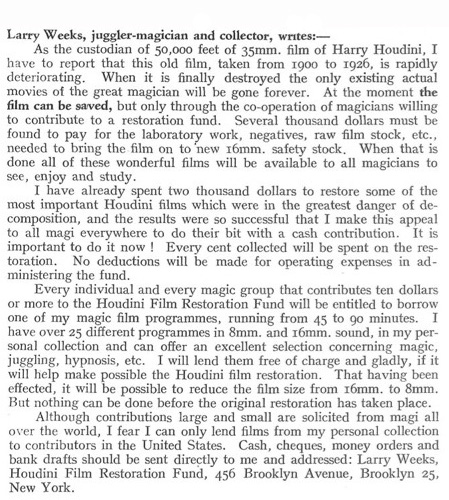
As a postscript, in 1958 Larry Weeks formed the "Houdini Film Restoration Fund." Larry knew that his nitrate prints were in danger of decay (recall that Rick said The Grim Game probably only had six months left). Check out this item written by Larry himself in a 1960 issue of Abacradabra:
Reading this 55 years later, one thing becomes clear. A lot of people were involved in this effort to find and restore The Grim Game, and a lot of people deserve credit. But the person who truly saved The Grim Game, the person who is most responsible for us now being able to see and enjoy Houdini's best film, is the late Larry Weeks, "Houdini's Biggest Fan."
Related:
Today I have a BONUS excerpt in which Rick and I discuss the mystery of the original 35mm nitrate print. This was said to be the last surviving print of The Grim Game, and it was disposed of in 1959 when Larry had the film transferred to 16mm safety film. But where did he get it?
WAH: Did Larry tell you how he got the original nitrate print?
RICK: He said he got it from Bess. I don't... Where would Bess have been in 1943?
WAH: Dead. Well, she died in early 1943, she was in Hollywood before that.
RICK: Exactly. So I don't think he got anything from Bess. He kept on saying that he got it from Bess. But Larry was just a kid, he wasn't even in the army in 1943. He definitely wasn't in Hollywood and he definitely didn't go to Hollywood to get this stuff.
WAH: Right.
RICK: Now, my guess is this. And this is just educated. Houdini had the lab in New Jersey. And when The Grim Game and his other film projects came they went to the lab. Basically it was like, "I've done the projects, and, by the way, guys, can you give me a print, I want to keep it for myself." Because he was an archivist, he saved his books, he saved his scrapbooks, he's gonna save his films. He was interested in films and he had the facility to keep it. Now when the lab closed...what year was that?
WAH: It's unclear when he closed to lab, but it was by mid '20s.
RICK: 1922, wasn't it?
WAH: Well, Haldane of the Secret Service was released in 1923, so I've always thought the lab closed down around that time. It took a while for Houdini to unravel his movie businesses.
RICK: Right, so the lab closes down, and the film elements of his negatives go to...probably Hardeen's Estate?
WAH: Hardeen ran the film lab, so, yes, he might have taken possession of a lot of that stuff.
RICK: That's what I'm thinking. So he took the films. Now if you look at what was said on the Kino, and you look at the history of the film, which makes perfect sense, around 1947 all this nitrate film is sitting in New York, and they have their house inspected. And they have a young Larry Weeks who's been in This Is The Army trying to buy everything he can. He may have bought a bookshelf [Larry had a Houdini bookshelf in his apartment], he may have gotten a scrapbook, he had a little money. Remember, he had been in an Irvin Berlin play on Broadway.
WAH: Now when you say this, you mean he's at Hardeen's home, correct?
RICK: Yes, that's what happened.
WAH: And Hardeen died in 1945, so Elsie Hardeen was unloading stuff.
RICK: Right. Again, this is where the detective works comes in, and where we think logical.
![]() |
| Film reels showing nitrate decomposition. |
So the film is sitting in New York, and the insurance man comes in to inspect the house, knowing nitrate in this day...people are watching it. I know many people who in the 1940s had to throw away many great nitrate films because, you know, they could explode an entire city block. So they have to get rid of them. And they were probably told they had to bring them somewhere that would have cost them money. So they call this kid who been pestering them for anything he can get on Houdini, and ask if he wants them. And he was up there like a flash. So Larry in 1947 obtains the films. That's my hypothesis. But if you think about it -- lab, Hardeen, the location...that's why I say "Houdini heirs" in the beginning. Does that make sense to you?
WAH: It makes sense to me. When Bessie sold 278, much of her stuff went with her to her sister's house -- the Hinsons. A lot of it remained with them when she went to Hollywood. The Hinsons did have a great many Houdini movies, and they were visited by the insurance man. That's where that story comes from. Marie Blood tells it. So when Larry said he got his stuff from "Bess", I always felt what he was saying was that he got it from the Hinsons. But the Hinsons say they threw out all their films after the visit from the insurance man and that Larry did not get The Grim Game from them. They are clear on that to this day. So, like you, I think Larry could only have gotten it from Elsie Hardeen, especially at that time. I heard that's what happened. And then he later acquired some things from the Hinsons because I do know that he visited them in 1956. And eventually it just all sort of melded together. That's why there's a confusion of when and where he got what. It all just became one collection of artifacts from the "Houdini family."
RICK: Right.
***
As a postscript, in 1958 Larry Weeks formed the "Houdini Film Restoration Fund." Larry knew that his nitrate prints were in danger of decay (recall that Rick said The Grim Game probably only had six months left). Check out this item written by Larry himself in a 1960 issue of Abacradabra:
Reading this 55 years later, one thing becomes clear. A lot of people were involved in this effort to find and restore The Grim Game, and a lot of people deserve credit. But the person who truly saved The Grim Game, the person who is most responsible for us now being able to see and enjoy Houdini's best film, is the late Larry Weeks, "Houdini's Biggest Fan."
Thursday, March 12, 2015
Hardeen hangs up his handcuffs
Here's a remarkable article from the January 21, 1917 Oakland Tribune announcing the retirement of Theo. Hardeen from show business. The article features a nice photo of Elsie Hardeen and their two sons, Harry Houdini Hardeen and Theodore Hardeen, Jr. Amusingly, it states that Hardeen will dump all his equipment into the San Fransisco Bay! Anyone up for an underwater expedition?
Hardeen would continue to fill periodic engagements throughout 1917 and 1918, so I guess not everything went into the Bay. But by 1919, he really was free of the escape business.
While there certainly may be truth to Hardeen's wish to be with his family, the real reason Hardeen left his career was so he could run Houdini's Film Developing Corporation. Houdini was responsible for Dash's career -- he came up with the Hardeen name and set him up with his full act in early 1900s. I can't help but wonder if retiring and running the FDC was something Dash wanted to do, or whether it was the new edict of his older brother. Nevertheless, Dash did it, and came away with ulcers.
After Houdini's death, Hardeen retuned to performing, although this might have happened even if Houdini had lived. A letter in the Arthur Moses collection shows that Dash was on Houdini's payroll until August 1926. He would have needed to seek work at this point.
This clipping from The San Bernardino County Sun for November 23, 1926 is the earliest mention of Hardeen's return to show business that I can find. It's just a mere 24 days after Houdini's death. But maybe the most curious thing about this new item -- is that mustache on Dash?
Clipping source: Newspapers.com.
![]() |
| Click to enlarge. |
Hardeen would continue to fill periodic engagements throughout 1917 and 1918, so I guess not everything went into the Bay. But by 1919, he really was free of the escape business.
While there certainly may be truth to Hardeen's wish to be with his family, the real reason Hardeen left his career was so he could run Houdini's Film Developing Corporation. Houdini was responsible for Dash's career -- he came up with the Hardeen name and set him up with his full act in early 1900s. I can't help but wonder if retiring and running the FDC was something Dash wanted to do, or whether it was the new edict of his older brother. Nevertheless, Dash did it, and came away with ulcers.
After Houdini's death, Hardeen retuned to performing, although this might have happened even if Houdini had lived. A letter in the Arthur Moses collection shows that Dash was on Houdini's payroll until August 1926. He would have needed to seek work at this point.
This clipping from The San Bernardino County Sun for November 23, 1926 is the earliest mention of Hardeen's return to show business that I can find. It's just a mere 24 days after Houdini's death. But maybe the most curious thing about this new item -- is that mustache on Dash?
![]() |
| Click to enlarge. |
Hardeen continued to perform as "Houdini's Successor" for many years before turning the show over to Douglas Geoffrey a.k.a. Hardeen Jr. (not his son) in May 1945. He died a short time later.
Related posts:
Friday, August 22, 2014
Under the radar
Potter & Potter's massive auction of Houdiniana is just 15 hours away, and we've only scratched the surface in highlighting the many historic Houdini items in this amazing sale. Here's a last look at a few more notable lots that have flown somewhat under the radar:
I would love to read and study these letters. I feel like the story of Sidney Radner and Hardeen is an untold and even misunderstood story of magic. I expect that story is all right here.
Film of Hardeen doing the overboard box escape! How did we not know about this until now?
Harry, Bess, Mama, Hardeen, and a great look at the inside of 278... Magnificent!
And there is still so much more, but we are all out of time. You can view and bid on all the items in the Potter & Potter auction now at Live Auctioneers. The auction itself starts tomorrow at 8AM PT.
Lot 66: Houdini’s holographic notes and sketches re Morritt
Houdini’s holographic notes and sketches regarding Morritt’s Black and White illusion. Together with Houdini’s notes on Morritt’s Spirit Table routine. Four 8vo pages, handwritten on the versos of membership blanks to The Magicians’ Club of London, of which Houdini served as president. Houdini details the construction and working of this large and clever illusion requiring a special arrangement of double glass and calico fabric, which were used in combination to conceal two assistants who are later produced from the cabinet. The third page shows what is perhaps the only detailed diagram of an illusion in Houdini’s hand to be made available for public sale. Hardeen would later write of the Black and White Illusion that it was “the most startling of small cabinet productions.” The fourth page, dated Sunday March 29, 1914, tersely describes Morritt’s spirit table routine, called here by Houdini, “A great big laughing hit.” Houdini describes the two gimmicks that make the trick work and also writes out directions for the routine: “Com[mittee] place[s] hands on table & slowly? Rises. Then makes er[r]atic jumps! This gets laughs.”
Estimate: $5,000 – $7,000
SOLD FOR $10,000
Patrick Culliton states: "Thanks to the notes Houdini took down (on Magician's Club stationary) as Morritt described "The Black and White" illusion, we finally know more about this lost masterpiece. The last anyone heard of this illusion, Hardeen had it up for sale in a 1945 Conjurers Magazine. Then he died. He'd performed it at least once on an SAM show. Houdini's notes, his handwriting, his drawing. A lost Morritt secret. This four page explanation with a Houdini drawing is Magic History gold."
Lot 53: Important archive of 64 letters from Theo Hardeen.
Important archive of 64 letters from Theo Hardeen to Sidney Radner. Spanning 1936 – 1945, and covering a wide range of topics, most importantly the various props, escape devices, handcuffs, locks, and Houdiniana Radner purchased from Hardeen. Hardeen explains the working of various articles, and also describes many of the escape devices and handcuffs sold to Radner over the course of their relationship. These included many of Houdini’s most famous escapes: The Water Torture Cell (in the correspondence, Hardeen refers to it repeatedly as the “U.S.D.” – short for “Upside Down,” as both he and Houdini called it), and the Mail Bag, as well as a handcuff cabinet, the Iron Man [Iron Maiden escape], and various pieces of Houdini memorabilia and photos, leg irons, keys, lockpicks, handcuffs. In one letter, Hardeen offers to sell Robert-Houdin’s trapeze automaton, Antonio Diavolo (referred to incorrectly as “Pyshio”).
Many of Hardeen’s notes are tantalizing: “…I am sending you a three sheet litho of the Chinese Water Torture Cell…” In one letter, Hardeen alludes to the fact that the “trap and irons” for Houdini’s famous illusion of Walking Through a Brick Wall will probably have to be thrown away, as that portion of the apparatus is simply too big and bulky to ship. In another he writes, “I saw Houdini’s Milk Can today and it is a beaut.” Several letters specifically list items Hardeen is selling to Radner, with asking prices (two punishment suits and two straitjackets for $25.00, for example). Others include Hardeen’s take on current affairs, including the biography of Houdini by Harold Kellock (“This book is full of lies, and I am writing a book with a lot of “quotes” and correcting them.”). Letters are written on a variety of Hardeen’s letterheads, most being 4to sheets, and most accompanied by original mailing covers, hand addressed by Hardeen to Radner. Length varies from short notes to three pages. Several holographic letters on hotel stationery, written en route, are part of the archive. In the first letter, dating to 1936, Hardeen addresses Radner quite formally. In the last letter in the archive, Elsie Hardeen writes to Radner as a close friend, just after her husband’s death, in a familiar and friendly tone. Most letters are signed with Hardeen’s nickname “Dash,” which was given to him by his mother, as is explained in one of the letters. A remarkable and significant archive, and essential to the understanding of Houdini, his brother, and the lasting fame of the Houdini name.
Estimate: $5,000 – $7,000
SOLD FOR $7,500
I would love to read and study these letters. I feel like the story of Sidney Radner and Hardeen is an untold and even misunderstood story of magic. I expect that story is all right here.
Lot 81: 16mm film of Hardeen’s overboard packing box escape.
16mm film of Hardeen’s overboard packing box escape. Short silent film of Hardeen escaping from a wooden crate after he has been nailed inside and the box has been sunken under water. Likely a later print. With a digital transfer of the original, on DVD. Originally in the collection of Dr. Morris N. Young.
Estimate: $300 – $400
SOLD FOR $1,300
Film of Hardeen doing the overboard box escape! How did we not know about this until now?
Lot 115: Houdini, Harry. Candid Photograph of Houdini and Bess
Candid Photograph of Houdini and Bess in Russia with Houdini’s notations. July, 1903. Houdini sits at a table with his wife and others in a garden, the American flag in the background. Holographic notes on the verso in his hand read, “Moscow Russia July 4 – 1903/Celebrating with American Consul in Russia.” Below Houdini’s writing is the penciled statement, “Property of B. Ernst.” 5 x 3 ½”. Old tear repaired with tape.
Estimate: $400 – $600
SOLD FOR $1,400
What I especially love about this photo is that Houdini talked about this July 4th celebration in his Dramatic Mirror column. Read: The Handcuff King's blog: Breaking into Russia.
Lot 171: Candid photo of Beatrice Houdini’s 35th birthday party
Candid photograph of Beatrice Houdini’s 35th Birthday Party. New York, 1910. Taken in the Houdini home at 278 W. 113th St., New York. Family and friends fill the image, including Mrs. C. Weiss, Mrs. Rahner (Bess’s mother), Houdini, Bess, Theo & Elsie Hardeen, and other members of the Weiss family. On the verso, in Theo Hardeen’s hand, each person is identified by name. Houdini has marked himself on and his wife with the letter “X” on the photo, and signed his name above his image. 7 x 5”. One corner damaged, wear and chips at margins.
Estimate: $1,000 – $1,500
SOLD FOR $4000
Harry, Bess, Mama, Hardeen, and a great look at the inside of 278... Magnificent!
And there is still so much more, but we are all out of time. You can view and bid on all the items in the Potter & Potter auction now at Live Auctioneers. The auction itself starts tomorrow at 8AM PT.
Happy bidding!
Related:
Tags:
278,
Auction,
Bess,
Correspondence,
Elsie Hardeen,
Hardeen,
Houdini's magic,
Methods,
Movies,
Overboard Box,
Patrick Culliton,
Photographs,
Photos (unpublished),
Russia,
Sid Radner,
Writings
Thursday, April 17, 2014
Hardeen dials in Radio of 1950
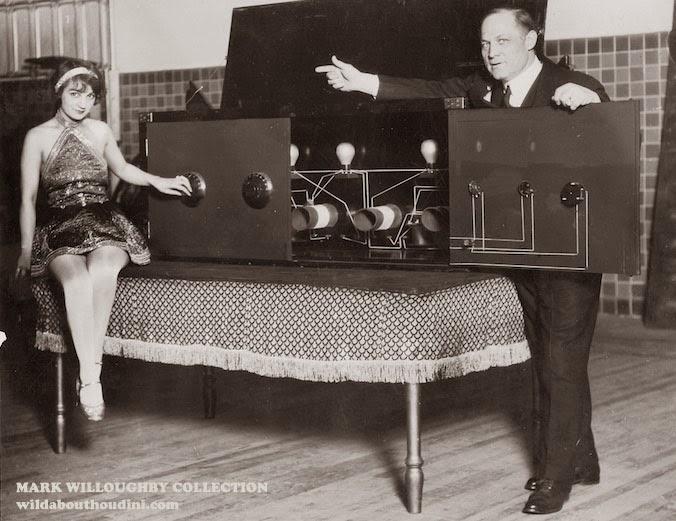
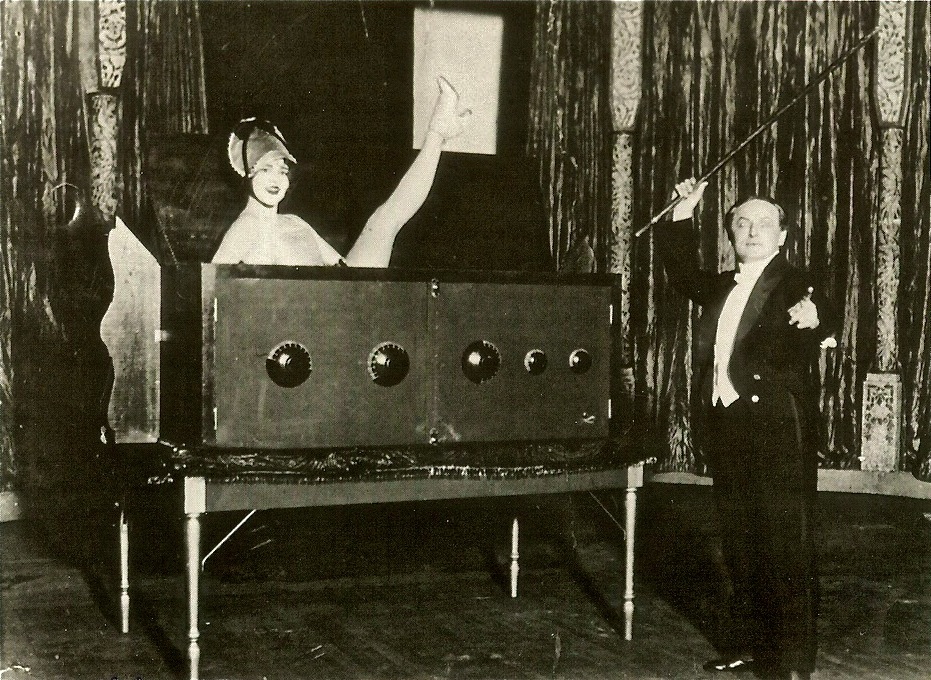
Here is a magnificent unpublished photo of Hardeen performing Houdini's "Radio of 1950" illusion. This comes from the collection of our good friend Mark Willoughby and there is a lot to love about this image.
First off, I'm struck by how much Dash looks like Houdini in this shot. It it wasn't for the hair, you could almost mistake this for Houdini. This is also the only photo I know of that shows the inside workings of the "radio" apparatus (I'm guessing those light bulbs were illuminated or even blinking). Finally, the assistant here is Hardeen's daughter, Gladys Hardeen (at least that's what it says on the back of the photo), and it's a rare shot of her.
I don't know much about Gladys Hardeen. Her passport application says she was born February 15, 1902 and Genii reported her death in Daytona, Florida on February 17, 1966. But according to Jon Oliver, Dash and Elsie Fozzard married in 1904 (this info came direct from Hardeen's son, Harry Houdini Hardeen). Was Gladys a stepchild? She later assisted Douglas Geoffrey aka Hardeen Jr.
Houdini developed Radio of 1950 for his full evening show of 1925-26. A review of Houdini's first performance of his full evening show in Baltimore called the effect "Radio 1925." Hard to know if this was a mistake or if Houdini later changed the name. In her 2003 booklet, Touring With Houdini, assistant Dorothy Young described how the illusion was staged:
Hardeen inherited the effect after Houdini's death and featured it in his own show. After he died, it was put up for sale for $125 along with other Hardeen-Houdini apparatus. Today the whereabouts of the Radio of 1950 illusion is unknown.
Below is a shot of Houdini himself doing Radio of 1950, showing the appearance of "Radio Girl" Dorothy Young. And if you're dying to know how this trick was done, check out Patrick Culliton's Houdini The Key (page 402). He gives a very good explanation of the method.
Thanks to Mark Willoughby for sharing this special photo and for the intel on Gladys Hardeen.
Related:
I don't know much about Gladys Hardeen. Her passport application says she was born February 15, 1902 and Genii reported her death in Daytona, Florida on February 17, 1966. But according to Jon Oliver, Dash and Elsie Fozzard married in 1904 (this info came direct from Hardeen's son, Harry Houdini Hardeen). Was Gladys a stepchild? She later assisted Douglas Geoffrey aka Hardeen Jr.
Houdini developed Radio of 1950 for his full evening show of 1925-26. A review of Houdini's first performance of his full evening show in Baltimore called the effect "Radio 1925." Hard to know if this was a mistake or if Houdini later changed the name. In her 2003 booklet, Touring With Houdini, assistant Dorothy Young described how the illusion was staged:
Radio was quite new in 1925. The first commercial station KDKA, had gone on the air in Pittsburg, Pennsylvania just five years earlier. So a magic trick about radio was a very up-to-the-minute feature.
To present the illusion of Radio of 1950, Houdini walked around and behind an empty table in the center of the stage so the audience could see there were no mirrors underneath. Then two assistants put the "radio" on top, completely filling the table.
"I would like to present my original conception of what radio will be like in 25 years." Houdini said, "Tune in to any station and get the girl you want. No, gentlemen, it is not for sale."
He opened the entire front, which consisted of two doors, and removed a panel that held various coils and transformers and large glass tubes the size of light bulbs that were used before transistors were invented. The audience could see there was nothing else inside. He replaced the panel and closed the front.
"Now," he said, "we will tune in Pittsburg Station KDKA." He began twisting the dials. Suddenly a voice from the radio speaker announced, "Miss Dorothy Young, doing The Charleston." That was my cue. As the orchestra started playing that popular jazz dance, I threw open the lid, popped up my head at one end and kicked one leg up in the air. I kicked the other leg, clicked my feet together, jumped up, and curtsied. Houdini opened the front of the radio, lived me down, and I went into a wild Charleston as the audience laughed and applauded.
Hardeen inherited the effect after Houdini's death and featured it in his own show. After he died, it was put up for sale for $125 along with other Hardeen-Houdini apparatus. Today the whereabouts of the Radio of 1950 illusion is unknown.
Below is a shot of Houdini himself doing Radio of 1950, showing the appearance of "Radio Girl" Dorothy Young. And if you're dying to know how this trick was done, check out Patrick Culliton's Houdini The Key (page 402). He gives a very good explanation of the method.
Thanks to Mark Willoughby for sharing this special photo and for the intel on Gladys Hardeen.
Related:
Tags:
[History],
3 Shows in One,
Assistants,
Dorothy Young,
Elsie Hardeen,
Family,
Hardeen,
Hardeen (family),
Houdini's magic,
Photos (unpublished),
Private collections,
Props,
Radio,
Radio of 1950
Thursday, December 5, 2013
Gaffed Houdini handcuffs at auction; NOT from the Water Torture Cell
In their report on the auction, the UK's Daily Mail claimed the cuffs "were a vital prop in Mr. Houdini's Chinese water torture escape." It appears the tabloid got this from Mike Heseltine, specialist in conjuring and performing arts at Bloomsbury, who speculated that the cuffs "could have been used in the Chinese Water Torture trick." The Times and other media have now taken the bait and are also reporting that the cuffs "are believe to have been used" in the Chinese Water Torture Cell.
However, there is nothing to indicate that these cuffs were used in Houdini's most famous escape. In fact, Houdini did not even wear shackles in the USD. Houdini did wear handcuffs like these in the Milk Can escape. That might have been the more astute speculation, but it's still a leap. But considering the rust and quick release mechanism, it is likely these were used by Houdini and/or Hardeen for underwater escapes.
![]() |
| Look, Ma, no cuffs! |
Other irons at auction include a pair of Lilly Leg Irons estimated at £2,000-3,000 [Lot 45], and a round barrel screw key padlock estimated at £1,000-1,500 [Lot 46]. Both were left by Houdini to Joseph Dunninger and later presented by Dunninger's widow to Richard John Silmser. They were then purchased by Joseph M. Tanner who sold the irons to John Fisher from a catalogue of Houdini memorabilia issued in 1988. Letters of provenance are included in both lots.
Houdini’s personal copy of Arcana of Spiritualism by Hudson Tuttle is among the rare magic-related books in the auction. With engraved portrait bookplate and a few pencil underlinings and markings, it is estimated at £250-350 [Lot 20].
In light of the high prices set this month for Houdini magic props and posters, it will be interesting to see what a pair of gaffed cuffs sell for. It's a shame the Water Torture Cell claim has muddied the waters a bit.
You can view the full action catalog and download a PDF at Dreweatts & Bloomsbury Auctions.
UPDATE: Bloomsbury will clarify handcuff claim.
UPDATE 2: The cuffs sold for £2300.
Sunday, December 25, 2011
Happy Holidays from the Hardeens
Here's wishing all my readers a Merry Christmas, Happy Hanukkah, and a very Happy New Year. Thanks for making WILD ABOUT HARRY's first full year of life such a blast! I'm going to attempt to take a few days off from posting (think I can do it?). See you all in 2012.
- John
Sunday, May 22, 2011
The untold story of Hardeen Jr.
Recently I had the pleasure of speaking with the nephew of Douglas Geoffrey aka "Hardeen Jr." Despite the fact that Geoffrey was the official successor to the Houdini-Hardeen show, precious little is known about him. Most think he only performed for a couple of years, but this is incorrect. Douglas Geoffrey performed as Hardeen Jr. well into the 1950s, and then under his own name until 1988! But let's start his story at the beginning.
Born on May 19, 1907, Douglas Geoffrey Mackintosh fell in love with magic at the age of 8 when he received a Gilbert's Mysto Magic set from his Aunt Lucie. At the age of 12 he saw Thurston perform, and was even invited onstage to assist in a trick. He later took magic lessons from magician Fred Estelle of Brooklyn. One bit of information that the nephew shared with me -- something I've never seen printed anywhere -- is that Geoffrey actually worked briefly with Houdini! At age 19 he got a job in Houdini's full evening roadshow. Unfortunately, his tenure was brief as Houdini died that same year.
![]() |
| Geoffrey assisting Hardeen in 1943 |
Geoffrey was initiated into the Society of American Magicians on May 19, 1944. Then on May 29, 1945, during his final show at the RKO Madison Theater in Ridgewood, New York, Hardeen named "Doug" his official successor. Hardeen would die a short time later -- it was Geoffrey who broke the wand over his casket in the S.A.M. ceremony -- and Geoffrey went on to perform as "Hardeen Jr", the professional name bestowed on him by Hardeen.
Along with the "Heir to the Throne of Magic" title, Douglas Geoffrey inherited the Houdini-Hardeen show props. Thankfully, Hardeen did not stipulate in his own Will Houdini's instructions to "burn and destroy" all his props following his death. The props Geoffrey decided not to use -- including most of the escape apparatus -- he sold off in the July 1945 issue of The New Conjurer's Magazine on behalf of Elsie Hardeen. Among the items listed was Hardeen's original Milk Can with an asking price of $500. (I believe this is the can currently on display as part of the Houdini Art and Magic exhibition.) One personal memento Geoffrey held onto was the monogramed pocket from the pajamas Houdini was wearing when he died. (Today it's in the collection of Arthur Moses.) He also wore Hardeen's masonic pin during performances.
The Hardeen Jr. show, first billed as Houdini Lives Again! and co-starring magician Bob Sherman aka "Sherms", toured vaudeville and with the USO starting in 1945. Featured in his act was The Flight of Time (advertised as "the last illusion invented by Houdini"); Mummy Case; Houdini Card Star; Nest of Boxes; and the Book of Life (the last effect invented by Hardeen). Even though his newspaper adverts sometimes featured escape imagery, the only "escape" he did was the substitution truck with handcuffs. At one point he was (unintentionally?) billed as "Houdini's nephew."
![]() |
| Two Hardeen Jr. ads: One for his show and the other for a "magic battle". |
Hardeen Jr. specialized in "challenge" magic contests, at one time holding his own in a card manipulation contest with Cardini. He also succeeded Hardeen in the Olson and Johnson Broadway show Hellzapoppin, playing a remarkable 80 weeks. Hardeen Jr. took his show international, performing in such far off locations as India and Saudi Arabia. While performing at Union City's Capital Theater, he was assisted by Hardeen's daughter, Gladys Hardeen.
Reviews where good. The Richmond News Leader noted that "the Hardeen act has all the flair of 'big time'. He moves with a clocklike precision, and an evenness that is so often missing in these performances that hit the road."
![]() |
| Hardeen Jr. in 1980 |
Geoffrey continued performing until he physically couldn't manage the coin and cards manipulations. He gave up the stage in 1988 and died on January 14, 1990 at age 82. The S.A.M. performed a Wand Breaking ceremony and buried him with his magician's baton. His close friend, William Rauscher, who penned the book The Houdini Code Mystery
Douglas Geoffrey did not formally pass on the Houdini-Hardeen-Hardeen Jr. show to any successor. But he carried the torch admirably for many years, and his life and name should definitely be celebrated as part of the larger legacy of Harry Houdini.
My thanks to the nephew of Hardeen Jr. for the information and the use of his photos.
Tags:
[History],
3 Shows in One,
Assistants,
Elsie Hardeen,
Flight of Time,
Freemasonry,
Hardeen,
Hardeen (family),
Hardeen Jr.,
Hellzapoppin,
Milk Can,
Other magicians,
Thurston,
William Rauscher
Wednesday, March 2, 2011
Related to Houdini?
The Indy Horror Film Festival (March 5) is promoting a special guest appearance by Aron Houdini, who's billed as "The Worlds Only Living Houdini and distant nephew of The Great Harry Houdini!!!"
I've never heard of Aron Houdini, but I'm pretty sure there is no way his last name could really be Houdini. Houdini had no kids and, apart from Hardeen, the rest of the family kept the name Weiss (I think some of the kids became "White"). But I'm not saying he isn't related. I just don't know anything about him.
Anyone have the skinny on Aron Houdini?
UPDATE: I've just exchanged emails with Aron himself who explains:
Pretty cool. Thank you, Aron...HOUDINI!
Aron Houdini has performed all over the United States and Canada including his famous escape from the United States Marshal’s service making him the ONLY magician/escape artist to escape the nations oldest Law Enforcement agency. Aron Houdini is a 3-Time Entertainer of the Year and World Champion of the Straight Jacket Escape. Including a Guinness World Record for the most regulation Straight Jacket escapes in 1 hour (30) , and the fastest regulation Straight Jacket escape. (11 seconds)
Aron Houdini has performed and been seen on NBC, ABC, CBS, SyFy, Fox, ESPN, and many more major television network stations.
Aron Houdini following in his uncles footsteps is also a professional Paranormal Investigator. Working closely with the Discovery channel’s Ghost Lab, also known as Everyday Paranormal. Aron Houdini has investigated some of the most haunted locations in the United States with more than 400 investigation behind him.
I've never heard of Aron Houdini, but I'm pretty sure there is no way his last name could really be Houdini. Houdini had no kids and, apart from Hardeen, the rest of the family kept the name Weiss (I think some of the kids became "White"). But I'm not saying he isn't related. I just don't know anything about him.
Anyone have the skinny on Aron Houdini?
UPDATE: I've just exchanged emails with Aron himself who explains:
"My grandmother is Iris F. Culver, born near Appleton Wisconsin. Her mom's name was Agnes Sanderson, maiden name Fozzard. Agnes, (my great grandmother) was sister too Elsie Fozzard. If you go back too Genealogy you will see Houdini's brother Theodore married, Elsie Fozzard, my Great Aunt!!! Making Harry Houdini, (Ehrich Weiz) my distant Great Uncle.
Growing up in my family at the family reunions they always talked about Houdini. It was 5 years after I started doing magic when I was 12 years old when I saw a show on tv about my "great uncle" Harry Houdini. It was at that point I realized I was going to be the new Houdini. THE DAY I turned 18, I went to the court house, filed the paper work, and the Judge legally added HOUDINI to my last name. Making me, Aron Sullivan Houdini. I've been Aron Houdini for the past 14 years."
Pretty cool. Thank you, Aron...HOUDINI!
Subscribe to:
Posts (Atom)