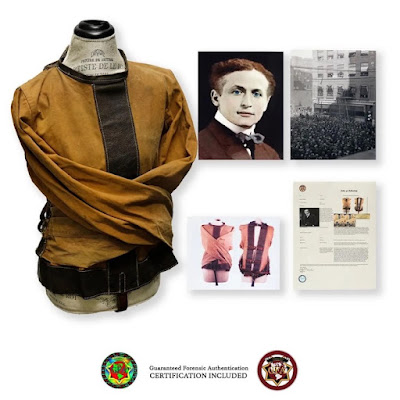
This Friday, August 16, comedy illusionist Ben Pratt will be performing at the Park Theater in Jaffrey, New Hampshire. Preceding the show will be a screening of Houdini's The Grim Game. Ben will also do a straitjacket escape during his performance.
- Home
- Life
- Escapes
- Magic
- Movies
- Houdini's Movies
- Les merveilleux exploits de Houdini à Paris (1909)
- The Master Mystery (1918)
- The Grim Game (1919)
- Terror Island (1920)
- The Man From Beyond (1922)
- Haldane of the Secret Service (1923)
- Velvet Fingers (1925-26)
- Medium Well Done (1937)
- Religious Racketeers (1938)
- Houdini Picture Corp.
- Film Developing Corp.
- Filming locations
- Unmade Movies
- Deconstructing Houdini '53
- Spiritualism
- People
- Beatrice Houdini
- Theo Hardeen
- Cecelia Weiss
- Mayer Samuel Weiss
- Jim Collins
- Franz Kukol
- Martin Beck
- Sir Arthur Conan Doyle
- Margery
- J. Gordon Whitehead
- Edward Saint
- Jacob Hyman
- Leopold Weiss
- Carrie Gladys Weiss
- Bernard M.L. Ernst
- Charmian London
- Jess Willard
- H.P. Lovecraft
- Sherlock Holmes
- Assistants
- Imitators
- Other magicians
- Media
- Full Bibliography
- By Houdini
- Biography
- Fiction
- Foreign
- For Kids
- Methods
- Wild About Harry Bookshelf
- Houdini His Life Story (1928)
- Houdini The Man Who Walked Through Walls (1959)
- Houdini The Untold Story (1969)
- The Life and Many Deaths of Harry Houdini (1993)
- Houdini!!! The Career of Ehrich Weiss (1996)
- The Secret Life of Houdini (2006)
- The Metamorphosis: The Apprenticeship of Harry Houdini (2012)
- The Witch of Lime Street (2015)
- The Life and Afterlife of Harry Houdini (2019)
Showing posts with label Straitjacket. Show all posts
Tuesday, August 13, 2024
Sunday, April 9, 2023
Houdini's spirit cabinet scares up $50K at auction
A spirit cabinet effect that Houdini performed as a "near perfect" escape at the New York Hippodrome in 1925 sold for $50,400 (including buyers premium) in yesterday's Potter & Potter auction of Houdiniana. This was the big seller of the 128 Houdini-related lots.
The bulk of the lots came from the collection of our friend Robert Somerdin who explained why it was time to sell in a special statement on the Potter website.
The other big ticket item was a straitjacket ($45,600) and a Houdini packing case said to have come 278 and once used to hold straitjackets. Bidding reached $32,000, but it did not meet the reserve and was a rare pass.
Overall, it was an auction of some surprises. Who would have ever thought a Margery pamphlet would sell for more than a Grim Game pressbook?
You can check out the lots with their prices realized at the Potter & Potter website.
Congrats to all the winners!
Wednesday, July 20, 2022
Houdini living on the air in Cincinnati
Reader Dutch Schantz checks in today with a "Hidden Houdini" he spotted in the classic TV show WKRP in Cincinnati. As you can see below, a "King of Cards" poster can been seen in the background of season 2, episode 7, Mike Fright. The episode first aired November 12, 1979.
Houdini appeared in Cincinnati ten times between 1899 and 1925. Eight of those engagements were at the Columbia/B.F. Keith's theater on 5th and Walnut streets. During these runs he did handcuff and a jail escapes from the local police station. He also did a suspended straitjacket escape from the Pickering Building in 1916. Houdini gave his spiritualism lecture at the Emery Auditorium in 1924. His final appearance in Cincinnati was at the Shubert Theater in 1925 with his 3 Shows in One.
You can bet this is a Lee Jacobs reproduction King of Cards poster. You can read the history this famous magic bedroom mainstay HERE.
But what of the real Houdini in Cincinnati?
Here's something that ties in nicely. Houdini also appeared on Cincinnati radio! During the week of September 20, 1925, Houdini broadcast nightly from station WLM. He addressed spiritualism and even gave magic lessons. I doubt he was as smooth as Dr. Johnny Fever, but I bet he didn't get mike fright!
| Rushville Daily Republican, Sept. 20, 1925. |
Eagle-eye Dutch also made an interesting sighting in The Greatest American Hero. A pair of straitjackets from the 1953 Tony Curtis Houdini biopic can be spotted in the season 3 episode, "The Resurrection of Carlini", which first aired November 19, 1982. As I covered in my last installment of Deconstruction Houdini '53, these straitjackets where custom made for the movie by Abbott's Magic Co. Wild to see them still available to productions in 1982. I wonder if these are still lurking in some Hollywood prop or costume shop?
Thanks for the trip down memory lane, Dutch!
Related:
Related:
Friday, July 15, 2022
The Grim Game flies high at Heritage poster auction
An original poster for Houdini's 1919 film The Grim Game sold for a hefty $63,000 (with buyers premium) at Heritage Auctions "Treasures of the Silent Screen: The Dwight Manley Collection" auction today. This 2-day sale is the largest auction ever dedicated solely to silent-era movie posters. The Grim Game was the second highest priced poster in session one, beat only by a King Kong one-sheet.
Related:
It's not generally known that the dramatic image on this poster is painted from an equally dramatic still photo. That photo has never been reproduced in any book, but you can see it below in this 1920 newspaper clipping.
![]() |
| The Spokesman Review, Jan. 4, 1920. |
Congrats to the winner of this stunner!
Related:
Saturday, June 25, 2022
Deconstructing Houdini '53: Magicians' Dinner
TODAY marks the 69th anniversary of Houdini's premiere at the Des Monies Theater in Iowa on June 25, 1953. So what better day to continuing my scene by scene dissection of the classic biopic and one of its most iconic scenes...
Chapter 8: Magicians' Dinner
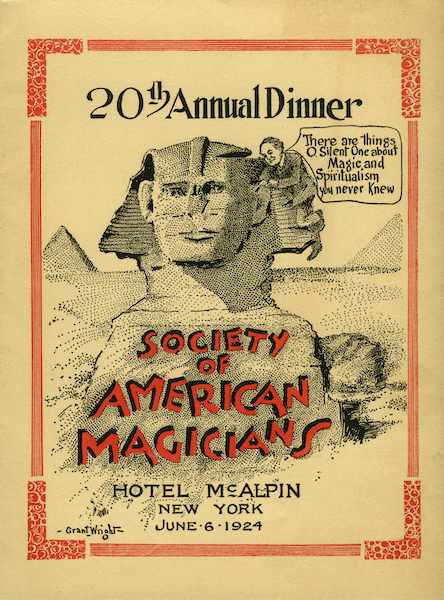
For starters, this entire event appears modeled on the Society of American Magicians annual dinners at the Hotel McAlpin in New York City. Houdini would organize and preside over these dinners and the gathering of wizards would always draw press coverage. This delighted Houdini as drawing attention to the S.A.M. as a national fraternal organization was one of his goals as their "Most Illustrious" president. So it's all a little out of time to have Houdini attending an event such as this as a wide-eyed novice. But it works wonderfully well as a representation of a larger organized World of Magic that he badly wants to join. We just need to forget he's the one who organized it!
Here it's called The Society of Magicians and this is their "Annual Halloween Dinner". Again, the idea of any magic organization marking Halloween as a national magic day only started after and because of the death of Houdini on Halloween. But this works as the first of several times in the movie that Halloween will be linked to Harry's fate.
We start with the Houdinis taking a table. Bess is instantly suspicious of her surroundings. "There's quite a few magicians here tonight," she observes. "Magic's becoming quite a hobby," says Harry innocently.
Our first treat is a performance by Magic Castle co-founder William Larsen Jr. (uncredited). Bill was the son of William Larsen who was Bess Houdini's lawyer and, along with his wife Gerrie, good friends with Bess during her final years in Hollywood. Bill and his brother Milt both knew Mrs. Houdini and even did magic for her. So having a Larsen performing for the young Houdinis is a nice insider nod.
Here Larsen does the Lester Lake head chopper illusion. This is an effect from the 1930s, not the 1890s, but we've already established that Houdini '53 features contemporary magic for a contemporary audience. It's a wonderful, uninterrupted performance by Larsen and now a piece of magic history in itself. (The girl is played by Norma Jean Eckart.) However, I'm always disappointed when the head drops off at the end. Not only does this rely on a camera edit, but it undermines the entire effect. If she was never in the stocks, there was no passing of the blade miracle. This feels like an idea foisted on the scene by someone who just wanted a gag ending, and it's the one time Hollywood "creativity" gets in the way of the magic in the movie.
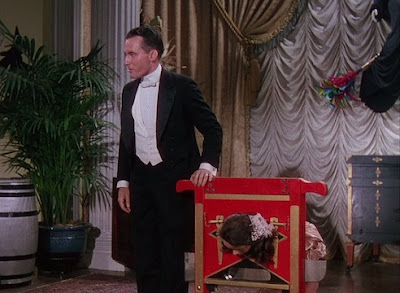
The evening's host, Mr. Malue (Ian Wolfe), then takes the stage. Malue greatly resembles Harry Blackstone Sr., one of the last great figures from the Golden Age of Magic at this time, so the resemblance may be intentional. Malue announces a special challenge in "escape routines that has never been tried before". Several straitjackets "from Bellevue hospital" are brought out and Malue says a Grand Prize will be given to the man who can escape. Again, it's odd to see escapology as part of the magic world pre-Houdini. It's worth noting that a similar straitjacket escape contest was held at the Des Moines Theater in Iowa for the film's premiere.
Harry is eager to volunteer. But Bess forbids him. He has to literally beg her, drawing attention and laughs from the audience. Bess relents and Harry joins to applause. It's a cute moment for the couple, but the movie may actually be channeling the real Houdini without even knowing it. In his notes, Houdini worked up a similar piece of business headed “Big Laugh”:
Plant in box, man and woman. Houdini asks committee to come on stage. Man starts to get up, woman pulls him back. Woman of a chatterbox type. Have the man try to get up two or three times, the woman scolding. If you wish to see this to a finish, have the man finally come up and the woman leave the theater.
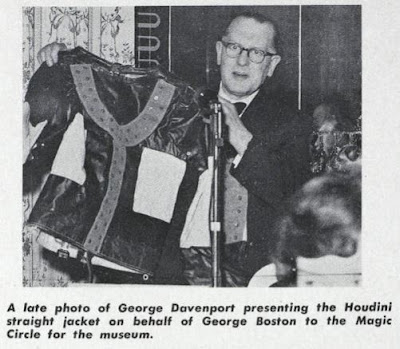
Houdini is strapped into the straitjacket along with the other men. The straitjackets used here are not from Houdini's time, nor are they from the 1950s. They were specially made for the production by the famed Abbott's Magic Co., and are beautifully dramatic in their design. I love that the production went to the trouble of creating their own unique cinematic straitjackets. A surviving jacket was given to The Magic Circle in London where it is still displayed today.
As the orchestra plays a jaunty tune, the men get down to struggling in what becomes a largely comedic entertainment. (Although the fall one man takes onto a stage-side table seems serious enough.) But Harry, unique among the men, remains on his feet in deep concentration. He appears as trapped as the others, but then he finds himself drawn to a spinning crystal hanging from a chandelier. It becomes hypnotic, aided by strains of a theremin-like score, and he's unable to look away. Bess notices. So does Mr. Malue. There's something strange happening to Houdini.
This mysterious power has been hinted at in several earlier scenes (notably Miner's Hall), but at last Harry seems to be in control of it. Suddenly he is able to strip the straitjacket off his body. The moment is less like an escape and more like a butterfly shedding its cocoon. HOUDINI has emerged! He then collapses to the stage, seeming not so much drained by his struggle, but by the power he just experienced.
"And I guess there's no doubt as to who wins the prize," says Mr. Malue who hands Houdini an envelope to applause.
A historical aside on what we just witnessed. The straitjacket escape was an effect Houdini did throughout his career. He was indeed the first man to do the escape on stage. What we saw here was Houdini escaping the straitjacket in full view of an audience. But the truth is it took Houdini several years to arrive at that presentation. For years he did the escape concealed inside a cabinet. It was his brother, Theo Hardeen, who discovered the effectiveness of presenting the escape in full view of the audience. Houdini quickly adopted this presentation and the rest is history.
The scene then dissolves to a private, post dinner conversation between Harry, Bess, and Mr. Malue. Here we experience what Joseph Campbell and screenwriting courses would call the "meeting with the mentor" scene. Here our main character is inspired by an elder to take the next step in his heroes journey, or is warned not to embark down a particular path. A warning that is typically ignored. Which version we have here will soon become apparent.
Malue reminds Houdini that no one has ever escaped from a straitjacket before. Interestingly, Harry says what he did was only "a trick". It's similar to the vanish at Miner's Hall. We the audience felt we just witnessed something supernatural, but Houdini later laughs it off as just one of his effects. But the old magician tells him, "It isn't a trick!"
Malue then relates the tale of a magician in Berlin named von Schweger who would escape from a sealed bottle that wasn't faked in any way. "The talk was von Schweger was able to dematerialize," says Maule. This greatly intrigues Houdini who has never heard of von Schweger despite having "Read all the books on the great magicians." This is a nice nod to the real Houdini's devotion to magic history from a young age. Malue tells him just when von Schweger could have made a name for himself, he quit the profession. "I think he he was frightened by what he was able to do," says Malue.
Herr J. von Schweger will become a big part of this story and he is not as fictional as some may think. But we will have a whole chapter devoted to him in due time.
Mr. Malue realizes they are the last people left at the dinner and he says his goodbyes to the Houdinis. He then offers the young magician his most sincere advise:
"Drop it. Drop it! It will make you famous. But it will kill you."
Thanks to Joe Fox for providing the information on the Abbott's straitjackets and photo of the Magic Circle presentation.
Thursday, February 10, 2022
Alleged "Houdini stunt-used straitjacket" at auction
As a rule, I try not to post about auctions in progress. However, I feel compelled to chime in on this one. LiveAuctioneers is listing a "Harry Houdini stunt-used straight jacket" signed by Houdini himself. The auction currency sits at $1,300 with three bids. But there are problems here.
For starters, I don't know of any photograph of Houdini in this style straitjacket. The auction provides no provenance and according to Magic Castle assistant librarian (and straitjacket expert), Joe Fox, this is an Abbott's straitjacket. These were first produced in the 1930s and Abbott's continues to sell them today. So made after Houdini's death. Also, the signature bares similarity to the work of a well-known Houdini forger.
The same auction house, Dalshire International, also listed a sheet of signed letterhead as "A perfect compliment to his straight jacket". This was, unquestionably, the work of that forger and the auction was taken down.
So red flags everywhere. Bidder beware!
UPDATE: Looks like this sold for $34,000.
Tuesday, June 8, 2021
Houdini certifiable?
This is one of Houdini's standard press kit stories that is likely more entertaining than true. But I still wanted to share as I've never seen this image of Houdini struggling in a straitjacket (which I believe is a photo heavily retouched). And the story is kinda fun. Enjoy.
Wednesday, May 19, 2021
The Steel Straitjacket
Near the end of Houdini (1953) we see Tony Curtis' Houdini challenged to escape from what the movie calls "a steel straitjacket." It's a terrific escape performed by Curtis without a cut. The "steel straitjacket" was provided by Houdini's technical advisor Joseph Dunninger, who claimed it was used by Houdini himself. Below is a photo of Dunninger with the jacket from the July 26, 1967 Middletown Journal.
The steel straitjacket was purchased along with the rest of the Dunninger collection by Henry Muller in 1967 to supply his Houdini Magical Hall of Fame in Niagara Falls, Canada. The jacket was displayed as the "Armoured Breast Plate" (it was no longer on display when I went to the museum in 1990). After the catastrophic fire of 1995 the steel straitjacket was housed in a warehouse along with the rest of the surviving collection.
One person who remembered seeing the straitjacket in the museum was magician and collector Rob Allen from Niagara Falls, New York. "I always remember seeing it on display there," says Rob. "I would always stop and look at it as I thought it was the most intriguing piece among the Houdini escaped pieces." Following the fire, Rob purchased some items from Henry's warehouse. But there was one item he always coveted. In a November 2007 issue of Magicol, Rob remembered:
After my first purchase from Henry, I met him numerous times, often taking things he owned to sell at Yankee Gatherings and Magic Collectors' Weekends. It was fun for me and I finally told Henry during one of our meetings that I wanted to buy the Steel Straitjacket although I couldn't afford to pay for it at that time."Rob, it's yours," he said. "It won't leave the warehouse. When you have the money you can come pick it up."That day finally came. If I had not arranged to buy it, the Houdini Steel Straitjacket would have been shipped with the rest of the warehouse contents to Hollywood, where the items were auctioned by Butterfield & Butterfield in November 1999.
Happily, Rob still owns the steel straitjacket today. Here's a photo he shared. Still looks fantastic!
But the question remains. Did Houdini really use this? Like the iron overboard box from the movie--also supplied by Dunninger who also claimed it was Houdini's--I've never seen any photo or read any reference to Houdini doing this particular escape. But how great would it be if one day we did find a photo of Houdini in this now iconic restraint?
Until then, we'll have to be satisfied with the scene from the movie (this is copyrighted so may have ads). Enjoy.
Thanks to Joe Fox for his help with the post, and a big thanks to Rob Allen for showing us the steel straitjacket today.
Tuesday, March 16, 2021
Pittsburgh fire truck escape mystery
![]() |
| Pittsburgh Post Gazette, March 5, 1925 |
So what exactly did Houdini do here? "Straitjackets and handcuffs"? At the same time? Or did he do multiple escapes as the word "series" seems to suggest? Accounts leading up to the escape reported he would be atop "an 80-foot fire department ladder", but no mention of a ladder here.
For context, Houdini was performing his second week at the Davis Theater in Pittsburgh. This was his last vaudeville tour before he devoted himself to his full evening show in the fall.
What I'd most like to see are any photos from this mystery event. It would be especially exciting to see Houdini in manacles at this later age.
Here is the intersection of 5th and Smithfield streets today.
Top image is a 1925 American LaFrance fire truck from artebellum.com, which may or may not have been the type of fire truck Houdini used on this day.
Friday, February 26, 2021
Boxcar straitjacket escape mystery (SOLVED!)
Here's another one of those familiar Houdini photos that has long had me
scratching my head. It shows Houdini being put into a straitjacket while
standing atop a railway boxcar. Everyone has smiles on their faces, which in
itself is a little unusual.
Here's another less well-known photo taken at this same time showing Houdini
escaping from the jacket. (This appears in the book The Importance of Harry Houdini
by Adam Woog.)
So what is this all about? Is it a challenge? Is it Houdini's first stab at an
outdoor publicity stunt using a straitjacket? (This is four months before
his first suspended straitjacket escape.) It's not a bad idea. Having to
free himself within a confined space or risk rolling off the top of the
boxcar has a nice element of danger, even more so if the train was moving.
There are a few things we do know. The photo is soured to the
Library of Congress which
credits it as being Cleveland in 1915. Of course, many LOC Houdini photos
are misidentified. But this does look like Houdini in 1915 to me, and he did
play Cleveland's Hippodrome Theater the week of March 29, 1915. Unfortunately, the major online newspaper archives have surprising few papers from Cleveland.
You can also see a Wells Fargo office in background. Could this have been a
challenge from the bankers? I reached out to Wells Fargo Corporate Historian
historian Alyssa Bentz who told me the Wells Fargo office in Cleveland was
located on East 9th Street and was indeed by a railroad. Unfortunately,
she knew nothing of any Houdini-Wells Fargo connection, but was excited by the possibility. (I suggested they hang this image in their Cleveland branch,
and they might!)
So looks like we know the when and where, but not the why. I've pretty much
hit a wall, so I figured I'd throw this out in the hopes someone might be
able to crack the mystery of the boxcar straitjacket escape.
UPDATE: The always amazing Bill Mullins has cracked the case! Below is a clipping from the Cleveland Plain Dealer showing this was an outdoor publicity stunt "before 4000 spectators" on March 30, 1915. It appears Houdini was atop the boxcar sheerly for visibility. I think we can indeed consider this a forerunner to his suspended straitjacket escape.
![]() |
| Click to enlarge. |
Thank you Detective Mullins!
UPDATE: Our friend Perry Reed contributes more to our new understanding of this escape. As the article states, the crowds lined the "Superior viaduct", which was a Cleveland engineering marvel at this time. Below is a photo from the 1890s that shows the railroad and gives an idea of where Houdini did the escape. It's likely those 4000 spectators (if we believe that number) lined the bridge above the action.
Thank you Perry!
Friday, October 16, 2020
Hardeen in caricature
We've seen plenty of Houdini caricatures, but what about Hardeen? Well, here's one from the February 8, 1917 Salt Lake Telegram when Hardeen was appearing at the Pantages Theater. Click it to enlarge because it has some nice humor to it.
![]() |
| Click to enlarge. |
This caricature accompanied an article that announced boxers Jack Dempsey and Jim Flynn, who were in town for a bout, would appear onstage together to strap Hardeen into a straitjacket.
Related:
Related:
Sunday, October 11, 2020
Did Smithsonian land a punch or poison the well?
However, there is still plenty to enjoy here. I'm a sucker for the graphics these shows cook up (such as the one that tops this post). The host, Dr. Lindsey Fitzharris, seems nice and appears sincere in her work. Author Joe Posnanski did a great job being the key interview for Houdini's biography. And we see some nice photos and film clips.
The episode also featured an interesting piece of Houdini history that struck me as new. (I've since learned it was discussed in the comments of this post at HHCE.) Apparently, Houdini was injured doing a straitjacket escape at a charity show in the summer of 1926. This is presented as the first of the series of unfortunate events that would end in his death. We see two on-screen sources for this accident, the first being part of a newspaper story:
The second source is a letter by Gertrude Hills written to Sir Arthur Conan Doyle on November 22, 1926. Hills closes with a mention of this same accident:
If you do not know what caused our friend's death, you will be interested to learn that he injured himself this summer while presenting for charity his straight jacket act. The injury was not taken seriously by himself, or his physician, I imagine, since the pain resulting from it was diagnosed as forms of "indigestion."
Unfortunately, the show didn't specify when this "summer" charity show took place, and I have no match in my chronology. But I'm reminded of this post which suggested Houdini was under the care of a physician during a charity event in September 1926. Related?
Something else that struck me as new was the mention of a "high society spiritualist" named Madame Marcie who accosted Houdini after his D.C. hearing, predicting he would be dead by November. This nugget of info is dropped by the show's crime expert, former detective Brian Hook, who delivers many of the show's more salacious assertions, such as his belief that Bess may have killed her husband for the insurance money. Oh my.
Okay, but what of the show's core premise that Houdini might have been murdered?
While I do not believe the age old claim that Houdini's doctors poisoned him with experimental serum, I'm not averse to the idea that Houdini could have been slipped arsenic or some other poison by fanatical spiritualists on one or more occasions. Of course, evidence would be nice. Right now there's only speculation. But I don't find it impossible and I'm open to any serious investigation. Heck, I'd even support exhumation if some new evidence compels it. (Curiously, the show didn't mention Bess's attack of food poisoning, which is the one place I see smoke.)
So as far as advancing the murder theory, The Curious Life and Death of... provides nothing new and maybe even sets things back by flogging silly conspiracy theories. But as a dose of superficial yet entertaining Houdini-themed TV, it gets the job done.
You can stream The Curious Life and Death of... on HULU, iTunes, and Amazon Prime.
Friday, September 11, 2020
Did Hardeen really discover the full view straitjacket escape?
I've always found this perplexing. How could Houdini, who knew full well the power of rope escapes done in full view of the audience, fail to see this himself? Nevertheless, here's proof positive that as late as November 12, 1904, Houdini is still doing the straitjacket escape inside his "red velvet tent." This is from the Birmingham Daily Gazette:
![]() |
| Click to enlarge. |
From this it appears the escape is still effective ("the applause was tremendous"), so maybe that's why Houdini never felt the need to experiment. I should add that I've found another cabinet straitjacket escape on December 2, 1904, at the Pavilion Theatre in Newcastle (with a carpet laid on the floor to ensure no traps), but the above clipping makes better reading.
So if Hardeen really did make this seminal discovery, exactly when and where did this happen? Turns out that is NOT an easy question to answer. There are conflicting claims and not one of them commits to a date. But we know Houdini is still in his cabinet in November-December 1904, and it's said he did his first full view escape in Paris in March 1905. So we can assume Hardeen made his discovery sometime between those dates.
Thanks to my recent deep dive into the British Newspaper Archive (which I've re-upped for another month), I have Hardeen's schedule at this time. So with this in hand, let's examine the major candidates:
Christopher:
In Houdini The Untold Story, Milbourne Christopher says Hardeen made his discovery at the Swansea Empire in Wales. He does not provide a date, but Hardeen played Swansea the week of December 26, 1904, which is within the timeline. Christopher says Dash sent Houdini a newspaper clipping. That makes me suspect his source is a letter. I wish I knew for sure, because Christopher is also the sole source for Houdini doing his first full view escape in Paris in March 1905. (The first account I can find is April 14, 1905 in Cardiff.) This is two months after Swansea, so either Hardeen took his time telling him or Houdini took his time in adopting it. Or maybe there's a better candidate...
The pitchbook:
I believe everyone, including Christopher, uses Hardeen's pitchbook, The Life and History of Hardeen, as the primary source for the dramatics of this event. And why shouldn't they? The pitchbook contains what appears to be a detailed newspaper account (which, unfortunately, is undated and unattributed). It even has a photo of the theater announcing the re-challenge on a huge outside banner.
The pitchbook identifies the events as having played out at the "London Empire." Now, when I hear "London Empire", I think of the Empire Theater in Leicester Square. But Hardeen never performed there. So this could be a reference to greater London, and Hardeen did play Empires in Hackney, Holloway, and New Cross in late November 1904, which are (just) within the timeline. [UPDATE: The photo is the Holloway Empire.]
But here's the problem. Elsewhere this pitchbook photo is credited as being 1906. This is well after Houdini is doing the straitjacket in full view. In fact, I have found numerous accounts of Hardeen being called out of his cabinet to repeat his straitjacket escape all throughout 1906. It appears to have been a standard (staged) re-challenge, similar to how Houdini would be "re-challenged" to do his packing crate escape. In fact, Hardeen becomes so associated with this, the English press dubbed him "the straitjacket man." Here is one such account from the Empress Theater in Hartlepool on April 7, 1906:
![]() |
| Hartlepool Northern Daily Mail. |
I now believe everything in the pitchbook is referencing one of these later staged escapes. It's also possible the story in the pitchbook is not even an actual newspaper clipping, which is why it is unattributed and suspiciously vague. So the pitchbook is pure misdirection.
Does this mean the entire story of Hardeen discovering the full view straitjacket escape is manufactured mythology? Did the brothers discover it in some other way, maybe even seeing an imitator do it? When going down one of these Houdini rabbit holes the "it never happened" option always has to be considered. But before we jump to that conclusion, there's one more candidate to hear from...
Hardeen (Himself):
In the March 1941 issue of The Sphinx, Hardeen provided a lengthy article called "Houdini-Hardeen Strait-Jacket Escape". In it he states he made his full view discovery at the "Bedford Music Hall, Camdentown, London." He also says the escape took a full "grueling hour." He doesn't give a date (why make it easy on us?), but I've discovered Hardeen at the New Bedford Palace of Varieties in Camden Town on March 24, 1905. Presumably Dash played the full week which began on March 20.
![]() |
| Music Hall and Theatre Review, March 24, 1905. |
This engagement fits like a glove! It is within the timeline and, better yet, it is while Houdini is in Paris. So Christopher's claim that Hardeen told Houdini about the escape via letter and that Houdini first tried it in Paris works beautifully. We also know Dash joined Houdini in Cardiff for his battles with Frank Hilbert during the week of April 12, and it's on April 14th that Houdini does the first documented full view escape that I can find.
(By the way, Hardeen states in this same article that he and Houdini saw their first straitjacket in Berlin in 1900, which cannot be right. But that's a can of worms for another time.)
While I'm still not sure we have this is 100% locked down, I do feel pretty good about the March 1905 New Bedford engagement as being the time and place Hardeen discovered the full view straitjacket escape. I also still believe the core claim; that it was Dash who made this discovery and not Houdini. The primary reason are the 1906 staged re-challenges. Only Dash did these, and that suggests he had some ownership over this particular twist on the act. Not to mention he was able to put the story in his pitchbook.
So, yes, I think we are safe leaving this one in Hardeen's column. Feel free to let me know what you think in the comments.
Thanks to Joe Fox for providing me with a copy of the original Hardeen Sphinx article. It is also reprinted in Pat Culliton's Houdini The Key and Hardeen: Monarch of Manacles by William V. Rauscher.
Thursday, August 13, 2020
The Westminster Bridge jump that wasn't
In August of 1908 Houdini returned to tour Europe after an absence of three years. He was bringing with him new escapes, such as the Milk Can, and his new practice of jumping from bridges handcuffed. He opened in Germany where he drew headlines by jumping off the Friedrichs Bridge in Berlin. When he arrived in London to play the Oxford Music Hall in November, he sought permission to jump from the famous Westminster Bridge. However, the night before the feat, permission was denied by the city commissioner. Furthermore, the police warned that if he "even attempted to carry out the project it would mean imprisonment." Just like New York, London was not a city that was going to allow traffic to be brought to a standstill so Houdini could gain publicity.
Here's where things start to get curious. When the feat was first announced, it was reported that Houdini would be "heavily manacled and encased in a straitjacket." Doing a bridge jump in a straitjacket was not something Houdini ever did. This would have been extremely dangerous. At first I thought the papers had simply gotten this wrong; that Houdini would have done the jump in handcuffs as he did all others. But this is where the above photo comes into play.
Houdini being denied permission to do the jump was also reported in the papers, and all the accounts said he was to have bound in a straitjacket. The Alderley & Wilmslow Advertiser even ran a photo (below). As you can see, this photo was clearly taken at the same time as the more familiar image. So this is why Houdini is in shorts. He's in his standard bridge jump attire!
So was Houdini really going to jump from the Westminster Bridge in a straitjacket? I still find this unlikely. Not only because of the added hazard, but if this was his new concept for bridge jumps, why did he never do it elsewhere? He did a jump in Liverpool just one month later in handcuffs only.
I'm wondering if it's possible that Houdini knew full well London officials would never allow him to jump from the Westminster Bridge, so he exaggerated what he planned to do. Or maybe the newspapers just got it wrong. Ether way, Houdini took advantage of the situation and had photos taken showing him in the impossible manner in which he "intended" to do the stunt. And it worked! With some photos as a sweetener, the papers widely reported the cancelled stunt, and Houdini was able to gain publicity for a stunt he didn't even do.
Pretty smart, Harry.
Saturday, April 4, 2020
Houdini's 1923 LA Examiner straitjacket escape
A reported 20,000 people gathered to witness the feat. Houdini, wearing a green plush hat, arrived shortly before 12:30 PM, having had to push his way through the throng. He made a short speech in which he asked the crowd for as much silence they could give him. When someone asked him about a book he had written, he snapped, "I've no time to think of books. This is a big job and I have to concentrate."
Houdini removed his hat, coat and vest, and was strapped into a straitjacket by Police Chief Louis D. Oaks. Also on hand were Lieutenant M. Thornburg (who had also participated in the 1915 escape), Detective Lieutenant Jack Finlinson, and Detective Lieutenant Walter Barr. His ankles were then roped to the block and tackle which was extended from the fourth floor of the building. Houdini called out, "Haul away", and he was raised 50 feet above the sidewalk. The Examiner takes it from there:
And then the impossible happen; the police officers didn't believe it. Nevertheless, there started an agitation up there under the flying jibboom. The magician's arms we're moving in a quick but rhythmical way and his entire muscular composition was in a sort of rapid ebb and flow. After a minute his arms were no longer bound to his back, but working somewhat freely in front, although still within the sleeves. From that moment on no one doubted the conclusion.
It appears Houdini milked an extra bit of drama out of the proceedings by not immediately rising after he had been lowered to the platform. He took several minutes to recover from what the paper called "a spell of dizziness." When he finally did stand the crowd let out a fresh cheer.
The next day the paper gave the escape front page coverage with a nice spread of photos.
![]() |
| Click to enlarge. |
"I was not sure whether the police would beat me this time or not; certainly they gave me all they had. And I want to thank The Examiner for making this the biggest open air exhibition of my career." -Houdini
The Examiner building still survives at Broadway and 14th Street and looks much as it did in Houdini's day. The building, which has stood empty since the paper went out of business in 1989, is currently undergoing a massive $56.4M renovation to become an office and restaurant space.
Below is a photo of the empty building in 2013 and an artist rendering of the proposed development.
A postscript. The straitjacket Houdini used that day surfaced on a 2011 episode of Pawn Stars. You can watch the full clip below. As you'll see, photographs from the Los Angeles escape (wildly misidentified as being Jan. 1, 1915 in St. Louis) were used to authentic the jacket. The straitjacket eventually sold at auction for $46,980.
Related:
- Checking up on the Examiner
- Unpublished Houdini: In Los Angeles
- SOLD! Houdini straitjacket captures $46,980 at Christie's
Subscribe to:
Posts (Atom)