Banner AI generated.
Showing posts with label Batman. Show all posts

Wednesday, December 4, 2024

When Houdini (1953) came home

I've covered the theatrical release of Paramount’s Houdini on June 25, 1953, and its television debut on January 30, 1963. So today I'm going to tackle the Home Video release. I recently nabbed this still-sealed VHS on eBay, and it made me curious to know exactly when it came out. Turns out there's a bit of a story behind it.


Houdini was released on VHS on April 8, 1991. If you think that seems late, you're right. VCRs had been around since 1976, and movies on VHS were ubiquitous throughout the 1980s. I remember waiting and wondering why Houdini had yet to appear. But to understand why Houdini took so long, we need to review the history of Home Video and, especially, pricing.

In the beginning, home video was primarily a rental market. Studios did not believe people were interested in owning movies to watch again and again. You could still buy a movie, but they'd cost between $50 and $100. I actually bought the entire James Bond series, one tape a month, at this full price. I also snapped up The Man From Beyond. Yes, The Man From Beyond appeared on VHS before Houdini!

In these rental days, studios primarily focused on providing video stores with new releases, recent hits, and classic films. Paramount Home Video was one of the best for classics, releasing Houdini producer George Pal's War of the Worlds (1953) in their first year of operation. You could find older and more obscure movies on independent labels at lower prices, but many of these were movies that had fallen into the public domain and were offered in poor EP mode quality.

Houdini (1953) did not fall into either category. It was not in the public domain, and while I consider it a classic, it appears Paramount did not. So, year after year, there was no Houdini in video stores. There could also be reasons that I don't know. Houdini was still shown often on television, so maybe it was part of a television package that prevented a VHS release at the time?

Disney was the first studio to offer movies on quality tapes at a consumer-friendly price. This would come to be called the "sell-through" market. But it was the sell-through releases of E.T. in 1988, and especially Batman in 1989, that proved the viability of this market. Turns out people did want to own movies! Suddenly, the average price of a movie came down to $29.95, and studios began reissuing new sell-through versions of their most popular rental titles. (Guess who bought the Bond series...again.)

With the rental market becoming "sluggish" and the rise of new stores devoted to just selling videos, such as Suncoast (a Paramount and Musicland joint venture), studios began to mine their archives for older movies and, slowly but surely, began releasing those to the hot sell-through market.

Hence, on April 8, 1991, Houdini appeared alongside Lil Abner (1959), Waterloo (1970), The Klansman (1974), and Is Paris Burning (1966). It was priced at $14.95, recorded in good quality SP mode, and used the original poster art on the box. It was also released on Beta, Paramount Home Video being one of the last companies to offer movies on that format.


Houdini's release on VHS was extra exciting as it was the first time one could be assured they were seeing the entire film. When Houdini aired on television, it was always edited for time, and whole scenes would be missing. But here was Houdini exactly as it appeared in theaters in 1953. The quality of the movie is, and has always been, surprisingly excellent. We've never had to wish for a better quality Houdini. Thank you, Paramount!

The Plain Dealer, June 17, 1991.

Looking back on the original newspapers, it's nice to see how much attention Houdini received. It was certainly the star title of its bundle. And it would remain so. In 1994, Paramount released the movie on the premium LaserDisc format (I snapped that up, too). When DVD and Blu-ray took over from VHS in the 2000s, it did not take long for Houdini to appear on both formats. And when streaming emerged, Houdini was there at a click.

Houdini may have been a little slow in coming to home video, but it has never left our living rooms. Hopefully, people are still discovering the story of Houdini via what I consider to be the best biopic.

Want more? You can see more advertisements for the Houdini VHS, along with other Houdini gems from the 1990s, as a member of my Patreon. It was a good decade for Harry!

Sunday, June 2, 2024

Eminem drops his own "Houdini"


Less than six months after Dua Lipa released her chart-topping single "Houdini," another major artist has released a single called "Houdini." This time, it's Eminem (aka Marshall Mathers aka Slim Shady). The rapper got an assist teasing the release from magician David Blaine on Instagram. The song's release on May 31st marked the biggest streaming debut of Eminem’s career.

The song only mentions Houdini's name in passing (it is the second time Houdini has been named-checked in an Eminem song), but I really like it. It's funny and a breath of fresh air. I also love the single's artwork above. 

You can watch the official music video below or in fullscreen on YouTube.

Monday, January 15, 2024

Houdini liked The Bat (apparently)

The Bat is a mystery-comedy play by Mary Roberts Rinehart and Avery Hopwood that became all the rage when it first played on Broadway in August 1920. It ran for 867 performances in New York before touring. Bob Kane claimed seeing The Bat as a child influenced his later comic book creation, Batman.

It appears Houdini was also a fan of The Bat, as evidenced by his endorsement in an advertisement for the play at the Majestic Theater in San Antonio in November 1923. Houdini had played the Majestic the previous week.

San Antonio Light, Nov. 21, 1923.

The Bat was adapted as a film three times. Below is an excellent overview of those films from one of my favorite YouTube channels Dark Corners Reviews.


If you're interested in reading the original play, an illustrated version is available on Amazon.com.

Related:

Sunday, March 6, 2022

FLASHBACK: When Houdini met (The) Batman

I saw The Batman this weekend and really enjoyed it. No hidden Houdinis, but I was reminded that Houdini and a similarly dark and realistic version of Batman met up in 1993 graphic novel, The Devil's Workshop. 

I figured this was a good time to re-share my 2012 post about that book. So click the headline to have a read, Bat-fans.

Saturday, September 8, 2018

Mystifier, Fourth Quarter 1994

Continuing my issue by issue look back at the Mystifier, the newsletter of the Houdini Historical Center that ran from 1991-2003.


New HHC curator Benjamin Filene kicks off the Fourth Quarter 1994 Mystifier with a review of The Life and Many Deaths of Harry Houdini by Ruth Brandon. It's a well-researched and considered assessment of what would prove a controversial biography. Filene does give the author credit for "considering the psychology behind his stunts," but says her "analysis becomes more erratic" when she shifts to "the psychology of the man himself." In the end, Filene concludes:

The Life and Many Deaths of Harry Houdini does offer a creative and, for the most part, well-argued look at a figure in need of a fresh interpretation. In the tradition of Houdini himself, Brandon should be commended for not being afraid to take a chance and for executing her maneuvers with style. She could, though, stand to learn more from the master about which challenges to accept and which to graciously let pass.

The newsletter only runs four pages this time. Filling out page 2 is is an update on the Gravesite Repair Funds, noting that $7000 has been raised. But it also says "repairs to the family grave are on hold for the immediate future, according to George Schindler, a trustee of the S.A.M. Parent Assembly #1." This, we now know, was the start of friction between the cemetery and the S.A.M. which, thankfully, is now in the past.

A report on a live Halloween radio broadcast from the HHC by Rick McNeal and Len Nelson of WAPL in Appleton follows. It says the DJs received their own "message from beyond" about the Green Bay Packers. The museum shop reports that it has in stock the graphic novel Batman/Houdini: The Devils Workshop and Harry Houdini: Legend and Legacy by Roger Wood and Brian Lead. Familiar names listed among the "New Members" are Lee Jacobs and Geno Munari.

Sid Radner devotes his "Backstage" column to that year's Official Houdini Seance, held at the Soldiers’, Sailors’, Marines’, Coast Guard and Airmen’s Club in New York City. Attendees included Stanley Palm, Maureen Christopher and Kenneth Silverman. Co-organizer Tom Boldt could not attend that year, but his wife Renee and her mother, Suzanne Goral, attended in his place. Houdini, as usual, was a no show.

Sid then reproduces in full an article about the seance by Barbara C. Bernard from the November 28, 1994 issue of the Union-News in Springfield, Massachusetts.

Mystifier
Volume 4, Number 4
Fourth Quarter, 1994
4 pages

Contents:
Book Review: The Life and Many Deaths of Harry Houdini
Gravesite Repair Fund Grows
Houdini's Spirit Comes Alive
Museum Shop
Backstage with Sid Radner


Related:

Monday, July 2, 2018

Mystifier, Fourth Quarter 1993

Continuing my look back at the Mystifier, the newsletter of the Houdini Historical Center that ran from 1991-2003.


The Fourth Quarter 1993 Mystifier starts with an article  by Morris N. Young about "Houdini's Journeys into Code-Breaking." Who knew? Says Young:

Early in his career as a magician, Houdini discovered that the secret arts of magic extended into unsuspected fringe realms. When presented with a challenge to decipher a group of scrambled letters, he succeeded in doing so.

By relating his knowledge of cryptography to the performing arts, Houdini was able to fathom methods used in training animals to respond to questions, as well as the mysteries of second sight, mentalism, and alleged communication with the spirit world.

The issue continues with Houdini's own unedited draft of article he wrote for the March 1926 Aeronautic Review called "Flight and Magic." This was provided by collector Manny Weltman. One interesting tidbit is that Houdini says he regrets not leaving his plane in a museum in Australia "for it was the first successful plane to fly there." He also claims to have held the first insurance on an airplane.

An article by Library of Congress curator Joan F. Higbee Ph.D. describes the two major collections housed at the Washington institution; one willed by Houdini himself and the McManus-Young collections donated in 1956.

An update on the museum shop ("Business has been booming!") notes the arrival of a "Special limited edition" of the graphic novel Batman-Houdini: The Devil's Workshop. I'm not sure what made this edition special, but the article states it's a "a one-time printing."

Finally, Sid Radner in his "Backstage" column discusses the 1993 Official Houdini Seance, held that year in Cincinnati at the Union Central Insurance Company--the company that held Houdini's life insurance at the time of his death. The inner circle attendees were: Henry Muller, Moira Thomas, Tom Boldt, Dr. Morris Young, Dr. Bernard Dolenz, Dorothy Young, Ken Klosterman, Marie Blood, and Tom Rozoff. Sid notes that the seance this year received world-wide news coverage via CNN.

The newsletter concludes with Christmas poem reprinted from the Dec. 15, 1923 The Sphinx.

Mystifier
Volume 3, Number 4
Fourth Quarter, 1993
6 pages

Contents:
Houdini's Journey into Code-Breaking
Flight and Magic
Magic at the Library of Congress
New Books at the Museum Shop
Backstage with Sid Radner


Related:

Friday, September 7, 2012

The Final Houdini Seance redux 1986

With the big news that the 86th Official Houdini Seance will be held this year as a public event in Fort Worth, Texas, I thought it was a good time to look back on another semi-public Houdini seance that many not not be aware of.

On the night of October 31, 1986, a handful of lucky participants, including myself, attended a Houdini seance at the Variety Arts Center -- a short-lived sister club to the Magic Castle housed in a historic theater in downtown Los Angeles -- that honored and recreated the famous 1936 Final Houdini Seance on its 50th Anniversary.

Organized by Houdini collector and historian Manny Weltman, the reenactment started with the tickets. Each ticket was an exact replica of the gold invitations from the 1936 seance with the modern details on the back. To enhance the event, guests were encouraged to come dressed in "optional 1930s dressy attire" (my buddy Mark and I rented vintage tuxedos from Western Costume).

Guests arrived at 7pm for an 8:30 seance, just as they did in 1936. On the seance table were laid out the items exactly as they were laid out 50 years earlier, including a custom built copy of the Houdini shrine and a replica of the Mirror handcuffs, reported to have been "brought from Montana".

John Cox and "Edward Saint" (Stefan Krayk).

Bess was portrayed by Geraldine Larsen Jaffe, matriarch of the famous Larsen magic family, who was also good friends with Bess Houdini and attended the 1936 seance. For the occasion, Gerrie wore a jeweled Russian brooch given to her by Bess. The part of Edward Saint was played by Stefan Krayk, complete with fake beard. Magic Castle co-founder Milt Larsen introduced the seance, and "Bess" and "Ed" read from the same script the real Bess and Ed had prepared for the original seance.

Sitting in the "inner circle" at the seance table were: Manny Weltman and his wife Nanette; Milt Larsen; ventriloquist puppeteer Shari Lewis and her husband Jeremy Tarcher; Gerald Kosky, who had attended the original 1936 seance; Universal Studios Vice President and Houdini enthusiast Tom Thayer; Penny and Michael Grosz-Salomon; legendary Famous Monsters of Filmland publisher Forrest J. Ackerman and his wife Wendy; and KABL-TV reporter Fred Anderson. Guest attendees included Batman creator Bob Kane, a long time Houdini buff. (My girlfriend's most vivid recollection of the night was meeting "some guy who told me he invented Batman.")

"Bess Houdini" (Geri Larsen) heads up the seance table.

Much like the evening in 1936, Houdini did not return, and there were no mysterious storms that night which would have really made this a true recreation. After the seance, guests lingered for an informal chat with Gerrie who shared stories about her friendship with Bess.

At the close of the evening, all the guests received a bottle of Magic Castle Houdini labeled wine, which were spirits enough for most.


Thanks to Joe Fox, who was also there that night, for loaning me "ESCAPISM" January 1987 which contained a full report on the seance and provided the details I've long forgotten.

Sunday, April 15, 2012

When Houdini met Batman

Last month I posted a look back at Houdini's encounter with Dracula in the graphic novel Ghosts of Dracula. Here's another unusual crossover -- Houdini meets Batman!


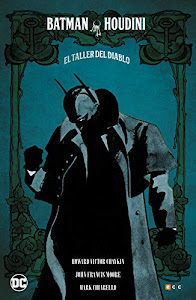
The Devil's Workshop was released by DC in 1993 as part of their experimental "Elseworlds" series (setting classic superheros in "strange times and places"). The book was written by Howard Victor Chaykin and John Frances Moore with illustrations by Mark Charello. The extremely dark story finds Houdini and Bruce Wayne/Bat-Man investigating child abductions in Gotham City. Not only does the book experiment with Batman's timeline, but it plays fast and loose with Houdini's timeline as well. Even though it's 1907, Houdini's mother is dead and he makes references to his Buried Alive stunt and friendship with Sir Arthur Conan Doyle. Houdini also smokes in the story. References to Houdini's Judaism abound. He even wields a Jewish star.

Unlike most graphic novels, we don't get a look at Houdini's stage act, but we do get to see a nifty seance in which the villain/medium conjures "Mama". The artist depicts Cecelia Weiss accurately, but for some reason Charello doesn't draw Houdini from any life image. He looks instead like a young Paul Riser. Tom Mix also makes a cameo appearance.

While I had thought Ghosts of Dracula was Houdini's only vampiric adventure, the villains at the end of The Devil's Workshop turn out to be vampires (I think).

It's really not the best Houdini or Batman adventure, but it is an  interesting experiment and a curiosity worth seeking out.

By the way, according to Patrick Culliton, Batman creator Bob Kane was a big Houdini fan.

Related:

Translate