Below are some more appearances of Houdini in animated comedy.
- Home
- Life
- Escapes
- Magic
- Movies
- Houdini's Movies
- Les merveilleux exploits de Houdini à Paris (1909)
- The Master Mystery (1918)
- The Grim Game (1919)
- Terror Island (1920)
- The Man From Beyond (1922)
- Haldane of the Secret Service (1923)
- Velvet Fingers (1925-26)
- Medium Well Done (1937)
- Religious Racketeers (1938)
- Houdini Picture Corp.
- Film Developing Corp.
- Filming locations
- Unmade Movies
- Deconstructing Houdini '53
- Spiritualism
- People
- Beatrice Houdini
- Theo Hardeen
- Cecelia Weiss
- Mayer Samuel Weiss
- Jim Collins
- Franz Kukol
- Martin Beck
- Sir Arthur Conan Doyle
- Margery
- J. Gordon Whitehead
- Edward Saint
- Jacob Hyman
- Leopold Weiss
- Carrie Gladys Weiss
- Bernard M.L. Ernst
- Charmian London
- Jess Willard
- H.P. Lovecraft
- Sherlock Holmes
- Assistants
- Imitators
- Other magicians
- Media
- Full Bibliography
- By Houdini
- Biography
- Fiction
- Foreign
- For Kids
- Methods
- Wild About Harry Bookshelf
- Houdini His Life Story (1928)
- Houdini The Man Who Walked Through Walls (1959)
- Houdini The Untold Story (1969)
- The Life and Many Deaths of Harry Houdini (1993)
- Houdini!!! The Career of Ehrich Weiss (1996)
- The Secret Life of Houdini (2006)
- The Metamorphosis: The Apprenticeship of Harry Houdini (2012)
- The Witch of Lime Street (2015)
- The Life and Afterlife of Harry Houdini (2019)
Showing posts with label Sex. Show all posts
Tuesday, September 8, 2020
Houdini is a Big Mouth
The (very) adult Netflix animated series Big Mouth features an appearance by Houdini's ghost in season 3 episode 5, "How to Have an Orgasm." Houdini is voiced by Andrew Daly. He shows up around the 20 minute mark, although Houdini is name-checked throughout the episode. This first streamed October 5, 2019.
Tags:
Animation,
Ghosts,
Humor,
Pop culture,
Risqué,
Sex,
Television
Monday, April 13, 2020
A week of Terror and SEX
In the run up to its wide release on April 18, Houdini's second Paramount feature, Terror Island, played an exclusive engagement at the Beacon and Modern theaters in Boston. These were showcase cinemas for Paramount-Arcraft films. But unlike the prestigious first run given The Grim Game in New York, Terror Island was consigned to the bottom half of double bill with a Louise Glaum vehicle called SEX.
SEX was produced by J. Parker Read and directed by Fred Niblo. Star Louise Glaum was a popular "vamp" of the era. According to Wikipedia, it was a morality story on the evils of marital infidelity and the wild lifestyle of New York actors. But the film included scenes of seduction and debauchery that made it the subject of controversy, not to mention the racy title. It proved to be a big hit for Paramount.
Houdini was performing in England at the time of Terror Island's release, so his unavailability to make personal appearances, as he had done with The Master Mystery and The Grim Game, may have contributed to Terror Island playing second fiddle here. But it also may have foretold Paramount's cooling on Houdini as a box office draw, although Terror Island would do respectable business in wide release. It was no SEX! But who won in the long run?
According to the excellent Cinema Treasures website, the Modern Theatre stood at 523-25 Washington Street in Boston until 2009. The original Beacon Theatre stood at 47-53 Tremont Street. It was demolished in 1969.
Related:
SEX was produced by J. Parker Read and directed by Fred Niblo. Star Louise Glaum was a popular "vamp" of the era. According to Wikipedia, it was a morality story on the evils of marital infidelity and the wild lifestyle of New York actors. But the film included scenes of seduction and debauchery that made it the subject of controversy, not to mention the racy title. It proved to be a big hit for Paramount.
Houdini was performing in England at the time of Terror Island's release, so his unavailability to make personal appearances, as he had done with The Master Mystery and The Grim Game, may have contributed to Terror Island playing second fiddle here. But it also may have foretold Paramount's cooling on Houdini as a box office draw, although Terror Island would do respectable business in wide release. It was no SEX! But who won in the long run?
According to the excellent Cinema Treasures website, the Modern Theatre stood at 523-25 Washington Street in Boston until 2009. The original Beacon Theatre stood at 47-53 Tremont Street. It was demolished in 1969.
Related:
Thursday, September 5, 2019
Get your Houdini erotica here
It was just a matter of time until we got some Houdini erotica, and it looks like that time is today! Time Travellers Erotica: Harry Houdini by Laney Samson is available for Kindle and runs 11 steamy pages. No, I've not read it, but Amazon offers up a taste:
You can purchase Time Travellers Erotica: Harry Houdini on Amazon.com. Enjoy the trip.
Related:
It is a personal policy of mine that I do not sleep with anyone that much younger than me. It’s a weird loophole when you start time travelling to have sex with a famous magician before he’s famous. Am I nine years older than this man? He dies at the age of fifty-two almost a century ago. (My time.)
I think it’s fine.
That’s how I ended up here, in the back seat of this ‘car’, with nineteen year old Harry Houdini’s hands up my shirt. I was a little afraid that vaudeville would include more make up. I draw the line at f***ing a clown in a car. Or actually… I don’t know. That sounds sort of fun. Maybe I shouldn’t draw so many lines.
You can purchase Time Travellers Erotica: Harry Houdini on Amazon.com. Enjoy the trip.
Related:
Wednesday, June 27, 2018
Houdini (1953) Confidential
I'll conclude my 65th anniversary celebration of Houdini (1953) with something a little kinky. These are from a series of promotional photos that, as far as I know, were never used. Yes, that's a lace straitjacket Janet Leigh is being put into by a lascivious Tony Curtis.
Even those these photos were taken by Life, my guess is they were earmarked for the men's magazines of the day, such as Gent, MAN, or Adam. These precursors to Playboy and Maxim offered male-centric stories and sexy photos, and flourished in the 1950s. So this was a way to reach a target male audience, although in a slightly underground way.
Of course, objectification was part of the job for an actress in the 1950s. Check out this bonkers photo from The Cincinnati Enquirer on June 28, 1953. This image ran widely in syndication without any explanation. I really don't know what's going on here--I'm sure it's innocent--but you can't deny it has a pretty horrible implication! #BessToo
Despite the predilections of the publicity department, the movie itself presents Bess as a strong-willed and intelligent woman, a true partner to Houdini in all regards. It's really one of the best and most positive portrayals of Bess Houdini ever put on screen. And throughout her life, Janet Leigh never expressed anything but positive memories of her time as Mrs. Houdini.
Related:
Even those these photos were taken by Life, my guess is they were earmarked for the men's magazines of the day, such as Gent, MAN, or Adam. These precursors to Playboy and Maxim offered male-centric stories and sexy photos, and flourished in the 1950s. So this was a way to reach a target male audience, although in a slightly underground way.
Of course, objectification was part of the job for an actress in the 1950s. Check out this bonkers photo from The Cincinnati Enquirer on June 28, 1953. This image ran widely in syndication without any explanation. I really don't know what's going on here--I'm sure it's innocent--but you can't deny it has a pretty horrible implication! #BessToo
Despite the predilections of the publicity department, the movie itself presents Bess as a strong-willed and intelligent woman, a true partner to Houdini in all regards. It's really one of the best and most positive portrayals of Bess Houdini ever put on screen. And throughout her life, Janet Leigh never expressed anything but positive memories of her time as Mrs. Houdini.
Related:
Saturday, January 13, 2018
Johnathon Schaech shares story of sexual abuse
Johnathon Schaech, who played Houdini in the 1998 TNT cable movie Houdini, is latest person to come out with a story of sexual abuse at the hands of a person in power. In a piece written for People.com, Schaech says director Franco Zeffirelli made repeated sexual advances on the then 22-year-old during the making of the movie Sparrow.
Says the actor, "For my son, for the future of all of our kids, we have to stop it. Stop the evil. That’s why I wanted to talk. I want future generations to know they’re not alone."
Zeffirelli's family have denied the accusations, saying their father is currently ill and unable to defend himself.
Houdini, which co-stars Stacy Edwards as Bess and Mark Ruffalo as Hardeen, is available on DVD.
Related:
Says the actor, "For my son, for the future of all of our kids, we have to stop it. Stop the evil. That’s why I wanted to talk. I want future generations to know they’re not alone."
Zeffirelli's family have denied the accusations, saying their father is currently ill and unable to defend himself.
Houdini, which co-stars Stacy Edwards as Bess and Mark Ruffalo as Hardeen, is available on DVD.
Related:
Thursday, January 11, 2018
The Girl Who Handcuffed Houdini #2 released
Minky Woodcock: The Girl Who Handcuffed Houdini #2 by Cynthia von Buhler has been released by Hard Case Crime and Titan Books. At least I think it has. The second issue in this adult four part series comes in two variant covers, as you can see below.
You can buy issues at comic book stores or online at Midtown Comics. For more on the series visit minkywoodcock.com. Also check out Bleeding Cool for a collection of photos from a recent launch party.
A collected edition of all four issues will be released in June and can be pre-ordered at Amazon.com.
Related:
Unappreciated at her father's detective agency, the fabulous, rabbit-loving Minky Woodcock straps on her gumshoes in order to uncover a magical mystery involving the world-famous escape artist, Harry Houdini. Created by acclaimed artist, author, director, and playwright Cynthia Von Buhler.
You can buy issues at comic book stores or online at Midtown Comics. For more on the series visit minkywoodcock.com. Also check out Bleeding Cool for a collection of photos from a recent launch party.
A collected edition of all four issues will be released in June and can be pre-ordered at Amazon.com.
Related:
Wednesday, August 10, 2016
The imposter
In 1946, Maurice Zolotow penned The Great Balsamo, a novel about a famous magician and escape artist. Even though the author states in his introduction that his character "is not a lightly doctored version of any famous magician," the similarities between Barney Balsamo and Harry Houdini are hard to escape.
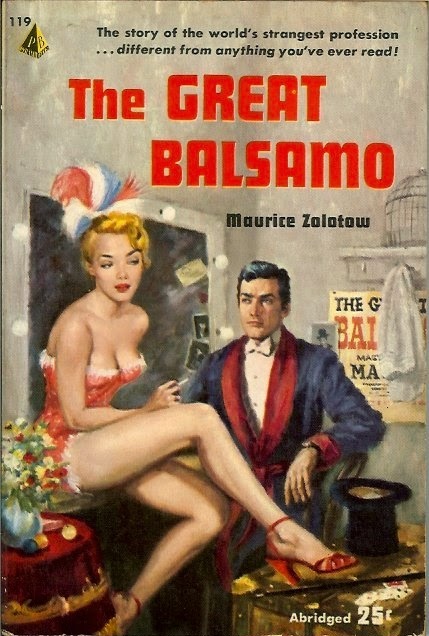
The Great Balsamo was first published in hardcover by Random House in 1946. It later appeared as an abridged paperback edition from Pyramid in 1954. I admit I've never read the book cover to cover. I've only scanned it. But even a scan tells me that Houdini was first and foremost on Zolotow's mind, and that he intended Houdini to be on the mind of the reader as well. Consider his description of Barney Balsamo in the first chapter:
The similarities continue. Balsamo, who doesn’t drink or smoke, performs with his wife Lami as The Balsamos. Their signature trick is the substitution trunk. When times get hard, they do a spiritualistic mind reading act that uses a word/number code. Zolotow spells out their code on pages 184-185 in a way that is very reminiscent of how the first Houdini biography, Houdini His Life Story by Harold Kellock, spelled out Harry and Bessie's own secret code.
In fact, it's pretty clear that Zolotow used the Kellock biography as a source in ways that border plagiarism. Compare these two passages from Kellock and Zolotow:
The similarities continue. Advised by vaudeville manager Sam Blitzer to focus on handcuffs escape, Balsamo hits it big as "The Handcuff King and Jail-Breaker." He travels to Europe and escapes handcuffs at Scotland Yard -- yes, his hands are locked around a pillar -- and experiences his own Hodgson-like challenge. (Both these sections again lift whole passages from Kellock). Back in the U.S., Balsamo performs suspended straitjacket escapes, vanishes an elephant, and is devastated by the death of his mother. In the end, Balsamo dies in an overboard box escape gone wrong.
The Great Balsamo is peppered with mentions of classic era magicians such as Thurston, Blackstone, T. Nelson Downs, and Horace Goldin. Zolotow also identifies S.W. Erdnase as being Edward Samuel Andrews. The name "Houdini" is conspicuously absent until near the end of the book when he warrants one quick mention (his photo is named among others on the wall of a magic shop).
It's also worth noting that Houdini himself used the name "The Marvelous Balsoma" for a fictional magician in his short story, "The Magician's Christmas Eve." Houdini was no doubt drawing the name from Cagliostro, who also happens to be a hero to Barney Balsamo.
So there's no question Zolotow is offering is a veiled portrait of Houdini in The Great Balsamo. However, it's not always a flattering one. Consider this passage near the end of the novel:
So who was Maurice Zolotow and what were his feelings toward Houdini?
Born in 1913, Maurice Zolotow was a prolific show business biographer. He penned the first biography of Marilyn Monroe, as well as biographies of John Wayne and Billy Wilder. He was also a magic buff who claimed to have seen Houdini perform at Coney Island. Later in life, he became friends with magician Ricky Jay.
In his psychological study, Houdini A Mind in Chains (1976), author Bernard C. Meyer (father of Houdini miniseries screenwriter Nicholas Meyer) repeatedly references Zolotow and Balsamo, stating, "it is clear that in fashioning the erotic aspect of his novel, Zolotow drew freely upon elements in Houdini's past."
Indeed, the erotic aspect of Houdini's life appears to have fascinated Maurice Zolotow. It was Zolotow who famously said, "Houdini loved only two women, his mother and Daisy White." (In Balsamo, Daisy is Myra Wilcox.) I don't know this for a fact, but I suspect Zolotow might have also influenced Melville Shavelson's 1976 biopic, The Great Houdinis.
In October 1979, Zolotow wrote a profile of Houdini for Los Angeles Magazine. It's surprisingly negative. He starts with an account of the Jess Willard confrontation and concludes: "All of Houdini's biographers relate this and similar stories about him, as if to prove what a heroic guy he was. To me, it suggests he was an arrogant bastard."
First edition hardcover (1946).
The Great Balsamo was first published in hardcover by Random House in 1946. It later appeared as an abridged paperback edition from Pyramid in 1954. I admit I've never read the book cover to cover. I've only scanned it. But even a scan tells me that Houdini was first and foremost on Zolotow's mind, and that he intended Houdini to be on the mind of the reader as well. Consider his description of Barney Balsamo in the first chapter:
He was not of commanding height, but when be began to speak in a firm, harsh voice, ungrammatical, but pervaded with unanswerable conviction, he could project any illusion about himself which he wished.
At the high point of his fame, Balsamo was a stocky muscular person with a large round face, curly black hair, and eyes of a murky marbled grayness, that fixed you with an immobile translucency. You were unable to escape from the eyes. They captured you like and insect on a scientific pin. You were lost in the eyes, like round, superbly polished stones in a ring, cloudy chrysophrase stones. Before an interview or a stage appearance, he placed a few drops of belladonna in his eyes to heighten the staring intensity.
The similarities continue. Balsamo, who doesn’t drink or smoke, performs with his wife Lami as The Balsamos. Their signature trick is the substitution trunk. When times get hard, they do a spiritualistic mind reading act that uses a word/number code. Zolotow spells out their code on pages 184-185 in a way that is very reminiscent of how the first Houdini biography, Houdini His Life Story by Harold Kellock, spelled out Harry and Bessie's own secret code.
In fact, it's pretty clear that Zolotow used the Kellock biography as a source in ways that border plagiarism. Compare these two passages from Kellock and Zolotow:
Houdini His Life Story (page 90):
Toward the end of the week he came home one evening with a whole packing-box for the fire. It was so complete that he obviously hated to break it up, and before tackling it he sat for a long time staring at it. At last, with a sigh, he began to wrench it apart.
"Bess," he said, "I have a new idea for a packing-box escape. I think I can get out without using a trick box. I'll work it out some day, and it will help make us famous.
In this curious fashion the idea of his famous packing-case escape had it's inception.
The Great Balsamo (page 207-206):
Lami could not help giggling when she saw what an absurd figure he made hauling the crate. It was the first time he had ever secured a box in such unbroken condition. He seemed to be reluctant to break it up and throw it into the stove. For a long time he stared at the box, and thumped its sides, examining the way the slates were nailed together. Finally, he began to dismantle the box.
"Lami," he said, thoughtfully, "I have a new idea for a packing-box escape. I think I can get out without using a trick box. I think I know a way where I can get a committee of carpenters to come on stage and build a box right on stage and nail me into it and I can escape and still leave the box it its original condition.
This was the germ of Balsamo's celebrated packing-box escape...
The similarities continue. Advised by vaudeville manager Sam Blitzer to focus on handcuffs escape, Balsamo hits it big as "The Handcuff King and Jail-Breaker." He travels to Europe and escapes handcuffs at Scotland Yard -- yes, his hands are locked around a pillar -- and experiences his own Hodgson-like challenge. (Both these sections again lift whole passages from Kellock). Back in the U.S., Balsamo performs suspended straitjacket escapes, vanishes an elephant, and is devastated by the death of his mother. In the end, Balsamo dies in an overboard box escape gone wrong.
Abridged paperback (1954).
The Great Balsamo is peppered with mentions of classic era magicians such as Thurston, Blackstone, T. Nelson Downs, and Horace Goldin. Zolotow also identifies S.W. Erdnase as being Edward Samuel Andrews. The name "Houdini" is conspicuously absent until near the end of the book when he warrants one quick mention (his photo is named among others on the wall of a magic shop).
It's also worth noting that Houdini himself used the name "The Marvelous Balsoma" for a fictional magician in his short story, "The Magician's Christmas Eve." Houdini was no doubt drawing the name from Cagliostro, who also happens to be a hero to Barney Balsamo.
So there's no question Zolotow is offering is a veiled portrait of Houdini in The Great Balsamo. However, it's not always a flattering one. Consider this passage near the end of the novel:
"Balsamo, growing older, resembled Cagliostro more and Balsamo less. In both, cunning and evil had gradually come to dominate and corrupt the physiognomy."
So who was Maurice Zolotow and what were his feelings toward Houdini?
Born in 1913, Maurice Zolotow was a prolific show business biographer. He penned the first biography of Marilyn Monroe, as well as biographies of John Wayne and Billy Wilder. He was also a magic buff who claimed to have seen Houdini perform at Coney Island. Later in life, he became friends with magician Ricky Jay.
In his psychological study, Houdini A Mind in Chains (1976), author Bernard C. Meyer (father of Houdini miniseries screenwriter Nicholas Meyer) repeatedly references Zolotow and Balsamo, stating, "it is clear that in fashioning the erotic aspect of his novel, Zolotow drew freely upon elements in Houdini's past."
Indeed, the erotic aspect of Houdini's life appears to have fascinated Maurice Zolotow. It was Zolotow who famously said, "Houdini loved only two women, his mother and Daisy White." (In Balsamo, Daisy is Myra Wilcox.) I don't know this for a fact, but I suspect Zolotow might have also influenced Melville Shavelson's 1976 biopic, The Great Houdinis.
In October 1979, Zolotow wrote a profile of Houdini for Los Angeles Magazine. It's surprisingly negative. He starts with an account of the Jess Willard confrontation and concludes: "All of Houdini's biographers relate this and similar stories about him, as if to prove what a heroic guy he was. To me, it suggests he was an arrogant bastard."
Zolotow goes on to quote conversations with Dai Vernon, a Houdini hater of the first order, which might account for the article's negative tone. And despite excellent sources, such as Manny Weltman, the article contains several factual errors.
In the same issue, Zolotow provided a short article about "The Houdini Gary Gilmore Connection" in which he spells out the claim by murderer Gary Gilmore that he was the illegitimate grandson of the famous magician. So it's clear Zolotow liked to dish dirt on Houdini.
Maurice Zolotow died on March 14, 1991.
The Great Balsamo stands as a curiosity. It's not a great novel, nor does it really work as a "veiled" Houdini biography. The real Houdini and his life remians just so much more compelling than any fictional version. But I still think it's an interesting book and a worthy addition to any Houdini bookshelf.
Zolotow's Los Angeles Magazine profile of Houdini (1979).
In the same issue, Zolotow provided a short article about "The Houdini Gary Gilmore Connection" in which he spells out the claim by murderer Gary Gilmore that he was the illegitimate grandson of the famous magician. So it's clear Zolotow liked to dish dirt on Houdini.
Maurice Zolotow died on March 14, 1991.
The Great Balsamo stands as a curiosity. It's not a great novel, nor does it really work as a "veiled" Houdini biography. The real Houdini and his life remians just so much more compelling than any fictional version. But I still think it's an interesting book and a worthy addition to any Houdini bookshelf.
Other selections from the WILD ABOUT HARRY bookshelf:
- "This book is full of lies" - Houdini His Life Story
- The secrets of The Secrets of Houdini - The Secrets of Houdini
- "Had Houdini lived he would have written this book" - Houdini's Escapes and Magic
- The gateway biography - The Great Houdini
- An alternative gateway - Houdini Master of Escape
- The first great Houdini biography - Houdini The Man Who Walked Through Walls
- The textbook - Houdini The Untold Story
- The perennial - Houdini on Magic
- The Fantastic Four - The Original Houdini Scrapbook, Houdini His Art and Magic, Houdini A Pictorial Life, Houdini His Legend and His Magic
- The Brandon book - The Life and Many Deaths of Harry Houdini
- The best forgotten Houdini book - Houdini's Fabulous Magic
Tuesday, May 31, 2016
REVIEW: Houdini & Doyle (ep. 5): The Curse of Korhza
Houdini & Doyle episode 5, The Curse of Korhza, will be of special interest to Houdini buffs as it brings Harry into battle with his traditional nemesis; the medium! In this case, it's the attractive Madam Korhza (Emily Hampshire), a psychic medium who specializes in solving crimes, especially lost children. Is Korhza for real, or is she "solving" her own crimes?
Needless to say, Houdini is the skeptic and Doyle the believer in a debate that in real-life brought about the end of their friendship. However, the idea of spiritualism as a movement and religion isn't part of the debate here. The focus is on the question of Korhza herself.
This is another solid, well-written episode with snappy dialogue and nice twists. In her séance parlor, Korhza pulls off manifestations that (temporarily) stump Houdini. She even does her own version of Metamorphosis. There is a nice secondary storyline with Houdini being suspicious (jealous?) of a man his mother is dating. We also get to see Houdini in underwater action as he saves the final child victim. "I work with water a lot," says Harry.
Surprisingly, mid-way through the episode, Houdini sleeps with Korhza. It seems a touch gratuitous, but I do like that it echoes the ultimate Houdini and Margery fantasy. In fact, there is a lot of Mina Crandon present in the characterization of Korhza. But we will talk more about that below.
Speaking of trysts, it appears the potential Houdini-Adelaide relationship is being sidelined as we delve deeper into the question of Adelaide's past and former husband, who we now learn is deceased. During the episode, Korzha predicts that "Adelaide Stratton" will not survive, and indeed she doesn't! That's because the episode ends with the revelation that Adelaide is living under an assumed name. This not only adds another layer of mystery to Adelaide, but also gives Korzha a layer of legitimacy.
In fact, Korhza comes off looking pretty good in the end. She's a trickster as skilled as Houdini, a detective as skilled as Sherlock Holmes, but also someone who might be able to plug into the other side. If there is a Season 2, I expect Madame Korzha will be back.
Just the facts
Houdini & Doyle is slowly revealing Houdini's biography, which is something I'm obviously enjoying about this series. In this episode, we take an important step in that we finally hear Houdini's real name, Ehrich (clip below).
As I mentioned above, Korhza appears to echo the real-life Mina Crandon a.k.a. Margery, a vivacious medium who had Boston society and scientists stumped until Houdini landed in her séance chamber. While Houdini never slept with Margery, there was one attempt at seduction. But Houdini famously said, "Her applesauce means nothing to me." How I would have loved it if Weston's Houdini would have mentioned Korhza's own "applesauce."
The most dramatic bit of Houdini history is Harry's admission that he worked a fraudulent medium in his early days. This, of course, is true. However, the story he tells about how one of his sitters killed herself to be with her dead husband is far more tragic than anything that ever happened to the real Harry. The strangest event is when Houdini predicted a boy would fall from his bicycle and break his arm. When it happened the next day, the hysterical mother returned to the theater and accused Houdini of black magic.
Of his time as a medium, Houdini later wrote:
This episode was penned by Magic Castle member Josh Brandon, so we get some nice nods to real magic effects. The Kellar Rope Tie gets a mention. And according to Josh, Michael Weston performed a one-handed card cut for the episode, but it was cut for time.
While I doubt Cecelia Weiss ever "dated" after Rabbi Weiss's death, the close and loving relationship between Houdini and his mother is all very accurate. In fact, this episode ends with a touching scene between them that beautifully illustrates the real-life closeness of mother and son. Houdini would have approved.
Next Monday: Houdini & Doyle travel to the country to face "The Monsters of Nethermoor."
Needless to say, Houdini is the skeptic and Doyle the believer in a debate that in real-life brought about the end of their friendship. However, the idea of spiritualism as a movement and religion isn't part of the debate here. The focus is on the question of Korhza herself.
This is another solid, well-written episode with snappy dialogue and nice twists. In her séance parlor, Korhza pulls off manifestations that (temporarily) stump Houdini. She even does her own version of Metamorphosis. There is a nice secondary storyline with Houdini being suspicious (jealous?) of a man his mother is dating. We also get to see Houdini in underwater action as he saves the final child victim. "I work with water a lot," says Harry.
Surprisingly, mid-way through the episode, Houdini sleeps with Korhza. It seems a touch gratuitous, but I do like that it echoes the ultimate Houdini and Margery fantasy. In fact, there is a lot of Mina Crandon present in the characterization of Korhza. But we will talk more about that below.
Speaking of trysts, it appears the potential Houdini-Adelaide relationship is being sidelined as we delve deeper into the question of Adelaide's past and former husband, who we now learn is deceased. During the episode, Korzha predicts that "Adelaide Stratton" will not survive, and indeed she doesn't! That's because the episode ends with the revelation that Adelaide is living under an assumed name. This not only adds another layer of mystery to Adelaide, but also gives Korzha a layer of legitimacy.
In fact, Korhza comes off looking pretty good in the end. She's a trickster as skilled as Houdini, a detective as skilled as Sherlock Holmes, but also someone who might be able to plug into the other side. If there is a Season 2, I expect Madame Korzha will be back.
Just the facts
Houdini & Doyle is slowly revealing Houdini's biography, which is something I'm obviously enjoying about this series. In this episode, we take an important step in that we finally hear Houdini's real name, Ehrich (clip below).
As I mentioned above, Korhza appears to echo the real-life Mina Crandon a.k.a. Margery, a vivacious medium who had Boston society and scientists stumped until Houdini landed in her séance chamber. While Houdini never slept with Margery, there was one attempt at seduction. But Houdini famously said, "Her applesauce means nothing to me." How I would have loved it if Weston's Houdini would have mentioned Korhza's own "applesauce."
Of his time as a medium, Houdini later wrote:
“No matter what I pulled, someone in the audience was pretty sure to claim it as a direct message. When I noted the deep earnestness with which my utterances were being received, and that I was being considered a medium of far more than ordinary psychic powers, I felt that the game had gone far enough.”
This episode was penned by Magic Castle member Josh Brandon, so we get some nice nods to real magic effects. The Kellar Rope Tie gets a mention. And according to Josh, Michael Weston performed a one-handed card cut for the episode, but it was cut for time.
While I doubt Cecelia Weiss ever "dated" after Rabbi Weiss's death, the close and loving relationship between Houdini and his mother is all very accurate. In fact, this episode ends with a touching scene between them that beautifully illustrates the real-life closeness of mother and son. Houdini would have approved.
Next Monday: Houdini & Doyle travel to the country to face "The Monsters of Nethermoor."
Friday, November 27, 2015
Houdini and Margery in the apple orchards
In last year's Houdini miniseries starring Adrien Brody, there is a scene in which Margery (played by Megan Hobbs) attempts to seduce Houdini in his hotel room. I pegged this as "False" in my Houdini miniseries fact check, pointing out that Margery did not have the opportunity to mount such a seduction. Unlike some other members of the Scientific American committee who investigated the medium in 1924, Houdini did not stay in the Crandons home at 10 Lime Street.
But it now looks like I owe screenwriter Nicholas Meyer an apology. In the excellent new book, The Witch of Lime Street: Seance, Seduction, and Houdini in the Spirit World, author David Jaher reveals that Margery did tempt the magician with what he famously called her "applesauce." But the location of this alleged seduction was not in Houdini's hotel. Here truth is stranger than the fiction.
On page 257, Jaher explains:
Later on page 266, Houdini himself revealed what went on in the bedroom:
It appears Houdini even alluded to this publicly during his anti-spiritualism lectures. On page 380 Jaher quotes Houdini as saying:
Boom. So...
Check out my full review of The Witch of Lime Street: Seance, Seduction, and Houdini in the Spirit World by David Jaher HERE. The book is available on Amazon.com (U.S.) and Amazon.co.uk (UK).
But it now looks like I owe screenwriter Nicholas Meyer an apology. In the excellent new book, The Witch of Lime Street: Seance, Seduction, and Houdini in the Spirit World, author David Jaher reveals that Margery did tempt the magician with what he famously called her "applesauce." But the location of this alleged seduction was not in Houdini's hotel. Here truth is stranger than the fiction.
On page 257, Jaher explains:
Despite the rift, Houdini discovered that Margery rarely made critics feel unwelcome at Lime Street. After his run-in with Conant, Houdini arrived to inform the Crandons and their guests that all was ready for seance that evening. The exchange between Houdini and the psychic were refreshingly pleasant away from the Charlesgate. Margery even asked the magician, who admitted he was exhausted, if he wanted to take a nap upstairs rather than retire to the Copley. After accepting her offer, he followed her upstairs to her absent son's bedroom.
She told him that John would be thrilled to know the Handcuff King had slept in his bed. Houdini replied that he would like to meet John sometime and entertain him. Privately, though, the magician could not understand why the Crandons sent their son away from home while any scientist who could quote William James was welcome to stay there.
Sometime later, Munn heard Margery descending the staircase. Joking that she had just tucked Houdini in, she rejoined them in the parlor.
Later on page 266, Houdini himself revealed what went on in the bedroom:
Margery had tried to vamp him in her own son's bedroom, he told Prince, and when seduction failed, her husband purportedly tried to bribe him at the final Charlesgate seance.
It appears Houdini even alluded to this publicly during his anti-spiritualism lectures. On page 380 Jaher quotes Houdini as saying:
"Margery handed out applesauce to the investigators," he asserted. "I know this because I have walked through the apple orchards myself."
Boom. So...
Check out my full review of The Witch of Lime Street: Seance, Seduction, and Houdini in the Spirit World by David Jaher HERE. The book is available on Amazon.com (U.S.) and Amazon.co.uk (UK).
Related:
Saturday, June 20, 2015
The Brandon book
Continuing my examination of books about Houdini using images and insights from my own collection.
The 1993 biography The Life and Many Deaths of Harry Houdini by Ruth Brandon is maligned by Houdini buffs. This is largely due to Brandon's pet theory, as expressed in the book, that Houdini was impotent. Brandon admitted this notion was not based on any evidence, just a "guess." But she believed it was the best explanation of why the Houdinis never had children. This was promoted as the sensational revelation of the book, and the author repeatedly shared her theory on TV and in documentaries. It even found its way into popular culture via a mention on Seinfeld.
Of course, the reason the Houdinis didn’t have children had to do with Bess's inability to do so, something her niece, Marie Blood, said she would have shared with Brandon had the author shown any interest (I got the feeling that Brandon had rubbed Marie the wrong way). I’ve also heard whispers over the years that Brandon, who authored the 1984 book, The Spiritualists, had a pro-spiritualist agenda. However, I see no real evidence of this in the book itself. (Unless the idea of robbing the great debunker of his sexual power could be considered an attack?)
But if we move beyond the bedroom, I think The Life and Many Deaths of Harry Houdini has a lot to recommend it. Certainly in 1993 it was a very welcome book. It had been 24 years since the last major Houdini biography (Houdini The Untold Story by Milbourne Christopher), and while Brandon didn’t really break new ground, she nicely consolidated a lot of the important new research from smaller, individual studies. It provided Houdini buffs with a nice "everything we know up to now" biography while we waited for the great game changer, Houdini!!! The Career of Ehrich Weiss by Kenneth Silverman.
It's also a very well written book. In fact, for people who want an easy read on Houdini, it's still a biography I'd recommend, impotency theory and all.
Publication
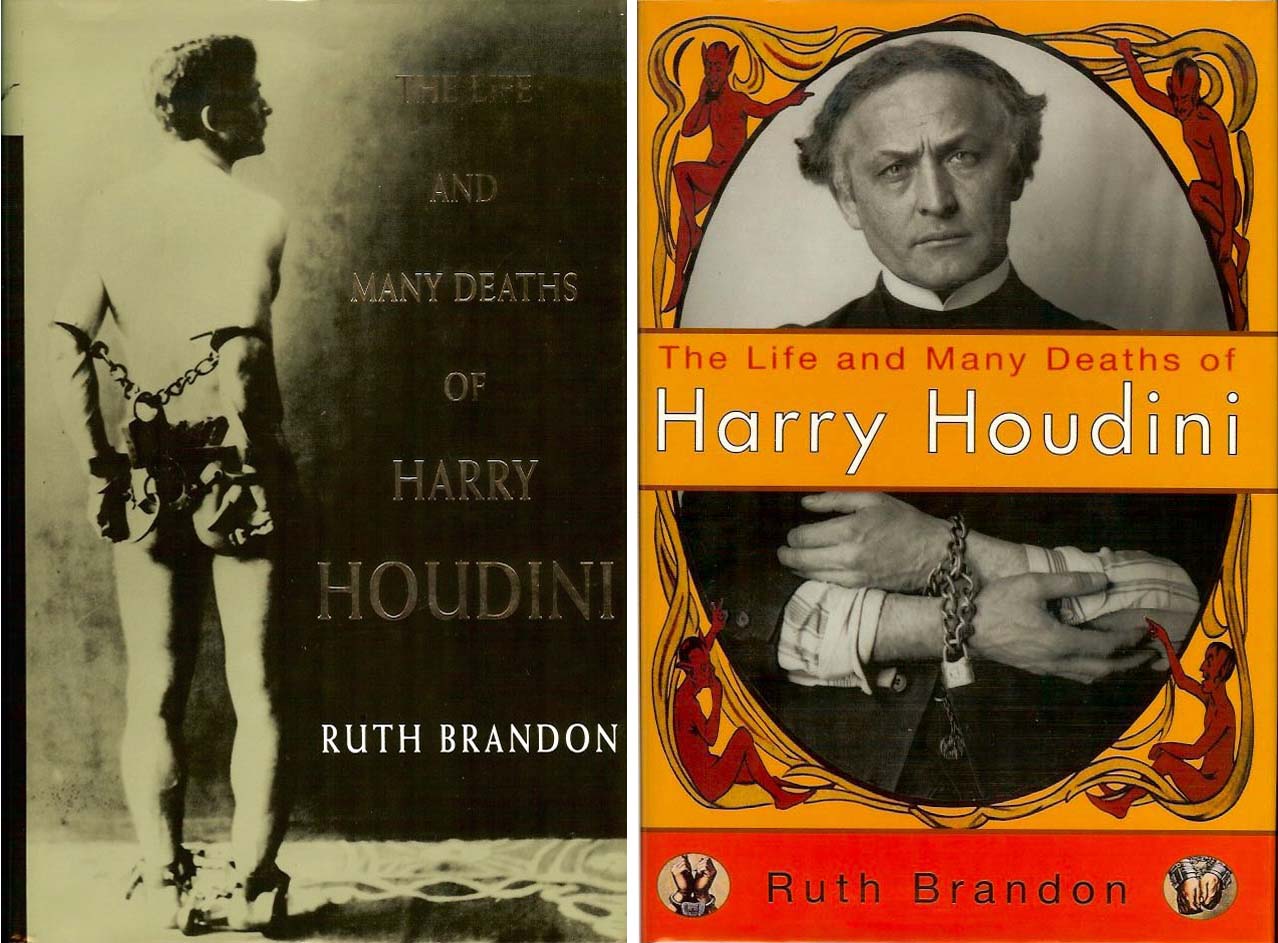
The Life and Many Deaths of Harry Houdini was first published in Great Britain by Martin Secker & Warburg Limited in 1993. It would take a year for the book to find its way "across the pond" to the U.S. where it was published by Random House in October 1994 (although the U.S. first edition shows only the 1993 copyright date). Both hardcover editions featured very nice cover art. The UK art was designed by William Webb with a photo credit to the Radner Collection. The U.S. cover was by Mike Lam with photo credit to UPI and poster images from the Granger Collection.
The Life and Many Deaths of Harry Houdini has so far seen two paperback editions in the UK. The first was published in 1994 by Mandarin and featured a shirtless Houdini on the cover. The second came from Pan Books in August 2001 and offered up more conventional cover artwork. This later edition also separated the photos into two sections instead of having all in one central section as in all other editions.
The first U.S. paperback edition was published by Kodansha Globe in 1995. It had an attractive cover designed by Lilly Langotsky. A later reprint from Random House appeared in October 2003. It featured an entirely new cover design by Tamaye Perry, who made nice use of stills from Houdini's movies. This paperback is still in-print today and is available on Amazon.
In my collection, I also have two U.S. pre-publication editions of the Brandon book. The first is a proof from publisher Random House. A very different cover concept is shown inside along with a review from the London Times. The second is a curiosity; a trade paperback edition featuring artwork that would appear on the U.S. hardcover. It's likely this is an early export edition, typically sold in airports and overseas markets, although there's nothing on the book to indicate it as such.
Despite the controversy, The Life and Many Deaths of Harry Houdini, "the Brandon book", is a worthy biography that deserves a place on any shelf of Houdiniana, if for no other reason than for these great cover designs.
The 1993 biography The Life and Many Deaths of Harry Houdini by Ruth Brandon is maligned by Houdini buffs. This is largely due to Brandon's pet theory, as expressed in the book, that Houdini was impotent. Brandon admitted this notion was not based on any evidence, just a "guess." But she believed it was the best explanation of why the Houdinis never had children. This was promoted as the sensational revelation of the book, and the author repeatedly shared her theory on TV and in documentaries. It even found its way into popular culture via a mention on Seinfeld.Of course, the reason the Houdinis didn’t have children had to do with Bess's inability to do so, something her niece, Marie Blood, said she would have shared with Brandon had the author shown any interest (I got the feeling that Brandon had rubbed Marie the wrong way). I’ve also heard whispers over the years that Brandon, who authored the 1984 book, The Spiritualists, had a pro-spiritualist agenda. However, I see no real evidence of this in the book itself. (Unless the idea of robbing the great debunker of his sexual power could be considered an attack?)
But if we move beyond the bedroom, I think The Life and Many Deaths of Harry Houdini has a lot to recommend it. Certainly in 1993 it was a very welcome book. It had been 24 years since the last major Houdini biography (Houdini The Untold Story by Milbourne Christopher), and while Brandon didn’t really break new ground, she nicely consolidated a lot of the important new research from smaller, individual studies. It provided Houdini buffs with a nice "everything we know up to now" biography while we waited for the great game changer, Houdini!!! The Career of Ehrich Weiss by Kenneth Silverman.
It's also a very well written book. In fact, for people who want an easy read on Houdini, it's still a biography I'd recommend, impotency theory and all.
Publication
The Life and Many Deaths of Harry Houdini was first published in Great Britain by Martin Secker & Warburg Limited in 1993. It would take a year for the book to find its way "across the pond" to the U.S. where it was published by Random House in October 1994 (although the U.S. first edition shows only the 1993 copyright date). Both hardcover editions featured very nice cover art. The UK art was designed by William Webb with a photo credit to the Radner Collection. The U.S. cover was by Mike Lam with photo credit to UPI and poster images from the Granger Collection.
![]() |
| UK and U.S. hardcover first editions. |
The Life and Many Deaths of Harry Houdini has so far seen two paperback editions in the UK. The first was published in 1994 by Mandarin and featured a shirtless Houdini on the cover. The second came from Pan Books in August 2001 and offered up more conventional cover artwork. This later edition also separated the photos into two sections instead of having all in one central section as in all other editions.
![]() |
| UK paperbacks. |
The first U.S. paperback edition was published by Kodansha Globe in 1995. It had an attractive cover designed by Lilly Langotsky. A later reprint from Random House appeared in October 2003. It featured an entirely new cover design by Tamaye Perry, who made nice use of stills from Houdini's movies. This paperback is still in-print today and is available on Amazon.
![]() |
| U.S. paperbacks. |
In my collection, I also have two U.S. pre-publication editions of the Brandon book. The first is a proof from publisher Random House. A very different cover concept is shown inside along with a review from the London Times. The second is a curiosity; a trade paperback edition featuring artwork that would appear on the U.S. hardcover. It's likely this is an early export edition, typically sold in airports and overseas markets, although there's nothing on the book to indicate it as such.
![]() |
| U.S. proof and early export paperback. |
Despite the controversy, The Life and Many Deaths of Harry Houdini, "the Brandon book", is a worthy biography that deserves a place on any shelf of Houdiniana, if for no other reason than for these great cover designs.
Enjoy these other selections from the WILD ABOUT HARRY bookshelf:
- "This book is full of lies" - Houdini His Life Story
- The secrets of The Secrets of Houdini - The Secret of Houdini
- "Had Houdini lived he would have written this book" - Houdini's Escapes and Magic
- The gateway biography - The Great Houdini
- An alternative gateway - Houdini Master of Escape
- The first great Houdini biography - Houdini The Man Who Walked Through Walls
- The textbook - Houdini The Untold Story
- The perennial Houdini on Magic - Houdini on Magic
- The Fantastic Four - The Original Houdini Scrapbook, Houdini His Art and Magic, Houdini A Pictorial Life, Houdini His Legend and His Magic
Monday, September 1, 2014
Fact checking HISTORY's Houdini - Part One
Did Houdini get trapped under the ice of a frozen river?
Even though Houdini himself would tell the story of being trapped under an ice sheet during a bridge jump, there is no evidence that it ever happened, and Houdini would alter the location and details in various tellings. But he never claimed his mother's voice or any supernatural power led him to the opening in the ice. He found his own way to freedom. (Read: Trapped under the ice with Houdini.)
Did Houdini have issues with his father?
Houdini spoke very highly of his father and honored him his entire life. Any suggestion of "daddy issues" is purely speculative. It is true that Rabbi Weiss lost his job in Appleton for being too "old world" (he didn't speak English), and this plunged the family into poverty. The story of him having to flee Budapest after killing a man in a duel was told by all the Weiss children. Some biographers doubt it as being too far fetched, but duels in Hungary were not unusual in the 1870s. (Read: Who was Houdini's father? New insights.)
Did Houdini run away from home and work with a traveling magician?
While it's true that Ehrich Weiss (the miniseries misspells it as Erich - grrrr) ran away from home when he was 12, he did not work with a traveling magician. This is a fiction seemingly lifted from a 1987 Disney movie called Young Harry Houdini. However, it is true that his interest in magic was inspired by the autobiography of Robert-Houdin, and that he took his name from the famous French conjurer. (Read: Homeless Houdini.)
Did Houdini live in Brooklyn?
The Houdini miniseries shows Harry growing up and later buying a large home in Brooklyn, NY. Not true. The Weiss family lived in a tenement in mid-town Manhattan, and Houdini later bought a large brownstone in Harlem. Likewise, the Weiss family plot is located in Queens, not Brooklyn. (Read: Discovering the home of Houdini.)
Did Houdini meet Bess when they were both performers in Coney Island?
While there are several romanticized stories of how Houdini and Bess met, screenwriter Nicholas Meyer opted for the truth here. Houdini did indeed meet his wife Bess at Coney Island while she was performing as part of an act called The Floral Sisters. They had a whirlwind courtship and married only a week after they had met. (Read: When Harry Met Bessie.)
Did Houdini create the challenge handcuff escape act in a brothel?
Houdini worked to perfect his challenge handcuff act over several years, and may have gotten the idea from an Australian magician named Lewis Paul. While Harry and Bess performed in Dime Museums, Beer Halls, Circuses, and traveling Burlesque shows, there is no record of them ever performing in a brothel. Besides, aren't brothels their own entertainment? UPDATE: Turns out this is based in fact. Read: The Houdinis in the bordello.
Did Houdini perform escapes as The Wild Man from Borneo?
While Houdini did briefly appear as "Projea The Wild Man of Mexico" in the Welsh Bros. circus, it had nothing whatsoever to do with his magic or escape act. Harry and Bess took on many side jobs during their travels with the circus. Houdini quit the Wild Man when he got hit in the eye with a piece of meat thrown into his cage by Clint Newton, ringmaster of the Welsh Bros. Circus.. (Read: Freaks of Octoberfest.)
Did Houdini achieve fame after escaping from a "Johnson County" jail in 1896?
Houdini performed handcuff and jail escapes in various cities across the U.S. in the late 1890s, they did not bring him recognition beyond that city. The idea that Houdini was "the most famous man in America" by the turn of the century is wildly incorrect. While he had achieved a measure of success in America by 1900, his true breakout success came in Europe. Houdini did not really become a star in America until his return in 1905. (Read: Houdini at the Colonial.)
Did Houdini do escapes in the nude?
To prove he concealed no keys or lockpicks, Houdini would strip nude and submit to an examination by a doctor during his jail escapes. But Houdini would also sometimes strip nude on stage during handcuff challenges, and even advertised himself as "Positively the only conjurer in the world who strips stark naked." He once even performed his Milk Can escape au naturale. He had a powerful physique and wasn't afraid to show it off. (Read: Ebay auction dates Houdini's first 'nude')
Did Houdini hire a magic store clerk named Jim Collins to create his effects?
Houdini's chief assistant and mechanic was named Jim Collins and he did have a genius for designing magic and escape effects. However, Houdini did not impulsively hire him out of an Ohio magic store, and Collins was not an American from Georgia. Jim Collins was born in England, possibly Portsmouth, and it was there that Houdini hired him to be his assistant. (Read: The man who kept Houdini's secrets.)
The Water Torture Cell was not Houdini's first major stage escape and certainly not invented in 1900 as shown in the miniseries. The USD, as Houdini called it, was the culmination of many escapes that came before it (including the Milk Can) and was first performed in Germany in 1912. Also, the idea that Houdini would be revealed as one of his own axe-wielding assistants at the end is not accurate. This "magical" spin on the Water Torture Cell was first performed by Doug Henning in 1975. (Read: The Chinese Water Torture Cell at 100.)
Was Houdini a spy?
Houdini was friendly with law enforcement and took great interest in the methods and practices of criminals and con-men. He even penned a book on the subject in 1906 called The Right Way To Do Wrong. While he might have communicated with William Melville of Scotland Yard about what he was observing in Germany and Russia (and even the "evidence" for this is paper thin), to show him working as a full-blown spy and using his magic act as "cover" is ludicrous. In fact, MI5 didn't even exist during Houdini's first tour of Europe. Of all the fictionalizations in the Houdini miniseries, this is by far the worst, and trying to work this fiction into the story is one of the reasons the movie so badly mangles the facts of his early career. (Read: Experts weigh-in on 'Secret Life' spy revelation.)
Did Houdini do the bullet catch for Kaiser Wilhelm II?
While it's possible Houdini might have done the bullet catch early in his career, he never did it during his fame, and certainly not for Germany's Kaiser in a private performance, as shown in the miniseries. After his friend Chung Ling Soo (William Robinson) was killed onstage doing the catch in 1918, Houdini announced that he would attempt it himself. But he was talked out of it by magician Harry Kellar. This gave the Bullet Catch an even more ominous reputation as being a trick so dangerous even Houdini wouldn't try it. (Read: Did Houdini do the bullet catch in the 1890s?)
Did Houdini ring the bells of the Kremlin?
Like the hole in the ice, this story comes from Houdini's time, but no verifiable source (such as a newspaper account) has ever surfaced to prove that it actually happened. It also tends to change from teller to teller, one of whom was Orson Welles, a great teller of tall tales. And while Houdini did perform for members of the Russian Royal Family in Moscow, the idea that Rasputin was among the gathering is not possible. Houdini toured Russia in 1903 and Rasputin did not meet the Russian Royal Family until 1905. (Read: Orson Welles remembers Houdini.)
Did Houdini give his mother a royal reception in Budapest?
It is true that Houdini brought his mother to Europe and gave her a lavish "royal" reception with relatives in Budapest. The dress Houdini had purchased for her was said to have been designed for Queen Victoria before her death. However, Houdini did not pour gold coins into his mother's lap on this occasion. He did this privately when he asked for his salary in gold coins so his could fulfill a childhood promise to his mother that one day he would pour gold into her lap.
Did Houdini fall apart when we saw Bess sitting on the lap of another man?
This is actually true. Bess purposely planted herself on the lap of a young Colonel to see if she could make her husband jealous. It worked. However, showing Houdini getting drunk is not accurate. Houdini was a well-known teetotaler. But for months, Houdini would be thrown into a deep funk if anyone around him used the word "Colonel."
Did Houdini engage in bondage sex with Lady Butler?
Houdini did not have an affair with British painter Elizabeth Thompson aka Lady Butler, nor is there any indication that they ever even met. And as far as we know, Houdini didn't indulge in any sexual fetish. He was quite puritanical in matters of sex. However, there is evidence that he did have at least one affair with Charmian London, the widow of Jack London. (Read: The illicit loves of Harry Houdini.)
Did Houdini own and fly his own airplane?
In 1909, Houdini became fascinated with aviation and purchased a Voison biplane. He flew in exhibitions in Germany and became the first man to ever fly a plane in Australia. However, the depiction of Houdini barnstorming across Europe with Bess on board is fiction. As with almost all planes at the time, Houdini's Voison could only hold a pilot and was not capable of sustained and reliable flight for travel. (Read: Houdini was the 25th person to fly.)
Did Houdini resent and resist early cinema?
Houdini embraced cinema almost from the start of the medium. He made a short film in Paris in 1909 and also filmed many of his outdoor escapes which played before his vaudeville act. Seeing Houdini frequently meant seeing a film. He was actually a pioneer of the medium. (Read: 'Houdini Defeats Hackenschmidt' and other revelations.)
Did Bess Houdini smoke pot?
The same biography that gave us the "spy" theory also claimed that Bess Houdini smoked pot. This comes from a 1927 note in which she mentions that she dined out with "no drink and no weed." However, "weed" was slang for tobacco, so it's more likely she is talking about cigarettes (she did smoke). While Bess enjoyed her champagne and did have trouble with substances after Houdini's death, the extent of her drinking during their marriage is unknown, and the suggestion that she was an alcoholic is speculative. (Read: Did Bess Houdini smoke pot?)
Did Houdini's career falter in 1914?
Houdini's audience never tired of escapes. If anything, it was the opposite. The audience expected and demanded escapes from Houdini even when he tried to mount a straight magic act. Houdini's fame and career was actually at a pinnacle in 1914. (Read: The untold story of Houdini's 1914 Battery Park escape.)
Still watching? The good news is Part Two is a big improvement over Part One as far as the facts are concerned. I will post a Fact Check of Part Two tomorrow. And if there's a question that I haven't answered above, please post it in the Comments section below and I will answer you there.
CONTINUE TO NIGHT TWO...
#HOUDINItruth
#HOUDINItruth
Tags:
Bess,
Biopics,
Bullet catch,
Fact check,
Houdini Miniseries (2014),
Ice exploits,
Jail breaks,
Jim Collins,
Mistresses,
Rasputin,
Russia,
Sex,
Spy,
Television,
Water Torture Cell,
Wild Man
Wednesday, August 27, 2014
LINK: Houdini, Sex & History
I really like this post by our friend David Saltman over at The Houdini File today, even though I admit I'm a fan of Bernard C. Meyer's Houdini: A Mind In Chains, and it doesn't appear to me that HISTORY's Houdini miniseries is really based on the Meyer book, despite what the credits read. (It's clearly adapted from a major biography, but I will save that for my review.)
Nevertheless, I like that David has uncovered some of the history behind Meyer's psychological conclusions and the connections he makes to Maurice Zolotow's fictional "Houdini" biography, The Great Balsamo. I've always been intrigued by Zolotow and his fixation on Houdini's personal life. He might have influenced Melville Shavelson's The Great Houdinis and it's "love triangle" between Harry, Mama and Bess. In fact, there's a whole weird Hollywood-Zolotow-Houdini thing that's been going on for years.
Anyway, check out David's post at The Houdini File.
Nevertheless, I like that David has uncovered some of the history behind Meyer's psychological conclusions and the connections he makes to Maurice Zolotow's fictional "Houdini" biography, The Great Balsamo. I've always been intrigued by Zolotow and his fixation on Houdini's personal life. He might have influenced Melville Shavelson's The Great Houdinis and it's "love triangle" between Harry, Mama and Bess. In fact, there's a whole weird Hollywood-Zolotow-Houdini thing that's been going on for years.
Anyway, check out David's post at The Houdini File.
Wednesday, June 11, 2014
Is this HISTORY's Water Torture Cell?
Celebrity art photographer Robert Sebree has used Houdini's Water Torture Cell as inspiration for two beautiful photos with models Nikki Leigh (below) and Raylin. But might these photos be revealing in more ways than one? Says the artist:
Now, here's my thinking on these. Why would a Water Torture Cell be "loaned" to Sebree's studio? Could it be because this is the cell used in HISTORY's upcoming Houdini miniseries? These photos were posted in December 2013 when the production had just wrapped shooting in Budapest. And look at the quick shot of the cell from the Houdini teaser trailer. The riveting and design matches perfectly. Maybe Sebree took photos of Adrien Brody as well?
"One of my favorite aspects of this job is the bazaar opportunities that arise. When a Houdini water tank was loaned to my studio I knew I had to fill it with water and induct a brave human to take the plunge."
![]() |
| Robert Sebree Photography |
Now, here's my thinking on these. Why would a Water Torture Cell be "loaned" to Sebree's studio? Could it be because this is the cell used in HISTORY's upcoming Houdini miniseries? These photos were posted in December 2013 when the production had just wrapped shooting in Budapest. And look at the quick shot of the cell from the Houdini teaser trailer. The riveting and design matches perfectly. Maybe Sebree took photos of Adrien Brody as well?
Another possibility is that this cell was just used to create the teaser trailer, which may have been shot in Los Angeles and had nothing to do with the production itself. This cell does look suspiciously like one that appeared in a recent episode of Castle.
You can see both photos in high res at Robert Sebree Photography. The Raylin shot gives an even better look at the cell, but it's NSFW (Not Safe For Work), so I will let you check that one out on your own.
UPDATE: So it looks like this is not HISTORY's Water Torture Cell after all. You can see that cell HERE.
Related:
- Houdini's Water Torture Cell (Robert Sebree Photography)
- Here is HISTORY's Houdini teaser
- The Chinese Water Torture Cell at 100
Monday, April 14, 2014
Facts and Chicks checks Houdini
The tumblr blog Facts and Chicks has offered up the following fact and chick. I like everything that's going on here.
By the way, the site sourced my own Houdini biography for this fact. I had nothing to do with the chick.
Saturday, April 12, 2014
Why does Jerry Seinfeld think Houdini was impotent?
JERRYYou know it happens to everybody. Happened to Houdini, and he could get out of a trunk underwater with his hands in chains. But he had a problem with that.
Later George returns to the subject...
GEORGEHey, is that a joke about Houdini?
JERRYNo.
GEORGEWell if Houdini couldn't do it, what chance do I have!?
So why does Jerry Seinfeld think Houdini was impotent?
The answer has everything to do with when this episode was made. "The Mango" was taped on Tuesday, August 17, 1993 (directly across the street from where I'm writing this now) and aired on September 16, 1993. At that time a new Houdini biography had just been released in the UK, The Life And Many Deaths of Harry Houdini by Ruth Brandon. This was the first major Houdini biography in several years, and in it Brandon engaged in some amateur psychology as to why the Houdinis didn't have children and why Harry wrote love letters to Bess. On page 52 the author states:
One can only conjecture as to the reason for this childlessness. […] Infertility is not uncommon. But my own guess, based on his effusive daily--sometimes thrice-daily--outpouring of love-declarations--is that Houdini may have been impotent. Why all those protestations? What was so wrong that he had to keep proclaiming his devotion? Was this constant need to reassure both Bess and himself?
This salacious "revelation" was used as a selling point and featured in book reviews and in interviews with the author. Brandon also shared her theory in the 1993 BBC documentary, Houdini, The Life of the World's Greatest Escapologist. It was in this environment that the Seinfeld writers wrote what at the time was a topical reference to Houdini's "impotency."
Of course, the reason the Houdinis didn't have children was because Bess suffered from a medical condition that prevented it, information that was shared with me by her niece, Marie Blood. (You can read more about that here.)
Brandon's theory received a dose of cold water just a few year after the publication of her book when Kenneth Silverman revealed evidence of an extramarital affair Houdini had with Charmian London in his own biography, Houdini!!! The Career of Ehrich Weiss (1996). Now the pendulum may have a swung a bit too far the other way with Houdini sometimes portrayed as a bit of a Lothario (we'll see how the upcoming Houdini miniseries handles all this).
It's too bad this blip in Houdini history had to be immortalized in pop culture. True or false, it's just not the kind of thing you want people to know!
Tuesday, March 25, 2014
Houdini haunts The Late Late Show
For the record, this was Season 10, Episode 1898 of The Late Late Show on CBS. It first aired March 24, 2014.
Sunday, September 15, 2013
Houdini's Dutch entanglements
Here are two ads from January 1903 that ran in the Dutch newspaper, Algemeen Handelsblad. These come courtesy of their discoverer, Dick Koornwinder. Notice that Houdini is sharing the bill with Milla Barry. That's a name that should ring a bell.
William Kalush revealed The Secret Life of Houdini that Houdini had some sort of a romantic entanglement with Barry at this time. It may or my not have been a full fledged affair, but Houdini complained to a friend that Barry was trying to break up his marriage. "I am having a hell of a time, and it will become worse," he wrote in a letter.
During this same engagement, Houdini offered 500 Gulden if he failed to escape from a straitjacket. I'm sure he succeeded. Escaping from Milla appears to have been more difficult.
William Kalush revealed The Secret Life of Houdini that Houdini had some sort of a romantic entanglement with Barry at this time. It may or my not have been a full fledged affair, but Houdini complained to a friend that Barry was trying to break up his marriage. "I am having a hell of a time, and it will become worse," he wrote in a letter.
During this same engagement, Houdini offered 500 Gulden if he failed to escape from a straitjacket. I'm sure he succeeded. Escaping from Milla appears to have been more difficult.
Thanks to Dick Koornwinder for sharing these ads. To see a photo of Milla click here.
Saturday, July 6, 2013
Harry Houdini, poetry lover
Who knew The Handcuff King enjoyed himself an occasional bit of verse? This book of Poetical Works by Felicia Hemans recently sold on eBay for $495. The book was owned by Houdini who inscribed it as "bot" in 1917.
Felicia Hemans was an English poet born in Liverpool in 1793. According to Wikipedia, "to many readers she offered a woman's voice confiding a woman's trials; to others a lyricism apparently consonant with Victorian chauvinism and sentimentality. Her poetry was considered morally exemplary, and was often assigned to schoolchildren. As a result, Hemans came to be seen a poet for children rather than taken seriously on the basis of her entire body of work. However, Hemans' critical reputation has been re-examined in recent years and her work has resumed a role in standard anthologies and literary studies, especially in the U. S."
Hemans' works appeared in nineteen individual books during her lifetime. After her death in 1835 they were republished widely, usually as collections, like this one.
Hemans Poetical Works was published by Leavitt & Company, New York, in 1851. According to a second inscription, the book was presented to the Ernest E. Ford collection by Clinton Burgess in 1927. Houdini edited and published Burgess' book, Elliot's Last Legacy, in 1923.
And now this from my Houdini scrapbook (apologies in advance)...
Felicia Hemans was an English poet born in Liverpool in 1793. According to Wikipedia, "to many readers she offered a woman's voice confiding a woman's trials; to others a lyricism apparently consonant with Victorian chauvinism and sentimentality. Her poetry was considered morally exemplary, and was often assigned to schoolchildren. As a result, Hemans came to be seen a poet for children rather than taken seriously on the basis of her entire body of work. However, Hemans' critical reputation has been re-examined in recent years and her work has resumed a role in standard anthologies and literary studies, especially in the U. S."
Hemans' works appeared in nineteen individual books during her lifetime. After her death in 1835 they were republished widely, usually as collections, like this one.
Hemans Poetical Works was published by Leavitt & Company, New York, in 1851. According to a second inscription, the book was presented to the Ernest E. Ford collection by Clinton Burgess in 1927. Houdini edited and published Burgess' book, Elliot's Last Legacy, in 1923.
And now this from my Houdini scrapbook (apologies in advance)...
![]() |
| Not a Hemans. |
Subscribe to:
Posts (Atom)