Showing posts with label Mystery Pictures. Show all posts

Tuesday, June 14, 2022

Joe Notaro cracks 'The Mystery of the Jewel'

Our friend Joe Notaro at Harry Houdini Circumstantial Evidence recently shared documents from his trip to the Harry Ransom Center related to Houdini's (ill-fated?) film acquisition, Il Mistero de Osiris aka The Mystery of the Jewel aka Ashes of Passion aka Reincarnation aka Ashes of Passion (again).

The story goes that Houdini acquired the negative of a 1919 Italian film, Il Mistero de Osiris, in a U.S. Customs auction of unclaimed goods in 1921. Just like his recently completed The Man From Beyond, the movie was a riff on the theme of reincarnation. Under the guise of a new company, Mystery Pictures, Houdini copyrighted the movie as The Mystery of the Jewel (Talisman) and printed an English translation of the plot synopsis, just as he had for his (bonkers) Yar The Primeval Man film treatment. And that's about all most books have to say about The Mystery of the Jewel, if they say anything at all.

But these documents reveal Houdini's plan to spruce up the film for release in the U.S. by creating new English inter-titles and inserting new footage. One sequence involved stock animal footage that Houdini provided specific instructions on how to assemble and where to insert into the movie. It's also possible Houdini planned to shoot new footage in Egypt, although that's not clear. Along the way the film's title changed to Ashes of Passion and in March 1922 Houdini attempted to interest the Vitagraph Co. in the still unfinished project.

Eventually, Mystery Pictures entered into an agreement to sell the movie, now titled Reincarnation, to Bernard Levey and Basic Enterprises for $5,250.00. A contact was drawn up on September 25, 1922 that shows Basic and Levey would hire a director to complete the film and share a percentage of the profits of any release with Mystery Pictures.

I was excited to see this contact as it appeared to finally explain what happened to the movie and I was set to search for a film called Reincarnation. However, Joe found another document dated April 24, 1923 in which Mystery Pictures entered into a new agreement with someone named Sheik Tahar. The movie was now back to being called Ashes of Passion and Tahar was granted a $1 option on the film against a $6000 purchase price. So it appears the Levey-Basic Enterprises deal didn't work out.

That's the last document, so it's unclear what became of Ashes of Passion. But I think it's likely Tahar never found a buyer and the film never saw a release. It became just another one of Houdini's unrealized and unprofitable film ventures.

You'll want to check out the original documents at Harry Houdini Circumstantial Evidence where you can also read a synopsis of the movie's plot. And be sure to follow Joe's current series looking at Houdini's various film treatments. His next installment will be on The Great Tontine.

Tuesday, January 4, 2011

Houdini Spook Show poster conjures phantom film

Spook Shows were a relatively short-lived phenomena during the 30s, 40s, and 50s. Held mainly in small town movie houses, they combined live magic, seance trickery, gore, monsters, girls, and of course their famous "blackouts" -- when all the lights would be turned off and the theater would erupt in screams. I've always loved the idea of Spook Shows, and there's a fair amount of Spook Show nostalgia out there.

A seller on eBay is currently offering this lot of Spook Show posters. The description is typically vague, calling these "original" and of "recent origin" in the same breath. But among the batch is a poster for an "All-Nite Magic Spook Show" featuring Houdini's films. Pretty cool if this were a real poster for an actual Houdini Spook Show, but it has one major tell.


Looking closely at the list of the familiar Houdini film titles we can see, The Soul of Bronze. A lost Houdini movie maybe!?

Unfortunately, no. As was first uncovered here, The Soul of Bronze was a 1917 french film entitled L’ame du bronze. Houdini acquired it with plans to add English inter-titles and distribute it through his Mystery Pictures Corporation. The U.S. film copyright record lists this title among Houdini's film work, hence it tends to show up as a "Houdini" film in encyclopedias and such. Lee Jacobs even once listed it on the back of a King of Cards reproduction in the early '80s, which had me wondering about this title for years!

Still, it a great looking poster -- as are all of these -- and I actually like that it includes The Soul of Bronze. That tickles my collector's bone as a desirable "error." But $50?

Blackout!

Sunday, January 31, 2010

'Houdini Defeats Hackenschmidt' and other cinema revelations

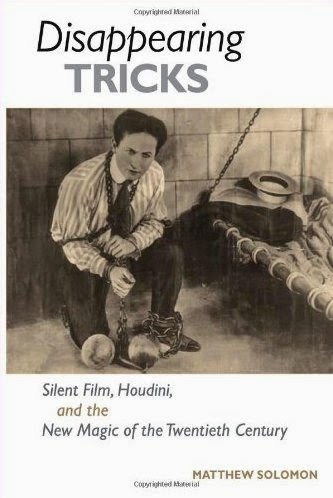
In his new book, Disappearing Tricks: Silent Film, Houdini, and the New Magic of the Twentieth Century, Matthew Solomon shines a spotlight on Houdini’s film work as never before. In doing so, Solomon has made several discoveries that rewrite Houdini film history.

First and foremost is the discovery that Houdini’s first stab at narrative film was not the 1909 short The Adventures of Houdini in Paris (more on this later), but a lost film from 1906 entitled Houdini Defeats Hackenschmidt.

The title refers to George Hackenschmidt aka “the Russian Lion,” a popular wrestler whom Houdini befriended in the UK. The Houdinis and Hackenschmidt became great friends, and Houdini even proposed bringing the wrester to the U.S. under his management.

Houdini Defeats Hackenschmidt was shown during Houdini’s engagement at Keith’s Theater in Boston in March 1906. While nothing is known about the content of the film, Soloman suggests in his footnotes that Houdini’s “defeat” of the famous fighter could have been financial instead of physical. Houdini took pride in the fact that his box office receipts of £300 eclipsed the £210 record set by Hackenschmidt in Sheffield. If this were the case, it could explain Keith’s management's private assessment of this latest Houdini attraction as merely “fair.”

Next up is major clarification regarding what had been considered Houdini’s first narrative film, Les merveilleux exploits de Houdini à Paris aka The Adventures of Houdini in Paris. This film has long been attributed as being produced by Pathe -- an attribution that can be traced back to Houdini himself who noted this on a still production photo (below). But it turns out this is not the case.

The Adventures of Houdini in Paris was actually made by Film Lux, a rival to Pathe. While it could be argued that maybe Houdini made an earlier film for Pathe in 1901 (as noted on the photograph), Solomon’s search of the Pathe archives turns up no work with Houdini, and he even nails down the precise release date for Merveilleux Exploits; May 17, 1909.


But why would Houdini attribute this film to Pathe when it was actually made by a rival company? My own speculation is either Houdini made a mistake when he annotated this photo years later (as he did with the date), or Houdini was engaging in his famous habit of rewriting his own history. Pathe clearly emerged as the more successful French production company, even setting up shop in Edendale, California, the first film colony in Los Angeles. It’s likely that Houdini preferred history to record him as working for the more famous company. If this were the case, the ploy worked...until now. Sorry Harry.

(A significant portion of Les merveilleux exploits is included on the 3-disc DVD set Houdini The Movie Star, although it is not identified by name.)

Finally, Soloman clears up what has been an intriguing mystery for many years; did Houdini star in a lost film called The Soul of Bronze?

The U.S. film copyright record lists this film title among Houdinis other work, as do several other sources, including some encyclopedias. Of course, it’s highly unlikely that an entire film, and all the publicity that would have accompanied it, could completely vanish. So what’s the story with The Soul of Bronze?

Turns out that in 1921 Houdini purchased two cases of films from the U.S. customs office in an auction of unclaimed goods. Ken Silverman first discussed this purchase in his excellent biography, Houdini!!! The Career of Ehrich Weiss, noting that Houdini would re-edit and attempt to distribute one of those films, The Mystery of the Jewell, through his Mystery Pictures Corporation.

But Soloman reveals that there was another film in this acquisition -- a 1917 french film entitled L’ame du bronze. Yep, The Soul of Bronze. Houdini copyrighted both these films as his own, hence, the unreleased The Soul of Bronze appears as a “Houdini film” in the official record. Mystery solved.

Disappearing Tricks: Silent Film, Houdini, and the New Magic of the Twentieth Century by Matthew Solomon is available now in paperback from Amazon.com. A hardcover will be released on February 15.

Translate