Monday, September 8, 2014

Houdini takes the ALS Ice Bucket Challenge

It looks like Houdini has been called out by his friend Charlie Chaplin to take the ALS Ice Bucket Challenge. This is pretty great.


In case you're wondering, the front clip is from The Master Mystery and the water wheel is from Haldane of the Secret Service. Always thought this water wheel escape was pretty harrowing as that really is Houdini on the wheel.

Thanks to @rj32 on Twitter.

Channel 4 shows extended 'Houdini' in UK

Viewers in the UK had to wait an extra week to see Houdini, but it looks like they are getting something special in return. Channel 4 is showing the full extended version of the miniseries, which will only be released here in the U.S. on DVD October 8. What's interesting is this extended edition includes a disclaimer on the front which reads:

"What you are about to see is FACT... It is also FICTION... We defy you to tell the difference."

A somewhat arrogant disclaimer (and I think we met their challenge), but at least it's a disclaimer! HISTORY might have mitigated some of the intense criticism it received had they left this on the U.S. broadcast version.

Our friend Narinder from the UK also tells of a scene, following Harry's proposal, in which Bessie's mother slaps her and shouts, "You married a jew!" This certainly wasn't in the U.S. version, and that's too bad because it helps explain Bess's later remark about being, "a dumb girl who married a jew", which I criticized in my review.

Looks like it may be necessary to do a re-review of the miniseries when the Extend Edition is released here in the U.S. next month. Some of my other criticisms may need to be reassessed.

And to fact check the Bess/mother scene -- per the filmmakers "defiance" to do so -- it is true that Bessie's mother threw her out of the house after she married Harry and refused to speak to her for years. Although all parties later reconciled, and Balbina Rahner became a regular fixture at 278, delighting in the magic Houdini would do at the dinner table. (Read: Marie Hinson remembers her sister Bess Houdini.)

Enjoy Part II next Sunday, you lucky Brits!

Thanks to Narinder Chadda and Mick Hanzlik for the UK intel. Your spy work is worthy of Fake Harry.

Sunday, September 7, 2014

History, Houdini, and the blogosphere


Like the Tony Curtis movie in 1953 and The Great Houdinis in 1976 (not sure anyone noticed the 1998 TNT film), HISTORY's Houdini miniseries has received a serious drubbing in the magic world, and especially among Houdini bloggers. While many agree the film was well made from a technical standpoint, and even the questionable casting of Adrien Brody seemed to have won over viewers in the end, it was the amount of historical inaccuracies (and flat out fictions) that doomed Houdini for many. Below are links to a few reviews on the major Houdini websites:


Even though I gave the miniseries a pretty rough review here, I don't think it quite deserves some of vicious criticism it's getting. It isn't the worse Houdini movie ever. Had they gotten the facts of his early success even remotely right and cut all that bogus spy stuff, I would have stayed on-board and ranked this miniseries pretty high. (As is, I put it somewhere in the middle of the pack -- waiting on the extended edition before I decide).

But I do agree with the overall sentiment that a channel which calls itself HISTORY should have made more of an effort to get the facts right (or close to right). At the very least, they should have included a disclaimer on the front telling viewers what they were about to see was a mix of fact and fiction. This is what ABC put in front of The Great Houdinis in 1976, and that was a responsible and respectful thing to do. But I guess ethics in television aren't what they once were. (Is it a pipe dream to think, owing to the negative reaction, that they might now add a disclaimer to the DVD?)

Disclaimer on the front of The Great Houdinis (1976).

As to fears that this is now what people will believe about Houdini... I don't know. This isn't like 1953 and 1976, or even 1998. We now have a powerful way to strike back and get the real story out to people who care enough to look for it. My blog and Fact Checks have received hundreds of thousands of hits since Houdini first aired, and I'm sure Tom, Kevin, David and Dean have experienced a similar surge in traffic. And if you look at the HISTORY Twitter and Facebook pages, there are people taking the network to task. This is really the first major Houdini movie that’s had to contend with social networks and established Houdini blogs, and that’s a good thing. Perhaps HISTORY will now spend a little more time worrying about how accurately they are presenting our history. Or maybe that's just another pipe dream.

#HOUDINItruth

Ragtime's first Houdini in fatal crash

Here's some tragic news. NBC reports that Chicago actor Bernie Yvon, who played Houdini in the first National Tour of Ragtime in 1998, had died in a fatal car crash in Northwest Indiana.

Yvon, 50, was on his way to rehearsal at a theater in Munster where he was scheduled to perform in Women On The Verge of a Nervous Breakdown, set to open next week.

General Manager of Theatre at the Center, Richard Friedman, said, "This is a tremendous loss of a fantastic performer and treasured colleague. Bernie made everyone he met feel better about life and every audience member who saw Bernie's work was fortunate to be entertained by a masterful artist."

'Houdini' airs tonight in the UK

Just a reminder that Part I of the Houdini miniseries airs tonight in the UK at 9pm on Channel 4. Part II airs next week at this same time.

Peter Iacono, Managing Director, International TV and Guy Avshalom, COO Lionsgate UK said "Houdini is the kind of premium programming that epitomizes the Lionsgate TV slate. We believe that Channel 4 is the perfect home for this television event, and we expect it to resonate with audiences in the UK."

The UK DVD is now available for pre-order on Amazon.co.uk (cover art pictured). The release date is October 6, a day before the U.S. release. However, it's unclear if this will be the extended edition.

Thanks to Paul Zenon.

Saturday, September 6, 2014

Houdini DVD now 45% off at Amazon

You didn't really think I was going to take a break, did you? Psych!

Okay, I am trying to spend a weekend free of the Handcuff King, but I just had to peek my head out and let you know that today would be an excellent day to pre-order the 2-disc extended edition Houdini miniseries on DVD, if you haven't already. It is currently discounted 45% at Amazon. Amazon discounts fluctuate and discounts this low don't last, but when you pre-order, you lock in that discount. And if the price goes ever lower, you'll get that lower price.

And, remember, this version has 26 extras minutes, so we might learn all kinds of new things about Houdini that we didn't know. (Come on vampires!)

Here's the new official DVD trailer from the good folks at Lionsgate and Click Communications.


Pre-order the 2-disc extended edition DVD of Houdini at Amazon (remember, when you purchase using my links, you help out WILD ABOUT HARRY).

Friday, September 5, 2014

Taking a rest

Harry is all tuckered out from his spy work and secret servicing Lady Butler, so he'll be taking a break this weekend in his Brooklyn mansion. But I expect he'll be back to his old self when he and I return next week with news of the next big Houdini event of 2014.


"Hell of a way to make a living."

Thursday, September 4, 2014

What is the best Houdini biography?

With the Houdini miniseries having aired this week in the U.S. (and in the UK this weekend), my blog has seen a massive increase in traffic. Many have discovered WILD ABOUT HARRY for the first time, and I welcome you! Most have come searching for more information on Houdini, and several have asked me via email what I consider the best Houdini biography.

I consider the best Houdini biography to be Houdini!!! The Career of Ehrich Weiss by Kenneth Silverman. For me it's the book that best succeeds in separating fact from fiction. Published in 1996, it is now out of print, but you can still find copies on Amazon at reasonable prices. So if you want to go beyond the movie get into the real life of Houdini, start your journey right here.


Below are links to posts I've made discussing the contents and merits of the other major biographies of Houdini:

"This book is full of lies" (Houdini His Life Story)
The gateway biography (Harry Houdini Magician Extraordinary)
The first great Houdini biography (Houdini The Man Who Walked Through Walls)
An alternative gateway (Houdini Master of Escape)
The textbook (Houdini The Untold Story)
The Brandon book (The Life and Many Deaths of Harry Houdini)
Unmasking The Secret Life of Houdini (The Secret Life of Houdini: The Making of America’s First Superhero)

If there's another Houdini book that you feel is even better than Silverman, please share your candidate for Best Houdini Bio in the Comments below.

LINK: Houdini, My Father and Me

In my review of the Houdini miniseries, I certainly had some things to say about screenwriter Nicholas Meyer's work. So I thought it only fair to share Meyer's own thoughts on Houdini and his approach to the writing the miniseries. This is an article he wrote for the The Jewish Daily Forward late last month. Read by clicking the headline or link below.

"There is unsubstantiated speculation that he also toiled in the clandestine world of espionage on behalf of the United States and Great Britain. Like so much of his mythopoesis, the Italian expression se non è vero è ben trovato ("even if it is not true, it is well conceived") seems to apply."
- Nicholas Meyer

Wednesday, September 3, 2014

REVIEW: History gets a C- in Houdini

The Houdini miniseries is a strange confection of fact and fantasy that is stylish and breezy enough to be entertaining to general audiences, but will disappoint and confound anyone with even a basic understanding of the real life of Harry Houdini.
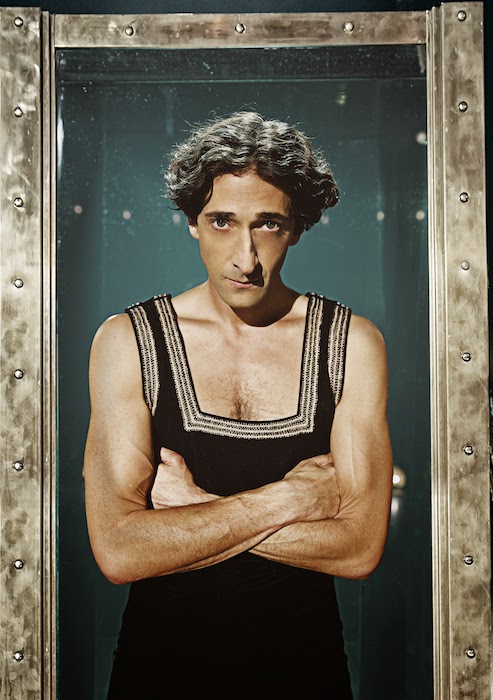
Houdini star Adrien Brody.
Anyone who has spent any time reading this blog knows that I am forgiving to a fault about inaccuracies in Houdini biopics. I love the 1953 Tony Curtis Houdini movie, despite the fact that Houdini biographer Milbourne Christopher correctly pointed out that, "If any phase of Houdini's life is shown on the screen you can be sure it didn't happen the way it's pictured." My favorite biopic is The Great Houdinis (1976), even though it invents a family triangle that made David Lustig, who knew Houdini personally, "feel nauseated."

I don't have a problem with these movies. Because at the end of the day, they still adhere to the basic superstructure of Houdini's life and career. Their dramatizations do not really change anything that is vital to our understanding of the Houdini story. A basic summary of these biopics will still give you the story of Houdini. That's because they had screenwriters who did their research, and even though they had to work within the Hollywood machine, and create conflict and drama, they showed respect for the notion of a biopic and respect for Houdini.

Screenwriter Nicholas Meyer is a hero of mine. He wrote what I consider to be the best Sherlock Holmes novel, The Seven-Per-Cent Solution. He wrote and directed the best Star Trek movie, Star Trek II: The Wrath of Khan. And don't even get me started on the awesomeness of Time After Time and, yes, I even kinda LOVE Volunteers. So when I heard he was writing the Houdini biopic, I was very excited. Sure, it would have fictionalizations, but that's the nature of the medium, and like the screenwriters who came before, Meyer would find a balance. I spent a better part of a year pre-explaining this.

Screenwriter Nicholas Meyer.
Well, it kills me to say that if any screenwriter can and should be sued for malpractice, it is Nicholas Meyer for his work on Houdini (at least in the first night). Meyer's script is not "artistic license," it's negligence, and at times Houdini is so bad it's actionable (I will explain later). When Houdini's life doesn't fit his fictions or lazy assumptions, he changes the life. How, when, and where Houdini finds fame and success -- a key component in the life story of any entertainer -- is completely thrown out the window for a version that is straight out of Meyer's imagination. Here, Houdini rockets to worldwide fame via a single "Johnson County" jail break in 1896. That's it. No Martin Beck. No trip to Europe. No Alhambra debut. No Scotland Yard challenge. Houdini springs fully formed (complete with Water Torture Cell) and is already the "most famous man in America" by 1900. This is so far from the truth it's shocking.

Now, I don't think I'm being nit-picky here. I'm not counting rivets on the Milk Can. I'm talking about something that is as fundamental to the story of Houdini as Pearl Harbor is to a story of World War II. Some things you cannot change, and it doesn't matter if you're the guy who made Star Trek II. Doing so shows a brazen disrespect for the subject and for the audience, and you will lose the world's most forgiving and supportive Houdini fan -- me.

Meyer's other offenses are more fundamental and just plain sloppy. He misspells Houdini's real name as Erich (it's Ehrich). He portrays a deep rift between Ehrich and his father, but never explains it. He presents the Water Torture Cell as Houdini's first major escape ... in 1900! Not just horrendously wrong, but it effectively erases the entire progression of Houdini's art and career. He places Houdini's home in Brooklyn instead of Harlem, seemingly for no reason other than personal taste? Houdini was a cinema pioneer. Meyer makes him a cinema holdout. Houdini was a famous teetotaler. Meyer shows him drunk. Houdini created an act and an identity for his brother as Hardeen in 1900. Meyer shows Hardeen performing successfully in the 1890s while Houdini is still struggling to make his own name. What kills me is Meyer just seems to take the approach that the truth doesn't matter. The truth is what works for him at the moment. The entire thing feels lazy, arrogant, and even amateur.

But it soon becomes clear why Meyer so badly mangles the facts of Houdini's early life, and to be fair, he may have been forced into this by producer Gerald W. Abrams, who bears as much responsibility for what we see here as Meyer. Because at minute 40, Washington D.C. comes a'calling and sends Houdini off to Europe as a secret agent! Now, this 2006 theory that Houdini did "spy" work for the U.S. and UK is HIGHLY dubious (and more so with each passing year of total silence on the subject from the authors who first proposed it) and should never have been included in something that purports to be a biopic. But Hollywood cannot resist a spy movie, and it dominates Night One. Suddenly, Houdini's career is sidelined and the miniseries turns into "Harry Houdini of the Secret Service," with Brody taking orders from "M" (get it?), running across embassy rooftops, and using his magic act only as a "cover." What was that about feeling nauseated?

Once the floodgates have been opened, more fictionalizations come pouring forth, supplanting real events in Houdini's life that would have provided much better drama. Instead of standing trial in Germany and proving himself by performing escapes in a courtroom (as really happened), Meyer substitutes a scene of Houdini doing a bullet catch for the Kaiser (never happened). Instead of his dramatic escape from the Siberian Transport Prison Van in Russia, we get a magic performance for the Royal family and a disapproving Rasputin (who, by the way, would not arrive on the scene for another two years). We also get to see Harry having a kinky affair with British painter Lady Butler which, of course, is pure kinky fiction. This all threw me so badly that I found Night One pretty hard to watch, even though it was nice to see things like Houdini's aviation career finally included in a Houdini movie (notice I didn't use biopic).

However, as I said, much of Meyer's machinations are so the silly spy elements will fit the narrative. This is why Night Two, which is finally free of the spy element (thank you, World War I!) is MUCH better. In fact, Night Two shows us what could have been, and goes a long way toward redeeming the disaster of Night One. Sure, artistic license and time compression are employed, but there finally seems to be an effort to tell Houdini's story accurately and respectfully. Meyer even resists the temptation to go directly from Mama's death (incorrectly dated as 1914 -- a year Meyer assigns to just about everything) to spiritualism, and therefore is able to give Houdini's movie career its due. This is the first time any biopic has done so and what a joy to see Harry and Bessie sitting in a Hollywood screening room watching The Grim Game with Brody dangling from the plane.

The best scenes in the miniseries are among the last -- Houdini's death in Grace Hospital in Detroit. Here the actors finally get to play dramatic scenes without the incessant voice over and hyperactive editing effects (more on that later). Houdini's bedside conversation with his doctor is right out of real life. The details of Houdini's death, while dramatically time compressed, are largely accurate. Houdini does not die in the Water Torture Cell in HISTORY's Houdini, which is a first. This shows that Meyer did do his research and, yes, might even care. And if you've made it to the very end without throwing a shoe through your TV screen, there is real footage of Houdini's graveside funeral that has never been shown before, including a look at the large "Mother Love" floral arrangement. Wonderful.

Meyer also has his moments of brilliance. After failing to seduce Houdini in his hotel room, Margery, nicely played by Megan Dodds, turns to him and says, "When you die, we will make you say whatever we like." That's a great piece of dialogue and shows just how good a Houdini biopic can and should be. I just wish whatever hand guided this second night was present during the first.

Producer Gerald W. Abrams.
Stylistically, Houdini is a very mixed bag. Producer Gerald W. Abrams said his inspiration was the Robert Downey, Jr. Sherlock Holmes (oh, why could it not have been Boardwalk Empire?). So Houdini strains to ape director's Guy Ritchie's filmmaking style with hyperactive speed ramping and frenetic editing. This works well ... when it's done by Guy Ritchie. It doesn't work here. It feels desperate, dated, and distracting. So does much of John Debney's bombastic score. Also, the entire 4 hour miniseries (3 without commercials) uses Harry's voice over to explain motivation and make transitions. There's some nice dialog in here -- "Most people escape life, I escape death" -- but voice over is a lazy narrative device that generally works to keep the viewer removed from the drama. It all feels like exposition. You keep waiting for the real story to start. Superimposed titles are used throughout to locate the action, yet not a single one is accurate. Why use locators if they are not identifying something real? It's just all part of the masquerade of a biopic.

The beautiful breakout talent of Kristen Connolly (House of Cards) is criminally under-used as Bess. Meyer writes Bess as somewhat dim and present largely to nag Harry into doing things like giving up his escape career (which, of course, never happened). At one point she even blurts out, "I'm just a dumb girl who married a Jew." This is a horrendous thing to put into Bess's mouth and disrespectful to her memory. Nevertheless, Connolly is still able to punch her way through this surprisingly chauvinistic script and deliver a feisty, funny, and very likable Bess. She also delivers heartbreakingly honest moments, such as the aforementioned scene when she talks Houdini out of performing escapes, and her death bed scene with Brody is perfection.

Speaking of the women in Houdini's life, call me crazy, but is there a weird sexual energy between Mama, played by Eszter Ónodi, and her son from their first scene to their last? More than once an object of Harry's sexual interest morphs into his mother. And mama's fixation on her son, both in human and spirit form, comes off as downright creepy. Is this the unstated problem between Houdini and his father? Even the official press material teases: "Houdini and his mother Cecelia had a close and loving relationship, some would say too close." Hmmm... Let's change the subject.

Magic! The magic and escapes in Houdini are beautifully recreated and staged, especially the cannon escape, and Houdini could only wish his own Vanishing Elephant was as effective as it is here. Kudos to technical advisor David Merlini. But its also here that Houdini commits its worst offense, and this is no joke. Houdini freely and cavalierly exposes secrets for no plot reason whatsoever. And these aren't small tricks: Metamorphosis, the Milk Can, the Bullet Catch, Walking Through A Brick Wall (although in this case it does serve the narrative and I would give it a pass). This is the first Houdini biopic to cross this line, and it's a shame to see cinema betray the art that was part of its birth. This is especially distressing as Adrien Brody started out as a magician and still has a deep interest in the art of magic. You'd think the Oscar winner could have had some say in stopping this. I'm hoping that the S.A.M., IBM, and AMA officially condemn this miniseries for this serious transgression.

On the topic of actionable issues, while the movie credits as its source Houdini: A Mind In Chains by Bernard C. Meyer (screenwriter Nicholas Meyer's father), it clearly isn't. There's nothing here about Leo and Sadie Weiss which is key to the Meyer book. Instead, Houdini is clearly adapted from The Secret Life of Houdini: The Making of America's First Superhero by William Kalush and Larry Sloman. Houdini's "spy" activities and Bessie's marijuana use (sigh) are only found in the Kalush/Sloman book. And there are dozens of other examples. Possibly the inclusion of Lionsgate as a producer means some kind of deal was made to use this exclusive material (they acquired the book when they bought Summit Entertainment in 2012), so maybe the only offense here is that on-screen credit was denied Kalush and Sloman so it could be given to the screenwriter's father. But this just adds to an overall feeling that something untoward is going on at the screenwriting level.

Okay, the script has problems, but what about the other aspects of the film, Mrs. Lincoln? Well, that is also a heartbreaker, because the technical work on Houdini is simply breathtaking! Shot entirely in Budapest, Houdini had a talented crew who clearly gave it their all. Costume and production design by Patrizia Von Brandenstein is phenomenal. The almost 300 special effect shots give the movie scale and scope. Uli Edel did a find job directing, and all the supporting cast deliver excellent performances. Even Adrien Brody, a poor physical match for Houdini, delivers a pitch perfect performance and projects a charisma that he surely shares with The Handcuff King. He's a great Houdini.

In fact, if you make your peace with the inaccuracies and watch this as Houdini fiction -- a tale told by an unreliable narrator "with just enough truth to make you believe the lies" -- it can be very enjoyable indeed. And I think it will be just that for general audiences. Because it's possible that I'm now Milbourne Christopher, watching the Tony Curtis movie and finding it impossible to see the value of something that doesn't follow the facts. And it's also just as possible that there is a 10-year-old version of me out there who will watch this miniseries, as I watched the Curtis movie, and find themselves captivated by the story of Houdini and will want to discover for themselves the truth of this amazing man. And in that way, this modern version of Houdini might just be magical after all.

Thank you and goodnight.

Read my Fact Checks of NIGHT ONE and NIGHT TWO. Houdini will be released in an extended edition (26 additional minutes) on DVD and Blu-ray on October 7.

LINK: Inside the Houdini-Industrial Complex

While we are all still discussing HISTORY's Houdini miniseries (and I'm scrambling to get my full review up in the next hour), it's worth taking a time out to read this article by Rachel Shteir in Salon about the current state of the "Houdini-Industrial Complex" (love that). You'll see a few familiar names quoted.


Tuesday, September 2, 2014

Fact checking HISTORY's Houdini - Part Two


Part One established HISTORY's Houdini as the least accurate Houdini biopic ever made. However, the miniseries redeemed itself in Night Two which, finally free of the silly spy movie narrative, was able to focus on the events of Houdini's real life and even right some wrongs of earlier biopics. For those who'd like to separate fact from fiction, we continue our fact check of HISTORY's Houdini.

Was Houdini's brother also a magician and escape artist?
Houdini was very close with his younger brother Theo a.k.a. Dash. In November of 1900, Houdini invited Dash to come to Europe where he set him up with a complete act and named him Hardeen. The idea was for Dash to take bookings in theaters and circuits that Houdini didn't play, and the brothers could effectively shut out the many cheap imitators of the escape act. This worked well and Hardeen established himself as a popular and credible escape artist in his own right. While the brothers sometimes posed as "rivals" for the press -- and might have had a few moments of genuine competition -- they were not rivals as shown in the miniseries. Dash left show business to run Houdini's film developing lab in New Jersey in 1916. After Houdini's death in 1926, Hardeen inherited his brother's props and resumed his magic career until his own death in 1945. (Read: Houdini vs. Hardeen in Oakland.)


Did Houdini do his first suspended straitjacket escape in San Francisco?
Houdini's first suspended straitjacket escape was in Kansas City on September 8, 1915. He then did the escape in many cities across the U.S., including San Francisco. Houdini would typically do the escape in front of newspaper offices, and would attract crowds numbering in the tens of thousands. It's become one of his most iconic escapes. (Read: Uncovering Houdini's 1915 Los Angeles straitjacket escape.)

Did Houdini give up doing escapes for his wife Bess?
While Houdini would sometimes comment to reporters how his wife would like him to give up his dangerous work, there is no evidence that this was an actual issue in their marriage, and Bess was fiercely supportive of her husband in all his career endeavors. Houdini never stopped doing escapes.


Did Houdini make an elephant disappear?
Houdini performed his Vanishing Elephant during a record-breaking engagement at New York's Hippodrome Theater in 1918. But unlike in the miniseries, Houdini vanished his elephant in a gigantic box made to look like a circus wagon. Houdini later revived the illusion using a smaller elephant for live appearances at the Time Square Theater to promote his film, The Man From Beyond. How exactly Houdini made his elephant vanish is still debated today. (Read: 100 years ago Houdini vanished an elephant.)

Did Houdini walk through a brick wall?
Houdini did indeed walk through a brick wall in July 1914, although he performed the illusion at Hammerstein's Roof Garden Victoria Theater in New York, and not in London as shown in the miniseries. Houdini only performed the effect for a short time before turning it over to his brother Hardeen. Yet it left such a strong impression that he is still called "the man who walked through walls" today. As to whether the method shown in the miniseries is the correct one... I'm not saying. (Read: When Houdini walked through a brick wall.)


Was Houdini devastated by the death of his mother?
It's true that the death of his mother in 1913 (not 1914) devastated Houdini. However, the direct connection of his mother's death and his involvement in spiritualism is not entirely accurate. Houdini had an interest in spiritualism from the start of his own magic career, and his crusade against fraudulent mediums did not begin until 10 years after his mother died. Although the possibility of contacting his mother was always on Houdini's mind. (Read: Mama's death and the birth of a myth.)

Did The Houdinis perform as spiritualists early in their careers?
It is true that Harry and Bess worked briefly as spiritualists, and it's said Harry even called out the identity of a murderer from the stage one night. (The man jumped up and fled the room.) The parents who confront the Houdinis backstage are based on a mother who did accuse Houdini of black magic when he predicted that her son would fall from his bicycle and break his arm. Houdini had earlier seen the mother scolding the boy for riding recklessly, and prediction had inexplicably come true. After this, Houdini gave up the spiritualism act. (Read: Meet the Robinsons.)


Did Houdini star in silent movies?
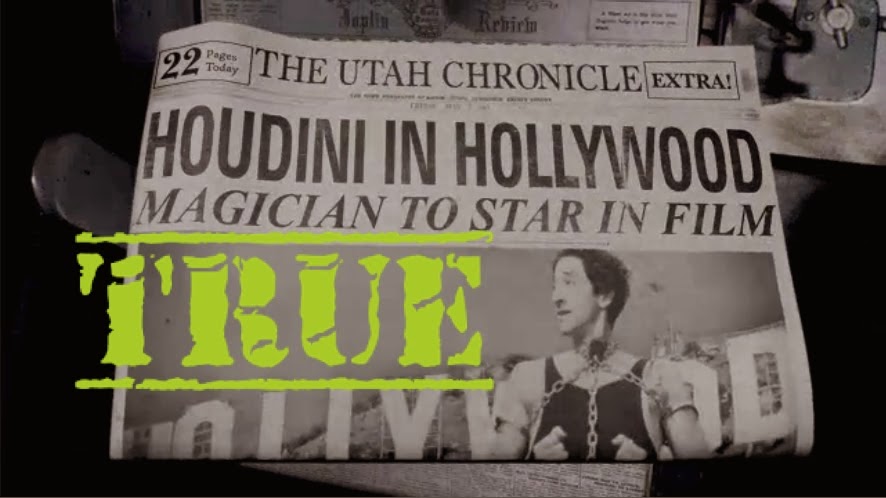
Houdini did indeed have a career in silent movies between 1918 and 1923. He made a successful 15-part serial called The Master Mystery; two feature films for Famous Players-Laskey Paramount, The Grim Game and Terror Island (the clip we see in the miniseries is actual footage from The Grim Game); and two films for his own production company, The Man From Beyond and Haldane of the Secret Service. He also owned and operated a motion picture film lab in New Jersey. The Houdini miniseries is the first biopic to acknowledge Houdini's film career. (Read: Houdini's rough ride at Niagara Falls.)


Was Houdini ever tied to a cannon?
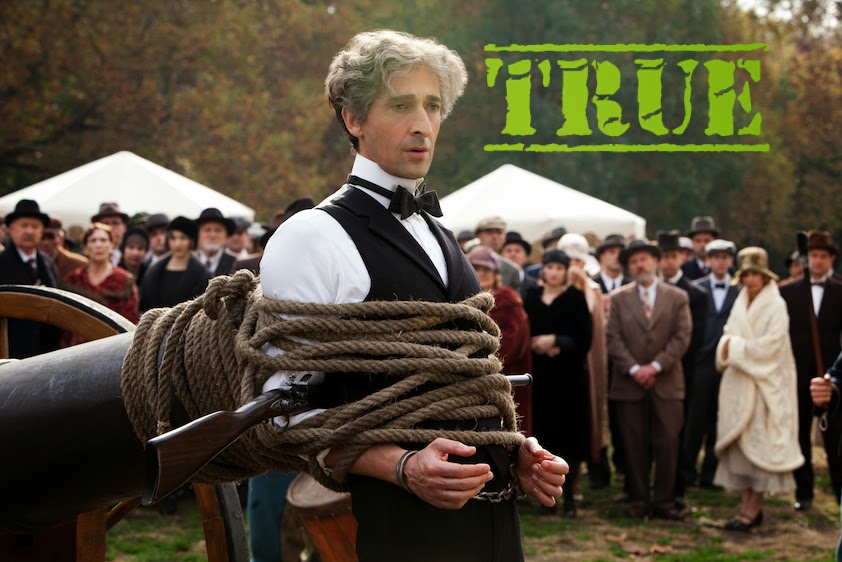
Houdini was bound to a cannon in almost exactly the manner as depicted in the miniseries (kudos to technical advisor David Merlini) on two occasions. The first was in England in 1911 when he was challenged by the Royal Navy. The second was in Los Angeles' Pershing Square in 1919. During this second challenge, authorities stepped in and would not permit the cannon fuse to be lit. (Read: Houdini's Cannon Challenge.)


Did Lady Doyle give Houdini a seance in which she contacted his mother?
It is true that in 1922 Sir Arthur and Lady Conan Doyle gave Houdini an automatic writing seance that supposedly contacted his mother. In fact, the words Lady Doyle speaks in the miniseries is largely verbatim. It's also true that Houdini did not accept the seance as legitimate. The three tells were that his mother's spirit made the sign of the cross (she was Jewish), wrote in English (she spoke German), and there was no mention that the day before was her birthday (not Houdini's birthday as shown in the miniseries). This seance was the beginning of the end of Houdini's friendship with Sir Arthur Conan Doyle. (Read: The Mama message.)

Did Houdini crusade against fraudulent mediums?
It is true that during the final years of his life Houdini exposed fraudulent mediums, both on stage and by going to seances in disguise. He also employed a small "secret service" of investigators who would go to seances on his behalf and bring back information. He testified in front of Congress in support of a bill to outlaw fortune telling in the District of Columbia. He published a book on his investigations called A Magician Among The Spirits. (Read: Houdini, the Hillstreet, and the birth of a ghostbuster.)

Did Margery try to seduce Houdini in his hotel room?
While Mina Crandon a.k.a. "Margery" fostered intimate relationships with some members of the Scientific American committee that investigated her in 1924, there is no evidence that she ever tried or even had the opportunity to seduce Houdini. Of her well recorded charms, Houdini said, "Her applesauce means nothing to me."

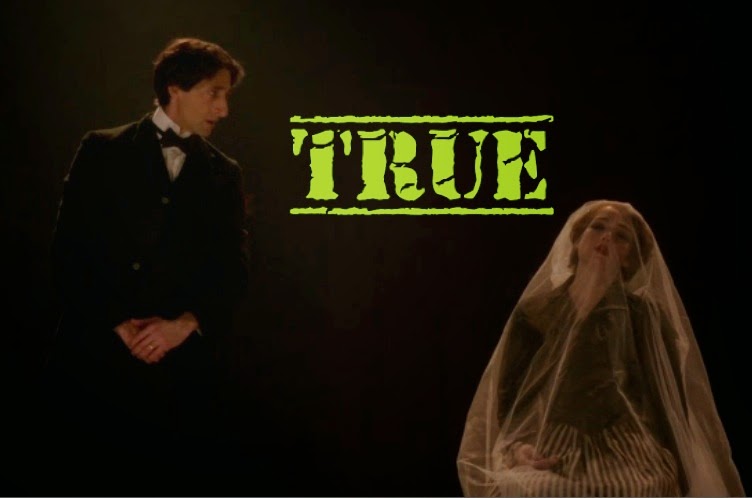
UPDATE: In the new book The Witch of Lime Street: Seance, Seduction, and Houdini in the Spirit World, author David Jaher reports that Margery did indeed attempt to seduce Houdini when she allowed the magician to take a nap in her son's bedroom. (Read: Houdini and Margery in the apple orchards.)

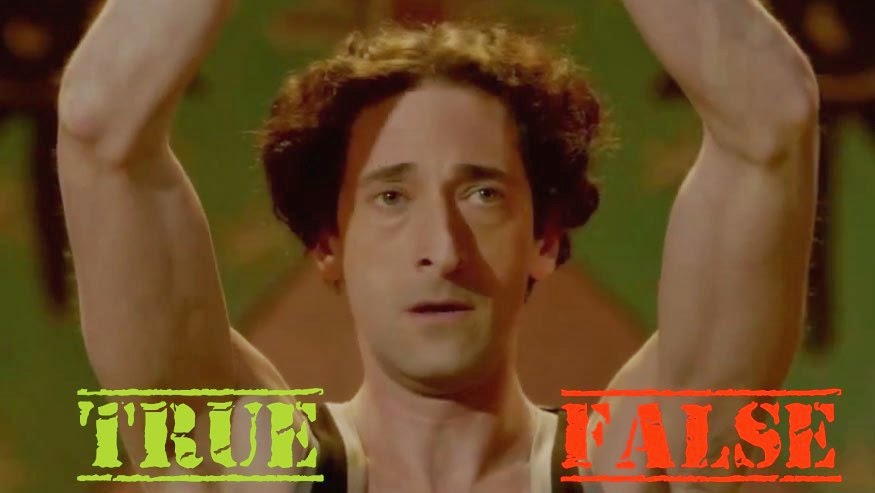
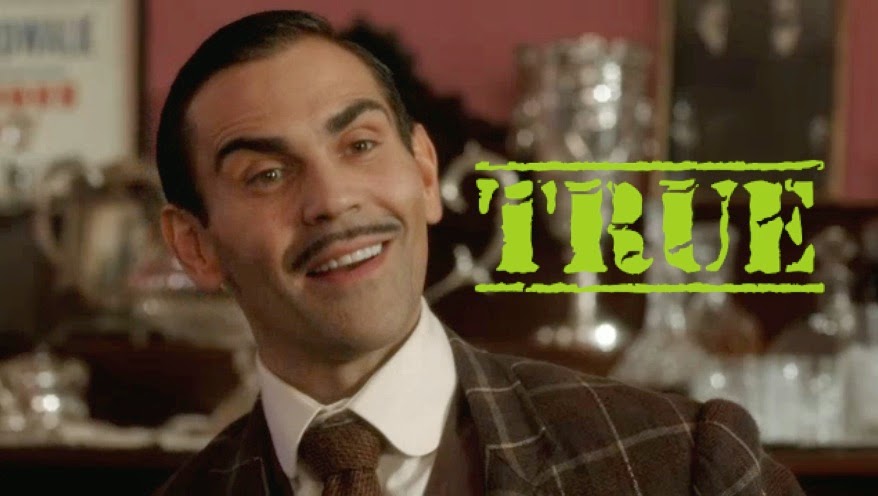
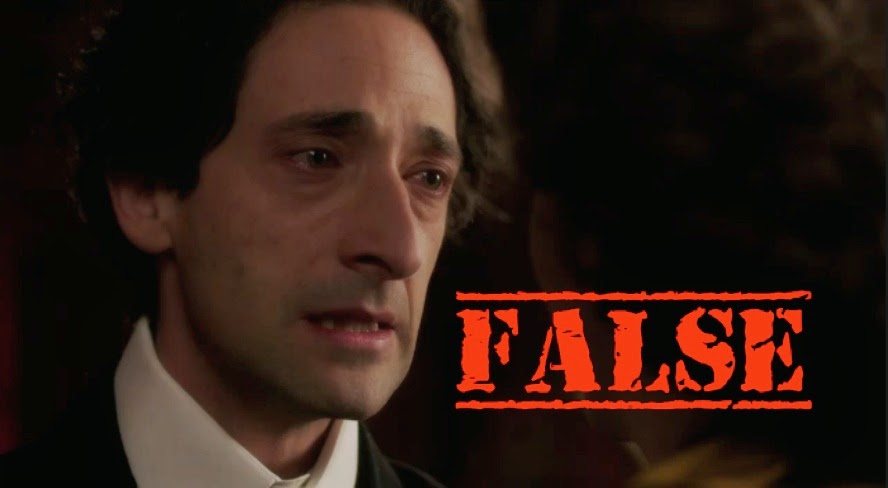
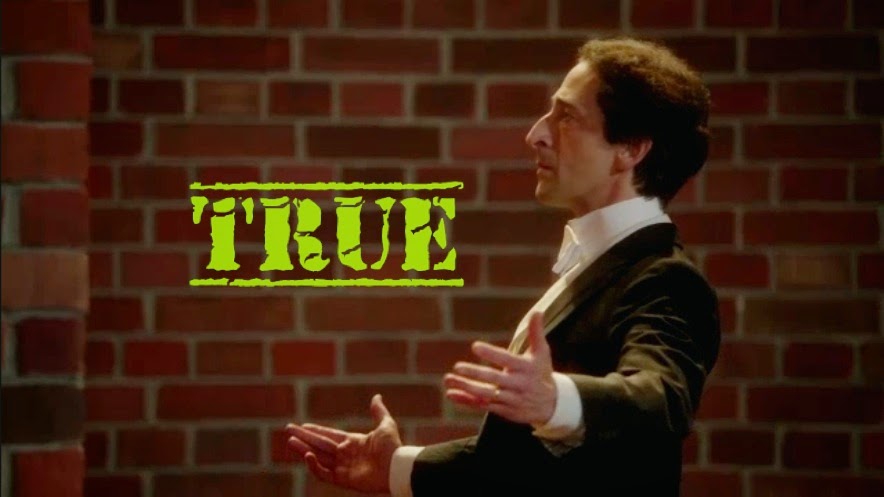
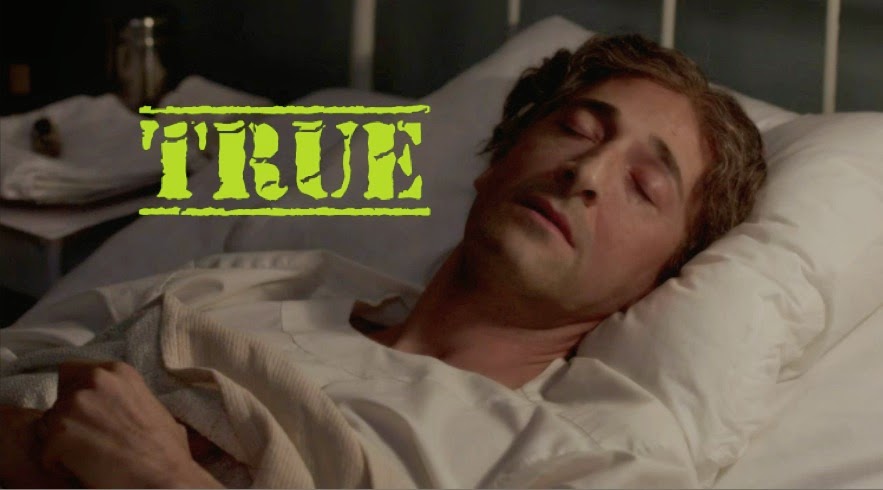
UPDATE: TRUE!

Did Margery put a curse on Houdini?
Following her exposure, it was widely reported in the press that Margery had put a "curse" on Houdini. Margery denied it and blamed Houdini for planting the story himself (which he almost certainly did). However, private correspondence shows that, during a seance, Margery's spirit guide Walter predicted that Houdini would die on December 25, 1925. Houdini survived the prediction by 10 months. (Read: Margery's curse.)

Did Houdini break his ankle in the Water Torture Cell?
It is true that Houdini broke his ankle while being raised from the stage during a performance of his Water Torture Cell at the Capitol Theater in Albany NY on October 11, 1926. Unlike what's shown in the miniseries, he did not continue with the escape, but was tended on stage by a doctor. Houdini cut the USD from his show and never performed it again. He died 20 days later. (Read: Houdini's Water Torture Cell accident.)


Did Houdini invite people to punch him in the stomach?
This has become an ingrained part of Houdini lore and is shown many (many!) times in the miniseries, but there is scant evidence that Houdini invited people to punch him in the stomach throughout his life. The first record of such a punch/challenge was a week before his death during a lecture at McGill University. This may have inspired the later punch in his dressing room that would prove to be so damaging. (Read: The Pickleman punch.)

Was the man who punched Houdini a supporter of spiritualism?
While Houdini historians love to debate the motives of J. Gordon Whitehead (named "Kelly" in the miniseries), the two eyewitnesses to the infamous dressing room punch did not indicate that there was any talk about spiritualism, and Whitehead did not scream out any accusations. The official record says that Whitehead asked if it was true Houdini could take a blow to the stomach, and then set about hitting him before he was ready. Even Houdini said it was an accident. However, Whitehead's later life revealed that he had tangential connections to the spiritualism movement and also suffered mental problems. He died in 1953 after living many years as a hoarder. (Read: Is this J. Gordon Whitehead at McGill in 1926?)


Did Houdini collapse on stage during his final performance?
Houdini actually made it through his entire final performance at the Garrick Theater in Detroit on October 24, 1926. Despite having a ruptured appendix and a 104 degree temperature, he concealed his illness from the audience (although some said they could tell something wasn't right). Even after the show, Houdini still refused to go to the hospital. He returned to his hotel and only after having a phone conversation with his own doctor in New York did he allow himself to be taken to Grace Hospital. (Read: 85 years ago: Houdini at the Garrick.)

Did Houdini die on Halloween?
Houdini did indeed die in Room 401 of Grace Hospital in Detroit on Halloween of 1926. The bedside conversation we see Houdini having with his doctor about being a "fake" is also true. Houdini died with his brother Theo (Hardeen) by his bedside at 1:26 p.m. (Photos of the hospital room here.)


I hope you found this Fact Check of HISTORY's Houdini helpful. If there's anything I didn't cover, please ask in the Comments below and I will answer you there. I will be posting my full review of the Houdini miniseries tomorrow.

#HOUDINItruth

'Houdini' conjures 3.7 million viewers

While we review the facts (and fictions) of Night One, HISTORY and A+E Studios are focused on the fact that matters most to them -- Houdini pulled in a lot of viewers! Here's a press release:

HOUDINI MESMERIZIES 3.7 MILLION VIEWERS

Part One of HISTORY’S® Miniseries Event Starring Academy Award Winner® Adrien Brody

is Cable’s Top Miniseries Premiere of the Year and History.com’s Best Movie Premiere of 2014


NEW YORK, NY – September 2, 2014 –Part one of HISTORY’s miniseries event HOUDINI starring Academy Award® winner Adrien Brody as The Great Harry Houdini, mesmerized 3.7 million Total Viewers last night, making it cable’s number one miniseries premiere of 2014. HOUDINI, which follows the epic tales of the master escape artist as he emerges as the world’s first bonafide superstar, also averaged averaged 1.5 million Adults 25-54 viewers and 1.2 million Adults 18-49 viewers in its 9:00pm time period, according to Nielsen Fast Cable Ratings.

At History.com, HOUDINI ranks as the site’s best scripted premiere of 2014 for visits, and top three of all time, trailing only The Bible and Hatfields & McCoys (source: Adobe Analytics).

Houdini concludes tonight at 9/8c.

Monday, September 1, 2014

Fact checking HISTORY's Houdini - Part One


After one night, HISTORY's Houdini miniseries starring Adrien Brody is on track to be the least accurate Houdini biopic ever made, and that's saying something. Nicholas Meyer's screenplay freely jettisons fundamental facts to make room for complete fictions. (More on that in my review on Wednesday.) Unfortunately, people believe what they see on TV -- especially when the network is called HISTORY -- so here are some points of clarification:

Did Houdini get trapped under the ice of a frozen river?
Even though Houdini himself would tell the story of being trapped under an ice sheet during a bridge jump, there is no evidence that it ever happened, and Houdini would alter the location and details in various tellings. But he never claimed his mother's voice or any supernatural power led him to the opening in the ice. He found his own way to freedom. (Read: Trapped under the ice with Houdini.)


Did Houdini have issues with his father?
Houdini spoke very highly of his father and honored him his entire life. Any suggestion of "daddy issues" is purely speculative. It is true that Rabbi Weiss lost his job in Appleton for being too "old world" (he didn't speak English), and this plunged the family into poverty. The story of him having to flee Budapest after killing a man in a duel was told by all the Weiss children. Some biographers doubt it as being too far fetched, but duels in Hungary were not unusual in the 1870s. (Read: Who was Houdini's father? New insights.)

Did Houdini run away from home and work with a traveling magician?
While it's true that Ehrich Weiss (the miniseries misspells it as Erich - grrrr) ran away from home when he was 12, he did not work with a traveling magician. This is a fiction seemingly lifted from a 1987 Disney movie called Young Harry Houdini. However, it is true that his interest in magic was inspired by the autobiography of Robert-Houdin, and that he took his name from the famous French conjurer. (Read: Homeless Houdini.)


Did Houdini live in Brooklyn?
The Houdini miniseries shows Harry growing up and later buying a large home in Brooklyn, NY. Not true. The Weiss family lived in a tenement in mid-town Manhattan, and Houdini later bought a large brownstone in Harlem. Likewise, the Weiss family plot is located in Queens, not Brooklyn. (Read: Discovering the home of Houdini.)

Did Houdini meet Bess when they were both performers in Coney Island?
While there are several romanticized stories of how Houdini and Bess met, screenwriter Nicholas Meyer opted for the truth here. Houdini did indeed meet his wife Bess at Coney Island while she was performing as part of an act called The Floral Sisters. They had a whirlwind courtship and married only a week after they had met. (Read: When Harry Met Bessie.)


Did Houdini create the challenge handcuff escape act in a brothel?
Houdini worked to perfect his challenge handcuff act over several years, and may have gotten the idea from an Australian magician named Lewis Paul. While Harry and Bess performed in Dime Museums, Beer Halls, Circuses, and traveling Burlesque shows, there is no record of them ever performing in a brothel. Besides, aren't brothels their own entertainment? UPDATE: Turns out this is based in fact. Read: The Houdinis in the bordello.

Did Houdini perform escapes as The Wild Man from Borneo?
While Houdini did briefly appear as "Projea The Wild Man of Mexico" in the Welsh Bros. circus, it had nothing whatsoever to do with his magic or escape act. Harry and Bess took on many side jobs during their travels with the circus. Houdini quit the Wild Man when he got hit in the eye with a piece of meat thrown into his cage by Clint Newton, ringmaster of the Welsh Bros. Circus.. (Read: Freaks of Octoberfest.)

Did Houdini achieve fame after escaping from a "Johnson County" jail in 1896?
Houdini performed handcuff and jail escapes in various cities across the U.S. in the late 1890s, they did not bring him recognition beyond that city. The idea that Houdini was "the most famous man in America" by the turn of the century is wildly incorrect. While he had achieved a measure of success in America by 1900, his true breakout success came in Europe. Houdini did not really become a star in America until his return in 1905. (Read: Houdini at the Colonial.)


Did Houdini do escapes in the nude?
To prove he concealed no keys or lockpicks, Houdini would strip nude and submit to an examination by a doctor during his jail escapes. But Houdini would also sometimes strip nude on stage during handcuff challenges, and even advertised himself as "Positively the only conjurer in the world who strips stark naked." He once even performed his Milk Can escape au naturale. He had a powerful physique and wasn't afraid to show it off. (Read: Ebay auction dates Houdini's first 'nude')

Did Houdini hire a magic store clerk named Jim Collins to create his effects?
Houdini's chief assistant and mechanic was named Jim Collins and he did have a genius for designing magic and escape effects. However, Houdini did not impulsively hire him out of an Ohio magic store, and Collins was not an American from Georgia. Jim Collins was born in England, possibly Portsmouth, and it was there that Houdini hired him to be his assistant. (Read: The man who kept Houdini's secrets.)


Was the Water Torture Cell Houdini's first major stage escape?
The Water Torture Cell was not Houdini's first major stage escape and certainly not invented in 1900 as shown in the miniseries. The USD, as Houdini called it, was the culmination of many escapes that came before it (including the Milk Can) and was first performed in Germany in 1912. Also, the idea that Houdini would be revealed as one of his own axe-wielding assistants at the end is not accurate. This "magical" spin on the Water Torture Cell was first performed by Doug Henning in 1975. (Read: The Chinese Water Torture Cell at 100.)

Was Houdini a spy?
Houdini was friendly with law enforcement and took great interest in the methods and practices of criminals and con-men. He even penned a book on the subject in 1906 called The Right Way To Do Wrong. While he might have communicated with William Melville of Scotland Yard about what he was observing in Germany and Russia (and even the "evidence" for this is paper thin), to show him working as a full-blown spy and using his magic act as "cover" is ludicrous. In fact, MI5 didn't even exist during Houdini's first tour of Europe. Of all the fictionalizations in the Houdini miniseries, this is by far the worst, and trying to work this fiction into the story is one of the reasons the movie so badly mangles the facts of his early career. (Read: Experts weigh-in on 'Secret Life' spy revelation.)


Did Houdini do the bullet catch for Kaiser Wilhelm II?
While it's possible Houdini might have done the bullet catch early in his career, he never did it during his fame, and certainly not for Germany's Kaiser in a private performance, as shown in the miniseries. After his friend Chung Ling Soo (William Robinson) was killed onstage doing the catch in 1918, Houdini announced that he would attempt it himself. But he was talked out of it by magician Harry Kellar. This gave the Bullet Catch an even more ominous reputation as being a trick so dangerous even Houdini wouldn't try it. (Read: Did Houdini do the bullet catch in the 1890s?)


Did Houdini ring the bells of the Kremlin?
Like the hole in the ice, this story comes from Houdini's time, but no verifiable source (such as a newspaper account) has ever surfaced to prove that it actually happened. It also tends to change from teller to teller, one of whom was Orson Welles, a great teller of tall tales. And while Houdini did perform for members of the Russian Royal Family in Moscow, the idea that Rasputin was among the gathering is not possible. Houdini toured Russia in 1903 and Rasputin did not meet the Russian Royal Family until 1905. (Read: Orson Welles remembers Houdini.)

Did Houdini give his mother a royal reception in Budapest?
It is true that Houdini brought his mother to Europe and gave her a lavish "royal" reception with relatives in Budapest. The dress Houdini had purchased for her was said to have been designed for Queen Victoria before her death. However, Houdini did not pour gold coins into his mother's lap on this occasion. He did this privately when he asked for his salary in gold coins so his could fulfill a childhood promise to his mother that one day he would pour gold into her lap.


Did Houdini fall apart when we saw Bess sitting on the lap of another man?
This is actually true. Bess purposely planted herself on the lap of a young Colonel to see if she could make her husband jealous. It worked. However, showing Houdini getting drunk is not accurate. Houdini was a well-known teetotaler. But for months, Houdini would be thrown into a deep funk if anyone around him used the word "Colonel."

Did Houdini engage in bondage sex with Lady Butler?
Houdini did not have an affair with British painter Elizabeth Thompson aka Lady Butler, nor is there any indication that they ever even met. And as far as we know, Houdini didn't indulge in any sexual fetish. He was quite puritanical in matters of sex. However, there is evidence that he did have at least one affair with Charmian London, the widow of Jack London. (Read: The illicit loves of Harry Houdini.)


Did Houdini own and fly his own airplane?
In 1909, Houdini became fascinated with aviation and purchased a Voison biplane. He flew in exhibitions in Germany and became the first man to ever fly a plane in Australia. However, the depiction of Houdini barnstorming across Europe with Bess on board is fiction. As with almost all planes at the time, Houdini's Voison could only hold a pilot and was not capable of sustained and reliable flight for travel. (Read: Houdini was the 25th person to fly.)


Did Houdini resent and resist early cinema?
Houdini embraced cinema almost from the start of the medium. He made a short film in Paris in 1909 and also filmed many of his outdoor escapes which played before his vaudeville act. Seeing Houdini frequently meant seeing a film. He was actually a pioneer of the medium. (Read: 'Houdini Defeats Hackenschmidt' and other revelations.)

Did Bess Houdini smoke pot?
The same biography that gave us the "spy" theory also claimed that Bess Houdini smoked pot. This comes from a 1927 note in which she mentions that she dined out with "no drink and no weed." However, "weed" was slang for tobacco, so it's more likely she is talking about cigarettes (she did smoke). While Bess enjoyed her champagne and did have trouble with substances after Houdini's death, the extent of her drinking during their marriage is unknown, and the suggestion that she was an alcoholic is speculative. (Read: Did Bess Houdini smoke pot?)


Did Houdini's career falter in 1914?
Houdini's audience never tired of escapes. If anything, it was the opposite. The audience expected and demanded escapes from Houdini even when he tried to mount a straight magic act. Houdini's fame and career was actually at a pinnacle in 1914. (Read: The untold story of Houdini's 1914 Battery Park escape.)

Still watching? The good news is Part Two is a big improvement over Part One as far as the facts are concerned. I will post a Fact Check of Part Two tomorrow. And if there's a question that I haven't answered above, please post it in the Comments section below and I will answer you there.

Translate