When
The Secret Life of Houdini: The Making of America’s First Superhero by William Kalush and Larry Sloman was first released in 2006, I gave it a
positive review. With its oodles of rare pictures and some intriguing new information, I still consider it a worthy addition to my Houdini library.
However, I did point out in my review that I was surprised to see so many apocryphal stories included in the text, like the tale in which young Harry frees a convict from a pair of handcuffs while working for a locksmith in Appleton. But the authors promised a full volume of source notes to be published at a later date that would prove the validity of all their findings.
Those notes have now been published in a beautiful two-book set (
The Secrets of Houdini Laid Bare) that I would highly recommend. However, to my eye, these notes reveal the authors took a very loose and, IMO, somewhat flawed approach to their research which now forces me to seriously reconsider my opinion of this book.
What troubles me is just how much the authors used the 1928 biography
Houdini His Life Story
by Harold Kellock as a primary source (particularly for Houdini's early life - the book is sourced 38 times in the first 83 pages), and how much they relied on material put out by Houdini himself during his career (via interviews, articles, and publicity material). Houdini was a chronic myth-maker and the last person that should be trusted with providing the facts of his own life.
Life Story, written in collaboration with his wife, is really just a consolidation of his greatest myths. Everyone who has studied Houdini knows this. It’s an entertaining book, but one that should never be used as a primary source. I believe Silverman said the first thing he did when researching his own Houdini biography (
Houdini!!! The Career of Ehrich Weiss )
) was to throw out all that had been written before because it was just too unreliable.
The
Laid Bare notes also reveal that, too often, the authors have taken the approach that if they could find something written down, even if it's a dubious news-story or self-aggrandizing publicity material, then it could be "sourced" and hence presented as "fact" along with all associations. But just because they found evidence that Houdini did in fact work for a locksmith as a boy does not automatically mean we can or should accept his "convict in handcuffs" tale with all its dramatic embellishments (many added by the authors).
While there IS some good groundbreaking research here to be sure (I’m thinking of the fascinating new Margery material), it is maddeningly mixed with Houdini generated fictions, and the authors decision to write the book in a narrative style continually blurs the lines. In fact, the very first notation in
Laid Bare admits that the Santa Ana buried alive stunt -- as told in great riveting detail in the first chapter of the book -- is considered by some to be “apocryphal.” So they opened the book with a story sourced only to Houdini that they couldn’t corroborate? As responsible biographers, shouldn’t they have tried to find the truth behind the stunt or, failing that, left it out entirely (as Silverman did)? What is the point of a new biography if not to present a truer picture of the man?
To be fair, the authors do cite some credible and groundbreaking source material, such as Manny Weltman’s
Houdini Escape into Legend
. But they do not seem to be working from any kind of reliable bibliography. As noted above, they seem to go with whatever source provides the most dramatic scenario. Bottom line, seeing their research methodology, I just don't know what to believe, and that makes
The Secret Life of Houdini a heartbreaker for a Houdini scholar.
And while it’s maybe unfair to bring this up, the authors now aborted plan to
exhume Houdini’s body to investigate the possibility that he was poisoned (one of the sensational "findings" of the book) has also left a taint. While the truth of this event is still elusive, most have concluded it was just a publicity stunt. Fine. But if the exhumation was just a publicity stunt, then how committed are the authors to their poisoning theory? What else is in the book solely for publicity value? Let’s not forget the book was initially sold on new-found "evidence" that Houdini was a spy, which has never been followed up in any way.
Unlike Ken Silverman's authoritative and well-researched
Houdini!!! The Career of Ehrich Weiss, it's now hard to view
The Secret Life of Houdini as a sincere attempt to strip away the myths and find the real story of Houdini. Instead, it seems to be a collection of EVERYTHING that has ever been written or told about Houdini, true or not, with a generous helping of provocative new myth-making. Entertaining? Absolutely. But as a definitive, trustworthy biography -- I’m just not sure anymore.
Your comments are welcome...

 Next is an Original Houdini packing crate from his home in New York City. The crate contains old shipping labels stating that the trunk belongs to Bess and Harry Houdini. Each end of the crate contains Houdini's theatrical labels in large black letters proclaiming HOUDINI. The crate has Houdini handwriting on one side. In pencil, he wrote "ALL STRAIT JACKETS, OCT 1920." Milbourne Christopher's biography on Houdini clearly states that this was during the time that Houdini formed his movie company and placed his props in the basement to concentrate on making motion pictures. Starting bid: $30,000.


 . It’s a small quality hardcover with a very nice dust jacket by Jo Obarowski. The text is a facsimile of the original 1922 edition by Dutton.
 to Summit Entertainment has grabbed headlines across the web and print media. Nowhere was the story given flashier coverage than in Friday’s print edition of The Hollywood Reporter (right) which scooped the news in a great front page spread. Houdini would be loving this!

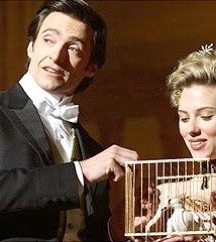

 , a 1953 biopic starring Tony Curtis and Janet Leigh. The most recent was
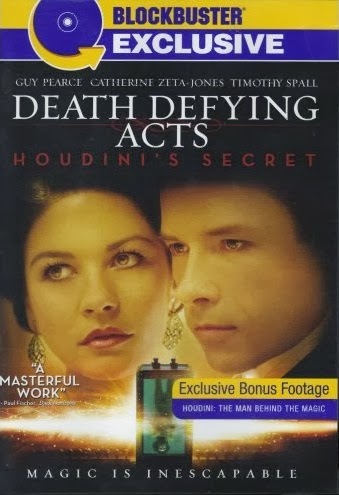
  , a 2008 release starring Guy Pearce and Catherine Zeta-Jones.