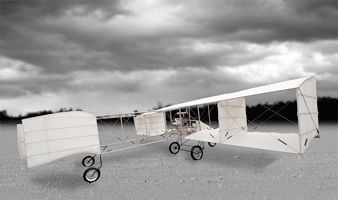
Melton resident Ian Satur, president of the Melton Model Aircraft Association, has dedicated 700 hours of work over 10 months to building the one-third scale model of Houdini’s Voisin II biplane, reports the Melton Telegraph.
The replica has a wingspan of about three metres and is capable of flight.
It can fly with the correct motor,” says Satur, “but that is not the intention; it will be used for display purposes only.”
Making model aircraft is both a passion and a hobby for the retired teacher, 69, who described the construction of the replica as “a labour of love.”
“I started my research mainly using the internet and old magazines. I managed to obtain one page of three-view drawings and some useful articles from the internet, including pictures of the aereoplane, some with Harry Houdini in view.”
"First was a trip to the local hardware store. Then began the arduous task of measuring, marking, cutting and shaping the materials required for the basic fuselage shell. Having settled for a nearly four-metre long fuselage and a three-metre wingspan, everything that had to be done became increasingly difficult, just because of the sheer size of the model.”
“In many cases, materials to be used were only decided upon after spending hours in the hardware store looking at all the possibilities. The model is made of hardwood dowels, balsa wood, plywood, wire, steel rods, cloth and more. It is as close to the actual aeroplane that Harry Houdini flew as I could get.”
The replica will be on display as part of the Houdini Centenary Celebrations at Diggers Rest, Australia, March 18-21, 2010.
Unquestionably the most famous Houdini biopic is Paramount's 1953 HOUDINI starring Tony Curtis and Janet Leigh. It's amazing just how many magic and Houdini buffs, including myself, cite this one film as the reason they became interested in the subject. While HOUDINI is almost entirely a work of fiction, it does capture the glamor, drama, and danger of Harry Houdini in a way that I think would have made the Master Mystifier proud.
Since the 1930s, Hollywood had worked to tell the life of the great magician. RKO developed, but never produced, a movie that would be a thinly veiled fictional biopic called Now You See It. In 1936, Beatrice Houdini and her manager Edward Saint sold film rights to the book Houdini His Life Story by Harold Kellock to Paramount. Under the supervision of Dore Schary, several scripts were developed, but no movie ever resulted. In May 1949, a former drug store operator, Joseph Raboff, and a real estate man, Earl Cohen, acquired the rights to the Kellock book in the hopes of making a movie and a television series with either John Garfield or Lee Cobb in the lead role. Again, the project never materialized.
Then in September 1951, Paramount reacquired the rights to the Kellock book from Cohen and Raboff when producer George Pal expressed interest in the project. This time the result was the big, bold Technicolor treat we know today as HOUDINI. Pal and director George Marshall cast real-life husband and wife Tony Curtis and Janet Leigh in the roles of Harry and Bess Houdini. Other cast included Angela Clarke as "Mama", and Torin Thatcher as Harry's fictional assistant and manager Otto. Dunninger receives a lavish credit as technical advisor, but according to Tony Curtis, the true technical advisor on the film was George Boston. "Dunninger was a blow hard," Curtis would tell a Magic Castle audience in 2009. And speaking of The Magic Castle, that's co-founder Bill Larsen, Jr. (uncredited) performing the Guillotine act at the SAM convention in the film.
HOUDINI is mounted as a lavish magic show within a movie. Several magical effects are played out in their entirety and primarily in long shot. In fact, it plays as such a magic show, live audiences I've seen it with applaud the conclusion of each trick. As for the stars, Curtis and Leigh are nothing less than glamorous!
The film also beautifully recreates many of Houdini's most famous escapes, including the straitjacket escape both onstage and suspended, a safe escape, a metal straitjacket (said to be an authentic Houdini prop), a jail escape, and Houdini's ordeal trapped below the ice following his escape from a submerged metal box. This is one of the most dramatic and memorable scenes in the film, and while Houdini himself was responsible for this fiction, it was actually first slated to appear in the unmade RKO film in 1932.
Most interesting to long-time fans of HOUDINI is the revelation of several cut scenes. Set photos posted on the LIFE magazine website show Curtis and Leigh performing the Cremation illusion, and a recreation of Houdini's Milk Can escape (the prop can used in the film now resides in the Houdini Seance Room at The Magic Castle). Also, the plane to plane transfer from Houdini's silent film The Grim Game was re-staged on the Paramount backlot for this film, making it the only biopic to acknowledge Houdini's silent movie career (well, it made an attempt to, at least).
The Milk Can and Grim Game airplane stunt were cut from HOUDINI
While HOUDINI starts off light and breezy with wonderful romantic byplay between Harry and Bess, the movie actually grows quite dark as Harry's obsession gets the better of him. One of the best scenes in the film is when Harry and Bess have an argument in an empty theater with a bubbling Water Torture Cell in the background (here called the Pagoda Torture Cell). "I wish it was another woman who took you from me, Harry, that I can fight. This I can't," says Bess. Faced with losing his wife, Harry promises to cut the Cell from his show.
However, on show day, Harry cannot resist the cheers of the audience and the cries of "more", and brings out the bubbling cell for an encore. But a tender appendix and an accidental blow backstage (he walks into a prop sword) weakens him and he becomes trapped in the cell and drowns before Bess and the horrified audience (establishing the myth that persists to this day that Houdini died in the Water Torture Cell). As his limp body is dragged from the smashed cell, the camera drifts off the dying magician to his first innocent magic poster and we are reminded just how far Houdini has traveled in pursuit of applause. It's a remarkably dark and tragic ending that makes a powerful impact.
HOUDINI was well received by the critics of the day. However, the magic community was less enamored. Magician and Houdini biographer Milbourne Christopher (Houdini The Untold Story) led the charge in a review that took the movie to task for its many fictions and inaccuracies. Said Christopher, "I won't attempt to list the anachronisms and inaccuracies in the film. Generally speaking, if any phase of Houdini's life is shown on the screen you can be sure it didn't happen the way it's pictured."
Perhaps this attitude is understandable. The magic community had waited years for a Houdini biopic, and one could see how a largely fictional treatment would disappoint. Of course, no one then had any idea just how influential the film would be, and how many magicians and Houdini enthusiasts it was inspire. In that regard, Paramount's 1953 HOUDINI is certainly the most successful of all the Houdini movies.
Happily, HOUDINI is also the most accessible of all the Houdini movies. It first aired on television (NBC) in January 1965, and is repeated on a regular bases to this day. It has also been released on VHS, LaserDisc, DVD and Blu-ray. It's even periodically still screened in theaters. To this day, HOUDINI remains one of star Tony Curtis' most well remembered and well regarded films.
Check out this new website devoted to silent movie star Nita Naldi. Naldi played "the vamp" in Houdini's 1922 feature, The Man From Beyond. Click the link if you're Wild About Nita.
Political pundits and cartoonists just love Houdini. They always have. In Gibson's The Original Houdini Scrapbook you can see political cartoons from the 1920s depicting “Houdini Sam” suspended in a “Pacific Alliance straight jacket,” and Congress boxed in a Houdini-like packing crate marked “Bonus Dilemma.”
More recently, Rush Limbaugh posted up a version of Houdini's King of Cards poster with President Obama as Barry Houdini (I still don't get it), and in England the Mail Online doctored a photo of then Prime Minister Gordon Brown under the headline: Even Houdini couldn't get out of this.
Now The Economist brings Houdini back into the conversation with their article, Barack Houdini Obama. You can read the politics over there -- I'm just here to show you the cartoon.
Illustration from The Economist
For the record, Houdini himself, while fiercely patriotic, was largely apolitical. He didn't belong to any of the political parties, was said to have voted only once in his life (for Warren G. Harding in 1920), and was an admirer of both Republican Teddy Roosevelt and Democrat Woodrow Wilson.
In fact, President Wilson anticipated a century of pundits when he said to Houdini in 1914: "Sir, I envy you your ability of escaping from tight places. Sometimes I wish I were able to do the same."
This originally aired in October, but I only just now caught a repeat on Spike TV. 1000 Ways To Die showcases silly, stupid, or gross (ideally all three) ways people have died or accidentally killed themselves.
In this 6th episode of Season 3 (The End is Weird), along with the vomit fetishist who choked on someone's else hotdog and the basketball played who accidentally hung himself by his bling, was Houdini!
They drastically abbreviated the story and spun it to be that Houdini's belief in his own invincibility was his undoing (kinda true), but it was a nicely produced segment featuring the great Jim Bentley as Houdini. In it he performs a straitjacket and roped chair escape and, yes, reenacts the infamous dressing room punch.
Okay, maybe not the most dignified of tributes, but at least Houdini's death had the best ranking of the entire show (#14). Harry wouldn't have it any other way.
Be sure and check out Wild About Harry this weekend for the fourth installment of our "Look Back" series. This time I'll examine the 1953 classic HOUDINI starring Tony Curtis and Janet Leigh. It will include some new info about the film, and its origin, that I don't think has ever been published before.
On December 3, 1925, at approximately 7:53pm, Houdini gave a radio address via station WTIC in Hartford, CT. In this address he spelled out his exact position on Spiritualism and issued his famous challenge for proof of authentic psychic phenomena or any "weird power" not explainable by science (thereby expanding his challenge somewhat).
Houdini felt this statement was important enough that he signed each page of his typewritten speech and had it witnessed and time stamped by a WTIC representative. What he said that evening -- or even the fact that he made this address -- has never appeared in any book to the best of my knowledge.
I own the original signed and witnessed speech that Houdini made that night. I figure it's not doing magic historians any good tucked away in my bookcase, so here is the full text of what Houdini said that night on WTIC.
If you are familiar with the cadence of his speech as heard in the famous wax cylinder recordings, you can really hear his voice in this.
Ladies and Gentlemen: --
It affords me pleasure to address you for a few moments on the subject of Spiritualism, and so that there is no misunderstanding regarding my attitude, I want it distinctly understood that I am not attacking the religion of Spiritualism, as that is what a number of Spiritualists claim.
I respect the genuine believer and I know many people who believe in the intercommunication with the dead, just the same as I know of Hindus who sleep on sharp pointed nails. Although I do not believe in their particular belief, nevertheless, I respect them for their sincerity.
So that the "listeners in" may know my object, I am the spokesman for an aggregate sum, closely amounting to $50,000, which is sort of a premium of reward to any human being gifted as a psychic who will prove under test conditions, without a shadow of a doubt, that the disembodied spirit can return and manifest with physical activity.
I am not a skeptic - I am willing to believe and my mind is wide open but in 35 years, I have never met a medium who could convert me. It has been my adventure to go to seances and detect noted mediums, fraudulently producing manifestations.
I would like to hear from anyone who is acquainted with a medium who I can present before the Committee of the Scientific American, which I represent and one of the Committee. Some medium who under laboratory conditions would submit to a Group A of Harvard professors selected by Dr. Morton Prince, Editor of Journal of Social and Abnormal Psychology who did me the honor of selecting me as one of Group A.
So that the "listeners in" will understand what is desired, the medium must present, not necessarily an invisible intelligence performing any acrobatic stunts, but if they are endowed with any strange or weird power, not explainable by any known science, the reward will be given to them without question.
The inspirational medium who under test conditions can prove the authenticity of their information, not by coincidence, chance or pre-arrangment, to the best of my knowledge could apply to the latter committee, but not to the Scientific American, as they demand physical activity for their reward.
I shall be at the Parsons Theatre all this week and then at the Opera House, Worcester, Mass. next week and would be delighted to hear from anyone who has a medium to report to me.
Now, please understand, this is not an attack against the religion, as everyone has a right to their own belief, as long as it does not conflict with the laws of the country or humanity.
He then annotates the speech by hand:
I also added "Here is a kiss for all the little girls."
Goodwishes
Harry Houdini
7:53 PM
Dec 3/1925
WC Johnson - WTIC - Hartford
12/3/25.
It's not generally known that Houdini did a lot of radio in the final years of his life. Radio was quickly becoming the mass media of the day, and Houdini was on top of it. Not only did he make speeches like this, but he also cut promos for his theater appearances. In fact, following the infamous dressing room punch and performance at the Princess Theater, Houdini went and did an interview with a Montreal radio station. With so much material, I firmly believe there must be undiscovered recordings of Houdini's radio work out there.
What about this one? While it appears to have been done live, it may be possible a recording was made. It was the Great Houdini after all. And having the precise date and time could be the key to discovering a recording if one exists.
Happily, WTIC-CT is still around (it's part of CBS Radio), so I sent off an inquiry to their Public Affairs dept. see whether they could find anything in their archives. Unfortunately, word came back that they were unable to turn up anything in their records. Dang. Although having some experience with archives, just because it's not in the current database doesn't always mean it's not in the vaults...somewhere. I'm not giving up hope.
So, for now, we don't have Houdini's radio voice. But we do have his words.
UPDATE: You can now see the original 2-page document as a member of my Patreon.
The Jewish Museum and the Film Society of Lincoln Center will present a special screening of Paramount's 1953 HOUDINI in memory of Tony Curtis and in conjunction with The Jewish Museum's current exhibition, Houdini: Art and Magic. The screening will be followed by a performance by magical entertainer Josh Rand.
The screening is a part of the 20th annual New York Jewish Film Festival, which will be held Jan. 12-27, 2011 at the Film Society's Walter Reade Theater, The Jewish Museum, and The JCC in Manhattan.
Tickets go on sale Sunday, January 2, 2011 at the Walter Reade Theater Box Office; and online at www.FilmLinc.com. For complete festival information, visit www.FilmLinc.com, www.TheJewishMuseum.org, or call 212.875.5601.
We interrupt your browsing for this very special announcement. On Wednesday, December 15, Wild About Harry will bring you an important broadcast message from The Great Houdini himself. This is one you won't want to miss! (It's here.)
A new documentary about magician David Blaine, David Blaine: Beautiful Struggle, had its debut last night on the Travel Channel. In it Blaine says his interest in magic all started when he saw this image of Houdini on the cover of a book in his local library. (He was obviously looking at the Dover edition of The Secrets of Houdini by J.C. Cannell.)
Says David, "As a kid I had very little, and the world seemed hard. I hoped I could be strong enough to survive almost anything. So when I saw a picture of Houdini chained to the side of a building, I was drawn to this beautiful image of struggle, and it stayed with me forever."
For the record, I think David Blaine is terrific, and the closest performer we have today to Houdini. I also think he produces some of the most stunning magic posters in the business.
While doing some research on Houdini's film work at the Motion Picture Academy's Margaret Herrick Library, I came across a review of Houdini's 1919 film, The Grim Game. But what made this review so special is it was written in 1974!
It appears this notoriously unavailable Houdini film was screened at The New School in New York on March 1, 1974, possibly the last time it was ever shown publicly. Patrick Culliton tells me this was the infamous Larry Weeks print, although the program notes by film historian William K. Everson says the film runs 6 reels while original 1919 reviews say it's only 5.
A couple things I really like here. First, this goes a long way toward confirming that Weeks has indeed preserved his print to safety film, as it is highly unlikely (maybe even illegal) that The New School would have screened a combustible nitrate print. It's also interesting that Everson mentions a "special short" Paramount prepared to promote The Grim Game using footage of the airplane accident. This is presumably Desperate Chances, a five minute short currently available on the DVD collection Houdini The Movie Star, which is the only footage from The Grim Game available to the public (maybe the inclusion of the short explains the 6th reel).
It's also just great to hear a modern reaction to this film, which many magic buffs, including myself, have never seen. Everson says it's "far and away the best" Houdini film, which is also what reviews of the day said about Harry's first Hollywood feature.
Here are William K. Everson's program notes for the 1974 screening of The Grim Game.
This wonderful photo, recently sold by Stephen Sparks (GranHoudini.net), shows Bess Houdini with director Cecile B. DeMille and his daughter Katherine in the 1930s. The photo is captioned: "OLD FRIENDS---Mrs. Harry Houdini calls at Paramount studios to invite her old friend, C.B. DeMille, and his daughter, Katherine, to the annual convention of the Pacific Coast Society of Magicians, which opens on July 25th at the Hollywood Knickerbocker hotel."
I was at Paramount on Friday and decided to go in search of the spot where this photo was taken. My working theory was that it was taken in an area behind the original administration building called Production Park. I've seen many photos of visiting celebrities and dignitaries in Production Park, and it's one of the few areas where you'll find grass on the Paramount lot.
However, as I stood there, I couldn't really find a set of windows that matched the spacing of those in the background of the photo. Orbiting the area, I discovered it's far more likely this photo was taken in front of the administration building, probably near the south/west corner where the spacing of the windows looked most correct (adjacent to what is now the DeMille Building, which may or may not be coincidence).
In the 1930s this was technically outside the studio. Until 1990, a public street (Marathon) ran along the front of the administration building and up to the Bronsan Gate. It can been seen clearly in this vintage postcard.
When Paramount sold Western Costume and demolished the building for its new theater, it enclosed the area. The street is now a pedestrian walkway and a parking lot now extends the studio to Melrose Ave.
It makes sense that this photo op would be done here instead of on the actual lot. The front of the studio was probably the most photogenic area in the 1930s when Paramount was a bustling, busy factory behind those famous gates (and still is).
Here's a modern map of the studio with a red asterisk where I believe the photo was taken.
Click to enlarge.
Was a Houdini here?
For those who wonder whether Bessie might have been feeling the ghosts from Houdini's own film work on this day, know that when Houdini made his two Paramount features, the studio was located at the corner of Vine and Selma. They wouldn't move here until 1926.
Just a shout-out to all my fellow Houdini buffs and magic bloggers to please consider adding WILD ABOUT HARRY (www.wildabouthoudini.com) to your links page. I'm working to increase my Google ranking, and links are a great way to do this. I've also expanded my own magic related links.
If you've already linked to my old site, Houdini-Lives, please consider replacing it with this one. This is where all the hot Houdini action is happening now.
Let's end the week with one from my own collection. Here's a beautiful original portrait shot of Houdini with a nice bold signature. But I admit I don't understand what he means when he calls himself "the reformed Handcuff Expert." As this was signed at the height of his movie career -- this is one of his Hollywood "headshots"-- maybe he's using the word here to mean "retired"? Or maybe it's a message that would only be understood by the recipient, whose name has unfortunately been cut away. (If you have another theory, please feel free to post it in our Comments section below.)
Whatever he meant, it's still a great shot. Enjoy.


 “I started my research mainly using the internet and old magazines. I managed to obtain one page of three-view drawings and some useful articles from the internet, including pictures of the aereoplane, some with Harry Houdini in view.”


 by Harold Kellock to Paramount. Under the supervision of Dore Schary, several scripts were developed, but no movie ever resulted. In May 1949, a former drug store operator, Joseph Raboff, and a real estate man, Earl Cohen, acquired the rights to the Kellock book in the hopes of making a movie and a television series with either John Garfield or Lee Cobb in the lead role. Again, the project never materialized.


 , LaserDisc,

 you can see political cartoons from the 1920s depicting “Houdini Sam” suspended in a “Pacific Alliance straight jacket,” and Congress boxed in a Houdini-like packing crate marked “Bonus Dilemma.”


 ), along with the vomit fetishist who choked on someone's else hotdog and the basketball played who accidentally hung himself by his bling, was Houdini!

 starring Tony Curtis and Janet Leigh. It will include some new info about the film, and its origin, that I don't think has ever been published before.



 in memory of Tony Curtis and in conjunction with The Jewish Museum's current exhibition,


 , which is the only footage from The Grim Game available to the public (maybe the inclusion of the short explains the 6th reel).


