Preorders begin in 8 days.

Tuesday, January 4, 2011

Houdini Spook Show poster conjures phantom film

Spook Shows were a relatively short-lived phenomena during the 30s, 40s, and 50s. Held mainly in small town movie houses, they combined live magic, seance trickery, gore, monsters, girls, and of course their famous "blackouts" -- when all the lights would be turned off and the theater would erupt in screams. I've always loved the idea of Spook Shows, and there's a fair amount of Spook Show nostalgia out there.

A seller on eBay is currently offering this lot of Spook Show posters. The description is typically vague, calling these "original" and of "recent origin" in the same breath. But among the batch is a poster for an "All-Nite Magic Spook Show" featuring Houdini's films. Pretty cool if this were a real poster for an actual Houdini Spook Show, but it has one major tell.


Looking closely at the list of the familiar Houdini film titles we can see, The Soul of Bronze. A lost Houdini movie maybe!?

Unfortunately, no. As was first uncovered here, The Soul of Bronze was a 1917 french film entitled L’ame du bronze. Houdini acquired it with plans to add English inter-titles and distribute it through his Mystery Pictures Corporation. The U.S. film copyright record lists this title among Houdini's film work, hence it tends to show up as a "Houdini" film in encyclopedias and such. Lee Jacobs even once listed it on the back of a King of Cards reproduction in the early '80s, which had me wondering about this title for years!

Still, it a great looking poster -- as are all of these -- and I actually like that it includes The Soul of Bronze. That tickles my collector's bone as a desirable "error." But $50?

Blackout!

Torture Cell claims another imaginary magician

The ABC series Castle will air a magic-themed episode on January 10, 2011. The description for the episode titled "Poof! You're Dead" reads:

When the owner of historic Drake’s Magic Shop in New York is found drowned in Houdini’s famous water torture tank, Castle and Beckett must delve into the world of magic, magicians and their secrets to find his killer. As part of their investigation, Castle & Beckett meet master magician Tobias Strange (guest star Gilles Marini, Brothers & Sisters, Dancing With the Stars). Meanwhile, the magicians aren’t the only ones keeping secrets, as a new romantic relationship is revealed for Esposito and Lanie, on Castle, MONDAY, JANUARY 10 (10:01-11:00 p.m., ET). 

It's funny to think just how many TV crime shows have pretty much done this exact same plot, and they are always a little embarrassing for anyone who knows magic. Nevertheless, I sense a Houdini name-check or two, so Castle gets our endorsement.

And, look, I think I spy Houdini's Metamorphosis and Buried Alive posters on the back wall of "Drake's." To the DVR!


Monday, January 3, 2011

New page - Houdini: A Biography

Today I'm excited to reveal a brand-new page here at Wild About Harry - Houdini: A Biography. The purpose is to provide a short, accurate biography of Houdini as refuge from his chaotic Wikipedia page. It's also a good way to get to know Harry fast, or use it as a quick reference while you're reading my blog. Give it a look and let me know what you think, and feel free to pass it along to anyone who you think might be interested in the life story of our favorite Master Mystifier. Enjoy.

Click to read

Houdini's mystery mistresses

Looks like we've opened a can or worms.

Following on my illicit loves of Houdini article (our most viewed post), Houdini expert Patrick Culliton has posted on his own website several photos of other women said to have been "sometimes associated with Houdini." But no names. That's for us to figure out.

Click here to check out the mystery women at Houdini's Ghost. You can also join the discussion at The Magic Cafe forum, which includes some criticism that we shouldn't be delving into Houdini's (alleged) extramarital adventures. Your thoughts?

How did I miss this?

Somehow I completely missed this when it was released in 2002, but I just caught Grand Illusions: The Story of Magic on Netflix, and was thoroughly impressed with the Houdini episode. It's actually one of the better Houdini documentaries out there.

My biggest surprise is that it contains the rare footage of Houdini performing the "Thumb Racket," which I had only just learned about in Pat Culliton's Houdini The Key. But it's been right here all these years! The other episodes are first rate as well, although some are now dated.

There is also a Grand Illusions: The Story of Magic Part Two, which you can bet I'll be checking out soon.

Link: The Upside Down x 2 or More

The Magic Detective is on the case of Houdini's Water Torture Cell. Just how many cells were there? Another must-read at Carnegie: Magic Detective.

Sunday, January 2, 2011

Matt Kindt conjures Houdini's ghost

Comic Book Resources has an interview today with Matt Kindt, creator of the popular 2007 graphic novel, Super Spy. Now Kindt reveals he is working on a paranormal follow-up, Super Natural, that stars the ghosts of Amelia Earhart, Morgan Earp, and Houdini.

"I really focus on each one of them as they interact with each other and examine their past to sort of uncover the mystery of their life — rather than their deaths," Kindt said. "Is that vague enough? I really don’t want to give too much away."

Below is a taste of Kindt's Houdini artwork for Super Natural (which may first be released as a web comic). Head on over to Comic Book Resources to read the full interview.

Comic Book Resources

FairyTale: A True Story (1997)

Harvey Keitel as Houdini. That's exciting! Harvey Keitel as Houdini in secondary role in a movie about two little girls and fairies? Less exciting. Nevertheless, that's the reality of FairyTale: A True Story, an underrated family film that was released on October 24, 1997 by Paramount.

Produced by Mel Gibson's ICON Entertainment and Wendy Finerman Productions, FairyTale: A True Story–originally titled One Golden Afternoon–tells the true story of Eisle Wright (Florence Hoath) and Frances Griffiths (Elizabeth Earl) who fooled the "experts" with photographs of paper cut-out fairies they claimed were real. Their greatest champion was Sir Arthur Conan Doyle, who wrote an entire book in support of their pictures, The Coming of the Fairies. Looking at the photos today, it's astounding to think anyone took them seriously.

Houdini was never involved in the Cottingley investigations as depicted in this film, but his inclusion makes for good drama and a counterpoint to Conan Doyle, played here by the great Peter O'Toole. The film strives to be similar in tone as other '90s hits like A Little Princess and The Secret Garden. Unfortunately, the filmmakers elect to show the real fairies within the first ten minutes of the film. I think it would have been far more effective to have held off until the very moving final scene. But this isn't a review per se. We're here to talk Houdini!

FairyTale wasn't Keitel's first encounter with the master mystifier, something that was revealed by director Charles Sturridge. Keitel was originally set to play Houdini in the 1981 movie, Ragtime (the small part was ultimately played by Jeffrey DeMunn). So when Keitel came to the project, he had already done quite a bit of research on Houdini.

As part of his ongoing research, Keitel consulted with Dorothy Young, who worked as an assistant in Houdini's full evening show in 1925. Says Dorothy, "He sent his limo down for me to go up and have dinner with him, and I did Houdini's entrance for him about twenty times, and he studied the mannerisms." UK magician Simon Drake is also credited as "magic advisor to Mr. Keitel." His research appears to have paid off. In a review of the film for the L.A. Times, Kevin Thomas said, "Keitel is flat-out perfect for Houdini, intellectually and physically."

Keitel does make a good Houdini. I like that he plays a more low-key, kinder magician, showing more keen intelligence than bluster. The temptation of many is to play Houdini as always stern and intense, but Keitel is quick with a smile, which matches what we see of the real Harry in newsreels. He's also not out to expose the girls, as might have been the obvious way to go here. Instead, he subtlety encourages them to keep their secrets, as all "masters of illusion" do.

Wardrobe also helps Keitel put his Houdini across. The suit he wears through much of the film is a faithful reproduction of an outfit we see Houdini sporting in several publicity photos from period, right down to his elaborate lapel pin (which here appears to be a small pocket watch). However, for some reason, the filmmakers felt it necessary to give the actor a huge fake hawk nose, which is terribly distracting.

The film opens with an impressive recreation of the suspended straitjacket. Not only is the staging reminiscent of newsreel footage of Houdini doing the actual escape, but specific newsreel shots are authentically recreated. We also get to see Houdini's dressing room table with tribute card to Mama.


It's become almost a requirement that any movie featuring Houdini as a character must reenact his Water Torture Cell, and FairyTale is no exception. It's a pretty good reproduction at that, although the stage design is much more elaborate than what Houdini would have ever used.

Production designer Michale Howell explained his approach. "I wanted to show the intensity of the showmanship and how that was part of the creating the sense of mystery. There's the idea of danger. There's this big storm backcloth and all the water. It's much colder and frightening. Then among all that blue and the black and gray, there is this big red devil in the background that comes out of the sky."

Another treat for Houdini fans is the inclusion of Jim Collins played by Jason Salkey. While Franz Kukol could be spotted in The Great Houdinis (played by Patrick Culliton), this marks the first time Houdini's most trusted assistant and chief mechanic has been portrayed on screen. Bess, unfortunately, is absent. Producer Mel Gibson appears at the end of the film in an uncredited cameo.

FairyTale: A True Story seemed to not only slip under the radar of movie goers in 1997, but of magic enthusiasts as well. You'd think Harvey Keitel as Houdini would have drawn more attention? But Houdini really isn't the star of this film, and only months before FairyTale was released there was the announcement of a new, big budget Houdini movie to be directed by Paul Verhoeven and, possibly, starring Tom Cruise. That film never happened.

FairyTale is a sweet, well-made family film with two terrific performances by the young leads and a memorable Houdini in Harvey Keitel. Happily, it's also a film that can easily be discovered (or rediscovered) on DVD.
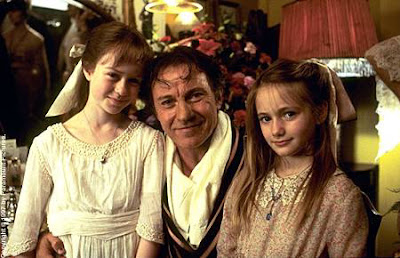
Three tricksters
One of the real Cottingley faire photos


Also enjoy:

Tickets on sale for special HOUDINI screening, Jan 17

Tickets are now on sale for the Jewish Museum and the Film Society of Lincoln Center's special screening of Paramount's HOUDINI on January 17 at 1:00pm.

The screening will be followed by a performance by magical entertainer Josh Rand.

The screening is a part of the 20th annual New York Jewish Film Festival and is held in conjunction with The Jewish Museum's current exhibition, Houdini: Art and Magic.

Tickets are on sale at the Walter Reade Theater Box Office or online HERE. For complete festival information, visit www.FilmLinc.com or call 212.875.5601.

Saturday, January 1, 2011

Happy New Year!

Welcome to 2011.

I've got a nice line-up of things all set to kick off the New Year. First, I'll take "A look back at FairyTale: A True Story." Also on tap is "A photo of Houdini you've never seen" and the story of my personal pilgrimage to "The home of Houdini." I've also got a few more items from my own collection to share, and I have something exciting to announce for February, but that's a magician's secret for now.

I'm also excited that in 2011 Houdini is coming HERE! Houdini Art and Magic will be coming to the Skirball Cultural Center in Los Angeles in late April. I've already heard rumors that it's going to feature some new, LA specific content that is not a part of the current New York exhibition. You can bet I'll be all over that! I'll then follow the exhibition to San Francisco in September for a full report on how the "City by the Bay" handles our Harry.

I'm also working on a short biography of Houdini, which I intend to feature as a stand-alone page on the site. It will be a reliable refuge from his crazy Wikipedia page, and a way for the curious to bone up on his life story in one easy read.

And, of course, I will keep you up-to-date with ALL the latest book and DVD releases, and the latest on my own research into Houdini's movie career (did I mention the never-before-seen stills from The Grim Game?). Because in 2011, I'm still Wild About Harry, and so are you.

Happy New Year from the staff

Friday, December 31, 2010

Auld lang syne

In 2010...

We celebrated the centenary of Houdini's first flight.

Houdini once again went on tour.

Patrick Culliton revealed the secrets of Houdini.

We lost the greatest Houdini.

And in 2010 we launched this website...to take Houdini into the future.

Have a happy and safe New Year's Eve and we'll see you all in 2011!

Houdini's favorite song as performed in 1910 by Frank C. Stanley

Polish Houdini biography

The mighty Kevin Connolly (Houdini Himself) alerts us to this book, 10 copies of which are currently being offered for sale on eBay.

This appears to be an original Polish biography of Houdini by Paul Sherman (as opposed to a Polish translation of one of the well-known english language biographies). Can't say I've seen many foreign language originals in my day.

Some further detective work reveals the book is 284 pages, a paperback, the publisher is Videograf II, and the release date was April 29, 2010. I can't find any indication whether the book is illustrated or not.

With shipping the total price comes out just under $20 U.S. Going to think about this one...

UPDATE: The same publisher appears to have released another original Houdini book in 2009.

Thursday, December 30, 2010

Adroit Harry and ancient hokum

It's easy enough to find contemporary takes on Houdini's movies and acting ability, but how were his films received by critics when they were first released? I took my curiosity to the Motion Picture Academy's Margaret Herrick Library and dug out reviews of Houdini's two Paramount features, Terror Island and The Grim Game.

Terror Island, Motion Picture News, Vol. 1, 1920: 
The sponsors of this picture made an apology for it in the introductory caption and so disarmed the spectator to some extent from being unduly critical. The result is one must accept it for what it is -- a mere vehicle for the exploitation of the handcuff king, Houdini. The apology was kept up throughout the length of the feature, which proves how those in charge erred in putting over something on the public. Really, Terror Island goes back to the nickelodeon days, there being an absence of rhythm and reason in theme, treatment and interpretation. A sophisticated audience will surely kid the life out of it, just as they did at the Rialto. The picture is nothing more or less than a wild serial compressed into five reels and the incidents contained in it might have been conceived in a nightmare.
Highly impossible as the ancient hokum is, it is going to take a lot of explanation as more apology than what is offered to make even a child believe the stunts that take place underwater. Houdini might get away with it on a bet, but not Lila Lee.
Ouch!

While Terror Island is not a masterpiece, it's not this bad. Feels like Motion Picture News had it out for Harry somewhat. It is interesting to find the phrase "goes back to the nickelodeon days" in a review from 1920. Cool how the industry had already developed a sense of advancement.

But it wasn't all bad for Harry in Hollywood. His first Paramount feature fared far better with the critics, including this review in the November 1919 issue of Photoplay:

The Grim Game, Photoplay, November 1919:
This is the best play Harry Houdini has ever grappled with, or wiggled himself out of, and it is the best of school which may be described as trick melodrama. In other words, all of Houdini's celebrated stunts, such as shaking off a set of bracelets, withering out of a straight-jacket, or breaking half a ton of manacles are included, but there are also many new and entirely localized manifestations of his diabolic cleverness; and almost all the feats, escapes, and what-not are part of a well-woven, logical plot. Includes in this five-reel fracas, also, is the actual air-collision which stirred Hollywood a few months ago. Two machines, performing at altitude for Houdini's play, accidentally crashed together and fell to earth wreaking themselves, but fortunately not killing and of the occupants. Ann Forrest -- who, at Triangle, was known as Ann Kroman -- is a delightful ingenue lead in the adroit Harry's adventures; and the cast includes, also, Mae Busch -- reappearing after nearly two years absence: she was formally at Keystone -- Anothy Boyd, Tully Marshall and Augustus Phillips.

This last review almost seems too good to be true -- and maybe it is. Recall that Photoplay was a part of Macfadden Publications where Houdini had a good friend in editor, Fulton Oursler (who would later write his own "Houdini" movie for RKO).

Nevertheless, The Grim Game is supposed to be Houdini's best film, so while this review might be a touch effusive, it's overall assessment is shared by many. One bit of nice info is that Ann Forest was also known as Ann Kroman. That I didn't know.

Harry gets comfortable and catches up on his latest reviews in Variety

LINK: Houdini and Lincoln

There's a must read post today over at Carnegie: Magic Detective about Houdini and President Abraham Lincoln. Dean contends that Lincoln, not Robert-Houdin, was Houdini's true boyhood hero (and I concur).

Click on the headline to read the interesting history of the Master Mystifier and the Great Emancipator at Magic Detective.

Translate