Banner AI generated.

Sunday, February 5, 2012

Houdini's leading ladies: Lila Lee

Continuing our look back the leading ladies who shared the bill with Houdini in his silent movies, today we meet the lovely Lila Lee, who was born Augusta Wilhelmena Fredericka Appel in Union Hill, New Jersey, on July 25, 1901.

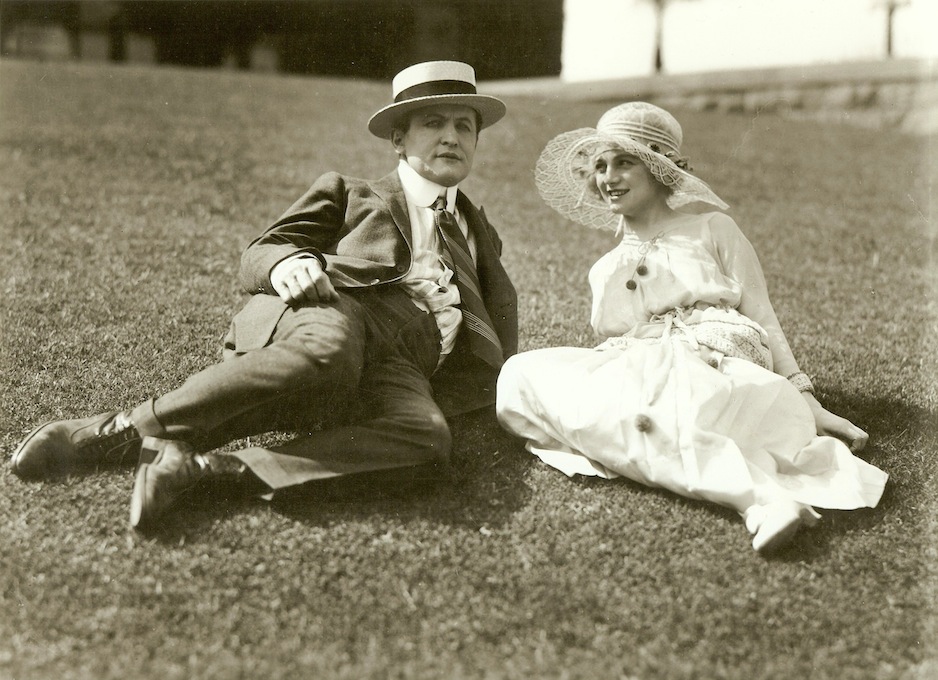
At age 18 Lee landed the part of Beverly West in Houdini's second feature for Famous Players-Lasky, Terror Island (1920). Lee is the most physical of all of Houdini's leading ladies, finding herself in the middle of much of the action. Her leap through a barn door on her horse is as impressive as Houdini's own spectacular stunts in the film (and it appears it's really Lee who did the stunt). She even appears alongside Houdini in a rare three sheet poster (below).

Here is Lila Lee's biography on Fandango:

A pretty, apple-cheeked WAMPAS Baby Star of 1922, Lila Lee had been a performer since childhood and was widely known as "Cuddles," one of the stars of Gus Edwards' kiddie troupe. She was brought to Hollywood by Paramount's Jesse Lasky and headlined in her very first film, The Cruise of the Make Believe (1918). In typical silent screen style, she played a poor girl secretly supported by a rich admirer and the New York Times thought she had a "limitless future before her."

After appearing as the servant wench in Cecil B. DeMille's Male and Female (1919), Paramount began to see the newcomer as a potential successor to that popular film's star, the elegant Gloria Swanson, and embarked on a hefty publicity campaign. Lee's detractors, however, were quick to point out that her work never really lived up to the ballyhoo. "She seemed permanently neutral," as one critic pointed out. Her co-starring turn opposite Rudolph Valentino in the immensely popular bull-fight melodrama Blood and Sand (1922) was still far from persuasive but her jet-black hair, severely braided in coils over each ear, created a trend and the fan mail kept pouring in. Her tumultuous marriage to matinee-idol James Kirkwood, very much an "A Star Is Born" affair, created additional headlines that lasted until their divorce in 1931.

Lila Lee's up-and-down screen career was bedeviled by severe bouts with what was euphemistically referred to as tuberculosis but whispered to be the results of acute alcoholism. As Lon Chaney's leading lady in The Unholy Three (1930), she was positioned to become one of the new sound era's first major stars but a series of bad judgments and, again, highly publicized bouts with illness, led to supporting roles in Grade-B films. In 1936, she was a witness to the suicide of playboy Reid Russell and the resulting headlines reportedly made her camera shy. There were several aborted stage comebacks in the 1940s, a short-lived marriage or two, and appearances on early television soap operas in the 1950s. Her son with Kirkwood, James Kirkwood Jr., became a noted author and playwright but Lee did not live to see his crowning glory, the legendary Broadway musical A Chorus Line. Retiring from performing after playing country singer Margie Bowes' hayseed mother in the Florida-lensed Cottonpickin' Chickenpickers (1967), the veteran star died of a stroke at Saranac Lake, NY, in November of 1973. ~ Hans J. Wollstein, Rovi

Lila Lee is one of only two Houdini leading ladies to have a star on the Hollywood Walk of Fame at 1716 Vine Street, very near the original location of the Famous Players-Lasky Studio where she worked with the Great Houdini.


More Houdini leading ladies:

Saturday, February 4, 2012

Houdini's leading ladies: Ann Forrest

Today I'm launching a series of blog posts featuring a look back at the leading ladies who shared the bill with Houdini in his silents movies. I thought I'd start off with Ann Forrest, who was born Anna Kromann on April 14, 1895 in Sønderho, Denmark. At age 24 Ann landed the plum role of aspiring reporter Mary Cameron in The Grim Game, Houdini's first feature film for Famous Players-Lasky.

Here is Ann Forrest's biography on Fandango (a terrific resource for bios of silent stars):

Danish-born silent screen actress Ann Forrest began her film career in 1915 performing diving stunts for the American "Flying-A" company under her real name, Ann Kroman. She became a star three years later opposite William Farnum in the first screen version of Zane Grey's The Rainbow Trail (1918), a major success for Fox, who would film the story twice more. It was Farnum who on the film's Grand Canyon location grandly rechristened the Danish actress as Ann Forrest; Kroman, according to Farnum, was too foreign for an American star. The brawny actor picked Forrest because, he explained, the name "signified something big, yet short and snappy." 
The newly christened Ann Forrest was Harry Houdini's beleaguered leading lady in the action melodrama The Grim Game (1919) and earned rave reviews for playing a pathetic kitchen maid in The Prince Chap (1920). Blonde and "cute" rather than beautiful, Forrest made a strong impression on director Cecil B. DeMille who signed her to a five-year personal contract. Not exactly the type to loll about on a tiger skin like DeMille's usual coterie of leading ladies, Forrest never actually appeared in a DeMille film but was instead shipped overseas for Love's Boomerang (1922) in which she earned above-title star billing. Filmed in both England and France, the melodrama was a major success but her return to Hollywood proved anticlimactic and she left films in 1926 in favor of the legitimate stage. 
In 1930, along with her director and leading man, Forrest was arrested and charged with "indecent exposure" during rehearsals for the then-controversial play Frankie and Johnny. That incident, along with a severe car accident, curtailed Ann Forrest's stage career and she retired completely from show business in 1931. ~ Hans J. Wollstein, Rovi

According to her Wikipedia entry, Ann Forrest died on October 25, 1985 in San Diego, CA. That would have put her at age 90. Of all of Houdini's leading ladies, Ann enjoyed the longest life. It's a shame she was never interviewed (as far as I know) about her recollections of working with the Great Houdini.

Houdini and Ann in a publicity pic for The Grim Game.

More Houdini leading ladies:

Houdini art exhibit in Philadelphia

A new travelling exhibition by Portuguese artist Braulio Amado called Houdini opens tonight at Phantom Hand, an artist-run gallery space in Philadelphia. The exhibition runs through February 18.

"Inspired by the greatest magician that ever lived, the series alludes to abstract universes and fantasies, exploring mind tricks and the possibilities of the impossible. The pieces invoke the unexpected and draw from raging sounds, like those of the Melvin's 'Houdini' record. Expect weird stuff."

Opening Reception for Houdini:
Saturday, February 4th 6:00PM-12:00AM
PHANTOM HAND
604 South Street / Philadelphia, PA

Friday, February 3, 2012

Moving the Milk Can

Recently Joe Fox lent me a January 1987 issue of ESCAPISM which contains a very good article by David De-Val about Houdini's Milk Can escape. De-Val tells the untold story of how Houdini had his can secretly modified in the middle of the night by a man named Harry "Henry" Robins in a Wolverhampton sheet-metal factory in December 1908. The modifications allowed Houdini to perform the escape faster. "I'll hardly have time to get wet," he is reported to have said when they finished work at 3AM.

One detail the story revealed was that Houdini traveled with the can inside a round wicker basket. David points out that the very basket can been seen in Milbourne Christopher's Houdini A Pictorial Life. All these years of looking at these photos -- and that basket -- and never once did I realized I was looking at Houdini's original Milk Can in transit. I love this kind of thing.


Houdini using a wicker basket to transport the Milk Can makes some practical sense when you consider it probably had to be moved in the high speed of Vaudeville while still wet. However, using a basket also opened up the can to potential damage, and a dented Milk Can could prove to fatal. This was the case in 1930 with a Houdini imitator named "Genesta" who drowned when he failed to escape from a can that had been dropped before his show.

Maybe that's why a later "Houdini Milk Can" -- currently on display as part of the Houdini Art and Magic exhibition (and I suspect is actually Hardeen's 1928 can) -- had a custom made traveling case which survives to this day (below).

© All rights reserved by Houston Museum of Natural Science

Thursday, February 2, 2012

Coming: Houdini's leading ladies

This weekend I will launch a new series, "Houdini's leading ladies", which will look back at the life and careers of the actresses who shared the silver screen with our Harry. Get ready to meet the ladies!

'Houdini's Paper Magic' for Kindle

Here's one for you eBook fans. Houdini's 1922 book, Houdini's Paper Magic, has just been released for Amazon's Kindle eBook reader.

The Amazon description promises, "This newly published kindle edition includes over 100 illustrative line drawings from the original book."

Purchase Houdini's Paper Magic (for Kindle) from Amazon.com.

Speaking of Houdini eBooks, I neglected to report on this when it was released in October of last year, but you can also get Houdini's first book, The Right Way To Do Wrong (1906), for the Kindle. This version appears to be a facsimile, right down to the original cover.

Wednesday, February 1, 2012

Houdini and Zukor


Feels like we've had a lot of somewhat sensationalistic blog posts lately (murder theories, reincarnation), so here's my attempt to get back to something more rooted in real research and within my own specialty; Houdini's movies.

While doing research last year at the the Academy of Motion Pictures Arts and Sciences Margaret Herrick Library, I uncovered a revealing letter from Houdini to Adolph Zukor. Zukor was the head of Famous Players-Lasky/Paramount Pictures, and a powerful Hollywood mogul. He revolutionized the film industry by organizing production, distribution, and exhibition within a single company, and by the 1920s dominated the industry with a theatrical chain of nearly 2,000 screens.

Zukor had produced and distributed Houdini's two Hollywood features, The Grim Game and Terror Island. Now here we see Houdini attempting to interest Zukor in his first independently produced feature, The Man From Beyond. On Houdini Picture Corporation stationary he writes:

HOUDINI PICTURE CORPORATION
CANDLER BLDG.
220 West 42nd Street
New York City 
                                  July 16, 1921 
My dear Mr. Zukor -- 
    Tried to get you on the 'phone a number of times this week but unfortunately failed to do so. Am starting on my second super special. My first production "The Man from Beyond" is finished and is a competitive picture to "Way Down East," referring to the thrill finish wherein we have our episode on the brink of Niagara Falls. Would like to make arrangements to show you this picture any time to suit your convenience and any place you designate. 
   May I suggest the possibility of bringing it to your home and running it as you did "The Grim Game." As I stated above, I am working in the day time on my next picture but I could come out any evening on Sunday. "The Man From Beyond" is a full seven-reeler and really believe I have a great, big financial success. 
             Regards, 
                  Sincerely yours, Houdini
We took six months to make The Man from Beyond.  

What's Houdini up to here? You could say he's trying to join the "producers club" by showing off his first feature to Zukor. But I think it's much more likely that he's soliciting Zukor here, hoping that Paramount might be interested in distributing The Man From Beyond (this is a full year before the film's release). Houdini clearly seems to be trying to entice him with the idea of "a great, big financial success." Also his likening the film to Way Down East (which he would continue to do in publicity), might be strategic, as that film was D.W. Griffith's first production for Paramount's competitor, United Artists.

But it's also clear that Houdini is not having much luck, failing to even get a return phone call. One can't help but sense a bit to wistfulness when Houdini mentions the screening of The Grim Game at Zukor's home.

So why is Zukor snubbing Houdini? It's possible Zukor felt he had already exploited Houdini the movie star to the maximum with The Grim Game and Terror Island. Certainly the returns and reviews on Terror Island showed diminishing interest in Houdini as a film star. Or maybe Zukor now considered Houdini, the producer, as competition, and didn't care to have a relationship. It's also possible Zukor did screen The Man From Beyond and didn't care for it.

Whatever the reasons, Paramount would not distribute The Man From Beyond. Houdini would instead distribute the film himself under the Houdini Picture Corporation banner. For his last feature, Haldane of the Secret Service, Houdini would turn to FBO for distribution.

But the fact that Houdini even solicited the movie to Zukor is a fresh revelation, and just another intriguing nugget from the still largely untold story of Houdini and his movies (a story I'm working to one day tell).

Tuesday, January 31, 2012

Midnight Mysteries: Haunted Houdini now available for download


The new Houdini computer game, Midnight Mysteries: Haunted Houdini Deluxe, is now available as a download for $2.99 from Big Fish Games. You can also download a free sample at the site. So far it looks like players are giving the game very positive reviews. Here's a description:

When Houdini’s promises of contact from beyond go unkept, his wife comes to you in a final plea to unravel his mysterious passing in Midnight Mysteries: Haunted Houdini Deluxe! When he promised his wife that he would try to reach her from the afterlife, it was seen as the ultimate stunt But after years of séances, Bess was never able to reach Harry in this life or the next, and her spirit has come to you in a final plea to reunite her with her partner!

Deluxe games include an Integrated Strategy Guide!
  • Meet other apparitions
  • Help Bess contact her love
  • Unravel Houdini’s mysterious death!

Midnight Mysteries: Haunted Houdini Deluxe requires Windows XP/Vista. Check out the trailer below.

Madeline meets Houdini


Continuing our French theme today, if you've never seen the episode of The New Adventures of Madeline in which Madeline and her friends meet Houdini, you can now purchase it on Amazon (Prime members can stream it for free). It's a pretty cute episode. We even get to see Houdini and Madeline sing a duet!

"Madeline and the Magic Show" first aired on February 12, 2001 and was episode 14 of Season 3. I've captured a few choice images below.

Les chroniques complètes

Book 4 was tricky, but I've finally managed to acquire all five books in the Les Chroniques du jeune Houdini series. These paperbacks tell fictional adventures of the young Houdini and are only available in French. Here's hoping a publisher might pick these up and offer English translations. As much fun as these are to have on my shelf of Houdini fiction, I would love to actually read them!


Click here for more about the series (including a plot breakdown of each book).

Monday, January 30, 2012

Saturday, January 28, 2012

Is this Houdini in a past life?

Yesterday I did a blog post about Houdini's belief -- according Walter B. Gibson -- that he was the reincarnation of a "German magician named Von Treck." I noted that I couldn't find any magician by that name. But now David Byron, a magic historian for The Mandala Magazine and blogger at Baroque Potion, thinks he may have found our man.

David suspects that the person Houdini had in mind (and body) was Friedrich von der Trenck. While he was wasn't a magician and he didn't die doing a Buried Alive stunt, he was German and famous for having made several daring escapes from a Prussian jail in 1746. He was later accused of being spy during the French Revolution and executed by the guillotine on July 25, 1794. (Oh dear, is this now ammunition for the "Houdini was a spy" theorists?)

As David points out, this illustration of von der Trenck from Wikipedia (above) "makes perfectly clear why Houdini might've had him in mind!"

Sensational find! Thank you, David.

UPDATE: The plot thickens! Joseph Pecore has sent me a link to Friedrich von der Trenck's autobiography where he talks about being buried alive!

UPDATE 2: Armed now with the correct spelling, the great Bill Goodwin at the William Larsen Sr. Memorial Library at The Magic Castle has sent over several articles from Houdini's lifetime that draw parallels between Houdini and Friedrich von der Trenck (called "Baron Trenck" in most of them). There is a lengthy article by Irvin S. Cobb titled, "Houdini Not First Handcuff King", and Houdini's own Conjurers Monthly Magazine cites an article about Houdini in New Age by Henry Ridgely Evans called, "A Twentieth Century Baron Trenck." Below is an example from The Sphinx, July 1920.

Click to enlarge

Thank you, Bill!

No, The Magic Castle did not just sell Bessie's furniture

This morning The Magic Castle in Hollywood had a parking lot "Fire Sale" of items from inside the club that are being discarded after the recent renovations. It was a rare opportunity for members to own a piece of magic and Hollywood history.

I showed up at 8:30am sharp because I knew choice items would be snatched up fast, and I wasn't wrong. The first thing I saw was a fellow member walking away with an original Dante poster from the Dante Dining Room.

But then I saw something that made me stop in my tracks. For years I have been telling my guests that the large oak sideboard which sat in the Cherub Room and later in the Terrace Dining Room had belonged to Bess Houdini. This is because I recalled that it once sat inside the Houdini Seance Room along with a small organ which is also said to have belonged to Bessie. When I went to the Castle for it's reopening earlier this month, I noticed the sideboard was no longer there. Now, much to my horror, here it was in the Castle parking lot in two sections and tagged SOLD!

How could they sell Bessie's sideboard!?

I was then fortunate enough to encounter the legendary Milt Larsen himself, so I asked him about the sideboard and whether it belonged to Bessie as I had once heard. Milt set the record straight. While the sideboard is a beautiful piece of furniture that he hated to part with, it had no history.

"We lie about a lot of things, but this isn't one of them," said Milt with a smile.

Milt then spoke about how he remembered going to Bess's apartment on Vermont, and despite my recollection, the sideboard had never been in the Houdini Room. (However, there is a photo of what appears to be the sideboard in the Seance Room on page 158 of Milt Larsen's Magic Castle Tour. But that same book later identifies it as coming from "a stately home in Pasadena", so...not Bessie's.)

Having solved the mystery of the sideboard (which I'm still sorry to see go), I was happy to come away with a beautiful wooden blade from a ceiling fan which Milt signed for me; "From The Magic Castle - Milt Larsen - 2012."

Be sure to check WILD ABOUT HARRY on Monday for a special milestone post.

Friday, January 27, 2012

Houdini, reincarnation, and a man named Von Treck


This one is a bit off the wall. Just want to warn you up front.

Recently I re-read Norman Bigelow's self-published 1983 book, Death Blow, which examines the question of whether Houdini was murdered (yes, that again). I'm not a fan or a supporter of the murder theories, especially after the recent Brad Meltzer's Decoded debacle, and I didn't find anything here that changed my mind. However, near the end of the book, Norm writes something that did catch my attention:

"In 1975, I spent and entire afternoon talking shop with historian Walter Gibson. He spoke freely about Houdini's belief in reincarnation. Gibson told us he had research material in his files on two people whom Houdini claimed to be in former lives. One of them was a German magician named Von Treck who failed in a buried alive stunt. He also told us Houdini went around everywhere talking about reincarnation."

Houdini believed he was the reincarnation of a German magician named Von Treck? This is pretty far out stuff. But there is ample evidence that Houdini did have an interest in reincarnation.

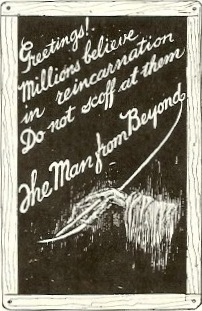
Bigelow cites The Detroit Free Press, November 1, 1926, which has a section headlined, "Reiterates Reincarnation Belief". And then there's Houdini's 1922 film, The Man From Beyond, which uses reincarnation a key part of its plot. In fact, The Man From Beyond press book contains a very pro story about "The theory of reincarnation", and Houdini featured the concept on advertising, such as the teaser on the right.

And then there's this little gem of a title card near the end of the film:

"Our personal beliefs are of no importance. The great teachers of the earth -- Zoroaster down to Moses and Christ -- who who have made civilization possible -- have taught the immortality and progression of the soul...reincarnation."

Okay. But what of Von Treck?

Unfortunately, I could find no record of any magician named Von Treck. Houdini's The Unmasking of Robert-Houdin -- a suburb source for pre 20th Century magic -- makes no mention of him (at least in the index). Even the eminent Bill Goodwin at the William Larsen Sr. Memorial Library at The Magic Castle could turn up no record of a magician named Von Treck. And would a magician really be doing a buried alive stunt before 1874, as this would have to have been in order for Von Treck to slip into the new born Ehrich Weiss?

Norman Bigelow (who it should be noted is a is a bit of provocateur when it comes to Houdini) says he doesn't know what ever became of Gibson files. But if this information did indeed come from Walter B. Gibson, who knew Houdini well, it's worth the mention.

Told you this was an odd one.

UPDATE: Our friend Joe Notaro over at Harry Houdini Circumstantial Evidence has posted a remarkable ad and article from The Grim Game pressbook that is even more aggressive in stating Houdini's "belief" in reincarnation. You know, I'm starting to think there really is something to this.

UPDATE 2: It now looks like we may have found "Von Treck". See: Is this Houdini in a past life?

Translate