Banner AI generated.

Friday, March 30, 2012

The true story of the Laurel Canyon Houdini Estate

Last month Patrick Culliton and I had the great pleasure of touring the "Houdini Estate" in Laurel Canyon, CA, with the current owner, José Luis Nazar.

There is some confusion about this property and whether or not Houdini ever lived here. Some say it was Houdini's house. Some say "he never set foot" on the property. Some identify a larger house up the street as the real "Houdini mansion." So I thought I'd use this blog to clear up the mystery and history of the Houdini house...as much as I can.

The truth is the property at 2400 Laurel Canyon Blvd was never owned by Houdini. It was owned by Ralf M. Walker, who in 1915 built a Mediterranean-style villa at what was then 2398 Laurel Canyon Blvd (the address became 2400 later). The house was three stories with 11 bedrooms, nine baths, a ballroom, a 15-foot stage for musicians, and a ballet room big enough for 10 dancers. He also built a four-bedroom guest house across the street at 2435 Laurel Canyon Blvd, and this is where Houdini comes in.

Walker and Houdini were friends -- Houdini might have even invested in Walker's Laurel Canyon Land Co. -- and when the magician came to California in 1919 to film his two features for Famous Players-Lasky, The Grim Game and Terror Island, he and Bess are said to have stayed at Walker's guesthouse at 2435 Laurel Canyon Blvd. That house is now long gone, but here the great Patrick Culliton, author of Houdini The Key and lifelong Laurel Canyon resident, shows us exactly where the Houdini house once stood.


Now, it needs to be said that we don't (yet) have smoking gun evidence that puts Houdini and Bess in the Walker guesthouse in 1919 (update). But we do have circumstantial evidence. In Harold Kellock's Houdini His Life Story (page 271), it says that Houdini spent "his leisurely evenings at home in the modest bungalow he had rented in Hollywood" and that "fellow players returning from late parties, who might have been moved to investigate the solitary light burning in the Houdini bungalow, would have seen the Handcuff king and escape artist scratching busily with his pen at a table littered with manuscripts and old volumes." 

The house at 2435 did indeed sit on a bluff above Laurel Canyon Blvd where, yes, one would have been able to see a solitary light burning in the window while driving to and from parties in the Hollywood Hills. There's also the below photo of Houdini diving into a swimming pool. Those who remember the Walker mansion identify this as the pool on the property. So it appears Houdini made himself at home on the larger estate.


But most significantly, we have Bessie's return to 2435 Laurel Canyon Blvd following Houdini's death. This suggests a familiarity with this Hollywood "home" and Mr. Walker. And unlike the brief 1919 stay, we have ample evidence of Bess and Edward Saint's occupancy at this time.


This is probably when the legend of the "Houdini mansion" took root. When Bess would throw parties or hold seances, etc., she would do so at the Walker mansion across the street. It has been said that the guesthouse even had an elevator that went down to a tunnel that ran below Laurel Canyon and came up in the big house grounds (the tunnel is sealed but still exists). One can understand how local magicians who attended these events came to assume that the house belonged to Bess and, by extension, Houdini. The "Houdini mansion."

Bess and Edward Saint left 2435 Laurel Canyon when Walker either died or sold the estate in 1935 to a real estate broker named Charles Wilson. The property went through a series of renters, including evangelist Joe Jeffers, who turned the mansion into the Temple of Yahweh and required donations of up to $100,000 to live on the property. Following Jeffers came an eccentric poetess, Lee Alden, who was known as "The Green Virgin." After Charles Wilson's death in 1954, Fania Pearson bought the property with the intention of turning it into a girls school.

But then in 1959, the Walker mansion and the guesthouse at 2435, which was then owned by a man named Al Sulprizio, both fell victim to the great Laurel Canyon fire. Newspapers at the time reported that "the old Houdini mansion" was among the homes destroyed. The clip below is a news report on that famous fire. 


Following the fire, the Walker property was abandoned. A petition to preserve the remains of the burnt-out house as a historical landmark was denied and the house was finally demolished in 1970. All that remained was a smaller carriage house and the sprawling paths, stairways, and stone archways, which for the next few decades became home to hippies and homeless, including a man known as "Robin Hood" who believed Laurel Canyon was Sherwood Forrest and would shoot arrows at trespassers. (For a taste of this time, read Escape from Houdini Mountain by Pleasant Gehman.)

The overgrown ruins were visible from the heavily trafficked Laurel Canyon Blvd, and the legend of it being Houdini's house only grew, especially when it was identified as such in the 1972 guide book, This Is Hollywood, by Kenneth Schessler. The property drew magic pilgrims from around the world. Even I trudged through the ruins with my sister and father in the mid 1970s, excited to carry away a brick from "the Houdini mansion." Of course, many claimed it was haunted by the ghost of Houdini (as well as the Green Virgin), and to this day it still gets written up in publications about "Haunted Hollywood".

Doing my best "Houdini" at the Walker ruins circa 1976.
Robin Hood's lair?

But what happened to the remains of the real Houdini house across the street? According to Patrick, whatever remained of 2435 was completely demolished in the 1960s when the hillside was graded back to widen Laurel Canyon Blvd at what had been a nasty hairpin turn. There are currently foundation ruins on the hillside (also said to be haunted) which someone has tagged "2435", but Patrick assures me those ruins are for a different house. 

Just to complicate matters, in 1991 the band The Red Hot Chili Peppers recorded their album Blood Sugar Sex Magik in what they believed to be Houdini's home. That house, which is owned by music producer Rick Rubin, sits a block north of the Walker property on Laurel Canyon Blvd. It has nothing to do with Houdini, but the publicity about the famous recording session, which includes the documentary Funky Monks, has created a second local "Houdini mansion" legend to contend with.

In 1989 the Walker property -- which was still owned by the reclusive Fania Pearson, then 70 -- was put up for sale for $2.5 million by Merrill Lynch. They initially listed it as "The Harry Houdini Estate" until Houdini historian Manny Weltman threatened to sue them for making a false claim (even though Manny had in his collection Bessie letterhead with the 2435 address). Merrill Lynch revised their sell sheet to state only that it was "known as" the Houdini estate.

The property was owned for a time by a man named Mark Jacobs. Then in June 1997, Patrick Williams, a colorful antique dealer from Georgia, purchased the property for $377,777.77 (his opening offer was $333,333.33). Williams cleaned away decades of brush and debris, and regularly uncovered "artifacts" that he thought could have belonged to Houdini (a pen with the initial "H" went right up on eBay as "Houdini's fountain pen"). He even developed a movie/book idea, "The Treasures of Houdini's Gardens", about a group of orphans who inherit the property and discover Houdini's secrets hidden in an underground lair.

Williams gave me a tour of the property around this time, showing me a gate that had the words "Houdini & Wilson 1919" stamped on it. (Charles Wilson, maybe?) If that stamp is legitimately from 1919, it's the smoking gun evidence that puts Houdini himself at the Walker estate.

Williams reportedly put the property back up for sale in 1999 for $1,777,777.77 (he likes his 7s). I'm not sure if it ever sold, but I know the property was back on the market in 2006.

And that brings us to the last chapter in the Houdini Estate story and to the new owner, José Luis Nazar. It's a happy ending! This is 3.9 acres of land in a very desirable area, and every time it goes up for sale, I dread seeing bulldozers come in and subdivide the land to make way for a dozen mac mansions. Happily, this isn't the plan. José has preserved the property and its history and has continued with extensive restoration, including tapping back into the natural spring and reinstalling large gates so the property is once again private. José has also opened up the estate for use as a location for parties, weddings, photo shoots, and filming. The estate now has a website thehoudiniestate.com.

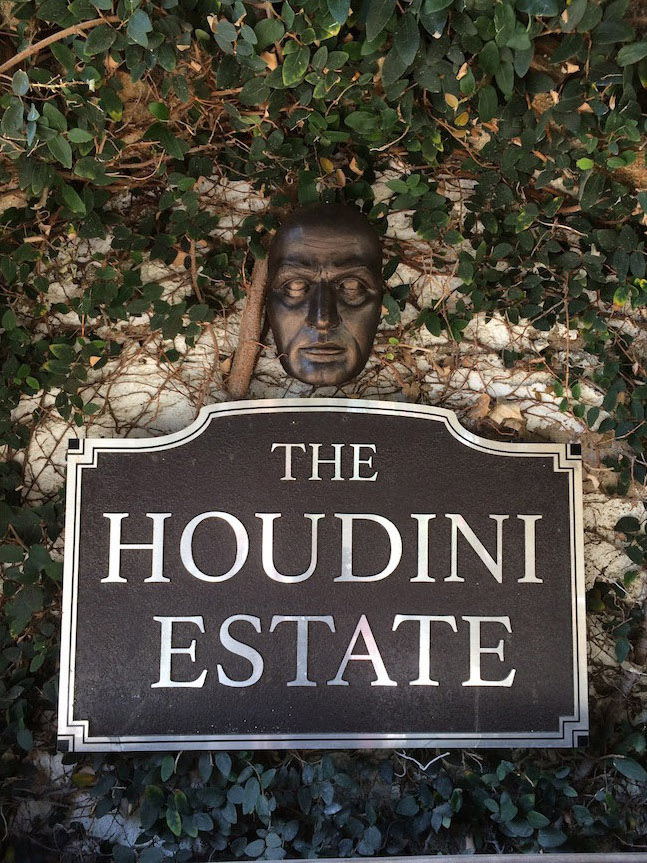
José is also genuinely interested in Houdini history and, as I said, generously allowed Patrick Culliton and I to freely roam the restored grounds of landscaped terraces, waterfalls, and beautiful works of art and statuary (including a massive authentic Buddha). There is also a large bust of Houdini that looks out over the property.

We also got to see inside the old carriage house, which is now expanded and decked out with a new pool and large paintings of Houdini in every room. There we toasted -- with 100-year-old port from José's world-class wine collection -- to the memory of Houdini in a house that is now worthy of the great man himself. It's a magical place indeed!


Sources:
  • "Houdini Lived Here (Well, Maybe)" by Bill Sharpsteen, Los Angeles Times Magazine, March 1, 1998.
  • Houdini is Haunting the Wrong Mansion by Patrick Culliton.
  • Who haunts the Houdini Manson by Richard Carradine.
  • "Houdini Legend Persists at Aging Estate but Facts Are Elusive" by Michael Szymanski, Los Angeles Times, October 29, 1989.
  • "Revelations About The 'Houdini Estate' in Hollywood" by John Booth, The Linking Ring, March 1997.
  • "List of Homes Razed" (unidentified newspaper clipping on 1959 Laurel Canyon fire).
  • Laurel Canyon Stories website by Steve Eastwood.

This story has been updated with new photos and information.

Thursday, March 29, 2012

Inside the Houdini Estate tomorrow

So I've finally written up a blog about my visit last month with Patrick Culliton to the "Houdini Estate" in Laurel Canyon. I know there is a question whether Houdini ever actually lived there, so I did some additional research and will lay out the full history of the famous property. So stop on by WILD ABOUT HARRY tomorrow for a journey Inside the Houdini Estate.

Chef Houdini

Magician, escape artist, author, aviator, actor, crusader...cook! Houdini did it all.

The mighty Kevin Connolly has posted to his blog Houdini Himself excerpts from two cookbooks in which Houdini provided special recipes.

The first is from the awesomely named The Stag Cook Book: A Man's Cook Book for Men (1922), where Houdini provides recipes for "Scalloped Mushrooms and Deviled Eggs."

Next is the Celebrated Actor-Folks' Cookeries: A Collection of The Favorite Foods of Famous Players (1916), in which Houdini gives his recipe for "Bread-and-Butter Custard." Says Harry, "I happen to have a weakness for sweets, and this is one you will not find in any other cook book."

So did Houdini really create these recipes or just lend his name to these books? Hey, I'm not here to reveal Houdini's secrets. But I'm willing to bet he was a better cook than Thurston!

Wednesday, March 28, 2012

Sherry and Krall perform Houdini's Water Torture Cell

Here's one we've been waiting for. This is video of Richard Sherry and Dayle Krall of Sherry and Krall Magic performing their authentic recreation of Houdini's original Chinese Water Torture Cell escape. The video was recorded on Houdini's birthday and commemorates the 100th Anniversary of the cell's debut in 1912.


Burt Randolph Sugar dies at 75


Sportswriter and boxing maven Burt Randolph Sugar, who co-authored the book Houdini His Life and Art with James The Amazing Randi, died on Sunday in Mount Kisco, NY at age 75.

First published as a paperback in 1976, Houdini His Life and Art was one of four coffee table sized Houdini books released to celebrate the 50th Anniversary of Houdini's death. It's actually an excellent book, under-rated as a biography, with sores of rare photographs. It was released as a hardcover in 1977 and has not been reprinted since. The copyright page shows Sugar as the sole copyright owner.

Click here to read Burt Sugar's obituary at The New York Times.

Thanks to Kevin Connolly at Houdini Himself for the alert.

Animatronic Houdini now appearing in Las Vegas

Houdini's Magic Shop at the New York New York Hotel and Casino in Las Vegas has added a life-sized animatronic Houdini mannequin escaping from a straight-jacket upside-down to their store. This pic comes from our friend MSW. I love it!

Tuesday, March 27, 2012

Wikipedia robs Houdini of his first Australian flight

It appears partisans in the ongoing pissing match over which region in Australia can celebrate the first airplane flight have struck the Houdini Wikipedia page and erased Houdini's status as the first man to fly on the continent, despite Australia's own historical record.

The aviation section, which I originally wrote for Wiki, now has Houdini's aviation career whittled down to a single small paragraph, eliminating Houdini's historic flight (and the fact that it was certified by the Aerial League of Australia as the first), and have instead devoted five rambling paragraphs to Colin Defries career and claim that he was first under the heading [Houdini] "Falsely reported as pioneer."

I went in and rewrote the section again, and included a reference to Defries claim because I do think that part of the story. But it was reverted by the same Defries-fixated user who added that my blog on Houdini's flight (sourced from the Houdini biographies by Ken Silverman and Bill Kalush) was "such an epic fail I wouldn't bother using it for anything."

Amazingly, Wikipedia -- which is usually very good about deleting bias and agenda driven edits -- is so far allowing these changes to stand, despite my repeated objections in the article's discussion area and two editors agreeing with me. At this point, all I can do is throw up my hands.

As I said, I wrote large sections of the Wiki Houdini page years back when it badly needed to be fleshed out by someone with some knowledge of Houdini. But over the years I've seen it modified by nuts, mischief makers, and people with agendas and/or bad information. The result is an unbalanced page that is now riddled with inaccuracies and weirdness. Certainly not what we want for our Harry.

Sorry for the negative post. I just needed to vent.

You can read my "epic fail" blog about Houdini's first Australian flight here. You can also read original newspaper stories, watch video, and see affidavits verifying Houdini's first and subsequent flights in Australia at Harry Houdini: Aviation Pioneer.

Monday, March 26, 2012

American Pickers are searching for Houdini


I love the History Channel show American Pickers, which follows Mike Wolfe and Frank Fritz as they travel around the country picking through people's garages and barns in search of "rusty gold." It appears the pickers are headed next to Pennsylvania, and according to Berks-Mount News, the show's producers are looking for fresh leads.

"Among the items Wolfe and Fritz are on the lookout for are motor scooters, Harry Houdini items, old advertising signage, old rodeo items, motorcycles, bicycles, military items from the late 1970s or earlier, Civil War antiques and old toys."

I admit whenever I watch the show I fantasize about seeing Mike and Frank pull an original King of Cards poster or a Magic Made Easy pitchbook from a pile of junk. Maybe this season...

Click here to see the Pickers full want list.

UPDATE: American Pickers find Houdini in Leadville.

Houdini's close call

Here is the only known photo of Houdini escaping after being tied to a burning stake. This challenge was made by the Boy Scouts of America and went wrong when the overenthusiastic scouts doused the flames with gasoline. By the time he was free, Houdini's clothes were singed. It was the only time he did such a fire escape.


UPDATE: You can now see more photos from this challenge: Rare photo shows Houdini staked out and Ransom Center shares Harry Houdini Scrapbook Collection online.

UPDATE 2: Christine U'Ren has identified this escape as talking place in San Francisco on or around April 7, 1923. Read more.

Saturday, March 24, 2012

HAPPY BIRTHDAY HOUDINI 2012

Today is the birthday of Harry Houdini, who was born 138 years ago on March 24, 1874 in Budapest, Hungary to Mayer Samuel and Cecilia Steiner Weiss. Today everyone is wild about Harry!

The Birthday Boy

Birthday wishes from the blogosphere:
Carnegie: Magic Detective: Happy Birthday Houdini
Houdini Himself: Happy Birthday Houdini
Houdini Museum: Happy birthday, Harry!
Every Day is Special: Happy Birthday, Harry Houdini
The Greenbelt: Happy Birthday, Harry
The Great Kat Shred Guitar Blog: Happy 138th Birthday Houdini!
Musings of a Mad Writer in LalaLand: Celebrating Harry Houdini’s bday...
Anneographies: March 24 Birthday: Harry Houdini
Mumanhakim: Happy Birthday, Harry Houdini
The Fabulous Birthday Blog: March 24 - Happy Birthday Mr. Harry Houdini
Wis U.P. North: Harry Houdini Born On This Day In 1874

The Magic Cafe: Happy B-Day Houdini
The Magicompany Happy Birthday Harry Houdini!
MacQueBlogSpot: Happy Birthday Harry Houdini

National Post: A magician's birthday

Friday, March 23, 2012

The biggest myth

Nowadays, most people seem to know that Houdini did not die in his Water Torture Cell. Most are now aware of the dressing room punch, and even those who still think the punch led to him becoming trapped in the cell are open to hearing the truth.

But let me tell you, this was not the case in the 1970s, especially in 1976 when there was a renaissance of interest in Houdini with the 50th anniversary of his death. As a young "Houdini Enthusiast," I can't tell you how many times I had to argue that Houdini didn't die in the USD and how I was generally disbelieved (even once by a teacher). After all, they had seen it in a movie!

Of course, they were right about that. They had seen it in a movie. The myth of Houdini drowning in his Water Torture Cell (or the "Pagoda Torture Cell," as the movie called it) was born of the 1953 film Houdini, starring Tony Curtis and Janet Leigh. Why the filmmakers decided to give Houdini such a dramatic and wildly inaccurate death is unknown, but it might have been rooted in Harry Cohn's early complaint that the Houdini story "lacked romance and needed a better ending than a punch in the solar plexus." Paramount gave it both.

It didn't help that the 1976 TV movie The Great Houdinis also depicted Houdini failing to escape from the cell. But at least they hedged it with a freeze frame and voiceover stating that he died in Grace Hospital.

However, Hollywood isn't completely to blame. Magicians at the time freely traded on the misconception of Houdini's death. Below are two adverts from 1976--one for Charlie Myrick and the other for the great Steve Baker--that flat out say Houdini died in the Water Torture Cell. I believe even Doug Henning alluded to this during his famous first NBC special.


But, as I said, the myth of Houdini's drowning death is much less prevalent these days, and in the age of the Internet, it's easy enough for anyone to fact-check something like this. That's why I now really enjoy items like the adverts above. It's part of the Houdini story--part of his posthumous history--that at one time people widely believed he died onstage doing his most famous escape.

What'd I do?

Thursday, March 22, 2012

Latest Houdini-Holmes crossover now shipping

Even though the release date says March 27, Sherlock Holmes: The Crossovers Casebook is shipping now from Amazon.

This new collection of Holmes short stories finds the great detective teaming up with notables of his era such as Arsene Lupin, Lawrence of Arabia, Calamity Jane, Sexton Blake, Colonel Savage (Doc's father), and, yes, Houdini!

The Houdini-Homes story is called "The Adventure of the Magician's Meetings" and is written by Larry Engle and Kevin VanHook. In it, Holmes and Houdini investigate a mystery involving a fake medium.

Purchase Sherlock Holmes: The Crossovers Casebook at Amazon.com.

Wednesday, March 21, 2012

What happened to Hollywood Magic's Houdini?

For over sixty years, the preeminent magic shop in Los Angeles was Hollywood Magic, which opened on Hollywood Blvd in 1942. This was one of the magic shops I frequented. I even got my first straitjacket there. Sadly, Hollywood Magic abruptly (and bizarrely) closed in 2008. It was real loss to the L.A. magic community.

One memory of Hollywood Magic is that they had a large portrait painting of Houdini that hung high on the wall along with portraits of Thurston, Blackstone, and other magic greats. The image always baffled me somewhat as Houdini appears to have white hair. Nevertheless, it's still a great portrait, and I suspect it dates back to the days of the store's opening, which means Bess Houdini may have gazed up on this image of her husband.


My question is, whatever happened to Hollywood Magic's Houdini?

Tuesday, March 20, 2012

Ad shows Houdini performed Buried Alive in 1926

The story on Houdini's "Buried Alive" just keeps on changing (or evolving). For years the conventional wisdom has been that Houdini's stage bound version -- which is advertised in two well-known posters and might have been developed as early as 1914 -- was something he planned to introduce in his 1927 season as a replacement for the Water Torture Cell. Unfortunately, he died in 1926 and the effect went unperformed.

But now this newspaper advert has surfaced on eBay that shows Houdini was performing the Buried Alive in 1926, at least at this theater. Note a feature for the evening is: "Buried Alive Under Tons of Sand."


Now, we know Houdini is still doing the USD in October 1926 (when he breaks his ankle), so maybe this was just a trial run of Buried Alive? "Slicing a Woman in Seven Parts" also appears to be something new. Or maybe it was an effect that could only be performed in certain venues. Certainly transporting "tons of sand" must not have been easy.

Seeing as Houdini was performing the Buried Alive in 1926, I'm hoping a photograph or review of the effect survives. I still have trouble getting my head around exactly how Houdini staged what must have been an enormous stage escape.

Unfortunately this ad does no show the exact date or city, but judging by "Mass" on the adjoining ad, this appears to be the Majestic Theater in Boston where Houdini performed from Sept 6-18, 1926 (Koval).

Time to hit the archives!

UPDATE: Houdini on being Buried Alive: "I like it very much."

UPDATE 2: I've been able to establish that this ad comes from Houdini's third and final week at the Majestic Theater in Boston (September 20-27). During his first two weeks he performed the Water Torture Cell.

Translate