Preorders begin in 1 day.

Wednesday, August 15, 2012

Death Defying Acts (2008)

In many ways, Death Defying Acts is the model for how not to make a film about Houdini. It opts for fiction over fact, spiritualism over magic and escapes, and incident over biography. It even omits Houdini's name from the title. What the filmmakers thought would be the "hook" of this movie is beyond me, except that it starred Catherine Zeta-Jones.

But having said that, Death Defying Acts is not without merit, and it was good to see Houdini in any form back on the big screen, if only for one week.

From the start, Death Defying Acts was more about the role of the fictional Mary McGarvie than Houdini. This was clear when the project was first announced in the trades as Death Defying Feats in 2005. At that time, Rachel Weisz was set for the co-starring role. Weisz even said she believed she might be related to Houdini! But even with the casting of Guy Pearce as Houdini the project would have trouble getting off the ground until Catherine Zeta-Jones, fresh off her Oscar win for Chicago, took over the role of Mary, reportedly agreeing to a pay cut that "saved the film."

Directed by Gillian Armstrong with a script by Tony Grisoni and Brian Ward, Death Defying Acts tells the fictional story of Houdini's obsessive search for a medium who can prove communication with the dead (and his mother) during a tour of Scotland in 1926. Houdini discovers McGarvie, a Scottish Music Hall clairvoyant, who along with her young daughter, Benji (nicely played by Saoirse Ronan), manipulates matters to get inside Houdini's cloistered world. Ultimately the two tricksters fall in love.

The film was shot in Edinburgh (where it is set) and in London's Savoy Hotel. Much was made by the British tabloid press about an on-set injury to star Zeta-Jones when a member of the crew accidentally stepped on her toe. The Sun reported that, "It virtually took the toenail clean off." Executive producer Dan Lupovitz threw cold water on the story by saying, "It was as minor incident which hardly disrupted filming. She's fine."

In the film, Guy Pearce plays Houdini as a bit of a primadonna who berates hotel porters and barks at his (fictional) manager, Mr. Sugarman (Timothy Spall). Pearce also effects a husky, gravelly voice. The result is the least likable Houdini of them all, although Pearce certainly looks the part with a very Houdini-like physique (although he's the Houdini of 1906 rather than 1926). Says Pearce: "There’s footage of Houdini and there’s audio stuff of him, but I decided to go in a completely different direction and really just work off what my own imaginative response was to the script anyway, I think, rather than really just trying to channel somebody."


The real highlight of Death Defying Acts is the outstanding production design by Gemma Jackson. The opening bridge jump in Sydney Harbor is truly evocative of the period. Many authentic Houdini photos are recreated with Pearce's likeness. Houdini's stationary is even accurately reproduced. The Chinese Water Torture Cell is nicely recreated, although Pearce's patter is hokey and its conclusion, with Pearce lounging across the top like a beach boy, seems out of character. While Bess does not appear in the film, her photograph does. Oddly, the filmmakers elected not to use a photo of the real Bess, but a photo of an unknown actress. Who is this mystery Bessie?

For once a Hollywood film does not portray Houdini as dying in the Water Torture Cell. However Death Defying Acts takes the punch in the stomach story to a new mythic level by having Houdini struck in public and dropping dead on the spot. The so credited "Montreal student", played by Justin Flagg, shouts "Trick or Treat" before he delivers the fatal blow. The punch, and Houdini's problematic appendix, are set-up throughout the film, but the depiction of his sudden death seems a bit lazy.

Produced for less than $20 million, Death Defying Acts was financed through the Australian Film Finance Corp., BBC Films and Myriad Pictures. After it was completed, The Weinstein Company bought the film after viewing a promo reel at the American Film Market, paying a reported $5.5 million for limited distribution rights. Myriad Pictures had already sold distribution rights in the U.K. to Lionsgate.

Death Defying Acts had its world premiere at the State Theater in Sydney Australia on March 10, 2008. A VIP after-party was held at the Zeta Bar at the Sydney Hilton. The film never saw a wide theatrical release in the U.S. Instead, the film played for only one week in two theaters: the Landmark’s Sunshine Cinema in New York and Manns Chinese Theater 6 in Hollywood (where I saw it on July 11, 2008).

The film actually received a good review in the Los Angeles Times, which stated; "Death Defying Acts is far more diverting and well crafted than its promotion-free release campaign might suggest. What the film loses in momentum as the romance takes over, it gains in sex appeal as its two attractive actors make their own kind of magic."

Death Defying Acts wasn't entirely "promotion-free". There was a novelization written by Greg Cox released by Pocket Books (left). This was only the second time a Houdini film was novelized (the first being The Great Houdinis in 1976). A CD soundtrack of the score by Cezary Skubiszewski was also released, and marked the first time a Houdini movie soundtrack made it into stores.

Death Defying Acts was released on DVD on October 28, 2008. The DVD packaging wisely carried a new subtitle, "Houdini's Secret". In some territories the title became Houdini's Death Defying Acts. The DVD includes commentary by director Gillian Armstrong and producer Marian MacGowan, and a Making Of documentary. A Blockbuster Exclusive DVD contained a short documentary, Houdini: The Man Behind The Magic, featuring the stars and filmmakers discussing the real Houdini.

Death Defying Acts is an interesting addition to the Houdini film canon. While maybe not the Houdini film we wanted for the 21st Century, its sincerity makes up for its flaws.


Death Defying Acts plays the Chinese 6 in Hollywood in 2008.

Also enjoy:

Tuesday, August 14, 2012

Houdini in the transport chain

Here's a terrific shot of Houdini in the Siberian Transport Chain, a popular effect that can still be purchased in magic shops today. This photo was most likely taken during the same 1901/02 photo session in Germany that produced the famous loincloth shots. This pic comes from an unrelated eBay auction for a "Scotch and Soda Coin Trick".


As with his Needles, I sometimes wonder whether Houdini carried around a Transport Chain as pocket magic. He seems always ready with a chain on hand. There is a photo of him appearing to be giving an impromptu performance of the escape for a group of WWI doughboys in The Secret Life of Houdini, page 336.

The effect is also sometime called the German Transport Chain and, as one might expect, the Houdini Transport Chain.

Saturday, August 11, 2012

Original Houdini handcuff photo locks down $687

Despite being in pretty poor condition, an original photo of Houdini in shackles sold on eBay today for an impressive $687 (the auction started at $14.99 without a reserve).

Taken in 1904 at the height of his fame as "The Handcuff King", this shot was used to illustrate Houdini's beautiful Europe's Eclipsing Sensation poster. It also appeared on the cover of his pitchbooks, tobacco cards, and continues to be widely used on book covers today. In many ways, it's the quintessential image of the great escape artist. This is probably why it fetched top dollar.

As always, congrats to the winner.

Friday, August 10, 2012

"Had Houdini lived he would have written this book"

Today I kick off a new series looking at books written about Houdini. I'll show the different cover art and discuss the publication history (to the best of my ability). All book images are from my own collection.

"Had Houdini lived he would have written this book." This is what Houdini's lawyer, Bernard M. L. Ernst, wrote in his preface to Houdini's Escapes, which first saw publication in 1930. Ernst goes on to explain:

"During the summer of 1926, only a few months before his death he sent me a mass of material including rough notes, drawings, blue prints, and manuscripts, with the request that it be arranged, edited and published in a series of books on magic and escapes with which his name should be connected. [...] As late as October 9, 1926, the last day he was in New York, before his death at Detroit, Mich., on October 31, 1926, he again spoke to me at my home about the projected books, and referred to additional material he had for such use."

After Houdini's death, Ernst handed the task of compiling the books to Walter B. Gibson, who was working with Houdini on a set of three books on intermediate magic at the time (the one book Gibson had finished, Popular Card Tricks, was published under his own name in 1928). In 1930 Houdini's Escapes was published by Harcourt, Brace and Company. A second volume, Houdini's Magic, would follow in 1932. A combo edition called Houdini's Escapes and Magic was published by Blue Ribbon in 1932, although the first edition shows the original 1930 copyright of Escapes, which can cause some confusion.

Houdini's Escapes (1930) and Houdini's Magic (1932).
Houdini's Escapes and Magic combo editions from 1932 and 1976.

The content of the books consist largely of Houdini effects that were never produced, such as an escape from a packing crate sent over Niagara Falls ("This can be worked into an extra good idea and needs doing some time.") and Houdini's oft discussed "escape from a block of ice". Ernst says in his forward that classic Houdini effects, such as the Water Torture Cell and the Vanishing Elephant, were deliberately omitted, and that the content was approved by the "Committee on Exposures of the Society of American Magicians" and Houdini's brother Hardeen. Nevertheless, these books still offer a terrific peek inside Houdini's mind and workshop.

Unlike many early Houdini books, the copyright on Houdini's Escapes and Houdini's Magic was not allowed to lapse into the public domain. The Ernst family, via Roberta Ernst, renewed the copyright on Escapes in 1958 and Magic in 1960. However, the books themselves remained long out of print.

Then in 1976 during the Houdini renaissance generated by the 50th Anniversary of his death, these books again saw publication. A new combo edition was published in both hardcover and trade paperback in January by Funk & Wagnalls. Individual mass market paperbacks where published by Bantam in November. These paperbacks included dramatic Houdini artwork on the backs. All the '76 editions contained a new introduction by Houdini biographer Milbourne Christopher, in which he notes: "It is fortunate this work is in print. Some of Houdini's notes, all of which Gibson returned, have since disappeared." (!)

1976 mass market paperbacks.
The 1976 paperbacks featured dramatic artwork on the back.

In 1980 a Canadian edition of Houdini's Escapes was published by Coles under the title, Houdini's Amazing Escapes. A reprint of Houdini's Escapes and Magic with a new forward by Sam Sloan was released in 2011 by Ishi Press. That edition used the cover art from the 1976 edition.

1980 Canadian edition of Escapes and the 2011 Ishi Press reprint.

If I've left out any important details or missed any editions, please let me know by leaving a Comment below.

Also enjoy:

Thursday, August 9, 2012

Climb inside Houdini's Milk Can, if you dare

Check this terrific pic of the Milk Can on display as part of the Chicago History Museum's Magic exhibition. Very clever! This shot is from an article about the exhibition in the Chicago Tribune.


The Milk Can on display is from the collection of the American Museum of Magic in Marshall, Michigan. Before the Chicago stop it had travelled with the Houdini Art and Magic exhibition. As I've speculated in a few blog posts, I believe it's actually Hardeen's Milk Can.

Magic runs through the first week of January 2013. Click for more information at the Chicago History Museum website.

Wednesday, August 8, 2012

Genii & Houdini: October 1956

Continuing our look back at issues of Genii magazine that have celebrated Houdini on their covers, here's Vol. 21, No. 2 from October 1956. This "Houdini Memorial Issue" (back to being an annual tradition) featured a dramatic bronze Houdini bust by Italian craftsman Nicholas Volpe on the cover.


Inside the magazine profiles Volpe's life and work, "The Magic in Art", and his desire to "recreate the face and legend of this master of magic." Where is the Volpe bust today, I wonder? It also has an article by David Price of the Egyptian Hall about a 1902 photograph of Harry and Bess.

But the real Houdini highlight in this issue is the full transcript of William Larsen Sr.'s lecture about the Final Houdini Seance in 1936. Larsen was an attendee of the seance. A lot of the information is familiar, but there are few new nuggets, such as that the night was "uncommonly cold" and that some guests "had the foresight to prepare for the occasion by stopping in at the Knickerbocker cocktail bar." Then there is this:

Now it seems that Dr. DiGhilini, a well-known West Coast mystery worker and a few other outstanding magicians didn't really believe anything was going to happen. They feared that the invited guests and the waiting world were doomed to bitter disappointment. So, they offered their services to help better matters. It would be excellent, they told Dr. Saint, to get Houdini's handwriting on the slate and they could assure its appearance there. Or, to cause a dove to fly up from the center of the table, seemingly created out of nothing. Dr. Saint refused these generous offers.


Also in this issue editor Bill Larsen Jr. announces the engagement of his mother Gerri (a close friend to Bessie in her final years) to Art Baker, a television personality most well-known for the show You Asked For It (which featured Houdini clips from time to time).

Coming next: October 1961

Tuesday, August 7, 2012

Houdini scores a double today

Need further evidence of the popularity of Houdini 86 years after his death? Well, how about the fact that today sees the release of two books aimed at kids that feature a young Harry Houdini as a character.

First up is The Treasure Chest #4: Prince of Air by Ann Hood. This series finds twins Maisie and Felix transported via a treasure chest time machine into the past where they meet up with famous historical figures. In this latest adventure the twins meet, you guessed it, Houdini!

The secrets of Elm Medona thicken...with Harry Houdini!

When Great-Uncle Thorne arrives at Elm Medona, Maisie and Felix's lives get shaken up again. Uncle Thorne moves the family into the mansion proper. One night, Great-Aunt Maisie arranges for Thorne, Maisie, and Felix to rendezvous with her in The Treasure Chest. Minutes later, Maisie and Felix find themselves at a magic show on Coney Island in 1893 starring Harry Houdini. As they follow him and his brother Dash to Pennsylvania and Rhode Island and back to New York City, they wonder what has become of Great-Aunt Maisie and Great-Uncle Thorne. Then one evening at Tom Pastor's Famous 14th Street Theater, the curtain opens and all is revealed.

The Treasure Chest: Prince of Air can be purchased at Amazon.com in both hardcover and paperback.

Also out today is the latest installment of Scholastic's popular interactive and multi-platform series, The 39 Clues. This time Houdini joins the adventure in The Cahill Files Book 4: The Houdini Escape by Clifford Riley.

Young Harry Houdini's family is eager for a fresh start in America, but secrets from their past have followed them to New York. When the aspiring magician is kidnapped by a dangerous enemy, the Vespers, Houdini discovers a secret talent: death-defying escapes. Will his rare talent allow him to survive the attack? Or will it get him into deeper trouble than he ever imagined?

The Houdini Escape is currently available only as an eBook. It can be purchased at Amazon.com.

Monday, August 6, 2012

Houdini on early television

Following up on my Fractured Mystery post about an early appearance of Houdini footage on T.V., Bill Mullins at the Genii forum has provided a list of even earlier appearances from his own collection:

The Washington Post, Feb 7, 1951, WMAL-TV – 6:45. "Yesterday's Newsreel" includes films of Theodore Roosevelt, Theda Bara, Harry Houdini, 1932 Olympics and second Johnstown flood. 
Los Angeles Times, July 6, 1953, p 24: Producer George Pal brings a movie of the famed Houdini in his spectacular under-water escape stunt when he guests on Art Baker's "You Asked for It" show, KECA (7) at 8 p.m. [This appears to be footage from the 1953 Houdini movie and not the real Harry.]
Washington Post, July 19, 1953, 7 p.m. – WMAL-TV. The life of magician Harry Houdini and his fabulous escapes is presented because "You Asked for It." 
Los Angeles Times, Dec. 4, 1960 (listings for Dec. 9): [channel] 13; Danger Zone (30 min.) Pappy Boyington shows films of some famous freak accidents, including the collapse of the Tacoma Bridge in 1940; the crash of a B-25 into the Empire State Building; and the late Houdini is seen in one of his well-known stunts.

Bill adds: "The 1951 show appears to be a clip show from newsreels. Prior to this, there were many other newsreel shows, and most of the listings for them didn't break out the contents. No doubt others ran Houdini footage before this one."

Thank you, Bill!

UPDATE: It now turns out the You Asked For It appearance in July 1953 was indeed film of the real Houdini, and lost footage at that! Read more here.

LINK: Great escape: Magician, wife want to free memorabilia

Click the headline for an article in the State Journal Register about the great Steve Baker (Mr. Escape) and his desire to rescue his props and memorabilia from a storage locker in California. Lots of info about Steve's career and the influence of Houdini.


Hopefully someone will step forward and help Steve preserve his legacy.

Sunday, August 5, 2012

Shelton pool test anniversary

Today is the anniversary of Houdini's famous test in the pool of the Hotel Shelton in New York City on August 5, 1926. In a bid to outdo and expose the "mystic" Rahman Bey, Houdini remained sealed in a submerged casket, which contained only a limited amount of air, for a full 91 minutes. He attributed his survival to remaining calm and controlled breathing and not to any trickery or supernatural power.

The Shelton Test is sometimes called "Houdini's last trick", although we now know he repeated the test at the Worcester YMCA and did a non-submerged version at Summerfield's department store. Still, it was certainly Houdini's last wildly covered publicity stunt, and anticipated the public endurance tests of modern magicians like David Blaine.

The New York American, August 6, 1926

A wonderful first hand account of test written by Houdini himself can be read at the blog Letters of Note. The Hotel Shelton is today the Marriott New York East Side, but the hotel restaurant still bares the name "Shelton Grill." The pool where Houdini performed his famous test was filled in in the early 2000s.


Houdini's Shelton test is being recognized today on other blogs such as Slice The Life and Jewish Currents, who I have to thank for reminding me of this anniversary.

Saturday, August 4, 2012

Houdini eComic for iPad and iPhone


Rok Comics, a "champion of independent comics on mobile", have released Houdini: Mists of London by Jamie Allan Nicklin and Simon Mark Wheeler, the first of what appears to be a series of eComics featuring the (fictional) adventures of Houdini.

This clever 28-page electronic comic has swipe to read navigation, a full audio soundtrack featuring the voices of Jerry Curran as Houdini and Shanna Sharp as Bess, and pop-up extras profiling key characters and the world of Houdini. Artwork is by Rafael Broseta and David Belmonte. Here's more from Comic Cloud:

Rok Comics is proud to present the audio-enhanced adventures of the world's best-known escape artist Houdini, featuring a full soundtrack that brings the story added life and excitement! 
Terror stalks the streets of Victorian London as a masked villain known as the Vanished Man kidnaps the partners of the rich and famous for huge ransoms! But has he bitten off more than he can chew when he snatches Houdini's wife, Bess, from the dressing room of the Alhambra Theatre? 
Join Houdini and the best of Scotland Yard as he races to catch his dangerous foe before he harms his much-loved wife – and discover a deeper mystery behind the first! 
Houdini: The Mists of London is a Rok Comcs production with art by Rafael Broseta and David Belmonte, backed by a full voice cast and soundtrack!

You can download Houdini: Mists of London FREE via the iTunes Store. Compatible with iPhone 3GS, iPhone 4, iPhone 4S, iPod touch (3rd generation), iPod touch (4th generation) and iPad. Requires iOS 5.1 or later.

Friday, August 3, 2012

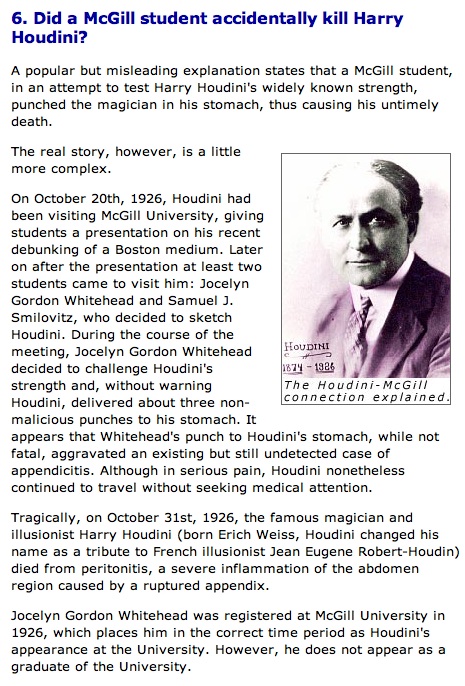
The McGill explanation

The official website for McGill University in Montreal has an FAQ section and one of those FAQs is, as you might expect, what role a University student played in Houdini's death. Here is their answer:


Pretty good answer (despite misspelling Ehrich). However, the University is certainly taking a path that resolves Whitehead -- and by extension the school -- of any responsibility. While many now believe Houdini had a developing case of appendicitis when he was struck, there are some, like Houdini expert Patrick Culliton (Houdini's Ghost), who believes the punches did cause Houdini's illness. And there are others, most notably the gang at the Houdini Museum in Scranton, who would not categorize Whitehead's blows as "non-malicious". They believe Whitehead had every intention of doing serious harm to Houdini that day.

It is interesting that the answer confirms Whitehead's enrollment in 1926. I believe Don Bell in his seminal work, The Man Who Killed Houdini, said he was never able to confirm that Whitehead was ever actually a student. News that Whitehead never graduated is also new, although I think this was always assumed.

Something tells me the question of Whitehead's intent and the timing of Houdini's illness might never be entirely resolved.


Thursday, August 2, 2012

La Maitre du Mystere

The mighty Arthur Moses offers us a peek today at a new find. These French Pathe movie programs from 1920 advertise Houdini's serial, The Master Mystery (La Maitre du Mystere). Some very nice imagery here. Note the photo of the elevator shaft scene on the last program. This is not a shot I'm familiar with, but it appears to be the inspiration for the spectacular French Master Mystery poster that sold in auction in 2008.


Merci Arthur!

Wednesday, August 1, 2012

Reagan in the seance room

Last month I reported on a recent Houdini seance at the Magic Castle attended by Bobby Kennedy Jr. In the interest of non-partisanship, here's one from the other side of the political aisle.

www.magiccastle.com

In the latest Magic Castle newsletter, medium Leo Kostka writes about the evening of November 26, 1991, when former President Ronald Reagan and First Lady Nancy Reagan attended a Houdini Seance with friends. Leo says there were eight Secret Service men keeping watch over the room, four on each door. He says he was pretty nervous and "investigated every working part of the seance room in preparation so that nothing would go wrong."

It still amazes me to think that the Secret Service would allow the lights to be fully extinguished and objects to unexpectedly fly about the room, but I'm assuming The Gipper got the full treatment!

By the way, how awesome is it that Reagan is wearing a Houdini Seance button on his jacket in the above pic? Guess he couldn't get into the room if he wasn't! Be cool to think that his Secret Service detail were also all sporting these. Reagan's button is the old style, which looked like this:


President Obama and Michelle...you're up!

Translate