Wednesday, August 14, 2013

A sober recap of Drunk History's Houdini episode


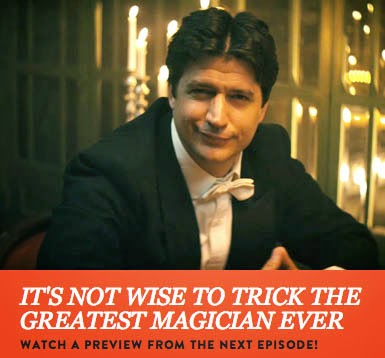
Last night Drunk History aired a segment about Houdini in an episode titled, "Detroit." For those who aren't familiar with the Comedy Central series, Drunk History features soused storytellers talking about real history while well-known actors perform their inebriated version of events. It's pretty funny stuff.

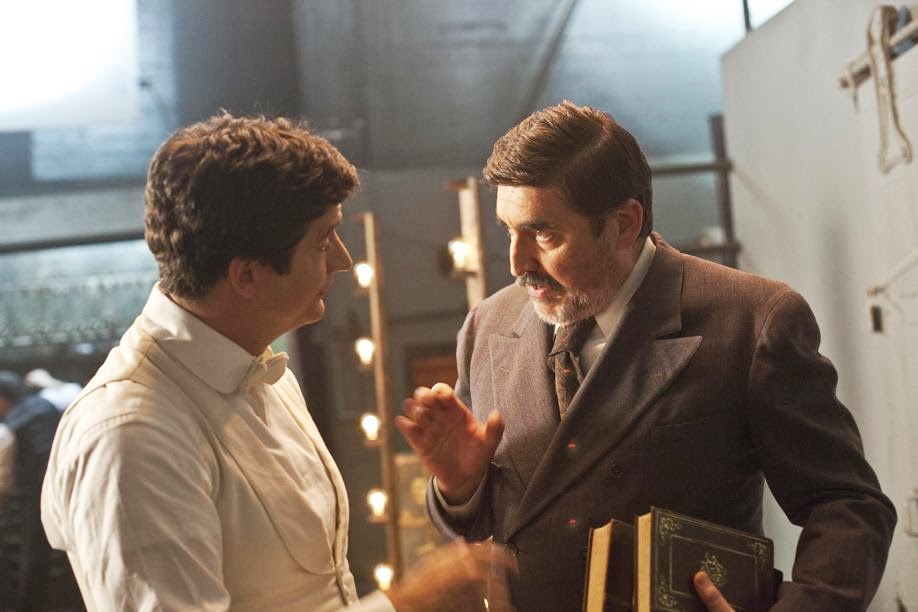
In last night's episode, Ken Marino and Alfred Molina played Houdini and Sir Arthur Conan Doyle respectively. The storyteller was Lucius Dillon, who was very, very drunk. The Houdini segment was the last, longest, and drunkest of the show. It was broken up by a commercial break.

For all the frivolity of their approach, Drunk History actually did a good job with their Houdini history -- far more responsible and accurate than some of the recent offerings from the cable networks (yes, Brad Meltzer's Decoded, I'm still talking about you). While there were no egregious inaccuracies, I can offer up a few picky points of clarification. So let's do this thing.

1234...

Houdini and Bess (played by Maria Blasucci) did indeed work briefly as spirit mediums early in their careers. However, they did a stage act, not private consultation as depicted in the reenactment. Also, I don't know where that bit about Bess posing as a "Bible salesman" to glean personal information came from. That must have been the booze talking.

Atlantic City 1922 is the correct date and location of the Houdini-Doyle seance. However, the show depicted Houdini as performing there with Doyle visiting him backstage. In reality the Houdinis were vacationing with the Doyles when the big seance went down.

The seance with Lady Doyle (played by Sarah Burns) was depicted as being spoken communication, whereas in reality it was all done via "Automatic Writing." In fairness, Dillon did say the communication would be done with "handwriting", but it was much funnier having the Burns/Dillon wildly articulate the ghostly words from Houdini's mother. Houdini did indeed ask if his mother's ghost could read his mind, and Lady Doyle did make the sign of the cross on the top of her notepad. The show depicted Houdini as blowing his top at the seance, but in reality he kept his feelings to himself at that sitting.

Houdini did wear disguises to seances (here's one) and aggressively exposed mediums on the spot. Whether or not he flipped them a double bird on his way out the door...only the spirits know.

1234...

The dressing room assault by J. Gordon Whitehead (here played by show creator Derek Waters) was not quite as abrupt as depicted in the reenactment. Houdini was also reclining on a couch at the time of the blows. The reenactment suggested a stricken Houdini went right from his dressing room to his final performance, but in reality the assault happened while Houdini was in Montreal. He traveled to Detroit to give his last performance two days later.

Houdini did indeed perform his final show at the Garrick Theater with a 104 degree temperature and a burst appendix (which probably ruptured on the overnight train ride to Detroit), although his appendicitis would not be discovered until he was operated on the next day. Houdini final performance was not as sloppy as shown in the reenactment, although the interior agony of it might have been very accurate for what Houdini himself was experiencing. There was indeed a man in the audience who had seen Houdini before (not sure about "8 times") who sensed that something was wrong. Others who had not seen Houdini thought the show was pretty good.

Houdini did die in Grace Hospital in Detroit on Halloween, although the Doyles were not by his bedside. Houdini died with his brother Hardeen by his side. His doctors at the time were noncommittal about whether the blows caused the fatal infection. That would be fought about between his lawyer, Bernard Ernst, and the New York Life Insurance Co. for the next year. Ernst ultimately succeeded in pinning the cause of Houdini's final illness on the blows, which enabled Bess to collect double indemnity for accidental death. The debate as to whether Houdini was suffering from appendicitis before the blows continues to this day.

The "10 year compact" is something that might need to be tackled in a fresh post at some point, because exactly what Harry and Bess arranged is not so straight forward as that. But for now, yes, Houdini and his wife arranged a codeword that would identify him should he come back. Bess did give up on seances after 10 years and she did say, "Ten years is long enough to wait for any man." And, yes, Bess's hair was white by then.

So there's your sober recap of Drunk History. Kudos to the show for treating our man right and doing a good job with the history while still having a lot of fun.

Cheers.

Houdini and the Doyles in Atlantic City at the time of the seance.

Monday, August 12, 2013

Seeing double on The Grim Game set

Recently our friend Joe Notaro discovered several rare behind the scenes shots from The Grim Game in the book, Aviators in Early Hollywood by Shawna Kelly. Joe teased a shot of Houdini's stunt dummy on his blog, Harry Houdini Circumstantial Evidence. Now thanks to Marc Wanamaker of the Bison Archives, I can share with you the full original photo.

Marc Wanamaker/Bison Archives. (Click to enlarge)

This shot shows Houdini and co-star Ann Forrest posing with stunt dummies used during production. They are standing in front of one of the bi-planes used in the famous aerial sequence. The Kelly book identifies the other man as Robert F. Kennedy, the stunt man who doubled Houdini in the aviation action (but I'm not sure about that). He is posing with a dummy used to double actor Clifton Allison who played the pilot, Augustus Phillips. All three dummies were used in the shot of the plane as it comes crashing down into a town square following the (real) mid-air collision.

One thing that's interesting is you can clearly see the cast on Houdini's broken left wrist. Houdini had originally sustained the injury during the making of The Master Mystery. The wrist was broken in three places, and after being set, it developed adhesions on the joints and needed to be re-broken by a physician. Even after six months he had not regained full flexibility. He then re-fractured the same wrist when he took a fall from a platform while filming the jail escape sequence in The Grim Game. The injury delayed completion of filming by two weeks, and it's said this was the reason Houdini did not do the famous mid-air plane to plane transfer himself (a blessing in disguise).

Houdini's left wrist continued to give him problems his entire life. Even as late as 1926 the wrist was reported to be at only 50% strength and in traction.

Thanks to Joe Notaro for helping me I.D. the third dummy, and to Marc Wanamaker of the amazing Bison Archives for allowing me to share this terrific image from the set of The Grim Game.

Aviators in Early Hollywood by Shawna Kelly can be purchased on Amazon.

Sunday, August 11, 2013

YO HOUDINI! Episode 2: Death Grip

Magician Adam Steinfeld of Magic Live has posted the second installment of his new Houdini-horror web series, YO HOUDINI!

Episode 2 is called "Death Grip" and was shot at Houdini's grave in Queens. It features the 1926 poem by MacKinlay Kantor, which I recently posted here. Adam tracked down the grandson of Kantor and discovered that he was only 22 when he wrote this tribute poem to Houdini two days after the magician's death. Kantor went on to receive a Pulitzer prize in fiction for his civil war novel, Andersonville.

Adam also incorporates some nice Houdini footage into this installment (with permission from Kino), and gave your humble webmaster a nice "Houdini Consultant" credit. Yay. So enjoy the latest episode of YO HOUDINI! It's getting scary...


For more information and to watch other episodes visit www.YoHoudini.com.

Saturday, August 10, 2013

Houdini vs. Hodgson in new book

A new book, Hodgson: A Collection of Essays by Sam Gafford, collects essays about the life and work of William Hope Hodgson, including "Houdini v Hodgson: The Blackburn Challenge," Gafford's in-depth investigation into what may have been Houdini's most difficult challenge. This essay first appeared in Weird Fiction Review #3. Here's a description of the book:

William Hope Hodgson (1877-1918) wrote many classic of supernatural horror including THE HOUSE ON THE BORDERLAND, THE NIGHT LAND, "The Voice in the Night", "From the Tideless Sea" as well as creating CARNACKI, THE GHOST-FINDER. Since 1992, Sam Gafford has been at the fore-front of Hodgson criticism and scholarship. This book combines several of his most important essays along with newer articles about Hodgson's life and work. Included here is the ground-breaking essay, "Writing Backwards: The Novels of William Hope Hodgson" that led to a completely new evaluation of Hodgson's novels with the revolutionary claim that THE NIGHT LAND was actually the FIRST novel that Hodgson ever wrote! An in-depth investigation of Hodgson's infamous with Harry Houdini in 1902 is the subject of "Houdini v Hodgson: The Blackburn Challenge". This collection provides a foundation for further criticism and study of Hodgson's life and career.

Purchase Hodgson: A Collection of Essays by Sam Gafford on Amazon.

Friday, August 9, 2013

Houdini gets tipsy this Tuesday


Houdini may have been a committed non-drinker, but he's going to get thoroughly blasted on Comedy Central's Drunk History this Tuesday, August 13. The series, created by Derek Waters, features drunk storytellers talking about history while well-known actors perform their inebriated version of events. It's pretty funny stuff.

Drunk History's Tuesday episode is called "Detroit" and will have a segment about Houdini and Spiritualism. Houdini is played by Ken Marino and Alfred Molina plays Sir Arthur Conan Doyle. I don't know who the selected storyteller is, but he'll be drunk!

UPDATE: A sober recap of Drunk History's Houdini episode.

Thursday, August 8, 2013

Mayor to proclaim Sept 27 as 'Dorothy Dietrich Day' in Scranton

Today I have a fantastic exclusive from our good friends at the Houdini Museum in Scranton, PA. Mayor Christopher Doherty will officially proclaim September 27, 2013 as "Dorothy Dietrich Day" in the city of Scranton.

The honor is being bestowed on Dorothy for all the business and tourism her Houdini Museum has brought to the city, as well as the publicity generated when she and Dick Brookz replaced Houdini's bust on his grave in Queens during a "commando" raid in 2011. September 27 marks the second anniversary of that event.

The proclamation will also acknowledge Dorothy's many accomplishments and titles given her over the years, including: The First Lady of Magic, America's #1 Female Magician, The Female Houdini, and the Modern Day Houdini. She's also celebrated as the first and only woman to perform the Bullet Catch in her mouth. Her Scranton-based Houdini Museum -- the only building in the world totally devoted to Houdini -- has celebrated the magician for over two decades, and is the site of the annual Original Houdini Seance. (The museum recently received an amusing mention on The Office.)

I'm very happy to see Dorothy being honored in this way. She's not only a bona fide legend of magic, but she is a tireless and selfless promoter of Houdini's history and legacy. With her museum, radio show, TV appearances, and her continued upkeep of Houdini's gravesite, it could be said that no one is as devoted to persevering Houdini's memory as Dorothy Dietrich. She's one of my heroes.

Congratulations Dorothy!

Wednesday, August 7, 2013

Houdini Begins

When did Harry Houdini become a magician? The answer is not always clear. While there are many tales of young Ehrich Weiss performing acrobatics and magic in five cent circuses in Wisconsin, most serious Houdini biographies attribute the start of his magic career with his reading The Memories of Robert-Houdin in 1891.

But according to the remarkable book, Sixty Years of Psychical Research, written by Houdini's boyhood friend Joseph F. Rinn in 1950, Houdini was giving semi-professional magic performances two years before he ever read the Robert-Houdin book. Rinn's recollections begin on page 65:

[In 1886] I joined the Pastime Athletic Club, which had grounds at Sixty-seventh Street and the East River, where I quickly developed as a runner. I became captain of the club and was its champion sprint runner in 1889, when a new member joined by the name of Ehrich Weiss, who later became famous as Harry Houdini, the magician and escape artist.

As Weiss was ambitious to win a running prize, he turned to me as captain for advice, and under my instruction he trained and won his first prize.

At the time, Weiss (or Houdini, as I shall henceforth call him) was making and lining ties at a low wage for H. Richter's Sons. His ambition to be a boy magician was curtailed by lack of funds for the purchase of paraphernalia, for performances he gave after working hours at small social affairs and in public schools.

When Houdini learned that I was a magic fan and a friend of the Herrmanns, we became good pals.

In the spring of 1889 Houdini has another friends in his shop, named Jacob Hayman, who was a magic fan, and they frequently worked together, giving amateur magic performances.

On April 30, 1889, Houdini informed me that he and Jack Hayman were booked to give a magic performance at some social affair. "I guess we'll make a flop of it," said Houdini ruefully, "because we haven't enough paraphernalia."

"Oh, I can remedy that," I said, "Come over to Martinka's with me and I'll make you a present of some magic apparatus. Consider it my Christmas present," I added, as Houdini was quite proud and touchy about money matters."

As this is before Houdini's exposure to Robert-Houdin, I wonder what named he and Jack used at what sounds like their first professional engagement?

Later in the book, Rinn recalls when his friend read that seminal work of magic and truly set off to become a professional magician:

It was early 1891 that Ehrich Weiss read The Memories of Robert Houdin, the French magician, and determined to become a professional magician under the name of Harry Houdini, which name he legally made his own at a later date.

A short time after he made his decision, he said to me, "I've made up my mind, Joe, to quite my job and become a professional magician under the name of Harry Houdini."

"But Ehrich, you are only seventeen," I protested. "Isn't that rather young to give up a good job for an uncertain theatrical career?

Houdini replied, "It may seem daffy to a solid businessman like you, Joe, but I've the urge in my blood to be a professional magician and nothing can stop me."

"Well, it's your funeral, Ehrich," I said resignedly; "but get a recommendation for your present employer in case you can't make a success of being a magician."

A few days later Houdini saw me and reported: "Well, I've quit my job, Joe. I followed your advice and got a recommendation. Here it is." I read the letter, which I now possess.


H. RICHTER'S SONS
502 & 504 Broadway

New York, April 3, 1891.
To Whom It May Concern:

We hereby certify that Mr. Ehrich Weiss has been in our employ for two years and six months as assistant lining cutter and we cheerfully recommend him as an honest, industrious young man.
H. Richter's Sons

It's interesting that this oft quoted recommendation letter found its way into Rinn's collection. He doesn't say how he got it, but I can imagine Houdini giving to it to his friend once he had achieved fame as The Handcuff King. Maybe he even gave it to him as "a Christmas present."

Joseph F. Rinn (Library of Congress Collection)

Tuesday, August 6, 2013

Houdini in Real Science Adventures 9

Houdini returns for yet another indie graphic novel adventure in Atomic Robo Real Science Adventures #9 by Brian Clevinger. The book is released this month by Red 5 Comics. Here's the plot description:

In the wake of financial panic of 1893, a cabal of industrialists plot to overthrow the government. Their "Black Coat" army stole Nikola Tesla's most top secret technologies. Now they lurk in the shadows of New York City. Starring Charles Fort, Winfield-Scott Lovecraft, and Ehrie "Harry Houdini" Weiss!

You can find Atomic Robo Real Science Adventures #9 at comic books stores and websites such as Midtown Comics.

UPDATE: This is the first in a serialized story, so you can look forward to more action with Ehrie "Harry Houdini" Weiss in Real Science Adventures #10, #11, and #12, coming soon.

LINK: Harry Potter star Evanna Lynch on becoming Houdini’s wife

The Irish Post has a nice interview and profile of Evanna Lynch today. The Harry Potter star has been tapped to play Bess in the new UK play, Houdini.

It was the story — and particularly the feisty, strong-willed character that is Bess — that attracted Lynch to the role in the first place. “He [Harry] called her his lucky charm and I think it’s so interesting to explore the minds of these people who were in the background, who were supporting these people who become our idols,” she says.

Click the headline above to read the full interview at The Irish Post.

Monday, August 5, 2013

Who-dini audiobook available in U.S.

AudioGo's Doctor Who-Houdini audiobook adventure, Doctor Who: Destiny of the Doctor 5: Smoke and Mirrors, is now available in the U.S. via Amazon.com. The title was released in May in the UK. Here's the official plot description:

The Doctor answers a psionic distress call sent from England in the 1920s. There, in the environs of a fairground, he is reunited with an old friend: Harry Houdini. To Adric and Nyssa the name means very little, but to the Doctor's companion Tegan he is a legend. Escape artist extraordinaire, Houdini's reputation will last for decades. But how does Houdini know so much about Tegan herself? Is it really just guesswork, as he says? Is Houdini right to be concerned about the fairground's fortune teller, who claims to have supernatural skills? Both he and the Doctor suspect an alien influence may be at work. What neither the Doctor nor his friends realise is that, somewhere in the shadows, a sinister and all too familiar presence is lying in wait for them...

Purchase Doctor Who: Smoke and Mirrors from Amazon.com.

Houdini's lost scrapbook is found in Magic Castle newsletter

The August 2013 Magic Castle newsletter contains a report by yours truly about the discovery of Houdini's lost spiritualism scrapbook last month. The Castle newsletter is sent out only to AMA members, but I'm taking the liberty of sharing this one page here.

Click to enlarge.

You can read my original report on the scrapbook here. If you are an interested, you can still send the owner, Mike, a confidential message via my Contact page.

With thanks to Magic Castle newsletter editor and media director Rich Cowley.

Saturday, August 3, 2013

Mr. Taroug would like to know...

A unique Hollywood-related Houdini item is on eBay at the moment. This is an original memo from director Norman Taroug dated Jan. 24, 1952. He is almost certainly talking about Paramount's Houdini with Tony Curtis and Janet Leigh here, and he appears to be cracking a joke. He was, after all, the director of the Martin and Lewis comedies.

Click to enlarge.

As this is before the start of production and Taurog was a major Paramount director at the time, I can't help but wonder if he was in consideration to direct Houdini? The film was ultimately directed by George Marshall.

Norman Taurog directed 180 films in his career. He received the Academy Award for Best Director for Skippy in 1931. He was later nominated for Best Director for the film Boys Town (1938). He later directed six Dean Martin and Jerry Lewis comedies (including my favorite, Living It Up with Janet Leigh) and nine Elvis Presley films. He passed away in 1981.

Related:

Friday, August 2, 2013

BBC: The new Doctor is "Houdini"

If you're a Doctor Who fan, you know that Matt Smith will be leaving the series after the Christmas special and a new actor will take his place as The 12th Doctor next season. The BBC will reveal who that actor is this Sunday on live television.

According to the Evening Standard, the BBC has instituted a codename to keep the new Doctor's identity a secret: HOUDINI.

"We can’t wait to unveil the next Doctor with everyone live on BBC1 on Sunday night," says BBC drama controller Ben Stephenson. "Amongst all the speculation and betting, there has been lots of fun and intrigue at work as we’ve been using the codename Houdini as a decoy."

Gotta love it.

Houdini and the Doctor have been engaged in quite a dance lately. Not only has Houdini been name-checked several times in the series, but recently a short story, Houdini and the Space Cuckoos, was offered on the official Doctor Who website. In May a new Doctor-Houdini adventure, Smoke and Mirrors, was released as an audiobook. There's also a new t-shirt, The Great Whodini, being offered on websites like teecraze.com.

So who is Houdini? Find out Sunday.


For a complete list of Doctor Who-Houdini references check out TardisWikia.

UPDATE: Houdini is [click here].

Thursday, August 1, 2013

Original challenge casket on display at Houdini Museum of New York

The original coffin built by the National Casket Company and used to challenge Houdini in Boston in 1907 is now on display at Roger Dreyer's magnificent Houdini Museum of New York. The casket comes from the collection of Kevin Connolly and I expect this is the first time it has ever been put of public display. Here is a photo of the casket as it appears in the museum, courtesy of Fantasma Magic.


The Houdini Museum of New York is located at the Fantasma Magic Store at 421 Seventh Ave., Third Floor. Open 11 a.m. - 6 p.m. Admission is free.

Click here to see more pics from the Houdini Museum of New York.

Translate