Showing posts sorted by relevance for query harlem. Sort by date Show all posts

Monday, January 17, 2011

Discovering 278: the home of Houdini

One of the great gifts for all Houdini buffs is that Houdini's New York home at 278 West 113th Street in Harlem is still standing. Not only that, but the house has remained largely unchanged (at least on the outside). While you can’t go inside, you can still view the famous brownstone from the street. It took me a ridiculously long time to do this. But in August of 2005, I finally made the pilgrimage and discovered the home of Harry Houdini for myself.

On my first trip to New York in 1990, I was just too overwhelmed by the city and subway system (hey, I'm from LA) to seek out the house -- although I was somehow able to locate Houdini’s grave with only the information that it was "in Queens." Also, throughout the '70s and '80s, all one heard was how the house was located in what had become a “bad area” (which was pretty much said of ALL New York City back then). Still, I deeply regretted not making the trek, and fantasized often about what it would be like to finally stand before Houdini's New York home. I even had dreams about it.

Then, in August 2005, I returned to New York with my then girlfriend, Athena, for a James Bond Collectors Weekend (yes, I'm also into Bond -- see my other blog). Part of the weekend would include a walking tour of locations used in the Bond books and films, during which I noticed we would travel to the edge of Harlem to see some locations from Live and Let Die. I knew that would put me within blocks of 113th Street, so I made a plan to peel off from the Bond tour at that point and pay homage to my other great passion, Houdini.

The tour ran long, and it was getting dark when we finally reached the edge of Harlem at the top of Central Park. Almost immediately, someone in a passing car shouted, "Get out of Harlem!" This set everyone on edge. But we still had some light, and true to plan, Athena and I bid our farewells to the group and proceeded up Malcolm X Blvd. and deeper into Harlem, much to everyone's horror.

Harry's hood

I didn't know exactly where the house was, but I knew we would eventually hit 113th Street -- which we did within a few blocks of Central Park North. We turned left, and from here on out, I counted on my ability to recognize the house when I saw it, although I certainly knew the famous address -- “278” which is how Houdini always referred to his Harlem home.

Now, I must say, the stories of this being a "bad area" are greatly exaggerated. Or maybe things have dramatically improved since the '70s and '80s (I'm told they have). 113th Street was actually very nice, with lots of families out on their front stoops and children playing. This is still a neighborhood of family homes, and the old brownstones that remain are really very beautiful.

We traveled further than I thought we would need too – crossing over another major street at 7th Ave. – but then, as we neared the end of that block, there it was! I recognized it instantly. Before me in the fading light was 278 – the home of Houdini!

That's it!

My first surprise on seeing the actual house was that it’s on the opposite side of the street than I had always imagined. Even my dreams had it wrong. (I supposed this proves I'm not psychic.) And while it’s a deeper reddish color than I expected, the house itself is unmistakable and largely unchanged from Houdini’s day.

Another surprise is that a historical plaque now hangs beside the front door, noting that this was Houdini’s home. (This plaque was installed as part of the Cultural Medallion Program). One disappointment is that there is now a gate cordoning off the property. Not only does this change the look somewhat, but my hopes of being photographed at the door, like so many other Houdini pilgrims, were pretty much dashed. But I could still take pictures.

Directly in front of the house was a group of clearly fun-loving gentlemen enjoying a late afternoon cocktail (or several). As they were in my picture, I decided it was only right to introduce myself and explain my presence. Also, did they know this was once the home of Houdini? They quickly answered, "Yep, we’re just sitting here waiting for him to come back!"

They were feeling no pain and were happy to move aside and let me take photos of house, and they especially enjoyed when I asked if I could take a photograph of them.

"We're just waiting for him to come back."

Houdini purchased 278 on August 11, 1904 for $25,000. At the time, the neighborhood was largely home to prosperous Jewish and German immigrants. According to Bill Kalush, the house was built in 1895, but the Houdinis were its first occupants. Houdini called the house "the finest private house that any magician has ever had the great fortune to possess."

Inside, Houdini had a gigantic bathtub and a large mirror installed to practice his underwater effects. The bathroom tiles were engraved with an "H," while Bess's bathroom sported a "B.H." Houdini also had the entire house wired for sound -- including an early "wireless" radio in the carpets -- so he could amaze visitors with mind reading effects. Even the front door was an illusion. It looked normal, but when you turned the knob, it opened from the hinge side.

The library inside 278

The first floor was a formal reception area, and for a time also the medical office of Houdini’s brother, Leopold (who was almost killed in the house by an intruder in 1907). According to Houdini’s niece, Marie Blood, who spent a great deal of time at 278, the living area was primary on the second floor, which featured a large blue carpet with a gold dragon. The third floor held the master bedroom, where Harry and Bess had twin beds and were served via a dumbwaiter. The bedroom also had a gold-leaf curio cabinet containing heirlooms, including the famous Mirror handcuffs. Houdini’s office and workroom was located on the top floor. The basement was used as a workshop and storage, and somehow continued to yield undiscovered Houdini treasures into the 1990s.

Houdini in his office.

Houdini lived at 278 with Bess, a menagerie of pets, and various family members, including both mothers, until his death in 1926 (although he refused to occupy the house for several years after his mother's death). Bessie sold the house in June 1927 to the Bonnano family, who lived across the street. Rose Bonnano and her sister claimed Houdini came to them in a dream and said he had buried treasure in the basement. Marie Blood said, “I think they spent the first year they lived in that house digging up the cellar.”

Rose Bonnano lived in the house well into the 1970s. For a time she rented part of it out as a dormitory for nearby Columbia University. Today it is subdivided into private apartments and appears to be in beautiful shape. It stands proudly as one of four original brownstones on the block.

It was getting dark. Athena and I still had to deal with finding our way back to midtown, so we left with a plan to return the following day, which we did after spending the morning at Houdini’s grave in Queens. This time we had good light and took several nice photos and video of the house and block. But what I really wanted to do -- what any Houdini fan would want -- was to see inside the house. But how?

That's when I spotted my chance. A UPS man was coming down the street, delivering packages to each of the brownstones. As he neared 278, I fell into step behind him and glided through the gate and up the steps. I stood just behind him as he rang the bell, and the door was opened by the property landlady (or so I assume). She signed for the packages, and as he turned away, I stepped forward.

I introduced myself as politely as I could, explaining that I ran a Houdini website and had come from Los Angeles -- would it be possible if I could just step into the foyer and have a quick look around? Unfortunately, she was unmoved by my story, and I was summarily rebuffed. Hey, it’s understandable. I’m sure this happens a lot, and she was just doing her job. I'm not even sure a bribe would have worked (which, unfortunately, only occurred to me after). But even though I wasn’t going to get inside, from where I was standing I could still SEE inside, and I soaked in what I saw…

Marie Blood had told me the first floor of 278 was very dark, and from what I could see, it still is. The foyer is well-documented as having been a sort of museum of Houdini mementoes, including his many trophies from around the world, and his collection of magic wands belonging to such greats as John Henry Anderson, Herrmann, and Harry Kellar. One visiting reporter referred to it as “a veritable fairy-tale sort of room.” Even though I’m sure it’s been renovated, I could clearly still see the birch and maple paneling amid dim lighting and could easily imagine where Houdini's treasures once stood. Pretty cool.

After the landlady closed the door on me, I found myself standing in a perfect place to take my pilgrim photo. Athena, who had hung behind at the open gate, was already framed up on me and snapped this terrific shot.

On hallowed ground

Before we left, it occurred to me to explore the street behind the house. This proved an inspired idea. Much to my delight, the back of 278 -- which I’d never seen in any photograph -- is almost entirely visible.


One unexpected point of interest is that the famous “Seinfeld Diner” (in reality called Tom’s Restaurant) is not too far away from 278 at 112th Street and Broadway, something I never knew until this trip. Inside it is not what you see on the show – it’s really a beautiful old restaurant with what we now consider “diner” characteristics: cashier, lunch counter, etc. It occurred to me as we ate there after our 278 adventure (I had the Hungarian goulash) that, had this restaurant been around in Houdini's time -- and it sure looked like it could have been -- it's almost certain that Harry and Bess would have eaten here. A fun thought.

Athena's pilgrimage

I've not been back to New York since that trip. But when I do return, I will certainly make another pilgrimage to 278 West 113th Street. Who knows? Maybe this time I will somehow be able to step inside those historic doors.

For the best description of the interior of 278, read Ken Slilverman’s Houdini!!! The Career of Ehrich Weiss, pages 267 – 269, and Marie Blood’s Appendix, “Recollections of Harry and Bess Houdini,” in this same book. Patrick Culliton also devotes an entire chapter to “The House of Mystery” in his new book, Houdini the Key. For the wild story of the attack on Leopold Weiss inside 278, check out The Secret Life of Houdini, pages 196 – 200.

Map showing the location of 278 in Harlem, NYC

UPDATE: Well, it finally happened. On June 18, 2017 I returned to New York and this time was able to enter the house. For a full report, check out: Inside Houdini's 278.

Tuesday, October 29, 2013

The man who lives in Houdini's house

The New York Daily News has an article about 71-year-old Fred Thomas who owns the greatest Houdini collectible of them all -- his house! The article includes this tantalizing photo of Thomas inside the foyer of 278. If those stairs could talk.

Here is the article in full:

Hey, Houdini fans, leave this poor man alone this Halloween

Owner of 'Houdini House' on W. 113th St. wishes fans of the magician would stop coming in droves. Traffic picks up around Halloween, the day of the conjurer's death.

BY SIMONE WEICHSELBAUM / NEW YORK DAILY NEWS
TUESDAY, OCTOBER 29, 2013

There’s no ghost, just a frustrated old man.

Fred Thomas, 71, lives in the famous “Houdini House” on W. 113th St. in Harlem — which becomes one of the city’s premiere tourist attractions every Halloween, the anniversary of the master magician’s 1926 death.

And Thomas has had enough.

"The lady who sold it to me never told me Houdini lived here. The neighbor told me after I moved in," said Thomas as he led The News on a rare tour. "People are always outside talking pictures of the house. I've developed a callousness.”

At the peak of his fame in 1904, Houdini, the stage name of Budapest-born escape artist Ehrich Weisz, bought the four-story house for the then-fantasmagorical price of $25,000. The magician and his wife Bess stayed uptown for two decades until his death.

By the time Thomas bought the place in 1991, the tools of Houdini’s spellbinding trade — shackles, handcuffs and the like — were long gone.

So if you’re looking for lingering magic, don’t bother, though Thomas kept some original features of the 19th-century house between Frederick Douglass and Adam Clayton Powell Blvds.

"I wanted to keep things original," said Thomas, though he quickly dispelled the main reason mystics flock to the building every Halloween: "There are no ghosts. There are no spirits," he said.

The good news is that Houdiniphiles can still gape at the illusionist’s memorabilia at the ad-hoc Houdini Museum of New York inside Roger Dreyer’s midtown magic shop near Herald Square.

Dreyer, 52, started his 3,000-item collection as a teen buying the goods from various magicians who were close to the elite family.

The best items are Houdini's "Siberian Chain Escape," a 12-inch steel rope which would wrap around the magician's wrist; and the "Metamorphosis Trunk," a four-foot-wide piece of luggage that Houdini used to trap himself inside.

Dreyer framed Houdini's business card, which lists W. 113th St. as his "permanent address."

"Harlem birthed some of the city's top entertainers," Dreyer said. "And during the early 20th century, no one was bigger than Houdini."

Houdini Museum of New York, 421 Seventh Ave. near W. 33rd St., open seven days. Admission is free. For info, call (212) 244-3633.

PHOTO: JAN RANSOM/NEW YORK DAILY NEWS

For more about Houdini's Harlem home, click here to read about my own visit to the house. Sorry, Mr. Thomas!

Friday, July 14, 2017

The owners and occupants of Houdini's 278


The big news of the last month is that Houdini's famous New York brownstone at 278 W 113th Street in New York City is on the market for the first time in 26 years. Having looked at the house inside and out, top to bottom, today I take a look at the history of the house and its various owners and occupants. Including a few ghosts!

At the time of its construction, "278" (as Houdini called it) was located in what the New York Times described as a "genteel enclave" of Harlem. Indeed, both Central Park and Morningside Park are within a few blocks, and it's said the area was populated with affluent German speakers. But exactly when 278 was built isn't entirely clear. Real estate websites such as Zillow show the date as 1890. But the earliest real estate listing for the house (and several others on the block) appears in the New York Herald on April 5, 1896. Interestingly, it reads "restricted."

New York Herald, April 5, 1896

The first occupants of 278 appear to have been Thomas K. Moore and his wife M.E. Moore. They are the ones selling in 1896 and may have been the original builders. The house is still on the market in May 1897. (You can see that listing here.) On May 2, 1899, the house was purchased my Moses Kahn, his wife Henrietta Kahn, and Theresa Goldsmith with a $10,000 mortgage from Seamens Bank.

The 1900 census shows David Lubin, a Polish inventor and agriculturalist, living at 278 with his wife, Flora, and their four children. It's likely the Lubins were renters. On January 28, 1902, a fire broke out on the second floor, resulting in $75 worth of damage to the building and $135 damage to the contents. The Lubins are still in the house as late as 1903.

278 in Houdini's day.
In 1904, Houdini bought the house for $25,000 cash (purchase price $20,000 plus $5000 still due on the mortgage). Houdini boasted it was "the finest private house that any magician has ever had the great fortune to possess." But he was really purchasing 278 as a new Weiss family home, and especially as a luxurious new home for his mother. It was a big step up from their previous dwelling at 305 East 69th Street. During these years, Harry and Bess were continually on tour, so 278 was open to any Weiss or Rahner in need of a room. Houdini even once referred to it as "my apartments."

278 also became the home and workplace of Houdini's brother Dr. Leopold Weiss (well before the brothers had their famous falling out). Leopold was New York's first radiologist, and he set up his practice in the house. In 1907, Leo survived an attack by an intruder wielding a razor. The papers reported on the incident and later the capture of the assailant, Frank Thomas. But none of the newspapers mentioned Harry Houdini as the owner of the house.

In July 1913 Houdini's mother died. Her death devastated him. Several months later, Harry and Bess moved in with the Hardeens in Flatbush and put 278 up for sale at a "sacrifice" price of $18,000. Below is the listing in the August 23, 1914 New York World.

New York World, Aug 23, 1914.

Why did Houdini want to sell? Most biographies say the house just contained too many memories of his mother. This sounds perfectly valid. But Houdini collector Jon Oliver (who owns furniture from 278, including Houdini's bed) says Harry Hardeen Jr. told him the real reason was that mama's body had remained in the parlor for a full week that it took Houdini to return from Europe, and the smell made the house uninhabitable. This might explain why the house never sold. Instead, he rented it out to student members of Sigma Alpha Mu, a Jewish fraternity at nearby Columbia University.

Either the house had a good airing out or Harry was finally able to shake his grief, because after four years with the Hardeens [read: The Flatbush years], Harry and Bess moved back into 278 in February of 1918. In July, Houdini transferred ownership of the house to Bess. Because of this, some newspapers mistakenly reported that Houdini "has just purchased a new home in Harlem."

Houdini then made 278 the home and "Houdini Central" that it had never really been before. At one point, Bess's mother Balbina Radner moved in permanently. The house also saw a succession of live-in maids and no shortage of animals. Visitors spoke of the trick front door that opened from the hinges, and also the fact that Houdini had wired the house for sound so he could amaze visitors with his "mind reading" prowess. Stacks of books and files filled every available space. Houdini once said, "I actually live in a library."

In fall of 1926, as Houdini was embarking on his tour, he reportedly stood outside 278 in tears. When Joseph Dunninger, who was driving him to the train station, asked him what was wrong, Houdini replied that he had seen his house for the last time. He was right. Houdini died that Halloween.

Six months after Houdini's death, Bess sold 278 to her neighbors, John and Filippina Bonanno for just $3000. A mortgage was arranged that had the Bonannos making twice yearly payments to Bess with 6% interest. While Bess had (amazingly) cleared the house of Houdini's collections, donating them to the Library of Congress and the New York Public Library, she left furniture and Houdini ephemera (including a Milk Can) in the basement. This appears to have been fine with the Bonannos, and everything remained there well after Bess's death in 1943.

Rose Bonanno, who knew Houdini when she was a child, was a good custodian of Houdini history. She did not make radical changes to the house, keeping as much of the original woodwork and period fixtures as possible. The house even remained on D.C. current well into the 1980s. In 1953, she welcomed Houdini producer George Pal to the house, whom she felt bore a resemblance to Houdini. Dunninger and Blackstone were also visitors.

Rose also allowed Houdini séances to be held in the house. During one séance in 1949, Rose claimed to receive a phonecall from Houdini who instructed the sitters to look at "Paper Magic, page 118, Fig. 12." (There is no Fig. 12 on page 118.) A photo of the last séance, done as a live Halloween broadcast in the early 1970s, appeared in Walter Gibson's The Original Houdini Scrapbook.


Rose kept up her twice yearly payments (in June and December) to Bess's sister, Marie Hinson, who had inherited the mortgage. With each payment, she included a friendly note. In one she wrote that she recently read Houdini The Untold Story by Milborune Christopher. "It is not a bad misinformed book," she told Marie. "He wrote nice things about him."

But her letters also sadly track the downfall of the area. In 1972 she wrote:

"We are all fine and always working hard to keep the house up but the neighborhood is in a deplorable condition. It's more like a slum, everyone back and front of houses, houses boarded up and windows broken and plenty of fires."

When Rose died on September 19, 1978, her brother, Rev. Charles Bonanno, inherited the property, but was unclear where the mortgage stood. "You see my sister died so sudden that I am not familiar with her debts and income," he wrote to Marie, now 92.

With the help of Marie's son, Vincent, Charles paid off the remainder of the mortgage ($750) on July 10, 1979. Now in a nursing home himself, he was eager to sell, but found it difficult. "On fifth avenue it would be worth a good deal but not in Harlem," he complained to Marie. "The section is very poor full of drug addicts and muggers." Indeed, the area had become so bad, the man who watched after the property would cover the front steps with lime to keep the junkies off them.

At one point Charles reported that he might have a possible buyer from the world of magic.

"Got a call from Rochester from a Mr. Peter Ruff (Houdinii) uses Harry's name with a extra "i" to his name, wants to buy the house if the price is right. I don't know what to say as I have no idea what to charge for it, have you ?? Hope I get a buyer soon as I can't hold out too long with the tenants in it taking advantage of my absence from the house and doing what they want."

Charles eventually sold the house in April 1980 to Louis Moise. At this time the basement was finally cleared and its contents and auctioned off in a general estate sale in New Jersey. Houdini buffs in the know walked away with countless treasures, including posters and portraits of Houdini's mother and father. (Read: The greatest Houdini auction ever.)

But treasures remained. In 1985, magician and Houdini buff Dixie Dooley paid a remarkable visit to the house (covered in his book, Houdini Question Reality). At this time, the house had a tenant named Mr. Wilkes. Wilkes did not allow Houdini fans into the house, but on this stormy night he made an exception for Dooley. In fact, not only did he allow the magician to see the entire house, but in a story that makes all Houdini fans green with envy, he gave Dixie posters, a printing block, an overboard box and a spirit table, all of which had somehow been lingering in the house all these years. Wilkes refused money for the items. The fact that Dixie promised to "treasure them" was good enough for him. He then told Dixie that the spirit of Houdini was a regular visitor. "One night he turned the lights on and woke me up from a sound sleep," said Mr. Wilkes.

In 1991, Fred Thomas purchased the house from Louis Moise. Thomas claims he had no idea it was Houdini's former home until his neighbors told him so. But Thomas shut out Houdini fans and historians, saying, "People are always outside taking pictures of the house. I've developed a callousness." A profile of him in the Daily News was headlined: "Hey, Houdini fans, leave this poor man alone."

Thomas lived on the first two floors (Garden and Parlor) and turned the top two floors into rental apartments. It's said during the renovations a stash of valuable Houdini silent movie posters were discovered in the walls. He also added a call box to the front of the house, which robbed it of any potential status as a historical landmark. (A historic plaque was eventually installed as part of the Cultural Medallion Program). In 2000, Thomas took out a $100,000 mortgage on the house, which was paid off in 2010.

During Fred Thomas's ownership, the only glimpse of the inside of 278 came when one of the apartment units came up for rent or a resident threw a party. The all-important parlor level, where Houdini had his trophy room and library, remained closed off to all. But Thomas's investment paid off as the area dramatically improved.

278 today.
Today 278 is on the market for $4.6 million, ironically returning to its relative value in 1904. On June 18, 2017, there was a one time only open house that finally gave Houdini fans a chance to see inside [covered in detail here]. Happily, much of the house has remained intact, especially the parlor. It's still very much the house Houdini inhabited.

The sale of 278 is being handled by Douglas Elliman Real Estate. As of this posting, I've not heard of a buyer. But let's hope whomever becomes the next owner of 278 honors its historic connection to the world's greatest magician, and will continue to preserve those parts of the house that have remained unchanged and still hold that Houdini magic.

A very big thanks to Tom Interval and Bill Mullins for uncovering the pre-Houdini history of 278 and sharing their research. Thanks to Fred Pittella for allowing me to share his 1914 real estate listing. And a very big thank you to John Hinson for providing me with the original mortgage and correspondence between Marie Hinson, Rose and Charles Bonanno.

UPDATE: HOUDINI'S 278 IS SOLD!

Related:

Thursday, August 22, 2013

1996: Houdini's grave plot thickens

The following article dated November 24, 1996 comes from the archives of The New York Times. I thought I'd archive it here as well. What I find interesting is the mention of the grave markers belonging to the last surviving Weiss siblings, Gladys and Leopold. To this day they are still missing from the plot. Were they indeed "sold off to collectors" as the article says some S.A.M. members suspect?

Check out WILD ABOUT HARRY tomorrow when I will provide the answer.

Houdinis' Plot Is Cleared Up, and Then Thickens
By CHARLIE LeDUFF
Published: November 24, 1996
Correction Appended

It's a mystery, with a little touch of sleight-of-hand.

After years of neglect and mindless vandalism, the final resting spot of the world's greatest escape artist, Harry Houdini, is finally getting a face lifting.

Two granite benches that were smashed to pieces in 1993 have been replaced this year. The enormous family monument has been cleaned and patched up, the granite crypt covers restored and the tomb foundations rebuilt.

The question is, whodunit?

Credit for the restoration of the 24-person family plot in Machpelah Cemetery in Ridgewood is a bone of contention between the Society of American Magicians and the operator of the cemetery, David Jacobson. The two parties have been bickering since Mr. Jacobson barred the society three years ago from performing a "broken wand" ritual on Oct. 31, the anniversary of Houdini's death. In the ritual, a "magic wand" is broken to symbolize the end of the magician's power.

The society claims to have raised $25,000 for the reconstruction of the crypt, most of it donated by David Copperfield, the illusionist.

"We did it to honor Houdini, who did the same for other magicians," said John Bohannon, president of the Parent Chapter of the Society of American Magicians in New York.

Houdini, a founding member of the society and president of the New York chapter, was known to visit the grave sites of magicians and often paid for their upkeep.

"Houdini made sure that other magicians' graves were respected and repaired," Mr. Bohannon said. "It's ironic this happened to him."

The cemetery's operator scoffed at the suggestion that the society paid for anything more than the reconstruction of the foundation pads, at a cost of $749, and the new granite benches.

"The Society of American Magicians never paid the cemetery for any restoration of the Houdini family plot in my tenure since 1988," Mr. Jacobson said.

The money came from the dwindling funds of the Machpelah Cemetery, he said.

The site is the final resting place of Houdini -- he was born Erich Weiss and grew up in Harlem -- along with his wife, his mother and 21 other relatives. Houdini is entombed in a bronze coffin, the same one he used for an escape stunt on his final tour. The granite monuments of Houdini's sister, Gladys, and brother, Leopold, are missing. Some members of the society say they believe that Mr. Jacobson has hidden them, or worse, sold them off to collectors.

"I have them," Mr. Jacobson replied. "They are broken and I'm looking for someone to restore them."

Houdini did not return calls.

Correction: December 15, 1996, Sunday An article in the Neighborhood Report on Nov. 24 about the tomb of the magician Harry Houdini, in Machpelah Cemetery in Queens, misstated the number of people buried in the Houdini family plot. There are 10, not 24. The article also misstated the burial place of Houdini's wife. It is Gate of Heaven Cemetery in Hawthorne, N.Y., not Machpelah. The article also misidentified the Manhattan neighborhood where Houdini lived as a teen-ager. It was Yorkville, not Harlem. And the article included an outdated reference to John Bohannon, a member of the Society of American Magicians, which maintains the Houdini grave site. He is a former president of the society's New York chapter, not the current president.

You can read more about the controversy involving the upkeep, or the lack thereof, of Houdini's family plot HERE.

IMPORTANT UPDATE: Society of American Magicians to resume upkeep of Houdini's grave

Friday, March 11, 2016

The Flatbush years


One hundred years ago, Houdini returned home after an exhausting seven month coast to coast Vaudeville tour. But the New York home he returned to was not his famous brownstone at 278 W 113th Street in Harlem. It's not generally known, but Harry and Bess Houdini lived in Flatbush for 3 1/2 years between 1914 and 1918. In fact, it was in this Flatbush house at 394 East 21st Street (pictured above) that Houdini produced what today might be considered his single most important surviving artifact, but I will get to that.

When Houdini purchased his Harlem brownstone in 1904, it was to serve as a new Weiss family home and, primarily, a new home for his mother. At the time, Houdini was performing in Europe and only returned to New York for short periods. As a family home, 278 saw a steady rotation of resident Weisses (and Rahners). Houdini's brother Leopold even set up his radiology practice in the parlor.

When Cecelia Weiss died in 1913, Houdini was devastated and reportedly didn't like the memories that came with the house. At least that's the official story. Jon Oliver, who spoke with Harry Hardeen Jr., claims the real issue with 278 was that mama's corpse had been left inside the house for the week it took Houdini to return from Europe, and it had become uninhabitable (and unsellable). Whatever the truth, Houdini felt the need to escape.

Houdini's brother Dash, who performed as Hardeen, had purchased a home in Flatbush in 1912. Hardeen's pitchbook identified the address as 394 Kenmore Place, but in reality it was located at 394 East 21st Street. However, it was more house than Dash required (or could afford?) and in July 1914 he put an ad in the Brooklyn Daily Eagle looking to sublet the top floor:


The tenants Hardeen ended up with were the Houdinis. Houdini moved to 394 East 21st Street in September 1914. On his new stationary (rimmed in black to show he was in mourning) he wrote to a friend:

Click to enlarge.

The Flatbush house became the hub of activity during the years Houdini was land-locked in North America because of the war in Europe. It was during his time that Houdini began to build what he hoped would be one of the world's greatest dramatic collections, and the mounds of new material he acquired flooded into Flatbush. When Houdini met Harry Kellar in 1916, he invited him to the house where he showed off his collection and also amazing the great magician (according to Kellar himself) with card magic.

But it was on October 29th, 1914, that the Flatbush house became the sight of what might arguably be the single most important Houdini artifact of them all. It was here that Houdini used an Edison wax cylinder phonograph to record his voice, now the only recording of Houdini's voice in existence. While I can't say conclusively that he made the recording in the house itself, he identifies his location as "Flatbush, New York" and his sister Gladys is with him, so I'm thinking it's likely this was done at home.

The Houdinis (and, presumably, their many pets) lived on the top floor of 394 while the Hardeens (and their children) lived below. Was living in such close quarters a strain? Possibly. In his book, Houdini!!! The Career of Ehrich Weiss, Kenneth Silverman identifies a few cryptic references in Houdini letters and diaries that suggest tension. "I do not like atmosphere re certain things in Flatbush" Houdini wrote to Oscar Teale. And when Houdini was honored at an S.A.M. banquet, he noted curtly in his diary: "Dash and Elsie did not wish to go."

The shared residence also caused some amusing confusion. When Hardeen was arrested for speeding, the Brooklyn Daily Eagle reported that it was Houdini who received the $25 fine. The paper later printed a retraction, quoting Houdini himself as saying that he had "never been arrested nor fined, and does not drive a motor car."

1929 map showing the location of 394.

Harry and Bess moved back to 278 in February 1918. His magic and drama collections alone filled six moving vans. Some of the papers mistakenly reported that Houdini had recently bought the house. Houdini transferred legal ownership of 278 to Bess on July 22, 1918. He would go on to make 278 the home that it really never was to him before.

Hardeen moved out of 394 in 1921, relocating a few blocks to 537 East 21st St. This would be the home he and Elise would live out the remainder of their lives.

Today a modern apartment block sits at the site of Houdini's forgotten Flatbush residence.


A very big thanks to Bill Mullins for his invaluable help in locating Hardeen's house and for the Brooklyn Eagle classified ad and map.

Also thanks to Joe Notaro of Harry Houdini Circumstantial Evidence and Jon Oliver. The Houdini Flatbush letter is reproduced from the collection of James Crossini on page 29 of The Illustrated Houdini Research Diary, Part 4: 1911 to 1915 by Frank Koval.

Related:

Monday, May 3, 2021

Are there Houdini handcuffs at the bottom of the Harlem River?


Here is an account of a little-known Houdini underwater escape in New York City on April 3, 1912. Houdini had planned to leap from the Willis Avenue Bridge into the Harlem River. But police forbade a jump from the bridge itself, so a rowboat had to suffice. But there's another detail here that really stands out. Houdini left his handcuffs and irons at the bottom of the river!

New York Tribune, April 4, 1912.

This isn't the only time Houdini did an underwater escape from a rowboat, so I can't say whether the below image from Shutterstock is from this specific jump. But his age looks right. The escape was also filmed.


So what about the claim that Houdini left his manacles in the river? This is the only time I've ever heard of him doing such a thing. Did the reporter get this right? If so, I doubt it was intentional as these would have been his own special "jump cuffs." So he might have accidentally dropped them. That would mean they are still there!

Wouldn't it be something if these cuffs could be recovered? They would have instant provenance and be valuable handcuffs indeed. The original Willis swing bridge was replaced with a new one 2010, but the location remains the same. So maybe it's time to break out the scuba gear!

This week Houdini was playing the Bronx Theater, located at 149th and 3rd Avenue. This was his first and only appearance in the Bronx. The theater survived until 2010 when its auditorium was finally razed. The exterior of the building survives as part of a hotel.


Related:

Wednesday, September 3, 2014

REVIEW: History gets a C- in Houdini

The Houdini miniseries is a strange confection of fact and fantasy that is stylish and breezy enough to be entertaining to general audiences, but will disappoint and confound anyone with even a basic understanding of the real life of Harry Houdini.

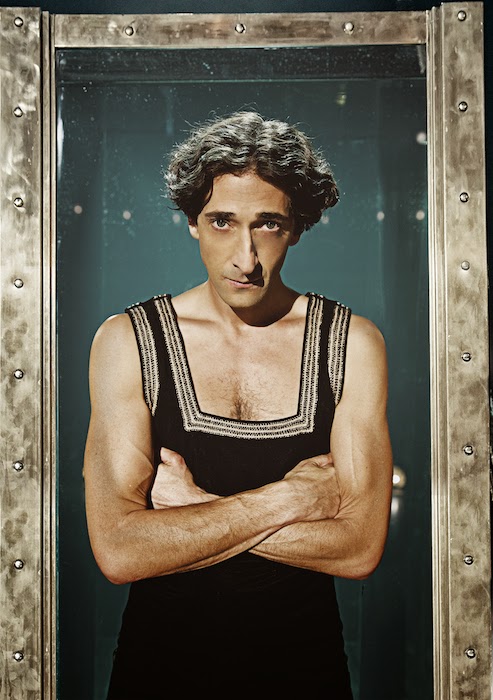
Houdini star Adrien Brody.
Anyone who has spent any time reading this blog knows that I am forgiving to a fault about inaccuracies in Houdini biopics. I love the 1953 Tony Curtis Houdini movie, despite the fact that Houdini biographer Milbourne Christopher correctly pointed out that, "If any phase of Houdini's life is shown on the screen you can be sure it didn't happen the way it's pictured." My favorite biopic is The Great Houdinis (1976), even though it invents a family triangle that made David Lustig, who knew Houdini personally, "feel nauseated."

I don't have a problem with these movies. Because at the end of the day, they still adhere to the basic superstructure of Houdini's life and career. Their dramatizations do not really change anything that is vital to our understanding of the Houdini story. A basic summary of these biopics will still give you the story of Houdini. That's because they had screenwriters who did their research, and even though they had to work within the Hollywood machine, and create conflict and drama, they showed respect for the notion of a biopic and respect for Houdini.

Screenwriter Nicholas Meyer is a hero of mine. He wrote what I consider to be the best Sherlock Holmes novel, The Seven-Per-Cent Solution. He wrote and directed the best Star Trek movie, Star Trek II: The Wrath of Khan. And don't even get me started on the awesomeness of Time After Time and, yes, I even kinda LOVE Volunteers. So when I heard he was writing the Houdini biopic, I was very excited. Sure, it would have fictionalizations, but that's the nature of the medium, and like the screenwriters who came before, Meyer would find a balance. I spent a better part of a year pre-explaining this.

Screenwriter Nicholas Meyer.
Well, it kills me to say that if any screenwriter can and should be sued for malpractice, it is Nicholas Meyer for his work on Houdini (at least in the first night). Meyer's script is not "artistic license," it's negligence, and at times Houdini is so bad it's actionable (I will explain later). When Houdini's life doesn't fit his fictions or lazy assumptions, he changes the life. How, when, and where Houdini finds fame and success -- a key component in the life story of any entertainer -- is completely thrown out the window for a version that is straight out of Meyer's imagination. Here, Houdini rockets to worldwide fame via a single "Johnson County" jail break in 1896. That's it. No Martin Beck. No trip to Europe. No Alhambra debut. No Scotland Yard challenge. Houdini springs fully formed (complete with Water Torture Cell) and is already the "most famous man in America" by 1900. This is so far from the truth it's shocking.

Now, I don't think I'm being nit-picky here. I'm not counting rivets on the Milk Can. I'm talking about something that is as fundamental to the story of Houdini as Pearl Harbor is to a story of World War II. Some things you cannot change, and it doesn't matter if you're the guy who made Star Trek II. Doing so shows a brazen disrespect for the subject and for the audience, and you will lose the world's most forgiving and supportive Houdini fan -- me.

Meyer's other offenses are more fundamental and just plain sloppy. He misspells Houdini's real name as Erich (it's Ehrich). He portrays a deep rift between Ehrich and his father, but never explains it. He presents the Water Torture Cell as Houdini's first major escape ... in 1900! Not just horrendously wrong, but it effectively erases the entire progression of Houdini's art and career. He places Houdini's home in Brooklyn instead of Harlem, seemingly for no reason other than personal taste? Houdini was a cinema pioneer. Meyer makes him a cinema holdout. Houdini was a famous teetotaler. Meyer shows him drunk. Houdini created an act and an identity for his brother as Hardeen in 1900. Meyer shows Hardeen performing successfully in the 1890s while Houdini is still struggling to make his own name. What kills me is Meyer just seems to take the approach that the truth doesn't matter. The truth is what works for him at the moment. The entire thing feels lazy, arrogant, and even amateur.

But it soon becomes clear why Meyer so badly mangles the facts of Houdini's early life, and to be fair, he may have been forced into this by producer Gerald W. Abrams, who bears as much responsibility for what we see here as Meyer. Because at minute 40, Washington D.C. comes a'calling and sends Houdini off to Europe as a secret agent! Now, this 2006 theory that Houdini did "spy" work for the U.S. and UK is HIGHLY dubious (and more so with each passing year of total silence on the subject from the authors who first proposed it) and should never have been included in something that purports to be a biopic. But Hollywood cannot resist a spy movie, and it dominates Night One. Suddenly, Houdini's career is sidelined and the miniseries turns into "Harry Houdini of the Secret Service," with Brody taking orders from "M" (get it?), running across embassy rooftops, and using his magic act only as a "cover." What was that about feeling nauseated?

Once the floodgates have been opened, more fictionalizations come pouring forth, supplanting real events in Houdini's life that would have provided much better drama. Instead of standing trial in Germany and proving himself by performing escapes in a courtroom (as really happened), Meyer substitutes a scene of Houdini doing a bullet catch for the Kaiser (never happened). Instead of his dramatic escape from the Siberian Transport Prison Van in Russia, we get a magic performance for the Royal family and a disapproving Rasputin (who, by the way, would not arrive on the scene for another two years). We also get to see Harry having a kinky affair with British painter Lady Butler which, of course, is pure kinky fiction. This all threw me so badly that I found Night One pretty hard to watch, even though it was nice to see things like Houdini's aviation career finally included in a Houdini movie (notice I didn't use biopic).

However, as I said, much of Meyer's machinations are so the silly spy elements will fit the narrative. This is why Night Two, which is finally free of the spy element (thank you, World War I!) is MUCH better. In fact, Night Two shows us what could have been, and goes a long way toward redeeming the disaster of Night One. Sure, artistic license and time compression are employed, but there finally seems to be an effort to tell Houdini's story accurately and respectfully. Meyer even resists the temptation to go directly from Mama's death (incorrectly dated as 1914 -- a year Meyer assigns to just about everything) to spiritualism, and therefore is able to give Houdini's movie career its due. This is the first time any biopic has done so and what a joy to see Harry and Bessie sitting in a Hollywood screening room watching The Grim Game with Brody dangling from the plane.

The best scenes in the miniseries are among the last -- Houdini's death in Grace Hospital in Detroit. Here the actors finally get to play dramatic scenes without the incessant voice over and hyperactive editing effects (more on that later). Houdini's bedside conversation with his doctor is right out of real life. The details of Houdini's death, while dramatically time compressed, are largely accurate. Houdini does not die in the Water Torture Cell in HISTORY's Houdini, which is a first. This shows that Meyer did do his research and, yes, might even care. And if you've made it to the very end without throwing a shoe through your TV screen, there is real footage of Houdini's graveside funeral that has never been shown before, including a look at the large "Mother Love" floral arrangement. Wonderful.

Meyer also has his moments of brilliance. After failing to seduce Houdini in his hotel room, Margery, nicely played by Megan Dodds, turns to him and says, "When you die, we will make you say whatever we like." That's a great piece of dialogue and shows just how good a Houdini biopic can and should be. I just wish whatever hand guided this second night was present during the first.

Producer Gerald W. Abrams.
Stylistically, Houdini is a very mixed bag. Producer Gerald W. Abrams said his inspiration was the Robert Downey, Jr. Sherlock Holmes (oh, why could it not have been Boardwalk Empire?). So Houdini strains to ape director's Guy Ritchie's filmmaking style with hyperactive speed ramping and frenetic editing. This works well ... when it's done by Guy Ritchie. It doesn't work here. It feels desperate, dated, and distracting. So does much of John Debney's bombastic score. Also, the entire 4 hour miniseries (3 without commercials) uses Harry's voice over to explain motivation and make transitions. There's some nice dialog in here -- "Most people escape life, I escape death" -- but voice over is a lazy narrative device that generally works to keep the viewer removed from the drama. It all feels like exposition. You keep waiting for the real story to start. Superimposed titles are used throughout to locate the action, yet not a single one is accurate. Why use locators if they are not identifying something real? It's just all part of the masquerade of a biopic.

The beautiful breakout talent of Kristen Connolly (House of Cards) is criminally under-used as Bess. Meyer writes Bess as somewhat dim and present largely to nag Harry into doing things like giving up his escape career (which, of course, never happened). At one point she even blurts out, "I'm just a dumb girl who married a Jew." This is a horrendous thing to put into Bess's mouth and disrespectful to her memory. Nevertheless, Connolly is still able to punch her way through this surprisingly chauvinistic script and deliver a feisty, funny, and very likable Bess. She also delivers heartbreakingly honest moments, such as the aforementioned scene when she talks Houdini out of performing escapes, and her death bed scene with Brody is perfection.

Speaking of the women in Houdini's life, call me crazy, but is there a weird sexual energy between Mama, played by Eszter Ónodi, and her son from their first scene to their last? More than once an object of Harry's sexual interest morphs into his mother. And mama's fixation on her son, both in human and spirit form, comes off as downright creepy. Is this the unstated problem between Houdini and his father? Even the official press material teases: "Houdini and his mother Cecelia had a close and loving relationship, some would say too close." Hmmm... Let's change the subject.

Magic! The magic and escapes in Houdini are beautifully recreated and staged, especially the cannon escape, and Houdini could only wish his own Vanishing Elephant was as effective as it is here. Kudos to technical advisor David Merlini. But its also here that Houdini commits its worst offense, and this is no joke. Houdini freely and cavalierly exposes secrets for no plot reason whatsoever. And these aren't small tricks: Metamorphosis, the Milk Can, the Bullet Catch, Walking Through A Brick Wall (although in this case it does serve the narrative and I would give it a pass). This is the first Houdini biopic to cross this line, and it's a shame to see cinema betray the art that was part of its birth. This is especially distressing as Adrien Brody started out as a magician and still has a deep interest in the art of magic. You'd think the Oscar winner could have had some say in stopping this. I'm hoping that the S.A.M., IBM, and AMA officially condemn this miniseries for this serious transgression.

On the topic of actionable issues, while the movie credits as its source Houdini: A Mind In Chains by Bernard C. Meyer (screenwriter Nicholas Meyer's father), it clearly isn't. There's nothing here about Leo and Sadie Weiss which is key to the Meyer book. Instead, Houdini is clearly adapted from The Secret Life of Houdini: The Making of America's First Superhero by William Kalush and Larry Sloman. Houdini's "spy" activities and Bessie's marijuana use (sigh) are only found in the Kalush/Sloman book. And there are dozens of other examples. Possibly the inclusion of Lionsgate as a producer means some kind of deal was made to use this exclusive material (they acquired the book when they bought Summit Entertainment in 2012), so maybe the only offense here is that on-screen credit was denied Kalush and Sloman so it could be given to the screenwriter's father. But this just adds to an overall feeling that something untoward is going on at the screenwriting level.

Okay, the script has problems, but what about the other aspects of the film, Mrs. Lincoln? Well, that is also a heartbreaker, because the technical work on Houdini is simply breathtaking! Shot entirely in Budapest, Houdini had a talented crew who clearly gave it their all. Costume and production design by Patrizia Von Brandenstein is phenomenal. The almost 300 special effect shots give the movie scale and scope. Uli Edel did a find job directing, and all the supporting cast deliver excellent performances. Even Adrien Brody, a poor physical match for Houdini, delivers a pitch perfect performance and projects a charisma that he surely shares with The Handcuff King. He's a great Houdini.

In fact, if you make your peace with the inaccuracies and watch this as Houdini fiction -- a tale told by an unreliable narrator "with just enough truth to make you believe the lies" -- it can be very enjoyable indeed. And I think it will be just that for general audiences. Because it's possible that I'm now Milbourne Christopher, watching the Tony Curtis movie and finding it impossible to see the value of something that doesn't follow the facts. And it's also just as possible that there is a 10-year-old version of me out there who will watch this miniseries, as I watched the Curtis movie, and find themselves captivated by the story of Houdini and will want to discover for themselves the truth of this amazing man. And in that way, this modern version of Houdini might just be magical after all.

Thank you and goodnight.

Read my Fact Checks of NIGHT ONE and NIGHT TWO. Houdini will be released in an extended edition (26 additional minutes) on DVD and Blu-ray on October 7.

Thursday, September 28, 2017

Is there a Houdini prop in the basement of 278?

If you were lucky enough to attended last weekend's open house at Houdini's 278 in Harlem, you got to experience something not afforded to those who attended the first open house in June. This time the basement was open to visitors. This is where Houdini is said to have worked on and kept some of his famous feats, some of which were still being stored there right up into the 1980s.

In fact, the basement may still contain one last iconic Houdini prop! Check out the photos below, taken by one of last weekend's lucky attendees.


Now, I know we discussed this back in July when David Saltman posted a photo of this "giant wheel" on his blog The Houdini File. But that photo didn't show the same detail. It looked like it might have been part of the house, possibly a gear from the disassembled dumbwaiter. But now getting a closer look, as well as learning the diameter (approx. 40"), one can see that this is actually a wagon wheel. All the elements are there, the most notable being the "Flat Steel Tire" as seen below.


So what's this have to do with Houdini? Well...


Before we get too excited, the wheel we see Houdini tied to above is not the exact same wheel (different number of spokes). But that doesn't mean the wheel in the basement wasn't used by Houdini in exactly this same way. This was one of Houdini's escapes. In his 1920 book, Magical Rope Ties & Escapes, Houdini devotes a section to what he calls "The Big Wheel Release." He even expresses a preference for the type of wheel to use, allowing for dramatic "scenery":

An audience which would go to sleep while and artist was making a really difficult escape from the wheel of a farm wagon will break into tumultuous applause over a comparatively easy one from a cannon wheel.

So how has this wheel remained in the basement all these years? Maybe it was just too impractical to take away. Or maybe those who say it didn't recall that the "Big Wheel Release" was part of Houdini repertoire. But after seeing these photos, I'm thinking the basement of 278 holds one last Houdini treasure, and that's pretty cool!

Here's a look at the full basement (which had a dirt floor in Houdini's day). I especially love those arches. Also notice the horseshoe on the far left. In his book Houdini Question Reality, Dixie Dooley reports seeing a horseshoe over the front door in 1985 that dated back to Houdini. Same one?


So what do we think? Is this wheel for real? Or are we going in circles? Sound off in the comments below.

Thanks to our open house attendee for sharing these terrific pics.

Related:

Friday, December 8, 2017

278 asking price drops by $1 million

The asking price for Houdini's famous New York home at 278 West 113th Street in Harlem is now $3.6 million. That's a full $1 million reduction from the original asking price of $4.6 when the house first went on the market in June. The sale of the brownstone is being handled by Douglas Elliman Real Estate.

Houdini purchased "278" (as he called it) in 1904. This is the first time the house has been on the market in 26 years.

If you follow this blog, you'll remember that I attended the first open house and gave a full report on what I saw inside. I also posted a history of the house and its owners over the years.

Thanks to Janet Davis for the alert.

Related:

Wednesday, July 27, 2011

Houdini's pets

Houdini & Charlie
Harry and Bess Houdini had no children. Maybe because of this, they lavished paternal attention onto their pets, particularly their dogs, Charlie and Bobby. We don't know too much about these fury members of the Houdini family, but what we do know is charming.

Charlie, a small white Pomeranian, was given to the Houdinis by the Grand Duke of Russia in 1903. Charlie accompanied the Houdinis on their first European tour. At certain points, the dog needed to be smuggled across international borders, which according to Ken Silverman in Houdini!!! The Career of Ehrich Weiss, Houdini accomplished "using one of Ching Ling Foo's conjuring methods." Houdini would write that he was "scared to death for fear of detection."

The Houdinis had Charlie for eight years and adored the animal. The dog appears in many family portraits, and when Houdini's mother visited him on tour in Cincinnati, Houdini noted that "Charlie the dog went wild for thirty minutes with joy." When Charlie died in 1909 they were both shattered. "Charlie, our dog, dying," Houdini wrote in his dairy. "Have taken him away from Surgeon Thompson so he can die at home. Bess crying. I don't feel any too good."

Houdini & Bobby
Charlie's successor was a fox terrier named Bobby. Bess later told the story of how she discovered Bobby in a Harlem butcher shop and tried to feed him a bone. When the butcher would not let her, Bess bought the dog in order to feed it. Houdini taught his "frisky" new dog how to escape from a pair of miniature handcuffs and a straitjacket and touted him as "Bobby The Handcuff King." He also claimed Bobby was "the greatest somersault dog who ever lived." Bobby's escape act headlined at the 14th Annual Society of American Magicians dinner in 1918 when Houdini was President.

Bobby died on December 15, 1918. As with Charlie, they had the dog for eight years. Houdini wrote an affectionate eulogy for his "good faithful Bobby" that was published in MUM Magazine. (It's reprinted in Gibson's Houdini on Magic.)

According to Ken Silverman, the Houdinis at one point also had another dog named "Eric", but I could find no info on that canine member of the family.

The Houdinis appear to be dog-less by the late 1920s, but they still kept a menagerie of other pets inside 278. Marie Blood recalls a six foot square aviary filled with birds, a talking parrot named "Laura" who lived in the Houdinis bedroom, and a pet turtle named "Petie" who she would "chase around the flower beds" behind 278. I've also heard mention of a parrot named Polly, a canary named Houdini, and a large rabbit named Rudy. And while not strictly a "pet", one cannot discuss Houdini and animals without making of mention of his famous vanishing elephant Jennie, whom Houdini said was "as gentle as a kitten." There was also his patriotic appearing American eagle, "Abraham Lincoln".

One final pet tale. After Houdini's death, when Bess was living with Ed Saint in California, she boarded their 25-year-old pet parrot named "Pat Houdini." But having "learned to pick locks while watching his master during his escape acts" (so claimed Ed Saint), Pat picked the lock of his cage and disappeared into the Hollywood Hills. According to the New York Times account of the daring escape, Pat was "singing as he soared away."

This post is in preparation for a much more serious blog that I will unleash on the issue of the Houdinis childlessness. It will reveal information that I don’t think has ever been revealed before. It's personal, and it might be controversial, so I'm working to present it in the just the right way. But, for now, I hope you enjoyed this look back at the Houdinis "kids", and watch for The problem with Bessie this weekend.

Translate