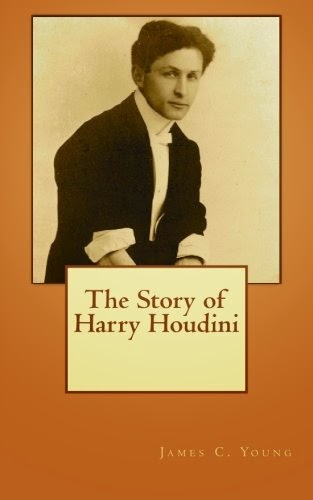
The Story of Harry Houdini by James C. Young is a 20-page booklet that consists of three newspaper articles originally published in The New York Times during Houdini’s lifetime.
"A Brief Biography of Harry Houdini" is from The New York Times, January 13, 1918. "Houdini, Mediums and Seances" is from May 7, 1922. The book concludes with "Thrown Overboard Manacled in a Box", a July 8, 1912 account of his first overboard box escape in New York Harbor. This book is not illustrated.
There isn't anything here that can't be found elsewhere or online for free -- such as at Tom Interval's amazing Houdini in the New York Times website -- but at $5.99, it's not a bad resource to have on the shelf for quick research.
Purchase The Story of Harry Houdini on Amazon.
- Home
- Life
- Escapes
- Magic
- Movies
- Houdini's Movies
- Les merveilleux exploits de Houdini à Paris (1909)
- The Master Mystery (1918)
- The Grim Game (1919)
- Terror Island (1920)
- The Man From Beyond (1922)
- Haldane of the Secret Service (1923)
- Velvet Fingers (1925-26)
- Medium Well Done (1937)
- Religious Racketeers (1938)
- Houdini Picture Corp.
- Film Developing Corp.
- Filming locations
- Unmade Movies
- Deconstructing Houdini '53
- Spiritualism
- People
- Beatrice Houdini
- Theo Hardeen
- Cecelia Weiss
- Mayer Samuel Weiss
- Jim Collins
- Franz Kukol
- Martin Beck
- Sir Arthur Conan Doyle
- Margery
- J. Gordon Whitehead
- Edward Saint
- Jacob Hyman
- Leopold Weiss
- Carrie Gladys Weiss
- Bernard M.L. Ernst
- Charmian London
- Jess Willard
- H.P. Lovecraft
- Sherlock Holmes
- Assistants
- Imitators
- Other magicians
- Media
- Full Bibliography
- By Houdini
- Biography
- Fiction
- Foreign
- For Kids
- Methods
- Wild About Harry Bookshelf
- Houdini His Life Story (1928)
- Houdini The Man Who Walked Through Walls (1959)
- Houdini The Untold Story (1969)
- The Life and Many Deaths of Harry Houdini (1993)
- Houdini!!! The Career of Ehrich Weiss (1996)
- The Secret Life of Houdini (2006)
- The Metamorphosis: The Apprenticeship of Harry Houdini (2012)
- The Witch of Lime Street (2015)
- The Life and Afterlife of Harry Houdini (2019)
Tuesday, March 17, 2015
Saturday, March 14, 2015
Houdini's escape from Murderers Row
Houdini was appearing at Chase's "Polite Vaudeville" theater at 1424 Pennsylvania Ave., and had already garnered headlines with two jail escapes in the city. The first occurred at the 10th Precinct police station on January 1, 1906. On a challenge from Superintendent of Police, Major Richard Sylvester, Houdini escaped from "invincible bracelets" and cell No. 3 in just 18 minutes.
Two days later came a familiar Houdini pattern; what I call the "mid-week drama." Typically this involves a challenger announcing they were unsatisfied with the conditions of the first test and/or revealing a method by which they believed Houdini escaped. They would then "defy" Houdini to repeat the escape under stricter control. These mid-week dramas were almost certainly orchestrated by Houdini to generate suspense for a grand finale "rematch" at the end of the week. In this case, the mid-week drama might have been genuine. Newspapers reported that 10th street jailer, H.B. Elliot, found a "needle" on the floor which he thought Houdini might have used to pick the cell lock.
Major Sylvester then challenged Houdini to repeat his jail escape, this time from the new Fifth Precinct jailhouse at 5th and E street, which had locks that were considered more secure. Even Houdini proclaimed the locks of the very best quality and "really too good for station purposes." Nevertheless, Houdini beat the jail, passing through six locked doors in 31 minutes. It was while he was at the 5th Street station that Houdini received a message from Warden J.H. Harris, challenging him to "try his art" from the most formidable cell at the United States Jail -- the grand finale.
The next day, January 6, Houdini travelled to what was described as "a cathedral-like prison along the Eastern Branch of the Potomac." There a large group of officials gathered in Warden Harris' office. Houdini was shown to Murderers Row in the south wing of the jail, which contained seventeen cells. Current residents included seven convicted murderers, a man named James Backus -- "the alleged money-order raiser" -- and a housebreaker named Clarence Howlett.
The group stopped before cell No. 2, famous for having housed Charles J. Guiteau (right), the man who assassinated President James Garfield in 1881. Guiteau himself escaped an assassination attempt inside this very cell when a man tried to shoot him through the bars. Guiteau was later executed by hanging. The cell currently housed Walter W. Hamilton, a black man who was convicted of smothering his wife, after which, according to press reports, he "sat all night beside the body of his victim, indulging in a drunken orgy."
Houdini was "stripped to the skin" and searched, presumably by one or all of the three Jail Physicians in attendance. He was then locked into the cell with Hamilton who, the press reported, remained "crouched in the far corner of the cell, presumably laboring under the belief that one of the arch-fiends was already there to get him for the red hot furnace." It's not recorded whether Houdini was also shackled. The officials then returned to the warden's office, leaving Houdini and his fellow inmates on their own.
The police had reason to be confident of their success in holding Houdini this time. The lock on the Guiteau cell was unreachable from the inside. A detailed account of the escape in The Washington Post explained:
All these cells are brick structures with their doors sunk into the walls fully three feet from the face of the outer corridor. When the heavily barred door is closed, and arm-like bar runs out to the corridor wall and then angles to the right and slips over a steel catch which sets a spring that fastens the lock. The latter is only opened by a key, and there are no less than five tumblers in the lock.
It only took Houdini two minutes to escape from the cell. (On page 134 of Houdini The Man Who Walked Through Walls, author William Gresham speculates on how Houdini might have escaped based on a device found in the Sidney Radner collection.) Houdini then embarked on a course of action that would make this escape legendary.
First, he opened the cell door of Richard Chase, who was serving 12 years for manslaughter, and ordered the stunned man to follow him. After the initial shock ("What are you doing without clothes?"), Chase followed the naked magician to the cell of Clarence Howlett. Opening the cell door, Houdini asked the prisoner, "What are you in for?"
"I'm a housebreaker," said the astonished Howlett.
"You're a bad one, or you could get out of here," replied Houdini.
Houdini then took Howlett from his cell and thrust Chase inside. Houdini then locked Howlett into Chase's cell.
Houdini repeated the process with each and every one of the convicted men. He then retrieved his clothes from another locked cell, dressed, and appeared in the warden's office. The Post reported that the men's "amazement passed all bounds." As to the prisoner exchange, Warden Harris "took the change with the utmost good nature." The escape had taken 21 minutes, and by Houdini's own count was his 64th jail break.
Warden Harris and Superintendent Sylvester both provided Houdini with glowing testimonials. Sylvester thanked the Handcuff King for providing him with information that could make his jails more secure. (You'll noticed that Warden Harris states Houdini dressed before swapping the prisoners around; but that makes the story a little less fun, so we'll ignore that.) Houdini later featured the letter from Harris on the back of his pitchbook, HOUDINI: The Adventurous Life of a Versatile Artist.
Houdini would repeat his prisoner swapping stunt two months later when he escaped from a cell in the famous Boston Tombs. This time he added a new twist in that he scaled the wall and sped off to the theater in a waiting car. But it was his escape from Murderers Row and the Guiteau cell that always held a special place in his publicity material.
The United States Jail, later known as the D.C. or District jail, stood until the early 1980s. Here are two photos of the jail, inside and out, from the website, The Hill is Home.
Houdini would return to Washington D.C. seven months later. How would he top himself? I'll have that story next week.
Clipping source: Newspapers.com.
Related posts:
2015 Magic History Weekend preview
Here's a terrific new promotional video for the upcoming Midwest Magic History Weekend to be held May 28-30, 2015 in Marshall, Michigan. I'll be there doing my Houdini talk in some great company. Hope to see you there!
Friday, March 13, 2015
Houdini the '70s superhero
Houdini's great powers and abilities, and as far as I know, did not come from the bite of radioactive spider nor a need to avenge the murder of his parents. However, this hasn't stopped him from ascending to the level of a "superhero" in our culture.
While Houdini himself started this trend with pulp stories such as Imprisoned With The Pharaohs, some of the most colorful depictions of Houdini as a superhero (and even super-villain) can be found in the pages of comic books. This one-pager from the January 1977 issue of DC Super-Stars Of Magic is one of my favorites. While this is a biographical piece, I love that the artwork by Mike Nassar and Terry Austin shows us Houdini in the style of a '70s comic book superhero. Eat your heart out, Doctor Strange!
The written copy on this page is uncredited. However, Steven Thompson at the blog Book Steve's Library did a little digging and discovered that the story editor for this issue was Carl Gafford. Thompson contacted the comic artist and writer who told the site:
Below is the cover of DC Super-Stars Of Magic featuring Zatanna and the Flash battling Abra Kadabra.
Related:
While Houdini himself started this trend with pulp stories such as Imprisoned With The Pharaohs, some of the most colorful depictions of Houdini as a superhero (and even super-villain) can be found in the pages of comic books. This one-pager from the January 1977 issue of DC Super-Stars Of Magic is one of my favorites. While this is a biographical piece, I love that the artwork by Mike Nassar and Terry Austin shows us Houdini in the style of a '70s comic book superhero. Eat your heart out, Doctor Strange!
The written copy on this page is uncredited. However, Steven Thompson at the blog Book Steve's Library did a little digging and discovered that the story editor for this issue was Carl Gafford. Thompson contacted the comic artist and writer who told the site:
"I wrote all the text features in the MAGIC ish, and pencilled the hand tricks for the magic features. Vinnie inked my pencils and Joe Letterese did whatever lettering we used, all on staff to save a buck. I colored the Flash reprint and Liz Berube colored the Zatanna reprint, using Tatjana's original coloring as a guide."
Below is the cover of DC Super-Stars Of Magic featuring Zatanna and the Flash battling Abra Kadabra.
Over the next few weeks, I'll take a look at some more past appearances of "Super Houdini" in the pages of comic books.
Thursday, March 12, 2015
Hardeen hangs up his handcuffs
Here's a remarkable article from the January 21, 1917 Oakland Tribune announcing the retirement of Theo. Hardeen from show business. The article features a nice photo of Elsie Hardeen and their two sons, Harry Houdini Hardeen and Theodore Hardeen, Jr. Amusingly, it states that Hardeen will dump all his equipment into the San Fransisco Bay! Anyone up for an underwater expedition?
Hardeen would continue to fill periodic engagements throughout 1917 and 1918, so I guess not everything went into the Bay. But by 1919, he really was free of the escape business.
While there certainly may be truth to Hardeen's wish to be with his family, the real reason Hardeen left his career was so he could run Houdini's Film Developing Corporation. Houdini was responsible for Dash's career -- he came up with the Hardeen name and set him up with his full act in early 1900s. I can't help but wonder if retiring and running the FDC was something Dash wanted to do, or whether it was the new edict of his older brother. Nevertheless, Dash did it, and came away with ulcers.
After Houdini's death, Hardeen retuned to performing, although this might have happened even if Houdini had lived. A letter in the Arthur Moses collection shows that Dash was on Houdini's payroll until August 1926. He would have needed to seek work at this point.
This clipping from The San Bernardino County Sun for November 23, 1926 is the earliest mention of Hardeen's return to show business that I can find. It's just a mere 24 days after Houdini's death. But maybe the most curious thing about this new item -- is that mustache on Dash?
Clipping source: Newspapers.com.
![]() |
| Click to enlarge. |
Hardeen would continue to fill periodic engagements throughout 1917 and 1918, so I guess not everything went into the Bay. But by 1919, he really was free of the escape business.
While there certainly may be truth to Hardeen's wish to be with his family, the real reason Hardeen left his career was so he could run Houdini's Film Developing Corporation. Houdini was responsible for Dash's career -- he came up with the Hardeen name and set him up with his full act in early 1900s. I can't help but wonder if retiring and running the FDC was something Dash wanted to do, or whether it was the new edict of his older brother. Nevertheless, Dash did it, and came away with ulcers.
After Houdini's death, Hardeen retuned to performing, although this might have happened even if Houdini had lived. A letter in the Arthur Moses collection shows that Dash was on Houdini's payroll until August 1926. He would have needed to seek work at this point.
This clipping from The San Bernardino County Sun for November 23, 1926 is the earliest mention of Hardeen's return to show business that I can find. It's just a mere 24 days after Houdini's death. But maybe the most curious thing about this new item -- is that mustache on Dash?
![]() |
| Click to enlarge. |
Hardeen continued to perform as "Houdini's Successor" for many years before turning the show over to Douglas Geoffrey a.k.a. Hardeen Jr. (not his son) in May 1945. He died a short time later.
Related posts:
Tuesday, March 10, 2015
Guest blog: Mr. Houdini Goes to Washington, Part III
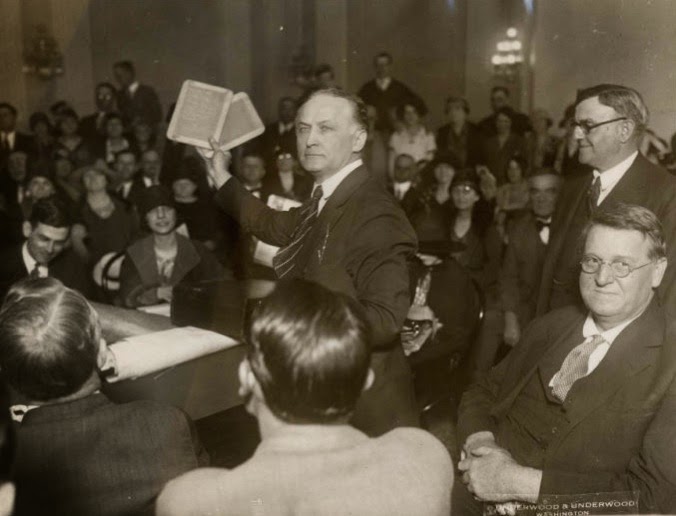
Today we have the conclusion of Neil McNally's fascinating examination of Houdini's testimony before Congress in 1926. Will Houdini triumph over the "rabid" mediums of Washington D.C.?
Act Three: Fighting the Good Fight...
As we return to the proceedings, it’s worth noting that Houdini had been through a lot throughout these hearings. While he may have been accustomed to a well-deserved red carpet being extended to him before, what he faced here was a room of cold and apathetic Congressional Representatives. Many of them it seemed were unimpressed by his over thirty years of experience and expertise in magic, sleight of hand, and, most importantly, spiritualism.
However, Harry Houdini had dealt with much, much worse in his long career. So, when the hearings adjourned in May of 1926 he had brought with him a special weapon. It was a weapon that had been by his side for many years, and one that he truthfully valued beyond any pick, lock, or key. Her name was Beatrice Rahner, but in the annals of magic history she was known simply as Bess.
Houdini: (to the Representatives) My religion and my belief in the Almighty have been assailed. I stated yesterday that I do believe in the Almighty. I have always believed and I will always believe. I am a Mason, and you must believe in God to be a Mason. My character has been assailed. I would like to have as witness here Mrs. Houdini.
(Laughter from the audience)
Step this way Mrs. Houdini. One of the witnesses said I was a brute and that I was vile and I was crazy. Won’t you step this way? I want the chairman to see you. I will have been married on June 22nd, 32 years to this girl…There are no medals and no ribbons on me, but when a girl will stick to a man for 32 years as she did and when she will starve with me and work with me through thick and thin, it is a pretty good recommendation. Outside of my great mother, Mrs. Houdini has been my greatest friend. (To Bess) Have I shown traces of being crazy, unless it was about you?
(More laughter from the audience)
Bess: No
Houdini: Am I brutal to you or vile?
Bess: No
Houdini: Am I good boy?
Bess: Yes.
Houdini: Thank you Mrs. Houdini.
(The audience applauds)
To say this exchange was not a calculated move on Houdini’s part is a vast understatement. With three simple words, Bess Houdini continued a long tradition of assisting her husband in times of dire need. While in this particular case their conversation was firmly tongue and cheek, it gives readers an endearing glimpse of how much Houdini loved and respected his wife. To hear him use the words “best friend” to describe her is a prime example of some of the many unique treasures this transcript holds.
Considering that the hearings were being held in Washington D.C., it’s ironic that the testimony eventually turned to one of the country’s founding fathers, Abraham Lincoln. As Lincoln was long rumored to have been interested in spiritualism, Houdini addresses the subject after Jane Coates let it cryptically slip earlier that some of D.C.’s most influential politicians, along with President Warren G. Harding himself, weren’t adverse to visiting mediums for some “otherworldly” advice.
Henry R. Rathbone (Illinois): Mr. Houdini, just a question or two, if you please. The question about Abraham Lincoln and his beliefs is brought up. I do not think it’s material to this bill, but you say you have investigated it and you know he was not a spiritualist.
Houdini: His son says so. I will read it if you wish (A letter from Robert Lincoln, Abraham Lincoln’s last surviving son, to Houdini). It is written to me and dated September 28, 1925. The importance of that is that they (the spiritualists) always use a great man’s name to get converts.
Rathbone: I think you will all agree who know about Abraham Lincoln that he was not a spiritualist as spiritualism is understood. Abraham Lincoln, if the authorities are correct at all, did believe and seek a number of times in his life, and spoke on the morning of his last day, of having a premonition of coming death. Is it your understanding that that has any relation to spiritualism?
Houdini: I believe in premonition absolutely, but, not in spiritualism…I believe in the subconscious mind, in the hereafter, in the Almighty God. But, I do not believe that the disembodied spirit can come back and do the things that the mediums claim that they can do…I have no malice against any mediums. They say I am quarrelling with their religion but that is their smoke screen…The money they charge means nothing. It is only the opening wedge to get fortunes, to get hold of some old man or lady and bring back (their) beloved dead.
It’s obvious from the preceding paragraph that while he denied it, Houdini rightfully did hold malice towards the spiritualist campaign and their actions against the innocent. In fact, as the hearing neared its end Houdini’s patience was tested when a line of bizarre, rapid, and suspicious questioning was directed at him by William C. Hammer of North Carolina.
Hammer: The original Houdini was a Hindu was he not?
Houdini: No.
Hammer: You are Houdini the second?
Houdini: No.
Hammer: You are the original Houdini?
Houdini: No, the original Houdini was a French clockmaker
Hammer: I thought he lived in Allahabab.
Houdini: Are you joking?
Hammer: No sir. I am in earnest.
Houdini: His name was (Robert) Houdin. My name is Houdini….
Hammer: You said the other day that you were the president of the Magician’s Association of America.
Houdini: Society of American Magicians….
Hammer: Is it a secret organization?
Houdini: No, only regarding our exploits…
Hammer: Is your father living?
Houdini: No, has this anything do with this bill?...I know you are asking spiritualistic questions and I want to let you know I know it.
Hammer: It is contended that you are a medium and do not know it. These people really believe that you have divine power and that you won’t admit it. That is the reason I am asking you these questions.
Houdini: Pardon me.
Hammer: Have you ever been in Allahabab?
The questioning continues on in a similar circuitous nature until Houdini reaches the limit of what even he can take.
Houdini: You did not get those (questions) out of the air! Why are you asking me those peculiar, irrelevant questions? They haven’t anything to do with the bill and are not the kind of questions that a man in your position would ask. They were given to you by some rabid medium and I am surprised you should ask me (them)…You did not get them out of your head.
Hammer: That is all right as to where I got them, but I did not get them from any spiritualist and I did not get them from any divine power either…
And in the End…
As one turns the pages of the transcript, it’s all hard to know where it will all lead. As Houdini sat there about to present his closing statements to the assembled parties he had to have wondered the very same thing. However, as the transcript shows even without his standard arsenal of tricks Houdini was always true to himself and the moral bigger picture at hand.
Houdini: Mr. Chairman, I think there has been enough said. In closing my support for the bill I wish to say that there are 500,000 vote less people here in the District of Columbia. The law as presented there positively does not interfere with anyone’s religious beliefs. They do put jokers in laws the way they have in a number of states, and there is one that I would like to warn the committee against. When I say warn I want to amend that…Now here is the joker in the law placed in there by the spiritualistic associations:
Provided: That the provisions of this act shall not be construed to include, prohibit, or interfere with the exercise of the spiritual functions or office of any priest, minister, or accredited representative of any religion. And Provided Further: That the provisions of this act shall not be construed to include or refer to the practice of the belief known as spiritualism or to any attempt at communication with the spirit world by or through these occult mediums.
I claim Mr. Chairman, and ladies and gentlemen, that this absolutely gives the spiritualist a 100% power to tell fortunes and do everything. One counteracts the other.
What eventually became of the bill? Had spiritualism had its day in the sun? Was Houdini, as usual, victorious in the face of adversity? Sadly, not this time. For reasons still speculated on today, Bill H.R. 8989 did not pass into law and stands as one Houdini’s few failures. Perhaps, as it seemed, politicians and mediums did make likely bedfellows after all.
Regardless of the outcome, Houdini simply and matter- of-factly stated that he had “performed a public service by exposing fraudulent mediums who prayed on the vulnerable, gullible, and bereaved.” In a modern age where fictional heroes light up our movies screens and comic books, it’s comforting to know that once upon a time there was a real flesh and blood hero who used his experience in dime museums, theaters, and séance parlors to benefit society’s greater good. For these reasons alone, it’s hard not to see what made “The Great Houdini” truly great!
Please join me in thanking Neil McNally for this terrific three part series. And be sure to visit Neil's website at neilmcnallywriter.com to see his other work.
This weekend I'll continue the theme of Houdini in Washington D.C. with a look back at his very first visit in January 1906 and his most spectacular jail escape.
Act Three: Fighting the Good Fight...
As we return to the proceedings, it’s worth noting that Houdini had been through a lot throughout these hearings. While he may have been accustomed to a well-deserved red carpet being extended to him before, what he faced here was a room of cold and apathetic Congressional Representatives. Many of them it seemed were unimpressed by his over thirty years of experience and expertise in magic, sleight of hand, and, most importantly, spiritualism.
However, Harry Houdini had dealt with much, much worse in his long career. So, when the hearings adjourned in May of 1926 he had brought with him a special weapon. It was a weapon that had been by his side for many years, and one that he truthfully valued beyond any pick, lock, or key. Her name was Beatrice Rahner, but in the annals of magic history she was known simply as Bess.
Houdini: (to the Representatives) My religion and my belief in the Almighty have been assailed. I stated yesterday that I do believe in the Almighty. I have always believed and I will always believe. I am a Mason, and you must believe in God to be a Mason. My character has been assailed. I would like to have as witness here Mrs. Houdini.
(Laughter from the audience)
Step this way Mrs. Houdini. One of the witnesses said I was a brute and that I was vile and I was crazy. Won’t you step this way? I want the chairman to see you. I will have been married on June 22nd, 32 years to this girl…There are no medals and no ribbons on me, but when a girl will stick to a man for 32 years as she did and when she will starve with me and work with me through thick and thin, it is a pretty good recommendation. Outside of my great mother, Mrs. Houdini has been my greatest friend. (To Bess) Have I shown traces of being crazy, unless it was about you?
(More laughter from the audience)
Bess: No
Houdini: Am I brutal to you or vile?
Bess: No
Houdini: Am I good boy?
Bess: Yes.
Houdini: Thank you Mrs. Houdini.
(The audience applauds)
To say this exchange was not a calculated move on Houdini’s part is a vast understatement. With three simple words, Bess Houdini continued a long tradition of assisting her husband in times of dire need. While in this particular case their conversation was firmly tongue and cheek, it gives readers an endearing glimpse of how much Houdini loved and respected his wife. To hear him use the words “best friend” to describe her is a prime example of some of the many unique treasures this transcript holds.
Considering that the hearings were being held in Washington D.C., it’s ironic that the testimony eventually turned to one of the country’s founding fathers, Abraham Lincoln. As Lincoln was long rumored to have been interested in spiritualism, Houdini addresses the subject after Jane Coates let it cryptically slip earlier that some of D.C.’s most influential politicians, along with President Warren G. Harding himself, weren’t adverse to visiting mediums for some “otherworldly” advice.
Henry R. Rathbone (Illinois): Mr. Houdini, just a question or two, if you please. The question about Abraham Lincoln and his beliefs is brought up. I do not think it’s material to this bill, but you say you have investigated it and you know he was not a spiritualist.
Houdini: His son says so. I will read it if you wish (A letter from Robert Lincoln, Abraham Lincoln’s last surviving son, to Houdini). It is written to me and dated September 28, 1925. The importance of that is that they (the spiritualists) always use a great man’s name to get converts.
Rathbone: I think you will all agree who know about Abraham Lincoln that he was not a spiritualist as spiritualism is understood. Abraham Lincoln, if the authorities are correct at all, did believe and seek a number of times in his life, and spoke on the morning of his last day, of having a premonition of coming death. Is it your understanding that that has any relation to spiritualism?
Houdini: I believe in premonition absolutely, but, not in spiritualism…I believe in the subconscious mind, in the hereafter, in the Almighty God. But, I do not believe that the disembodied spirit can come back and do the things that the mediums claim that they can do…I have no malice against any mediums. They say I am quarrelling with their religion but that is their smoke screen…The money they charge means nothing. It is only the opening wedge to get fortunes, to get hold of some old man or lady and bring back (their) beloved dead.
It’s obvious from the preceding paragraph that while he denied it, Houdini rightfully did hold malice towards the spiritualist campaign and their actions against the innocent. In fact, as the hearing neared its end Houdini’s patience was tested when a line of bizarre, rapid, and suspicious questioning was directed at him by William C. Hammer of North Carolina.
Hammer: The original Houdini was a Hindu was he not?
Houdini: No.
Hammer: You are Houdini the second?
Houdini: No.
Hammer: You are the original Houdini?
Houdini: No, the original Houdini was a French clockmaker
Hammer: I thought he lived in Allahabab.
Houdini: Are you joking?
Hammer: No sir. I am in earnest.
Houdini: His name was (Robert) Houdin. My name is Houdini….
Hammer: You said the other day that you were the president of the Magician’s Association of America.
Houdini: Society of American Magicians….
Hammer: Is it a secret organization?
Houdini: No, only regarding our exploits…
Hammer: Is your father living?
Houdini: No, has this anything do with this bill?...I know you are asking spiritualistic questions and I want to let you know I know it.
Hammer: It is contended that you are a medium and do not know it. These people really believe that you have divine power and that you won’t admit it. That is the reason I am asking you these questions.
Houdini: Pardon me.
Hammer: Have you ever been in Allahabab?
The questioning continues on in a similar circuitous nature until Houdini reaches the limit of what even he can take.
Houdini: You did not get those (questions) out of the air! Why are you asking me those peculiar, irrelevant questions? They haven’t anything to do with the bill and are not the kind of questions that a man in your position would ask. They were given to you by some rabid medium and I am surprised you should ask me (them)…You did not get them out of your head.
Hammer: That is all right as to where I got them, but I did not get them from any spiritualist and I did not get them from any divine power either…
And in the End…
As one turns the pages of the transcript, it’s all hard to know where it will all lead. As Houdini sat there about to present his closing statements to the assembled parties he had to have wondered the very same thing. However, as the transcript shows even without his standard arsenal of tricks Houdini was always true to himself and the moral bigger picture at hand.
Houdini: Mr. Chairman, I think there has been enough said. In closing my support for the bill I wish to say that there are 500,000 vote less people here in the District of Columbia. The law as presented there positively does not interfere with anyone’s religious beliefs. They do put jokers in laws the way they have in a number of states, and there is one that I would like to warn the committee against. When I say warn I want to amend that…Now here is the joker in the law placed in there by the spiritualistic associations:
Provided: That the provisions of this act shall not be construed to include, prohibit, or interfere with the exercise of the spiritual functions or office of any priest, minister, or accredited representative of any religion. And Provided Further: That the provisions of this act shall not be construed to include or refer to the practice of the belief known as spiritualism or to any attempt at communication with the spirit world by or through these occult mediums.
I claim Mr. Chairman, and ladies and gentlemen, that this absolutely gives the spiritualist a 100% power to tell fortunes and do everything. One counteracts the other.
What eventually became of the bill? Had spiritualism had its day in the sun? Was Houdini, as usual, victorious in the face of adversity? Sadly, not this time. For reasons still speculated on today, Bill H.R. 8989 did not pass into law and stands as one Houdini’s few failures. Perhaps, as it seemed, politicians and mediums did make likely bedfellows after all.
Regardless of the outcome, Houdini simply and matter- of-factly stated that he had “performed a public service by exposing fraudulent mediums who prayed on the vulnerable, gullible, and bereaved.” In a modern age where fictional heroes light up our movies screens and comic books, it’s comforting to know that once upon a time there was a real flesh and blood hero who used his experience in dime museums, theaters, and séance parlors to benefit society’s greater good. For these reasons alone, it’s hard not to see what made “The Great Houdini” truly great!
![]() |
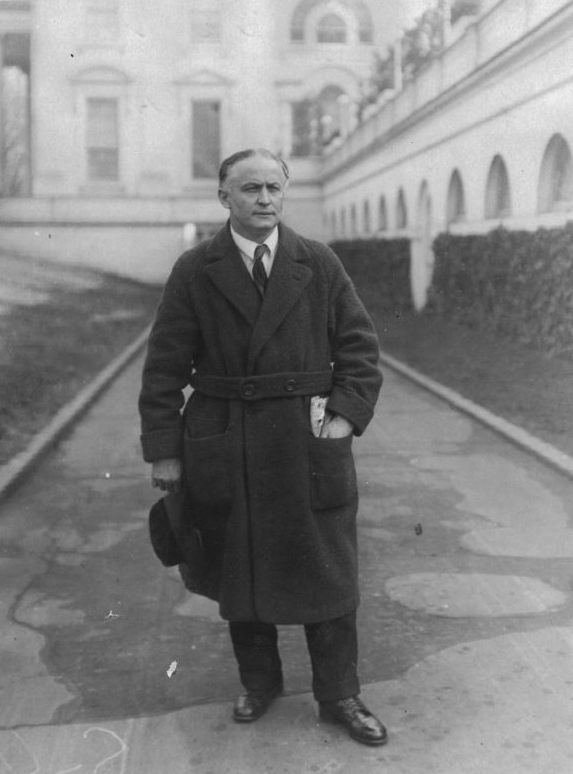
| Houdini at the White House. |
Please join me in thanking Neil McNally for this terrific three part series. And be sure to visit Neil's website at neilmcnallywriter.com to see his other work.
This weekend I'll continue the theme of Houdini in Washington D.C. with a look back at his very first visit in January 1906 and his most spectacular jail escape.
Related:
Fifth graders keeping Houdini alive
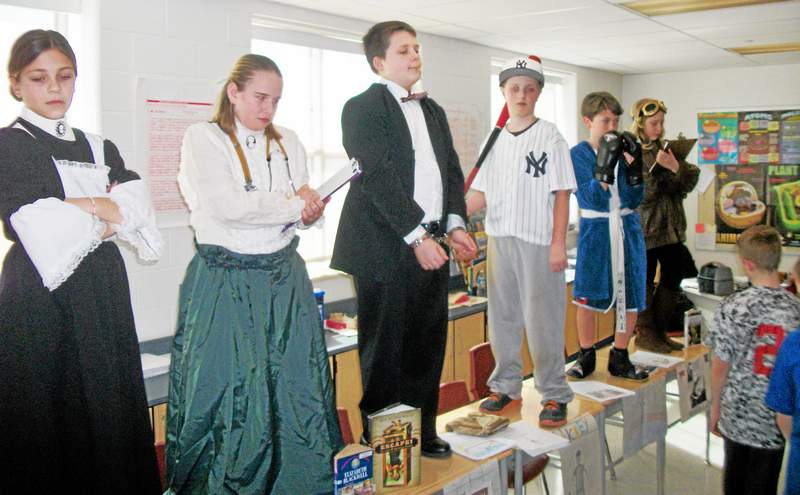
Houdini himself may have never made it beyond the 4th grade, but he's certainly a strong presence in grade school classrooms these days. Check out these 5th graders from Perry Elementary Center. Each year the students do a book report on famous historical figures, then hold a "Wax Museum" in which they get to dress up as their subjects "frozen in time."
Notice in the photo below the young man as Houdini. He appears to have done his report on Sid Fleischman's ESCAPE! The Story of Houdini (an excellent choice of book). The keys in the mouth are a clever touch.
You can read more about the bright young students at Perry Elementary at Berks-Mont News.
Related:
Monday, March 9, 2015
TCM Festival details: The Grim Game screening at the Egyptian, March 29
While I'm disappointed that the Festival organizers decided not to screen The Grim Game in the larger Chinese Theater (instead they are showing the 1964 Sophia Loren film, Marriage Italian Style), the Egyptian is a nice venue for this film. Built in 1922 by Sid Grauman, it was one of Hollywood's first movie palaces, and the site of the first-ever Hollywood premiere. The exterior and interior walls feature Egyptian-style paintings and hieroglyphics. The theater was restored in 1996 by the American Cinematheque. In 2012 it hosted a Houdini double-feature of Terror Island and The Man From Beyond.
If you wish to attend The Grim Game premiere, you have a few (not great) options. You can buy a festival pass, but even a pass doesn't guarantee entry. You'll still need to line up. Individual tickets are also sold at the door at the time of the screenings depending on availability. Again, because the festival decided to play this in a smaller theater, getting in could be a magic trick. Even I'm not 100% sure I'm getting in.
The festival will also screen the 1953 classic Houdini with Tony Curtis and Janet Leigh at the Chinese Multiplex House 6 on March 29 at 4:45pm.
For more information about the festival visit the TCM Classic Film Festival website.
Related:
TCM festival screening Houdini (1953)
Not only will the upcoming TCM Classic Film Festival in Hollywood (March 26-29) feature the world premiere of Rick Schmidlin's restoration of Houdini's long lost The Grim Game, but the festival will also screen Paramount's classic Houdini (1953) starring Tony Curtis and Janet Leigh.
Both Houdini films will screen on Sunday, March 29, the final day of the festival. While The Grim Game will screen at the Egyptian Theater at 8:15pm, Houdini will screen at the smaller Chinese Multiplex House 6 at 4:45pm.
To attend, you can buy a festival pass at the official website. Individual tickets are also sold at the door at the time of the screenings depending on availability.
Related:
Both Houdini films will screen on Sunday, March 29, the final day of the festival. While The Grim Game will screen at the Egyptian Theater at 8:15pm, Houdini will screen at the smaller Chinese Multiplex House 6 at 4:45pm.
To attend, you can buy a festival pass at the official website. Individual tickets are also sold at the door at the time of the screenings depending on availability.
Sunday, March 8, 2015
'Houdini' now streaming on Netflix
The Houdini miniseries starring Adrien Brody is now streaming on Netflix. Unfortunately, this is the condensed version that aired on HISTORY back in September 2014. The full unedited version can be found on DVD and Blu-ray.
The Houdini miniseries co-starred Kristen Connolly as Bess Houdini and Evan Jones as Jim Collins. You can revisit my review HERE.
Related:
The Houdini miniseries co-starred Kristen Connolly as Bess Houdini and Evan Jones as Jim Collins. You can revisit my review HERE.
Related:
Saturday, March 7, 2015
Haversat & Ewing Galleries March auction now LIVE
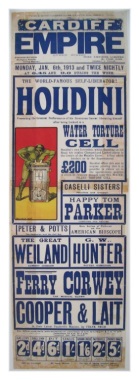
Haversat & Ewing Galleries March auction is now LIVE. Among several nice Houdini items is Lot #191, a rare English Water Torture Cell playbill poster:Lot # 191: Houdini Panel Poster - Cardiff Empire Monday, Jan 6, 1913. Presenting the Greatest Performance of his Strenuous Career liberating himself after being locked in a Water Torture Cell. Houdini's Own Invention! Professionally mounted on linen. Measures 33.5" in height by 13" wide. The poster has areas that are darkened from what appears to be remnants from being in a scrapbook. Otherwise the poster is in good condition for being 102 years old, and is ready to be framed and proudly displayed as a center piece of any Houdini collection. Rare $8,000-$10,000
The auction ends on Saturday, March 14th at 5:00 p.m. EST.
Click here to view and bid on all the auction lots.
UPDATE: This playbill reached $4,550, reserve not met.
Friday, March 6, 2015
Flim Flam: Houdini and the Hereafter available in paperback
A printed version of Gene Franklin Smith's magnificent play, Flim Flam: Houdini and the Hereafter, is now available on Amazon. The book contains a Forward by the great Patrick Culliton and an Introduction by Gene Franklin Smith.
Flim Flam: Houdini and the Hereafter ran at the Malibu Playhouse in the summer of 2014. It starred Rick D. Wasserman as Houdini, Melissa Kite as Bess, Sabra Malkinson as Margery.
You can read my review (which I'm honored to see is blurbed in the book) HERE.
Purchase Flim Flam: Houdini and the Hereafter on Amazon (U.S.) and Amazon.co.uk (UK).
A stage play based on actual events. In the summer of 1922, Harry Houdini and Sir Arthur Conan Doyle team to investigate psychic mediums for the Scientific American committee. Their friendship is challenged when Conan Doyle champions a beautiful and seductive psychic as authentic. Houdini is determined to prove that she is a phony, until she apparently contacts Houdini's beloved dead mother, and he must confront his own beliefs about life-after-death.
Flim Flam: Houdini and the Hereafter ran at the Malibu Playhouse in the summer of 2014. It starred Rick D. Wasserman as Houdini, Melissa Kite as Bess, Sabra Malkinson as Margery.
You can read my review (which I'm honored to see is blurbed in the book) HERE.
Purchase Flim Flam: Houdini and the Hereafter on Amazon (U.S.) and Amazon.co.uk (UK).
Thursday, March 5, 2015
Catch your first glimpse of The Grim Game
We are now only a matter of weeks before Houdini's The Grim Game returns to movie screens with the world premiere of Rick Schmidlin's restoration at the TCM Classic Film Festival in Hollywood, March 26-29. Now you can get your first brief glimpse of the long lost Houdini film at the festival website. The latest promotional video on the main page contains a mention of the movie along with two quick clips starting at 00:40 and, well...CHILLS!!!
I know a great many of you are dying to know details of The Grim Game screening -- time, place, how to get tickets, etc? I know some of you want to make travel plans. All I've been able to nail down at the moment is that the screening will take place on Sunday, March 29, the last day of the festival. It will be attended by restorationist Rick Schmidlin and musical composer Brane Živković.
As far as tickets go, it looks like the best way to see the film is to get a festival pass, but those aren't cheap, and its not yet clear which pass includes admission to the Houdini movie. However, I've been told by friends who have attended the festival in the past that individual tickets are sold at the door at the time of the screenings, and they rarely sell out. But this is depending on the theater size, and it's not yet known where the Houdini film will screen (please be at the Chinese!).
Everything else there is know at the moment is on the TCM Festival website.
I will keep drilling for info and report what I can as soon as I can. It's getting exciting!
Wednesday, March 4, 2015
Houdini at home -- "looks human"
On August 8, 1926, the Oakland Tribune Sun ran a lengthy article about Houdini's famous Shelton pool test ("Houdini Exposes Fakir By Staying Under Water Hour in Metal Casket"). The excerpted paragraphs below jumped out at me. I love first hand observations like these.
Related:
Later in the article, the reporter notes that: "Houdini is 52 years old and he avers he is good for many more." The sad irony is that Houdini would live for just three more months.
Human indeed.
Clipping source: Newspapers.com.
Subscribe to:
Posts (Atom)