Sunday, June 5, 2022

Houdini comes alive at the 2022 Chautauqua festival


Houdini is one of the historical figures who will "come alive" at Greenville Chautauqua's History Comes Alive festival which runs June 9-19, 2022. Long time Houdini performer Larry Bounds will portray the Master Mystifier several times across the different venues. 

CLICK HERE for a full list of "Houdini's" appearances.

For more information on the festival check out their official website and Facebook. To get an idea of the festival, here's a video narrated by Larry Bounds (as himself).


The real Houdini appeared in Greenville giving his spiritualism lecture at Textile Hall on March 6, 1924. So this marks a welcome return!

Friday, June 3, 2022

Cabinet photo fever

Original Houdini cabinet photos appear to be doing especially well at auction these days. This beautiful cabinet photo just sold together with a 1909 English broadside for a healthy $13,440 (including the 28% buyers premium). I've never seen this image and I love it!

The auction listing dates this as 1901 as that is written on the back. However, to my eye, this looks like it was taken at the same time as the famous "my two sweethearts" photo at the Frederick Gutekunst studio in Philadelphia on January 3, 1907. (The Houdinis weren't even in the U.S. in 1901.)

Congrats to the winner of this beauty.

Wednesday, June 1, 2022

The Benninghofen confession

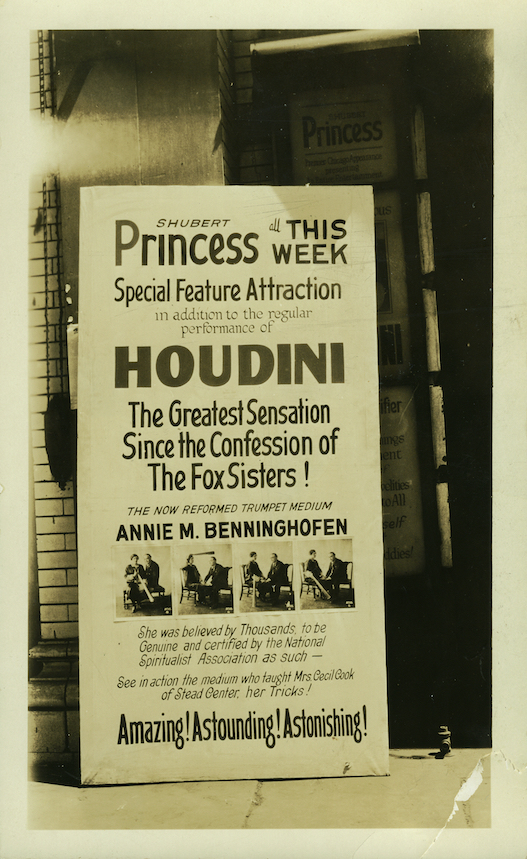
Let's return to the front of the Princess Theater in Chicago with another terrific image from the collection of the McCord Museum. This captures a sidewalk stand advertising a very special week during Houdini's record 8-week run at the Princess in 1926.

Photo: McCord Museum

The confession of acclaimed trumpet medium Annie M. Benninghofen was a major coup for Houdini and a real blow against spiritualism. On April 15, 1926, Houdini held a press conference at the Hotel Sherman in Chicago with Benninghofen who admitted that she had practiced fraud for 30 years. Houdini and the medium then gave a demonstration seance for the gathered reporters exposing her techniques.

"My father was a spiritualist. He was devout in his belief," explained Mrs. Benninghofen. "He was an educated man, but he was duped just like all the others. Although I now admit the work I did was a fraud, I must say that at the time I was sincere. I really believed I was helping the spirits. But I never fooled my mother. And on her deathbed, she asked me to give it up. I refused, but I got to thinking about it, and finally I quit."

Houdini added, "They are all just alike. I have yet to meet a real medium. Mrs. Benninghofen is the greatest of all of them I have met, and she admits that her work was a fraud."

Mrs. Benninghofen appeared with Houdini onstage during his 3 Shows in One on the evening of April 16. Houdini then featured her as part of his show for the entire following week (April 19-25). That's the week we see advertised above. I love that it promotes it as "The Greatest Sensation Since the Confession of the Fox Sisters!" Also notice the mention of Cecil Cook. Houdini had busted her a year earlier.

Houdini and Mrs. Benninghofen took a series of photos together at the Butler studio in Chicago. You can see several of those photos affixed to the sidewalk stand. Below is another less common photo from the McCord collection.

Photo: McCord Museum

When Mrs. Benninghofen completed her week with Houdini at the Princess, she gave him her spirit trumpet along with sworn statement that it was used for fraud. Today there are several Houdini owned spirit trumpets in private collections, but I'm not sure which is the famous Benninghofen trumpet. If anyone has any info on that, I'd love to hear it.

Thanks to the McCord Museum for helping unlock these stories with their magnificent images.

UPDATE: Brandon Hodge of The Mysterious Planchette has come forward with what he believes to be the Benninghofen trumpet, and I think he's right! Brandon writes:
I know lots of folks make big claims about Houdini items, but I have long suspected I own the Benninghofen trumpet. I have two trumpets acquired from the Dunninger estate (which had many Houdini-associated items), and one is not only the same configuration as the Benninghofen trumpet (the fully rolled bell-edge is a rare feature on historical trumpets), but has the same slightly darker/mis-matched pieces.

Related:

Tuesday, May 31, 2022

Model of Houdini's plane is safe for now

Ian and Janice Satur with the model Voisin. (Melton City Council)

Back in February DiggersRest.com reported the distressing news that the model of Houdini's Voisin biplane created by Ian Satur for the 2010 Centenary celebrations was due to be scrapped. The article read in part:
Unfortunately, despite a number of open-ended promises by Melton City Council to accommodate the model within a permanent setting, it’s understood that the model will be destroyed in the coming days.
The good news is Australian Aviation Historian Graeme Minns has stepped forward and will provide storage for the model until a permanent and hopefully public home can be found in Australia.

Diggers Rest resident David O'Connor, who has been spearheading the effort to display the plane, recently interviewed the 81-year-old Satur about making the model and what he discovered about Houdini's original plane. It's an excellent interview that you can listen to at ©Melton City Council.

Monday, May 30, 2022

Houdini and his doughboys take a dunk


Here's a wet one for this Memorial Day.

You'll often hear the story of how Houdini taught World War I soldiers the secrets of escaping from German handcuffs and restraints. This is true. Houdini was provided with his own "class room" on the promenade level of the New York Hippodrome Theater where he gave his lessons to a regular rotation of doughboys.

While this did generate publicity, it wasn't a publicity stunt. Houdini's classes were actually sanctioned by the War Department, as you can see in the below.

The Evening World, Feb. 27, 1918.

Recently I found there was another class that Houdini gave to soldiers from Camp Upton (where he had entertained a few weeks earlier). But this time the lesson was given in the famous Hippodrome water tank. Check it out.

The Standard Union, March 8, 1918.

The Hippodrome water tank, which was under the stage and would be opened for special aquatic performances, was equipped with several secret underwater diving bells. I wonder if these came into play here -- maybe showing the soldiers how to survive inside pockets or air within a sunken ship? Below is a photo of the bells from the blog New Yorker State of Mind. 


By the way, Houdini did some notable underwater challenge escapes in the Hippodrome tank doing his lengthy Cheer Up engagement, once from a straitjacket. I suspect he may have utilized these bells as well. But that's a different story.

Have a Safe and Happy Memorial Day

Top image: "Soldiers Swimming and Playing in the Water during World War I" from Mondovisions. Clippings: Newspapers.com.

Sunday, May 29, 2022

My choice for Houdini is still Tom Cruise

This Memorial Day weekend Top Gun Maverick roars into movie theaters and is already setting box office records. I loved the movie and think it deserves all its success and more. Tom Cruise still knows how to make a movie for everyone.

But all this just reminds me of how close we came to having a big budget Houdini movie starring Tom Cruise. Cruise was interesting in, and may have even been attached, to the Houdini project producer Ray Stark tried for many years to launch at Columbia.

The one Ray Stark commissioned script I've read was written by Stephen J. Rivele and Christopher Wilkinson. It's excellent and on every page you can envision Tom Cruise in the part. An early scene in which Houdini is filming the rapids action for his movie The Man From Beyond, doing his own stunts and demanding perfection from his crew, seems right out of the Tom Cruise playbook. So does Houdini's drive, his intensity, his fearlessness, and his sense of moral justice. 

I really feel like Tom Cruise and Houdini are cut from a similar cosmic cloth and that Cruise would embody Houdini better than any other actor. And Cruise's compact 5' 7" frame is a nice physical match. Yes, I know he's now older than Houdini ever became, but have you seen Maverick? Apparently not an issue

Recently Paramount announced they were developing a new Houdini movie. Of course, Paramount is also the home base for Tom Cruise's production company, Cruise/Wagner. While the Paramount movie is being developed by a different producer, maybe the two can get together? Although, personally, I'd love to see them just go back and shoot the Rivele and Wilkinson script.

Oh, wait, Houdini and Tom Cruise....both pilots! So how about a movie dramatizing Houdini's race to be the first man to fly in Australia?


Click the links below to read more about the Houdini movies that never were. And see Top Gun Maverick. Trust me.

Saturday, May 28, 2022

The Escape Artist (1982)

The excellent blog Travalanche by Trav S.D. takes a look back at the 1982 film The Escape Artist which turns 40 today. The movie was produced by Francis Ford Coppola and stars Griffin O'Neal as an aspiring magician and escapologist.

I remember not knowing what to make of this movie when it came out in 1982. It was a smaller film with a light touch in an era when big budget spectaculars were becoming the rage. So despite the magic and escape connection, I wasn't all that interested. But I did love the poster! (I still have my original.) I also recall having the paperback novelization.

However, when I finally saw the movie years later on DVD, I realized I had missed a gem. I also saw that some magic heavyweights worked on the film (which was shot in 1980), such as Ricky Jay, Mark Wilson, Bill Liles, Steve Baker, and John Gaughan.

You can read more about the movie on its 40th at Travalanche. It's also still available on DVD and streaming and I would certainly recommend a watch.

Related:

Friday, May 27, 2022

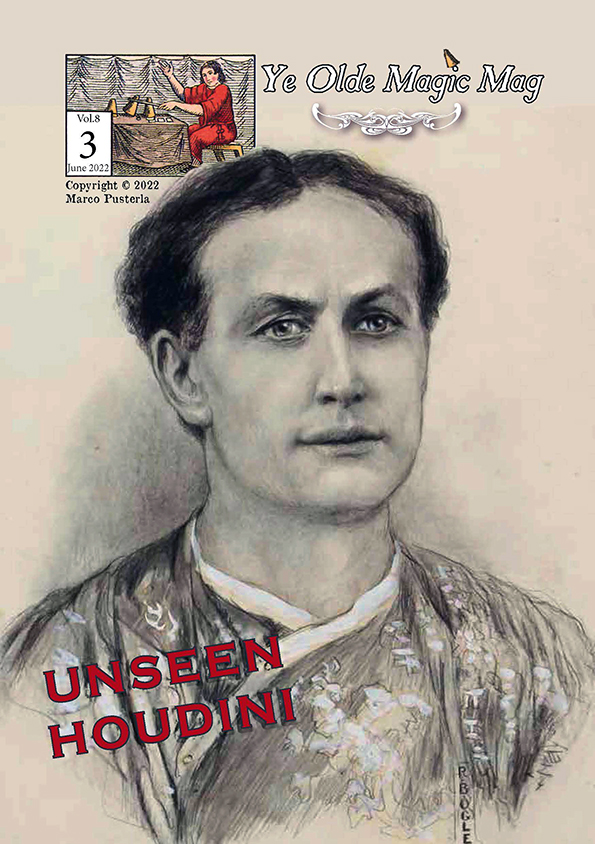
Ye Olde Magic Mag offers "Unseen Houdini"

The current issue of Marco Pusterla's Ye Olde Magic Mag features Houdini on its cover with the headline "Unseen Houdini". I don't have the mag so I can't tell you what's inside, but the cover image is a rare illustration by R.B. Ogle who provided artwork for some of Houdini's adventure fiction in the 1920s.

Ye Olde Magic Mag is available as a digital download and in a limited quantity of printed editions. If you act fast, you can grab one of those printed copies HERE.

Thanks to Leo Hevia for the alert.

Related:

Thursday, May 26, 2022

Houdini's gibbet and the Hippodrome war float


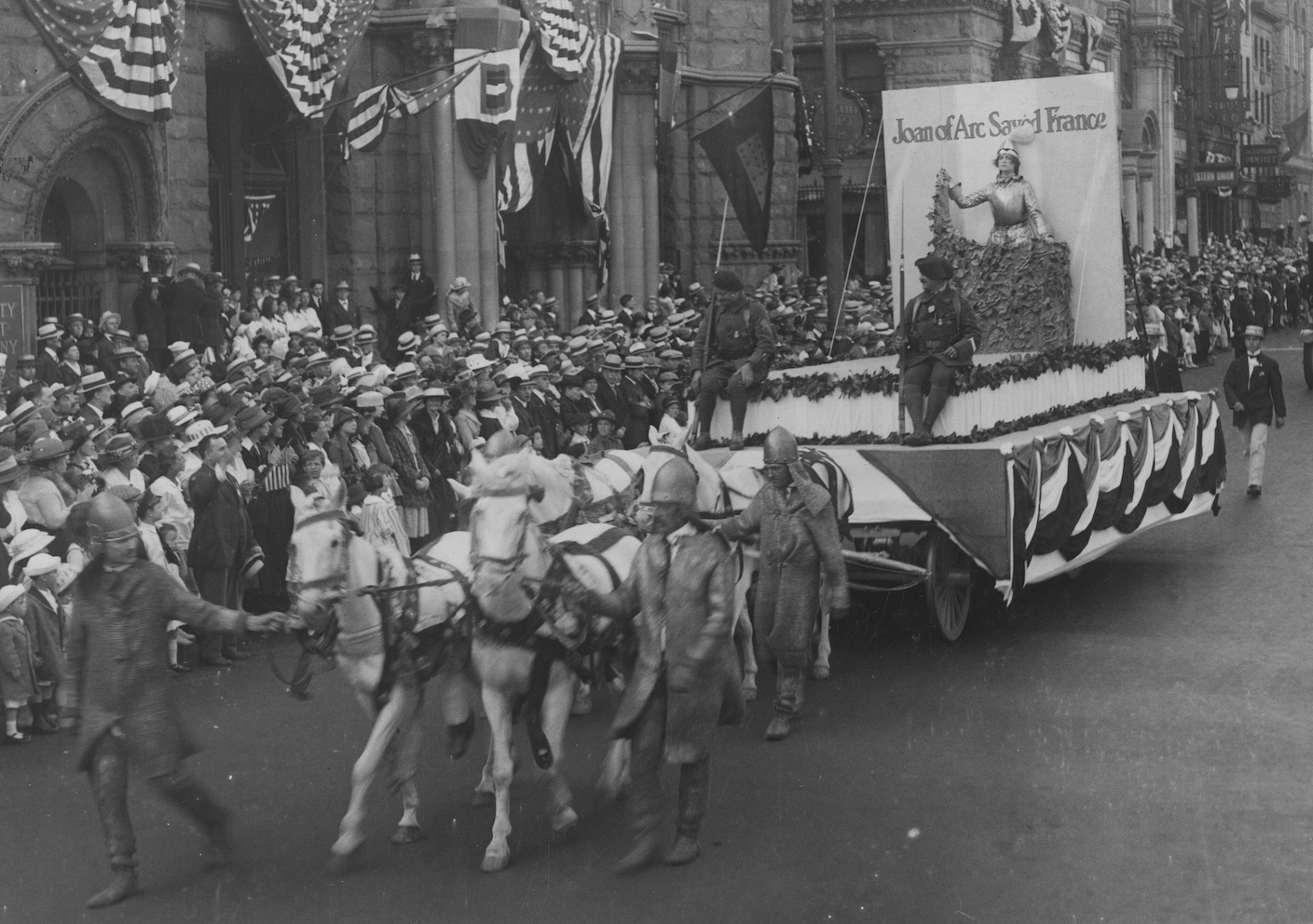
On April 20, 1918, a War Stamp and Liberty Loan parade snaked its way through New York City starting at 6th Avenue and 45th Street. Among the marching bands and dignitaries were three large floats created by the New York Hippodrome. One float featured star Belle Story costumed as Joan of Arc. A second carried a browning machine gun. And as for the third float, well, you can read for yourself:

New York Tribune, April 13, 1918.

Houdini was playing the Hippodrome as part of the revue show Cheer Up at this time. I've not been able to find a photo of this float, but the photo at the top of this post will give an idea of what it might have looked like (this is from a later War Stamp parade in Newark). But what were these "German instruments of torture"? A follow-up story provides the answer:

New York Tribune, April 21, 1918.

I'm pretty certain what crowds saw that day was Houdini's own gibbet. This is sometimes called an Iron Maiden, but that is not technically correct. (At least according to this guy, and I'm not about to argue with him!) Houdini's gibbet was made by blacksmiths in Scotland as a challenge escape in 1909. Houdini would repeat the gibbet challenge on occasion and frequently display the macabre device. He even once set it out on a Baltimore street during a suspended straitjacket escape.

So how fair was it to present the gibbet as a "German torture device"? As you might expect, this was pure war time propaganda. Gibbets were not unique to Germany. They had been used throughout Europe and even in America. But the practice of gibbeting, in which freshly executed corpses would be put on display until they decayed, ceased by the 1840s.

Sidney Radner acquired Houdini's gibbet from Hardeen and displayed it at both the Houdini Magical Hall of Fame and the Houdini Historical Center in Appleton. In 2004 David Copperfield acquired the gibbet in The Great Houdini Auction for $65,000. He then re-created the original frame using period wood. Another fun fact: this frame is the actual "gibbet." The iron cage hanging inside is called the gibbet irons, gibbet cage, or sometimes a crows cage. (Again, this guy.)

Today Houdini's gibbet resides happily in Copperfield's International Museum and Library of the Conjuring Arts in Las Vegas, where it still looks ready for use!

Tuesday, May 24, 2022

Houdini never ceases to surprise

To mark their 100th Anniversary, the McCord Museum in Montreal is is allowing free use of their online digital images believed to be in the public domain. This includes select images from their Houdini collection. What's especially nice is these are high resolution downloads that can sometimes reveal details not seen before. That's what brings me to this.

The below photo shows the Princess Theater in Chicago during Houdini's record 8 week run of his 3 Shows in One in 1926. I've seen this photo before and never thought all that much about as there are better images of the theater facade showing Houdini's sidewalk displays. But in this higher res version I noticed there is someone changing a lightbulb on the Princess marquee, which is kind of fun. But then I had a closer look.


Now, call me crazy, but I think the man changing the lightbulb is Houdini himself! Certainly his hair and body resembles Houdini in 1926. And if this was an electrician or stagehand, wouldn't he be in coveralls and work boots? This guy is wearing dress shoes!


But why would Houdini be doing this himself? We can only speculate. The 3 Shows in One played legitimate theaters that may not have the same level of upkeep as a vaudeville house. It could have been just a just single bulb that was out. But I could see that irritating Houdini to the point that he'd grab a ladder and change it himself, especially if he had requested it be done and it was not. We know he wasn't afraid of heights! And we know he was a bit of a show off.

I can also see Houdini handing off his camera to an assistant and saying, "Get a picture of me doing this." Because why else would this picture be taken? That might actually be the best argument for this being Houdini.

Or maybe I just want this to be Houdini so we have something in common.


So what do you think? Is this Harry? And what's your guess as to why he might be doing this himself? Illuminate us in the comments below.

Thanks to the McCord Museum.

Monday, May 23, 2022

'Death and Harry Houdini' free workshop at UC Davis

The UC Davis Department of Theatre and Dance will present a free workshop of a new musical Death and Harry Houdini on June 2 and 3 in the Wyatt Pavilion Theatre at 8 p.m. Below are details.

Created by Keaton Wooden, Granada Artist-in-Residence, the project is based on an original play by Nathan Allen. Alumna Lisa Quoresimo (PhD, performance studies, ‘18) directs the piece which features musical staging by graduate student Edward Talton-Jackson and music direction by Graham Sobelman.

This musical in development centers on young Erik Weisz, who after witnessing the death of his father, becomes haunted by death and vows to prove himself its greatest opponent in history. Terrified, but stubborn, Erik transforms his life to become “Harry Houdini” and uses his skills for showmanship, strength, and illusion to prove to death, and himself, that he fears nothing. Along the way Harry meets his future wife, foils charlatans, and inspires a nation to believe in the impossible. How will Harry finally defeat the greatest foe every magician, human, and artist faces?

Saturday, May 21, 2022

Earliest known professional photo of Houdini sells for $78,000

The earliest known professional photo of Houdini and his brother, Theo, sold today for a whopping $78,000 (including 20% buyer's premium) at Potter & Potter's "Houdiniana and Magic Memorabilia" auction. The photo captures "The Brothers Houdini" at the start of their careers and was taken by Feinberg in New York. The auction dates it as 1892/3. There are at least three other known images from this photo session, but this is the only original I've ever seen. A treasure indeed and a new record for a Houdini photo.

The auction contained many other rarities from the family of Houdini's brother, William Weiss, and the collection of Manny Weltman (which you might recall I mentioned here). One of the stranger items was a carved cigarette holder presented given to William by Houdini. The auction says this rarity demonstrates "not only their close relationship, but Houdini’s generosity and self-love." But I can't help but think it might have been a gag gift. I can see his brother saying something like, "Every time I open the paper I see Harry's ass." So Houdini gives him this. Well, someone paid $20,400 for that view today.

SOLD for $20,400.

Speaking of Bill Weiss, his inscribed portrait sold for $660. An hitherto unknown photo of Houdini inscribed in 1904 took in $21,600. A portrait of a very young Theo Weiss sold for $3600. A photo of the young Cecelia Weiss with her mother and sister dated 1874--the auction listing speculates she may be pregnant (with you know who)--sold for $2400. This was the first appearance at auction for any of these rarities.

Inscribed Houdini ($21,600) and brother Bill ($660).
Young Theo ($3600) and Cecelia Weiss ($2400).

But the biggest seller in the auction was a spiritualism and magic scrapbook given to Houdini by Henry Ridgley Evans in 1924. This came from the Manny Weltman collection and was one of the items that failed to meet the reserve in the Weltman Swann auction in 2002. Today it blew away the auction estimate of $30,000 - $60,000 and landed at a wild $102,000 (including premium).

SOLD for $102,000.

However, the item that most bewitched me personally was a framed engraved print showing Moses transforming a staff into a serpent before a Pharaoh. This was obtained by Larry Weeks from the Houdini family and once hung inside Houdini's home. This blew past its $400-800 estimate and landed at $6,600. Happily, the winner was our friend Lee Terbosic. Congrats Lee! Now the hunt is on for a photo of this hanging inside 278.

SOLD for $6,600.

Afraid the only thing I came away with was the auction catalog. But it's a beauty!


Congrats to all the winners and to Gabe Fajuri at Potter & Potter for another wildly successful Houdiniana auction.

Thursday, May 19, 2022

The Pecoraro Files

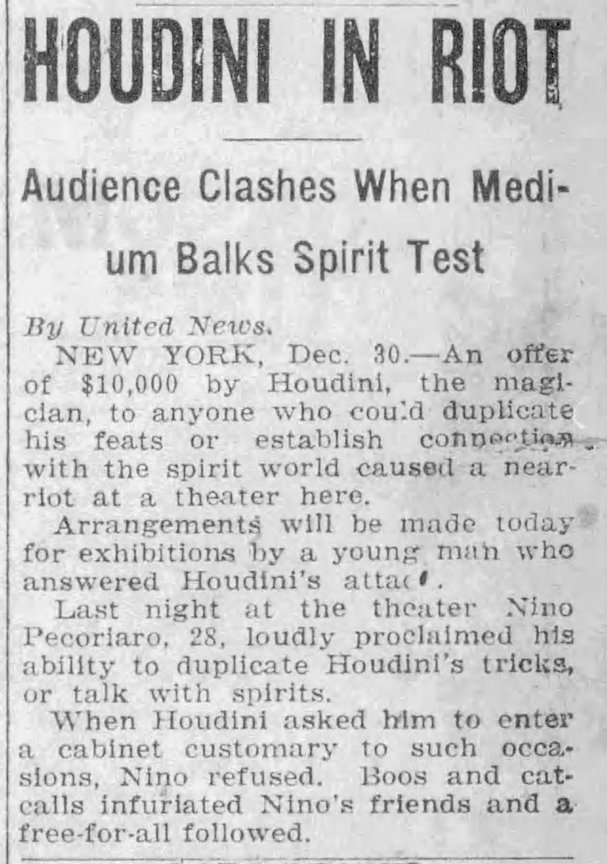
Here's a news item that was widely syndicated in late December 1925. This occurred during Houdini's 3 Shows in One at the National Theater on 41st Street in New York City. An evening with Houdini was never dull!

The Cincinnati Post, Dec. 30, 1925.

Nino Pecoraro (misspelled Pecoriaro in the above) was an Italian spiritualist who claimed his spirit guide was the deceased medium Eusapia Palladino. Pecoraro's reputation was greatly bolstered when he impressed Sir Arthur Conan Doyle during a seance at the offices of the American Psychical Institute in New York City in 1922. However, Doyle was dismayed when full details of the seance appeared in newspapers the next day "with the copyright mark below it, to show that it had been duly paid for."

The incident at the National wasn't Houdini's first encounter with Pecoraro. In 1923 the famed "boy medium" was tested by the Scientific American committee on which Houdini served. Houdini was on tour and did not attend the first two tests, during which Pecoraro impressed the committee with his ability to manifest ghostly phenomena while securely bound. The head of committee, J. Malcolm Bird, who would later collude with Margery, even wondered if the smell of garlic on the Italian's breath could be "celestial garlic." No joke.

Things looked good for Pecoraro. That is until Houdini arrived for the third test on December 18. He was mortified to see the committeemen securing Pecoraro with a single piece of long rope. Houdini cut the rope into pieces and tied the medium himself. That put an end to Pecoraro's ghost show and his shot at the Scientific American prize. (For an excellent account of all this check out The Witch of Lime Street by David Jaher.)

While Houdini biographies all contain the story of the Scientific American tests, none of them mention this follow-up incident at the National. Was it really a "riot"? One thing I find intriguing is the photo below. This shows Houdini and Pecoraro around the time of this confrontation. In fact, Houdini and the young medium took a series of portraits together at a New York photo studio. Why would they do this? Were they planning a public test, as alluded to in the article, that never came to pass? Could the theater incident have been a publicity stunt that got out of hand? There may be an untold story here.


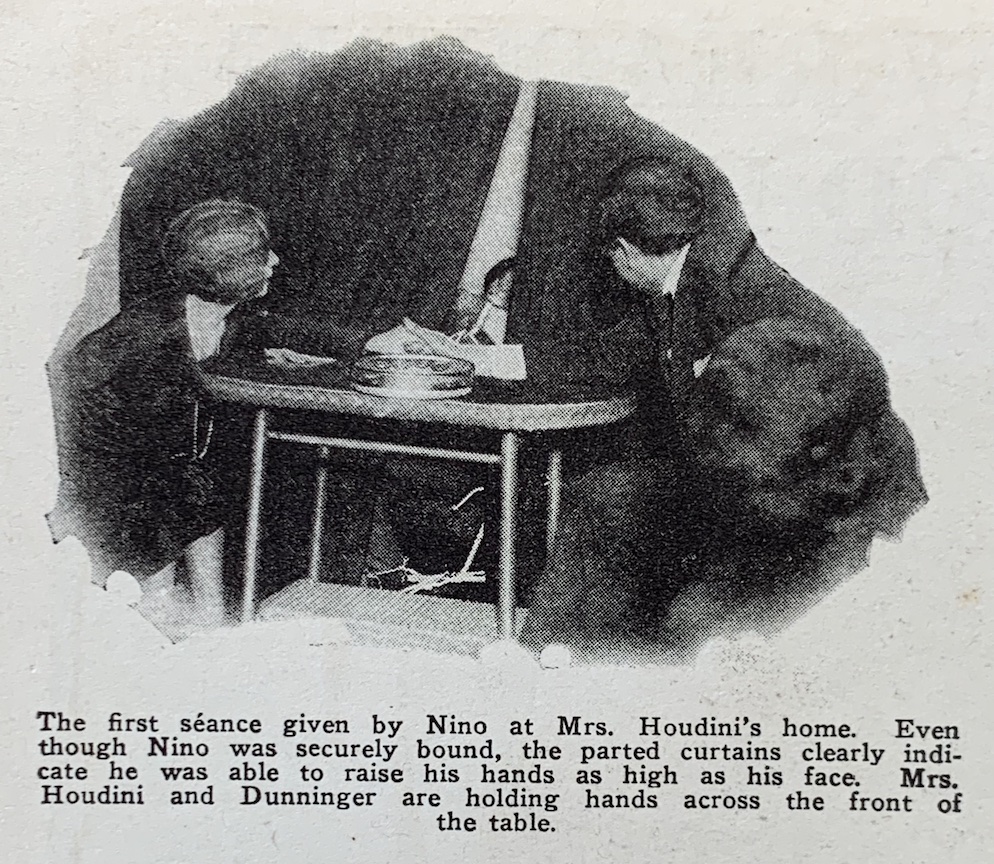
After Houdini's death, Pecoraro gave Bess a private seance at her home on Payson Ave. Joseph Dunninger was also in attendance. Nino went through his regular routine but failed to deliver the all important Houdini Code to Bessie.


In 1928 Pecoraro was at it again. This time the medium offered to produce Houdini's physical spirit at the offices of Science & Invention magazine which offered a $21,000 prize for genuine spirit phenomena. Bess attended the seance and cameramen surrounded Pecoraro's cabinet, ready to snap a photo of the master magician. Nothing happened. "Not Even for $21,000 Would Houdini Show Himself at Seance" read a newspaper headline the next day.

A few days later Joseph Dunninger recreated Pecoraro's seance using trickery for better results. The photo below shows "Houdini" making his reappearance with Bess looking on. Pecoraro's manager, Charles E. Davenport, asserted that Dunninger had mediumistic powers even if he didn't know it.


In 1931 Pecoraro finally confessed to being a fraud. He demonstrated his methods, which included producing a message from Houdini, at a New York press conference. The resulting United Press story is pretty amusing.

The Ogden Standard Examiner, April 9, 1931.

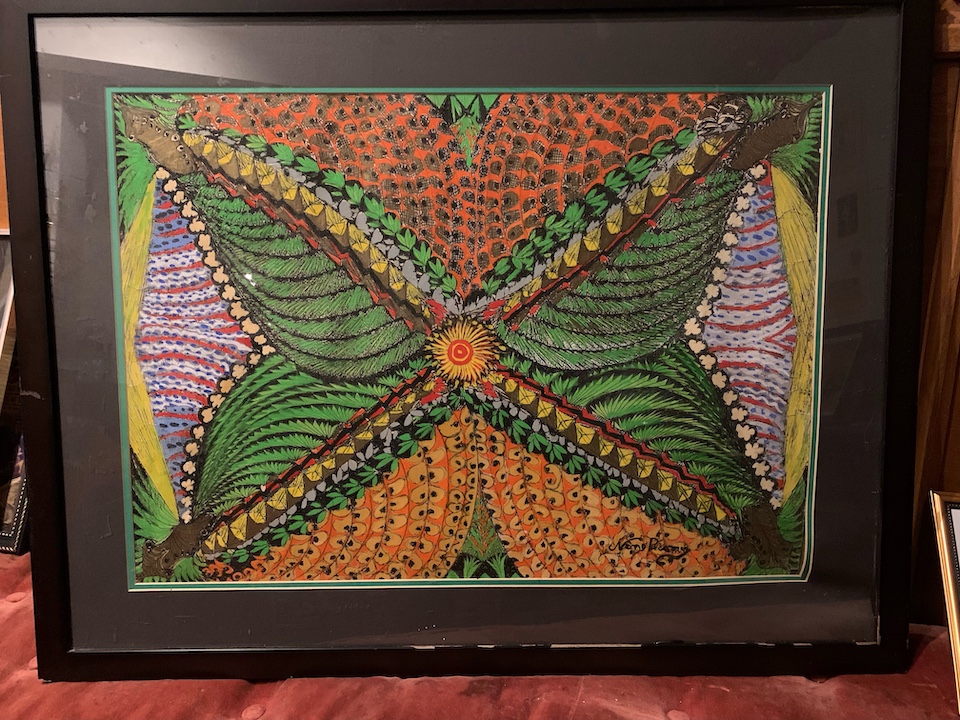
It's unclear if Pecoraro ever did become a cement salesman, but he did continue to paint. In fact, two of his paintings are on exhibit at the Houdini Museum in Scranton, PA.

On April 27, 1973, Pecoraro collapsed while walking with a friend in Naples and died on his way to the hospital. He was 74.
Painting by Nino Pecoraro at the Houdini Museum in Scranton.

Thanks to the Houdini Museum in Scranton for the photo of their Nino painting. Other images come from Houdini: A Pictorial Life by Milbourne Christopher, Houdini's Sprit Exposes by Joseph Dunninger, and Newspapers.com.

Wednesday, May 18, 2022

McNulty's Book Corral is wild about Harry (and Gresham)

Here's a fun review of William Lindsay Gresham's 1959 biography Houdini: The Man Who Walked Through Walls by McNulty's Book Corral on YouTube. Mr. McNulty gives WILD ABOUT HARRY a very nice unsolicited shout-out near the end of the video, so I thought I'd return the favor! Enjoy.


Thanks to Diego Domingo for the alert.

Translate