Monday, September 14, 2020

10th Anniversary: Randi at the Castle

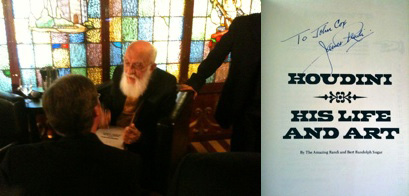
It was 10 years ago that I reported on an event at the Magic Castle in Hollywood with James The Amazing Randi. This was my first time meeting Randi who remains one of my magic heroes.


TEN YEAR UPDATE: Randi did make his return appearance at the Castle in 2012, which I also covered HERE. Today Randi is still with us at age 92, and, boy, has my hair gone grey!

    Sunday, September 13, 2020

    Wait, what?

    These "Houdini handcuffs" recently sold at auction for a whopping $16,520. What makes this all the more remarkable is the auction provided no provenance whatsoever, and I'm not sure having been displayed at the America Circus Museum in Sarasota adds much. Even an authenticated pair of (ungaffed) Houdini handcuffs would not sell for anywhere near this price. Maybe the buyer knows something we don't?


    You can follow the discussion of this at Kevin Connolly's Conjuring History Facebook Group. Below are links to some more curious "Houdini handcuffs".

    Friday, September 11, 2020

    Did Hardeen really discover the full view straitjacket escape?


    It's an established part of Houdini lore that he originally performed his straitjacket escape inside a cabinet until Hardeen discovered the power of doing the escape in full view when challenged to do so one night by an audience that didn't believe his cabinet escape. After that, Houdini quickly adopted the full view presentation and the straitjacket became one of his most iconic and popular escapes.

    I've always found this perplexing. How could Houdini, who knew full well the power of rope escapes done in full view of the audience, fail to see this himself? Nevertheless, here's proof positive that as late as November 12, 1904, Houdini is still doing the straitjacket escape inside his "red velvet tent." This is from the Birmingham Daily Gazette:

    Click to enlarge.

    From this it appears the escape is still effective ("the applause was tremendous"), so maybe that's why Houdini never felt the need to experiment. I should add that I've found another cabinet straitjacket escape on December 2, 1904, at the Pavilion Theatre in Newcastle (with a carpet laid on the floor to ensure no traps), but the above clipping makes better reading.

    So if Hardeen really did make this seminal discovery, exactly when and where did this happen? Turns out that is NOT an easy question to answer. There are conflicting claims and not one of them commits to a date. But we know Houdini is still in his cabinet in November-December 1904, and it's said he did his first full view escape in Paris in March 1905. So we can assume Hardeen made his discovery sometime between those dates.

    Thanks to my recent deep dive into the British Newspaper Archive (which I've re-upped for another month), I have Hardeen's schedule at this time. So with this in hand, let's examine the major candidates:

    Christopher:
    In Houdini The Untold Story, Milbourne Christopher says Hardeen made his discovery at the Swansea Empire in Wales. He does not provide a date, but Hardeen played Swansea the week of December 26, 1904, which is within the timeline. Christopher says Dash sent Houdini a newspaper clipping. That makes me suspect his source is a letter. I wish I knew for sure, because Christopher is also the sole source for Houdini doing his first full view escape in Paris in March 1905. (The first account I can find is April 14, 1905 in Cardiff.) This is two months after Swansea, so either Hardeen took his time telling him or Houdini took his time in adopting it. Or maybe there's a better candidate...

    The pitchbook:
    I believe everyone, including Christopher, uses Hardeen's pitchbook, The Life and History of Hardeen, as the primary source for the dramatics of this event. And why shouldn't they? The pitchbook contains what appears to be a detailed newspaper account (which, unfortunately, is undated and unattributed). It even has a photo of the theater announcing the re-challenge on a huge outside banner.


    The pitchbook identifies the events as having played out at the "London Empire." Now, when I hear "London Empire", I think of the Empire Theater in Leicester Square. But Hardeen never performed there. So this could be a reference to greater London, and Hardeen did play Empires in Hackney, Holloway, and New Cross in late November 1904, which are (just) within the timeline. [UPDATE: The photo is the Holloway Empire.]

    But here's the problem. Elsewhere this pitchbook photo is credited as being 1906. This is well after Houdini is doing the straitjacket in full view. In fact, I have found numerous accounts of Hardeen being called out of his cabinet to repeat his straitjacket escape all throughout 1906. It appears to have been a standard (staged) re-challenge, similar to how Houdini would be "re-challenged" to do his packing crate escape. In fact, Hardeen becomes so associated with this, the English press dubbed him "the straitjacket man." Here is one such account from the Empress Theater in Hartlepool on April 7, 1906:

    Hartlepool Northern Daily Mail.

    I now believe everything in the pitchbook is referencing one of these later staged escapes. It's also possible the story in the pitchbook is not even an actual newspaper clipping, which is why it is unattributed and suspiciously vague. So the pitchbook is pure misdirection.

    Does this mean the entire story of Hardeen discovering the full view straitjacket escape is manufactured mythology? Did the brothers discover it in some other way, maybe even seeing an imitator do it? When going down one of these Houdini rabbit holes the "it never happened" option always has to be considered. But before we jump to that conclusion, there's one more candidate to hear from...

    Hardeen (Himself):
    In the March 1941 issue of The Sphinx, Hardeen provided a lengthy article called "Houdini-Hardeen Strait-Jacket Escape". In it he states he made his full view discovery at the "Bedford Music Hall, Camdentown, London." He also says the escape took a full "grueling hour." He doesn't give a date (why make it easy on us?), but I've discovered Hardeen at the New Bedford Palace of Varieties in Camden Town on March 24, 1905. Presumably Dash played the full week which began on March 20.

    Music Hall and Theatre Review, March 24, 1905.

    This engagement fits like a glove! It is within the timeline and, better yet, it is while Houdini is in Paris. So Christopher's claim that Hardeen told Houdini about the escape via letter and that Houdini first tried it in Paris works beautifully. We also know Dash joined Houdini in Cardiff for his battles with Frank Hilbert during the week of April 12, and it's on April 14th that Houdini does the first documented full view escape that I can find.

    (By the way, Hardeen states in this same article that he and Houdini saw their first straitjacket in Berlin in 1900, which cannot be right. But that's a can of worms for another time.)

    While I'm still not sure we have this is 100% locked down, I do feel pretty good about the March 1905 New Bedford engagement as being the time and place Hardeen discovered the full view straitjacket escape. I also still believe the core claim; that it was Dash who made this discovery and not Houdini. The primary reason are the 1906 staged re-challenges. Only Dash did these, and that suggests he had some ownership over this particular twist on the act. Not to mention he was able to put the story in his pitchbook.

    So, yes, I think we are safe leaving this one in Hardeen's column. Feel free to let me know what you think in the comments.


    Thanks to Joe Fox for providing me with a copy of the original Hardeen Sphinx article. It is also reprinted in Pat Culliton's Houdini The Key and Hardeen: Monarch of Manacles by William V. Rauscher.

    Thursday, September 10, 2020

    Private investment fund circling David Merlini's House of Houdini

    A private investment fund, CCV (Centurion Capital Ventures), is offering David Merlini $18.6 million for his House of Houdini museum in Budapest and the rights to Houdini's name. David controls the use of "Houdini" in the EU. The news broke via a press release late last month.

    David has now confirmed for the Hungarian news outlet Blikk that the offer is legitimate. Says David, "I can’t comment on the details of the deal, but I have to make the difficult decision in days."

    David Merlini opened The House of Houdini in 2016. Is the only Houdini museum in Europe. The museum, which is located in Buda Castle on Castle Hill, had reopened for business. But due to a Covid spike in Hungary, the government is once again ordering all museums to close.

    UPDATENo sale for The House of Houdini in Budapest.

    Related:

    Ghost burster

    The website lavanguardia.com has an article about Houdini and Margery by John William Wilkinson. It's in Spanish so I don't know if it's any good, but this animation by Martin Tognola that tops the story is terrific!


    Is it just me, or have things been a little quiet on the Margery front these days? Below are a few Margery goodies from the past.

    Wednesday, September 9, 2020

    Houdini flies again in 1926

    While Houdini never piloted an airplane after his historic Australian flights of 1910, he did occasionally board aircraft as a passenger. This was before passenger air travel was well established. He flew to Catalina Island during production of Terror Island in 1919. In 1920 he and Bess flew across the English Channel to France. But here's an airplane journey in the last year of his life that I was not aware of. This is from the February 19, 1926 York Daily Record.


    This wasn't the only talk of air travel for Houdini in 1926. While playing the Orpheum Theater in York, Pennsylvania, Houdini had to travel to Washington D.C. to appear before Congress at 2:00 PM on February 26. His plan was to take a train in the early morning and return by airplane in time for his show that evening. However, insurance forbade him to take the flight. But Houdini appears to have still made it back in time for his show. Might he have taken his flight anyway?

    One thing this tells us; had Houdini lived, he almost certainly would have become a frequent flyer.

    Tuesday, September 8, 2020

    Houdini is a Big Mouth

    The (very) adult Netflix animated series Big Mouth features an appearance by Houdini's ghost in season 3 episode 5, "How to Have an Orgasm." Houdini is voiced by Andrew Daly. He shows up around the 20 minute mark, although Houdini is name-checked throughout the episode. This first streamed October 5, 2019.


    Below are some more appearances of Houdini in animated comedy.

    Monday, September 7, 2020

    That meme you've seen

    This meme has been making the rounds on Facebook and I've received a few emails asking if it's real. Well, it is real in the sense that this is an image of Houdini in 1918 when the flu pandemic was raging. But it has nothing to do with the pandemic. This is a screen grab from Houdini's The Master Mystery. Houdini is wearing a mask here to protect himself from the dreaded "Madagascar Madness." I'm actually the one who first shared this image on Facebook. But then someone made it into this meme and it has taken on a life of its own. 

    So while it's a little misleading, the sentiment is certainly legit. Wear a mask!


    Here's wishing everyone a safe and Covid free Labor Day.

    Sunday, September 6, 2020

    Beat the heat with Hardeen

    Today is going to be a hot one in Southern California. It's forecast to be 114℉ in my own Burbank. Even Catalina "Terror" Island shows 107℉, which I didn't think was possible. Coincidently, yesterday I stumbled on this ad from almost exactly 114 years ago. Despite being "the hottest day of the summer" in the UK, people still packed the non-air conditioned Ealing Hippodrome to see Hardeen! Imagine what they would have endured for Houdini?

    Music Hall and Theatre Review, Sept. 7, 1906.

    Notice this ad shows Hardeen was also managed by Harry Day in the UK. I love the inclusion of "my pal." That seems very Dash.

    Stay cool.

    Saturday, September 5, 2020

    Watch the Houdini episode of The UnXplained

    Season 2 of the William Shatner series The UnXplained features a Houdini segment in episode 9, "The Greatest Escapes". I didn't see this when it first aired back in July, but I was finally able to check it out on Amazon. It's well done. It was respectful and I especially liked the colorized animated images of Houdini (below). It also did a nice job of mythologizing the Overboard Box as his most baffling escape. That might be debatable, but you'll need to take it up with Shatner!


    The episode features interviews with the great Jim Steinmeyer, Dean Gunnarson (who knows the danger of the Overboard Box firsthand), investigative journalist David Whitehead, and yours truly. The interviews were shot at the legendary Brookledge in a room frequented by Bess Houdini, so that was a thrill.


    Of course, it wouldn't be the "History" Channel without conspiracy, pseudoscience, or superstition, hence their conclusion that Houdini may have possessed supernatural powers. Even the filmmakers knew this was hokum, but that's the network. (If you're wondering what happened to the History Channel, check out this YouTube video.)

    You can purchase The UnXplained season 2, episode 9, The Greatest Escapes, at Amazon.com. If you have cable you can stream it on the The UnXplained website.

    Related:

    Friday, September 4, 2020

    Selling The Master Mystery in the UK

    Today marks the 101st anniversary of the release of Houdini's The Mastery Mystery in the United Kingdom. As in the U.S., the serial was aggressively marketed to exhibitors via trade magazines. Below are several ads from The Bioscope pushing the serial. Did you know The Master Mystery was "The Greatest Money-Maker Ever Produced"? Now you do. I especially like how the trade screenings were promoted as "Houdini Days." Enjoy.


    Houdini had originally planned to be touring the UK while the serial rolled out across the country. But he changed his plans when it was decided to film his second Lasky feature, Terror Island, that Fall. When Houdini finally arrived in the UK in early 1920, The Master Mystery had done its work and England was ready to see Houdini (Himself).


    Thursday, September 3, 2020

    More trouble for Mysto

    Following up on Tuesday's post about Houdini's exposure of Carl Mysto's coffin escape in 1904, our friend Fred Pittella sends over these gems from his collection. This playbill predates the Salford exposure and is almost certainly the work of Houdini.

    Click to enlarge.

    Poor Mysto. Maybe it's his failed 1902 audition and Houdini calling him "a common bum and a dirty one at that", but I admit I feel sorry for him. I feel like he pulled himself together and came up with good idea with his coffin escape, especially the idea of his hands manacled through the top, and he didn't do anything to warrant its exposure.

    But as said on Tuesday, Mysto's skirmishes with Houdini actually brought him publicity and bookings that he wouldn't have otherwise received, and he did go on to have a long career in English Music Halls. In 1922 he even starred in a popular musical comedy show, O.K., in which he played a magician detective named "O.K." In 1930 he renamed himself The Great Neudini.

    Thanks to Fred Pittella for the share. Be sure and check out Fred's own website Houdini & Escapes Museum.

    Wednesday, September 2, 2020

    Blaine ascends

    This morning David Blaine presented his latest outdoor spectacle, Ascension, in which his floated nearly 25,000 feet into the air holding balloons. It was another beautifully conceived feat that was both awe inspiring and terrifying, and exactly what it must have been like to experience Houdini.


    You can rewatch the live stream of "David Blaine Ascension" on YouTube.

    Tuesday, September 1, 2020

    Opening Mysto's coffin


    Contrary to popular belief, Houdini did not go after each and every imitator of his act. Theaters were awash in Houdini wannabes, and to have tangled with them all would have left no time for his own act and just brought them publicity. So unless an imitator made false claims about Houdini or used his name in their advertising, he largely ignored them.

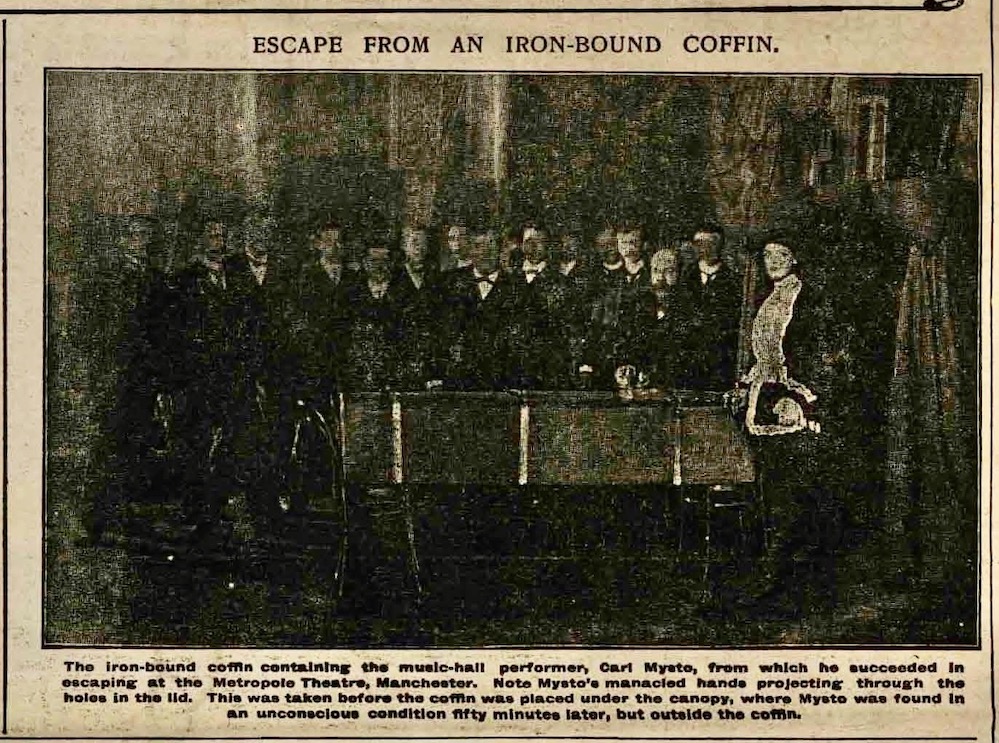
    In 1903 an escape artist who called himself Carl Mysto began performing challenge escapes in the UK. This was not typical of other Houdini imitators who largely confined themselves to the handcuff act. One of Mysto's feats was to escape from an "iron-bound coffin" with his hands manacled through holes in the top. The escape was a good one and it drew a fair amount of attention, even landing Mysto a photo spread in the Houdini friendly London Daily Illustrated Mirror (above and below).


    Houdini had first met Mysto in October 1902 when the budding magician wrote asking if Houdini could arrange an audition. Houdini remembered: "Carl Mysto at the time was working in pubs, doing magic and passing the hat. He was a tramp. I gave him a pair of pants and a few old shirts and half a dollar. He gave a trial show and did not make good. He was a common bum and a dirty one at that."

    In September of 1904, both Handcuff Kings found themselves playing opposite theaters in Salford near Manchester. Houdini was at the Regent Theatre of Varieties and Mysto at the Hippodrome. Mysto ran into trouble during his first week. On September 21 he was summons to the Salford police court on a charge of stealing a pair of handcuffs from a challenger, Thomas Skellington. The case was dismissed. 

    Did Houdini have a hand in this? If so, it could help explain why the Hippodrome's manager, Broadhead, felt compelled to take a swipe at Houdini during a manager's meeting, saying Mysto gave a better show and did not "talk endlessly of his triumphs." Furthermore, at £10 a week, Mysto made a better profit than Houdini at £150 a week. Houdini's hatred of imitators was matched only by his hatred of unscrupulous managers, and when he learned of Broadhead's words the gloves came off.

    Instead of challenging Mysto to a coffin breaking contest as one might expect, Houdini took an approach wholly bent on ruining his signature feat. He paid the man who made Mysto's coffin, Reuben Shaw, to make him a duplicate. He then exposed the escape on the stage of the Regent for two straight nights. The London Daily Illustrated Mirror ran a story complete with photos showing Franz Kukol and Hardeen (presumably standing in for Shaw) assisting in the exposure.

    Unlike the stories of Houdini undoing Kleppini with the French Letter Cuff or Frank Hilbert with a crafty disguise, the Mysto affair doesn't present Houdini in an especially heroic light. It's an out-and-out exposure of another magician's original invention and a clear breech of the Magician's Code. Local magicians were said to be "blazing with anger", and at least one reader of the Mirror found Houdini's behavior unsportsmanlike:


    Houdini portrayed his actions as providing a public service, saying the use of a coffin was "entirely out of place" and that after his exposure "no coffin will ever again be used as an accessory to a public amusement." Privately he told local magician Harry Whiteley that he regretted exposing the coffin trick, but his fight was with Broadhead, not Mysto. The incident did not hurt Mysto, who suddenly found himself in demand. But it also opened the door to exposure acts, many of which would target Houdini.

    Despite Houdini's claim to have made the theatrical world safe from coffins, in January 1907 he presented his own coffin challenge escape at the Boston Athletic Association. That coffin is on display today at the Houdini Museum of New York along with an original poster from the 1904 Mysto exposure.


    Thanks to Joe Fox for helping me uncover the Harry Whiteley letter and the name of manager Broadhead. For more on Mysto in Salford check out Harry Houdini Legend & Legacy by Brian Lead and Roger Woods, 1993.

    Translate