
Friday, February 11, 2022
Remembering Bess
Just a quick post to remember Bess Houdini on this the 79th anniversary of her death on February 11, 1943.


Thursday, February 10, 2022
Alleged "Houdini stunt-used straitjacket" at auction
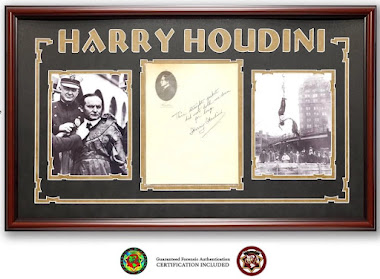
As a rule, I try not to post about auctions in progress. However, I feel compelled to chime in on this one. LiveAuctioneers is listing a "Harry Houdini stunt-used straight jacket" signed by Houdini himself. The auction currency sits at $1,300 with three bids. But there are problems here.

For starters, I don't know of any photograph of Houdini in this style straitjacket. The auction provides no provenance and according to Magic Castle assistant librarian (and straitjacket expert), Joe Fox, this is an Abbott's straitjacket. These were first produced in the 1930s and Abbott's continues to sell them today. So made after Houdini's death. Also, the signature bares similarity to the work of a well-known Houdini forger.
The same auction house, Dalshire International, also listed a sheet of signed letterhead as "A perfect compliment to his straight jacket". This was, unquestionably, the work of that forger and the auction was taken down.
So red flags everywhere. Bidder beware!
UPDATE: Looks like this sold for $34,000.
Wednesday, February 9, 2022
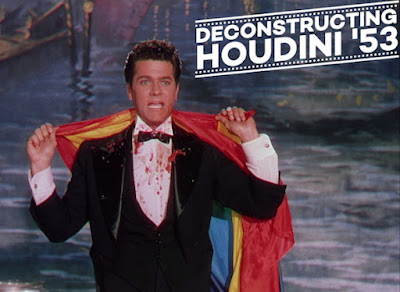
Deconstructing Houdini '53: Miner's Hall
Continuing my scene by scene dissection of Paramount's classic 1953 biopic Houdini. Last time we joined Harry and Bess on their Wedding Night. Today we hit the road...
Chapter 6: Miner's Hall
We open on the uncredited Billy Bletcher performing as "Luratti, The Little Man with the Big Voice". (That is his real baritone.) This is a world of show business that you don't really see in other biopics, but it is very representative of the world that Houdini performed in. He was almost always part of a rotation of acts on a variety bill. Here the act is billed as "The Great Houdinis", but the real Harry and Bess called themselves just "The Houdinis". As I've previously mentioned, Houdini rarely used "Great" in his billing. It sounded as corny then as it does now. But Hollywood finds it irresistible.

After Luratti is driven off the stage by the vegetable throwing audience, The (Great) Houdinis reluctantly take the stage and launch into their magic act. The trick we see Houdini perform is the Whirlwind of Colors, an effect performed by the real Houdini and later Bess. But instead of producing a flapping American "Eagle" from the scarves, here he conjures a teetering stack of goldfish bowls. This just invites an especially rowdy audience member (Joe Ploski) to shoot Bess with a spit-wad, causing her to drop all the bowls. It's a mess and poor Janet Leigh looks to be having a genuinely difficult time getting off the slippery stage.

Houdini's plea, "At least give us a chance," is met with a tomato to his face. He then steels himself and announces he will do a trick "never before seen on any stage." He then vanishes before the stunned crowd and reappears within the audience where he delivers his own tomato to the face of his tormentor. This wins over the audience who cheer him heartily.

The vanishing effect as performed here is worth talking about. This is not a trick that can be performed impromptu in any space. This is a big theater effect. Tony Curtis plays it as if he is digging into some deeper reservoir of magic power brought on by his anger. Suddenly he IS the greatest magician of all time, the future HOUDINI, and he does the impossible. Tellingly, Bess, who will later express her fear of this power, is not there to witness it. Or is this just another magic trick? We never find out, and playing with this ambiguity is part of the fun of Houdini.
Harry then joins Bess in their (unrealistically large) dressing room. She expresses her frustration with life on the road. When their next stop, Wheeling, is mentioned, Bess laments, "We'll probably get shot there." This may or may not be a nod to Harry getting shot in the hand in Coffeeville, Kansas, during this time. Bess suggests Harry consider taking a job in a lock factory. This is not something Harry takes well. We then get this exchange:
Bess: Nobody seems to want your magic, Harry. There's nothing new in card tricks. What does it mean to go through trap doors and escape from cabinets. What does it all mean?Harry: I don't know what it means. I only know what it does to me. Like tonight when I did that disappearing act, tough as they were, you should have seen their faces. I gave them a thrill. Something to take home and talk about.Bess: So you thrilled them for a minute. By tomorrow it will be forgotten.Harry: Next time I'll give them a bigger thrill. Something they won't forget so soon.
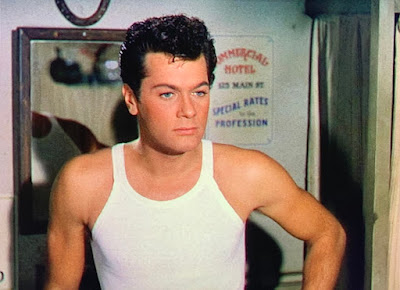
This is nice foreshadowing, and I love the moment in any biopic when Houdini expresses what it means to be a magician. We also get a bit of Harry's backstory here when he says, "I never went to school. I started working when I was nine years old with the magician in a tent show." Neither is true, but it's an effective bit of expository dialogue that sets up his rags to riches story.
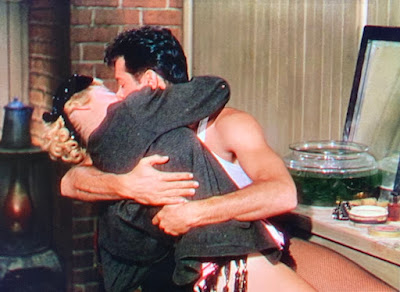
Bess seems resigned to this life and asks Harry to help her out of her costume so they can catch the milk train to Wheeling. But instead Harry pulls her into his arms and gives her a deep kiss.

As their kissing grows more passionate, we hear the sound of the train in the distance, suggesting they are not going to make their connection. Does this mean Harry has acquiesced? The next scene will tell us...
Monday, February 7, 2022
Outing Margery in Sherman, Texas
Maybe it has something to do with the new Houdini Seance at the Magic Castle (which I recently had the pleasure of re-experiencing with my fellow "Houdini Nuts"), but Margery seems to be angling for my attention lately. Here's a tidbit that recently found it way to me that I don't believe has appeared in any biography, yet it pinpoints an important moment in Houdini-Margery history.
Houdini's first public exposure of Margery, which included officially outing her identity as Mina Crandon, wife of the eminent Boston surgeon, Dr. Le Roi Crandon, took place on the evening of October 16, 1924, at Sherman Hall on the campus of Austin College in Sherman, Texas. Houdini had teased the coming news during his lecture in Waco a few days earlier.
The famous Margery seances had taken place in August, but Houdini was bound by the Scientific American's embargo on all details of the Margery investigation. That embargo lifted at 8:00 AM on October 16 while Houdini was in the middle of his nationwide spiritualism lecture tour. Houdini wasted no time working a full Margery exposé into his lecture that very night. Three days later, on October 19, he released his famous pink pamphlet, Houdini Exposes the Tricks of the Boston Medium "Margery".
Sherman was not one of the larger cities on Houdini's tour, and until recently the only record I had of this lecture was the below newspaper clipping that sold on eBay a while back. I don't know who won this, but happy to let them know of its added historical significance!

Related:
Thanks to "Houdini Nut" Joe Notaro for providing me with a copy of Ron Cartlidge's "Houdini Final Texas Tour" lecture notes.
UPDATE: Just want to add that while Houdini officially named "Margery" as Mina Crandon at this lecture, her identity had leaked in the press in early August.
Related:
Sunday, February 6, 2022
The Professor fooled Houdini 100 years ago today
It was 100 years ago today that Dai Vernon fooled Houdini with his Ambitious Card at an S.A.M. banquet at the Great Northern Hotel in Chicago. To mark the occasion, here's video of The Professor himself doing that very trick. This is from a 1976 Canadian show, Celebrity Revue, hosted by Carol Taylor and Peter Pit.
Vernon did the trick for Houdini seven times and, it's my understand, varied his method each time. He would forever pride himself on being "The Man Who Fooled Houdini." Vernon's own mementos from that night sold last year at a Potter & Potter auction, including the group photo below.
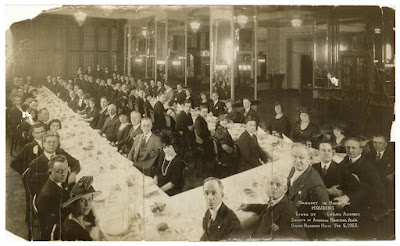
What I'd love to know is what happened to the signed four of diamonds?
Saturday, February 5, 2022
Margery & Houdini: Part Four - Broken Spirits
The Snake's Paw has produced a 4-part audio drama about Houdini and Margery written by Matthew Morris and Andrew Farrier with help from Jack Townsend. Houdini is voiced by Harmon Gunston and Margery is voiced by Helen Jaksch. Below is the fourth and final installment: Broken Spirits.
Based on true events, Margery & Houdini relates how the most mystifying medium of her day and the most famous escape artist of all time came to meet each other - and how each struggled to prove the other wrong.
In Part Four, the committee tests Margery's powers by locking her in constraints, leading to a confrontation with Walter and the conclusion of the contest.
You can listen to all four parts in one 2-hour clip at The Snake's Paw's YouTube channel. You can also support The Snake's Paw with a donation on Ko-fi.
Thanks to Jonathan Fells in Wales for the tip.
Thursday, February 3, 2022
The Man From Beyond screening in Greenfield, MA

Houdini's The Man From Beyond will screen this Saturday, February 5, at 6pm at the Greenfield Garden Cinemas in Greenfield, Massachusetts. The screening is part of Greenfield's 100th Annual Winter Carnival which begins Friday.
"This was the perfect film to feature for Greenfield's 100th Winter Carnival," said Garden Cinemas owner Isaac Mass. "It was the Frozen of 1922."
The film will will have live musical accompaniment by Jeff Rapsis, who has provided accompaniment for several Houdini films over the years. Says Rapsis: "These films are audience favorites, and people continue to be surprised at how engrossing and exhilarating they can be when shown as they were intended: in a theater, and with live music."
The Greenfield Garden Cinemas also has a connection to magic history. Greenfield native Penn Jillette had his first job at the theater. Penn gave the screening a special shout-out in a video he prepared for the theater's Facebook page.
Tickets for The Man From Beyond are available online at www.gardencinemas.net. For more information, call (413) 773-9260.
Thanks to the Greenfield Recorder.
Related:
Wednesday, February 2, 2022
Strange Harry
Here's an unusual photo of Houdini that ran with a review of the William Lindsay Gresham biography, Houdini The Man Who Walked Through Walls, in the London Evening Standard on March 29, 1960 (Headline: "Oh, why do they have to give Houdini away?") At least it says this is Houdini! I'm not familiar with this photo and it almost looks like a Houdini impersonator or even a wax figure. A strange Harry indeed.


Related:
UPDATE: Mystery solved.
Tuesday, February 1, 2022
Joe Posnanski on The Fantastic Story Society podcast
Joe Posnanski, author of The Life and Afterlife of Harry Houdini, is interviewed on The Fantastic Story Society podcast. This is one of the better interviews I've heard with Joe. Co-host Scott Markus is also a friend whom you may recall from his 2014 Houdini tour. You can listen to the interview below or head on over to Apple Podcasts.

Joe Posnanski has made a career by being inspired by curiosity and following his own passions. That's lead to him writing numerous books, winning awards and most importantly, surrounding himself with people that fascinate him.
The Life and Afterlife of Harry Houdini is available on Amazon.com and Amazon.co.uk. You can follow Joe at JoeBlogs and on Twitter.
Related:
Monday, January 31, 2022
The Doug Henning Project visits 278

For more 278 check out the links below. And be sure to follow Neil's site for all things Doug!
Related:
Related:
Saturday, January 29, 2022
Margery & Houdini: Part Three - Grasping in the Dark
The Snake's Paw has produced a 4-part audio drama about Houdini and Margery written by Matthew Morris and Andrew Farrier with help from Jack Townsend. Houdini is voiced by Harmon Gunston and Margery is voiced by Helen Jaksch. Below is the third installment: Grasping in the Dark.
Based on true events, Margery & Houdini relates how the most mystifying medium of her day and the most famous escape artist of all time came to meet each other - and how each struggled to prove the other wrong.
In Part Three, Houdini and his colleagues converge on the Crandon household, witnessing for the first time the phenomena they're supposed to declare real or false.
I will post Part Four next week. But if you can't wait, know you can listen to all four parts now at The Snake's Paw YouTube channel. They also have the entire series in one 2-hour clip HERE. You can support The Snake's Paw with a donation on Ko-fi.
Thanks to Jonathan Fells in Wales for the tip.
Thursday, January 27, 2022
Houdini's Frozen in Ice escape of 1911
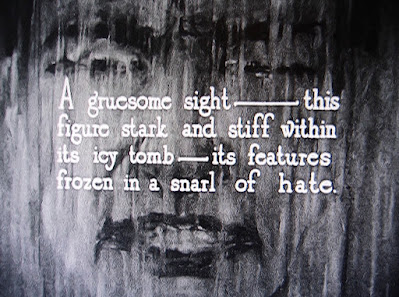
Harry Houdini, of handcuff and other fame, who has been appearing at the Nottingham Empire with huge success, has been confiding with a correspondent of the "Encore" that he "has another big surprise to spring up on the public." He avers that his tank act will be a "pup" to his new show, and I believe him. Clad in a diving suit––the helmet will contain an air enough to last him 10 minutes––he proposes with the aid of a glass box, to allow himself to be frozen solid. The freezing plant will be on the stage in full view of the audience. The squares of glass, brass fitted and jointed, constitute the box, and when the wily one is thoroughly frozen, the entire outfit is placed in his cabinet, and he does the rest by releasing himself, yet leaving the ice intact. How it is going to be done Houdini himself only knows, but he has tried it and accomplished the seeming impossible, I presume there will be no "frost" as far as he is concerned. The above show he proposes springing upon London in five or six weeks' time.
I always believed Frozen in Ice was a concept Houdini was working on near the end of his career. But here it is in 1911! While Houdini never did "spring" this upon London (as far as I know), this is still an exciting find as it offers the first and most detailed description of any frozen in ice escape that I'm aware of.
The use of a diving suit is entirely new. I also can't help but wonder if the glass box, "brass fitted and jointed", is the Water Torture Cell. The debut of the USD was still a year away (the "tank act" referred to here is the Milk Can), but the cell was likely in construction at this time. Could Houdini have been considering a very different use for the cell? Or could this all be a ruse to conceal the actual escape Houdini had in mind?
Houdini's Escapes by Walter Gibson contains a chapter on a "Frozen in a Block if Ice" escape. But that is a very different concept and Gibson offers no history behind it. The version that finally did make it to the stage was performed by Bess in 1927 but, again, a very different concept.
 |
| Gibson illustration (left) and Bess version (right). |
Thank you Joe!
UPDATE: Joe Notaro of Harry Houdini Circumstantial Evidence has found another description in the January 15, 1911 "The Umpire" that provides a few more performance details:
The performer, having dressed for the part, will take his place in the water in a glass tank, the sides of which fit into brass sides, and the freezing process will be effected in sight of the audience by means of a special plant installed on the stage. When the refrigerator has got in its fine work, the glass slides will be removed, and the block of ice, with Houdini inside, will be placed under the canopy. A few seconds later the performer will reveal himself in kind friends in front, and the iceberg will be shown intact.
Fred Pittella of Houdini and Escapes Museum sends over a detailed look at how Bess's 1927 freezing effect operated. This sounds very similar to the "plant" as described in the 1911 clippings. I'm wondering if it was the same apparatuses?
 |
| Science and Invention, September, 1928. |
Thanks Joe and Fred!
Related:
Related:
Wednesday, January 26, 2022
Salem's "Houdini Way" mural
Last year came news that the City of Salem, Massachusetts, would rename Front Street "Houdini Way" in honor of Houdini's jailbreak from the Front Street police station on April 16, 1906. As you can see below, the name now appears on a concrete barrier that extends across the passage. This image comes from Mink Creative Studio who created the mural.


Related:
UPDATE: The good folks at Mink Studio inform me that this barrier was erected in October just for the busy tourist season. So it's likely no longer there. But let's hope it reappears this year as it was a popular spot for photo ops. Even among Salem's witches!
Related:
Tuesday, January 25, 2022
REVIEW: The Zanetti Mystery by Harry Houdini

Houdini's fiction tend to be parables or melodramas that are very much products of their time. Even the stories ghostwritten by greats like H.P. Lovecraft are clearly written for a target audience looking for simple action and thrills. They all work well enough. But as with Houdini's movies, you're never in any real danger of becoming lost in a work of Houdini fiction.
Having said that, I actually found myself becoming lost in The Zanetti Mystery! My biggest surprise on reading this novel is that it's actually pretty good. The basic plot, about a medium named Zanetti who lands a whale of client who offers him one million dollars to conjure his dead wife in the flesh, holds up today. (It also bares a striking similarity to William Lindsay Gresham's bestseller, Nightmare Alley. Gresham would go to pen a biography of Houdini. Could The Zanetti Mystery have been his secret inspiration?)
Written at the height of his crusade against fraudulent medium, Houdini's purpose in creating this story was to further educate the public in the practices of such frauds. So a lot of the story is a peek behind the curtain at the mechanics of spiritualistic graft. This is all very entertaining. The characters who work with Zanetti in and outside his seance room have an almost Runyonesque quality. There's even an interesting sidebar about a Broadway casting agent who provides showgirls for questionable jobs and clients. It all feels authentic and offers a real romp through the underworld of 1920s New York.

The biggest disappointment about The Zanettii Mystery is that it is clearly unfinished. The final chapter, which greatly expands the story and raises the stakes for our heroine, reads more like an outline. It's an abrupt change of narrative form and a rush to the conclusion. I suspect what we are reading is closer to the basic outline Houdini would provide to his ghostwriter to flesh out, and for some reason that didn't happen. So while this provides some insight into how Houdini crafted his tales and will be of interest to students of Houdini, it may be a let down to readers.
The Zanettii Mystery is a must for all Houdini fans as it is now his last published book and belongs on the shelf alongside his other work. And those who decide to actually read the book might find themselves pleasantly surprised that, in the end, Houdini finally produced a work of fiction that has a life of its own.
Purchase The Zanetti Mystery by Houdini at Amazon.com and Amazon.co.uk.
Subscribe to:
Posts (Atom)