Thursday, February 11, 2021

The Germany problem


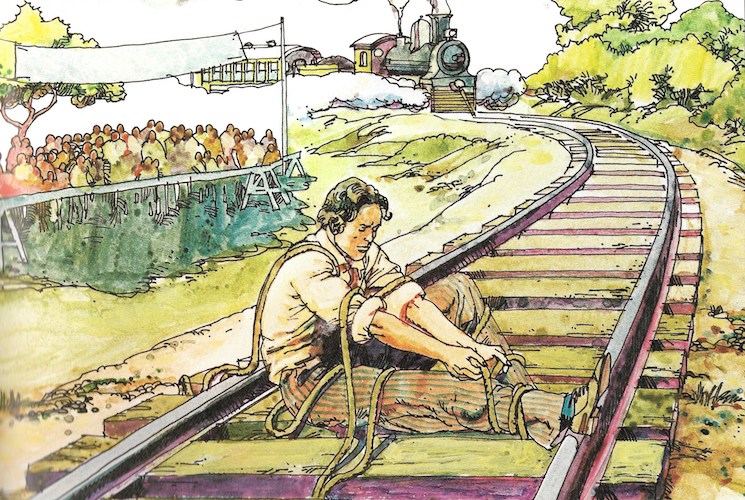
Last weekend our friend Joe Notaro at Harry Houdini Circumstantial Evidence shared a post about Houdini's Train Track Escape - Believe it Or Not. This is an event I've never been able to confirm. The sole source appears to be Walter B. Gibson, who did at times inadvertently spread mythology (including the trapped under the ice story). But Joe has found an account written by Gibson in 1954 that now gives us a location: Dresden, Germany. That's good! And it's bad.

I will let you go read about the escape at Joe's site. Instead, I want to talk about how this illustrates what I've come to think of as "the Germany problem."

From 1900 to 1913, Houdini performed in Germany as much as any other country. He spoke the language and was generally very comfortable with all things German. He even preferred traveling on German steamships. His engagements in Germany were lengthy and he seems to favor the country as a place to try things out for the first time. We know he did his first challenge packing crate escape in Essen, learned to fly in Hamburg, and debuted The Water Torture Cell in Berlin. It's even said he tried out a version of Buried Alive for the first time in Germany.  So Germany is a big part of Houdini's early career. Yet we know almost nothing about these engagements!

The reason for this seems due to the fact that Houdini history has largely been written by English speakers, and the stories of his German exploits would found be in German newspapers. Sure, we have a passable amount of information that can be found in his English pitchbooks (the Cologne trials, Kleppini, etc.). But I'll bet my knackwurst there is so much more!

It now appears the train track escape may be one of those "lost" German stories. But at least we now know where to look. Houdini performed at the Central Theater in Dresden during the entire months of September 1900 and October 1903. So if there is any newspaper account of this escape, it would be during those times. Also, the Harold Kellock biography claims Houdini did his first bridge jump in Dresden. That's another one I’ve never been able to confirm because...the Germany problem.

So here's a shout out to any German Houdini nuts who care to take up the challenge and uncover Houdini's adventures in Dresden. Not only might you find this train track escape, but you also may find his first bridge jump, and who knows what other untold stories!

Oh, we also have a Netherlands problem. But I guess we can tackle that another time.

Train track illustration from The Great Book of Magic by Wendy Rydell.

Wednesday, February 10, 2021

Watch clips from The Grim Game at TCM.com

The TCM website has posted three clips from Houdini's The Grim Game along with the Robert Osbourne introduction to the 2015 airing. What makes these interesting they are from the second showing which used the alternate musical score by Steve Sterner.


Still hoping for a proper DVD release someday. If we have any entrepreneurs out there, you can enquire about the home video rights via Park Circus. I'd be happy to provide a commentary!

Related:

Tuesday, February 9, 2021

Did Houdini really almost drown in beer?


On February 9, 1911, Houdini was challenged by the Joshua Tetley & Son Brewing Company in Leeds to escape from his Milk Can filled with beer. This was the first of his popular "beer challenges." But the reason the Tetley challenge is so famous is not because it was first; it's because Houdini is reported to have failed. In Houdini His Life Story by Harold Kellock, it's said Houdini, a teetotaler, became "stupefied" by the beer fumes and passed out before he could free himself. Only the quick action of an assistant "who entered the cabinet and hauled him out" saved his life.

Tetley's is still around today and they've not forgotten this night. They even feature the following on their official website:


But there's a problem with all this. If Houdini really had such a dramatic on-stage failure during such a well-publicized challenge escape, one would think it would have been big news at the time. But I have yet to find any newspaper account of any accident or failure that night. Furthermore, in his book The Great Houdini: His British Tours, author Derek Tait reproduces an eyewitness account from audience member who says the escape went as planned.

So what really happened at the Leeds Empire exactly 110 years ago? They can't both be right. Or can they? 

I think the truth is actually hidden in the eyewitness account itself, which is also filled with nice details about how the challenge was staged. I'm reproducing it below with Derek's permission. This comes from the Yorkshire Evening Post, December 22, 1928:

"When the curtain went up, the barrel of ale was on a gantry and four brewers' men were on the stage. To a lively tune by the orchestra, they tapped the barrel and filled a jug. They poured out a glass and handed it to Mrs. Houdini and she put it to her lips but did not drink any. Then Houdini pretended to take a drink. Then the brewers' men had a glass each. After that, they filled up a tin (which was something like the milk churns you see on the railway) with beer.

Houdini, who in bathing costume, kissed his wife, and went head first into the tin. Immediately, half-a-dozen men, who were are on the stage as a committee, fastened the lid on with padlocks all around the lid, the padlocks being locked to staples that were on a collar on which the lid fitted. The can was then lifted into a cabinet and the curtains closed. In a very short period, one of the attendants went into the cabinet and almost immediately opened the curtains and Houdini walked out. The tin was then brought out and the padlocks were still fastened.

Although I met Houdini many times, I never heard of him being stupefied by the beer as his biographer says. And, by the way, a few nights after the beer episode, he did the trick in the can filled with milk."

While the eyewitness said nothing went wrong, it seems clear to me that something did. Notice he says "one of the attendants went into the cabinet" shortly before Houdini appeared. This may have appeared normal, but it was not. The only reason I can think of an assistant going into the cabinet is if something was wrong. This also comports with the Kellock account. But the speed in which Houdini appeared suggests he wasn't fully unconscious and was able to cover. So the accident appears to have happened. It's just no one in the audience knew it!

There are a few other things that stand out here. It's interesting to see Bess present, suggesting that while she retired from performing in 1908 she still appeared on stage during select escapes. I also love the whole staging of the challenge with the tapped cask and everyone taking a drink. It's also striking that the eyewitness says Houdini went into the Milk Can "head first." This was not typical. Could this have been the real reason Houdini had difficulty escaping and not the fumes?

Houdini went on to do the beer challenge (successfully) many times. Below is a list of brewers who challenged Houdini to either escape from his Milk Can or a beer-filled cask. Is your brand among them? Cheers!

Joshua Tetley & Son Brewing Company, Leeds, UK (1911)
Independent Brewing Co., Pittsburgh, PA (1911)
Hoster-Columbus Associated Breweries Co., Columbus, OH (1911)
Moerlbach Brewing Co., Rochester, NY (1911)
Jacob Ruppert, Brewers, Knickerbocker Beer, New York, NY (1912)
Hauck's beer, Atlanta, GA (1912)
Louis Bergdoll Brewing Co., Philadelphia, PA (1912)
Fink's Brewery, Harrisburg, PA (1912) 
Schlitz Brewing Company, Milwaukee, WI (1912) 
Hacker Brewery, Munich, Germany (1913) 
Burkhardt Brewing Company (Tivoli beer), Boston (1914) 
The Louis Bergdoll Brewing Company, Philadelphia, PA (1914)
Haberle Brewing Co., Syracuse, NY (1915) 
Dow's Brewery, Montreal, Canada (1915)
Standard Brewing Co. (Tru-Age Beer), Scranton, PA (1915) 
Hanley Brewery (Hanley's Peerless Ale), Providence, RI (1915)
Indianapolis Brewing Co., Indianapolis, IND (1915) 
Frank Fehr Brewing Co., Louisville, KY (1915)
The Cleveland & Sandusky Brewing Co., Cleveland, OH (1915)
Interboro Brewing Co., New York, NY(1916)
Abner and Drury's - Washington D.C. (1916) 
G-B-S Brewing Co. (Arrow Beer), Baltimore, MD (1916)
Phoenix Brewery, Buffalo, NY (1916) 
Olt Brewing Co., Dayton, OH (1916)


Thanks to Allan J. Taylor of the UKEA (United Kingdom Escape Artists) for his help with this post.

Related:

Monday, February 8, 2021

History Goes Bump Ep. 368 - Haunted Houdini

The episode of the History Goes Bump podcast is well researched and well presented, covering much more than just the standard Houdini biography. Worth a listen!


Houdini has certainly become a favorite podcast subject of late. Below are more to enjoy.

Saturday, February 6, 2021

Guest Blog: Chronicles of the Mystery WTC (Part 2)

It was one year ago that Richard Sherry & Dayle Krall made the remarkable discovery of a working Water Torture Cell in Canada. The cell resembled Houdini's original Water Torture Cell, which was destroyed in a fire in 1995, almost exactly. The appearance of this "Mystery WTC" sparked curiosity and controversy as to its origins and purpose. 

Over the past year Richard and Dayle have been examining, restoring, and researching their discovery. Today I'm excited to share the second part of their two part Guest Blog that explains all they have uncovered. Enjoy!

Chronicles of the Mystery WTC
by Richard Sherry & Dayle Krall

Part 2: Discoveries and Theories

During the process of reassembling (see Part 1), we have had many new discoveries which we would like to share. 

When we removed the large hasp that locks the stocks, we discovered another set of screw holes behind it. We found this curious. 


Another discovery that we found earlier and wanted to share again for those who had not seen it. As Richard took the brass plate off of one of the locks and was looking at the lock, he noticed that there was something wedged between the lock case and the cut out in the wood of the stocks. After removing it he found that it was a 1909 British coin. It looks like this coin was being used as a shim and would have been installed when the stocks were built. We wonder who put that coin there and why? The interesting part is that the WTC was built in Britain around 1910-1911.


It is also extremely peculiar that there are four Collins locks on the stocks. They add no additional functionality. Does anyone have any ideas why there would be four?

Lifting Ring Puzzle 
The lifting ring is made from 5/16” thick, 1 ½” x 1 ¼” angle iron. It appears to be cast and weighs a ton. Richard has always found it curious why the lifting ring had cut outs in it to accommodate the large hasps that fasten the stocks to the Cell. The hasps are bent in a way that they will pass over the lifting ring so why the cut outs? It is Richard’s belief, that there was an error made during the construction and the thickness of the lifting ring was not considered. Richard believes this because the cut outs in the lifting ring are just a little bit deeper than the thickness of the metal of the ring. The slots were cut down 3/8” deep. Does anyone else have any other ideas why this would be the way it is?

Ring Hooks
One of the large ring hooks came off. It would not fit back into the hole in the lifting ring. It appears that the ring hooks were heat fitted – where the hole in the lifting ring frame was heated and the ring shaft was put into the hole and when it cooled down it was a perfectly tight fit.

Two exceptional discoveries
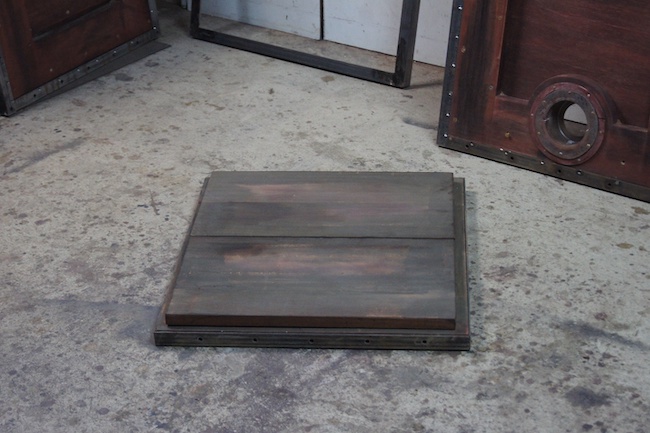
This picture shows how the panels are joined together using lap joints. It appears that there was some kind glue or sealant of some sort that was put in between the lap joints to help prevent water leakage.


When we were assembling the 5 panels on the right side of the Cell, Dayle noticed that the centre panel was different. Upon further inspection we noticed a couple of things. One, the lap joints were clean. There wasn’t any residue on the joint. Two, the corners of the joint were perfectly straight whereas the corners of the rest of the panels were ever so slightly rounded. This leads us to believe that this panel may have been replaced at some point in time.


Here we have a real bombshell. One day when Richard was polishing the glass inside the Cell he dropped the Windex bottle and noticed that the bottom back panel moved. After examining the bottom panel, it was discovered that between the lap joints was a metal tube. This tube could be lifted vertically and may be some kind of breathing tube. Of course, we do not know if this had ever been used.

The board was spring loaded so it would pop open if hit at the back. We won’t go into the complete description of it right now, but it is almost something out of James Bond.

In the picture, Richard replaced the steel spring that had decayed into two pieces just to see how this worked. He thinks this is how it would have worked.


This Cell has a working gaff and John Cox has the pictures to verify it but we will not be including those pictures for public release.

We tried to remove the wood rings that surround the drain valves but couldn’t. We had to remove the drain valves first because there was a membrane attached to the wooden rings. This, of course, made total sense to prevent leakage.

We also noticed on a couple of screws that there was steel wool wrapped around them. This was often used when a screw thread was starting to wear to tighten it.

The frames of the Cell were constructed with mortise and tenon joints. This was noticed because one of the joints had come loose.

It was also very curious that on the back panel of the Water Cell, the panel themselves were opposite. The lap joints were opposite compared to the other two sides because the screws of each panel were installed above the seam whereas they were installed below the seam on the other two sides.

There are also two diagonal gouges in the back panel. Both near the third bolt from the top on each side. These gouges are possibly from a chain that was wrapped around a Cell when moving it. We are not certain of this, but this explanation matches the gouges perfectly.

Missing Items
When we received this Cell we noticed that there were a few thing missing:
  • 2 drain plugs
  • 2 brass handles on the back of the stocks
  • Upper section of right brass hasp near the front
  • 8 bolts
  • A few screws 

After reassembling the Cell and having developed a much better sense of how it was built and works we are wondering, now more than ever, where this Mystery WTC came from.

Years ago, Richard built what he thought was an exact working replica (right) of Houdini’s WTC from pictures and other information he had gathered over the years. This Mystery WTC is constructed slightly different than his previous understanding. Richard had contacted Dave Dorsett to verify the measurements of the Cell that sat in the Niagara Falls museum that was going to be sent out for restoration. From Richard’s understanding Dave Dorsett had bid on the contract to restore the WTC in 1991 and was therefore able to get all the measurements of the Cell that was in the museum at that time. The measurements that Dave Dorsett provided were essentially the same measurements as the working replica WTC Richard built years ago. These measurements do not match the Mystery WTC.

With the discrepancy between the measurements Dave Dorsett provided of the WTC in the Niagara Falls museum and the measurements we had of the Mystery WTC we had no idea what the Mystery WTC was and where is came from. It wasn’t until Richard had discussed the Mystery WTC with Dean Gunnarson that new information came to light. Dean provided the precise measurements and dimensions of the WTC that James Randi had drawn up of the Cell that was first delivered to the Niagara Falls museum in 1971. These measurements and dimensions match the Mystery WTC exactly and they are not the same measurements that the Cell in the museum had after the museum moved locations.

Just to name a few discrepancies between the two Cells:
  • The steel frame is a little over 3” in the WTC in the museum that everyone is familiar with, however the frame in the Mystery WTC is 3 ¼” which is the same as what Randi documented in 1971. 
  • The Mystery Cell is also 2” deeper which is the same as what Randi documented in 1971.

Here is our theory, as crazy as it sounds. When the museum was being moved to the second location, a local farmer stored the WTC and other items from the museum as a favor. The items that had been stored were moved into the new museum location; everything except the WTC. Parts from this Cell had been removed (the two back handles, two plugs, one piece of the side hasp, etc). The Cell that was stored remained stored for decades – minus the parts mentioned. Over the years other magicians and collectors had been contacted regarding a sale but there were no buyers. A fellow performer from Nova Scotia had been approached but he was not in the position to purchase it at that time. We purchased the Cell when Dayle had been contacted by the seller and this was because they had found her as "The Houdini Girl" and thought she might be interested.

We are not certain, but we think that the Cell that went into the museum that Randi had measured had been left in storage when the museum moved, and a duplicate Cell was made using the parts removed from the original WTC. This duplicate was then put in place in the new museum location.

Maybe this is why no one really cared about the condition of the WTC that was in the museum and it was so neglected over the years? After the fire and the insurance claim was processed the Cell that was stored had to remain hidden.

After all the time and money invested, we still do not have any definitive proof of what this Mystery WTC is, BUT WE LOVE IT! These are some very wild ideas but what better place than Wild About Harry to discuss them?

If anyone has any information or questions, they would like to discuss that cannot be posted publicly on Wild About Harry, please feel free to contact us at richard@sherryandkrallmagic.com. 


Thank you Richard & Dayle!

Thursday, February 4, 2021

Guest Blog: Chronicles of the Mystery WTC (Part 1)

It was one year ago that Richard Sherry & Dayle Krall made the remarkable discovery of a working Water Torture Cell in Canada. The cell resembled Houdini's original Water Torture Cell, which was destroyed in a fire in 1995, almost exactly. The appearance of this "Mystery WTC" sparked curiosity and controversy as to its origins and purpose. 

Over the past year Richard and Dayle have been examining, restoring, and researching their discovery. Today I'm excited to share the first of a two part Guest Blog that explains all they have uncovered. Enjoy!

Chronicles of the Mystery WTC
by Richard Sherry & Dayle Krall

Part 1: Reassembly

We would like to thank those interested in our Mystery WTC for their patience. When we found time between projects, we pulled the WTC out of storage and discovered its worsening condition. We pulled the entire Cell apart to look for any further mold and mildew between the panels and the frame and in the process removed almost 700 screws and 65 bolts. Many of the heads of the bolts had been extremely stripped. 

To preserve the Cell, we sent all metal and brass parts to be cleaned and clear coated to help preserve them. We applied a mold inhibitor (Concrobium Mold Control) to the inside wood to prevent further decay. We found an easy hack to clean the screws using Coca Cola.

To clean the outside wood sections of the WTC we used a heat gun to strip off the layers of old wax with a plastic putty knife. This process did not damage the wood in any way, and we were very happy with this, but it filled in a lot of the screw holes and interesting characteristics in the wood which we regret. 

Here is a picture of the frame of the Cell after we had removed the panels, the glass and the wax had been removed with a heat gun.


Another picture we would like to share is of the Cell being prepared to be reassembled. We received the metal back and were beginning to re-attach the hardware to the panels prior to reassembling which can be seen in this picture. 


Reassembly of the WTC

Following is a sequence of the manner that we reassembled the WTC. This picture is of the very bottom of the WTC. This is the outside bottom that would sit on the stage.


The inside bottom piece of wood sits on the outside bottom framework that was shown in the previous picture. This is the wood that would have been under water.


These two panels are attached together with bolts and then bolted to the base making a solid structure. The third panel is fastened in the same manner.


Here is another picture of the inside.


The 3/8” thick metal plate is attached to the top of the front. It is massive and heavy.


Here is a picture of another angle of the assembled Cell.


Here is a picture of the assembled Cell with the front glass, metal and stocks.


Here is another picture of the fully assembled Cell but from a different, often unseen, angle. The back of the WTC is even more rarely seen in photographs.


Thanks to Richard and Dayle for sharing these insightful images. In PART 2 they reveal their "Discoveries and Theories", including what they believe to be the truth behind this cell. Hold on to your rivets!

Wednesday, February 3, 2021

A Houdini doc you've never seen

Houdini: The Man From Beyond is a documentary made and presented by Dan Witkowski of Magiccom that aired on WCCO-TV in Minneapolis-Saint Paul on October 26, 1976 (to mark the 50th anniversary of Houdini's death). Dan sent me this himself, writing: "It is unlikely anyone else has a copy, however, I thought you should have it. You are welcome to do anything you like with it with my good wishes."

So I've decided to share this with everyone as it's really a very well done doc that truly captures a moment in time. It even has the original commercials! But probably the most notable aspect is Dan's interview with the great Walter B. Gibson.

So travel back to October 1976 and discover a Houdini documentary you've (probably) never seen.


You can see more rare documentaries like this at the WILD ABOUT HARRY YouTube Channel.

Thank you Dan!

Tuesday, February 2, 2021

The Great Harry Houdini presented by Arthur Moses

Our good friend Arthur Moses will be giving a Houdini presentation on Zoom this Thursday, February 4, at 4:30 PST for the Congregation Beth El - Norwalk. Presumably we'll be getting a good look at Arthur's Houdini room and collection, which has to be seen to be believed!


Facebook event page:

Zoom link

Monday, February 1, 2021

Pre-order 'David Copperfield's History of Magic'

This new book just appeared for pre-order on Amazon. Release date is October 26, 2021. No need to explain why this is a must buy!

An illustrated, illuminating history of magic from the world’s most successful magician, capturing its most audacious and inventive practitioners, and showcasing the art form’s most famous artifacts housed at David Copperfield’s secret museum. 

In this personal journey through the history of magic, David Copperfield profiles twenty-eight of the world’s most groundbreaking magicians. From the 16th-century Englishman who wrote the first book on conjuring to the 19th-century man who fooled Houdini, to the woman who levitated, vanished, and caught bullets in her teeth, David Copperfield’s History of Magic takes you on a wild journey through the remarkable feats of the greatest magicians in history.

The magicians he profiles were all outsiders in their own way, many of them determined to use magic to escape the stifles of class and convention. But they all have one thing in common: they were great innovators who influenced popular culture, adapted to social change, revealed profound insights into the human mind, embraced the latest technological and scientific discoveries, and were inventors themselves. 

The incredible stories are complimented by over 100 never-before-seen photographs of artifacts from Copperfield’s exclusive Museum of Magic, including a 16th-century manual on sleight of hand, Houdini’s straightjackets, handcuffs, and water torture chamber, Dante’s famous sawing-in-half apparatus, Alexander’s high-tech turban that allowed him to read people’s minds, and even some coins that may have magically passed through the hands of Abraham Lincoln. 
By the end of the book, you’ll be sure to share Copperfield’s passion for the power of magic. 

Pre-order David Copperfield's History of Magic on Amazon.com and Amazon.co.uk.

January 2021 in review

Here's a rundown of posts by category that appeared on WILD ABOUT HARRY in January. 

Most Viewed Post

Houdini History

Events

Private Collections

Saturday, January 30, 2021

Set of Houdini printing blocks sell (quickly!) on eBay

On Monday there was some excitement on eBay when six original Houdini wood printing blocks appeared from a seller in Florida with relatively low Buy It Now prices (which quickly shot up as they started selling fast!). When the dust settled, I was thrilled to come away with the below.


Wood blocks like these were used in the printing of newspapers and other print media and can be one of a kind. The seller says she found the entire set at an estate sale of a 90+ year-old man. Three of the blocks are etched plates like the above and three are photos on copper. The largest of these is the well-known "Houdini at Different Ages of His Career" page from his pitchbook. Below are the auction images.


While I recognize all these blocks from their newspaper appearances, my own block is a bit of a mystery. While I suspect it was also used in newspapers, the only image I've found so far is the below print in the McCord Museum. Is this the original drawing from which this block was made? You'll notice it has the artist signature. Unfortunately, I can't make it out. [See UPDATES.]

McCord Museum

I would love to more more about printing blocks in general. Were they all one of a kind? How did newspapers acquire them? Would Houdini have provided them himself? If you have any answers, please let me know in the Comments.

Thanks to Todd Karr of The Miracle Factory for giving me the heads up on these!

UPDATE: Chuck Romano of My Magic Uncle tells me the artist here appears to be Howard K. Elcock, an English pen and ink illustrator who did a lot of artwork for Will Goldston's publications. The following is from The Magazine of Magic, February 1915:


UPDATE: Another development. I've just discovered this illustration appears in the "Revised 1920" edition of Houdini's The Adventurous Life of a Versatile Artist pitchbook (below). Curiously, the illustration is not in the later "Revised 1922" edition. Instead, the original photograph appears in its place. Maybe he lost the block!


UPDATE: I've now learned these plates came out of the famous 1980 278 estate sale. Also, what the seller told me about these coming from the estate of a 90+ year old man may not be accurate.

Friday, January 29, 2021

'Hurry Up, Houdini' french paperback refresh

Attention completists. A new French edition of 2013's Hurry Up, Houdini by Mary Pope Osborne has been released by Bayard jeunesse. While the French translation was first released in 2014, this refreshed paperback sports new cover art and a slightly different title. Illustrations are by Philippe Masson.

The fictional book tells the story of two kids who set out to discover the secret of Houdini greatness via some time travel magic.

La Cabane Magique, Spectacle de magie avec Houdini can be purchased on Amazon.com or Amazon.fr.

Related:

Thursday, January 28, 2021

Harry Houdini's top hat

Inspired by Andrew Basso's recent acquisition of Houdini's tuxedo collar (my most visited new post of the year so far), here's another cherished piece of Houdini apparel; his top hat! This comes from the collection of John Hinson, the great nephew of Harry and Bess Houdini. The label shows it was made in London.


Despite the classic image of a magician in a top hat, as far as I know Houdini never wore or used a top hat on stage. Looks like his was for use in regular life. Below are two photos of Houdini in a top hat, the first being Paris in 1901 and the second from his movie Haldane of the Secret Service (made in 1921). Could one or both of these be this hat?


So as far as surviving Houdini clothing goes (and not counting straitjackets), I'm currently aware of the tuxedo collar, this top hat, his pajama pocket, and his baby shoes. If you know of anything else, please let us know in the comments below.

Wednesday, January 27, 2021

Scottish Rite Journal reveals Houdini the Mason

The January-February 2021 issue of Scottish Rite Journal, a magazine devoted to Freemasonry, has a cover story about Houdini's involvement with the Order. "The Sorcerer's Entered Apprentice" is written by Maynard Edwards and is well researched.

I'm not sure where one gets Scottish Rite Journal, but you can read the issue in full at the Scottish Rite website. Just keep it secret!

UPDATE: The author of this article has provided a revised and updated version as a Guest Blog HERE.

Translate